Time Travel to Stop EVIL via Astral Projection: Part II! “Mandao Returns” reviewed! (Indie Rights / Digital Screener)

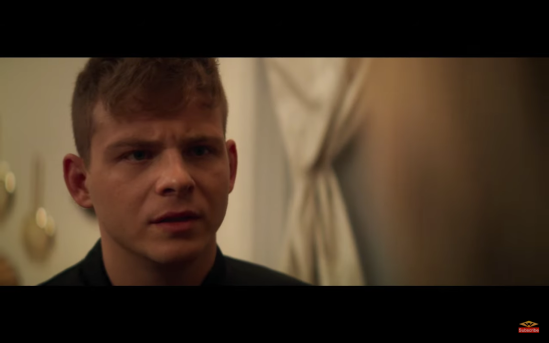
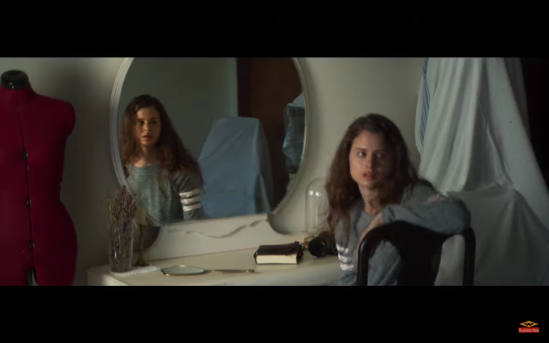
With his powerful ability to astral project, along with the help of a motley entourage of friends and family, Jay Mandao saved multiple lives, some who are close to him, from his blood thirsty ex-girlfriend on Halloween night.  Two months later, days before Christmas, and now living in the scheming medium Cousin Andy’s townhome after his unrelated cousin Jackson set fire to his apartment, Mandao and Jackson float through life, sleeping in Cousin Andy’s living room and barely off the royalties of Mandoa’s father breakfast cereal line.   Dreams of his father, Raymond Mandoa, urging him to stop astral projecting as dark entities will discover him are reluctantly ignored when Cousin Andy connives a get-rich-quick opportunity to contact the recently deceased Aura Garcia, a well-known B-movie actress having died a few nights ago after a drug overdose, but as soon as the spiritual and time planes are disturbed, sinister plans of murder, from the living and the dead, deck the halls with a blood red Christmas.  
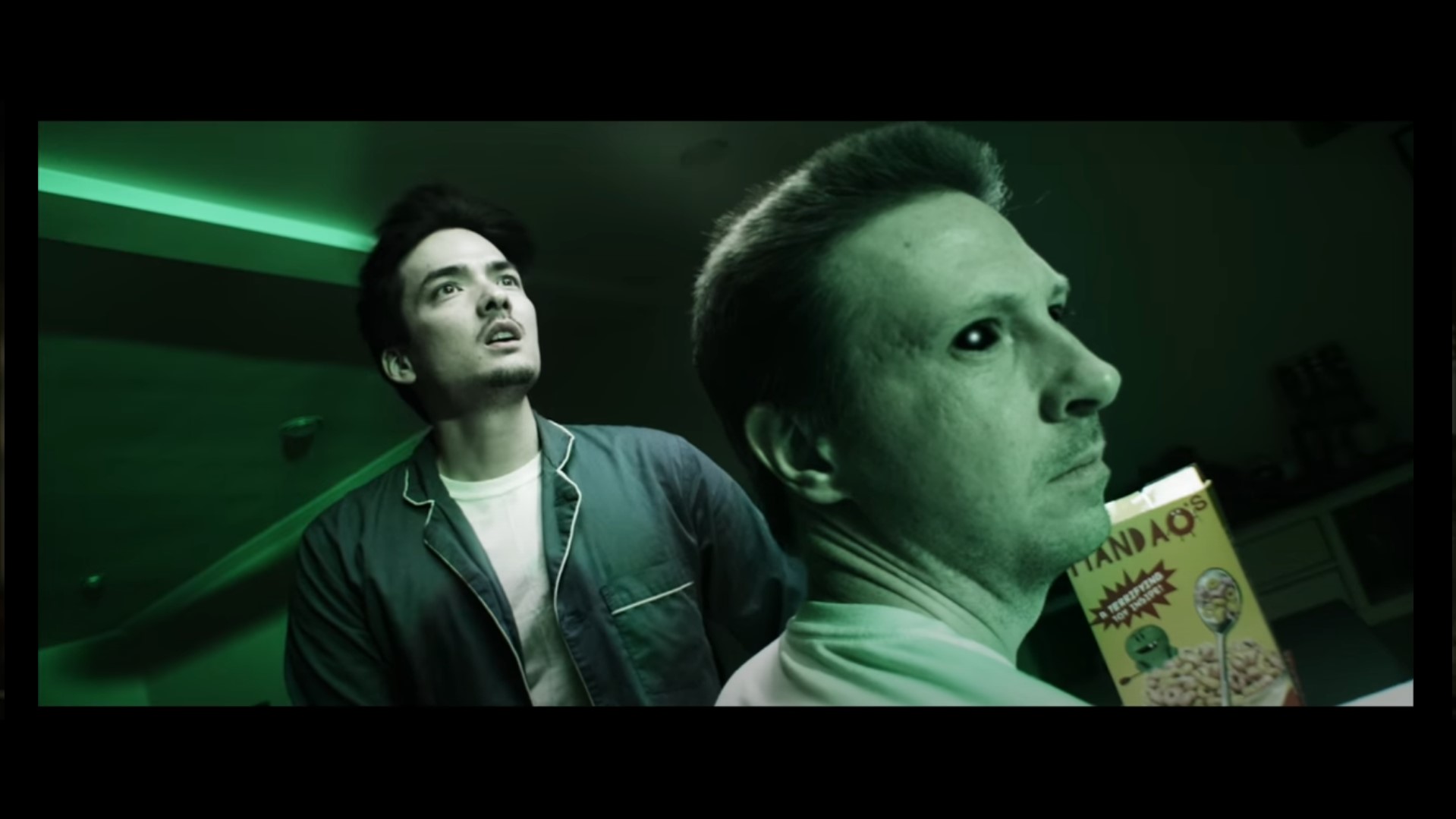
Mandao is back!  Or rather returns in a new scouring the astral plane misadventure entitled “Mandao Returns.”  When we last reviewed the Scott Dunn 2019 comedy-horror sleeper hit, “Mandao of the Dead,” an open ending left us salivating with a possible sequel under, what we know now to be a working title, “Mandao of the Damned” that promised exploring the nonphysical and paranormal realm’s mysteries and secrets that threatened Jay Mandao’s whole grain boxed-in existence, at least according to Mandao’s father, Raymond with a foreboding sign of inexplicable things to come.  The Kickstarter.com, crowdfunded modern cult favorite raised more than $26,000, doubling the first film’s budget, from approx. 250+ generous likeminded supporters within two weeks time that brought back four core characters essential to “Mandao of the Dead’s” grim, but lighthearted success to battle half-cocked the supernatural forces of evil.  Instead of a blood drinking cultist, a by-midnight death ceremony concretes stardom and greatness, but not if Jay Mandao has something to say about it.  “Mandao Returns” is a production of Scott Dunn’s Dunnit Films and distributed by Indie Rights.

Returning, obviously as stated in the title, to ensure the safety and well-being of those who incessantly annoy yet deep down care for him on a daily level is the hapless Jay Mandao, the titular hero played by writer, director, and story creator, Scott Dunn, along with Dunn’s wife, Gina Gomez Dunn, who steps back into a co-producer role for the sequel as well as stepping back into the shrewdly wild shoes of Fer, a close but no cigar Mandao love interest continuing to become mixed up in Mandao’s spiritual shenanigans while being a private driver for the Uber-equivalent Bum Rides.  Though blood is thicker than water, Mandao’s cousin-by-marriage Jackson oozes with dense innocence as Sean McBride reprises the daft role to another perfect tune of witless naivety.  Together, Mandao and Jackson arouse a likeable dynamic duo that becomes the keystone to both films’ success because without McBride’s timely childlike disposition, Mandao would just be a snippy and angsty loner and without Dunn’s subtly serious tone, Jackson would overrun the comedy-horror with one-sided gullibility.  With any sequel aiming to top its predecessor, the buddy comedy needed to be bigger and by adding the fourth returning character, Cousin Andy, as an important ingredient to the mix, Sean Liang adds a grounding hoodwinking conspirator that thrusts Mandao and Jackson into action on the astral plane field when the no-good antagonist, Aura Garcia, played by newcomer Jenny Lorenzo, becomes scorned in the spiritual world and takes heinous vengeance that not only involves Mandao, Cousin Andy, Jackson, and Fer, but also Garcia’s talent manager, Ted (Jim O’Doherty), in a sacrificial ritual gone terribly wrong. 

“Mandao Returns” is a smartly written script from creator Scott Dunn whose able to mold fallibly fascinating characters into unlikely heroes juxtaposed against a monumental occurrence much greater than themselves with the vast possibilities in the spacetime continuum.  Of course, the cinema flair to decorate the otherworldly dimensions with accessible ease and gloomy aesthetics faces speculation of existential questions of mindpower and life after death and the challenges the mechanics of the theory of metaphysics, but all that abstract mumbo-jumbo is pushed aside in order to make the “Mandao” films entertaining and for a good reason because when the script has colorful characters and a working narrative, “Mandao Returns” allows audiences to turn off rationality for approx. 71 minutes to enjoy a modestly produced Sci-fi comedy-thriller with a cast accurately in sync with each other’s methods.  The one thing I will say about “Mandao Returns” that I found to be a sore spot, despite still immensely enjoying, is that the story echoes eerily to “Mandao of the Dead.”  With a slight tweak to Mandao’s astral projection powers and trading in a different breed of villain, from point A to point B, from dynamics to outcome, everything seemed nearly identical to “Mandao of the Dead’s” narrative, delivering nothing distinctively new to the table to elevate the character’s fate and circumstances into unique, un-before-seen horizons.  Dunn comes close to challenging and upgrading the prior narrative by hinting something lurking within the spirit world was on the verge of closing in on Jay Mandao if he continues blindly using astral projection by the forewarning words of his father, Raymond Mandao, but slips out of that digressional stream to pit Mandao versus greenhorn cult acolytes looking for glam and glory by way of the gory and that, done in the Dunnit Films’ essence, is okay too.

As a quirky, out-of-body sci-fi thriller experience, “Mandao Returns” succeeds in succeeding as the sequel that brings the thrills and the laughter of far-fetched heroes ready to tear into the fabric of time to stop evil once again. The film comes to you from distributor Indie Rights and is available now streaming only on Amazon Prime so get your pandemic pants on aka comfy, stretchy pants, grab some movie style popcorn, and recline back to watch “Mandao Returns.” Experience the vibrant and wraithy-visioned glow cinematography of A.J. Young, returning from “Mandao of the Dead” as well as Dunn’s first film “Schlep” and another camping trip horror film, “Camp 139.” Young stays true to the films atmospherics with hard lighting a variety of hues and creating a story through the presence of shadows, working movie magic creating an opulent visual experience when really only working with about 25 grand. There were no bonus features nor extended credit scenes with this digital screener. One day, I’d like to see Scott Dunn and his Dunnit Films team work with a good chunk of budget cash and push the limits beyond the simplicities of the “Mandao” films, but until then, “Mandao Returns’ is disseminated with a whimsical awareness and fervent macabre that’s intent to please.

Watch “Mandao Returns” on Prime Video. Click the Poster!

EVIL Drugs Are Bad, Mmkay? “Beyond Hell” reviewed (Indican Pictures / Digital Screener)


A lowkey party experiments into a new drug called Changa, brought back from South America by one the friends but is no ordinary narcotic. After inhaled, Changa opens a conduit to an infernal dimension oppressively reigned by Belial, a trickster demon seeking to rule the world of man. Channeling his dark energy through the utterly wholesome Maryssa, Belial exploits her innocence to reach her friends and one-by-one their hallucinogenic and horrible deaths give way to releasing their souls to him. Once he obtains enough souls, Belial will be able to freely walk the Earth and damn everyone on the planet into servitude. Its up to Maryssa and her remaining friends to thwart Belial diabolical plans and send him back to Hell.

Is seeing disembodied, outreaching arms and shape-shifting demons covered in broken glass and tentacles to the effect of a gateway drug!? The invasively surreal and drug repercussion-themed “Beyond Hell” is the 2019, pre-apocalyptic. doom and damnation, survival thriller from writer-director Alan Murray in his first feature film production. The Cambridge, Ontario born filmmaker shoots in his home country to entertain and scare audiences with a version of religious text’s prime opposition to God, the Devil, in the form of the heavily prosthetic and dastardly theatrical Belial. “Beyond Hell” is a co-produced by Murray alongside Gavin Downes under the Dark Spirits Films banner with Don Smith, Jacqui Smith, and Christopher Lane serving as the film’s capital investments of executive producers.

“Beyond Hell” plays considerably into the slasher blueprint that aims to off, one-by-one, inept school students, whether they’re the self-stated part of the college body or, in a slight of confusion, sit in on classes and have row lockers like high schoolers, who stumble with defensives against a much darker scheme of soul extracting exploitation and world domination. Murray takes a full-on female primacy with strong heroine-performances by introducing Kearston Johansson and Natalie Jane to set aside their characters’ at-odds, find security in their flaws, and battle it out against an ancient evil. The respective roles in the goody two-shoes Maryssa and wildly eye-cutting Brook’s backgrounds are kept in a palpable line by Johansson and Jane’s drive to roleplay one-upping the other despite a petite background for character support and they’re anchored by Sebastian Deery (“Bad Dose”). The UK-born Deery plays the pursued rake, Jake, in a triangular love interest with Johansson and Jane’s characters. While Deery seemingly attempts to rein back his English accent without much success through his satisfactory presence as a level-headed, good-lookin’ guy, Jake’s acutely transforms into a wily coquet by initially buttering up Maryssa with good intentions and verbally loathe Brook for her derogatory attitude toward Maryssa only to then switch quickly to desiring a distraught Brook when Maryssa winds up in a mental institute for the criminally insane after the gruesome death of one of their friends. The off-putting dynamic pens a promiscuous casualness about these group of friends. Dominique Smith, Sean Rey, Chris Kapeleris, Shahrad Fredotti, Richard Collier, and Gavin Downes as the profaner Belial.

“Beyond Hell” conjures a sassy-mouth, wise-cracking demon, Belial, adorned in a black and white molten-rock shape skin with curved horns and rows of beaded sharp teeth, but the makeup effects, though strong in prosthetic effort, appear extremely rubbery to the point that even Belial’s teeth bend and flap when Gavin Downes tosses out sarcastic quips when ripping the souls from his victims.  This awkward stance of where our eyes and brains struggle to compute what make sense from the worst-of-the-worst of hell bound fiends is where “Beyond Hell” becomes forehead-rubbing frustrating because of how much time and application goes into the overall look of the creature that, in the end, just dips into disbelief.   The gory, but crude practical effects trend into the visual effects territory, going beyond the gates of hell to where Belial himself would be frightened by the sheer shock of shoddiness.  In one frantic scene where Brook attempts to escape Belial’s brimstone breath, decrepit arms breach a stairwell wall to grab her, but the arms, which are all of the same cut and move in the same motion, float like ghosts without ever puncturing through the drywall, or even breaking through that plane of narrative reality for that matter, that’s reminiscent of the horrendous flock of CGI birds, hovering autonomously as survivors try to whack at them in an awful reaction in James Nguyen’s “Birdemic:  Shock and Terror.”  Now, I’m not saying that “Beyond Hell” is as rough as intangible birdies behaving badly as Murray avails in manufacturing a stable low-spirited atmosphere of plague youth in between the real world and the underworld with their innocent lives hanging in the balance in a sordid enterprise off ill-will.

More laic than spiritual, “Beyond Hell” scratches the surface of narrative depth in a modest clash of “Hellraiser” meets “A Nightmare on Elm Street” from the celluloid plunging distributor, Indican Pictures. The 89 minute supernatural thriller has entered the digital platform realm, at least in the U.S., this December. “Beyond Hell” is Rhys Jones’ first director of photography venture filmed in 5K Raw on a RED Dragon that’s uninhibited in the illuminating details. While the shots are mostly natural, clearly capturing the pimples on the young actress’ foreheads, Belial is always casted in a semi-harsh blue tint to hide any part of the latex inflections and imperfections that might expose Downes even more as a man in a monochromic rubber suit. Dan Eisen and Norman Orenstein (“Diary of the Dead”) team-up to compose a single note and pennywise synth blended score that plays into a cleaved pop-glazing and survival horror video game and, can at times, be on the precipice of one of John Carpenter’s Lost Themes without evoking a soul-binding tension. Though the depth isn’t spectacularly precise and the dialogue disperses with echo at times, the range of audible effects is vast in echoing the unsettling cacophonies of a shrilling Hell, making the feature’s soundtrack and score a highlight in the rest of the mediocre quality. I applaud “Beyond Hell’s” ambitious, no holds barred concept, but the indie picture malnourishes a healthy dose of unconfined horror with bastardized acting and a haphazard flank of effects that make this Alan Murray film so bad it’s good to the very cringed tone ending.


Click Banner to Rent or Own “Beyond Hell” on Prime Video!

The Dying Baltic Traditions Live in the Ashes of EVIL. “Cult Girls” (Umbrella Entertainment / DVD)

The pagan Cult, the Golden Path, remains nearly all that is left of the ancient practice as Lithuania becomes one of the last countries to be converted to Christianity in the late 14th century.  Led by an archaic, yet powerful, goddess named Ragana, the Golden Path promises to flourish once again with the power of death, reincarnation, and control through sordid misdeeds.  When Dalia and her two young sisters become prepped for a ritual of an important role in the cult, potentially leading them down the path of sex and sacrifice, a traitorous follower helps the sisters attempt to escape their emmeshing fate as the police raid the Golden Path compound ensuing a firefight that leads to the death Ragana and Dalia’s getaway, but her sisters are kidnapped and held captive by the remaining cult members.  Years later and riddled with guilt, Dalia must know what happened to her sisters and she tracks down a death metal cultist, Moloch, who seemingly has a connection to Golden Path, with the help of Samoth, a black metal fanatic, but Moloch forestry hermit lifestyle cuts off Dalia and Samoth from the rest of the world and the convicted arsonist against all things Christianity may have more up his sleeve than what meets the eye.

With a title that sounds like an all-girl goth band from the grunge era of the 1990’s, or maybe even more so from the “Scooby Doo” franchise (Hex Girls anyone?), “Cult Girls” summons the actuality of being an acute quasi-historical and dark fantasy thriller hailing from the Ozploitation capital of the world, Australia.  “Cult girls” is the second, non-documentary film from “The Matrix’ inspired “Narcosys” director, Mark Bakaitis, who directed, wrote, and edited his the multi-location sophomore film that has on location scenes from not only in Australia, but also in Lithuania, at the notable Hill of Crosses landmark, and in the indiscernible urban locations of Germany.  Bakaitis serves as producer alongside executive producer Douglas Kaplan of the diverse arts platform production company, All Edge Entertainment, based in Santa Monica, California. 

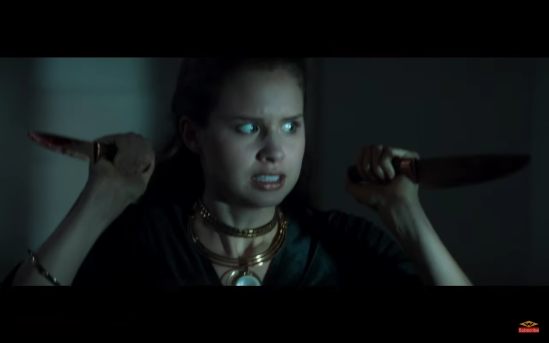
The Australian production casts an American to star as Ragana, the brood matriarch destined to rejuvenate Golden Path’s permanence, with “V’s” very own Jane Badler.  Badler brings an international presence to the feature and isn’t a stranger to films from the down under.  With the actress’s soul-seducing cutting eyes and demonic empress allure, the New York born Badler exacts Ragana’s clutching strength as an underground Pagan seeking unlimited decadent power.  However, Badler is overshadowed by the timorousness of Dalia whose polar opposite presence is granted a more favorable chunk of screen time.  Finnish born Saara Lamberg plays the humbled Dalia, living her life out of a covenant while searching out the cult that once almost stitched her into the sew of sleazy affairs to unearth the whereabouts of her younger sisters.  Dalia’s a bit of a dull principle with no substantiated efforts in finding her siblings and it isn’t until Samoth stalks her one night, recognizing the Golden Path’s symbol tattooed on her wrist and offering his manhunt services to find the expelled Moloch, an exaggerated black metal anti-Christianity anarchist in a saturating performance by Albert Goikhman.  In the middle, masked brutes, half naked women, and, fallen by the waist side, Dalia’s sisters in standalone plot point narratives that, as far as story structure goes, does nothing to motivate the narrative other than be an ostentatious aesthetic of locations and debauchery.  “Cult Girls” rounds out the cast with Tony Markulin (“MurderDrome”), Algias Karazija, Dean Kirkright, a handful of Bakaitis’s family, and Simay Argento, a distant relative to Dario Argeno playing a Cult Auntie in the film.

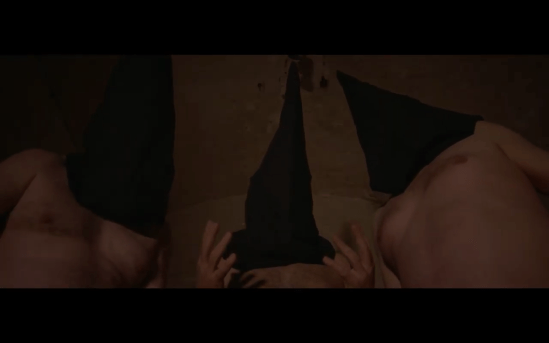
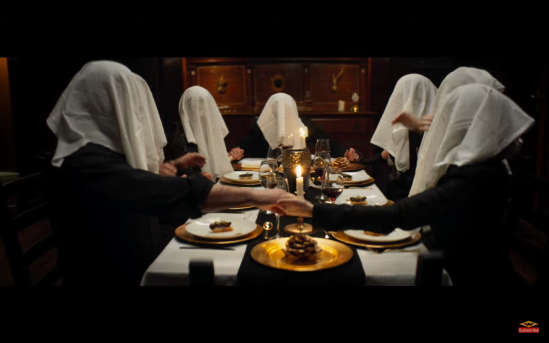
“Cult Girls” borders being avant-garde of an unfiltered auteur’s will in a mesh of artistic polishes and prose dialogue, but the film slides into being more of an 83 minute music video over staying it’s welcome and drudges through a repetitive stylistic cycle to an almost nearly unwatchable extent.  Yet, “Cult Girls” somehow manages to retain attention despite the chewy acting and it’s ambling story that hits a dam wall of uncertainly of where the script should head. Bakaitis shoulders the story for modern Gothicism tapped with half naked occultist, sometimes bathing in blood, and a plague of nightmare imagery that director of photography Trent Schneider tunes into well with noir vitality despite being the cinematographer’s debut feature film, but through the shiny exterior of a handful of solid mise-en-scene work, “Cult Girls” numbs the impact of the soul corrupting Pagan syndicate, that may or may not be shrouded with supernatural foundations, and the anti-Christian propaganda with half-baked violence from geriatric men, masked with Dia de los Muertos style masks, able to be kingpins of an untouchable prostitution ring façade for their occult sacrifices in broad public without a bat of an eyelash.  Granted, prostitution is likely legal in Germany and Lithuania so authorities might turn a blind eye, but brothels are a convenient opportunity for police investigations. “Cult Girls” treasures the fact of Lithuania’s languishing heritage without being overly filmic heresy by blending in shaded sleaze and death, but there lies no story in Dalia’s unenthusiastic search for her sisters in a much more preacherly themed death metal horror that confuses cult with religion.


Apocalyptic reincarnations and traditional folklores collide in Mark Bakaitis’s “Cult Girls” on DVD now from Umbrella Entertainment. The Australian release is a single layer DVD with region 4, PAL encoded format, presented in a widescreen 2.40:1 aspect ratio. Trent Schneider’s keen eye captures a grim fairytale surface of black magic masochism and, at the same time, breathtaking in the pure nature scenes, but the imagery is mostly in devoid of richer color that lingers around a bluish-gray monochrome tone and struggles with hazy details, especially around facial features, that smoothly fuzz over. The English, German, and Lithuanian Dolby Digital 5.1 surround sound mix battens down with shiplap genres of traditional Lithuania folk and modern metal from composing sound designer Erin McKimm, implementing the traditional songs of Lithuania sung by the Melbourne-Lithuania community singers, The Lost Clogs. Industrial action fills in every nook and cranny of the remaining score with decent range and depth of ambiance. While the dialogue is prominent and clear, there are spelling errors and tiny text issues with the English subtitles when the narrative lands in Germany and Lithuania. The DVD’s bonus features includes audio commentary, making of featurettes with cast and crew interviews, Bakaitis’s short film, “Mercy Kill” that serves one of the founding themes for “Cult Girls,” and music videos directed by Mark Bakaitis. For an Australian film, “Cult Girls” will feel more worldly, unlike anything else that comes out of Australia, and have partisan propaganda against Christianity, but in the end, the insidious Pagan evil, on the precipice of resurrecting, wearies on, like a tireless sermon of doom.

EVIL Fillets Family Strife. “Broil” reviewed! (Well Go USA Entertainment / Blu-ray)

Chance Sinclair is a rebellious 17-year-old closeted lesbian and Catholic student.  After a couple of school related incidents she didn’t instigate, Chance’s parents send her to live with her despotic grandfather, August Sinclair, despite her parents’ reluctance.  August rules with an iron-fist not only with his grandchildren, but with his entire family of powerful elitists who have a dark secret – they’re actually soul harvesting demons preying on the malintents around the world and is headed by August.   When Chance’s parents want out of the family business and reclaim their daughter from August’s authoritative grip, they hire a culinary prodigy with a skill for assassinations for a grand dinner that’ll have the whole family in attendance.  Chance is ignorant of her family’s history and the balance of power is not the only stake served on the menu, but also Chance’s very soul hangs in the very midst of the Sinclair’s family game night of internal carnage. 

Like a Gothic storybook enclosed with deception, murder, and unhallowed demons at their last supper, “Broil” is a going to hell in a handbasket supernatural feast and an unholy coming-to-age sophomore feature from by the upcoming “Cosmic Sin” writer-director Edward Drake and co-written alongside Piper Mars.  The 2020 Canadian murder-for-hire thriller vies against the stylish similarities of the “Twilight” saga with well-groomed, well-off, and sophisticated groups of strangers bound as family from supernatural circumstances, but distills itself out the frivolous teeny-bop pulp and teen heartthrobs for a modestly R-rated cutthroat kindred melodrama by the netherworld’s most notorious soul-suckers, shot in Vancouver, British Columbia, Canada.  “Broil” Is produced by “Cabin Fever 2:  Spring Fever” executive producer, Corey Large, and first time producer Kashif Pasta with 308 Entertainment (“It Follows”) and Good Complex serving as production companies. 

“Broil” doesn’t denote a lead character at the heart of this story, but pinpoints principles along a chaptered structure, signifying their importance by following them with an objective point of view.  The whole setup begins with the granddaughter, Chance Sinclair, who a bit rough around the edge and doesn’t play with her schoolmates, especially having an affinity for the same sex while being a student in a Catholic school, but that factoid doesn’t blossom into thing though be noted a couple of times.  Instead, Chance, played by Avery Konrad in her first principle character role, struggles with her teenage angst and hormones like any more adolescent, but she finds her educational woes pale in comparison under her family’s archaic secret ruled by the patriarchal domination of August Sinclair, a ruthless enforcer and head of the family business brought to an autocratic fruition by Irish actor Timothy V. Murphy (“Snowpiercer” television series). While Chance and August strongly convey a presence in the first act, Jonathan Lipnicki reins in the latter acts in an unexpressed spectrum performance of Sydney “The Chef” Lawson, a calculating killer taking out the transgressional trash informed by a mentor and father-like man named Freddie Jones, “Jason vs. Freddy’s” Lochlyn Munro, who may or may not have ulterior motives in exploiting The Chef’s gift for murder. Lipnicki’s work is a culinary delight in as much as The Chef’s actually culinary expertise, braising the character to eventually be the mainstay character. There are other exigent roles that seem important, but are only keystones that hold more principles roles from crumbling, such as Chance’s parents, June (Annette Reilly “Chilling Adventures of Sabrina”) and December (Nels Lannarson “The Cabin in the Woods”) Sinclair, who initiate the murder-for-hire spark that set things in motion. Rounding out “Broil” is Corey Large, Megan Peta Hill, Abby Ross, Jenna Berman, Phoebe Miu, Alyson Bath, David Hennessey, John Cassini, and Kyra Zagorsky.

Playing out in chapters, “Broil” feels like a murder-mystery adapted from a on fleek novel written by a panache author from Switzerland, but from what I’ve researched, “Broil” is an original narrative only to be segmented to amass refined character details and redirect turn of events as they unfold. However, the chaptering aspect veers the narrative off course, careening “Broil” more toward edit oblivion that doesn’t layer the foundation properly causing as much confusion as the inhuman characters trying to decide whether the Sinclairs are either vampires, demons, witches, or some kind of incubus-succubus blend for a better part of the film. A theme that doesn’t withstand the pressures of Drake’s zigzag directional layout is the unholy atmosphere the Sinclair’s protrude into the world. Chance, who is ignorant of her lineage and of what she really is, turns crosses upside down, turns crucifix necklaces ablaze, and her family sends her unusual gifts like parceled decorated daggers as seen on sacrificial stones, but the satanic tropes cease to do little more than be hints bound to expose the Sinclair’s true selves and really nothing to do with Satan himself, leaving much of the Sinclair powers left unexplained, like their lightning speed and pulsating purple glow that illuminates in patches under the skin (another “Twilight” element?). The acting is palpable, even if it’s melodramatic and under a slew of unlikeable characters, and the story does throw a few notable curve balls, some wickedly diabolical knuckle curves involving eating a child, to intrigue an inch by inch progression of the story. “Broil” unsheathes moments of Gothic schadenfreude, but the moments are fleeting, too short and far in between, to swimmingly bask in the horror of demonic soul snatchers in the throes of a murderous coup d’état.

A delicacy unlike anything you’ve ever experienced, “Broil” is served onto a Blu-ray release as the plat de jour distributed by Well Go USA Entertainment. The unrated film is region A coded and presented in high-definition, 1080p, of a 16:9 widescreen format. Details on the image render very soft, undiscerning outlines that infuse where a person ends and the background begins, but as the lighting choices change from flared hues to more hard lighting, profiles are to take more shape. Director of photography Wai Sun Cheng, making his introduction into feature films, keeps the focus primary in the foreground, obscuring the backdrop just enough to make it still perceivable and mixes well in the extreme close ups with wide angled shots to not be a one trick cinematographer. The English language 5.1 DTS-HD Master Audio has severe troubles with Hugh Wielenga’s score tremendously overpowers everything else with a profound overlap. The composition is so unbalanced and loud that the resonating LFE completely drowns out the dialogue at times. “Broil” does not contain any feature specific special features other than a static menu containing upcoming previews of other Well Go USA films. Despite the title and the infernal nature, “Broil” is a dish served too cold with an unsavory plot of a young woman’s coming of age tribulations in midst of family squabbles and treachery that Edward Drake couldn’t quite fuse together.

Pre-order “Broil” at Amazon.com

Let’s Ride the Ol’EVIL Succubus to Chastity High School in “Sadistic Eroticism” reviewed! “Wild Eye Releasing / DVD)


At California’s Chastity High School, a strict and sadistic far-right facility body abuse and favor a select assembly of pupils, isolating the semi resembling studious teenagers, who wear black trench coats, innocently worship indie horror flicks, and the idea of women, to the whims to not only a rapist principal and a Nazi fascist assistant principal, but also suffer prolonged torment from the school’s popular kids. When one of the regular teachers slips, falls, and dies on a pool of ejaculate, a voluptuous and alluring substitute teacher, Ms. Lizz, fills in, hoping to become a permeant teacher at Chastity High, but Ms. Lizz has a three hundred year old secret being a vampiric succubus who lures in and possesses the popular, sex-crazed, hormone driven high school jocks who will do her bidding in abducting the beautiful high school sluts and for Ms. Lizz to drink their blood to retain immaculate beauty. Its up to three Troma loving and heroine doping geeks and an odd janitor to stop Ms. Lizz before she laps up slut blood and moves on to the next school.

Like a barrel full of doured high school rape jokes bubbling in a stasis of formaldehyde, the farcical cringe-worthy comedy-horror, “Sadistic Eroticism,” is the brain damaged brainchild from writer-director, Alex Powers, as his debut feature film shot entirely on VHS cassette that pays homage to the SOV horror of the early 1980’s, such as “Boarding House” or “Sledgehammer.” Powers, who went on to helm “GrossHouse” and its sequel, congeals on a slapstick of analogue digressions to introduce himself as an auteur filmmaker who, unrestrained, can exceed beyond the distinct hardline of political suitably that’s not only a testament toward the very title of the film, but also, perhaps, securing Powers on a number of studio blacklists unwilling to touch him with a single junk-destined email originating from the other ends of the Earth. Starchild Video serves as production company, which if entering “Starchild” and “Sadistic Eroticism” in the same search engine field, you’ll get a nice little stern warning about your search results involving child sex abuse and any images depicting such should be notified. Yikes.

More promising than the infamous history of the Hungarian noble woman, Elizbeth Bathory, to which “Sadistic Eroticism” properly appropriates it’s title and abstract character from, is the colorful, if not disdainfully charged, personalities teeming with a variety of depraved intentions and the entire cast embraces the full blown degenerate toxicity. More than likely, most of the cast list is made up of not household names like JD Fairman, James Coker, Nicholas Adam Clark and T.J. Akins as a black Nazi fascist hard up on Christian values and stern punishment. On the flipside of that coin, genre fans can root through the blurry, sometimes overexposed, tape recordings and find familiar faces of the then scruffy looking filmmaker James Cullen Bressack, writer-director of the popular indie found footage thriller “To Jennifer” and producer to the subsequent franchise films, “2 Jennifer,” “From Jennifer,” and “For Jennifer,” suited up in a shirt-sized Confederate flag as one of four high school bullies to fall under Ms. Lizz’s spell. The prolifically half-naked all the time indie actor, Michael Q. Schmidt (“The Pricks from Pluto Vs. The Vaginas from Venus”), straps on BDSM gear for a little sodomy counseling as Principal Buggary, “2001 Maniacs” Field of Screams” Miles Dougal slaps on a wife beater for some sleazy slumber party slime ball in a high school girl’s father role, and, of course, the lovely pornographic actress who branch out and take a break from oral sex, group sex, three-way kissing, and – oh wait – they do and simulate that in this Powers’ as well. Tori Avano, Imani Rose, and Jayden Starr are the three high school sluts who shameless flaunt their assets for Sophie Dee to snatch up and soul suck her way for anomalous aesthetics as a satanic form of cosmetic surgery. The latter actress, Sophie Dee, is endowed, more ways than one, with the role of the vampire-succubus Bathory, keeping well….well abreast her monotonic acting talents with her adult industry persona. All four ladies show an abundance of above waist skin and engage in some solo girl, boy-girl, boy-boy-girl, girl-girl-girl, boy-boy-boy-girl… and now I must sit down a rest my brain. Dou Waugh, Sto Strouss, Paymon Seyedi, Candis Higgins, Mel Martinez, Aaron Granillo, Matt Johnson, Ian Fisher, Jody Barton, and Yajaira Bardales round out the cast.

Jokes and slapstick humor disassociated, “Sadistic Eroticism” still relates to the Elizabeth Bathory backstory told on VHS through a tube television presentation of Ms. Lizz’s abnormal history subjects. The succubus creature is nothing less than a buxom beaut that undresses with her feminine wiles zombifying men to do her bidding without her lifting a finger to break a nail against the hypersexualized school girls; yet, to show this century’s old cacodemon as provocatively dressed and to skim around bellying up the tension isn’t quite enough to sell the dominance an ancient evil should be wielding like she owns the whole damn school. There’s more of visceral presence of evil between Principal Buggary and Assistant Principal Defur and though they’re also vaguely under the influence of the succubus, their combined power is the epitome of “Sadistic Eroticism.” The script, characters, and subject material are indicative of Alex Powers attempting to reel in Lloyd Kaufman and his Troma slum-empire to purchase and distribute the filmmaker’s squawking lechery of a film and yet, perhaps, the Troma acquisition team also saw too much of a yawn-fest to bare the Troma brand as the nearly two hour runtime sluggishly relies too hard on being incoherently schlocky to be coalescing competent to make sense. “Sadistic Eroticism” is more masochistic in it’s ostentatiousness to desensitize power and rape and call it comedy, but rocks a mean cast of players from all walks of life to be a mean-spirited take of The Blood Countess.

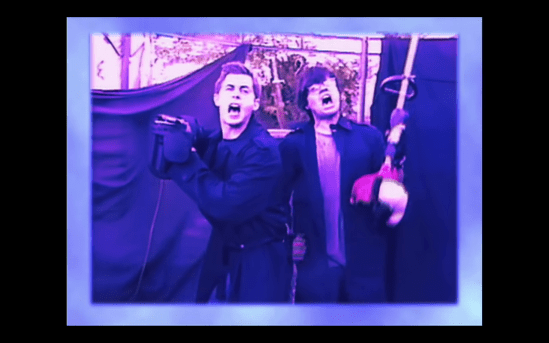
Open your lesson books and get ready to be schooled by the twisted and obscene in Wild Eye Releasing’s re-release of “Sadistic Eroticism” on the label’s Raw and Extreme banner, distributed by MVDVisual. The region free, unrated release is presented in a SOV full frame of 4:3 aspect ratio. Tracking is the least of the problems with this uncouth image presentation rendered from pillar to post quality of warm tinges, severe color corrections required, and gauche details emblematic of cassettes, but all that was Alex Powers intended design to relive in the era of SOV. However, there are some less than stellar, even for SOV, that negate the effort, such as high contrast and poor lighting nearly blanking out darker scenes and the entire climatic end has a neon purple border and the scenes are also recorded in an awful tint of purple, making the entire finale be seen through Grimace vision. To top it off, the jagged opening titles, credits, and crooked visual composites are nearly discernible. The English language mono track is touch and go, mostly go as dialogue wanders into a deaden muffle and is also drowned out by a stock score tracks. There’s not much range or depth as much of the audio is picked up by the poor quality of the VHS handheld mics as exhibited on the special features, which include a director’s commentary and a behind the scenes hosted by that James Coker, who does a pretty good engaging the actors for the in-the-face interviews to explain their characters, scenes, and just overall thoughts with porn starlets and actors milling about or in takes. Sophie Dee’s bosomy eye-catchers, Tori Avano’s star-shaped nipples, Imani Rose’s vivacious sexual appetite and a stockpile of lewd, crude, and nude wets the very foundational whistle of “Sadistic Eroticism” bungled in a sloppy heap of first time filmmaking.

Order “Sadistic Eroticism” on DVD at Amazon!