The Evil That Doesn’t Kill You Makes You Stronger! “Jungle” review!


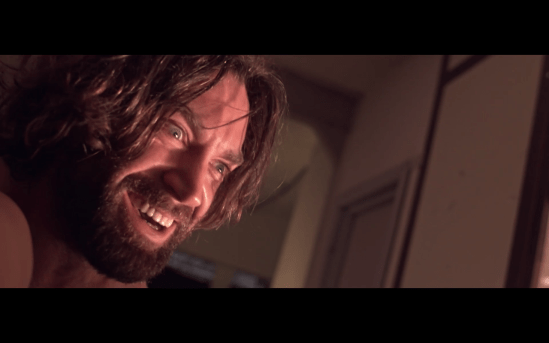
Yossi Ghinsberg yearned for more than the comfy, cushy life he was born into and being young and adventurous, Yossi travels abroad to backpack in Bolivia to pursue self-discovery and beauty in places far less travelled despite his father’s wishes. He quickly befriends fellow backpackers Marcus and Kevin and together, they lay tracks through the eclectic terrain of the breathtaking Bolivian landscape, but wasn’t until an Austrian geologist named Karl approached Yossi about a promise of unearthing gold and experiencing hidden tribes deep inside the lush jungle. After some convincing, the three friends venture into the jungle with only Karl to guide them and, at first glance, the wilderness is an escape from the noise and pollution of human corrupted inhabitations, but a drastic realization quickly washes over them when they’re force to separate and that the jungle is a cauldron of constant survival. Along with captivating beauty, fire ants, poisonous snakes, symbiotic organisms, jaguars, and torrential rains tip the iceberg of everything that embodies the sequestered jungle and Yossi must endure the trials and tribulations alone in order to make it out alive.

Based off the book of true events from Yossi Ghinsberg comes the motion picture retelling of Ghinsberg harrowing tale of survival in “Jungle.” The 2017 biographical adventure-thriller is penned by Justin Monjo (teleplay writer for TV hits like the sci-fi odyssey “Farscape”) and directed by “Rogue” and “Wolf Creek” director Greg McLean. “Jungle” showcases the night and day environment of one of the world’s most beautiful, yet deadliest locations, cascaded with awesome uncharted landscapes with an augmentation of great mortality once man is introduced. However, the thing with the jungle is that no matter what man’s objectives may be with the rainforest, whether it’s to destroy it or to embrace it as were Yossi’s intentions, nature treats all with the same merciless brutal as it’s kill or be killed. Yossi is in the midst of a man versus nature thematic element where Darwin’s survival of the fittest lays all well true and from his book, Yossi Ghinsberg went through a nearly three weeks of severe isolation, stomach-devouring starvation, and vigilant hyperawareness against the local wildlife. Yet, somehow, he survived.

To play such as downtrodden character needed an actor committed wholeheartedly to the story and, luckily for McLean and the rest of the crew, Daniel Radcliffe encompassed Yossi Ghinsberg and his plight with passion and dedication. So much dedication that the Harry Potter famed actor lost about 14 to 15 pounds in order to mimic starvation and really put his body close to the hazards Yossi had faced. “Jungle” has certainly solidified his range as an actor inside the genre of not only fantasy films, but also thrillers as well. From “Horns” to “Imperium,” the English-born, 5’5”, 28-year-old actor has placed a major footprint in the industry that stretched from low-budget to Hollywood stardom and doesn’t seek to stop in the near future. Radcliffe is joined by a pair of Australian actors in Alex Russell (“Chronicle” and “Bait”) as American photographer Kevin Gale and Joel Jackson as Swiss teacher Marcus Stamm on sabbatical. A standout performance, one that really rivals Radcliffe in cliffhanging suspense with cryptic intentions, is that of Thomas Kretschmann (“Blade II”) playing the Austrian geologist Karl Ruprecther. Fantastic chemistry between all four men with spot-on performances, especially not portraying their native heritage.

While Greg McLeans has no fear in getting gritty where gritty needs to be get, “Jungle” has a tame nature about it for a director well-known for Outback cruelty. McLean doesn’t exact the right amount of perilous attitude that was unfortunately bestow upon Yossi. Much of Yossi Ghinsberg’s book was not translated to screen such as his rectum being impaled by a large stick when he falls down a slope. The hard stop editing and pivot bounces the viewer around being out of control on a trampoline. When we meet Yossi for the first time and he encounters Marcus Stamm, a cascading event of one jointly pursuit with another that string along and attach Kevin Gale to a web of awkwardly editing scenes of traveling through Bolivia in what felt like a slapdash montage with the sole purpose of setting up the trio’s friendship in an unsympathetic way. Another issue with the editing was that the film had to keep reminding the viewers about previous events, such as when Yossi was bitten by a fire ant, and those scenes ended up being a redundant time filler that points audiences to being naive and inattentive to cherry pick previous actions.

Umbrella Entertainment releases “Jungle” on a rated mature, region B Blu-ray with crystal clear full high definition, 1080p presented in a widescreen 2.35:1 aspect ratio. Image quality bares no marks of compression issues nor any flagrant fouls in the coloring, whether natural or generated. Aliasing is also a non-issue. The 5.1 DTS-HD English soundtrack has moments of low fidelity at the beginning of the film where making out the dialogue can be challenge, but the jungle ambiance and the Johnny Klimek (“Land of the Dead”) score bring alive the eclectic atmospherics of the wild, wildlife. Bonus features include a featurette that extends up Danial Radcliffe becoming Yossi Ghinsberg, the making of the Yossi Ghinsberg story, cast and crew interviews, and the theatrical trailer. “Jungle’s” adventurous first half sets up the catalytic downfall into desperation and despair of a man versus nature thriller in the latter half, splitting Daniel Radcliffe into two auspicious roles of enchanting self-discovery and a fight for survival. The movie most certainly encourages one to read the book of Yossi Ghisbergs edge of death misadventure.

A Lonely Mind Plays Evil Tricks. “Visitors” review!


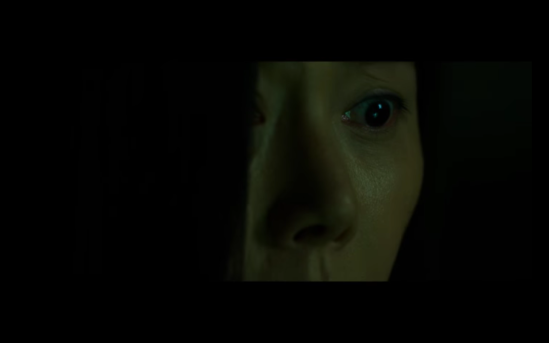
Yachtman Georgia Perry aims to be a part of the best of the best by joining a handful of women who’ve sailed around the world. The rules are simple: don’t step on land, don’t let anyone step on your boat, and don’t turn on your outboard motor. As Perry heads out into the open ocean, the 25-year-old carries with her a burden of lifetime baggage stemming from her mother’s acute depression and gruesome suicide, her father’s accident and deteriorating health, and the bond between her and her boyfriend Luke coming unraveled. Combine all that weight with complete isolation, loneliness, and no wind to push her sails, Georgia quickly spirals downward into a turbulent state with her only traveling companion being her cat with whom she has conversations on her becalmed sloop. All her fears come to fruition, blurring the line between reality and disturbing fantasy that threatens her voyage and, maybe, even her life.

Bayside Pictures presents “Visitors,” the last helmed feature by the late Richard Franklin of “Psycho II” and “F/X2” fame. “Razorback” writer Everett De Roche penned the 2003 psychological thriller and is able to conjure out some wicked mind buckling material of a woman subjected to cabin fever in the form of a volatile, non-linear story. Franklin adds his two-cent charm with impressive visual sets and effects from the early turn of the century, implementing CGI where appropriate, being practical when deemed, and, by golly, the effects resulted didn’t come out too shabby. The ocean has always been beautiful, yet terrifying mystery that has yet to be fully explored, and Franklin’s able to capture the ominous anomaly that associates with the deep blue sea under an overwhelming guise of mental health and severe isolated confinement.

Before she wandered into “Silent Hill,” but after becoming forsaken in “Pitch Black,” Radha Mitchell showed strength in solitary by playing the headstrong, nautically ambitious sailor, Georgia Perry. Mitchell, who was slightly older than her 25-year-old character, fabricates a troubled young woman willing to risk it all, even her life, even if it meant to leave to escape all her woes and that she holds dear at home. The “Rogue” and “The Crazies” remake actress from Melbourne has a sensationalized and systematic dynamic with her on-screen mother, played by the late Susannah York, in what’s considered to be a disturbing role of manipulative motherhood that forced Georgia to be extremely close and clingy to her endearing father, an underrated role bestowed upon Ray Barrett. A young and upcoming Dominic Purcell (“Blade: Trinity” and “Primeval”) costars as Georgia’s lover and business manager who may or may not have other underlying intentions with Georgia’s sponsors. Appearing never together and putting Mitchell at the epicenter of their lives, the foursome played their roles beautifully by stretching the limits of reality without being overly absurd to the point of being unbecoming of a thriller.

By no means is “Visitors” a woman versus nature premise. Yes, Georgia faces any elements that would plague any sailor who ventured into the ocean alone, but nature was only accessorial. “Visitors,” for the sake of being funny, is more of a film about a young girl embarking on a journey of self discovery. Georgia must get away from negativity that has been eating at her zealous spirit ever since the terrible childhood accident that had crippled her father and destroyed her parents’ marriage. Her embattled mother’s constant belittling, berating, and blaming is the brunt of that that has been burdening. At sea, Georgia battles her onshore demons, which also includes her father’s failing health and her failing relationship with Luke, and coinciding is her ever present looming and underlying fears that lurk out into manifestation, or a visitation if you will, during severe cabin fever. The trip around the world won’t kill her, but her inner demons just might which begs the question if “Visitors” is more of a mental health film and the answer is a firm yes without salty doubt.

Umbrella Entertainment releases “Visitors” onto a region 4 home entertainment DVD. The DVD is beyond an upgrade from it’s region 1 counterpart in the image and audio departments. The anamorphic widescreen, 2.35:1 aspect ratio, renders a cleaner image with slightly more natural color tone as well as offering more film flesh on either side from the 35mm negative. The English Dolby 5.1 audio track offers a range of diversity. The dialogue is clear and fine, the ambient track syncs with ample depth, and the brooding and perilous soundtrack from composer Nerida Tyson-Chew (“Anacondas: The Hunt for the Blood Orchid”) provides a delectable varied score to Georgia’s though process. The extras are thin, not much different from the Stateside release, including a photo gallery, cast and crew bios, and the Palace Film’s theatrical trailer. Considered widely as an Australian ozploitation film, “Visitors” is deep-seeded, mental trench warfare on the high seas set on a course of psychological doom. A fine film for being Richard Franklin’s last hurrah.

The Unspeakable Evil That Drugs Do to Your Body! “Red Krokodil” review!


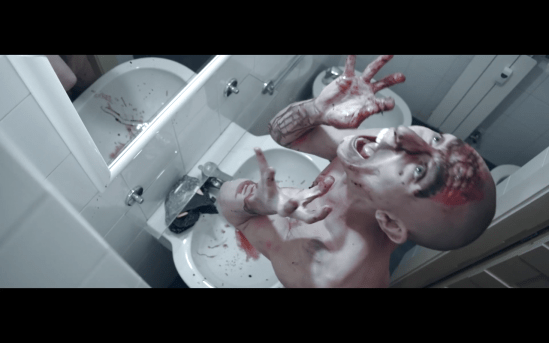
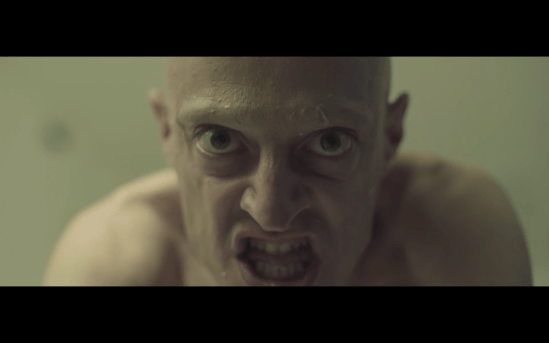
“Krokodil is a homemade drug. It combines codeine, lighter fluids, gasoline, paint thinner, alcohol, and other ingredients.” This fast growing Russian street drug gnaws along the inner layers of one man’s insides and clawing its way out. Also, the drug deteriorates his mental stability, invigorating extreme hallucinations from his damaged cerebral equilibrium and manifesting faux body images of himself as well as inviting humanoid demons into his tattered reality. The powerful opioid, if fabricated haphazardly, induces prolonged and deathly ill effects, both physical and mental, and as his body has survived in a post-nuclear world, his mind is as much of a ramshackle as the rest of the world is in ruin. As he spirals down, out of control, through the opioid rabbit hole, he becomes only a shell of himself, transforming into the purest toxicity of the drug that creates alligator scale-like sores over portions of his body.

The need to put the definition of Krokodil” first and foremost, in front of the plot summary above, felt necessary. Director Domiziano Christopharo made it essential to do the same prior to the credits of his 2012 film “Red Krokodil.” To the average joe, the very mention of “krokodil” means nothing other than a seemingly skewed, alternate version of the English word crocodile, but the gore and shock director, best known for his debut work “House of Flesh Mannequins,” wanted the background behind the street drug to sink in, to be injected, to be snorted, and to be smoked before audiences continue with their trip through the breakup of the body. Based off a script written by Francesco Scardone, the Italian director had set the stage with his grippingly ghastly tale telling talents toward the dominion of body horror combined with ample psychological manipulation from substance abuse and while Christopharo is no David Cronenberg, the eclectic filmmaker cycles the story through a poetic flow with mostly an off-screen monologue approach that gives glimpses of a degenerative mindset.

Co-producer of the film, Brock Madson, also stars as the withering drug addict. There are hints Madson plays the character named Arthur, but the film only credits the character as simply him, and theoretically, that’s proportionate to the storyline staged as a post-apocalyptic world where it’s just him, ensnared and isolated. The role’s non-verbal role leaves Madson to go full-throttle in physicality with a semi-to-fully nude performance and he maintains an animated disconcerting fear and aloof glee whenever the moods start to swing. For most of the duration, Madson is solo, but a couple of minor characters, fabricated by his addiction, freakishly gloom over him. Viktor Karam, as the Bunny Man, and Valerio Cassa, as the Monster, positions themselves as enduring internal calamities that plague the Madson’s character.

“Red Krokodil” is laced with themes and symbolism, especially in a religious sense with the resurrection of Jesus Christ that parallels the trials and tribulations of the addict, mainly with going through the withdrawals. In order to save himself to be reborn, he must first sacrifice himself and Madson literally dons the crown of thorns and self-inflicts a stake through his feet. However, this self-crucification is all in his head, but when he awakes he’s able to ignore the heavily influential calls of the krokodil. Christapharo had kept the addicts apartment a dull, colorless prison, growing with filth and decay, but once the addict has saved himself, the room brightens, the outside sky has illuminated, and the near-death abuser has a little life left to be jovial, but to keep the grim themed tone against this man’s struggle to live through strife, Christapharo invokes false hope that ultimately becomes the addict’s concreted freedom from it all. The addict’s inner monologue goes through the steps how recovery, rekindling good memories from the past and wanting to not feel himself as it’s painful to feel your own skin be on fire from the corrosive drug, but rather be a personification of the wind, sun, water, or the grass, an element of the film that touches upon how humans mistreat the Earth much like they mistreat their bodies.

Unearthed Films and MVDVisual present “Red Krokodil” on a director’s cut, high definition, 1080p Blu-ray. Sporting a macabre, yet gorgeously illustrated cover, the release also has the same attributes in the image quality presented in a widescreen 1.85:1 aspect ratio. Like most film distributed by Unearthed Films, the grime and the disgusting reign as supreme and “Red Krokodil” has ample muck with bleeding orifices and an unappetizing uncleanliness about it, but the picture quality is clean and detailed with very little electrical interference. Color palettes, when the addict dreams to escape to nature, is a potent reminder that “Red Krokodil” isn’t just transmitting two-toned, gray and black, scale and displays exquisite landscapes. Even the computer generated Chernobyl like waste land of a city going up in an atomic fashion is well done with only a slightly glossy feel. The Dolby Digital 2.0 track broods with the ideal amount of LFE from composer Alexander Cimini that’s not acutely jarring, but still manages to showcase the detriment. Bonus material includes an alternate musical ending, deleted scenes, photo gallery, the CGI test of the nuclear explosion, teaser trailer, two theatrical trailers, and Unearthed Films tailer reels. “Red Krokodil” is a total out of body experience. Overwhelmingly brutal with muscular and mental breakdown, director Domiziano Christapharo’s indie picture of ill-effects of drug abuse has done what “Requiem for a Dream” has done for the mainstream with the matter-of-fact implication that manufactured street drugs are the purest evil that we could voluntarily do to sabotage ourselves.

Buy “Red Krokodil” from Amazon today!

Evil Surgical Nightmares…on Repeat! “Inoperable” review!


From being stuck in stand still Floridian hurricane traffic to waking up in a hospital without any recollection of how she got there, Amy Barrett finds herself in a seemingly evacuated sanitarium on the verge of being hit by a category 5 hurricane. When she finally makes contact with the limited hospital staff, Amy discovers that the staff are not in the position to help, but desire to perform unnecessary surgeries. Then, she finds herself in traffic again. Then, she wakes up in hospital…again. Amy, and other patients, find themselves trapped in a nightmare loop forged by the powers of the massive hurricane. Before the storm passes over, Amy must find a way to end the corkscrew of timelines that propel her limbo hell or else she will be trapped in the hospital forever.

To the O.R. stat! From writer-director Christopher Lawrence Chapman comes “Inoperable,” the horror equivalent to Bill Murray’s exceptional dark comedy “Groundhog Day.” As Chapman’s sophomore directorial, first in the realm of horror, the director takes “Inoperable” to rebrand the quantum paradoxical plight by introducing a medical butchers with hours upon hours, days upon days, years upon years of experience with exploratory surgery and ghastly invasion procedures. Behind the wormhole of terror script with Chapman is co-writer, the b-horror screenwriter, Jeff Miller whose extensive credits include “Axe Giant: The Wrath of Paul Bunyan” and “Jolly Roger: Massacre at Cutter’s Cove.” In this go-around, Miller explores the space-time-continuum, or does he, with Amy reliving the same moment, experienced slightly differently, in an endless loop of grisliness.

Starring in “Inoperable” is the “Halloween’s” franchise third favorite star, behind Jamie Lee Curtis and Donald Pleseance, being Danielle Harris (“Halloween 4,” “Halloween 5,” and Rob Zombie’s “Halloween” remakes). Harris keeps and maintains the tension, supplementing an increasing annoying and frustrating tone with each and every reset, and does superbly in extended takes running through the hospital’s dark corridors. Amy’s center storied character really puts Harris to work on her ability to flex in sequentially illogical scenes that go in various tangents and come to a dead halt in the end, flipping the script that forces the modern day scream queen to relive some of those killer “Halloween” moments. Harris is accompanied by Katie Keene and Jeff Denton, both whom worked with Chapman previously on the clownsploitation slasher “ClownTown.” Keene and Denton’s characters are also caught up in the same situation as a Denton plays a beefy good looking cop named Ryan who brings in a witness, Keene’s JenArdsen, a dolled up blonde who while in his custody, to the hospital following a multi-vehicle pile up; the very exact incident Amy in which Amy was involved. The two fall for each other more and more with each and every restart and that pain coldly passes over when to bare witness to each other’s demise over and over again is disturbingly twisted. Rounding out the cast is Chris Hahn “Axe Giant: The Wrath of Paul Bunyan”), Cher Hubsher (“The Amityville Terror”), Michelle Marin (“Bloody 27”), Philip Schene, and Crystal Cordero.

The trio of resetters formulate a wildly speculated theory that a nearby military compound, experimenting in spatial physics, was ravaged by the hurricane that oozed out their experiments that disrupted timelines, affecting this particular hospital, and the only way to escape the madness is by displacing the same energy that was put into it; so for example, since Ryan and JenArdsen arrived together, they would have to escape together. As long as Amy doesn’t die, every trapped soul is eligible for escape. Wait, what? Like aforementioned, Amy is the centerpiece to the puzzle and the whole entire situation actually revolves around Amy, intentional or not. Even though clues try to put a monkey wrench in that notion, the story always seems to revert back to Amy much like the loop she’s caught in. That in itself is the biggest hint of all that funnels to a underwhelming ending in null and voids the rest of the story.

ITN Distribution presents “Inoperable” onto DVD and VOD. The DVD is presented in a widescreen to “preserve the aspect ratio of its original exhibition” and, yes, this was done so. Nothing too particularly to note about the image quality being a modern release, but the color palette is balanced and vivid. The English language 5.1 Dolby Digital track has some good range and clear dialogue that effective communicate all theories and explanations on why this is happen to Amy, Ryan, and JenArdsen. Extras are slim that include a cast and crew commentary and the theatrical trailer. The Zorya Films and Millman Productions’ “Inoperable” is open heart surgery gory and is unique in a deadfall environment that’s sublimely refreshing for the over saturated genre, but culminates flaccidly with a conventional finale too predictable for comfort.

Subliminal Evils Slithered Inside Your Head! “The Holly Kane Experiment” review!


The questionable techniques of radical psychologist Holly Kane have been effective in redirecting and controlling unconscious thoughts through sensory deprivation. Facing potential legal trouble even after a successful Hospital procedure, Holly Kane turns to the offer from Marvin Greensdale, a wealthy and well-known psychologist seeking to employ Holly for clinical trials that would lead toward legitimizing her practice. In conjunction, Holly begins a romantic relationship with an admiring Dennis MacIntyre as her life and her life’s work have seemingly taken a turn for best, but as soon as she starts the clinical trials, Holly begins experience hallucinations and hearing whispering voices and she fears that her despondent and bleak family history of mental illness might be catching up with her or is it something else that’s covertly sinister?

Between Brighton and London is steered a conspiracy-riddled thriller entitled “The Holly Kane Experiment from a father-son filmmaking duo, writer Mick Sands and director Tom Sands. The filmmakers behind “Backtrack,” aka “Nazi Vengeance,” go deeper into the mysteriousness of subconscious cauterized by a fleshy cloak and dagger aspect layered thick, chillingly dense, and richly dark. Tom Sands invades the personal space of the senses by introducing sensory disrupting attributes in the same vein as Darren Aronofsky’s “Requiem for a Dream,” but Sands then diverts away from a snowballing psychedelic thriller to an undermining exploitation on a clandestine level.

Kirsty Averton stars as the titular character, the obsessed and isolated psychologist looking for answers inside the depths of her own mind. Averton performs well as the highly stern and fiercely focused Holly Kane and the English actress has a body to match. That’s remark is important to the story because with her beauty, the story would take an entirely different angle with her Holly’s employer, and lust admirer, Marvin Greensdale, played faultlessly by long time actor Nicky Henson (“Psychomania”) who flourishes an distinguished socialite whose more charming than aging youth. Also in the mix of the love triangle, James Rose makes his feature film debut as Dennis MacIntyre, a man trying to forget his past when he meets the beautiful Holly Kane. If there was an ever an odd wheel or a black sheep in the cast, Rose fit the bill with his scruffy appearance, homeless attire, and the insecurity in his voice and in his acting. The Scottish native has a personal interest in this film as he is, according to IMDB, a graduate of cognitive hypnotherapy and psychology, which begs the question, did Rose provide professional consultation? Holly Kane’s exclusive drug dealer, a chemist graduate named Jeannie, falls on the shoulders of Lindsey Campbell who mirrors as Kane’s opposite. Jeannie’s free spirit attitude and candid drug use sets up the fitting actress to nearly be free of constraint and to act under a hallucinogenic state until she encounters trouble with Greensdale’s operative goon Carl Grower in a riveting information extraction scene. With a chiseled jowl and a gaunt look, Matthew Neal certainly has a memorable role that he intensifies with a heart piercing look through a thousand yard stare and snare so devilish that Carl Grower instantly becomes a character favorite, but the character lacks significant screen time and is limited to basically the third act.

“The Holly Kane Experiment” subliminally pushes out the true intention of the plot and turns massively psychosexual. Once true intentions are made light, a thick film of filth just washes over and that’s subtle, yet poignantly subversive. However, Mick Sands’ scribing of the dynamic between Kane and Greensdale’s licentious activity through the power of suggestion form complexities turned improbabilities. Basically, the story was unchallenged by the writing with characters falling for obvious scrupulous activity. Also, the undercooked character developed plays a bit part in denoting the true power of individuals and the wane in others. Like aforementioned, Holly Kane is obsessive, fierce, and maybe even a little paranoid, but the character is easily blindsided by the very first instance of opportunity for her technique, even if blotted by questionable motives.

Today, “The Holly Kane Experiment” premieres in the UK on digital platforms. The Substantial Films production is a drug-fueled, psychosexual thriller poised to spotlight brainwashing and be an anti-establishment picture, but doesn’t quite pass the finishing mark with a jerky storyline that disrupts and undermines the time and spatial impurities, leaving a discombobulated aftertaste. The finale is also disconcerting with an abrupt and dissatisfying ending to forthright explain where characters land and I’m talking about all the characters fates. Overall, “The Holly Kane Experiment” is worth the time despite the issues with jarring the mind and violating the body, bending both to do bidding against one’s will, and that alone is impressively fearful. You can learn more about “The Holly Kane Experiment” at the film’s official website – www.thehollykaneexperiment.com.