Nuclear war had demolished the quiet rural areas harboring bio-engineering plants and has crumbled societies in a post-apocalypse. The nuclear fallout caused a deadly bacteria to thrive and spread amongst the region, wiping out millions of lives in its path. A group of scientists seek to rebuild the devastated population by devising a plan to send an electromagnetic pulse that will directly input inhibitors in the brain to block the bacteria from overwhelming a dwindling human race, but the success of the pulse came with a severe cost involving the death of every child on the planet. Also embedded in the pulse is a mind altering virus that encoded itself into every person’s brain to act as a mind control device. The only person virally immune, a fallout survivor, is a struggling father, Jake Slater, trying to protect his adolescent daughter, Molly, at all cost as she’s the only child left on Earth due in part to her father’s immunization. Malevolent creators behind the virus aim to get their hands on Molly and experiment on her immunization before inevitably releasing upon the world a much more sinister version of the virus from the pulse tower that only Jake can destroy.

“Blue World Order” is the martial arts, post-apocalyptic, science fiction flick from first time feature directors Ché Baker and Dallas Brand. Baker and Bland co-wrote the screenplay with Sarah Mason that flaunts a major concept, perhaps better suited as a major Hollywood studio concept, but wouldn’t quite cross that threshold of positive public opinion stemmed from cramming too much into the a non-stop, action-packed contiguous acts laid simply out to illuminate an aged old theme of power hungry Government against meager do-right resistance. To further add on top of all that doesn’t feel right about this film, we’ve all seen this film before or, perhaps, a similar rendition of it. The 1989 Jean-Claude Van Damme film, one of many Van Damme guilty pleasures, “Cyborg,” blends martial arts with a futuristic wasteland decimated by a deadly plague and while the gritty and dark “Cyborg” carries itself vastly different from Bland and Baker’s more flashy and glossy approach, the story’s core is virtually the same with oppositions desiring to save the world for an interior motive.

Since this is an Australia production set on location in Australia, seems like a no brainer that Melbourne born actor, Jake Ryan (“Wolf Creek” the television series), would snatch the lead of Jake Slater. Ryan’s beefy build and rugged appearance have him a prime candidate for a hero, a fighting father, in a world in turmoil, but the way the film’s edited, Ryan comes off a bit aloof and a droll warrior. Ryan is joined by a few other familiar Australians and New Zealanders such as Jack Thompson (“Star Wars Episode II: Attack of the Clones), Bruce Spence (“Mad Max”), and Stephen Hunter (“The Hobbit” trilogy) as a screw loose rebellion leader with a awful martial arts stand-in that dons a lighter shade wig. There’s also Billy Zane. Zane, a native of Illinois, has a knack for hitching himself onto foreign products; his last venture we reviewed was a Greek production entitled Evil – In the Time of Heroes, but Zane’s a remarkable actor whose able to morph into the essence of any character, especially characters that sport lopsided power like his character Master Crane, a martial arts instructor turned catastrophic savior post-fallout. The cast rounds out with newcomer Billie Rutherford, Kendra Appleton, and Bolude Fakuade.

One headache smoldering as a consistent motif throughout is the lack of character development. Before his calling as the one to save humanity, a dream sequence exposition touches upon Jake Slater’s time before nuclear war. Slater’s seen engaging in a friendly, if not slightly competitive, martial arts bout with instructor Master Crane. The two have an important, intrinsic history, involving Jake contracting a debilitating disease and able to bounce back with rehab through Master Crane’s teachings, that goes sorely unexplored. Most likely, the lack of development can be a direct result of the aforementioned with too much jammed into an already cluttered heap that jumps from one thought to the next without a proper seque. Even the introduction and the removal of characters has a nauseating sway. For example, when Stephen Hunter’s Madcap is introduced, he suddenly runs up to a fleeing Jake Ryan and the overweight, disheveled, rambler is able to best the physically fit, martial arts instructed, desperate father in more than one occasion. More instances like these can be exploited throughout, but we could be here all day breaking down the details or lack there of.

Random Media delivers Ché Baker and Dallas Brand’s fantasy-action “Blue World Order” onto DVD and VOD nationwide. A DVD-R screener was provided and can’t officially comment on the presentation or the audio tracks, but if there’s one issue to be said about the image quality, the special effects are horrendously Sy-Fy channel cheap with superimposed flames reaching six feet high in a monolithic-like pose. With effects like that, the indie Sci-Fi picture’s intended purpose is to solely entertain on a round house kick and uppercut punch level and not to invoke too much thought into a series of concepts. Instead, to sell the next Billy Zane installment, the selling point long shot of a “Back to the Future” Delorean car chase through the Australian desert is nice and attractive and proven to work. Shoddy blaster sounds and crumbling CGI put the last few straggling nails into “Blue World Order’s” vast coffin for a film that aimed really high for the bar but missed really low with unfocused material and devastating plot holes on a world-ending scale.
Category Archives: Trailers
Evil Doesn’t Care About Your Love! “True Love Ways” review!

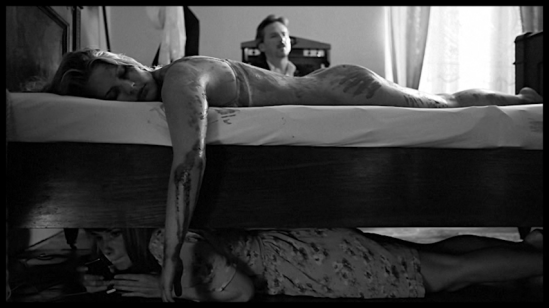
An absent Séverine wants to take a holiday away from her boyfriend Tom after she awakes from a dream where she has fallen in love with a man in a top open, white car. Frustrated and desperately in love with her, Tom agrees to a pact with a bar room stranger to stage a faux kidnapping of his lovely girlfriend and Tom would her hero, swooping in to rescue her from “evildoers” and hoping to rekindle her passion for him, but the Tom’s newfound stranger friend has a more devious agenda up his nicely tailored coat and white collared shirt sleeves; one that involves kidnapping young women to star in their snuff movie productions. When the plan begins the unravel and actual intentions are exposed, Séverine’s forced into a deadly cat-and-mouse game against unsympathetic sadists who have laid the prep work foundation into getting to know their victim and know every inch of her youthful body, but Séverine won’t submit without an unflinching, vicious fight as she trudges through areas of an old villa compound, looking for to escape or kill her captors.

If you search for a combination of the classic Hitchcockian style with a smidgen of cold blooded savagery, Mathieu Seiler’s “True Love Ways” would be at the top of the search result. The 2015 German, black and white thriller surpasses being a surprising sleeper film and goes directly into a notorious favorite category helmed by the Switzerland born director who integrates a complex lead character into an unfathomable story of selfishness, unscrupulous power, and sheer determination. Despite the sepia overlay, the colorful venomous of the characters explodes brilliantly, adding vim and vigor to a story that begins with a slow burn to quickly escalating in an anxiety-riddled and captivating narrative pivoting to one harrowing moment to the next. Seiler, who also wrote the script, blends a detailed art house thriller with feminist undertones that surface the severe ugliness in man whose either selfish with his needs, sexually deviant, or insecure. There’s even a case where Séverine’s father isn’t safe from being scrutinized. Séverine’s the strongest character in the bunch by overcoming one obstacle over another while managing each male driven situation with disregard and hostile improvisation.

Steering Séverine’s reactive and survivalist rampage is Berlin native Anna Hausburg. The then 25 year old actress embodies a major milestone in maturity for her physical performance. The entire film is driven by physicality, not dialogue, and Hausburg prove her grit and sexuality seemingly effortless. Hausburg is joined by Kai Michael Müller as Séverine’s unassertive husband Tom. Together, Hausburg and Müller couldn’t be more distant from each other while David C. Bunners interjects with a sly director of snuff film operations. Bunners has a modest performance, but if you accept it, let it sink in, you’ll experience his devilishly, rugged good looks and sophisticated business intelligences just ooze out into a white collar sleaze, perfectly suitable with Bunners’ method on his character. His production crew, played by Michael Greiling, Axel Hartwig, Beat Marti, and Marcel Schneider, are equally skeezy in a choreographic manner whom each have a role to play. Rounding out the cast is Christian Samuel Weber, Anja Margoni, Alina Sophia Wiegert, and Margarita Ruhl.

Seiler’s “True Love Ways” is open to many different interpretations. One that seems to bubble up over and over again in the analytical gear works is that could the entire ordeal, Séverine’s ordeal, be all a lie. Not just a single cell lie, but a couple of angles that undercut the linear option laid before the viewers. For instance, the first lie would be that the dark, heinous snuff producers are all in Séverine’s head. Too many coincidences from the specifics from her dreams to come true in such a manner and she always has this mysterious ailment, near the beginning, that’s never explicitly explained. Second lie would be is this Séverine embraces the darkness of her captors; is she herself unstable after the ordeal that the very sever boredom of regular life? The predictability of it all from her vivid dreams have turned her to seek the man who wants to exploit her and who “freed” her from the incompetent men in her life – Tom, her father, etc. Seiler’s abstract bookends shed light upon slithered clues that reveal potential possibilities of where Séverine’s stands as a hero or anti-hero lead character.

MVDVisual and Synergetic Distribution present “True Love Ways” onto home video DVD. Like the monochrome tone, the DVD cover is elegantly simple with blood covered Anna Hausburg, looking disheveled and holding a blood stained axe, standing in front of a white background encasing the 95 minute film. Presented in a 1.85:1 aspect ratio, the black and white appears absolutely timeless, especially with Mathieu Seiler’s directorial style. However, slight aliasing can be detected in fast paced scenes that liquify the detailing and there’s a bit of digital noise amongst the black objects, like the Old Villa door. The German 2.1 stereo has slightly lower fidelity, but has a still absolute and manageable to understand. There wasn’t really much to test for dialogue depth or range as the film progresses physically rather than with dialogue so many woodsy chase sequences, running through the Villa house, and cars speeding down an isolated road to which all ambient nicely enough. There are no extras included on this release. What starts out as a melodrama between a withering couple turns barbaric under a perennial style of filmmaking. “True Love Ways” provides two-tone carnage with some gore, some sexuality, and a lot of inhuman nature that signifies what’s great about this German indie picture with cascading undertones.
Evil Climbs the Cut-Throat Corporate Ladder! “Mayhem” review!

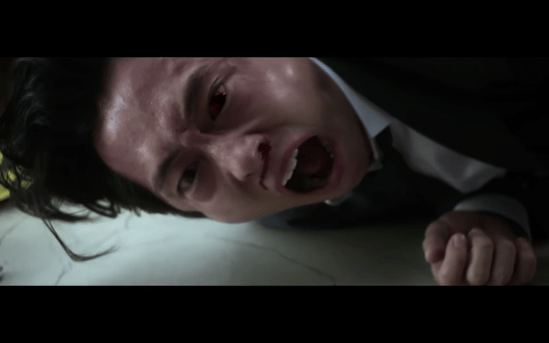
In a world under sieged from a highly contagious virus, known as the ID-7 virus, that blocks the uninhibited and explosive impulses, workaholic Derek Choe attempts to make a footprint at his ruthless, white collar firm, but lands on the receiving end of a frame job that results in a pink slip and being escorted out of the building. Before being able to walk through the exit by security, an ID-7 invasion as quarantined the office and symptoms are seeping to the surface. All hell breaks loose amongst co-workers, exacerbating the already highly caffeinated, extremely strung out, intensely coked up, and amoral aggressive behaviors of a volatile workplace environment, and an infected Choe aims to reach the top floor to violently express to the firm’s board on why they should reconsider his termination, but a drug-fueled, and also infected, boss strives to make that endeavor challenging with the assistance of his lower tiered, corporate suits.

“Mayhem” is a HR nightmare! The Joy Lynch 2017 directed action-horror film is “The Firm” meets “The Raid: Redemption!” Luckily for the viewers, “Mayhem” is a hardcore insight into unlocking all of your deepest, darkest inhibitions to the tun of explicitly telling off your boss with every four letter expletive in the book, giving your rotten colleague a firm piece of your mind, or just knocking everyone’s teeth down their smug throat. Yeah, it’s that kind of movie. Lynch (Wrong Turn 2: Dead End) runs with the first time feature film from screenwriter, Matias Caruso, who designs a virus, called the ID-7, that removes or ceases to function what defines us as human, from compassion to sympathy, in order to frankenstein a demented rendition of Donkey Kong and Caruso’s characters basically all have singular mode – asshole – but that subversive level stems from an infection induced state and the characters, deep down, maintain a slither of their original selves in an extremely dark comedic sense.

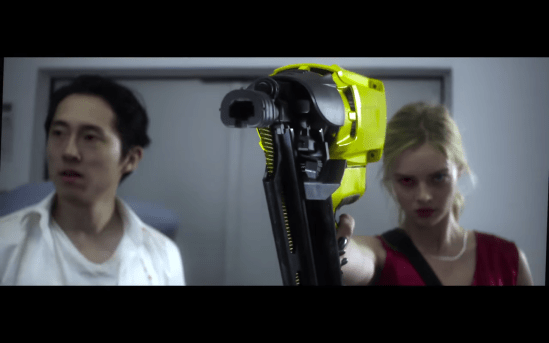
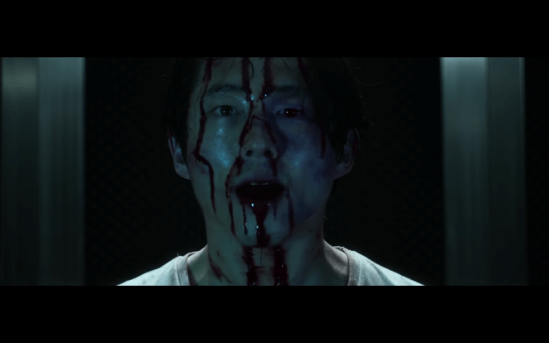
On the coattails of his character’s brutal demise on AMC’s “The Walking Dead,” Steven Yeun remains in an dimension plagued by a different kind of viral infection. Instead of blowing the brains out of walkers, Yeun brilliantly and entertainingly fills the ambitious workaholic shoes of account manager Derek Choe who literally battles his way to the top after being canned by his unscrupulous consulting firm and when the ID-7 overwhelms each and every employee. Choe is a far cry from Glenn on “The Walking Dead,” a pure hearted character with a good moral compass. Yeun’s character’s moral compass is skewed without doubt and double skewed with introduced by the virus. Choe forms an unlikely pact with a desperately disgruntled borrower Melanie Cross fighting against the firm, and the firm’s bank, looming foreclosure and the sassy, blond ass kicker, embraced by “The Babysitter’s” Samara Weaving, can chew gum and kick tail all at the same time. The pair are pitted against the some of the office’s most ruthless suits, such as a sociopathic HR enforcer known as The Reaper (played by “The Walking Dead” vet in Dallas Roberts), a manipulative snake charmer Cara Powell (Caroline Chikezie of “Æon Flux”) and at the top is none of than the big boss played by “Hellraiser: Revelations'” Steven Brand. Not only does “Mayhem” have colorful, well-scribed anchoring characters, but the supporting parts are just as well-quick-e-quipped too with Kerry Fox, Claire Dellamar, André Eriksen, and Mark Frost (“Faust”).

“Mayhem” relishes in the ferocity of that of a Mark Neveldine “Crank” franchise, but lacks a certain coherency untuned to seamlessly sustain the story to the end. Moments of purely poor editing don’t convey the full message intended, leaving much desired when considering the hero and heroine’s plight through the firm’s ruthless hierarchy to the top. These moments don’t make or break the story and are minuscule in portion size but are large enough to thwart going unnoticed. Another annoyance of how the story is told is the off screen violence. With a feature entitled “Mayhem,” by very definition states, “violent or damage disorder, chaos,” one would imagine that any and all violence would be in full display, showcased proudly and exhibited without ambivalence, and the beginning starts off energetic enough with an explosive scene of a conference room brawl involving the attendees in a all out melee, a half naked couple sexing right on the conference table, and ending the scene with a murderous gashing of one’s carotid artery. Narrating why these berserkers are killing and humping each other is Steven Yeun’s Derek Choe, setting up the ID-7 as the uninhibited virus. The violence that pursues goes into a hot or cold state where the latter involves off-screen violence, especially between Chikezie and Clarie Dellamar’s characters in a fight to the death between boss and assistant, but in a heated exchanges that had more girth in the dialogue, their actual bout screens over to Choe and Cross’ blank stare expressions and the determination of who bests who goes into a big question mark status.

RLJ Entertainment releases “Mayhem” onto various formats include a not rated DVD, Blu-ray, and streaming platforms. I am unable to comment or critique on the audio and video qualities of the film as I was provided a streaming link that didn’t include bonus material; instead, I’ll comment on how Lynch and the rest of filmmakers did a remarkable job constructing an ambiguous building structure along with the help of the two Stateside based production companies Royal Viking Entertainment and Circle of Confusion. Though the film was shot in Bulgaria, the location could have been right in downtown of your nearest city and that fairs in “Mayhem’s” success to establish anywhere as a victim to the virus or a workplace go array in the world. The next time you want to take a heavy duty Swingling stapler to you’re supervisor’s noggin for assigning to many TPS reports to you, check out “Mayhem” to instill that visceral courage and audacity to do so all the while being entertained by utter, unadulterated violence and violent thoughts and actions that usually spur underneath the breath of a common office environment.
Bite Sized Evil With a Real Bite! “Ghastlies” review!

Four sorority sisters embark on a isolated cabin vacation for an all girls’ weekend in the quiet woods. Through all the booze and the trips to the lakeside beach, Sloane, Abby, Margot, and Lulu reap the benefits of solitude and sisterhood and just when everything seems to be going delightfully swell, even when Sloane’s perverse boyfriend and his friend show up unexpectedly, trouble brews beneath their feet, under the leaf-riddled surface, when Abby unwittingly unleashes three space originated, pint-sized ghastly ghouls. As the miniature and ferocious creatures rip through unlucky victims, nobody knows how to stop, let alone escape, their woodland carnage, especially when they’re being aided and abetted by human caretakers.

In the filmmaking fashion of Brett Piper (“Queen Crab”) or Mike Lyddon (“First Man on Mars”), Brett Kelly offers his low-rent talents in construction an 80s-esque creature feature on a pygmy scale in more ways than one. The Ontario born director has helmed a vast amount of independent b-horror prior to, including such great titled credits as “The Bonesetter,” “Attack of the Jurassic Shark,” and “Raiders of the Lost Shark.” Now, released for the very first time on any format, anywhere, is “Ghastlies,” a “Gremlines” or “Critters” creature feature that aims to rain down terror when all hell breaks loose with ankle biters running around and while the low budget production or creature value doesn’t par with the more popular Joe Dante or Stephen Herek films, the heartfelt attempt in this modern day feature accomplishes the intended effect of a 1980’s horror comedy, complete with synthesized score and era correlating attired.

“Ghastlies'” lineup consists of Brett Kelly regulars such as Jessica Huether and Kendra Summerfield from “Raiders of the Lost Shark.” Huether’s and Summerfield’s performance as the nerdy, yet overall good girl Abby and the snobby, superficially rich bitch Lulu, instilling the yin and yang personas of the group, and their joined by Julie Mainville and Kim Valentine as the unforgettably clueless Margot and the sisterhood leader in Sloane. Mainville more memorable out of the four sisters as she has spot on timing and delivery with the witless and likable Margot. John Migliore, known more for slabbing on the prosthetics and makeup to be a zombie, has a minor costarring role as a dimwitted bike cop Officer Vinnie and Migliore, whose donned zombie wear in films like “Land of the Dead” and “Ninjas vs Monsters,” filled multi-faceted shoes for the Kelly film by dappling into the spaceship special effects and providing the Ghastlies puppetry. Migliore’s Officer Vinnie is paired with another similar goofy character in Peter Whittaker as Officer Frank as well as Joel Elliott “Countrycide,” Eric Deniverville, Stephanie Moran, and Kyle Martellacci who also co-star in the zany trope-ladened homage. As his first feature credit, Chris Bavota’s script creates no real dynamic between the characters who all pertain to a self-serving purpose under a guise of slapped together dialogue that’s no more substantial than a boulder in outer space.

And there in lies the rub. “Ghastlies” inability to click together to fulfill the allusion of was what-once-was is the film’s weakness. The cartoonish hand puppets, the implausible effects, and the technical inconsistencies can all be overlooked as campy charm, passed aside to enjoy “Ghastlies” for what it’s worth, but what can’t subside is the wonky connection between the cast that doesn’t favor well that’s diluted at the end by the starkly questionable and abrupt editing, resulting in a presumed unfinished film that seeks to either be an open ended invitation for a potential sequel, defined by one of the characters standing up with a makeshift mini-gun and garbed in Rambo-like gear, or a hasty cut that provides a lukewarm, satisfactory, and budget friendly finale that actually invokes more confusion than viewership appeasement. Shortly following the live-action wrap up, a short animated comedy, illustrated by the multitalented John Migliore, in the same vain as the quirky Looney Tunes but with Ghastlies.

The lovely, cuddly, and ghoulish “Ghastlies” is released onto DVD and Blu-ray combo from Camp Motion Pictures. Image quality for the Blu-ray format is by far stunning for a low-budget feature presented in 1080p encoded MPEG-4 AVC BD 25. The coloring naturally displays and even the darks had great depth without distortion or inconsistencies. The English Dolby Digital 2.0 is another story as, unlike the image quality, the presentation is inconsistent with imbalanced levels that make a few scenes difficult to comprehend. Clarity isn’t necessarily an issue with no blights on the tracks, but the technical placements could have been smoother. The electric score score by Tomb Dragomir, the composers first score ever, manages to engross and re-illuminate the decade that inspires “Ghastlies.” Bonus material includes a special effects interview with john Migliore’s helping hand into Ghastlies’ FX, Tomb Dragomir discusses his experience scoring his first feature, “Ghastlies'” music video, the trailer and Camp Motion Pictures’ trailers, and an audio commentary with director Brett Kelly. “Ghastlies” is part “Gremlins,” part Lovecraftian, and all borderline shlock-y fun, but the loose character interactions and out of kilter editing embargo the full bodied experience.
The Myth. The Legend. The Evil…. “Leatherface” review!

Texas 1955 – the pride of the Sawyer family was not their tattered farm, but a bloodline taste for something else – callous murder and a penchant for human flesh. Verna Sawyer sought to instill that pride into her children, especially her youngest, Jed, but when Hal Hartman, hard nose local Sheriff, learns that his daughter becomes victim of the Sawyer’s suspect nefarious carnage, he executes the law to his advantage, deeming the Sawyer house unfit for children and removes Jed from his labeled degenerate mother Verna. Ten years later, a group of teenage patients escape a mental hospital, kidnap a young nurse, and reek bloody havoc in their voyage to Mexico in an attempt to elude the very same lawman who put them away, but this time, Hartman isn’t adhering to the law, straying off his moral compass to pursue a vengeance mission against unprincipled youth that’s personally driven by Jed and the Sawyer family. Once the embattled Hartman catches up with his prey, a series of gruesome events lead to the creation and the construction of one of the most notorious killers Texas will ever see.

I love a good origin story. There’s something to be said about understanding the commencement of character, to be in the shoes of a long running icon, and to be able to sympathize with their story no matter how atrocious. Directors Alexandre Bustillo and Julien Maury’s 2017 “Leatherface” does just that with the film’s own origin enlightenment on how the chainsaw wielding, human skin mask wearing psychopath came to fruition inside a home of unspeakable brutality and influenced externally by a unforgiving society. From a script penned by Seth M. Sherwood, “Leatherface,” serving as a direct prequel to Tobe Hooper’s “The Texas Chain Saw Massacre,” briefly touches upon the preteen years to setup the catalytic road trip from hell, birthing a monster in a time of adolescence and if part of a legacy spanning over forty decades inspired by Ed Gein, the real life human skin wearing and notorious serial killer, then you damn well know “Leatherface” has to be genetically predisposed to be ultra-violent drenched in blood splatter. The French filmmaking duo, who’ve helmed 2007’s “Inside” and had directed the “Xylophone” segment in “The ABCs of Death 2,” nail the dark and gritty tone that not only breathes a gassy and exhaust fumed life into a massive flesh-ripping chainsaw, but also inflicts heartlessness across the story board into a heartfelt homage to the characters and to the story fathered by Kim Henkel and the late Tobe Hooper, both of whom were attached as executive producers.

Over the years, many actors have held the mammoth power-drive cutting tool in their hand that’s ready to chip away at flesh such as Andrew Bryniarski (“The Texas Chainsaw Massacre” 2003 remake), Bill Johnson (“The Texas Chainsaw Massacre 2”) and, most famously, Gunnar Hansen, the original Leatherface. However, I’m not going to divulge who the pubescent Leatherface is in the story because the film plays out as a who out of the group of degenerate teens is the son of Verna Sawyer, even though you can easily obtain the information in a simple click and search on Google. Instead, Sam Strike, James Bloor, and Sam Coleman portray the three escapees who are accompanied by an equally insane sociopath in Jessica Madsen and an eagerly novice kidnapped nurse by Vanessa Grasse. Amongst a sea of English actors are a pair of vets to shepherd the young cast and be the embattled bookends to the dawn of an icon. Lili Taylor (“The Haunting”) and Stephen Dorff (“Blade”) face off as Leatherface’s mother, Verna Sawyer, who butts horns with a longstanding sheriff, Hal Hartman, with a steadfast vendetta against the Sawyer family. Christopher Adamson (“Razor Blade Smile”), Nathan Cooper (“Day of the Dead: Bloodline”), and Finn Jones (“Wrong Turn 5: Bloodlines”) co-star.

Usually with a pair of directors, two different styles spawn to an end result. With Bustillo and Maury, styles merge into a seamless effort of elegant wonders. Each shot emerges a purpose to the story whether it’s painting an image of the Sawyer’s death house to pulling a one-eighty with characters, the filmmakers ability to combine each element into a single story, that has such a close knit cult following, and still manage to cinematically pull off the atmosphere, the grit, and the gory carnage of a Texas Chain Saw Massacre film is impressive. Cinematographer Antoine Sainer, whose worked previously with the directing duo on the “The ABCs of Death 2’s” segment “X,” has the ever so poised eye that’s able to well-round and solidify Leatherface’s terror tenor, particular exampled in a foot chase scene through a moonlit forest, smoke bellowing out of a growling chainsaw, and a tattered young girl bawling, screaming, and fleeing for her life from a deranged masked killer whose huffing, snarling, and growling during the pursuit.

Lionsgate Home Entertainment presents the Millennium Films produced “Leatherface” onto Blu-ray + Ultra-violet combo disc, a MPEG-4 AVC encoded disc with a 1080p resolution and presented in a widescreen, 2.38:1, aspect ratio that displays the Bulgaria landscape in a yellowish-brown, Texas-like backdrop. Details are noticeably fine that exquisitely reveal the death and destruction of the Sawyers and those who unfortunately surround the family. The English DTS-HD Master Audio 5.1 track evenly distributes and consistently a range of engrossing fidelity, ambient, and dialogue layers. Bonus material includes a play feature with an alternate ending that’s less superior in contrast to the final product, deleted scenes, and a behind-the-scenes making of that includes brief interviews with directors Alexandre Bustillo and Julien Maury, actors Sam Strike, Stephen Dorff, Lili Taylor, and others, and goes behind the scenes in creating the tone and style of “The Texas Chain Saw Massacre” while implementing their own vision. “Leatherface” forces the unsavory and unpleasant down the throats of TCM fans, jamming an attempt to exposition a futile chance to a destined maniac of cannibalistic proportions and manages to mix up the Tobe Hooper’s weathered franchise with a barbaric bruiser of a tale.