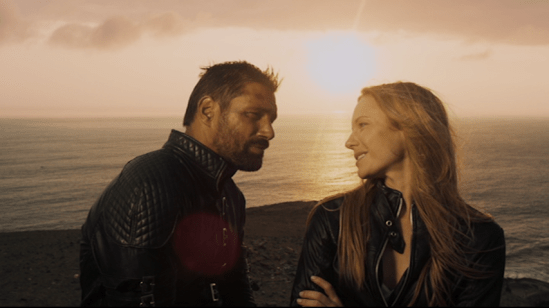
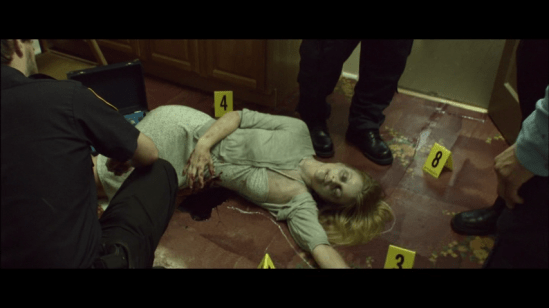
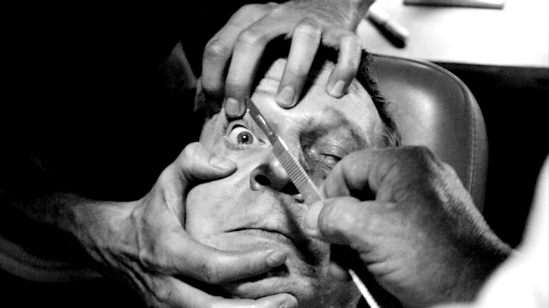
Daryll, a New York City night shift janitor and decorated Vietnam war veteran, becomes obsessed with beautiful female reporter and wealthy socialite Tony Sokolow. When Daryll claims to be a key witness to a murder of one his business building’s high profile tenants, a once in a lifetime opportunity opens up to meet Tony when she’s assigned to cover the murder and as Daryll pours his heart out to the reporter, he’s also torn by his claim that could place his war buddy friend Aldo, a hapless former employee of the recently deceased and the prime suspect in the murder investigation, in jeopardy even more. Is Aldo the killer or is the mystery much deeper, tied to a world unforeseen by Daryll whose working in the depths of the building’s janitorial confines?

Hot off from her success from Ridley Scott’s “Alien,” Sigourney Weaver goes from sci horror-thriller to mystery-thriller and alongside her is up and coming co-star William Hurt in Peter Yates’ 1981 mystery drama “Eyewitness.” The film sparks a string of obsession suspense features that would span a decade and firmly place the genre into a popular notoriety among audiences who couldn’t get enough of the peeping tom debauchery. A hefty roster of talented actors also co-star, some on the verge of stardom to the likes of Hurt and Weaver, including Christopher Plummer (“The Sound of Music”) in the prime of his career, the crazy eyes of James Woods (John Carpenter’s “Vampires”), an un-grayed Morgan Freeman (“Se7en”), Kenneth McMillan (“Dune”), “Mission: Impossible” television series’ Steven Hill, and Pamela Reed (“Kindergarten Cop”).

Performances all around are phenomenal as every actor and actress cultivates their character’s purpose in the story and you can surely experience the humble beginnings to some of the biggest A-list celebrities of today; however, Hurt’s performance was one of the only concerning factors. Hurt’s portraying a modest, perhaps slightly traumatized, Vietnam veteran with an afar obsession toward an attractive public figure and his presentation was overly awkward and certainly creepy too the point where I even felt embarrassed and uncomfortable. What made the situation more bizarre was the verbal and facial exchanges between Hurt and Weaver’s characters. Tony didn’t quite seem affected by the oozing creepiness this supposedly good man seeps from every pore of his skin and she, in fact, embraces his forward, if not crossing the line, affections that would certainly warrant a restraining order in today’s society. Maybe social interactions vary from generations and decades, but this type of relationship building dialogue and scenes didn’t produce the appropriate type of chemistry between Weaver and Hurt reducing the strength of their bond.

The Steve Tesich script strummed the strings reminiscent to my viewing experience of George A. Romero’s “Land of the Dead.” Yes, you read that correct – “Land of the Dead” – and what does this zombie horror film have in common with “Eyewitness?” Well, in the 2005 film about the continuous decline of humanity in a zombie apocalyptic world, Romero had written a social commentary about the separating of social classes where, even in a dying world, the rich stayed safe in their loft, sustaining an obsolete lifestyle, and the poor suffer below their feet living in the present, but in the end, anyone and everyone is fair game for being unprincipled and for the undead. Tesich’s script does the same without being lavishly upfront and without the hordes flesh eating zombies. Beneath the obvious murder mystery lies the merger of the classes as Dyrall and Tony eventually fall for each other, but their friends and family on either side condemn the relationship, making the statement numerous times that a janitor absolute can not fall for someone as wealthy as Tony. James Woods’ Aldo becomes just another example out of many where a court-martialed and discharged Marine with erratic behavior and struggling with living a middle class life becomes suspect number one in a murder case, but with a victim whose profession was international trading, the pockets might be a bit deeper and with a laundry list of ill-will individuals.

Signal One Entertainment releases “Eyewitness” in the UK for the first time on Hi-Def region B Blu-ray anywhere with a 1080p presentation in a widescreen 1.85:1 format. The video quality is far superior than, of course, it’s DVD revival with the restoration of much of the natural color tones without a hint of compression artefacts or obvious image or edging enhancements from the 35mm stock footage. The English LPCM audio 2.0 track is fair, full-bodied, and well balanced with really no issues, especially not with composer Stanley Silverman’s lively score. Signal One Entertainment certainly knows how to treat a classic film providing a slew of extra features including an audio commentary with director Peter Yates and film historian Marcus Hearn from 2005, an audio only conversation with the director along with film critic Derek Malcolm and another conversation with another film critic Quentin Faulk on a separate extra feature. Composer Stanley Silverman discusses his approach to scoring “Eyewitness” and there’s also an alternative VHS presentation of the film under one of the original titles “The Janitor.” Original trailers and TV spots round out this robust bonus feature cache. “Eyewitness” on Blu-ray is a must own with a clean and refreshing version of a this classic whodunit thriller from Signal One Entertainment!

Category Archives: Trailers
Decadent Evil Takes the Form of Two Blood-Sucking Lesbians! “Vampyres” review!

A dense English forest surrounding a decaying manor house sets as the hunting playground for a pair of seductive female vampires, Fran and Miriam, who have reigned a disconcerting terror through the area’s local inhabitants. When Fran lures and imprisons a touristing male as her bloodletting sexual hostage, Miriam believes Fran is diverging into a dangerous game of simply playing with her food for too long. Miriam proves to be right when a trio of campers stumble upon the vampires’ manor lair, causing a fair amount of distraction when the three friends attempt to uncover the secrets of the area and the myths of the house that will expose the true and terrifying nature of the two vampires. A mistake the three may wish they never would have made.

“Vampyres” is a Victor Matellano 2015 rendition of the 1974 José Ramón Larraz directed abundantly sensual, over sadomasochistic vampire film of the same title but also known as “Vampyres: Daughters of Darkness.” Matellano’s remake faithfully follows the original storyline and with the assistance of Larraz himself tacked on as a credited writer, Matellano was able to keenly hone in on the ambient tone and the graphic slaughtering display the story necessarily requires to quench it’s own thirst for blood. Let’s also not forget the sex, the sex, and the sex that absolutely sinks it’s teeth into of most scenes. Long time has passed since the rebirth of an erotic creature of the night; a plague of mindless ferocity has been the modern vampire. From “Blade” to “The Strain” to one of the more recent reviews of an independent film in “Black Water Vampire,” a dark cloud of a deformed and mutated species of bloodsuckers have been more popular with the masses. Matellano’s “Vampyres” is a love song to the erotic European vampire that’s powerfully seductive, classically gothic, and simply pure blooded with two fantastic femme fatales.

Underneath the dark and ominous cloaks are the beautifully succulent Marta Flich and Almudena León as blood fiend lovers Fran and Miriam. Flich and León have a combined total of 5 feature length films between them, including “Vampyres,” but where the duo lack in experience, Flich and León thrive with their onscreen chemistry that delivers an piercing intensity with a dynamic blend of softcore porn and tantalizing terror as if they’re real life lovers with a real life knack for killing. León has previously worked with Victor Matellano under the Spanish director’s prior horror film, 2014’s “Wax,” and their relationship growth comes whole with the addition of Marta Flich, a buxom brunette willing to savor every moment and put forth every effort into some extremely difficult scenes. No two women can make gore sexier than Flich and León.

Vampires Fran and Mirian heavily overshadow the remaining characters consisting of actors such as Verónica Polo, Anothony Rotsa, Victor Vidal, Christian Stamm, and Fele Martinez who, as a whole, do a fine job performing in this rekindled niche of horror. To add a bit of flare and to help “Vampyres” stick out from above other remakes involving an slew of unknown faces, “Dracula A.D. 1972” and Captain Kronos – Vampire Hunter’s” Caroline Munro and “Tombs of the Blind Dead’s” Lone Fleming have more than cameo appearances, providing familiar genre faces fans know and are attached to when riding along the reminiscing train from the era of which this film’s story is birthed. Munro and Fleming are also accompanied by other genre vets including “Zombie Lake’s” Antonio Mayans, Concrado San Martín from “The Awful Dr. Orlof,” and Hilda Fuchs and the late May Heatherly from 1980’s “Pieces.”

Visually, “Vampyres” dotes as cinematography worthiness in being a European inspired film from a Spanish production by not being flashy but rather grim and simple. Using elementary special effect techniques, “Matellano” doesn’t cheapen an already intentional trashy vampire schlock film with story stiffening CGI; instead, buckets of blood and practical effects elevate the aspiration toward the resemblance of a 1970’s inspired story complete with broken English performances. Set locations are purposefully vanilla, including a plain small bedroom with white sheets overtop a simple bed frame, a bleak forest inhabited with thin trees, and an isolated manor with middle life bones standing lifeless in the woods, and with key shots staged with vivid conventional colors, such as the bathtub scene that’s feels very clean even with the amount of blood used, and the cellar finale that’s very subtle in it’s background even if it’s the root motivation for the vampires.

“Vampyres” is one of the best remakes there is, there ever was, and there ever will be by staying faithful to the Larraz’s original film and Artsploitation Films should be basking in the fresh, warm blood of their latest and greatest release. José Ignacio Arrufat’s brooding score seizes to snare the soul from the well balanced Dolby Digital English 5.1 Surround Sound mix laid over a 2.35:1 anamorphic widescreen presentation. With a slight tilt toward a darker variation on the grayscale, the overall picture is clean and unhindered and even though stark colors don’t run throughout, the bland coloring provides richer qualities toward a excellent homage. One thing is for sure, blood red is the only vivid hue here. Bonus features include an Interview with Caroline Munro, a making of the “Vampyres,” and trailer reels of Artsploitation Films films. The modern masses can have their disease-ridden vampire genres for the very fact that director Victor Matellano’s “Vampyres” entices with an alluring butchery based on fundamental foundations of European horror values and endearment, resurrecting the erotic vampire once again!
Evil’s Calling… “Cell” review!

Clay Riddell just landed in Boston after scoring a huge deal in New York involving concepts for his graphic novel. With all the cellphone charging stations occupied, Clay calls his estranged wife from a pay phone to speak with his son, but when the landline severs communications, that’s when it started. People on their cellphones turn into Phoners, murderous maniacs who tear through anyone in a destructive path mindless insanity. Clay, in the midst of panic, bumps into subway train conductor Tom McCourt and fight their way out of the city, barely escaping with their lives. Fleeing a burning Boston overran by Phoners, Clay is determined to track down his family in New Hampshire with the help of Tom and two teens, Alice and Jordan, but the Phoners are not just absentminded anymore as individuals start to flock together exhibiting the beginning signs of their telepathic network lending to something far more sinister than just temporary mayhem.

“Cell” is the feature film adaptation to Stephen King’s novel of the same title and reunites John Cusack with Samuel L. Jackson once again since their last costarring venture of King’s book-to-silver screen production of “1408.” King shares screenplay credits with Adam Alleca, who co-penned “The Last House on the Left” remake in 2009, and with “Paranormal Activity 2” director Tod Williams at the helm. From the first inkling of a “Cell” movie, back with Eli Roth was attached, the excitement couldn’t be contained as I read the Stephen King novel and was captivated by the unique story of mixed and varied human emotions and the uncontrollable yearnings to be a part of the collective through being electronically connected that ultimately becomes mankind’s undoing.

However, “Cell” was heading in the direction of certain doom from the moment Roth unattached himself from the project, sending “Cell” into the annoyance of limbo until a production company conglomerate formed to pull “Cell” from it’s stagnant state and attached Williams to direct. Yet once again, King’s beloved story goes into the throes of uncertainty with distribution after filming wraps in 2013. 2016 comes and Saban Films, along with Lionsgate , distributes “Cell” theatrically and within the home entertainment market respectively.

After all the monumental problems, I personally wanted to “Cell” to be one of the most entertaining and frightening horror films of the modern age, but as fate would have it, the Williams’ film disappoints. An film adaptation of a King novel needs more minutes to cover the story’s girth and “Cell” lacked pages of warranted minutes to be a full tell all for Clay, Tom, and the Raggedy Man. Portions of the novel were translated to the screen, but for the majority of the film, a rushed version of the story debuts to silver screen audiences that loses the book’s essence and dilutes character development, such as with Raggedy Man who has a sizable role in the book, but the character in Williams’ movie barely scratches the surface with being just a figurehead for the Phoners and not the collective’s soap box looming leader. The film started out great with intense chaos at Boston airport, pictorializing to life the Phoners from the King’s book with pinpoint precision, but from there on, the story’s time span goes vague whereas the book stretches out the length of time. Only a matter of two or three days does it seem the survivors jump from Boston, to the school, to the bar, to the story’s final location of Kashwak, but in reality terms and in the amount of devastation and character portrayal, weeks have passed.

The ending has been rewritten from a surprisingly mixed reaction to the book’s and yet, the unravelling of the finale does more than convolute matters when Clay finds his son. There lies almost a dual ending where one’s interpretation can be the film’s own storybook ending. Stephen King’s “The Mist” had an ending that, when compared to Frank Darabont’s totally new ending for the film, was totally inferior to Darabont’s and I feel like that’s the stage that was trying to bet revisited here with “Cell” and it just missed the mark completely. Not all changes are for the worst. Character Tom McCourt, whose white in book, went to Samuel L. Jackson who absolutely fits the role without question, nailing PTSD stricken McCourt with little emotion but with untapped hurt. If I ever had to choose an middle aged white actor for the role of Clay, John Cusack would be my first and only choice even before casting began for the film. I do feel like having a white Raggedy Man was purposefully steered away from social sensitivities with an antagonistic young black male in a hoodie. The cast rounds out with Isabelle Fuhrman, Owen Teague, and Stacy Keach (“Slave of the Cannibal God”).

The digital visual effects were so poorly constructed and composited that I’m not surprised “Cell” didn’t have a longer theatrical run. The book had a number of jaw-dropping visuals the imagination could run with and now with seeing the depictions of those visuals on screen, they seemed seriously slapped together in such haste to where the devastating sensationalism turns inane and bland. King’s apocalyptic story warrants Hollywood scale effects, but received a few levels below that bar, failing to deliver major catastrophe on a world ending scale to the likes of “War World Z” or to cleverly style the film through a smaller medium such as George Romero accomplished with this first three “Living Dead” films.

Lionsgate’s Blu-ray release is presented in widescreen 2.40:1 aspect ratio and the 1080p Hi-Def resolution becomes a disadvantage that clearly outlines the quality of the effects. The English 5.1 DTS-HD master audio is par for the course, but slightly in-and-out with dialogue that’s difficult to balance. The 98 minute feature’s bonus features includes an director’s commentary and “To Cell and Back: The Making of the Film” which is redundant if you’ve read the novel. Bottom line is if you’re fan of Stephen King’s novel, you’ll be sorely disappointed with Tod Williams’ “Cell” that’s nothing more than a long awaited entertaining rated-R apocalyptic horror with obsolete effects and with star-studded names attached to this Stephen King story adaptation.
Canada’s Evilest Alien Movie…Ever! “Phobe” review!

Sergeant Gregory Dapp, A lone wolf space cop, travels lightyears to Earth, ordered to hunt down and capture one of the universe’s deadliest and sought-to-extinction creatures, simply called a Phobe, before the extraterrestrial being reproduces on a massive, world obliterating scale. This particular species has wiped out all of Drapp’s special Phobe hunt and destroy unit and were thought to have been blotted out off the face of his planet until one lands on Earth. Drapp must team up with Jennifer, a local high school girl caught in the middle, to help capture the Phobe before spreading it’s seed for world domination.

“Phobe: The Xenophobic Experiments” is an extremely ambitious sci-fi action film from Canada. Directed by Niagara, Ontario filmmaker Erica Benedikty, the 1994 film had a ultra-micro-budget of only $250 to cast a two-world, space odyssey complete with light-saber action and a behemoth amount of laser fodder. Being a slave to nearly no financial backing, “Phobe” had to manage without shame and roll with the flawed punches and, somehow, obtained popularity when broadcasted at a television station with which Benedikty was associated even when the film had to be diluted down to PG content. Fast forward 22-years later, Intervision Picture Corp. releases the aspiring director’s DIY fantastical vision in a glorious and plentiful remastered DVD edition.

The Benedikty written and directed alien action feature pulls inspiration from many admired blockbuster sci-fi films including some potent familiarities, such as a revamped form of the alien from “Predator” who stalks with heat vision and blends in with camouflage or the dazzling lightsaber duels from the epic saga that is “Star Wars,” creating an endearing homage from a knowledgeable science fiction enthusiast with a dedicated cast and crew during a year long shoot. The Ontario filmmaker scribes her hero as not necessarily the hunter, but as the hunted because as soon as Dapp lands his ship and saves Jennifer’s life from a Phobe laser (a roman candle blast), Dapp and Jennifer spend the entire night on the run, never challenging the being until forced to do so and the structure harps upon a plot similar to “The Terminator” with a “Battlestar Galatica” villain presence.

Rostered completely with unknown local actors, John Rubick stars as the mullet sporting, Phobe asskicker Sgt. Gregory Dapp who bolts into light speed with a very John Belushi appeal set upon the shoulders of a calm and candid Rubick demeanor throughout the entire Phobe capturing and Phobe egg destroying ordeal. Dapp’s semi quasi love interest Jennifer, Tina Dimoulin, blankly unconditionally follows Dapp into certain utmost danger. The Dapp and Dumoulin combo are Earth’s last hope against the Merv Wrighton’s portrayal of an invading, combat-ready, ultimate killing machine species. Wrighton’s tall and broad shoulder stature ideally constructs an intimidating antagonist being ultimately unraveled by a very inanimate casted mask with no texture or any kind of cosmetic makeup whatsoever and that highly resembles a toothless ivoried skull.

“Phobe” won’t be palatable to every sci-fi devotee’s intergalactic taste. Only a microscopic niche fan base will greatly appreciate the tongue-in-cheek fashioned computerized imagery, the depth scale modeling, and the automaton deadpan acting that establishes “Phobe” as cult material and Severin’s InterVision Picture Corp. label does right by this small time Canadian film by remastering the original video elements and supplementing the DVD with a vast amount of bonus material. The video quality presented in a full frame 1.33:1 aspect ratio is as good as it’s going to get with the inconsistencies of magnetic tape from a camcorder as the darker scenes are, at times, hard to visually construct because of the digital noise, but the Dolby Digital 2.0 stereo audio quality is quite balanced and clear. The laundry list of bonus material includes an audio commentary from writer-director Erica Benedikty, the first feature film from Benedikty “Back in Black,” “The Making of Phobe,” Q&A with cast and crew, original FX shots from the 1995 broadcast version of “Phobe,” outtakes, and “Phobe” theme performed by Gribble Hell. Whew, that’s a lot of extras. To sum up the experience, “Phobe” is campy sci-fi schlock with stellar intentions and with tons of heart made of grenade tomatoes (this reference will make sense once you see the film) all while breaking the DIY mold.

Get Caught In Evil’s “Flytrap” review!
Newly hired UCLA astronomy professor James Pond becomes mixed up with peculiar behaving individuals when his car breaks down in a quiet suburban neighborhood. Held hostage in a small house, James reluctantly follows orders from an automaton man named Gilligan involved with a unusual plan for James to reproduce with the lovely Mary Ann. James’ ensnarement feel like a gag at first until he awakes bound to a bed and strapped with a shock collar; the once thought innocent fling with Mary Ann has taken a turn for the worse when he the realization that the whole human race could be in jeopardy. James becomes captivated by Mary Ann’s innocence, naivety, and beauty making his attempts to escape more difficult without her, but if he decides to stay, a ominous question mark will determine his fate.

“Flytrap” is a micro sci-fi thriller production written-directed by 1995’s “The Mangler” screenwriter Stephen David Brooks and stars television series “Salem” Jeremy Crutchley as Jimmy Pond, Austrian born Ina-Alice Kopp as Mary Ann in ambivalence, and Jonah Blechman as the emotionless Gilligan. From the get-go, “Flytrap” slowly builds a momentum, but never really gains the full steam while revolving around Jimmy Pond’s detainee state. Ambiguity plagues the story with many unanswered questions, leaving more for the audiences’ imagination rather than to the exposition and that begs the question whether everything that did happen to the astronomer happened in reality or in just in his mind? For example, the voice in the air condition duct stays anonymous until, maybe or maybe not, the end and, perhaps instead, that was all just Jimmy’s subconscious informing him of his rational side opposed to what his heart desires such as, for instance, Mary Ann is not who she seems. Is Jimmy that much wrapped up in his paranoia?

If you didn’t notice from the film’s synopsis, references from “Gilligan’s Island” are abundantly staged throughout, especially with the character names. Jason Duplissea has a minor role as the Skipper for only a brief moment and we never see Duplissea grace the screen with his presence again. Besides, Duplissea didn’t resemble his television show namesake as the others. Other pop culture references, such as Alfred Hitchcock, MTV’s Punk’d, and various others, are mentioned but the conveying of these felt as if the film didn’t have a single original thought starting with their characters, especially with the hip English astronomer and his vast knowledge of American and British pop culture. Yes, Jimmy Pond was struggling to humanize his captors, who supposedly hail from the planet Venus, with bad dancing, some romance, and an unquenchable yearning to be free, but the intention comes across technically clunky, delivered with no substantial soul. Other technicalities fair far better with great lighting to create an inauspicious atmosphere. Combine that with some solid performances from Jeremy Crutchley, Ina-Alice Kopp, and a frightening mechanical Jonah Blechman and the situation turns hopelessly weird.

Aside from Jason Duplissea making little less than a cameo, other characters quickly pop in and pop out of the story. Billy “Sly” Williams involvement lacked girth when his character Rondell sits rather very patiently through the weekend, waiting for Jimmy to call or pickup his cell. There’s no motivation other than sit and wait and call the police where the inept police department uses a machine instructs to leave a message of a crime being committed. When Rondell finally has the opportunity to do big things in order to assist Jimmy, another moment is zapped away without a trace. Like Williams, Jonathan Erickson Eisley’s Azarias had a brief scene shunted even more quickly away once introduced chained tightly bound in the house’s basement and at that precise moment, a window of opportunity cracks open to help clear up the baffling enigmas giving much puzzlement to Venus’s plan to take over or destroy mankind. Given his incarceration, we can assume Azarias is Jimmy’s equal, a previous captive with a failed outcome. Omit Williams and Eisley roles and the Brooks’s film prospers into comprehension that much more.

“Flytrap” is a festival winner – “Best Non-European Indie Feature at the European Independent Film Festival in France, Best Low Budget Feature at Worldfest Houston, Special Jury Prize at the Chelsea Film Festival as well as Best Feature, Best Supporting Actor (Jonah Blechman) and Best Ensemble at the Los Angeles Independent Film Festival” – but falls to captivate and entertain even if chocked full of shadowy undertones of paranoia and loneliness. Pond, Jimmy Pond – a Bond reference “Flytrap” also made – needed more development to sauté an emotionally motley character until he’s well burnt to an cracked crisp. There will be no critiques on the audio and video as the disc provided was a screener. Check this psychological sci-fi thriller on digital HD through Amazon Instant Video, Vudu, and iTunes.