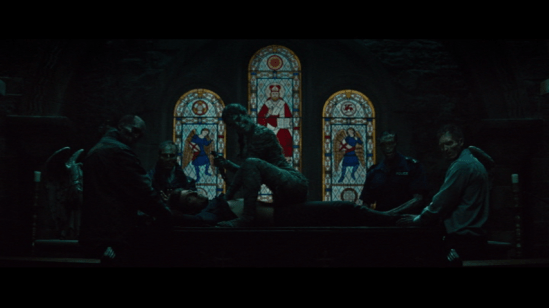
In 1968, former Nazi occult officer, Samuel Sears, runs a strict farm in rural America, restricting his only daughter Alice from the corruption of the outside world with an infinite workload, and Alice violently rebels against her tyrannical father, Samuel kills her with rage. Hidden deep in the dark basement of his plantation home, a powerful Nazi-occupied amulet, charged by fear and hate, feed on his rage and fear and curses him to do the unspeakable. In the present day, four college girlfriends retreat to a friend of the family’s recently purchased foreclosure farm house, the abandoned and forgotten Sears farm, for a relaxing weekend getaway, but after night of drinks and games, the amulet reignites an ominous and dark cloud, reviving long forgotten, evil spirits who search for an endless quantity of fear and hate and will stop at nothing to swallow the souls of each and everyone inside the Sears’ estate home.

“The Hatred” is the 2017 haunting thriller from writer-director and Brooklyn native Michael Kehoe and produced by long time “Halloween” franchise producer Malek Akkad. Kehoe tells the story in two parts with the first delving in the Sears family, getting a first hand look at the hardworking German mennonite character that is Samuel Sears whose a former war time Nazi that’s settled down and raised a family in America’s backcountry. From what can be gathered about Samuel Sears, the farmer protects his past identity and isn’t ashamed of yet, but rather proud of his accomplishments alongside the Führer. All of the attributes of a proud countryman come suddenly alive when he receives a mysterious package containing the amulet, a photo of him in full Nazi dress standing with Adolf Hitler, and a signed letter personally acknowledged by the Nazi leader himself offering him the amulet as a gift for his fine work during the War and that ultimately becomes his downfall, pitting him against his family. The second part of the film tells a more uncharismatic story of four young girls staying at the Sears farm in present day. One of the girls, Regan, just finished college and is about to start a new job and what’s her ideal getaway with her girlfriends? An old (haunted) farmhouse.

“Wishmaster” himself, Andrew Divoff, gives “The Hatred” much more life despite his joyless character Samuel by somehow giving the former Nazi, now American farmer personality traits that are haunting in an unforgettable performance during the first act. The same can not be said about the four girls – Regan (Sarah Davenport), Layan (Gabrielle Bourne), Samantha (Bayley Corman), and Betaine (Alisha Wainwright). There’s no comparison as Samuel is a superiorly written and finely performed character than those he stalks beyond the afterlife. The gaggle of women offer no substance in the face of adversity or just plain ole progression of their character. Numerous times does Regan’s sick grandmother have scenes and Regan passively forgets about her poor grandmother’s health or Samantha’s uncanny interesting in history that really goes no further than the random facts that she spews. Regan and Betaine seem to have this close knit relationship, yet it founders and is suddenly cut short when all hell breaks loose. There are no personal connections established, offering little-to-no worth to their lives when Samuel comes calling for their souls, and leaves “The Hatred” in the take-it or leave-it column in the second and third act. Darby Walker, Nina Siemaszko, and Shae Smolik complete the cast.

Kehoe does display intense, nail-biting visuals with the materialized embodiment of fear and hate as well as sly editing with a scene involving Shae Smolik’s Irene, a little girl whose friends with Regan, who asks Regan to check under her bed, for supposed shadowy figure. When Regan pulls back the skirt to look, she sees another Irene putting a finger to her mouth, hushing Regan, and saying, “that’s not me,” as she points upward toward Regan’s impending doom. The heart-stopping moment will tear eyes away from the screen in anticipation of what Regan will see atop of Irene’s bed. However, that’s the sad truth in the extent of Kehoe’s story; a story riddled with plot holes and underdeveloped subtexts in which one in particular pertains to the aforementioned subplot of Regan’s ill stricken grandmother that goes undercooked when attempted to connect with the supernatural portal that of the Sears farm home. Characters disappear to never be seen again, character motivations go unexplained, and backstories are like a hazy dream and the entire ensemble is a mismatched, muddled mess in a premise that should have continued with the motif of the Nazi infiltration into America and less about scaring the wit out of witless girls with the creepiness of an alternate dimension seeping out of an unholy amulet.

The Lionsgate Films’ “The Hatred” is presented by Anchor Bay Entertainment on Blu-ray and UltraViolet home video in a 2.40:1 aspect ratio from an encoded AVC 1080p transfer that’s sleek and well lit, especially capture Samuel’s earthly and grim nature. The overall atmosphere doesn’t particular hone in a horror palette design, but offers realistic ventures into brightly lit areas of dark scenes. Details are fine in more of the natural aspects of the film whereas the CGI goes soft at times, but still very well detailed. The English language Dolby TrueHD 5.1 keeps Kehoe’s film buoyant with a leveled mix through and through with clear fidelity and good, if not great, surround sound output. Instilled with conventional horror schemes, burdened with design flaws, and unfocused in it’s inability to pin down an narrative identity, Malek Akkad and Michael Kehoe’s spook house feature “The Hatred” requires much tender loving care to uplift this unkempt cliche horror into a coherent thriller.
Evil Gets Trashy in this Giallo-Inspired Mystery! “Three Tears on Bloodstained Flesh” review!

Before being butchered in the woods of a small town, a frightened young woman, Lexie, sends her estranged Uncle Dominic a letter desperately asking for his help. Plagued by his own dark past and a penchant for being hot tempered, Dominic drags his wild, coked up daughter Kendall to his quaint home town which he had long ago abandoned. Most town folk don’t want Dominic snooping around, investigating a town that faces a sinister murder spree under the unmotivated supervision of a perversive and power hungry eye of the local sheriff. Dominic’s anger rages on, fueled by sheer vengeance, as he searches answers for the cause of his niece’s untimely and gruesome death in which three strips of her flesh were torn from her bloodstained thigh, but the closer he gets to the unbearable truth, those closest to him are swallowed by the town’s harboring unimaginable secret and that’s when Dominic’s true violent calling becomes unleashed upon the unsuspecting locals.

Self-described as a “modern, Midwesternized spin on the Giallo,” Jakob Bilinski’s “Three Tears on Bloodstained Flesh” is the writer-director’s comprehensive ode to the multifaceted cult genre. Set on location in Evansville, Indiana, Bilinski unapologetically implores an outrageous white trash horror story that can drop just as many F-bombs and be just as sadistically crude as any Rob Zombie production, but on an indie budget. A budget with unlimited constraints when pinpointing a genre identity as “Three Tears on Bloodstained Flesh” has the word play of a Giallo-like inspired title, even accompanied with masked antagonist armed with a switchblade in a complex plot, but also sharply pivots and dabbles heavily in subgenres such as the revenge thriller, the occult, and torture porn that engages a plot twist, after plot twist, after plot twist up until the very end.

Bill Gobin stars as Dominic and Gobin’s appearance and actions channel very similarly that of Michael Chiklis’ Vic Mackey from F/X’s hit cop drama “The Shield,” but with an important piece of Dominic missing to fully sell the performance. Dominic’s tender melancholy moments of his lost Lexie are to bring out the human side in a cold and stern tough guy, but Gobin lacks that rightful emotion, replacing the tearjerking moments with more of the icy blank stare used in just about ever other scene and to the point where Gobin just might smack his tears back into his tear ducts. Kendall (Kayla Crance) is the constant bittersweet thorn in Dominic’s life as the father and daughter are more like father versus daughter. Crance challenges Gobin very well, even overpowering him in select scenes, protruding a defiant brat without an inkling of remorse until bodies start to really pile high. While Dominic and Kendall are certainly scribed as emotionless mavericks, Stella (Angela Steel) brings us down to a more sensible and realistic character who grieves for her slain daughter with alcohol and depression while also rekindling a once extinguished flame in a surprising twist of events. The best character performance overall goes to Jim Dougherty as the local sheriff who can stand toe-to-toe with Dominic and spitfire insults between Dominic and Sheriff Rex scribed very well for the Indiana University studied actor. Rounding out the cast is Scott Ganyo, Rosalind Rubin, and Grant Niezgodski.

Perhaps a little too ambitious trying to compact a endless frontier, Grand Theft Auto world story into over two hours, clocking in at 142 minute runtime, that feels every minute of it. There’s, perhaps, too much going on here with the potluck genres and plot twists that once the apex of the story has finally been reached, the first acts take on a whole different significance that doesn’t build to the necessary resulting finale that ultimate defines Dominic who, in the beginning, starts off strong, a tough guy who doesn’t take crap from anyone and that’s including his rebellious daughter Kendall, but then flounders just after reaching the small town, interacting passively with his sister Stella and a few townies, to the point where Dominic is just an inquisitive visitor. Dominic’s purpose is the push, push, push the town folk into giving the answers he seeks, like Porter tracking down his share of the stolen money in “Payback;” instead, Dominic’s is the one being pushed to the point of breaking and, finally, then do we see the Dominic’s dark side and his particular skill set in torture and manipulation.

Unearthed Films and MVDVisual presents a not rated 2-disc DVD collector’s edition of Jakob Bilinski’s “Three Tears on Bloodstained Flesh.” The 2014 Cinephreak production is display in widescreen, 1.78:1 aspect ratio, and the image quality above par with a clean picture composited with natural color tones and colorful filters to give some Giallo cinematography charm. The CGI bloodsplatter near the end is, well, CGI, but the run of the scene is fun and brutal that the generated pseudo-blood is used appropriately. The Dolby Digital 5.1 dishes out a well-balanced concoction of ambiance, soundtrack, and dialogue, with the dialogue being clean and clear even during more intense moments. Disc one contains the feature film with option audio commentary by writer-director Jakob Bilinksi and star-producer Bill Gobin. There’s also commentary by Cinematographer DP Bonnell along with Bilinski on the track. Disc two contains even more with a making of piece entitled “Peeling Back the Flesh,” 21 deleted and extended scenes, a gag reel, auditions, and Unearthed Films trailers. Under a stellar presentation within the plentiful content of a 2-disc set from Unearthed Films and MVDVisual, “Three Tears on Bloodstained Flesh” is certainly a “modern, Midwesternized spin on Giallo,” plus much, much more when considering the other genres that might have diluted the foul-mouthed scripted story and left the focus more fuddled, but happens to maintain a fun, semi-gory approach that can’t be argued.
The Bromfield Family are Dysfunctionally Evil! “Night of the Scorpion” review!

Millionaire Oliver Bromfield’s drinking problem perhaps cost the life of his estranged wife Helen. Unable to bear the tremendous guilt, the now sober Oliver vacates his family’s mansion, leaving behind a widowed stepmother Sara who lusts after her step son Oliver and his lesbian sister Jenny whose love affair with Helen drove Oliver mad with jealously. Oliver returns with a newly eloped and young wife Ruth, immersing her into the peculiar and mischievous family who each carry a bulging enigmatic complexity about Oliver bringing home a new wife on the anniversary of Helen’s death and as Sara continues to seduce Oliver and Jenny still simmering over Helen’s untimely death, a sinister plot to murder Ruth emerges. The body count rises with a killer on the loose and everyone becomes a prime suspect inside the eerie Bromfield home that’s isolated from the rest of the neighboring village.

“Night of the Scorpion” aka “La casa de las muertas vivientes” is a 1972 Spanish Giallo film written and directed from long time spaghetti western filmmaker Alfonso Balcázar under the pseudo name of Al Bagram. The suspenseful mystery thriller was produced Balcázar own production company and collaboratively produced in conjunction with an Italian production compnay to give it that authentic Italian Giallo flare, but maintains a native Spanish cast and still maintains the element of the Spanish horror era of the 1970s. The simplicity of “Night of the Scorpion,” by not building too many suspect into the riddling web of suspicion, keeps a tight knit storyline and keeps focus on the characters confined to the Bromfield property and the casual pace of the story builds exposition, delving continuously into the background of Olive and Helen, Helen and Jenny, and Sara and Oliver, a love triangle built upon uncompromising guilt, lust, and desire.

José Antonio Amor stars in the biggest role of his career as the wealthy recovering alcoholic Oliver Bromfield and he’s paired with the lovely Daniela Giordano (“The Inquisition”) as his new wife. Together, Amor and the former Miss Italia winner are a night and day couple on screen with Oliver’s troubled grasp with reality as he’s plagued with visions of his late wife’s death and Giordano, as a Ruth on the verge of a nervous breakdown, offers a rational approach to in the midst of being introduced to new family members Sarah (Nuria Torray of the werewolf thriller “El bosque del lobo”) and Jenny (“The Feast of Satan’s” Teresa Gimpera). The tension fabricated by Amor, Torray, and Gimpera is inauspicious and thick with an uncomfortable dynamic between Sara and Oliver in a show of will power and determination that adds to the psychological terror on not only Oliver, but also on Ruth who witnesses first hands Sara’s desiring eyes for her stepson. Jenny’s attached attitude to her brother’s life provides a mysterious wonder about her; her year long depression bares an underlining grudge that Gimpera displays so very well with a blank, nihilistic facading expression.

As aforementioned, “Night of the Scorpion” is a simple Gothic tale of a puzzling murder mystery and with that as such, under the guise of a fair amount of good thespian performances, the weak point for Balcázar’s film is the effects. In true Giallo fashion, only the killer’s gloved hand and gleaming blade arise into frame to bring a razor sharp steel from ear-to-ear on flesh. The first kill was remarkable with a very believable thrust and penetrate into the neck followed with a right to left motion across the unsuspecting victim. Proceeding kills bore the obvious lack of effort with the flat side of the blade up and a blood emerging at more of a smear than a seep through the layers of open skin. However, that’s the extent of the effects on a very low body count due to the very limited character roster.

Dorado Films presents for the first time on full 1080p high definition, all-region Blu-ray of “Night of the Scorpion” fully uncut and uncensored, despite Nuria Torray’s noticeably catered body double intercuts into the romantic moments with Oliver. Gioia Desideri, as Helen in the flashbacks, make up for Torray’s lack of skin with her own topless scene. In cut Spanish version of the film, Desideri’s topless scene is completely cut along with Torray’s body double because of the nudity ban during the 1970s, making Dorado Films’ uncut “Night of the Scorpion” an automatic must own export version. The rare-euro film distributor scans the 35mm negative to 4k and exhibits in a widescreen 2.35:1 aspect ratio. The negative is relatively clean with minor grain and little-to-no damage, but the coloring offers more of a sepia tone and there’s some noticeable overexposure to perhaps lighten up darker scenes suggesting that touch ups were done at a minimum. The Blu-ray back cover notes, due to fan requests, no digital restorations were made. The dubbed English 2.0 track has a bit of hissing in the dialogue and the soundtrack lacks range, but still a pretty good mix for the transfer with optional English, Spanish, and Italian subtitles available. The bonus material includes an audio commentary with Giallo expert Troy Howarth, author of “So Deadly, So Perverse: 50 Years of Italian Giallo Films” and 53 minutes of Spanish film trailers. Overall, Dorado Films provided a faithful version of “Night of the Scorpion” which the Spaniards, to my knowledge, have not had the pleasure of viewing and in a modern time of plot twists and intricate premises, the Alfonso Balcázar written and directed Giallo is a refreshing blast from the past, embodying a rich palette of Gothicism and noir.
Dark Universe Resurrects an Ancient Evil! “The Mummy” (2017) review!

Entombed under the volatile sands of what’s now the Iraqi dessert, an ancient Egyptian princess Ahmanet, who made a pact with an evil God named Set, lies and waits for more than 500 years to rise again and fulfill a destined promise to birth hell on Earth and rule the world. Ahmanet resurrects after being mistakenly unearthed by loose cannon treasure seeker Nick Morton and curses a reign of archaic terror over Nick and all of modern day London in search for a gem cladded dagger to make good on her pact. With the help of a well-funded secret organization called Prodigium ran by mysterious physician Dr. Henry Jekyll, and skillful researcher Jenny Halsey, the cursed Nick will need all the help he can muster to save himself and humanity from a mummified, hellbent she-devil.

Alex Kurtzman’s “The Mummy” is the gateway reboot that’ll give life once again to Universal’s classic monsters and place them in Universal’s newly established realm known as Dark Universe, think what Marvel accomplished with Marvel Comic Universe but with monsters. The kickoff action-horror has the delectable adventure wit seen from the Stephen Sommers directed, Brendan Fraiser starred trilogy from 1999 to 2008 while channeling the Boris Karloff mysticism and menace that made a frightening black and white classic. So, how did Kurtzman exactly provide new breath to an ancient, decrepit mummy that’s been redone two times over and has been spun off more ways than wrapped? One major way was to be the inaugural launch of Universal’s Dark Universe that opens the door for other classic monsters such as Frankenstein, Dracula, and The Creature from the Black Lagoon. In fact, Dr. Jekyll and Mr. Hyde makes a brief appearance as the head of the Prodigium, the ringmaster that’ll be the epicenter connecting creatures together. In another aspect, Kurtzman isn’t afraid to use practical effects, such as Ahamanet’s mummy minions, while also lighting up the screen with some brutal thrilling moments, such as murdering a baby and killing pilots with a murder of crows, that clearly separates the 2017 film from it’s 1999 predecessor, but watch for the quick scene easter egg that pays homage to the Fraiser film.

Upon first hearing Tom Cruise would star in a reboot of “The Mummy,” a long moment of hesitation washed over like a cold wet blanket as the “Mission Impossible” star hadn’t tackled a horror film since the adaptation of Anne Rice’s 1994 Lestat film “Interview with the Vampire” during a time when Cruise bathed in dramatic thrillers and added quite a bit of finesse to his characters. However, with every passing year, Cruise becomes more and more involved with not only his love for acting, but sides heavily with the unquenchable need to a part of action films and “The Mummy” promised to display his enthusiasm for accomplishing his own rigorous stunt work and the script provided the heart-throbbing intensity that’ll sure to awe audiences. Cruise’s performance as a shoot first, ask questions later Nick Morton snugly fits the razor sharp mold the megastar has equipped himself ever since the first “Mission Possible” film over two decades ago, but as a selfish knucklehead, Cruise short sells the charm with a flat expressive tone and doesn’t progress his shell of Nick Morton to a enlightened savior battling for the fate of humankind. Yes, there are other actors in “The Mummy” other than Cruise. Russell Crowe fills the mighty big shoes of Dr. Jekyll and Mr. Hyde, splitting his personalities into two and fulfilling both characters to the very epitome they’ve been classically scribed. Love interest Annabelle Wallis (who was also in John Leonetti’s “Annabelle”) sparked little-to-no chemistry with a overpowering Cruise and she felt rather like a Robin sidekick in a Joel Schumacher Batman film, but Wallis did a fine job as a historical researcher with a lifelong goal of discovering ancient artifacts. Algerian actress Sofia Boutella as the titular character was almost non-existent until the filmmakers had to scramble to redesign the villain due to similarities in another film, but the dark features of Boutella and her elegant performance made Ahmanet lustfully scary with dual irises and body-riddled tattoos, like a wild animal with deep blue eyes, and she sinks into Ahmanet’s malevolent soul and embraces the darkness that is the mummy. Jake Johnson (“Jurassic World”), Courtney B. Vance (“The Last Supper”), and Marwan Kenzari, who will star in Guy Ritchie’s upcoming “Aladdin” film, costar.

Now while “The Mummy” is overly successful and generally positive, an itch of amiss pains a slimly slithering way nearly through the entire runtime. Perhaps because the premise involving a mummy sets itself more in the dank and dark allies of London rather than in the hot Egyptian sands where thirst, heat, and isolation provide a slew of dangerous possibilities. During multiple scenes, a looming sensation that Jack the Ripper would pop out with blade in hand ready to strike at Jenny Halsey’s non-prostitute neck, but like a good adventure film, the story’s progression goes through numerous UK hotspots such as the Natural History Museum and tries to blow up London with every Mummy superpower. Ahmanet compounded concerns about her powers such as the introductory prologue of her characters, told in flashback scenes, where after she obtains all this evil power, the princess is easily taken down by Egyptian guards with blow darts and spears. You figured a Demigod like Ahmanet would be able to summon creatures to her aid, mold the sands of Egypt to free her, or resurrect other Egyptian dead, but none-the-less she was mummified alive and buried thousands of miles away under a giant crypt.

“The Mummy” is a win for the first of many Universal reboots under the Dark Universe label. The September 12th release of the 2-disc Blu-ray/DVD combo set, with also a digital copy, clocks in at a hour and 50 minutes and is presented in 1080p High Definition 2.40:1 aspect ratio with no flaws in the image, quality is crisp, and the coloring is naturally lively. The digital effects don’t exhibit an amateur hour complexion that was more attuned to the 1999 film, a different time two decades ago. The Dolby ATMOS is booming with LFE action that reverberates nicely with every nail-biting mummy scenes; certainly balanced with the surround sound. The dialogue is coarse at times during these intense sequences but overly prominent and clear for the most part. Extras on the release are about as monumental as the antagonist with deleted and extended scenes, Cruise and Kurtzman: a conversation, Rooted in Reality – a behind-the-scenes look at the making of “The Mummy,” Life in Zero-G: Creating the Plane Crash, Meet Ahmanet – the stark villain, Cruse in Action – a segment involving Cruise’s action in the film, Becoming Jekyll and Hyde, Choreographed Chaos, Nick Morton: In Search of a Soul, a graphic novel about Ahmanet, and featured commentary. “The Mummy” is all Cruise, all the time, but lives and breathes like a true Universal classic monster movie in modern day, providing superb visuals, an engrossing storyline, and delivers an action-topping-action ferocity. A whole new line of respect must be bestowed upon star Tom Cruise for his insane work ethic and his dedication to any project, especially a one half horror film that redesigns the gender of the iconic villain while maintaining the values of the original.
Marco Ferreri’s “The Flesh” and the Blu-ray desire! September 12th release!
Cult Epics has announced in a press release the upcoming Blu-ray/DVD combo of Marco Ferreri’s 1991 romantic black comedy and cult film “The Flesh” set for a September 12th release date. For this first time ever, the Italian film will be release with an upgraded HD transfer from the 35mm negative and exclusive bonus material including Behind the Scenes of The Flesh, Interview with Marco Ferreri, Francesca Dellera, Sergio Castellitto from the Cannes Film Festival 1991, Original Theatrical Trailer, The Flesh Lobby Cards photo gallery, Original art Slipcase with newly commissioned artwork by Gilles Vranckx – limited to first 3000 copies!!!
Synopsis:
“THE FLESH (La Carne) is a romantic black comedy about a divorced piano player named Paolo (Sergio Castellitto) who meets and falls in love with a most beauteously busty woman (bombshell Francesca Dellera), who uses her special powers to turn the man into her sex slave. The film depicts the oftentimes torturous nature of carnal desire and the erotic power of women in a cinematic work where Francesca becomes a symbolic representation of male desire, with her voluptuous figure and sex appeal being intoxicating to Paolo. While he is completely taken by his desire for Francesca, she eventually gets bored with him and decides to leave. Unfortunately for Francesca, Paolo loves her and has no intention of allowing her to go.“