The long awaited follow up to Sami Raimi’s “Army of Darkness,” STARZ original series “Ash Vs. Evil Dead” will summons itself to retail shelves on August 23, 2016 on Blu-ray and DVD. Evil Dead producer Robert Tapert and director Sam Raimi come back to be executive producers for Bruce Campbells big return as Ash for the small screen, television series.
“Campbell reprises his role as Ash, the stock boy, aging lothario and chainsaw-handed monster hunter who has spent the last 30 years avoiding responsibility, maturity and the terrors of the Evil Dead. When a Deadite plague threatens to destroy all of mankind, Ash is finally forced to face his demons – personal and literal. Destiny, it turns out, has no plans to release the unlikely hero from its “Evil” grip.”
“Ash Vs. Evil Dead” Blu-ray
Street Date: August 23, 2016
Pre-book: July 20, 2016
Catalog #: BD63966
UPC: 01313263966680
Run Time: 294 mins.
Rating: TV-MA
SRP: $49.99
Format: Blu-ray
Aspect Ratio: Anamorphic
Audio: Dolby TrueHD 7.1
Subtitles: English SDH, Spanish
“Ash Vs. Evil Dead” DVD
Street Date: August 23, 2016
Pre-book: July 20, 2016
Catalog #: ST63965
UPC: 01313263965980
Run Time: 294 mins.
Rating: TV-MA
SRP: $39.98
Format: DVD
Aspect Ratio: Anamorphic
Audio: Dolby Digital 5.1
Subtitles: English SDH, Spanish
You can Pre-order “Ash vs Evil Dead” over at Amazon.com!
Christina Von Belle is a youthful playgirl heiress who travels through the exotic locations of Europe modeling and making love to the men of the world. Her jet-setting life screeches to a full and sudden stop when a vicious and merciless faction of lesbian guerillas, led by their determined leader Rosa who seeks to inspire young women to live a life of liberated homosexuality, kidnaps Christina for a high dollar ransom because paying for the liberation cause is quite pricey. Christina will be put through multitudes of depravity seductions to pursue the heiress that woman does not need man. As the ecstasy of her captures becomes more and more difficult to defend against, Christina jumps into action, escaping when the chance presents itself, and finds herself leaping into the arms of smugglers and thieves who seek to also use Christina’s title for a wealthy pay out. Christina’s only weapon, her only means of freedom, is her young, sensual flesh that puts everybody, even lesbian commandoes and high society smugglers, under her sultry spell.
One of Francisco Lara Polop’s (under the moniker credit of Poco Lara) last known feature films and penned by the legendary schlock writer Harry Alan Towers (under the moniker credit of Peter Welbeck), “Christina” expos a mingling cast of B-movie stars and starlets such as “Return of the Living Dead’s” Jewel Shepard. Before Shepard was a blue-haired, punk-rocking goth chick ready to be munched on by brain eating zombies, the native New Yorker stripped bare as a promiscuous woman meandering quickly through hordes of wealth and a legion of similar status men. For much of Poco Lara’s film, Jewel Shepard is damn near naked the entire time, exposing her perky breasts whenever the opportunity presents itself. The same whip-it-out concept can be attributed for nearly the rest of the female cast: Josephine Jacqueline Jones (“Black Venus”), Pepita Full James (“The Story of O 2”), Helen Devon, and Anne-Marie Jensen. The male performer counterpart understandably lacks in comparison, but rounds out nicely with Ian Sera (Pieces), Emilio Linder (Monster Dog), Tony Isbert (Tragic Ceremony), and Emilian Redondo (Black Venus).
Christina’s sexual adventures turned passionate plights purposefully lays the groundwork in attempting to pave a similar path toward the highly popular French series “Emmanuelle,” its sequential films, and it’s cheaply produced spin-offs which simply focused around the erotic escapades of a young woman seeking to enhance her sexual experience. Also akin to the “Emmanuelle” series is the fact that “Christina” is an adaptation from a series of sexually charged books printed by Playboy Press. Yet, “Christina” failed to peak interest in spawning sequel additions, despite the high production value that includes exotically breathtaking locations in France and Spain and also the impressive car, dirt bike, and horse chases. To further be pro-“Christina,” the gratuitous nudity explodes onto nearly every single scene with Jewel Shepard’s tight and slender physique causing most tongues to go limp from gawkers’ mouths, secreting saliva with hound dog anticipation for more.
Though prevalent nudity thrills, the sex scenes lack that certain special something. The longevity of the scenes seem as transient as the Christina character, leaving more of the sexual intercourse to the far reaches of the implied sector than trying to push the envelope. The lesbian moments with Josephine Jacqueline Jones and Helen Devon cut briskly away to a dream sequence where Christina faints from the intensity of her captor’s advances and in these dreams, she’s metaphorically assessing her experience with black glove cladded hands rolling cars and tanks around the curvatures of her breasts and teasing the pubic edges of her nether regions. Another dilution of “Christina” is the stunts. While I mentioned the chase sequences were a refreshing surprise for soft core erotica, the hand-to-hand combat nullifies that pleasantry. The lesbian mercenaries fight each other, literally ripping the clothes from their hard bodies, to award themselves the pleasure of guarding, and seducing, Christina while Christina fights her way to escape from their enlisted clutches; yet, the choreography is horrendously slow and bad, resulting in more of an awkward contest rather than a test of might. I will say that the actresses did, in fact, do their own stunt work. Intervision Picture Corp. and CAV Distribution release a region free, re-mastered Blu-ray edition of “Christina” in a spellbinding Hi-definition 1080p resolution. The widescreen 16×9 presentation only adds to the HD transfer without forcing to strain the image framing and clarity. Clearly more vivid than any of the film’s at-home distributed predecessors, Intervision Picture Corp.’s improvement bares ample of detail, pops the natural coloring, and balances the blacks amongst the original print damage from minor grain to centering scratches. A few times a grey-to-blue toned sepia interludes during more closeup scenes, but the vast exteriors of locations, and for most of the film as well, share in the wealth of the image upgrade. The Dolby Digital English 2.0 mix has varying levels that, at times, sporadically lower the dialogue which might have stemmed from misplaced mic setups. No hissing or pops detected, resulting in clear and spotless finish on the tracks that smooths out the dialogue and sports a rather snazzy synth Ted Scotto soundtrack, especially during more action packed moments. Finally, no extras are included with this release.
Overall, a solid piece of lost skin-er-iffic treasure dug up for display by Intervision Picture Corp. Never in my lifetime would I have guessed that Casey from the “Return of the Living Dead” would be fully nude, nearly full time, in a unique sexploitation gem entitled simply “Christina.” The Poco Lara directed soft core film might be based off the popular sleaze reads and trashy sex novels of the same name, but ultimately “Christina” just couldn’t gain any steam powered momentum on film as it so rightfully did in bedroom fantasies, leaving the kinky-lust and the misadventures of our heroine permanently in black and white of its literature bound kin.
Want a part of Christina? Own the Blu-ray of this rare film! Purchase by clicking the Amazon link image above!
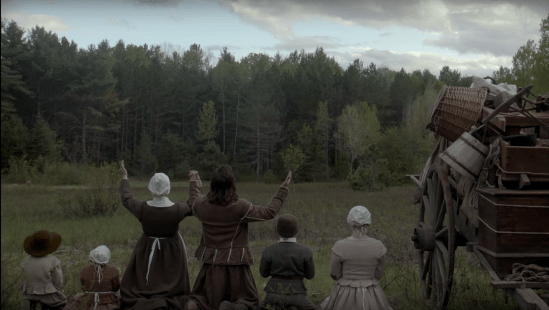
Set a few years after the 1620 arrival of the Mayflower ship, a faith-entrenched Puritan family becomes ostracized by a tightly knit plantation community and leave their home to settle near a woodland landscape. The family of seven build upon their quaint home, growing crops for food and for trade, but when the youngest child, an infant, disappears into the depths of the dark woods, the family slowly starts to unravel at the inexplicableness of their loss. The once tranquil and beauty of the woods dreadfully alter into a coven for dark and fear inducing figures that root themselves between the family binds, untying their sanity and faith that once held them close and separating them toward a Godless path of destructive witchery.
Writer-director Robert Eggers’s “The Witch” steps into a time machine and travels back in time to the New World era and delivers an American Folklore horror film that’s honestly genuine and deeply haunting. Eggers constructs a mood and tone stripped of comfortable commodities from the moment the family takes on the New World for the very first time away from the plantation. The isolation is immense, the tension is thick, and the cast and crew dynamic squeezes tight around the heart, ripping out every raw emotion and turning the display into a gut-wrenching performance. Eggers had done the appropriate leg work by researching various diaries, folklore tales, and recorded accounts of the time to achieve elaborate detail; even the dialect is true to the period.
The film’s devil worshipping namesake ghastly conjures a simple, yet legendary form. Without the use of glossy special effects, “The Witch” mesmerizes with practical makeup, slight of hand editing, and implied black enchantment while pulling at our internal sinful desires of the flesh, lust and deceit. Eggers kept the mainly nude Bathsheba Garnett in the shadows to give the menacing Witch a closing-in threatening appeal that corners an easy prey, such as children. The Witch’s power, a contractual perk with the devil, is vast and unholy that becomes a fierce antagonist to the family’s unnerving, yet powerless faith.
Eggers and his team uses a sepia visual to devoid much of the color as possible from a naturally bleak mid-17th century community style that’s more binary and cramped, setting the stage for doom and gloom. To continue with the adverse affect, an everlasting current of formidable abstracts are implemented for uneasiness. These signs of inauspiciousness can be as obvious as Ralph Ineson’s sonorous voice as the family’s patriarch and resonating religious leader William or can be as opaque as their corn crop turning suddenly rotten or the reoccurrence of a toying hare and an unsteady, long-horned goat named “Black Phillip, who may or may not be the devil himself.
In the midst of the family being torn apart, the eldest daughter Thomasin (Anya Taylor-Joy) desperately tries to keep her family together, but with her mother Katherine (Kim Dickie) in severe grief after the loss of her newborn son, Thomasin absorbs the blame and disdain from her mother. Thomasin’s abuse doesn’t end with her mother, which the story mainly touches upon with each of Thomasin’s parents and siblings, in one way or another, demeaning her. The oldest brother Caleb (Harvey Scrimshaw) under the spell of hormones repeatedly stares at his sister’s chest, lusting after the female form. Thomasin’s sibling twins Mercy and Jonas remorselessly believe her and label her a witch from the time of Samuel’s disappearance. Even her father, who stood up for her honor and her dignity when neither her mother or siblings would, eventually broke with a misguided view of trust. Thomasin’s world of faith, family, and, basically, everything she once believed in has been stripped away and without that barrier of ideals, a contract with the devil tempts her weakened will.
Lionsgate home distribution releases the horror sub-genre reviving “The Witch” on DVD and Blu-ray. This review covers the Blu-ray release that consists of a MPEG-4 AVC encoded disc that delivers a stunning high definition 1080p picture in a rare 1.66:1 original aspect ratio. The intentional reddish-brown coloring properly dates the era the film is set and the picture is detailed to display the grit, the dirt, and the muck that further enhances the foreboding of calamity. The DTS-HD Master Audio 5.1 is crisp and clear, favoring more on the shocking and slightly experimental soundtrack, but still manages to place the dialogue in the forefront, steering clear from the cacophony. Still, I found the dialogue hard to follow because of the puritanical dialect of that time. Bonus features include an audio commentary with director Robert Eggers, the featurette “The Witch: A Primal Folklore,” Salem Panel Q&A, and a design gallery.
Folklore horror hasn’t died just yet. In fact, the sense of a witchcraft resurrection is on the horizon, possessing now a new high profile inside the horror community that’s sure to pick up steam. Newcomer Robert Eggers puts new life into gothic, despondent horror with contrast characters living in a stark reality. “The Witch” will launch Eggers into horror orbit and keep Lionsgate as a friend to the genre.
Recently engaged lovers Daniel and Mina take a trip to visit Daniel’s brother. When they stop to take in one of California’s breathtaking beaches, two vicious bikers, looking for kicks, intrude on the lovebird’s romantic getaway, looking to rape Mina but ending up mercilessly murdering Daniel. Mina’s grief turns the distraught lover into a vengeful bitch, taking the lives of all salacious and beastly men who wish to exploit Mina’s virginal beauty. Meanwhile, Daniel’s brother, a praised police detective, personally takes on the case despite his Captain’s insistence of not getting to close due to his personal connection. The detective tracks down the drug dealer Black Pepper, the head of a notorious biker gang connected to the slaying of his brother, that results in an all out war!
“Dangerous Men” is an action film you hate to love, being so bad it’s good. The film was the non-aborted child of Iranian born, U.S. bound director John Rad, a pseudo name, who had a life-long vision from way back in 1979 to put an eternal awesomeness on the big silver screen and, in one way or another, completed that feat no matter how long the creative process. Only 26 years stood in between John Rad and his masterpiece “Dangerous Men” from being completed and theatrically released to the public, but, low and behold, “Dangerous Men” didn’t succeed into billions or even millions of box office dollars; instead, Rad’s film gained popularity in its notoriety, gaining almost instantly cult status through a niche group of garbage cinema aficionados. By the grace of the provocative arthouse film brew masters at Drafthouse Films and their continuous begging toward Rad’s daughter, “Dangerous Men” redefines the term guilty pleasure.
But what makes “Dangerous Men” so irresistibly appealing? Is it that fact that Iranian born Peter Palian from “Samurai Cop” fame is the most experienced crew member on John Rad’s amateurish, if not solo performing, team? To properly answer that conundrum-filled riddle, looking at what makes “Dangerous Men” so standardly terrible would ultimately lead to the answer. For one, a prominent lead character doesn’t exist in a plot that can’t focus due in part of the two decades the film was shot that resulted in the actors or actresses not being available or unwilling to complete Rad’s work. Various characters, like Mina (Melody Wiggins) or the cop brother (Dutch Van Delsem), come and go in their respective, decade housed plot paths and like one of Drafthouse Films’s bonus features makes light, the film ends on a still frame of characters who have had less than half an hour of screen time. Secondly, the amateur acting in exposition, the cut and dry editing, and the cartoonish foley, by the also writer-director John Rad, hones straight toward gut-punching you to explode into outrageous, painful laughter. “Dangerous Men” is a serious film that’s full of wacky action and some great moments of exploitation, especially scenes involving women knees, but when all the punching and exasperating is of the identical sound bite, like in a “Street Fighter” video game, taking Rad’s film seriously is hard to fathom. Thirdly, the longevity of filming created many production goofs that mistakenly implied the decade. From props, to haircuts, and to clothes, hints of years were obvious to the naked eye. Lastly, a title like “Dangerous Men” should end on an detonative high note; instead, falls just short of a chuckle and a “WTF.”
“Dangerous Men” snuggly finds a spot within the realm of other bad movies not to be missed. “Troll 2,” “Silent Night, Deadly NIght 2” with the infamous garbage day line, “Leonard Part 6,” and “Jaws: The Revenge” would gladly welcome “Dangerous Men” with open arms as a peer in preposterousness. With a little over a measly $2,300 in ticket sales on opening weekend from a film that probably cost John Rad thousands upon thousands of dollars to produce and a whole hell of a lot of time to construct, “Dangerous Men” is most likely an action-packed feature you’ve never, ever heard of before. One positive remark is the soundtrack, which is also composed by John Rad, was, in my humble opinion, swanky and, well, rad – a true testament to the era and the best effort for such bad film. Unfortunately, John Rad never saw his film blossom as he died soon after the release of his masterpiece, sometime mysteriously between 2005 and 2007.
Drafthouse Films, in association with MVDVisual distribution, courteously releases “Dangerous Men” on a sleek not rated two-disc, 1080p 1.85:1 widescreen Blu-ray and DVD set which has a region free presentation that still manages to hold in the cigarette burns and the faded coloring in a sort of time capsule from the 80’s and 90’s. The original print looks to have been kept in good condition for an easy upgradeable and cleanable transfer. The Dolby Digital mono stereo mix is fairly clean aside from some misaligned dialogue tracks with the video and the prevalence of background noise in certain scenes of poor record quality such as the Daniel and Mina restaurant scene. Drafthouse Films doesn’t discriminate amongst the quality of their releases when considering the bonus features. A 16 page booklet featuring documented full-length interviews with director John Rad, audio commentary featuring “Destroy All Movies” authors Zack Carlson and Bryan Connolly, “That’s So Rad,” an epigram stemmed from this film, is an original documentary about the film and its initial 2005 release, an interview with cinematographer Peter Palian, Rare footage of John Rad’s appearance on local access television, and the original theatrical trailer. Quite the laundry list of extras! “Dangerous Men” is so spectacularly unspeakable and trashy it shouldn’t go unseen for absolutely anything, not even for the birth of your first born child!
Alicia, a reporter working tirelessly on reports of missing children, receives a letter from Erda of Limbo, a haven for unwanted children located in an isolated area of Argentina. When Alicia arrives, she can’t shake strange inklings that the children’s faces seem familiar to her. Come to find out, all the children are vampires, created shamelessly by adult vampires, and now some of the vampires, some elder in age who are stuck in the body in which they were turned, live under the care of their human caretaker Erda. However, the children are not safe as vampire hunters have assembled around their serene community, lying and waiting to drive a stake into each of the timeless vampires. Their survival depends on Erda, Alicia’s reporting, and the 90-year-old grandson of Dracula himself. Though the community of vampires seek to reap the world of mortals as they have an apocalyptic plan to put in motion.
“Children of the Night,” also known under the original title “Limbo,” is written and directed by Ivan Noel and under the thumb of numerous Argentinian producers and actors, the mythology of Dracula lives yet again on screen. The film uniquely puts a different spin on the old Prince of Darkness tale, creating a jutting story that surrounds a scenario with Dracula’s bloodline kin. While the idea touches on the rarity of vampire children, contrasting with “Interview with the Vampire” or more recently “Let The Right One In”, there arguably lies missing pieces to Noel’s film to properly complete a story of this size and, perhaps, the microbudget hindered and faltered under financial stress rather than just becoming a medium of storytelling. For instance, much of the background on Erda’s writing to Alicia’s to travel to Limbo isn’t necessarily forthright and that feels neglected not on purpose, but rather feels neglected absentmindedly and financially.
Secondly, the children characters vary in age and the girth of their long lives should have been explored more to develop more meaningful characters. Noel’s version bypasses many valuable characters and their traits to make the children of the night more likable, or hated, or something, because in Noel’s version, the children could live or die and not an emotion would be concerned. Noel does bring a certain enigma to children’s position in the world as we’re not totally convinced their evil or well-intentioned. Children caregivers are similarly forgotten when regarding their attributes. Alicia’s and Erda’s hemophilia condition is suppose to echo the children somehow, but the idea barely misses the cutting room floor completely and is only mentioned briefly upon Erda’s and Alicia’s initial meeting.
The specials effects are minor, but effectively garnered. The majority of the effects shine through the second and third acts, especially during the all out bloody vampire hunter and children vampire brawl in an open field where children will be children and play with their food before slicing and sinking their teeth right into the necks in a blood splattering type fashion. I also thought the wooden stake on a rotating drill was a fascinating, if not very phallic. Along with this gruesome play yard greet and eat, comedy is sprinkled in throughout the duration, but some of the material falls flat; the comedy feels dated or obsolete, offering nothing new to that side of the genre. “Children of the Night”, simply put, is a vampire film with a feat of a concept, but the film lies at the fringe of being a horror-comedy that stirs up calamity with my critique about Ivan Noel’s semi-serious take on the Dracula mythology.
The performances are little to be desired for with the inclination that the actors, mostly involving the children, are being spoon fed dialogue or given cue cards, especially in more serious toned scenes. Dracula’s grandson The Count becomes the poor performance scapegoat. Child actor Lauro Vernon portrays The Count and his naturally sculpted ominous almond shaped and gloomy eyes, protruding upper lip, bronze skin, and lanky thin features creates a stereotypical creepy child archetype, but Vauro’s attempt to execute a Dracula-esque character, waning the powers of Dracula, is less expressive and more passive in deliverance. The Count in the script is powerful; one who oversees the children as a protector and a worthy warrior against a vast superior, well armed vampire hunting band of men, but instead the character weakly wanders from scene-to-scene even when his flock is being picked off and staked one-by-one.
“Artsploitation Films” releases this 2014 Spanish-languaged Argentinian film on Blu-ray and DVD. The Blu-ry is presented in a widescreen 1.87:1 aspect ratio and looks fairly decent during daytime or lighted scenes with slightly noticeable ISO noise. However, with a film titled “Children of the Night,” night scenes more common and also reek more havoc on the quality as many of the night scenes maintain a blocky posterization with the digital film. Digital noise also plagues the digital film produced during low lit scenes, creating undefined shadows and blob-like shapes. Overall, “Children of the Night” has a fair share of budgetary quirks and flaws and the story loosely presents itself with an unclear and oddly edited lineage. Totally ignoring this release would be a mistake as producer, writer, and director Ivan Noel has fain under the limitations and manages to technically achieve a few great medium and long shots, though Noel seems to be attached to the closeup. Check out “Arsploitation Films” Blu-ray or DVD release of “Children of the Night” for another take on the mythology of Dracula!





 It's Bloggin Evil!