The Apocalypse is Four EVIL Active Shooters and the Hell They Create in “The Dead Ones” reveiwed! (Artsploitation Films / Blu-ray)

Four errant students are ordered to do a summer cleaning of their high school after a terrible tragedy that has left the hallways and classrooms in shambles.  As they meander around the closed school doing more chatting than they are cleaning, a masked and armed group calling themselves The Four Horsemen chain the doors and windows, barring every means of escape, and snake through the school’s layout setting a plan in motion to deliver a macabre message to the campus grounds.  Something just doesn’t feel right when the students try to track down the masqueraders who move around more like specters with an eerie clamor of theatrics that’s becoming more and more eternally harmful the longer they remain inside the school. 
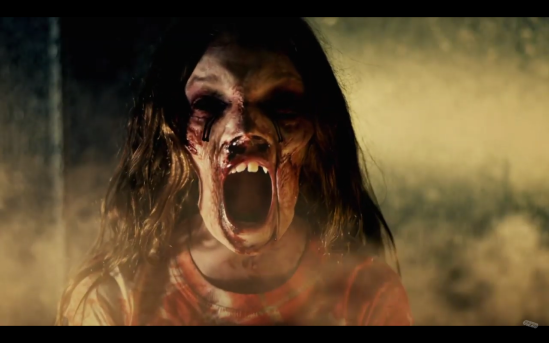
“The Attic Expeditions” and “All Souls Day:  Dia de la Muertos” director, Jeremy Kasten, has a new ghoulish, outcast teen horror on the verge of release with the American made, calamity surrounding “The Dead Ones,” entailing a theme of choice on the wrong side of deviancy when influentially steered by the negative forces of the besieging cruel society.  The script is penned by Zach Chassler on his fourth collaboration with director Kasten, following their efforts on the vampiric allegory for drug use “The Thirst,” “The Wizard of Gore” remake, and “The Theater Bizarre,” a horror anthology, in over a span of a decade’s time.  “The Dead Ones” presents a two-timeline parable with an inciting, yet disturbing, core involving every parents’ worst nightmare and America’s most disgraceful statistic, a high school shooting.  Sick-O-Scope Motion Pictures serves as the listed production company behind the film.
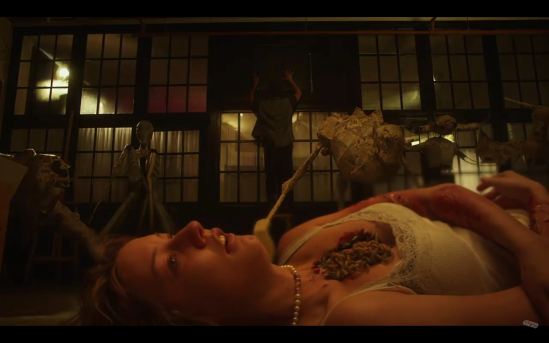
Detention attendees is comprised of four teenage outcasts who are also quasi-friends that seem to know each other well, but are personally rough around the edge, denoting more distinct tensions amongst their insoluble secrets.  In an introduction with the teens, we’re glimpsed into flashes of a nightmare images inside one of the teens’ head as their driven together to the school by their principal, Ms. Persephone, played by “The Thirst’s” Clare Kramer who is just as stunning as her in-story goddess inspired moniker.  Ms. Persephone’s passengers include the “The Dead One’s” core characters with a victim of relative abuse in Alice “Mouse” Morley (Sarah Rose Harper), a bullied nonconformist in Scottie French (Brandon Thane Wilson), an unhinged self-cutter in Emily Davis (Katie Foster), and an aggressive sociopath in Louis Friend (Torey Garza).  Performances are heavily relied upon as the cast of four are called forth by the story’s dual timeline where various plot points from two individual paths are needed to be crucially achieved for the unfolding to be organically ambiguous for it to converge in a blend of reality and, possible, damnation.  “The Dead Ones” round out the cast with Amelia Talbot, Michael James Levy, Shane Tunny, and “Dusk Till Dawn 2: Texas Blood Money’s” Muse Watson whose always a nice addition to any horror character set in an eviscerated and sleazy father figure role.
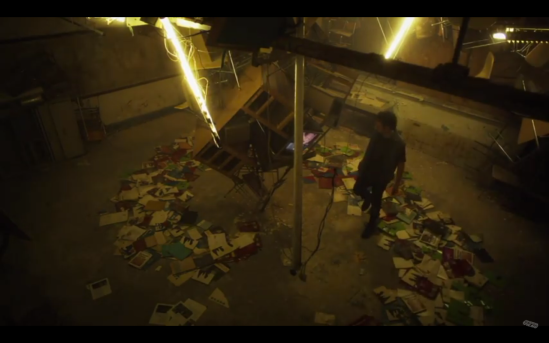
“The Dead Ones” is a film that’s always in a temporal flux, weaving back and forth between utter chaos of an active shooter situation in the normal light and the near totalitarian order saturated with an infernal hue inside a dislodged environment.  As the band of misfits reflect on their battered existence, one mentions, multiple times, his stint in Juvey while another can envisage the patterns to cut into her flesh, a bread crumb trail of hints and past misgivings lead them down a path of self-awareness, of remembering exactly how they landed into the ruined capillaries of the school in the first place.  Yet, “the Dead Ones” isn’t solely about paying for one’s sins, honing in toward more of a cause and effect choice for redemption, which begs an essential question, that goes slightly under the radar of Kasten’s direction, on whether the two timelines are rather parallel to each other instead of rendering past and present events?  It’s certainly one of those open ending conversations about what perils our souls could be fatefully curtailed under the corporeal spectrum by the choices we make while still living and breathing.  For myself, connecting with Kasten’s carnivalesque and ultra-sleek horror panache has been difficult to digest and become accustom to, especially with my own personal dissatisfaction with the remake of “Wizard the Gore” that starred one of my favorite eccentric actors, Chrispin Glover, but Kasten relishes an unorthodox methodology that goes against the traditional grain of filmmaking and while that usually isn’t the problem for him, or any director, to be discouraged from,  “The Dead Ones” ultimately tips over into the same disheartened gray area for one main reason – the editing.  “The Dead Ones” is edited by Maxx Gillman whose chief credits are on short films and documentaries, marking Kasten’s film Gillman’s debut into feature film market, but as like a good documentary editor, “The Dead Ones” is overtly choppy that cuts up the scenes in an egregious way, thwarting any sense of conveying emotions and shortening them to near nauseating back-and-forth cuts.  With a 73 minute runtime, the potential for lingering on the morose rhetoric or teetering compassion of the teens is lost and could have been stirred into their affixed affliction for a more targeted approach to their limbo circumstances. While timing might be less than desirable, Jeremy Kasten summons judgement for “The Dead Ones” to be convicted of unnerving decorum and executes psychological absolution with the tenderness of a Satan himself.
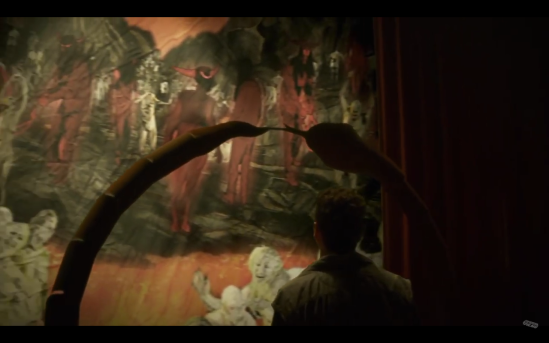
Surreal with a hard, open-hand slap of realism, the metaphysics of “The Dead Ones” shoots for an otherworldly life sentence as the September 29th release day for the Blu-ray and DVD is on the horizon courtesy of Artsploitation Films in association with Raven Banner. The Blu-ray was reviewed and is presented in high-def, 1080p with a 2.39:1, anamorphic widescreen, aspect ratio. The digitally recorded image is packed with visually popping nightmares under a slightly greenish warm tint while still propelling range into heavy fog, a seamless composite of scene transitions and matted visual effects, and copious amounts of rich shadows and shadowy characters. The overall tone of the “The Dead Ones” has a strong 90’s grunge manifestation with some CCTV black and white moments that would fit rightfully in before the turn of the century teen horror collective. The English language 5.1 DTS-HD master audio maintains clear dialogue pathways and a resounding, almost mechanical, score resembling that of an infernal machine at work. The ambient range and even a good chunk of the dialogue has a softer demeanor that sidesteps to the incessant score that would have rung about in Virgil’s Dante Inferno, as the school auditorium playbill show that’s transparent through the film. There is also optional Dolby Digital 2.0 audio. The bonus features include a special effects featurette of the special effects work by the late Elvis Jones, on one of his works with “The Dead Ones,” and his intern Jax Smith, a set tour with production designer Jeffrey Pratt Gordon to showoff his vision of hell, and two commentary tracks alongside the film with commentaries by the director, producer, and crew. Saving a soul damned to hell sounds like an enormous feat of only divinity interaction can accomplish, but Jeremy Kasten finds virtue in sinful acts, imbedding a safety net in the guise of a forked path, and opens an ingress to a putrid perdition for those under more severe scrutiny than just “The Dead Ones.”

Pre-Order “The Dead Ones” By Clicking the Poster!

EVIL Does a Little Bathhouse Wet Work in “Melancholic” reviewed! (Third Window Films / Blu-ray Screener)

On nights when a humble Japanese bathhouse is supposed to be closed for business, the lights remain illuminated, gleaming off the crimson covered ceramic tiles of Mr. Azuma’s bathhouse floors as body’s soak in a pool of blood.  The proprietor, Mr. Azuma, is in severe financial debt to Yakuza boss Tanaka who turns his meager business into a nightly slaughter house to dispose of Yakuza opposition or those just on the syndicate’s bad side.  When Tokyo University graduate, Kazuhiko, applies for a job as an attendant to see a girl who regular attends the bathhouse, the reserved model employee becomes enthralled with the disposing and cleaning up of the corpses, working alongside a couple of professional hitmen, Matsumoto and Kodero, but when the job he’s so passionate about requires him to be more hands on with the assassination assignments and the endless pressure from the Yakuza bares down on his colleagues and friends, Kazuhiko’s radical plan to eradicate the woes of his newfangled position just might mean his very life. 

Seiji Tanaka’s self-esteem building and identity attaining crime drama, “Melancholic,” might not reside as absolute horror, but any film involving the Japanese Yakuza is an unpredictable, Machiavellian expo worthy of every second.  Originally titled in Japan as “Merankorikku” or “メランコリック,” writer-director Tanaka retains a bloody disposition of the historically violently depicted Yakuza-storied narrative, but is asymmetrical with a converging love affair, complementary conflicting the dark and light with clarity of the centric character’s unintended double life into the criminal enterprise of cleaning a bloody bathhouse.  Based off Seiji Tanaka’s short film of the same title, “Melancholic” mops up as an immersive black dramedy from Seiji Tanaka as the filmmaker’s first credited feature film produced by One Goose production in association with Uplink and JGMP.

The story concentrates most of the effort around Kazuhiko, a graduate of the prestigious Tokyo University who doesn’t have a good job and lives with his pampering parents, fitted by Yoji Minagawa as a social misfit living on the outskirts of the Japanese mantra of diligence and integrity.  Minagawa bores out Kazuhiko’s diffidence, chocking up his damp disposition to the indecisions toward his future, that forces other characters to influence his choices, such a former high school classmate in Yuri with an effervescent performance by “Tag’s” (“Riaru onigokko”) Mebuki Yoshida.  Yuri’s infectious affection for Kazuhiko and her regular attendance at the bathhouse encourages Kazuhiko to apply and become hired for a cleaning attendant position alongside a blonde, and undereducated in comparison, counterpart in Matsumoto (Yoshitomo Isozaki), but to Kazuhiko’s surprise, his overqualified ego is shattered when he discovers that the bathhouse is a Yakuza place of execution and those all around him are more experienced in that trade, detonating a plume of black comedy, work place haughtiness that Kazuhiko has to balance with his personal relationship growing with Yuri.  Most of the exchanges are straight forward and culturally inflection heavy, especially when dire moments rear their heads, but some more compassionate and delicate scenes rouse through the overt inflections with Minagawa and Yoshida at the helm of their blossoming onscreen romance, adding to the stark contrast to the opposing narrative. Stefanie Arianne, Makoto Hada, Yasuyuki Hamaya, Takanori Kamachi, Hiroko Shinkai, Masanobu Yada, Keiji Yamashita, and Yuti Okubo fill out “Melancholic’s” cast.

“Melancholic” is a rather odd title integrated into the briefly pensive struggles of Kazuhiko to an intrinsic network of assassination gunplay and backstabbing knavery, offering little profound sadness and despair and more shrewd hostility when those in charge ask for an inch but take a mile out of the personnel pool. For a Yakuza film, Tanaka’s bath and butcher story has barely a budget to entertain technical action sequences in tight spaces, but the action is kept taut and intense and despite the lack of a Yakuza presence, with only one single boss representing an entire faction, the transposing of Kazuhiko’s personal and professional stations washes away much of budgetary concerns down the drainpipe as an irresistible curiosity to see how our hero softly stumbles through a sudden confluence of the two repelling paths will play out. Most audiences will overlook the comedy for a countless reasons as “Melancholic” up plays into the satirical rigors of the Japanese sullen humor. The fact that that the subject matter is also about mercilessly murder people in a bathhouse will undoubtedly pigeonhole the film with pre-labeled genre. Tanaka slips in gallons of subdued irony ripe for the complex circumstances hazardous to all bathhouse employees and their pryingly oppressive management.

The award winning Japanese film (aggregated wins from multiple Eastern Asian film festivals) “Melancholic” arrives onto a dual format DVD/Blu-ray from UK distributor Third Window Films, a loyal provider of extreme Asian cult and horror. Since the Blu-ray was a screener, the A/V aspects won’t be reviewed in it’s entirety and the specifications weren’t provided with the screener. Ryô Takahashi’s cinematic vision brings out the beauty in simplification without being ostentatious with camera angles or relying heavily on tint boxes; yet, the blend of steady cam and handheld tilts to the one side with the jitteriness of the handheld seizing the stage. Bonus features were included on the screener, including a behind-the-scenes of a documentary-style shot look at moments before, during, and after takes, a Q and A panel with the cast and crew, and the “Melancholic” short film. Seiji Tanaka’s breakthrough bloodbath, “Melancholic,” sounds more despondent than the dismal thought of a cold shower on a freezing day, but the heated ferocity rite into adulthood keeps this Japanese dramedy warm with tension and cozy with vortex humor.v

Purchase “Melancholic” on Blu-ray / DVD!

Crawldaddy and Her Two EVIL, Incestual Kids in “Skinned Alive” reviewed! (Tempe Digital and Makeflix / Blu-ray UE)


Crawldaddy and her two children, Violet and Phink, are psychopathic makers and sellers of fine leather apparel right off the backs of, well, literally ripped right off the fleshy backs of anyone they come across! When their van breaks down in a small, dumpy, low-bred Ohio town, Crawldaddy is forced to play nice with the town’s only mechanic, Tom, who offers a complete line of unreciprocated hospitality to the strange out-of-towners, but that doesn’t stop her and her children from committing slice and dicing of the local residents while bunkering in Tom and wife’s basement spare room. When Tom’s neighbor, Paul, an alcohol abusing ex-cop on the edge as a result of a brutal divorce, senses trouble and discovers Crawldaddy’s den of skin, the quiet small town explodes with bullets and blades in a macabre showdown.

Forget the Firefly family that has brought backwoods kin-in-arms killers to the masses in vogue fashion. Otis, Baby, and Captain Spaulding have nothing on Crawldaddy’s foul-mouth, foul-smelling skinner family who ranks as the top trash, living the nomad lifestyle with all the depraved trimmings of the criminally insane. Written and directed by Jon Killough, who after working on J.K. Bookwalter’s “The Dead Next Door” and “Robot Ninja” in multi-hat roles, “Skinned Alive” was bestowed a greenlight by Bookwalter to explore the creative side of Killough’s vile and offensive laden hillbilly horror that was released in 1990, before that very subgenre was coined and monetized years later. David DeCoutea, who envisioned the eviscerated virtuoso of the gruesome filmmaking talents from Todd Sheets to J.R. Bookwalter, served as executive producer and Bookwalter’s The Tempe Suburban Company tackled “Skinned Alive” with all the ingenious bloody pizzazz and outlandish death set financier and production company while filming the project in Ohio.

Since The Suburban Tempe Company is a tight-knit production company, familiar faces from Bookwalter’s previous films have been cast, beginning with Paul Hickox, the ex-cop with a drinking and ex-wife problem, played by Floyd Ewing Jr. The Hickox character crosses over from “Robot Ninja” into “Skinned Alive,” but exhibited in a dichotomous life position. While Ewing nails being a man dragged through the pig slop of divorce, Paul feels cut short with the amount of buildup written for the character that’s centered around ex-wife woes of losing his house and kids, depressed into drinking, and has to deal with a sleazy lawyer whose also litigating his former wife in a court of a sex. However, “Skinned Alive” is all about the bad guys.  In the majority of horror films, the bad guys are always the most interesting because of their rancid flavored persona and for our culturally-collective love of the eccentric, the offbeat, and the grim of villainy.  Crawldaddy embodies those despicable characteristics without so much of breaking a sweat with a abhorrent-welcoming performance by the late Mary Jackson.  Jackson, who went on later to work Bookwalter again in a minor role in “Ozone,” is transformed from a singing beauty to a basket case of a wretched, wheelchair bound hag, unearthing her uncouth Hyde at the flip of a switch.  Jackson is complimented by Susan Rothacker as the alluring-but-deadly Violent, a roll filled in the last minute by the film’s makeup artist when things didn’t work with Jackson’s daughter Lorie, and the one and only Scott Spiegel as Phink.  The energetic Spiegel has been a part of the longstanding Sam Raimi entourage, having minor roles in Raimi films, such as “The Evil Dead,” “Darkman,” and “Drag Me to Hell,” and when “Skinned Alive” became in need of a Phink, Spiegel may have just saved the film by his presence alone as the “Intruder” and “Dusk Till Dawn 2:  Texas Blood Money” director brings the manic ticks and callous charisma to Phink’s traits.  Rothacker ups the character dynamics with Phink as the pair’s love-hate relationship is a slap-stick of incest and homicidal cravings that fits right into the vile veneer of the story.  “Skinned Alive’s” cast rounds out with Lester Clark (“The Dead Next Door”), Barbara Katz-Norrod (“Kingdom of the Vampire”), Mike Shea (“Robot Ninja”), Mike Render (“Robot Ninia”), J.R. Bookwalter as a tortured Jehovah’s witness, and Jon Killough as an unlucky the hitchhiker.

As Killough’s indirect byproduct of Tobe Hooper’s “The Texas Chainsaw Massacre,” “Skinned Alive” is the skewed, bad dream version of the devious Sawyer family with heavy notes of black comedy chucked into the fold for an all-out odious assault on all fronts, but Killough’s first and only feature didn’t come out totally unscathed as a harmonious horror-comedy.  With little film stock left to shoot with and production controversial new scenes written by Killough and then altered by Bookwalter without consent, “Skinned Alive” became a rapid fire production of short shots compiled together that resulted in a choppy flow.  You could also discern which filmmaker wrote which dialogue in the filler scene between ex-cop Paul and his ex-wife with her sidepiece arrogant lawyer; Bookwalter adds witty, if not smart, dialogue to reinforce Paul’s degrading life while Killough’s dialogue for the rest of the feature is an expletive warzone without much of a strategy.  Both discourses work for the benefit “Skinned Alive,” but do cause a blatant, patchwork barrier between the conversing styles.  David Lange and Bill Morrison’s special effect makeup work is a complete continuation from “The Dead Next Door” and “Robot Ninja” of rendering gooey, gory visuals on a budget.  Sometimes, yes, you can see how unflattering the realism can be and easily securitize the flaws, but at the same time, the ingenuity trumps over cost and that elevates the effects beyond any dollar figure the film might cost.  That partial prosthetic of ripped flesh on Spiegel’s Phink when he’s hot in the face is one my favorite effects not only for the gruesome details, but for also its versatility.  It could easily be a bear claw swipe or a flesh eating bacteria, making the possibilities endless for Lange and Morrison.  Thirty-years later, “Skinned Alive” has preserved a rightful staunch cult following for it’s unparalleled grotesque veneer that will endure to linger for another 30 years plus thanks to technological advances and vehement filmmakers who are also filmic preservationist like J.R. Bookwalter.

Speaking of which, J.R. Bookwalter and his company, Tempe Digital, has painstakingly restored “Skinned Alive” and released it on a region free ultimate edition, dual-format Blu-ray/DVD, distributed by Makeflix.  The original 16mm A/B roll cut negative was scanned in 2K and is presented in the retained 1.33:1 aspect ratio.  The scan brought the transfer int a low-contrast in order to color correct and bring more life into the presentation from previous untouched versions and removed all of the white speckled dirt and scratches from nearly much of movie; a silver-lining made possible by COVID-19 quarantine that allotted the time to do so.   The color grading now has a much more vibrant appeal though slightly losing details from the high contrast with some of the more brilliant red glowing scenes in Tom and Whinnie’s basement.  Limited to 1000 pressings, “Skinned Alive,” the 30th Anniversary ultimate edition, by visuals alone, should be blipping frantically on any avid collector’s radar and sought by all genre aficionados.   The English 5.1 DTS-HD Master Audio surround sound stem from the DA-88 tape archives of the original 16-track audio masters and while much of the dialogue and musical score remained, a good chunk of the ambience and effects were rebuilt and remixed, defining a clearer, cleaner audio track presentation of balanced levels from all different file sets.  Aside from some small synchronization issues between the dialogue and the scenes, the range is pitch perfect and the depth is excellent.  There are optional English and Spanish subtitles included.  Bonus features, you say?  The ultimate edition has you covered with the BR disc one containing a 2020 commentary with writer/director Jon Killough and moderated by Tempe historian Ross Snyder of Saturn’s Core Audio and Video as well as a 2002 audio commentary with producer J.R. Bookwalter and makeup effects artist David Lange.  Other new material includes a 16 minute featurette entitled “Carving Up 30 Years of ‘Skinned Alive,'” featuring a number of interviews with the cast and crew recollecting good times on set, a remembering Mary Jackson featurette that includes Jackson’s son and daughter, among cast and crew, commemorating the Crawldaddy actress, an interview with Scott Spiegel, 2020 location tour, artwork and promotional gallery, behind the scenes gallery, production stills, and, my personal favorite, J.R. Bookwalter walking through the restoration process step-by-step giving insight on the time and effort into restoring the films such as “Skinned Alive.”  Disc 2, the DVD, includes a 2002 audio commentary with Doug Tilley and Moe Porne of The No-Budget Nightmares Podcast, the 1987 and 1988 “roommates” TV sitcom episode featuring the “Skinned Alive” cast and crew, the Joy Circuit “Love Turns to Darkness” music video, a making off featurette of “Skinned Alive,” behind the scenes, Camera and wardrobe tests, a short 2 minute segment about the 2002 remastering and the original DVD release trailer.  That’s not all!  Let’s not forget to mention the equally packed release package that includes a reversible wrap featuring original 1990 VHS artwork in the casing and new cover art by Alex Sarabia on the slip cover, plus an eight-page color booklet with liner notes by Ross Snyder.  The only thing missing is a soundtrack CD compact…wait, there is one!  Come September 18, the original motion picture soundtrack, featuring 29 tracks, will be released with scores composed and performed by J.R. Bookwalter, songs by Hang Dangle, Foxx, Virgil Pittman, Joy Circuit, Dave Jackson and Kenny Boyd, Seven Sez U, The Ninja Sequencers, and Willie and the Wagon Wheels.  This 2-disc set is the holy grail for die hard “Skinned Alive” fans who know and appreciate the unique, second to none hillbilly horror that’s flagrant on every level.

Pre-order the soundtrack!!! Click to go to Amazon.com

When EVIL Knocks at the Door, Don’t Answer It. “The Strangers” reviewed! (Second Sight / Blu-ray Screener)


Kristen and James return home late from a wedding reception to James’ isolated family home off the main road. The joyous occasion becomes an afterthought when an unprepared Kristen declines James’s subtle engagement proposal outside the reception venue, straining their once jovial relationship into uncertainty of where it stands now. Before the couple discuss relationship next steps, a strange knock on the door around 4am becomes the initial stirrings of a clouted atmosphere brimming of paranoia, fear, and confusion when three masked strangers menacingly toy with the couple. The fight for survival in the dark early morning hours will determine their fate against strangers compelled to kill them just for the sake of killing.

Call me 12 years behind as I catch up on getting caught up into the brutal home invasion thriller, “The Strangers,” from writer-director Bryan Bertino. “The Strangers” has been panned by critics for being nihilistic and fraudulent with no plot twist In a premise that pits two innocent people against three violent hungry intruders, finding common ground with Wes Craven’s more sadist-driven “Last House on the Left” and the Charles Mansion murders of the late 1960s while also pulling harrowing experiences from Bertino’s own small town suburbia. As Bertino’s debut film, “The Strangers” has become something of a cult film over the years with discussion upon Bertino’s themes, especially the act of pure random violence upon another person, that has become more relevant today than ever. Universal Pictures also saw an intriguing quality illuminating in it’s filmic soul and farming it out the spec to their offshoot, genre label, Rogue Pictures, in association with Vertigo Entertainment, Mandate Pictures, Intrepid Pictures, and Mad Hatter Entertainment.

Bertino’s script attracted it’s leading lady in “Heavy” and “Armageddon’s” Liv Tyler who had to stretch her vocal range to the max in order to scream her head off like her life depended on it. As the disenchanted Kristen, Tyler brings beauty and tenderness to the heartrending woe of the newfangled corroding relationship Kristen and James are experiencing while serving as a stark contrast to the barbarism oppressed upon her. Opposite Tyler, and equally as disenchanted stricken in character, is “Underworld’s” Scott Speedman as Kristen’s beau, James, who difficulty to express himself in an unpredictable moment is greatly felt. Tyler and Speedman exact a crystal clear your head moment of awkward silence, frustration, disappointment, and heart ache that’s suddenly ripped from them, stolen in a away, by masked psychopaths. We’re never privy to their faces, keeping the mystery alluring and suspenseful, but the three actors, Gemma Ward, Kip Weeks, and Laura Margolis, exude a haunting and chilling performance of random acts of violence.

While performance wise is solid, the character logic struggles slightly for a viewer to embrace their actions seriously. I find that when the couple, being the only two terrorized people isolated in a quiet house, split up thinking the act as a sensible way of survival and is completely logical when, in reality, is hell to the no it isn’t! Three versus two together is better odds than three versus two split up, but, thinking outside the box, what if the split is emblematic of their dissolving relationship; no longer will Kristen and James do things together that make them more stronger and more accomplished as a pair. “The Strangers” can be indicative of many themes, whether instilled by Bertino or not who had complete control over the script and direction. Is there a theme of nihilism? Yes. Is there a theme of grim, unprovoked violence? Yes. “The Strangers” purposefully deviates from conventional cinematic means and outcomes, leaving that gutted feeling of dread and psychological torment in an unsullied, overwrought terror film. That uncomfortable pit in the back of your throat is the thick tension your unable to swallow in every moment of breathtaking fear; a feeling that’s very real when the hot flash sweat, producing adrenaline beads down your hair-raised skin, senses danger. The sensation is the welcoming byproduct Bertino’s “The Strangers” fosters toward being a legacy cult film, pivotal by all means as a rightful modern horror.

For his first feature run, Bryan Bertino has captured fear in a bottle with is shocking home invasion thriller, “The Strangers,” that’ll receive the Blu-ray treatment from a Second Sight limited edition release come September 28th. The UK release will be a region B playback format and presented in a widescreen 1.85:1 aspect ratio that’ll include the theatrical cut and the extended cut of the film. Limited to only 3,000 copies, the package will include a soft cover book with new essays by Anton Bitel and Mary Beth McAndrews plus stills and behind-the-scenes images and also include a poster with new artwork. Tomandandy’s floating and distinctive one tones, stretched and strung with the occasional interweaving string and percussion, score is not anything I’ve heard from them being unlike their sonorous scores from “47 Meters Down” or “Resident Evil: Afterlife” that meld a static-electronic rock, sometimes injected with adrenaline, to the action or inaction of the scene. Since a Blu-ray screener disc was provided for review, there will be no critique on the A/V quality. However, the screener did come with special features, including new interviews with director Bryan Bertino, editor Kevin Greutert, actress Liv Tyler, and the masked Pin-Up girl, Laura Margolis; however, be aware and warned that all the interviews segue into the sequel, “The Strangers: Prey at Night,” so there might be some spoiler moments for those who haven’t seen the sequel…like myself. Plus, rehashed special features from previous releases that dive into the same material the interviews provided, but also some exhibits shot locations, technical challenges, and some other brief interviews with cast and crew. A pair of deleted scenes are also available, but, surprisingly, the release won’t have the cut extended climatic finale you hear a lot of about in the new interviews and was in fact filmed, which would give the masked characters more depth into their methodology. Yet, the overall bonus material is vast with wealth of insight from the lengthy new interview material coursing through ever facet from the story’s genesis to the current reception of a film after little more than a decade ago. “The Strangers” is an advocate for the underdog independent narrative told through the eyes of a major studio willing to market and take a chance on pure terror over just putting butts in theater seats.

When Music Videos Go EVIL! “The Backlot Murders” reviewed! (Dark Force Entertainment and Code Red / Blu-ray)


After a night of drinking that ends in breaking a bottle over the bar owner’s head, a struggling and internally conflicted rock band kicks out the cancerously unhinged and troublesome member before their rise to stardom. Unfortunately, all the talent went out door along with the excommunicated band member, forcing the band to impress with an extravagant music video shot on Universal’s iconic backlot, sponsored by their agent and the lead singer’s girlfriend’s music mogul father. Instead of intense pyrotechnics and scantily cladded female groupies dancing on their crotch, the band, their girlfriends, and the crew find themselves caught in the gloomy, labyrinth-like movie lot, housing spooky interior and exterior sets, unaware the lurking murderous manic taking them out one-by-one.

By far a polar opposite polished genre film than the sadistically raw brutal rape and murder extravaganza that was “Chaos,” writer and director David “The Demon” DeFalco dabbles in the early 2000’s revival of the slasher genre with his 2002 released feature “The Backlot Murders” in the wake of the widespread success of the “Scream” franchise. In much of the same way “Chaos” came to fruition derived from “Last House on the Left,” DeFalco, once again, finds inspiration in the form of cult horror director Wes Craven. However, DeFalco strays away from the meta-horror and trope-reversal techniques and replaces it with a satirical façade of the music industry where glam is more important than meaningful substance. The slasher-comedy carves up nods to Van Halen, Pearl Jam, Aerosmith, and even Elvis Presley with a horrendously skewed mask version the killer wears. “The Backlot Murders” were co-written by Paul Arensburg and Steven Jay Bernheim with the latter writer serving also as co-producer with DeFalco in association with Dominion Entertainment.

A contributing factor to “Scream’s” success was the diverse in career cast that clicked together as well as twisting archetypical roles into atypical whammy that veered audiences to the edge of their seats. “Scream” shocked audiences with the immediate death of a well-known actress right out of the gate, nabbed “Friends’” star Courteney Cox, “SLC Punk” and “Hackers” actor Matthew Lilliard, teen heartthrob Skeet Urlich, one of the Arquettes with David Arquette, and, perhaps, would have guaranteed Neve Campbell a slab of concrete for the Hollywood Walk of Fame along with an already cemented label as a scream queen and a final girl. The same eclecticism could be transfixed by “The Backlot Murders’” acquisitions but on a more obscure scale with a cast from all walks of life that includes the Roger Rabbit voice actor himself, Charles Fleischer, “Three’s Company” star Priscilla Barnes, 1997’s Playboy Playmate Carrie Stevens, and the late Corey Haim (“The Lost Boys”) as the band’s guitarist in a role that seemed below his fame stature. Most gaps are plugged with interesting characters treated with some backstory buildup that becomes more stagnant than footfall companions in order to get to know them better before their demise, but their persona conductors include Brian Gaskill (“The Bloody Indulgent”), Tom Hallick, Jaime Anstead, Dayton Knoll, Lisa Brucker, Ken Sagoes (“A Nightmare on Elm Street 3: Dream Warriors”), LoriDawn Messuri, Angela Little, and Tracy Dali.

“The Backlot Murders” didn’t set out to revolutionize the slasher genre, but only relished in the after success and donned a more satire effort that purposefully retreated back into the conventional tropes to form an entertaining run of sex, drugs, and rock’n’roll gags, but the one thing missing, and it’s a doozy, is the actual killer presence in the film who is treated as an afterthought of slim importance and chucked into a insignificant plot twist that forces DeFalco’s hand to become a routine hack’n’slash lemming. One positive aspect of “The Backlot Murders” is the extremely high body count that produces a continuous stream of nixing off a slew of characters with their own death scenes inside the renowned confines of a Universal backlot backdrop that’s not only good-humored irony but also a sizeable effort by the Bernheim/DeFalco producing team. Yet, despite the high body count, the kills and gore felt sorely uninspired and underwhelming, rehashing into homage death scenes from “Friday the 13th” and “Scream” with a few forgettable approaches to call its own, until DeFalco breaks the damning goreless streak with a gruesome Columbian necktie effect that goes for the throat. I make “The Backlot Murders” seem unenjoyable and heartless when, in fact, the early 2000 slasher-comedy is immensely funny with a Charles Fleisher gold recorded, laugh track amongst the relentless mocking of the music industry from a far in this true to form slasher accessorized with a high body count kill dozer of a villain.

When things are quiet on set, “The Backlot Murders” evoke the slasher spirit on a new-to-Blu Blu-ray release in the U.S. from Dark Force Entertainment and Code Red with MVDVisual handling distribution. The 1080p, hi-def release is presented in an anamorphic widescreen from a brand new 4K scan of the original 35mm negative. The cool contextual colors render nicely amongst the shadowy gloom and foggy backdrop that’s reminiscent of a softly lit late 90’s and early 2000s slasher. The textures are sharper than the Razor Digital DVD release; the tactile feeling of asphalt when a bluish white glow hits the pavement or the gritty backlot sets vibrant with an ominous glow strike powerful chords of a lively presence from the transfer. There doesn’t seem to be any cropping, edge enhancing, or any other manipulation to the transfer present. The English mono track, which leans away from the LFE, has the opposite, lackluster appeal with a single channel blockade that doesn’t project the bands pyrotechnics, the screams of being chased, and settling for limitations on other wide range of girthy resounding audio. However, the dialogue is clear, unobstructed, and in the forefront. Bonus material includes a new audio commentary with director David DeFalco and Code Red’s Banana Man plus three new and very bizarre interviews with Carrie Stevens lingering from effects of the #MeToo movement to making home fudge, with Charles Fleisher and dissociative disorder or madman genius insight, and ending with a fairly regular interview with Brian Gaskill recollecting the film and his career through a tough industry standard. The Fleisher and Gaskill interviews end with a video op with The Demon himself, David DeFalco. “The Backlot Murders” had forefront potential of systemic slasher films of the time period, but pitter-patters for levity and a sweeping kill count that reconstructs the dread into death and comedy.

“The Backlot Murders” on Prime Video!