This Movie is So EVIL, It’s Real! “The Paranormal” reviewed! (Visual Vengeance / Blu-ray)

“The Paranormal” is a 3-D Experience Without the Glasses!

Kyle Jennings is a struggling pro-paranormal scientist unable to convince the department head for more research funding without repetitive, physical evidence.  Jennings’ paranormal hypothesis is put the test when an old movie theater in Englewood, Ohio spikes to the cycles the eager researcher has previously recorded.  Accompanying his fact-finding examination of theater is the department head with her own theories to explain the phenomenon.  With the assistance of two theater employees, they experience unexplainable occurrences of movie reels coming alive and playing themselves, unlockable doors mysteriously locked, and a ghostly apparition lurking in the attic, all surrounding an old nitrite film reel with immense paranormal energy.  The foursome find themselves trapped inside a theater with the film reel causing rifts into another dimension through every reel change and splice of a cheap zombie movie.  Before movie zombies step into their reality from off the screen, Kyle must journey to the other side and stop them simply by locking an unlocked door but that’s easier said than done when every act Kyle does in film changes the narrative significant and not in their favor.   
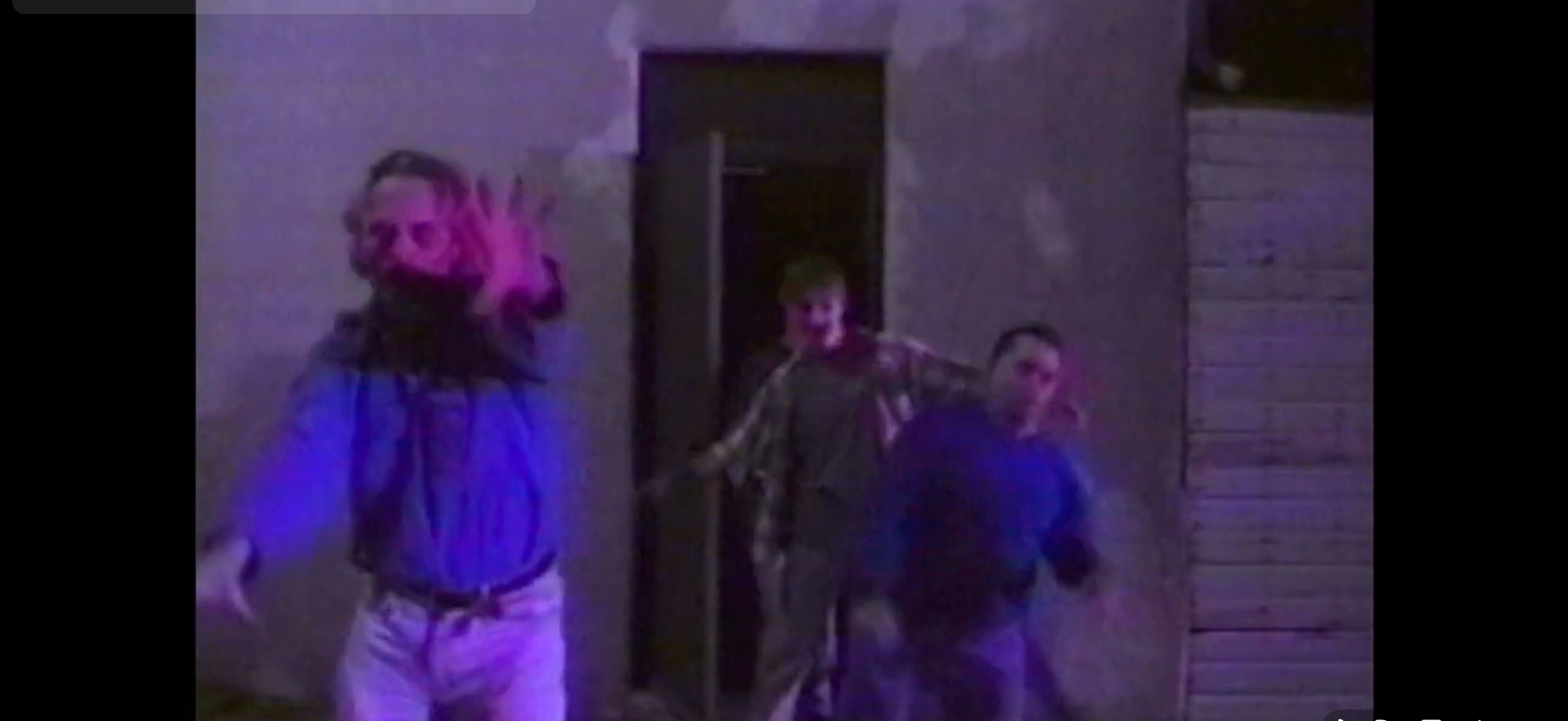
Every once and awhile you’ll come across an obscure, independent made film that just knocks your socks off in all categories.  Todd Norris’s “The Paranormal” is one of those very films.  Norris writes-and-directs the 1998 film alongside cowriter C. Wayne Owens, marking their first and only collaboration together.  Norris went on to do be an accomplished short film editor and cinematographer, working on select cheeky horror full-length features such as “Cadavella” and “Bonnie & Clyde vs. Dracula.”   “The Paranormal” is the debut film of Todd Norris, filmed in the America Midwest, Kansas City, Mirssouri to be specific.  Riding the device of being a mise en abyme, or more loosely described as a meta-film, “The Paranormal” has a novel concept that makes this film something special. 
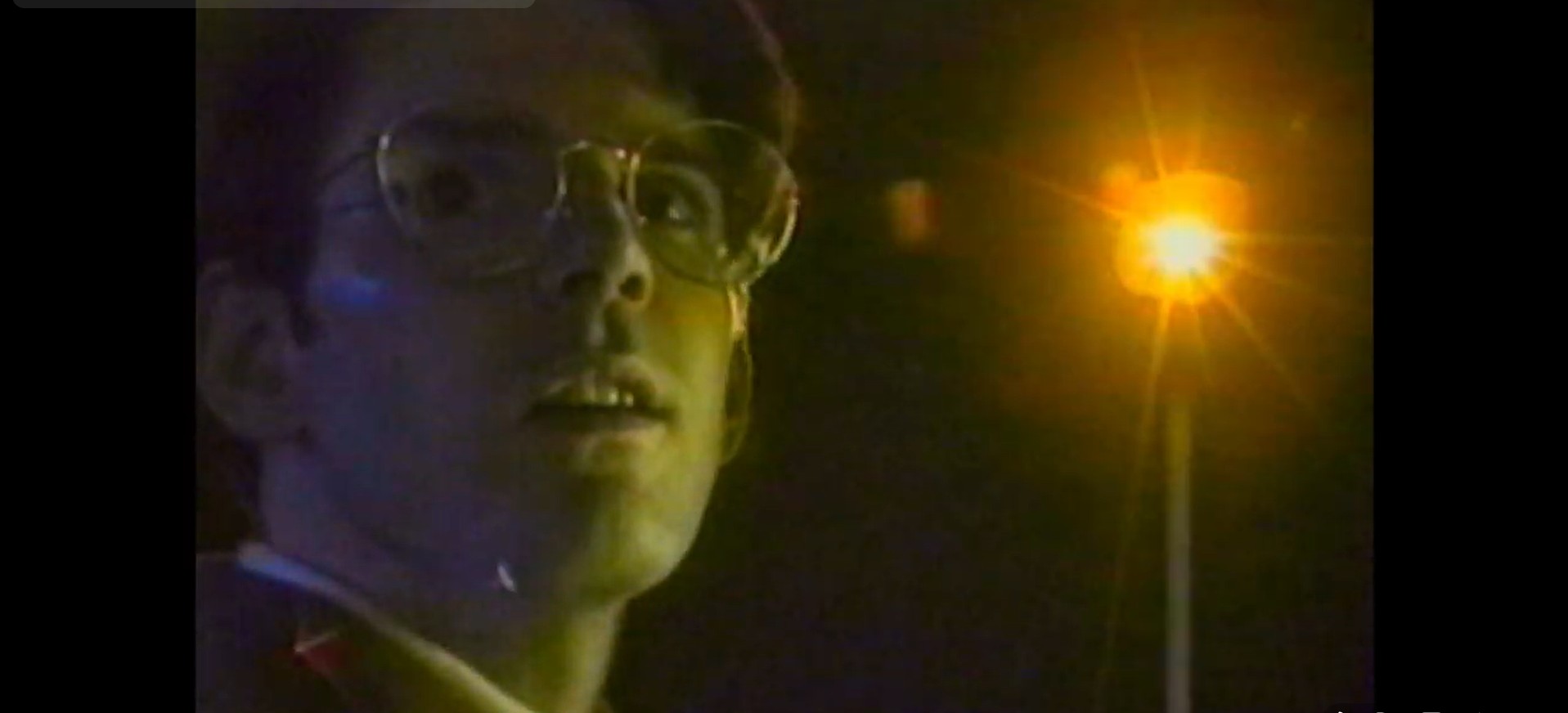
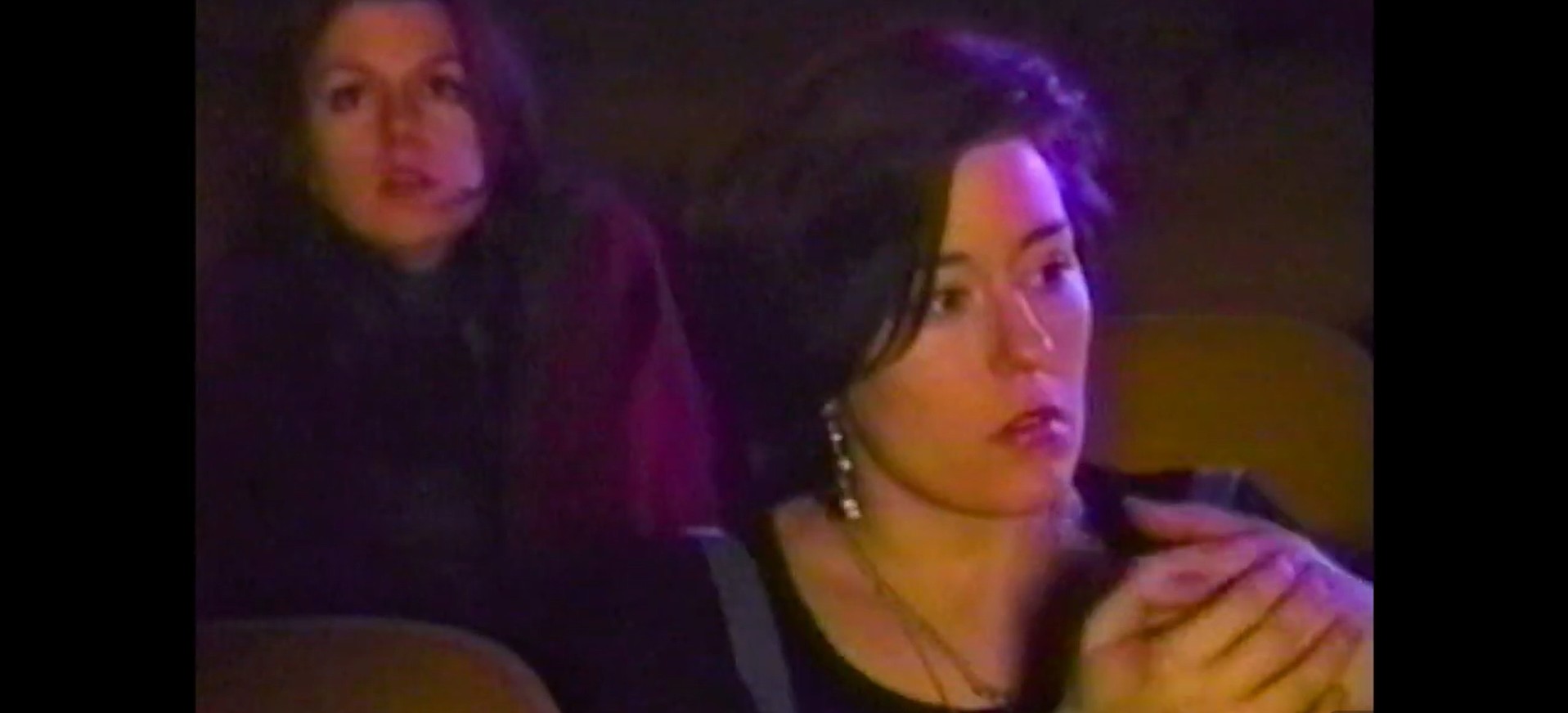
Norris not only writes and directs, the then late 20s filmmaker also starred as the lead character, a pro-paranormal scientist named Kyle Jennings who, from the opening, introductory scenes, struggles with validating his department and research that is seen as nothing more than a joke, or is even suggested to be a pseudoscience amongst cross-departmental peers at an undisclosed shared university.  As an actor, Norris never flinches from his nerdy-confident persona, dressed down to seem like a normal man with an equally dressed down obsession toward his research.  The approach and reaction of rejection is a very real-world view and response to being denied opportunity, but he’s given the chance once an unexplained occurrence in Englewood has a striking coincidence to his theorized research on paranormal activity.  Jennings is challenged by theoretical physics and science department chair head Cass Charbonneau (Lisa Winegar) who has this underlying want to believe, in a stoic, scientist indifference type way but can’t swallow the truth that something might more unexplainable out there.  We don’t really get a satisfying character arc with her character as she never really displays the change of heart or update from her rigid persona to welcome Jennings into the university scientific community.  Does he finally get accepted?  We don’t know.  Audry Crabtree and Gina Tarantino respectively play theater owner as well as Jennings’s love interest Lynne Meredith and projectionist Johnnie, providing additional strong female roles unafraid to face the supernatural front alongside Winegar.  The cast rounds out with Jennings’s colleagues and zombie movie characters with C. Wayne Owens, Carol Koehler, Brain Stubler, Jeffrey Sisson, and Davide Baldin who either support a broad pro-paranormal acceptance as we see with C. Wayne Owens moving persuasive speech to convince a reluctant Jennings to investigate Englewood and to support parts in a narrative that changes with every decisive action to keep movie zombies from entering reality. 
For a SOV film, “The Paranormal” is a case study for what to do right during principal and post photography.  Editing and special effects on tape can be cumbersome and clumsy, but Norris makes it look easy with effective sleight of hand tricks and use of multiple video tape recordings to provide overlapping effects that turned out quite well and was quite effective.  Couple that technical success with a fascinating, movie-within-a-movie storyline, there’s little to dislike about this indie feature with a big budget heart.  Horror fantasy becomes reality as supernatural forces bring the movie to life, an idea that germinated before Arnold Schwarzenegger’s 1994 action thriller “The Last Action Hero.”  While Schwarnegger’s narrative crossed realities in a bigger, more explosive way, “The Paranormal” teases the threat with brief windows of opportunity that could potentially send fleshing eating zombies into the real world.  Every time I thought the story would falter under its own narrative weight, Norris surprises me with continuous persistence in making the sequences work.  The only downside to “The Paranormal” is the mystical reel that generated the supernatural rift.  The nitrite-filmed reel didn’t receive much of a backstory on how and why it causes the in-movie movie “Z is for Zombie” to be the chosen destructor of the Englewood Theater inhabitants and, potentially, the world.  There’s a flash of a woman apparition that in conjunction with the reel’s unyielding power that, too, isn’t explained.  These inexplicable elements leave plot holes in a what is otherwise a near flawless picture. 
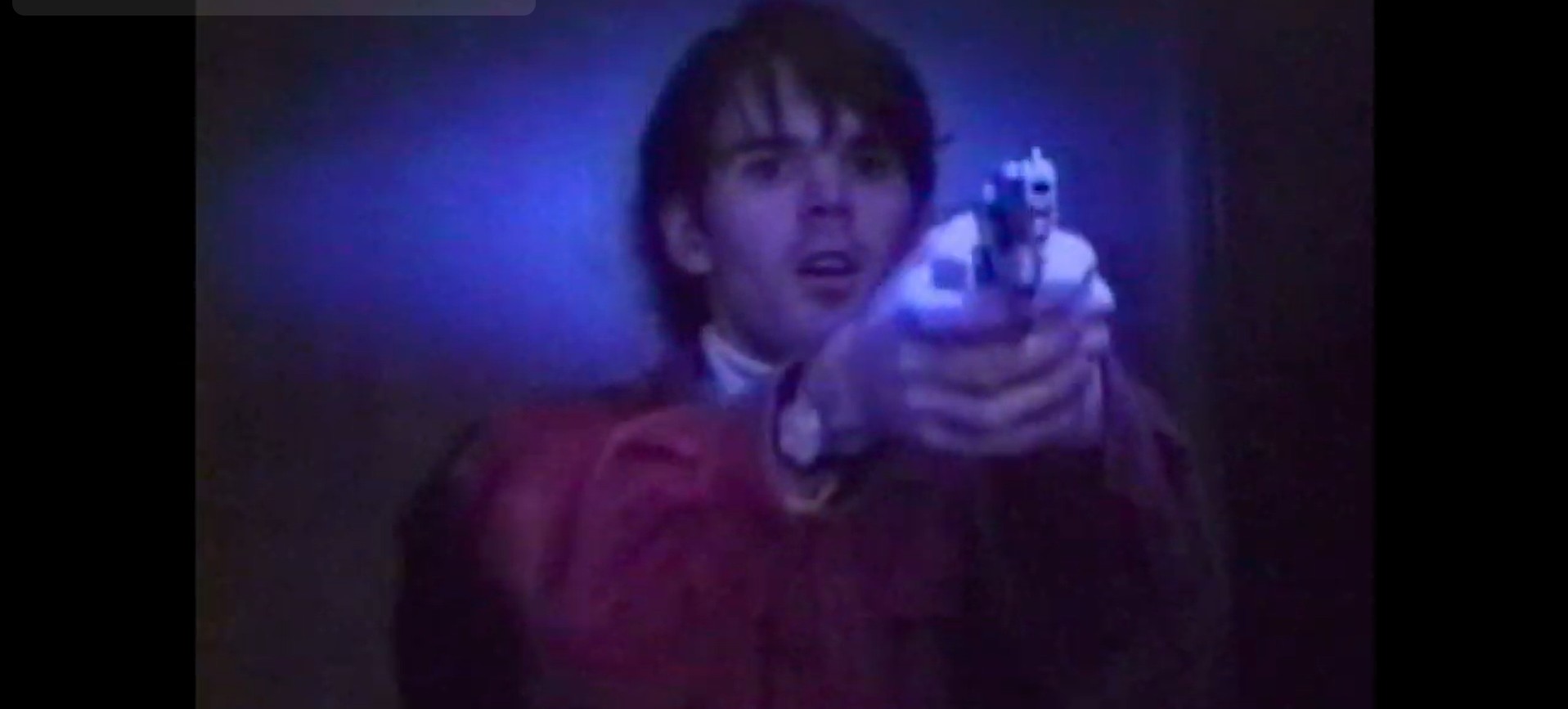
Visual Vengeance continues to drop SOV gold right into our hands.  “The Paranormal” is not only a fantastic meta-horror but now it has sex appeal with profound physical qualities.  The single disc, Blu-ray set comes AVC encoded with 1080p high-definition resolution, encoded on a BD50.  The original tape elements were scanned with director supervision and the quality of the tape retained for its original aesthetic, complete with tracking lines and a distorted, warm coloring amongst the analog anomalies associated with tape.  There’s clearly no hard-edge definition or textural allowance so you can get the feeling that you’re watching magnetic tape just as the media gods intended, exhibited in the full frame 1.33:1 with pillar boxes.  The English LPCM stereo cleanly discerns dialogue, soundtrack, and certain action aspects without the presence of sidetracking distortion, and that’s saying something for an innate original audio recording, but there’s noticeable subtle electrical interference in it’s not so robust reproduction of audio.  The A/V should come at no surprise as Visual Vengeance continues to be upfront with their releases with a precautionary statement before every feature regarding the commercial and inferior equipment used to make these types of films.  Optional English subtitles are available.  Special features are aplenty, as usual with Visual Vengeance, with a Todd Norris feature-length commentary, a second commentary with Norris and composer Paul Roberts, various cast and crew interviews produced by Norris a video interview between Norris and Lisa Winegar and subject interviews with Jeffrey Sisson and Davide Baldin, an interview session between Todd Sheets and Todd Norris as The Two Todds of Kansas City SOV filmmaking, “The Paranormal” channel 5 TV airing, blooper reel, deleted scenes, original script excerpts, a storyboard gallery, short films “The Closed, “I…,” “Night of the Growling,” and “Parallax,” and trailers for other Visual Vengeance at home releases.  The clear Amaray Blu-ray case comes with a limited-edition O-ring for the first pressing with art by graphic artist Uncle Frank.  The original sleeve art is done by The Dude and inside is a mini poster by Giorgio Credaro.  Three graphic artists given the chance to shine on one release is pretty neat.  There’s also the original VHS cover on the reverse side of the sleeve.  Inserts alongside the mini-folded poster include an faux advert for faux movie “Z is for Zombie,” a Ghost Finder for viewing entities (think a slim-downed Viewfinder but can’t see through it), and the usual retro VHS sticker sheet.  The 70-minute feature is unrated and is region free.

Last Rites: Acting, special effects, and the meta concept are all what makes “The Paranormal” a solid film of immersive fantasy becoming an on the verge of a zombie apocalyptic reality.
“The Paranormal” is a 3-D Experience Without the Glasses!

EVIL Sleeps with Women to Anticipate the Antichrist’s Arrival! “Violent New Breed” reviewed! (Visual Vengeance / Blu-ray)

“Violent New Breed” is a violent Visual Vengeance video available now!

The city of New York is under siege by a new drug as the narcotic Rapture sticks in the arms of his addicts, leaving them mindless and helpless to the effects.  At the head of the snake, a demon race known as Breeders are responsible for trafficking Rapture across the city.  Jack and Steve are part of a covert government operation well versed with the Breeder’s stimulation scheme of the junkie community. Going undercover at a Breeder establishment front, Jack concealed effort is blown and he falls to the Breeder’s vile ways, leading partner Steve, along with Jack’s teenage daughter Amy, down in the underbelly of the Breeder lair where cyborg servants are constructed and human women are led to breed more demonic spawn, one in particular in plan to be the birth of the antichrist.  In a hellish, NYC basement, amongst viscera and body part leftovers, Steve and Amy must complete the mission and stop the antichrist from reigning hell down on Earth. 

Independent horror filmmaker Todd Sheets has become a master of the microbudget horror scene since the mid-1980’s.  His evolution began with humble shorts, such as “Blood of the Undead” and “Dead Things,” with the latter being re-imagined by Sheets a decade later, and those early years really sowed the seeds of his behind-the-camera love for extreme and outrageous gore and horror as he creates low-budget horror through the years a rapid, breakneck pace, releasing titles such as the lycanthropic “Moonchild,” the anthological horror “Hi-8 (Horror Independent 8) that brings eight of the best indie filmmakers together to tell their tales of terror, and “Clownado.”  Yes, “Clownado” is, you guessed it, a tornado swirling with murderous clowns in it’s vortex.  My personal favorite has always been “Dreaming Purple Neon” for its off-coloring performances and survival-esque storyline with demons and drugs.  “Violent New Breed” is in the middle of his career having been released in 1997 with Sheets gaining traction on multiple filming locations, employing more principal and supporting cast members as well as an abundance of extras, and upping the violent tone and degenerate microcosms that transport viewers to seedier and deadlier worlds.   “Violent New Breed” is written and directed by Sheets under his early production label, Trustinus Productions, securing him a producer credit too.

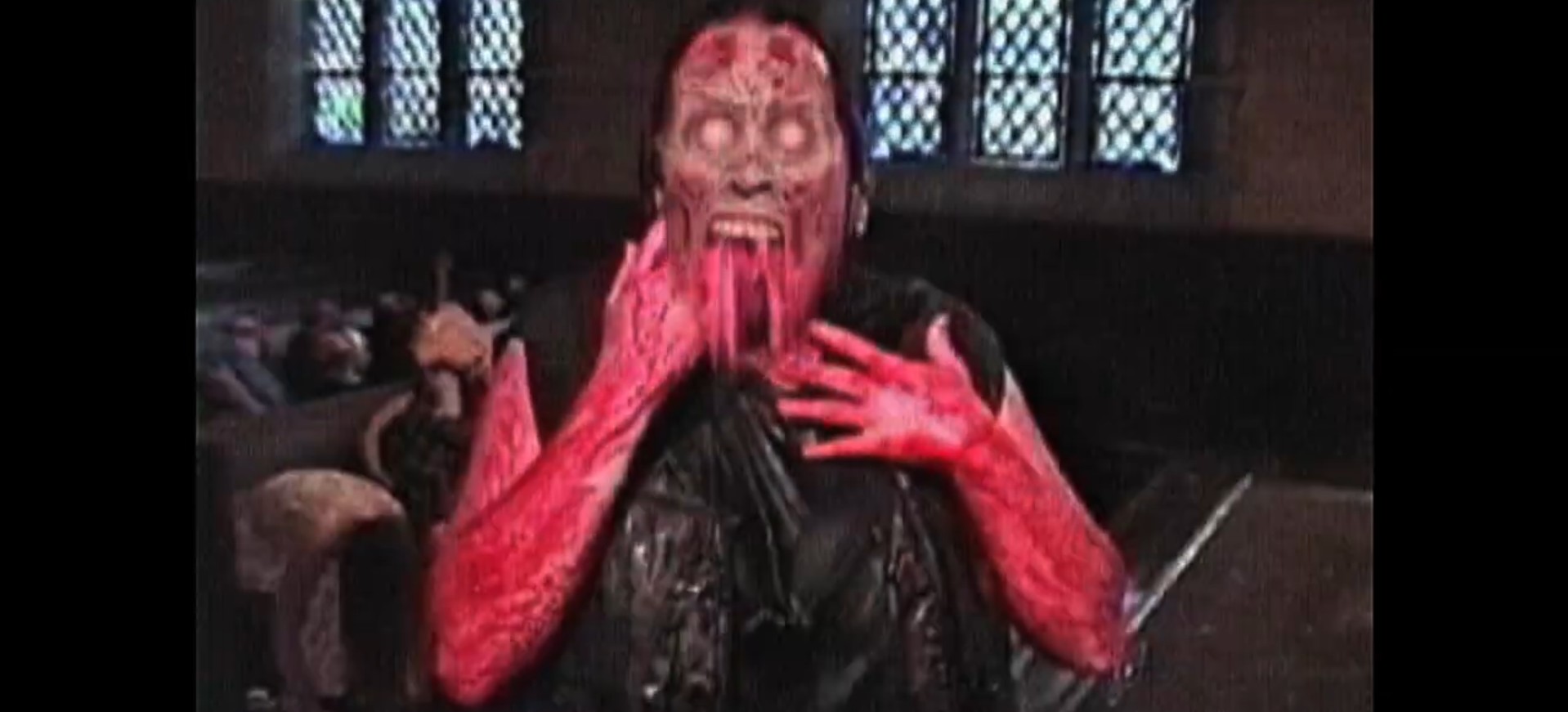
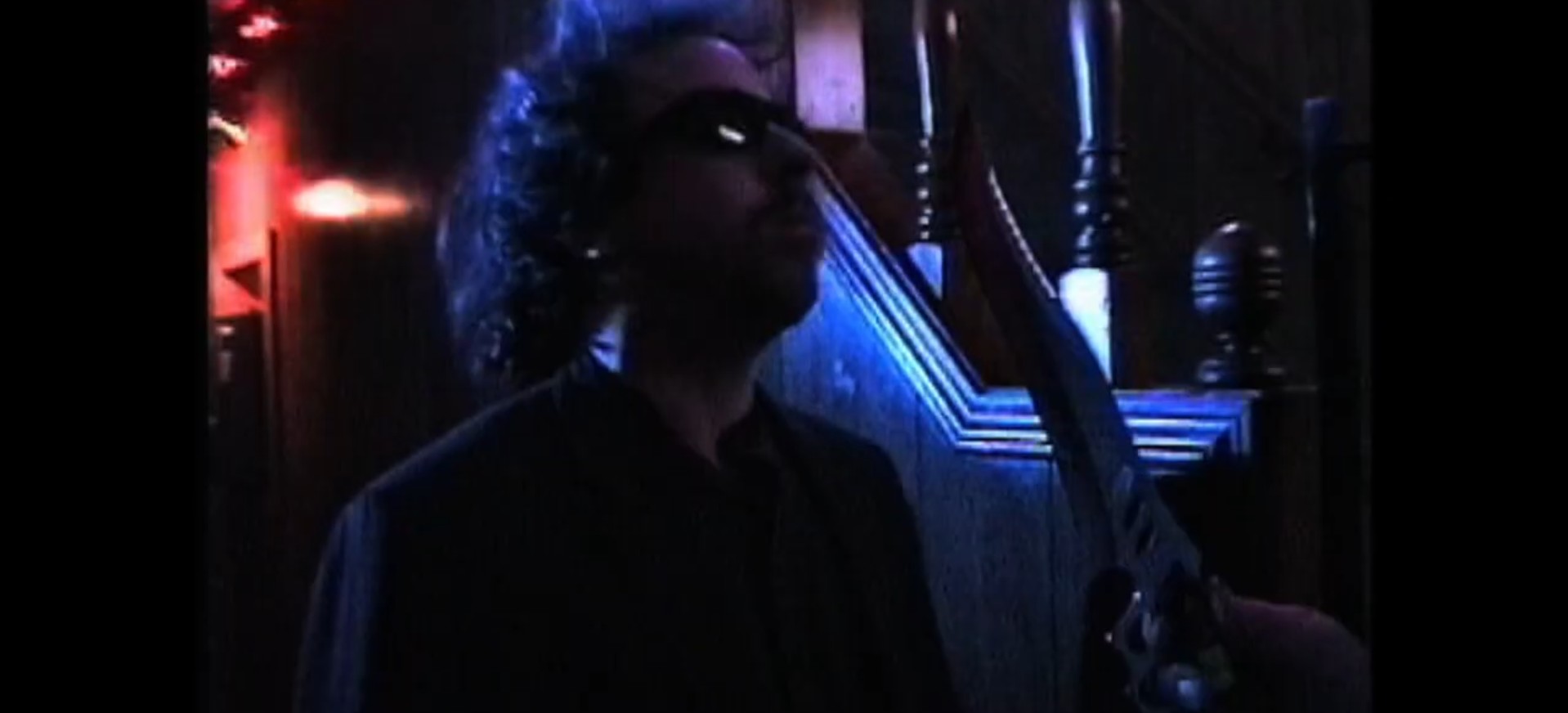
Sheets has never been the type of filmmaker to follow conventional guidelines when it comes to his characters, often switching them around or executing a red herring to flesh out the real protagonist or anti-hero.  “Violent New Breed” plays into the former with a switcheroo of the principal protagonist, initially beginning with Jack going undercover and infiltrating the Breed’s strip club bar used as a front for their demonic dealings and ending with partner Steve taking the antichrist to the finish line.  The audience will get pretty far and involved with Jack’s life as he struggles with his divorce and custody of daughter Amy (Rebecca Rose).  Mark Glover, who has worked with Sheets on “Bloodthirsty Cannibal Demons” and “Zombie Bloodbath 2,” lands the subconscious weight of personal strife as he inevitably becomes the lone cop sheep in a den of demonic wolves that leave Amy fatherless.  That’s when Nick Stodden (“Clownado”) steps into the fold as Steve.  Steve’s not terribly present in the fist half of the film but is thrust into the Breed labyrinth by duty and by promise to his partner to keep Amy safe.  Strodden plays an average hero with Steve’s bravery in plenty of supply, but the character lacks the hand-to-hand combat skills or weaponry for a government agent trained to deal with supernatural killers.   Embracing entirely Asmodeus, the slick-rick head honcho of the demon hierarchy, is “Moonchild’s” Dave Miller who rather dons the nice suit, cocky attitude, and twisted demon leader suitably despite some reckless decision-making faux-pas moments that ultimately cost the character everything he’s worked toward.  The characters a mostly filled in with little human survivors of the foreboding infernal uprising, such as with Tamara (Jenni Geigel, “The Shivers”) and Trixie (Becky Stodden, “The Shivers”) who find themselves caught in the middle, and with Rod Will (“The Shivers”), Joel Hedge, Jody Rovick (“Prehistoric Bimbos in Armageddon City”), and Andrea Ureno as numerous demons, even one that has a carcinization lower body while still resembling a humanoid at the top-half with protruding mandibles, an absurd radical efforted pulled off successfully by Sheets and his limited budget. 

Sheets’ vision has always been larger than his funds, but the ambitious indie horror filmmaker can’t be contained or constrained by the size of his wallet and the size of his heart for the genre that inspires his creativity.  “Violent New Breed” epitomizes that Todd Sheets ingenuity and the image of a horrifying tomorrow with a large cast, lots of blood, and a striving story set on the streets of New York City while not actually taking one step in the Big Apple.  Yes, “Violent New Breed” is completely filmed in the Midwest, more specifically in Sheets’ hometown and state of Kansas City, Missouri, but the urban jungle is sold through the editing with interjected NYC cityscapes. However, none of the action really happens on the streets but in enclosed bars, basements, and backalleys that could sell to be anywhere, USA. Like many other Todd Sheets productions, there’s not a ton of backstory to chief characters, such as with Jack and Steve’s covert company of infiltrating and obliterating Breeder operations in what is considered an off-the-books undertaking, not recognized officially, yet the pre-apocalypse of the Breeders’ mission isn’t worth the money or resources to warrant the assignment more than two men. Breeders also outweigh hundred-fold, have abilities to invisible-phase, and have an army of Cyborgs all with the influencing poison on the streets to control most of the human population. Sheets sets up a David vs. Goliath narrative without much fight in the heroes and heroines with the Breeders’ shortcomings breed essentially from them tripping over their own shoelaces by not taking advantage when advantage appears opportune. The heroes’ dumbluck constantly and consistently happen through the film and becomes tiresome to watch weak torchbearers fumble to save all of humanity against domineering supernatural terror from Hell!

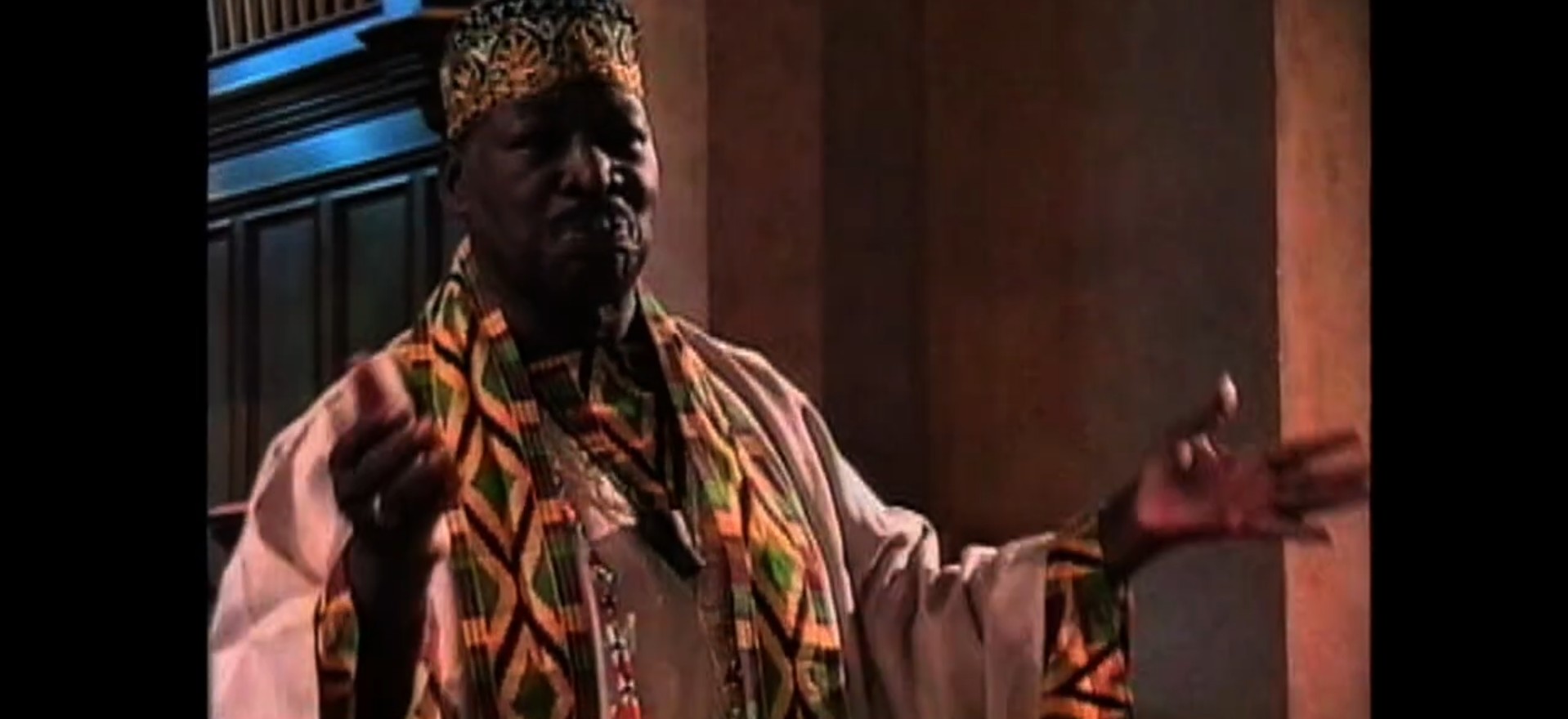
‘Violent New Breed” gets a violent-illustrated new release from Visual Vengeance. The new Blu-ray glorifies Sheets’ SOV artistic style through an AVC encoded, 1080p high-resolution, BD50. The precursing title card warning of the film’s technical imperfections through commercial or economical equipment, a wonted service by the Wild Eye Releasing’s SOV label, are not egregiously touched up but rather accentuate a cleaner, meaner version for show, presented in its original pillarbox full screen 1.33:1 aspect ratio. The world-wide debut Blu-ray contains the director approved transfer of the SD master tape elements. The faded details incline toward a warmer tone that almost seems ablaze with a glowing heat lamp just out of frame and this also, along with the 720p video, suppresses finer textures with notes of aliasing around character actions. Sheets’ color gels and hazy lighting work to an extent but there’s little pop to the graded coloring. The English Dolby Digital 2.0 Stereo offers more bite than expected out form it’s two-channel output but has some difficulty deciphering distinct layers inside the scene. Dialogue echoes and varies in volume sporadically through the picture with it also melding into the diegetic environment in a less-than-refined sound. However, dialogue does push through to an extent and is discernible with a rock soundtrack scoring through more effectively like a hot knife through butter. There are English subtitles available for selection. Packed with 12 hours of bonus content, Todd Sheet fans will receive a comprehensive look on not only a “Violent New Breed” but as the filmmaker as a whole. Those with older format copies of the film with be familiar with one of three commentary tracks on the Visual Vengeance release that includes director Todd Sheets and actors Nick Stodden, Antwoine Steele, and Becky Stodden. There’s a Tony Strauss of Weng’s Chop magazine commentary and a Visual Vengeance produced 2023 remastered commentary with Sheets and Rob Hauschild, founder of Wild Eye Releasing. Other bonus content contains an interview with actor Jerry Angell and director Todd Sheets, Sheets discussing working with the late “Dolemite” actor Rudy Ray Moore who plays the last-standing city cleric, a behind-the-scenes documentary, a 2023 Q&A session at the Nitehawk Cinema / Visual Vengeance screening, a blooper reel, a behind-the-scenes image gallery, the original Kansas City local news spot, an uncut version of the strip club entrance sequence, Todd Sheets’ 2014 short zombie-western “Fistful of the Undead” from the 2016 anthology “Grindsploitation 2: The Lost Reels,” and the original and Visual Vengeance trailers. Also included are two alternate versions of the film: the DVD version and The Movie Channel’s R-rated cut. Three movies from the prince of one! Now that you’ve gone through 12-hours of encoded content, next stop is the hefty physical content beginning with graphic artist Heavy J’s Ghana-inspired artwork on the pink carboard O-slipcover that unveils inside a more traditional-approach to Visual Vengeance’s orange, yellow, and black, character-compiled primary art for the standard, clear Blu-ray Amary. The reverse side has the original poster art of a blue-tinted negative image of an axe-wielding Breeder cultist. The insert section has a single-sided folded mini poster of the Ghana art, a trifold essay from Tony Strauss with a bio on Todd Sheets, his filmography, and on “Violent New Breed” that also includes behind-the-scene and movie stills, a single fold, cardboard birth announcement for the coming of the antichrist, and a retro sicker sheet. The 114-minute feature is not rated and is region free encoded.

Last Rites: Todd Sheets enlarges an evil urban with an insidious poison coursing through the city, taking women when they please, and bring forth the antichrist and there’s only a handful of ill-equipped humans to stand in their way. “Violent New Breed’s” Visual Vengeance release, packed with extra content and a spiffy physical presence, is a victory for Todd Sheets and all independent filmmakers like him.

“Violent New Breed” is a violent Visual Vengeance video available now!

An Experiment Backfiring with EVIL Payback. “Moonchild” reviewed! (Visual Vengeance / Blu-ray)

“Moonchild” now on Blu-ray from Visual Vengeance!

An Inhuman government body of a dystopian future experiments with genetic splicing to create the ultimate weapon, known as Project Moonchild, against the human rebellion. That weapon, Jacob Stryker, is unaware of his newly encoded abilities when he escapes one of their holding labs to rescue his captive son from the very same apathetic regime. Stryker teams up with a group of human rebels and uncover by mistake Stryker’s hidden super solider talent of turning into an unstoppable beast – a werewolf. Hellbent on taking down his son’s brainwashing captives by any means necessary and to do it before an intestinal bomb explodes within 72 hours, Stryker convinces the rebels to assist him and now they have an ace in the pocket as they traverse in search for Stryker’s boy, encountering android and mutant bounty hunters, cannibalistic human survivors, and a surfeit of governmental soldiers hot on his tail, but when the werewolf comes out, Project Moonchild is out to seek and destroy those son-stealing son-a-of-bitches by ripping them to shreds.

Director Todd Sheets has long been considered one of the kings of SOV. The “Zombie Rampage” and “Clownado” Kansas City filmmaker writes and directs “Moonchild,” the 1994 direct-to-video, post-societal, lycanthropy actioner is Sheets’ attempt in splintering himself away from the gore. The American Prince of Gore and the Master of Splatter accomplishes the lessened bloodletting and liquid innards coming outwards werewolf feature with a dystopian rescuer that pits what remains of a separatist human society on a verge of collapse to go on a quest to cure a dividing mutation affliction and to go up against the malign immortals of killers and assassins constructed with nuts and bolts and sawblades on a super independent budget. The ambitious project comes with car chases, a large cast, and a hairy beast that fights for family! Executive producer Greg Petrak returns to Todd Sheets’ side after “Bloodthirsty Cannibal Demons” and is a production of Sheets’ very own Extreme Entertainment, a now 34-year standing product company based out of Kansas City, Missouri. Feel old yet?

Playing the lab rat, the werewolf, and the integral hero, Jacob Stryker, to the story is Auggi Alvarez (“Zombie Bloodbath”) as a widowed father who will stop at nothing to save his son Caleb (Stefan Hilt) in the hands of iron-hearted inhuman leader, Lothos (Harry Rose). Alvarez, like much of the rest of the cast, fall into a monotonal expositional black hole that can make “Moonchild” a slog between the excitement. While fleeing captivity, Stryker runs into Rocky (Julie King, “Zombie Bloodbath 2”), Talon (Dave Miller, “Violent New Breed”), and Athena (Kathleen McSweeney, “Violent New Breed), a band of underground resistant fighters who are desperate enough to overthrow the authoritarian ruling class that’s comprised of henchmen with duct tape masks and are skippered by a mustache wearing an unadorned samurai kabuto helmet – catching a tad resemblance to Mel Brooks’ Lord Helmet of “Space Balls.” If you have noticed already, the cast is an entourage of Todd Sheets regulars, a small niche of actors and actress with close ties to the Master of Splatter and have reoccurring roles in most the director’s early 90s indie gems. That trend continues with Carol Barta (“Prehistoric Bimbos in Armeggedon City”) as the bounty hunter, Medusa. Looking more like your next-door neighbor grandmother, Medusa is viper-tongued assassin with an unforgettable cackle and a throaty super ability that’ll inject nightmares for nights to come. Barta’s performance is one of those cliched it’s so bad, its good acts that you have to see to believe. Cathy Metz, Kyrie King, Rebecca Rose, Jody Rovick, and Mike Hellman round out the cast.

Character names drenched with Greek mythology inspiration and a contemporary take on the werewolf canon, “Moonchild” is an interesting and unorthodox story to say at least. Todd Sheets had obviously perfected the limited capabilities of S-VHS shooting or was confident enough to build in a lengthy car chase into a project that didn’t rely on disgusting audiences with blood and guts, but rather actionable thrills and singular characters of the post-apocalypse with only a smidgen of horror. You see, the werewolf doesn’t make too many appearances on screen, only surfacing from beneath Jacob Stryker’s human skin twice in total. The wolfish transformation is shoddy but for the budget, there is an appreciation for the amazing looking effect as well as the other practical effects throughout the feature. “Moonchild’s” pacing can be concernedly plodding to make sure the exposition covers aspect of Stryker’s intentions, slowing down the film to the point sluggishness. It doesn’t help that the scripted word-for-word, automaton performances are not tonally textured with droning dialogue that can’t captivate and contributes to the fatigue at times. Though “Moonchild” is an evolving project for Sheets with conviction in his ability to produce, there are still some editing continuity blunders that downgrade the overall result. Upward closeup shots of Julie King as she looks down when supposedly holding a rifle on Auggi Alvarez show her hand mock holding a rifle as it comes into the frame and then the next cut is the actress actually holding a rifle. Another scene involving King has her smash in the head of a traitor on a concrete floor and the next shot is of her running down the hallway away from where the body should be but wasn’t. The corpse had vanished. Howlers, pun intended, like these conspicuous examples are what depreciate an already discounted movie, curbing any kind of recognition for Todd Sheets going outside his blood and guts comfort zone.

As one of Visual Vengeance’s SOV cult-horror titles, we come to expect temperamental image and sound quality from the Wild Eye Releasing banner due to the consumer grade S-VHS equipment and the novicey of the filmmakers as, and mostly related to the former, Visual Vengeance warns of prior to the start of every feature so thus far, but the 50GB, MPEG-4 encoded, 2-disc Blu-ray set, that presents the feature in 1080p of the 1.33:1 aspect ratio, is the best technical-looking SOV to date for the company. Hardly any tracking issues, artefact issues, and any tape distortion of any kind and while still lacking premium quality as we all expect today, nothing is taken away from “Moonchild’s” original SD master transfer that is a director supervised. The single soundtrack audio option is an English analogue 1.0 mono mix and the dialogue as well as the score come over nicely despite a less punchy channel output. There’s a steady, feature length electrical interference from start-to-finish that is no surprise and is not terribly audio intrusive. Depth suffers mostly with the type of equipment that doesn’t filter and level out ambient noise, but the range of sound is pleasant with the added clip tracks. English subtitles are option. The bonus features include two new audio commentaries – director Todd Sheets and star Auggi Alverz and Todd Shoots and Visual Vengeance. Other bonus features include the alternate VHS cut, Wolf Moon Rising documentary, archival behind-the-scenes cast and crew interviews featurette, the original VHS trailer, deleted ending, the Todd Sheets’ directed music video Burn the Church by the now defunct Kansas City-based, goth metal band Descension, short film “Sanguinary Desires,” trailer for Todd Sheets “Bonehill Road,” and other Visual Vengeance trailers.” The phyical release comes with a 2nd disc, a bonus audio CD of the movie soundtrack, reversible cover art featuring original VHS cover on the inside, new art on the clear cased Blu-ray snapper, and original art on the cardboard slipcover by The Dude Designs aka Thomas Hodge. Inside the snapper lining are four-page liner notes by Matt Desiderio, folded mini poster of the snapper front cover, and the standard VHS throwback sticker sheet. “Moonchild” on a Visual Vengeance Blu-ray comes unrated, region free, and with a runtime of 87-minutes. Todd Sheets is a maniacal moviemaking machine with “Moonchild” being released a decade after the gorehound began and there’s plenty of admirable spirit and effects in the Kansas City werewolf in dystopia tale, but one can’t shrug off the oversights and the exasperating exposition that goes way off trail the turbulent path of indie filmmaking.

“Moonchild” now on Blu-ray from Visual Vengeance!

Crawldaddy and Her Two EVIL, Incestual Kids in “Skinned Alive” reviewed! (Tempe Digital and Makeflix / Blu-ray UE)


Crawldaddy and her two children, Violet and Phink, are psychopathic makers and sellers of fine leather apparel right off the backs of, well, literally ripped right off the fleshy backs of anyone they come across! When their van breaks down in a small, dumpy, low-bred Ohio town, Crawldaddy is forced to play nice with the town’s only mechanic, Tom, who offers a complete line of unreciprocated hospitality to the strange out-of-towners, but that doesn’t stop her and her children from committing slice and dicing of the local residents while bunkering in Tom and wife’s basement spare room. When Tom’s neighbor, Paul, an alcohol abusing ex-cop on the edge as a result of a brutal divorce, senses trouble and discovers Crawldaddy’s den of skin, the quiet small town explodes with bullets and blades in a macabre showdown.

Forget the Firefly family that has brought backwoods kin-in-arms killers to the masses in vogue fashion. Otis, Baby, and Captain Spaulding have nothing on Crawldaddy’s foul-mouth, foul-smelling skinner family who ranks as the top trash, living the nomad lifestyle with all the depraved trimmings of the criminally insane. Written and directed by Jon Killough, who after working on J.K. Bookwalter’s “The Dead Next Door” and “Robot Ninja” in multi-hat roles, “Skinned Alive” was bestowed a greenlight by Bookwalter to explore the creative side of Killough’s vile and offensive laden hillbilly horror that was released in 1990, before that very subgenre was coined and monetized years later. David DeCoutea, who envisioned the eviscerated virtuoso of the gruesome filmmaking talents from Todd Sheets to J.R. Bookwalter, served as executive producer and Bookwalter’s The Tempe Suburban Company tackled “Skinned Alive” with all the ingenious bloody pizzazz and outlandish death set financier and production company while filming the project in Ohio.

Since The Suburban Tempe Company is a tight-knit production company, familiar faces from Bookwalter’s previous films have been cast, beginning with Paul Hickox, the ex-cop with a drinking and ex-wife problem, played by Floyd Ewing Jr. The Hickox character crosses over from “Robot Ninja” into “Skinned Alive,” but exhibited in a dichotomous life position. While Ewing nails being a man dragged through the pig slop of divorce, Paul feels cut short with the amount of buildup written for the character that’s centered around ex-wife woes of losing his house and kids, depressed into drinking, and has to deal with a sleazy lawyer whose also litigating his former wife in a court of a sex. However, “Skinned Alive” is all about the bad guys.  In the majority of horror films, the bad guys are always the most interesting because of their rancid flavored persona and for our culturally-collective love of the eccentric, the offbeat, and the grim of villainy.  Crawldaddy embodies those despicable characteristics without so much of breaking a sweat with a abhorrent-welcoming performance by the late Mary Jackson.  Jackson, who went on later to work Bookwalter again in a minor role in “Ozone,” is transformed from a singing beauty to a basket case of a wretched, wheelchair bound hag, unearthing her uncouth Hyde at the flip of a switch.  Jackson is complimented by Susan Rothacker as the alluring-but-deadly Violent, a roll filled in the last minute by the film’s makeup artist when things didn’t work with Jackson’s daughter Lorie, and the one and only Scott Spiegel as Phink.  The energetic Spiegel has been a part of the longstanding Sam Raimi entourage, having minor roles in Raimi films, such as “The Evil Dead,” “Darkman,” and “Drag Me to Hell,” and when “Skinned Alive” became in need of a Phink, Spiegel may have just saved the film by his presence alone as the “Intruder” and “Dusk Till Dawn 2:  Texas Blood Money” director brings the manic ticks and callous charisma to Phink’s traits.  Rothacker ups the character dynamics with Phink as the pair’s love-hate relationship is a slap-stick of incest and homicidal cravings that fits right into the vile veneer of the story.  “Skinned Alive’s” cast rounds out with Lester Clark (“The Dead Next Door”), Barbara Katz-Norrod (“Kingdom of the Vampire”), Mike Shea (“Robot Ninja”), Mike Render (“Robot Ninia”), J.R. Bookwalter as a tortured Jehovah’s witness, and Jon Killough as an unlucky the hitchhiker.

As Killough’s indirect byproduct of Tobe Hooper’s “The Texas Chainsaw Massacre,” “Skinned Alive” is the skewed, bad dream version of the devious Sawyer family with heavy notes of black comedy chucked into the fold for an all-out odious assault on all fronts, but Killough’s first and only feature didn’t come out totally unscathed as a harmonious horror-comedy.  With little film stock left to shoot with and production controversial new scenes written by Killough and then altered by Bookwalter without consent, “Skinned Alive” became a rapid fire production of short shots compiled together that resulted in a choppy flow.  You could also discern which filmmaker wrote which dialogue in the filler scene between ex-cop Paul and his ex-wife with her sidepiece arrogant lawyer; Bookwalter adds witty, if not smart, dialogue to reinforce Paul’s degrading life while Killough’s dialogue for the rest of the feature is an expletive warzone without much of a strategy.  Both discourses work for the benefit “Skinned Alive,” but do cause a blatant, patchwork barrier between the conversing styles.  David Lange and Bill Morrison’s special effect makeup work is a complete continuation from “The Dead Next Door” and “Robot Ninja” of rendering gooey, gory visuals on a budget.  Sometimes, yes, you can see how unflattering the realism can be and easily securitize the flaws, but at the same time, the ingenuity trumps over cost and that elevates the effects beyond any dollar figure the film might cost.  That partial prosthetic of ripped flesh on Spiegel’s Phink when he’s hot in the face is one my favorite effects not only for the gruesome details, but for also its versatility.  It could easily be a bear claw swipe or a flesh eating bacteria, making the possibilities endless for Lange and Morrison.  Thirty-years later, “Skinned Alive” has preserved a rightful staunch cult following for it’s unparalleled grotesque veneer that will endure to linger for another 30 years plus thanks to technological advances and vehement filmmakers who are also filmic preservationist like J.R. Bookwalter.

Speaking of which, J.R. Bookwalter and his company, Tempe Digital, has painstakingly restored “Skinned Alive” and released it on a region free ultimate edition, dual-format Blu-ray/DVD, distributed by Makeflix.  The original 16mm A/B roll cut negative was scanned in 2K and is presented in the retained 1.33:1 aspect ratio.  The scan brought the transfer int a low-contrast in order to color correct and bring more life into the presentation from previous untouched versions and removed all of the white speckled dirt and scratches from nearly much of movie; a silver-lining made possible by COVID-19 quarantine that allotted the time to do so.   The color grading now has a much more vibrant appeal though slightly losing details from the high contrast with some of the more brilliant red glowing scenes in Tom and Whinnie’s basement.  Limited to 1000 pressings, “Skinned Alive,” the 30th Anniversary ultimate edition, by visuals alone, should be blipping frantically on any avid collector’s radar and sought by all genre aficionados.   The English 5.1 DTS-HD Master Audio surround sound stem from the DA-88 tape archives of the original 16-track audio masters and while much of the dialogue and musical score remained, a good chunk of the ambience and effects were rebuilt and remixed, defining a clearer, cleaner audio track presentation of balanced levels from all different file sets.  Aside from some small synchronization issues between the dialogue and the scenes, the range is pitch perfect and the depth is excellent.  There are optional English and Spanish subtitles included.  Bonus features, you say?  The ultimate edition has you covered with the BR disc one containing a 2020 commentary with writer/director Jon Killough and moderated by Tempe historian Ross Snyder of Saturn’s Core Audio and Video as well as a 2002 audio commentary with producer J.R. Bookwalter and makeup effects artist David Lange.  Other new material includes a 16 minute featurette entitled “Carving Up 30 Years of ‘Skinned Alive,'” featuring a number of interviews with the cast and crew recollecting good times on set, a remembering Mary Jackson featurette that includes Jackson’s son and daughter, among cast and crew, commemorating the Crawldaddy actress, an interview with Scott Spiegel, 2020 location tour, artwork and promotional gallery, behind the scenes gallery, production stills, and, my personal favorite, J.R. Bookwalter walking through the restoration process step-by-step giving insight on the time and effort into restoring the films such as “Skinned Alive.”  Disc 2, the DVD, includes a 2002 audio commentary with Doug Tilley and Moe Porne of The No-Budget Nightmares Podcast, the 1987 and 1988 “roommates” TV sitcom episode featuring the “Skinned Alive” cast and crew, the Joy Circuit “Love Turns to Darkness” music video, a making off featurette of “Skinned Alive,” behind the scenes, Camera and wardrobe tests, a short 2 minute segment about the 2002 remastering and the original DVD release trailer.  That’s not all!  Let’s not forget to mention the equally packed release package that includes a reversible wrap featuring original 1990 VHS artwork in the casing and new cover art by Alex Sarabia on the slip cover, plus an eight-page color booklet with liner notes by Ross Snyder.  The only thing missing is a soundtrack CD compact…wait, there is one!  Come September 18, the original motion picture soundtrack, featuring 29 tracks, will be released with scores composed and performed by J.R. Bookwalter, songs by Hang Dangle, Foxx, Virgil Pittman, Joy Circuit, Dave Jackson and Kenny Boyd, Seven Sez U, The Ninja Sequencers, and Willie and the Wagon Wheels.  This 2-disc set is the holy grail for die hard “Skinned Alive” fans who know and appreciate the unique, second to none hillbilly horror that’s flagrant on every level.

Pre-order the soundtrack!!! Click to go to Amazon.com

EVIL Waited 30 Years. Now It’s Unleashed! “Zombie Rampage II” reviewed! (Wild Eye Releasing / DVD)


A zombie ravaged world divides survivors into gangs. In this case, two warring rivals, a group of decent folk versus cannibalistic savages, spar over little territory left untouched by the undead. Seeking tactical advantage, the contentious factions either scheme a plan for appropriating the land while the other recruits and trains an inexpert survivalist to better their odds against one another. Leave it to humanity to still be the most dangerous animal on Earth during a zombie apocalypse when an armed showdown opens the doors for death and the undead to wreak havoc on the best and worst parts of being human.

Full disclosure. I have never seen or even sought out Todd Sheets’ renown direct-to-video, zombie epic, “Zombie Rampage,” from 1989. So, when the opportunity came around to check out the sequel, “Zombie Rampage II,” presented on a Wild Eye Releasing DVD, I jumped at the chance to witness the anticipated follow-up despite the sequel not being steered by Sheets himself. The “Bonehill Road” director’s involvement extends to the credit of producer and co-writer of the aborted 1990 sequel, which had unearthed VHS footage repurposed for the 2019 release, while Alexander Brotherton makes his directorial and script debut the new material and Mike Hellman and Charles Gooseman, who were a heavily involved duo of the original discovered footage, are credited as co-directors. In the last few years, Brotherton’s been a staple of Sheets’ films in some skeleton cast and crew capacity from the satirically bonkers “Clownado” to the narcotically world toppling chaos of “Dreaming Purple Neon” and with full confidence in Brotherton, therein lies sanctions for the filmmaker to pay homage to the 1989 original with its own shot-on-video rendition that maintains that gritty VHS integrity, continuing to be a financial churned out by Todd Sheets’ production company, Extreme Entertainment, which has been goring out content since 1988 and that makes “Zombie Rampage” and “Zombie Rampage II” larger than life, honorary bookends to Sheets’ continued indie success.

Cast is comprised of Sheets’ entourage of actors and actresses, starting off with Antwoine Steele whose reprising the afro-sporting, smooth talking, lady loving, ass-kicking Durville Sweet from “Zombie Bloodbath 3: Zombie Armageddon.” Steele steals the show with his indifferently foul mouth Sam Jackson approach that somehow manages to spin into a favorable personality trait. Another show stealer is Dilynn Fawn Harvey serving a plate of scantily-cladded roughness with the sexually suggestive Hot Stuff. Harvey jumps at the opportunity to show off her chest again while being the sultry lass who never has to be the dame in distress. Both Steele and Harvey are bigger than life on screen and that trend continues with other key players in Jack Mccord as the cross-dressed Mr. Hyde, leader of the cannibal gang, Eve Smith as an androgynous warrior for the good side, Jay Perkaple as the inept survivor recruit, and Skyler Roberts as a psychotic cannibal with a severed finger partner in crime. The supporting cast is made up of Daniell Bell, Carol Word, and Jenny McCarty.

“Zombie Rampage II” is a rough, SOV mix of black-to-satirical humor and a healthy amount of zombie carnage that isn’t a direct sequel. Don’t expect the carnage to be overwhelming complete and gory as the low budget bullet flatlines the realism of any kind of flesh-eating horde violence, but that lack of zombie realism is to be expected from the kitschy quality that seals in air tight the stank of the 30-year-old VHS predecessor. Yes, mistakes and miscues will be a natural condition of a penny-pinched film, such as a conspicuous train passing by in the background during a supposed zombie desolated world, fight sequences that will be hilariously and horrendously overstated, and the gore would be nothing more than quick explosive flashes of red matted paint and be about as Wharferin thin to the point of being limpid clear. Yet, what bothers me the most out of everything is the drifting flimsy and anorexic plot that initially emphases on finding Stewart and his assimilation into the gang of well-versed survivalist, but then grossly upends more for a battle of territory between gang one and gang two with a final showdown involving Durville swinging a colossally fluorescent, two-sided dildo as a num-chuk and the bashing of heads in with foam covered kids’ toy bat that you can purchase offline for $10. There’s a crude and abnormal sense of poetry in that scene involving an adult’s orifice stuffing sex toy with a children’s athletic plaything being combative instruments in the same scene, but for the sake of not going off on a tangent, “Zombie Rampage II” bares little plot growth that flaunts more tasteless humor than rampaging a zombie chorus and the destruction that leaves in it’s wake.

For fans sworn to be loyal acolytes of Todd Sheets, take a long, hard gander at “Zombie Rampage II” on DVD home video from Wild Eye Releasing on their Raw and Extreme banner. Those who’ve waited for a sequel will be pleasantly surprised in how the video presentation and quality are comprised of two similar but distinct formats with a letterbox 16:9 in the recently shot video that bookends the letterbox 4:3 footage from 1990. Both formats are heavily lossy in providing a detailed presentation and express vapid color that comes to not surprise inside a production value cost little-to-nothing at all. “Zombie Rampage II” definitely harks back to the demeanor of a shot on video film where quality is but an intangible illusion compared to the unfathomable gore that fills the quality caliber void, but to my shock, there is just not enough fake blood in the sequel to justify a purchase of a subpar quality pardon. The English language single channel stereo output caters to the same lossy conditions of a low bitrate amplitude with a stiffened dialogue track and poorly edited stock foley inserts. Again, all telltale attributes of an indie video recorded classic that’ll certainly get SOV and Todd Sheets’ fans rocks off. The only special feature amongst a model static menu available is the film’s trailer, but the visceral DVD cover, distributed by MVDVisual, has a milky eyed zombie grotesquely chowing down viscera that’s very poignant of a Raw and Extreme title and very welcoming, eye-catching package feature. There are bonus features before and after the feature with a fake trailer for “Durville Sweet and the Lost Temple of Ass Pirates” and bloopers during the rolling credits. “Zombie Rampage II” covers 30-years of ground, breaking the laws of time, and giving retrograde VHS and Todd Sheets aficionados what they want – blood, boobs, and butchery.

“Zombie Rampage II” on DVD!