What EVILS Lie After Death? “We Go On” reviewed! (Lightyear Entertainment / Remastered Blu-ray)

Get Haunted as “We Go On” is now on Blu-ray!

Miles Grissom lives in fear every minute of his life.  What scares the editor of shoddily performed, midnight television infomercials the most is the unknown after death.  The question is Is there a life after you die or is there just a black void of nothingness?  To answer that existential question, Miles places a quarter page newspaper ad seeking an ounce of proof of the afterlife with a $30,000 reward attached for one single person who can show him that there is an existence beyond death.  With the unconditional support of his mother, he scours through hundreds of fakes, solicitors, crazies, and the like until he narrows down the advert answerers to a few possibilities that have real promise.    As Miles investigate the claims of each one, he finds himself closer to the truth than he ever wanted to be and now he’s forever trapped between existential planes for the rest of his life.  

One of the longstanding and biggest questions in the universe is what happens to us when we die?  Where does our immortal soul, the individualistic essence of our being, wander to after the corporeal shell is empty?  Or does it just poof vanish, like an extinguished candle flame?  While all of these questions can be up for philosophical debate amongst the various, and often contentiously stubborn, religious groups and cultures, filmmakers Jesse Holland and Andy Mitten use the idea for their 2016 drama-horror “We Go On” that gives one possible, uncontested and cinematically electric, explanation as well as imparting a somethings are better left unknown dread.  The duo behind “YellowBrickRoad” returned to write-and-direct their sophomore U.S. production with a principal photography location shoot in Los Angeles.  “We Go On” is produced by Logan Brown, Irina Popov (“Chilling Visions:  5 Senses of Fear”), and Richard W. King (“The Witch in the Window”) under the production banner Filmed Imagination.

Miles Grissom is a mild-mannered and scared into solitude individual.  His loneliness, though not conspicuous to any extent, extends to his profession of a video editor of infomercials and other overnight television programming.  Agoraphobia and thanatophobia keeps Miles securely isolated in his modest apartment building where a recurring dream of a car accident sends his heart racing, a side effect of a core, back history moment yet to be explored when we meet Grissom, who is played by a stiff, but gets the psychologically wounded character across, Clark Freeman who has worked previously with Holland and Mitten on “YellowBrickRoad.”  “Cat People” and “Superman III” actress Annette O’Toole fills in as Miles’s ride-or-die, overprotective mother with a deep, dark secret of her own coated with a thin film of backseat family drama that’s doesn’t make her character shine like it should, especially being an important piece and highly influential to Grissom’s character.   Instead, the exposure of the secret and the impact it’s supposed to have is left on the backburner for Nelson to come into play, a greasy airplane janitor with deadly drug problem in what can be described as the best Sean Whalen role he never played with Jay Dunn filling those janitorial coveralls.  Dunn, who would go on to have a role in Andy Miton’s solo project, “The Harbinger,” dons slicked over balding hair, grimy teeth, and a deep, sunken eyes to be a bane toward Grissom’s existence and while Dunn doesn’t have dialogue for half of his onscreen time, he makes for a perfect hang around the background, meanspirited glarer.  The rest of the “We Go On” cast pop in and out as Grissom dwindles down his list of fakes and phonies with appearances from Laura Heisler (“YellowBrickRoad”), Giovana Zacarías, and the always wonderful on screen, “Gremlins 2’s” actor, John Glover, as a scientist trying to scare Grissom into giving him the reward money.

“We Go On” encases more drama elements than horror but the circling horror imagery enclosed has a beautifully grim layout with the minor touches, such as the slow turn of a hanging corpse or the statement of a ripe smell of a long dead overdose victim, that add a palpability, reinforcing the horrific moments and increases the ghastly tension.  The further we journey with Miles Grissom in his obsessive search, the grislier the imagery gets in what is essentially a two-part tale that firstly puts us and Miles on the hunt for life after death that quickly nosedives into a leeching supernatural torment.  Oddly, Grissom takes his newfound nuisance almost instantly in stride with not a ton of obstacle or self-realization work to warrant an acute enlightenment of how to handle an orbiting ghost that flashes disturbing images every other minute inside his mind and allows him to see between the planes of other gruesome ghosts stuck in limbo.  There are other examples of these sudden reversals or improvements that work against the pacing and don’t invite reward through struggle or pain in what is a walk in the park for Miles Grissom to see and handle ghosts being introduced to audiences as a man emotionally crippled by a traumatic, underlying fear.

Via Lightyear Entertainment, an American coast-to-coast independent film distributor, “We Go On” receives the Blu-ray treatment with an AVC encoded, 1080p high-definition resolution, BD25.  There’s little information regarding the remastering of the film with the only kick up being a digital restoration and enhanced visual effects and touchups to provide a smoother, cleaner picture presented in the film’s original anamorphic widescreen aspect ratio of 1.78:1.  Having never watched the DVD or first Blu-ray version, I have to take Lightyear’s restoration at face value which does have a crisp, clear picture full of natural color and graded with brilliance that sometimes makes the picture look too digitally sterile with not a ton of contouring shadows that can make the picture look depthless at times.  The infused visual digital f/x add about the same flavor, but the images never linger on screen, turning brevity to the film’s effects advantage.  No apparent issues with compression on the 25gig BD; textures modestly tactile despite the bright and airy grading and blacks are deeply saturated with spectrum banding.  The English language audio options include a lossy Dolby Digital 5.1 and a lossy Dolby 2.0 Stereo.  Dialogue is clear and projecting over the other layers but lacks that full-bodied, full-channeled trait of lossless.  Supernatural effects find distinctive ground and synch greatly with the sudden scares in transition between reality and the ghost realm.  Range and depth are favored by the remastering in the scenes that warrant both, such as the LAX’s airstrip takeoffs that considers the jet plane’s positioning in the background or above, increasing steadily the jet noise volume whenever a plan is in the extreme background to a more overhead location.  Also added for the remastered release are three new, feature-length commentaries:  two with the individual directors in Andy Mitton and Jesse Holland with the third houses the two stars, Annette O’Toole and Clark Freeman. The clear Blu-ray Amaray arranges a darker composition cover art than what the movie actually entails with an interior disc pressed with the same cover and a reversible cover that has one of the more memorable scenes from the feature. There are no insert materials included. The region free, unrated release has a runtime of 89 minutes.

Last Rites: You get what you ask for is the moral of the story maxim in Andy Mitton and Jesse Holland’s “We Go On,” a commercially technique, light-weight thriller with a thin lining of grim imagery between drug overdoses and suicide and adequate performances by Annette O’Toole and Clark Freeman that drops the everlasting question of desire and extreme, emotional fear for instant peace of mind, even if experiencing the terrifying truth firsthand.

Get Haunted as “We Go On” is now on Blu-ray!

Is this EVIL Real or is it a “Deathdream” reviewed! “(Blue Underground / 4K UHD and Blu-ray Combo)

The Nightmare is Here. “Deathdream” on 4K UHD Blu-ray!

The Brooks family just sat down for dinner before receiving a personal house call by a military commander, conveying the tragic killed in action telegram of their son Andy during a Vietnam War skirmish.  Very early next morning, Andy inexplicably arrives at their doorstep and the whole family is elated with his return and relieved in the military’s gross error about his death.  But something isn’t right with Andy; he isn’t the same affable young man his family and friends knew.  All day, every day Andy sits in his room, gliding back and forth in his rocking chair, won’t eat or drink anything, and has the social personality of a slug.  While his father can’t grasp Andy’s bizarre behavior, his mother defends him, being overjoyed, comforted, and relieved by her son’s safe return.  Anybody who comes close to discovering what Andy has done or has become is preyed upon by Andy’s need for concealment and need for blood. 

If there was ever the quintessential anti-Vietnam War film, Bob Clark’s “Deathdream” is it.  The 1974, Alan Ormsby (“Cat People,” “The Substitute”) scribed grindhouse classic introduces combat shock to audiences through a macabre and ghoulish lens as the U.S. involvement in the Vietnam War came to an official end in 1973.  Before becoming one of the holidays’ household names with “A Christmas Story” and “Black Christmas,” Bob Clark sat in what would be one of his first films as a director, a film that wasn’t sold in taking just one title having also been bestowed “Dead of Night,” “The Veteran,” “Night Walk,” and “It Came from the Grave.”  The U.S.-based shot and crewed feature, filmed in and around Brooksville, Florida, is a production of Quadrant Films and Impact Films with United Kingdom producers Gerald Flint-Shipman, Peter James (“Children Shouldn’t Play with Dead Things”), and Geoffrey Nethercott (“Blue Blood”) with John Trent and Bob Clark coproducing.  

For the ambiguous terror of “Deathdream” to work without baffling audiences to a nonsensical death, the cast had to really give it their all and not only that but also sell the deteriorating dynamics of an American nuclear family when the son returns home strangely different from then when he left for war.   The debut film of Richard Backus, playing the reclusive and uncharacteristic Andy who has returned home from the battlefield, is complimented by the heart-wrenching performances miseries of his onscreen parents in John Marley (“The Dead Are Alive!”), as the distraught father over Andy’s peculiar behavior, and Lynn Carlin (“Superstition”), as the denialist mother who can’t or won’t see the issues with Andy, the gift of her little boy returning home. Not only does Andy’s return ignite a slow-burning divisive wedge between parents and child but it also exposes pre-war schisms that were long established years ago.  We’re initially introduced the family sitting around the dinner table filled with compassion, hope, and happiness but Andy’s return kicks the wasp’s nest and we can see their true nature.  The father is a crotchety, dogged man who can’t connect with a more sensitive son and the mother spoils his only boy the point where Andy must enlist himself voluntarily to prove something to toward his father’s disappointment.  Then, there’s sister Cathy.  Poor sister Cathy, the gentle, positive, and sweet daughter who is all buy nearly forgotten by her parents as they push her out of the way by her father stating to mind her own business or is exclaimed in so many words of her little worth in compared to her brother by her mother.  Yet, Cathy, played softly and attractively by Alan Ormsby’s then wife, Anya Ormsby (“Children Shouldn’t Play with Dead Things”), continues a cool and level head about her shoulders as the only true family member willing to give Andy time, to let him be himself, while acclimating back into society, let alone his family.  However, the family’s opposing forces is ultimately what destroys them in conjunction with Andy’s terrible, morbid secret.  Henderson Forsythe, Jane Daly, Arthur Anderson, Michael Mazes, and David Gawlikowski fill out the cast.

All of the costly signs of shell shock and PTSD are present within the context of “Deathdream,” blanketed under a sensationalized, representational guise, but the film’s cinematic façade of Tom Savini’s rot and decay special effects and the appalling imagery of living death doesn’t alleviate or even dilute the horror of the revenant in the actual disorder.  In fact, it pales in comparison if you ruminate on it for a while.  Andy’s withdrawn from the likes of acquaintances, friends, and family alike and is severely impassive at signs of cordiality.  Director Bob Clark emphasizes the effect even further in one scene where a World War II veteran anecdotally describes in nonchalant detail the death of a brother in arms and this flashes images in Andy’s mind of him and his friend’s own mortal wounds in the jungles of Nam, sending the young man into a minor fight or flight moment, two of the associated signs of shell shock:  fight and flight.  Within the sensationalized horror context, Andy requires blood to keep his body from decaying, like a reanimated corpse trying to hang on a little long before his skin and muscle tissue just seep and ooze off, and in one scene of attack, Andy shoots up his victim’s blood with a hypodermic needle in a reminiscent drug addiction scene of shooting up narcotics right into the vein of one’s arm, an experience afflicted on many PTSD vets. Ormsby’s script might be specific in the anti-Vietnam War propaganda but is not so detailed in the narrative’s whys and wherefores as much of Andy’s unlikely, and undead, return to his family falls into that inexplicable, ambiguous, “Twilight Zone,” and “Tales from the Crypt” category to foster a greater cloud of mysticism and darkness around the story, one in which has a hopeful, desperate mother conjure will and desire in order to see her son come home again.

In continuing to upgrade their catalogue to the best possible format currently available, “Blue Underground” pulls an Andy and returns “Deathdream” from the dead, heading home to the nearest ultra high-definition player. The 2-disc 4K Ultra HD and Blu-ray combo set arrives with a brand-new restoration, scanned in 4K 16-bit from the 35mm negative with Dolby Vision HDR in honor of its 50th anniversary. The UHD is HVEC encoded onto a 66GB Blu-ray with 2160p resolution while the Blu-ray is AVC encoded, 1080p resolution, on a BD50, both presented in a widescreen 1.85:1 aspect ratio. A grainy 35mm print is ingrained with superior color saturation and understanding of how to manage the perceptibility of image. Blue Underground’s previous restorations show a spectrum, step-by-step improvement to get to where the film is today in a higher, upgraded format. “Deathdream” can be a very dark film at times and often, but this release eliminates speculation of events without collapsing the contrast integrity, providing a clear and concise image for its spot in history. Blu-ray is a step down albeit only minorly and with some color stability shimmer, more notably in the finale with a less than standardized and wear-showing deleted scene that is integrated back into the story. A single, English DTS-HD master audio mono track is available. The lossless option doesn’t need any more or any less to effectively be the overlaid track. Distinction runs through the single channel with managed assurances that dialogue, ambience, and soundtrack divide and conquer their respective uniquities. English SDH, Spanish, and French subtitles are available. Due to space on 4K UHD disc, all of the package’s special features are encoded onto the standard Blu-ray. The UHD Blu-ray includes an archival commentary from director Bob Clark, a commentary by writer Alan Ormsby, and a brand-new commentary with a pair of film historians Troy Howarth and Nathaniel Thompson, plus the theatrical trailer. All that and a slew of previously recorded content, including a recollection featurette with Alan Ormsby and star Anya Liffey (Ormsby), an interview with composter Carl Zittrer Notes for A Homecoming, an interview with production manager John “Bud” Cardos Flying Down to Brooksville, an interview with star Richard Backus Deathdreaming, an interview with Tom Savini regarding his early years in special effects, a screen test of the original Andy actor Gary Swanson, an alternate opening title sequence, Alan Ormsby’s student film, theatrical trailer and still galleries. The only other new content is an interview with the original Andy actor Gary Swanson The First Andy. The same illustrated cover art composite from the 2017 Blue Underground Blu-ray is recycled for the 4K UHD Blu-ray with tactile elements of a raised title and taglines on the cardboard slipcover. The primary art also resides on the black UHD Amary but the reverse side has retro traits of the film’s starkly contrasted yellow and blue poster art and the “Dead of Night” title to which, once again, is preferrable for me to have diverging slipcover and case cover arts. The two discs reside on their respective sides of the interior with the 4K UHD pressed with the illustrated art and the Blu-ray going contrarily retro like the reverse cover art. There are no loose insert materials. With an 88-minute runtime, Blue Underground release comes region free and is rated R.

Last Rites: Andy didn’t destroy his family. He was only the last straw, a catalyst that tipped the boat over into a sea of slowly brewing tempest. Doesn’t help that he was also decaying right before their eyes as the embodiment of walking death and looked good doing it too with the help from Blue Underground’s sharp-edged and solidly sound 4K upgrade.

The Nightmare is Here. “Deathdream” on 4K UHD Blu-ray!

Who Let EVIL Out of the Bag? “The Catman of Paris” reviewed! (Imprint / Blu-ray)

Meow!!  “The Catman of Paris” is on the Prowl on Imprint Blu-ray!

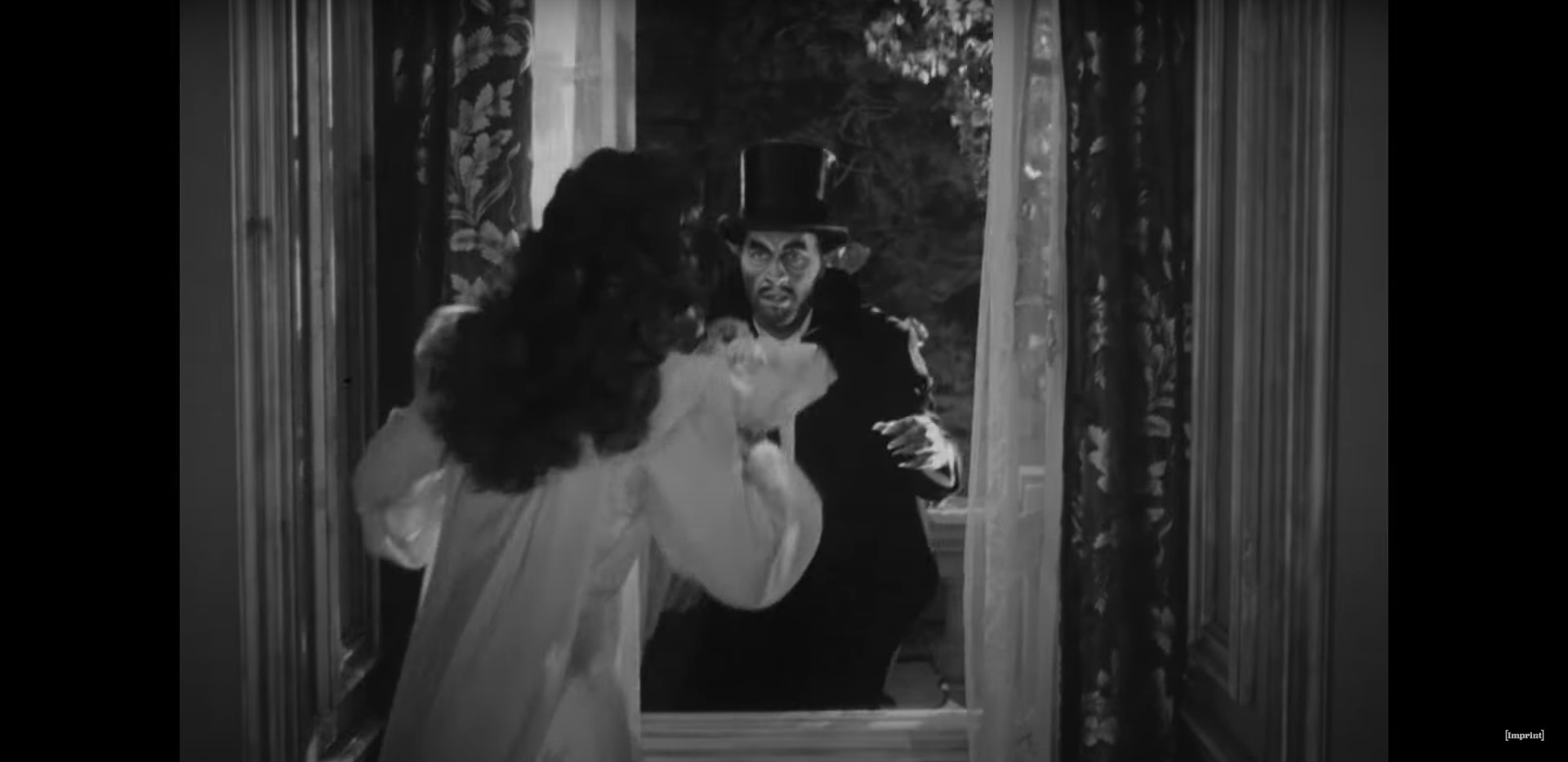
From rags to riches, writer Charles Regnier pens one of the most popular and polarizing books of France.  Titled Fraudulent Justice, the subject matter coincidently contains secret court case information in it’s text.  Regnier stands firm his book is creative fiction while the French government think otherwise.  When a government agent of the Ministry of Archives, carrying the detail accounts of the case to be reviewed, is found slashed to death and the case file missing, the police naturally suspect Charles Regnier while also another, eccentric police theory circulates of a monstrous cat person.  Regnier, who suffers from headaches and blackouts from a tropical fever he contracted during his two year travels away from Paris, begins to suspect himself as the deranged killer on the loose, attacking and killing those around him.  Without a solid alibi and the unknown from his blackout memories, Regnier evades the police by hiding with his darling lady friend, Marie Audet, but when the headaches begin and Regnier conscious slips into a strange darkness, will he let the cat out of the bag to strike again?

Let’s travel back in time to 1946, just after the Great Second War, when the movie industry rolled film once again and take a pawing look at Lesley Selander’s shapeshifting film noir “The Catman in Paris.”  Though story set in Paris, the black and white horror film helmed by “The Vampire’s Ghost” director is a United States product shot on location at the Republic Productions studios in Los Angeles, reusing and transforming many of the company’s stout storage of Western set pieces into Parisian milieus.  From the spittoon saloons to high end restaurants and from dusty stagecoaches to redesigned aristocrat carriages, Republic Pictures aimed to take transformative risks in order to hop on the Val Lewton and his 1942 “The Cat People” success train while making statements of his own from a Sherman L. Lowe (“Valley of the Zombies”) script.  “The Catman of Paris” is produced by Belarus expat Marek Libkow who fled Europe because of World War II but the feature would be his last producing feature.

In the ambiguous role that puts into question his sanity and his humanity is the Austrian actor of “Slave Girl,” Carl Esmond.  Esmond plays the rift creating writer adored by the public and despised by the government, driving him back into a corner of continuous defense of his work that has been argued to be plagiarized form secret documents and unlawful for the access of aforesaid secret documents regarding a controversial court case decades prior. On his tail is a paranormal receptive prefect of police (Fritz Feld, “Phantom of the Opera” ’43) and a more pragmatic inspector named Severen (Gerald Mohr, “The Monster and the Girl”) who, based on little-to-no evidence, immediately suspect the writer by affiliation to the court case he could in no way possible have known. This dichotomy of theory doesn’t affect the prime suspect, doesn’t seep into a larger suspect pool, and keeps the investigation status quo up until the revealing finale, but the police state characters have subjectively targeted Regnier with all but a harassment mentality, adding to Regnier’s conflicted dismay about the association between the killings and his disassociation with consciousness – which is visualized by a series of random, inverted images of a gusty barren tundra, a buoy gushing ocean water, a dark and cloudy moon, and a black cat’s eyes at the center. Regnier finds comfort in the bosom of Marie Audet (Lenore Aubert, “Abbett and Costello Meet Frankenstein”) over his finance (Adele Mara, “Curse of the Faceless Man”) and in his promised fickleness, broke her heart before falling victim to the cat’s claw in a metaphoric gesture of aggressive sexual assault. The whole love triangle is loosely adhesive to “The Catman of Paris’s” integral entanglement of un-kittenish affairs. In fact, Regnier is very kittenish with Marie to the point that his engagement appears to be frivolously made and has locked him into an inescapable promise because of emasculating masculine posture. Instead, the writer could care less about his word, or rather conveniently forgets, as he plays footsy with the girl of his dreams. “The Catman of Paris” rounds out the cast with Douglas Dumbrille, Francis Pierlot, and Georges Renavent.

Long thought derivative of Val Lewton’s “The Cat People’s” success, Republic Pictures challenges the perspective with a cattier fracture of manhood, putting the main protagonist of their own cat person horror, “The Catman of Paris,” through the whiskery wringer of test and tribulations of harboring suspicions about oneself. Charles Regnier has seen the other side of the tracks. For all intents and purposes, Regnier was a nobody who suddenly rose to respect and wealth in the eyes of the general public with the stroke of a pen for creative thought to formulate an enthralling story, out of the fabric of his own mind he assumed he wrote. Yet, his work of fiction has also become a sign of guilt, suspicion, and unlawfulness in the eyes of the authorities. If the weight of the government isn’t burdensome enough, Regnier is also divided with personal doubt when a killer’s bodies pile during his time spent in a stint of amnesia and all of evidential signs point in his clueless direction. The more dire latter echos his former self in a subconscious belief that he isn’t his true self, such as with imposter syndrome in which he questions his current, more affluent status and fame with being contributed by a darker, murderous side, perhaps a sign of his impecunious past. The story has Regnier averting decisions to marry into opulence when he really just wants to continue his fervent pursuit of his publisher’s daughter, a sign that now he’s worth a pretty penny, he can muster enough confidence to chase after the woman of his dreams and still feel grounded to the common people despite is sudden wealth. At one point in time, “The Catman of Paris” was a harrowing horror tale with fantastic prosthetic cat features, a decent carriage chase and crash sequence, and a whodunit mystery quencher for the masses, but, for today, the 1946 is about as antiquated as they come like most of “The Golden Age of Film” features with a one-note suspense narrative and a monotone melodrama that’s imposing and frank without a lot of flair. I will say one thing about “The Catman of Paris'” twist ending is it’s not easily reckoned as Selandar has beguiling direction to pile on guilt to the point that audiences will have to submit to the director’s feline frisky hokum.

A part of the Imprint Collection, coming in at #219 on the spine, is “The Catman of Paris” on an Australian Blu-ray release. The limited edition high-definition release is AVC encoded on a single layer, BD25. The 1080p Blu-ray presentation comes from a 2017 4K scan of the original negative and is presented in the Academy ratio of 1.37:1. The original print material has sustained a few visible marks of infrequent vertical scratch damage, minor dust and dirt, total loss single frames, noticeable cigarette burns, and wavering levels in grayscale and contrast stability during edit transitions. Yet, there’s still a richness of the black and white image for the majority that refuses to fold outside the competent restoration attempt that gives dimension to a nearly 80-year-old film. The overall picture is a solid pass above par as it’s likely the best we’ll ever see in our time. The English language LPCM 2.0 mono track crescendos with a run of the mill brass band score overtop a quite clean dialogue track. Sure, the unmitigated track is slightly sullied by a consistent yet unimposing shushing with sporadic, stifled popping; however, there are no major issues with the mix and the dialogue through the dual channel is clean and distinguishable. Optional English subtitles are available. Special features include a new audio commentary track feature film historians Kim Newman and Stephen Jones, an oldfangled feature length documentary running through the cinematic history of stills and video clips from Republic Pictures The Republic Pictures Story, and a film historian Kat Ellinger video essay entitled Mark of the Beast: Myth Making and Masculinity in The Catman of Paris. Imprint’s tangible package is eye catching with color-washed front cover image on a thick cardboard side-slipcase; the illustration is pulled from one of the feature’s various marquee posters. Inside the slipcase, a character composition mockup includes the menacing Catman at the forefront with Regnier and female principals frozen in fear. The Imprint release runs at a slim 64 minutes, is unrated, and has a region free playback. “The Catman of Paris” is in servility of early Cat People productions but stands on its own two, or rather four, feet with an entrenching murder mystery that can keep you anthropomorphically guessing.

Meow!!  “The Catman of Paris” is on the Prowl on Imprint Blu-ray!