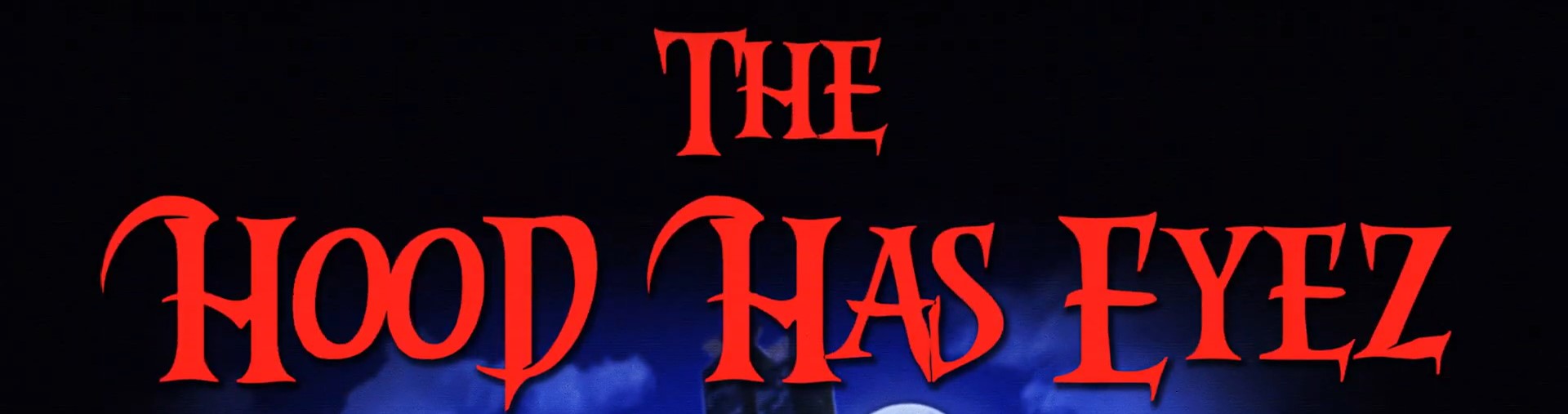
EVIL Will Suck on Your Menstrual Soaked Tampon. “The Hood Has Eyez” reviewed! (SRS Cinema / DVD)

An Early 2000s Exploitation With Lots of Infamy!  “The Hood Has Eyez” on DVD!

Attending a school ditch party was the last thing the obedient Kimmy wanted to do but the peer pressure from her fellow Catholic schoolgirl friends convinced her to the other side of the tracks of town.  On the way, a half-naked woman runs out in front of their car and in attempt to flee the scene on foot, to protect their innocent repute status, they run into two gangsters holding them at gunpoint in an alley.  The now frightened teens are forced into an isolated park area, joined by the now fully-clothed and not injured woman they hit earlier in what has been revealed to be a ruse to rob them, but the gang leader, Psycho, has more distasteful and violent plans to squeeze more out of his prize than cash.  Psycho brutally rapes Kimmy and is left for dead by not only the gangsters but also the one other surviving girl she had considered to be her friend.  Battered and broken, Kimmy’s morality and reality snaps, sending her down an unmerciful vengeful path against those who condemned her to die.

If filmmaker Terrence Williams set out to make an exploitation film of genital mutilation, forced sodomy, and a man sucking on a bloody tampon, then mission accomplished!  The straight-to-video, SOV rape-and-revenger of monstrosities, “The Hood Has Eyez,” pulls no punches, knows no limits, and cares to give no concern for the atrocities it depicts.  A bastardized yet familiar rephrasing of an early Wes Craven classic, “The Hills Have Eyes,” Williams uses Craven’s basic setup plot to write-and-direct his own version of uncivilized lowlifes exploiting and murdering out-of-their-element travelers in the most graphic and appalling ways.  Williams takes the fear out of the hills and drops it into a remote park plopped in-between the suburbs and urban grounds, swapping out inbred hillbillies for Latino gangsters and a nuclear family for schoolgirls in short skirts and one unlucky white dude.  Collaborating producer and wife of Terrence Williams, Nicole Williams, has previously and subsequently worked together other films, such as “Curse of La Llorona” and “Horno,” under their now defunct joint company, Cinema Threat Productions in Los Angeles. 

The 2007 released “The Hood Has Eyez” reunites a good chunk of the cast from Williams’ “The River:  Legend of La Llorona,” “Revenge of La Llorona, “Llorona Gone Wild” and “Curse of La Llorona” films completed and released within a couple years previously which created a certain level of comfortability and trust amongst the cast as well as the cast and director.  With some of the intimately graphic content of “The Hood Has Eyez,” those warm and cozy congenialities play key to selling a broken bottle scene being rammed up a vaginal cavity or a nail hammered down into penis urethra.  Without that delicate easiness in the air, scenes like the aforementioned won’t work, resulting in the entire project collapsing upon itself even before wrapping up principal photography.  At the tip of the spear are Cyd Chulte and Antonia Royuela as the principled Kimmy and her antithesis, the deranged Psycho.   Chulte, who cut her teeth with roles in “Curse of La Llorona,” takes one-half the lead of a young woman broken by the barbarity and succumbs to justified vehemence for torture, dismemberment, coat hanger abortions, and eventual death but before being pushed to the edge of her life and into a state of insanity, Kimmy’s presence melds into the group of a lemming unit and takes a backseat to the other lead half behind Royuela’s unhinged ultra-violence of a gangster gone rouge from the plan.  Psycho’s posse – Joker (Carlos Javier Castillo, “Axeman”) and She Girl (Anne Stinnett, “Revenge of La Llorona”) – truly reflect their handles as Psycho’s devil and angel on his shoulder, trying to either egg him on or have him withdrawal while withdrawing is still in his favor but, of course, we wouldn’t have a debauchery and savage movie if the angel over the shoulder had prevailed and so Psycho has his perverse way with Kimmy and friends – Susan (Jesselynn Desmond, “Horno”), Rachel (Jamielyn Lippman, “The Absent”), and Jerry (Tom Curitore, “Llorona Gone Wild”). 

The way I see it, Terrence William’s trashy exploitation nod “The Hood Has Eyez” has three distinct parts, much like the three-act structure of any narrative archetype.  Terrence Williams defines these acts tremendously clear in an almost too simple of a way that it feels rudimentary, maybe even old fashioned.  The setup is simple:  overweening teens doing what they’re not supposed to be doing become caught up in an unfavorable part of town with a maladjusted gang.  The confrontation squares the two factions to a literal position of facing each other while the teens coward in fright and disadvantage as they forcibly bend to the will of the gun-toting gang calling all the shots.  The resolution pivots the story 180 degrees, like any good rape-revenge thriller should, after misdeeds thin out whose left for dead and who’s intractable impulses are fully left satisfied and goes right into execution mode without passing go, without collecting $200, and without pause of a trauma processing moment as Terrence Williams wastes no time digging deep into the sludge of psychiatric stability with a hasty move right to rectifying an eye-for-an-eye balance.  Up until a point, “The Hood Has Eyez” carries a lot of dire weight within the confrontational girth that can be hard to stomach.  There’s a few casually lighthearted and fun witty moments peppered beforehand, such as a jokes at the expense of airhead Susan and her player boyfriend, but then after the grave assault that leaves Kimmy left to suffer all the post-traumatic syndrome results, things really go dark, and I’m’ talking black comedy dark.  Kimmy goes into full Rocky Balboa training mode, doing pushups and enthusiastically practicing staff spinning in the light of the falling sun.  Terrence Williams actually gives Kimmy a rousing montage before ripping the dick off a two-bit thug.  Where am I getting to with all this?  Well, I’m not sure how Terrence Williams wanted audiences to digest his brutal film that goes through touchpoints of opposing genres.  Usually, if comedy and gore are present in one narrative, slapstick typically is the go-to conduit – think “Evil Dead II” or “Dead Alive.”  For “The Hood Has Eyez,” the gore effects are hearty, the characters are vicious and victimizable, and Williams maintains an intact beginning-to-end narrative, but confounds with a few choice character actions that sully the overall presentation.

The Cinema Threat Production has now been integrated into SRS Cinema’s Extreme and Unrated Label – Nightmare Fuel – and unquestionably is underground extreme horror at its foulest.  Released with a widescreen aspect ratio of 1.85:1 of the 420p standard definition, camcorder tape footage and in a new director’s alternative cut, “The Hood Has Eyez” has relatively decent image clarity with a very subdued amount of lossy compression results, especially for progressive scan 480 pixels.  Details are soft as expected with the commercial equipment and lower resolution but though a slightly faded color scale, the coloring range renders intense enough for higher marks and can play a trick on the eyes by falsely delineating the objects to create a space based off the hue edging alone.  The English Dolby Digital 2.0 track props up the quality even more with Terrence Williams using a boom mic attachment instead of the built-in mic to gather meticulously the intended dialogue and skirmish kerfuffle.  As a result, dialogue is really sharp here, especially during Psycho’s off-the-rail verbal abuse, rants, and one-liners.  The post-production Foley stands apart from the inhouse sound with prefabricated sound bytes but that’s the way of micro-independent filmmaking.  The alternate cut includes a newly shot opening scene that was originally intended for the original script that was added back in to actualize the Williams’ vision after a cast sudden dropout departure.  Bonus features include a commentary with Terrence and Nicole, a raw, secondary cam behind the scenes footage in making certain scenes, a blooper reel, image slide show, two original cut trailers, a new trailer, and a Women in Horror vignette featuring Nicole Williams discussing the importance of women in horror and her contribution to the genre.  The release is presented in a traditional DVD snapper with a beautifully illustrated cover art based off the shoddy composited “The Hood Has Eyez’s” one sheet.  In the past few years, SRS has upped their game with cover arts and continue to impress with their new branding campaign that makes these films feel no longer cheap at first glance.  Inside, the DVD press art is the same as the cover with much of the RGB removed to a single layer red. There is no insert inside the case.  Terrence Williams set out to capture the inelegant essences of nitty-gritty exploitation and hits the nail on the head, literally, with this passion project of perversity. 

An Early 2000s Exploitation With Lots of Infamy!  “The Hood Has Eyez” on DVD!

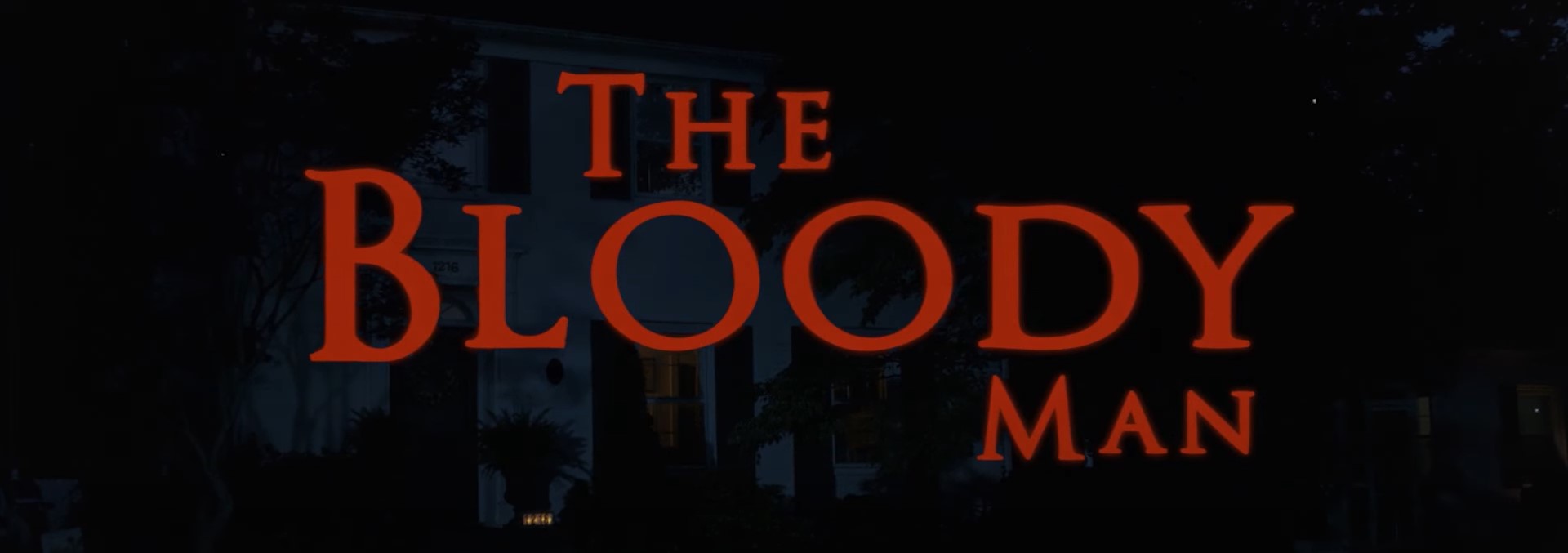
Watch Out! EVIL is Coming for Your Dysfunctional Family! “The Bloody Man” reviewed! (Wild Eye Releasing / Blu-ray)

Better Behave or “The Bloody Man” Will Get You!  On Blu-ray at Amazon.com.

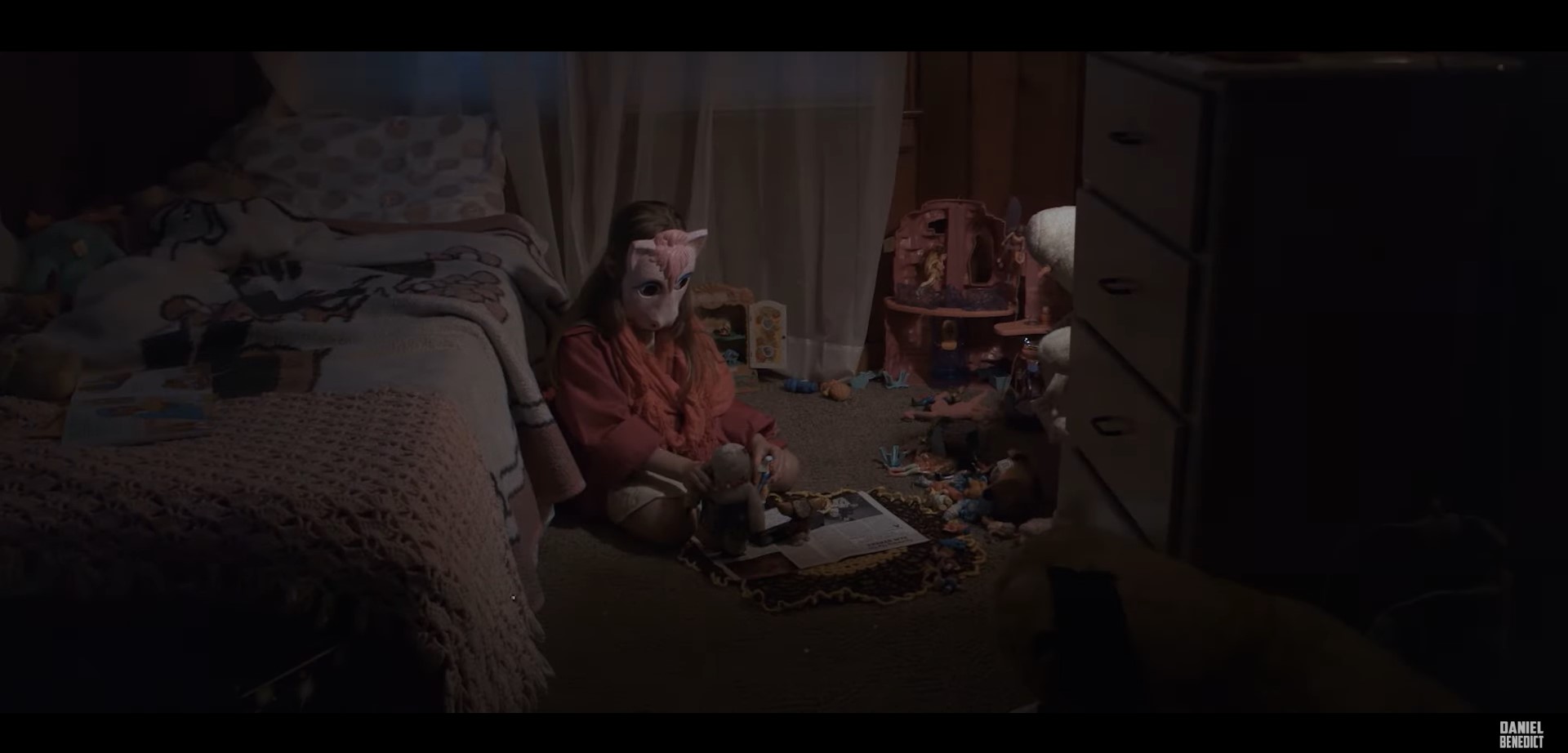
Set in the 1980s, Sam doesn’t cope well with life without his recently deceased beloved mother.  Getting along with his new stepmother proves to be challenging at best, his older brother continues to disregard him as an insignificant pest, his little sister gets under his skin in playing with his action figures without consent, and the school bully makes his life that much more difficult.  The young boy’s unhappiness spurs him into desperate measures by reciting a spell passage on the back of his favorite comic book, hoping the passage truthful to conjure up his deepest desire – to bring his mother back from the dead and fix a broken family.  The passage instead summons a demon, the Bloody Man, who seeks to rip fractured family apart even farther until their eventual dissolve and demise.  Able to possess and take shape of his stepmother, Sam must reunite his family in order to save not only his siblings but also his stepmother from fragmenting into nothingness and death at the hands of a demented demon trickster.

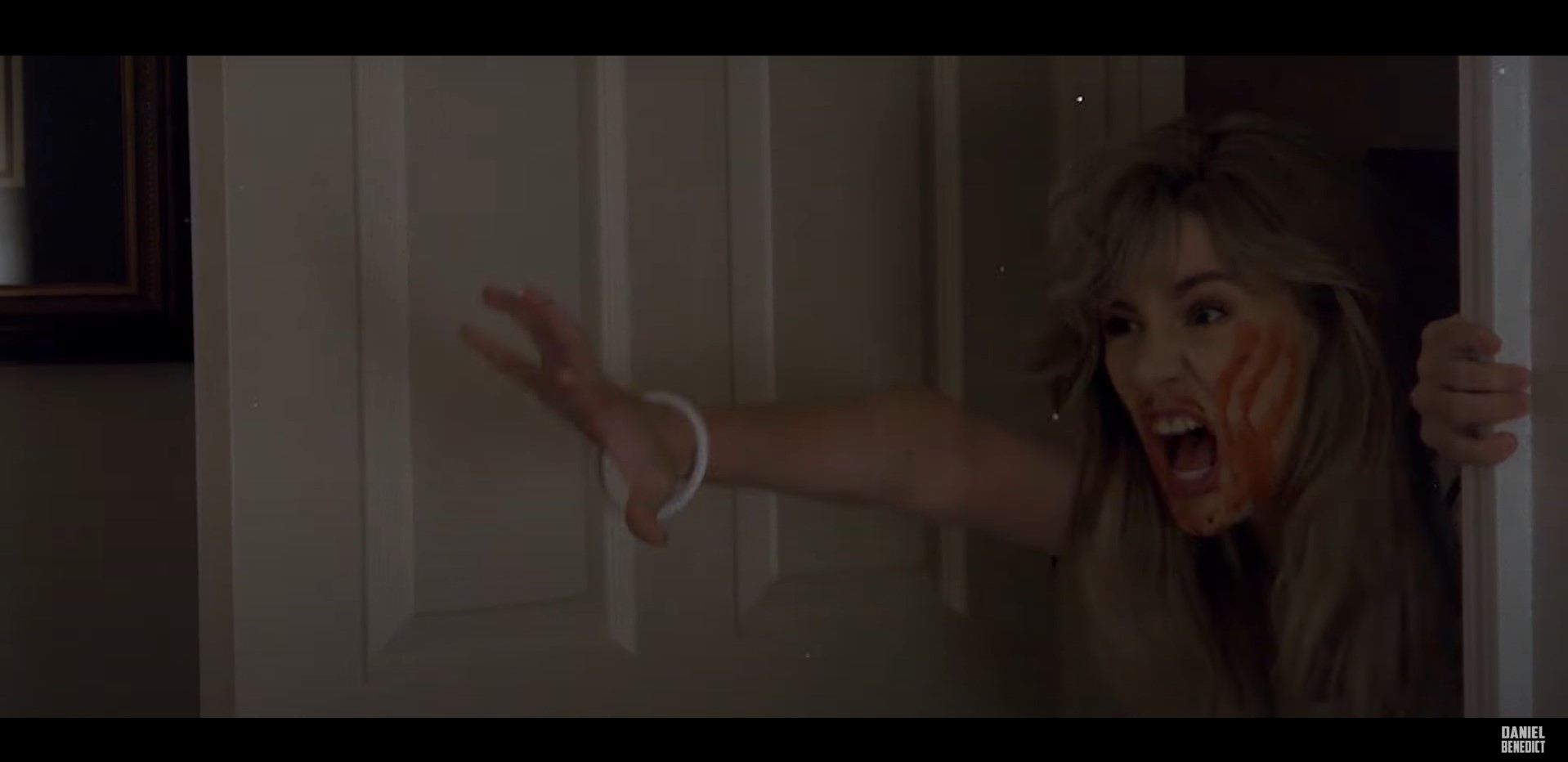
An homage to all things 1980s, “The Bloody Man” is a modern-day resemblance of one the more recent golden ages of cinema with a synth-laden soundtrack, all the popular play toy trinkets and new wave styles of the era, and a magazine loaded millimeter film stock shot in attempt to remove as much of the digital aerodynamics as possible in contemporary times.  Daniel Benedict, the director of the Halloween-themed slasher “Bunni” involving a sexy, leather-cladded, fishnet stockings wearing costume killer with bunny ears, takes a step back from extreme slashers and hops into more family-oriented terror with the protagonist heroes being kids stepping up against the forces of evil, think of films like “The Gate” or “Ernest Scarred Stupid.”  Not as slapstick as the “Ernest” droll-troll paragon of ritualized Halloween movie lineups, this crowdfunded project can be a little more vicious in delivering on the lines of the same heartwarming message that instilled into us from the Jim Varney 30-years-ago, that love is key in overcoming darkness.  Benedict pens and helms the 2020 production with wife Casi Clark, aka Casi Benedict, co-writing a script that loosely pulls in and indirectly references Benedicts’ collaborated efforts on a He-Man inspired fan made short “Fall of Grayskull” into their boogieman story.  The Benedicts’ production company Red Serial Films confects the film into fruition with Mercedez Varble, Jason L. Watson, Garrett M. Johnson, and Rihannon Crothers producing. 

Despite not having top bill on the film, David Daniel leads us through the angsty complications of a new family dynamic as well as being the centric force of rebuilding a crumbling household as the middle child, feeling every bit like the world is against him, Sam Harris.  Daniels debut feature and leading role depicts well the internal argumentative aspects of having to go along with a life-forming change no child should ever go through, the death of a mother, and that sends him and his family careening toward dissolution despite his cheerful father’s overly confident optimism.  The top bills go to a pair of “A Nightmare on Elm Street” alum who both play mother to Sam.  Lisa Wilcox (“A Nightmare on Elm Street:  The Dream Master” and “A Nightmare on Elm Street:  The Dream Child”) and Tuesday Knight (“A Nightmare on Elm Street:  The Dream Master”) switch back-and-forth, between flashback-and-present, Sam’s biological mother and his new, soon to be, stepmother.  Surely, it comes to reason that the Wilcox and Knight names not only provide a couple of “The Bloody Man” selling points for die hard Freddy Kruger acolytes but could also be seen as an homage to the Robert Englund franchise with a similar living between two planes of existence nightmare antagonists hunting down a house full of kids, using unhappiness as a vessel rather than dreams.  Though not scarred by full body burns, wielding a finger bladed glove, and sporting a dirty striped sweater and fedora, the Bloody Man has his own characteristics being a black magic sorcerer.  Dressed traditionally in a snug black Chinese robe and blood running down his wild eyed face, Nicholas Redd enlivens the Bloody Man on a playfully perturbing level but the script doesn’t allow Redd to deliver the Bloody Man’s full potential while also not cutting the villain fully into the fold until the nearly last act.  Instead, the Bloody Man is reduced to a few here-and-there appearances, some one-liners, with half of the character’s screen time awarded to Tuesday Knight in a duality role as the Bloody Man uses the caregiver’s looks to draw in the Harris children.  Redd has promising lunacy that’s sorely underutilized in more ways than one and in so much so, the film itself shouldn’t be titled after the character.  “The Bloody Man” remaining cast includes Sam Hadden, Olivia Sanders, Jeremy Carr (“Calm Before”), Dominick Wilkins (“6 Feet Below Hell”), Dan Eardley (“Retro Freaks”), KateLynn E. Newberry (“O9en Up”), and Ellie Parker (“Bones and All”).

I’m all for a quasi-kid friendly horror of the same antithetical vein as “Monster Squad” or “Gremlins” where the subject matter borders the edge of being too risky, eking above the terror threshold for children who would be roughly the same age as the story’s principal leads battling for the very reconciliation of family before the Bloody Man kills them.  “The Bloody Man” lurks under the veil of being lighthearted in contrast to the brushing scenes of severed, sentient arms, blood streaking down various maniacal faces, a mildly gruesome decapitation, and moments of good ‘ole fashion terror that may induce nightmares for anyone under the age of 12.  A child’s lack of sleep because they’re waking up with fright-filled sweats will for sure not provide parents any favors, but Benedict skirts a fair amount of gore and does imply the significant damage and death offscreen almost as to shelter general audiences’ eyes for a broader invitation to watch the movie and, as mentioned previously, the titular bad guy doesn’t make an appearance until much later in the story that has been setup comically with a wrestling fanatic principal, Perry’s godawful verbal teasing, and a lot of 80’s inspired shots that nailed the decade’s analog paint job – a silver lining against the night terrors.  Honestly, the third act also drags out the culmination of events.  For such a small house, the Bloody Man chasing the Harris kids might as well taken place in a labyrinthine mansion, but the ground level with basement rancher slows down the hide-and-seek or maybe the Bloody Man is just really bad at childish game as the kids could stay in rooms for extended periods of time, even playing pretend with toys at one point, and in not once instance, does the Bloody Man bust in to snatch up a tyke to terminate.  Where “The Bloody Man” also struggles is buttoning up the summoning of the soulless sorcerer who’s conjured up by a mere passage reading off the back of Sam’s favorite Barbarian Man comic books.  The comic, which is introduced as a fairly over-the-counter object, holds this mystical darkness that must be conjoined with a family’s spiraling.  Yet, the story contradicts itself as the Bloody Man pursues another broken home that didn’t warrant the reading of the comic’s back cover passage, creating some confusion on how the cruel chaser of disconcerted children operates on a phantasmic plane.

As far as 80’s-inspired films go, “The Bloody Man” can run with the best of them, even with Netflix’s “Stranger Things,” and Wild Eye Releasing sees fit to drop a special edition Blu-ray of the Daniel Benedict comedic chiller.  The AVC encoded, high-definition 1080p, BD25 is presented in a widescreen 2.35:1 aspect ratio.  What makes the film feel decade authentic and that can suck you into it’s existence is Benedict’s decision to shoot either in 35mm or with a 35mm digital overlay that has characteristic dust speckles and a fine grain.  Image quality remain at a consistent color and black levels with a few flare ups of compression artefact issues, such as splotches in darker scenes, in squeezing this long runtime film onto a BD25 along with an atypical accompaniment of Wild Eye Release robust extras.  The bitrate does have large swings from lower teens to upwards of high 20s Mbps.  Yet, details generally come through with enough depth to create visual spacing between objects.  The English language Dolby Digital 2.0 stereo renders adequate for a narrative that doesn’t have a ton of range with an intimately tight story surrounding Sam and his siblings but is complimented greatly by Johnathan Fan Octo Evans retro-synth soundtrack with an oscillating pulse and a crescendo of tension, solidifying even more the 80’s inspiration. English subtitles are optionally available. The special features include a director’s commentary with Daniel Benedict, a gag-blooper reel, a local newscast behind-the-scenes segment, various promotional videos from Kickstarter, Indiegogo, Barbarian Man toys, an emulated One to Grown On based PSA show from the 80s, and a Showbox promo with the original trailer bringing up the tail. One last bonus scene is also at the end of the credits so stay to the very end. The physical features include a clear Blu-ray snapper case with latch that houses glow lit Harris kids geared up to tackle the looming Bloody Man, or that is my assumption of who that is on the front cover as that figure looks nothing like the Bloody Man on screen. A more true-to-form Bloody Man is on the cardboard slipcover in another retro illustrated, compositional mockup with a similar layout as the actual Blu-ray front cover. Inside the snapper case, the reverse front cover has a still image from the movie, typical of many Wild Eye Releases, a folded one-sheet with the additions of Tuesday Knight and Lisa Wilcox amongst the child leads, and a disc art pressed with the unknown version of Bloody Man. The region free release comes not rated and has an excessive runtime of 133 minutes, contributing to the pacing issues of the last act. “The Bloody Man” doesn’t exactly live up to the moniker in this tame throwback but what the film has is a mighty nostalgia that brings back feelings of a superlative horror age that was once, and still is, goosebump arousing.

Better Behave or “The Bloody Man” Will Get You!  On Blu-ray at Amazon.com.

Eventually, You’ll Have to Stand Up to EVIL. “The Retaliators” reviewed! (Quiver Distribution / Blu-ray)

Man Up and Take Back Your Life with “The Retaliators” on Blu-ray!  Click to Purchase from Amazon.

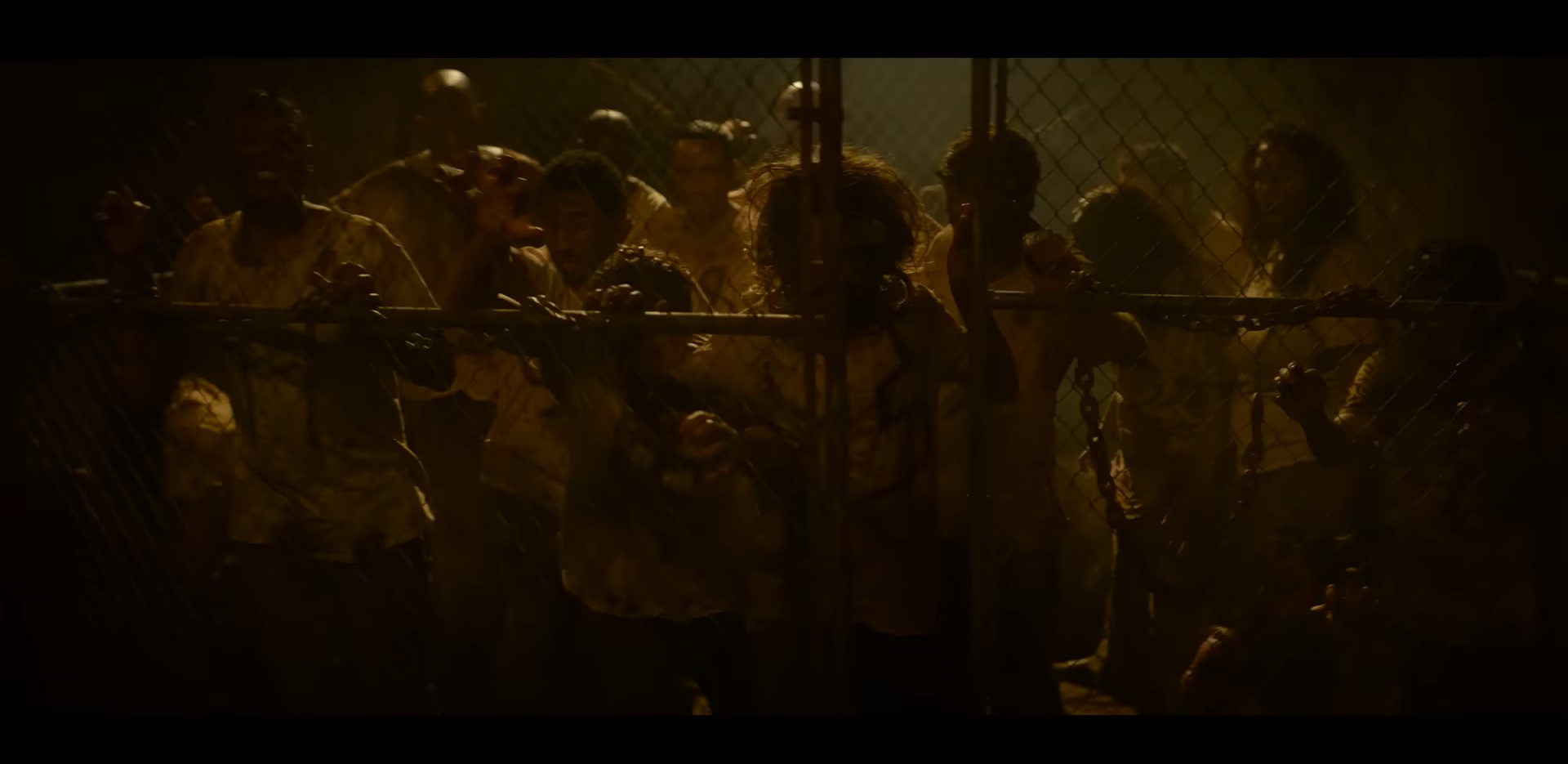
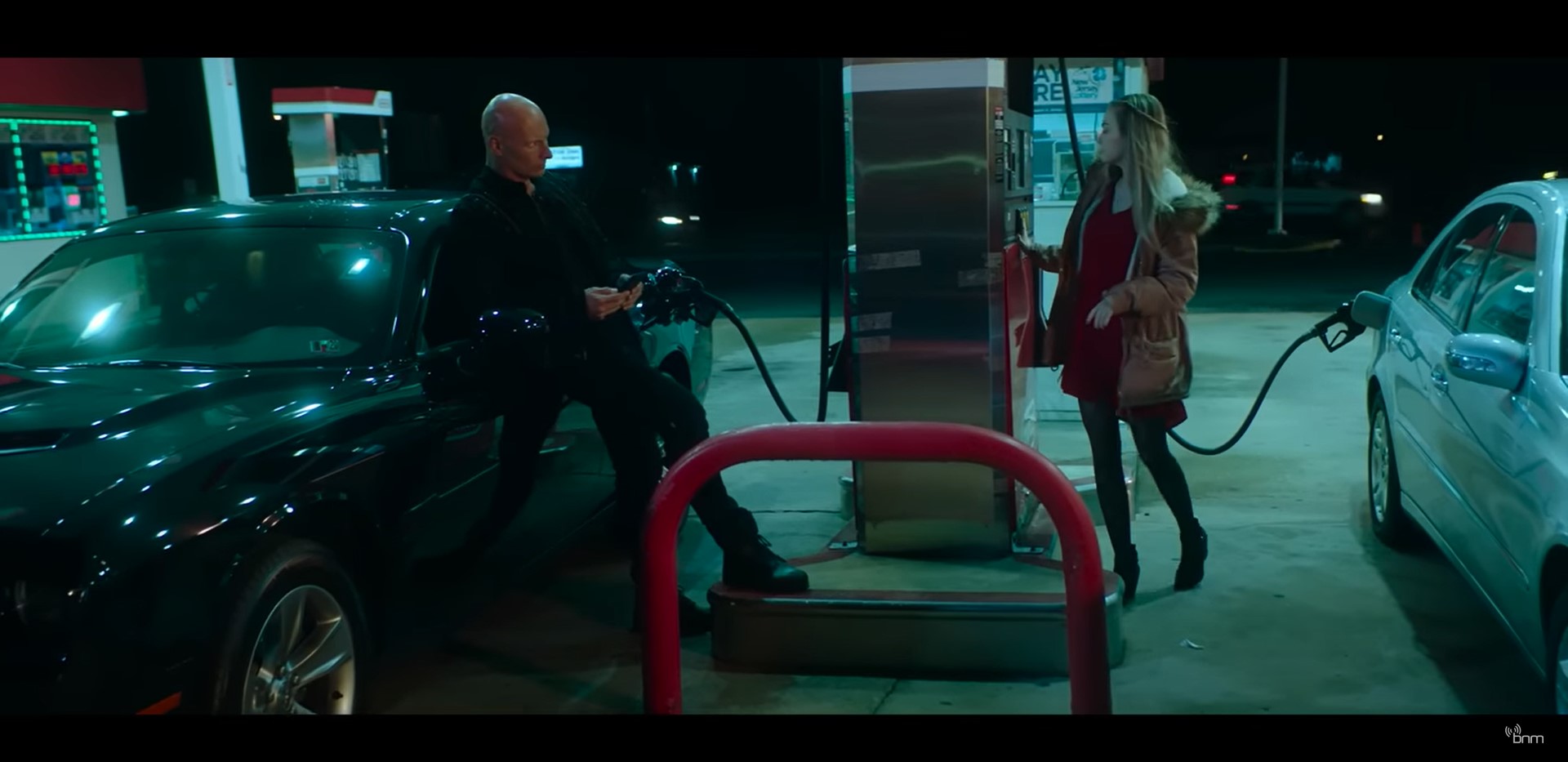
Having recently lost his wife, Pastor Bishop tries hard to keep his two school age daughters safe with an oversight thumb, but when his oldest daughter, Sarah, begs him for the car, God himself knows that the Pastor’s children can’t stay children forever. Bishop fears come reality when Sarah is chased by a sadistic man, ran off the road, and zip tied to her steering wheel as her car is pushed into a nearby ravine. Destroyed by another loss, there is seemingly no way out of the grief hole for the man of the cloth until a Detective, who once shared Bishop’s pain and suffering with a similar, personal experience, introduces him to his isolated former fallout bunker turned torture cabin in the woods with the man who killed Bishop’s daughter chained captive in the basement and next to him sits a variety of melee tools of affliction. Deeper into the Detective’s subterranean dwelling lies a more terrible, caged secret, one that is incidentally unleashed upon the world, and will wreak carnage upon the land and it’s up to the grin and bear it Pastor to take a stand against pure evil.

Frighting for yourself and for special persons in your life is crucial for any self-respecting person to be able to look at themselves in the mirror and say, “I did all I could.” Those who believe in understanding and forgiveness ultimately fall into being trampled on and biting the bullet because just surviving the other end of a contentious situation can be a false sense of security and an opaque veil to the ever-present dangers lurking in every crevice. The 2021 release of “The Retaliators” accouters that theme of following one’s combative conscious to protect what’s dear while also sporting a hefty amount of violence, blood, subhuman psychopaths, and a nearly all nu metal musician cast. Co-directed between from short and music video filmmaker, Samuel Gonzolas Jr., the film’s star and “Central Park” actor, Michael Lombardi, and music video director, Bridget Smith, “The Retaliators” aims to show an ugly, real truth that can affect and twist good men into the same abhorrence and villainy they’ve struggled to repel and resolve. “The Retaliators” mark the first screenplay from the Geare Brothers, Darren and Jeff Allen, is shot across various locations in the U.S., including states Nevada, New Jersey, and Connecticut, and is a production of Lombardi’s Better Noise Films with the company’s CEO, Allan Kovac, and Philly Born Film’s Mike Walsh also producing.

As a company that’s half part a music record label, the film was destined to showcase some of the independent rooted musical and elemental talent of the rock genre, but the narrative is convoyed by a fellow musician, who will humbly admit they are not trained or experienced actors, but rather actors who are rock artist sympathizers, in the case of principal leads Michael Lombardi and Marc Menchaca of Peacock’s new horror thriller “Sick” and who you may not have recognized in the third season of Amazon’s “Tom Clancy’s Jack Reason” as a high-and-tight, clean-cut naval captain. Menchaca is anything but burred cut as a bearded and wavy-haired, somber detective assigned to Pastor Bishop’s (Lombardi) case of his murdered daughter. Menchaca does his work in feeding off the dark energy cocktail of Lombardi’s grief, despair, and vengeance-stricken neo-pastor. Lombardi’s heartfelt performance definitely deserves praise for how one should react in losing a child and also reflects the helplessness that burdens the parent into a black hole of sorrow. As a character, Bishop struggles morally with seeping into and being swallowed by the grim circumstances gifted for him despite however the circumstances may seem to be in his favor. The gears Lombardi has to switch from a faithful person, to rancorous, to then finally a path of soul changing redemption goes smoothly enough to justify his position as principal lead. Menchaca’s demented detective almost feels left out to an extent, but the audience will get enough of a taste to satiate his unglued righteousness. While no love interest makes it into the fold of characters, the narrative does house spots for the nu metal and rock musicians in supporting or minor roles. Papa Roach’s Jacoby Shaddix, Mötley Crüe’s Tommy Lee, Ice Nine Kills Spencer Charnas, Escape the Fate’s Craig Mabbitt, From Ashes to New’s Matt Brandyberry, Lance Dowdle, Danny Case, and Matt Madiro, and Five Finger Death Punch’s Ivan L. Moody, Zoltan Bathory, and Chris Kael are just a select few of rockers you’ll see in “The Retaliator’s” lineup. Personally, I wanted to see more of Jacoby Shaddix as Quinn Brady, a homicidal madman in a horrific cat-and-mouse lark with the detective. Who knows, maybe we’ll see a prequel with Shaddix returning to the role. For the most part, like Shaddix, the musicians are well integrated with diverse roles that range from biker club, to strip club DJs, to bartenders, and to AA participants. “The Retaliators” round out the cast with Katie Kelly (“Deadly Seduction”), Abbey Hafer, Cree Kelly (“Aftermath”), and the massively built and scary-looking Joseph Gatt (“Titanic 666”) as the child-killer strapped and prepped for Pastor Bishop to physically and mentally break.

Better Noise Films is comparable to another divisional filmic offshoot of a larger parent music record label. Cleopatra Entertainment, of Cleopatra Records, often builds film structures and narrative plots around the company’s signed ensembles to promote and market their lyrical and thrash-heavy material as well as putting names to faces and thrusting them out into the world to those who may not have heard of their music. Aside from likely being a huge cost-savings benefit, these films are often scored by their artists, leading to a diverse sounding and electric soundtrack that typically works out less than desired. What the directors end up implementing, musically, yields result only half of the time while the other half is forced unto the audience for the sheer effect of promotion despite the off-putting composition. Not every intense scene needs a band backdrop to flourish raw emotion and pump up the blood but that’s what films, like “The Retaliator’s,” is bred to show off in a marbled genre that has categorical plot pivots all along the way to the grand finale of an all-out brawl, fight for your life skirmish with the criminally and tortured insane. That latter concept is perhaps one of the more interesting and original ideas of reinventing the psychopath that I’ve seen in a long time and the anticipatory excitement and thrills of their release to wreak havoc like barbaric rippers had found moments of great gore excess when Paster Bishop finds his divine strength to help the savage sadists meet their maker by way of machete, a shovel, and a woodchipper. “The Retaliators” make use of familiar horror tropes, such as the fog machine and a blend of lowkey and neon flushed lighting, to conjure an unconventional crypt of rock and homicide, putting its own unique stamp of indirect evil leading to up to another bigger, badder bedlam of things.

Chalked up to be an 80’s-stylized 90’s cinematic horror pulp, with early 2000’s soundtrack, “The Retaliators” arrives onto Blu-ray home video courtesy of Quiver Distribution. The AVC encoded, high definition, 1080p BD50 has a CinemaScope, aka anamorphic, widescreen 2.39:1 aspect ratio. The large storage formatted disc offers more variety as the capacity can handle the expansion of color and range of content. From complex, diversly lit, and heavily foot trafficked interiors to the great outdoors with trees fields, gravel terrain, and watery brooks, the quite a bit that’s going on looks pretty good on screen and the anamorphic widescreen doesn’t have that squeeze-it-in feel either but can’t escape a few scenes of lens flare. Details provide a tactile enamel, but the colors are quite soft with a lower dialed in color grading. The English DTS-HD 5.1 surround sound has more teeth in the soundtrack that overlaps and snuffs out any ambient sound design, essentially making “The Retaliators” a 96 minute, give-or-take a few scenes, music video. Dialogue doesn’t suffer the same backseat fate as the script-to-screen exchanges are in the forefront and though the soundtrack is a bit flat, the original, nebulous-electronic score in between by “Stranger Things” composers Kyle Dixon and Michel Stein does stand out to add a nice underlayer of questionability and suspense. Special features include cast interviews with actors and music artists speaking to their experience on the film, “The Retaliator’s” music video, and theatrical trailer. The physical release comes with a cardboard slipcover on the first pressing with a rendered pseudo-illustrated mockup of pyramid arranged character heads with Pastor Biship standing bloody and machete in hand right smack in the middle. The standard Blu-ray snapper includes the same cover arrangement art as the slipcover. Not listed on the back, the unrated film does support region A playback. “The Retaliators” pumps up the blood as well as the jams during an overhaul of one’s convictions in a baptism by hellfire.

Man Up and Take Back Your Life with “The Retaliators” on Blu-ray!  Click to Purchase from Amazon.

Write Down Your EVILEST Desire and Have It Become Reality. “Invitation Only” reviewed! (Unearthed Films / Blu-ray)

Have the “Invitation Only” Blu-ray Stapled to Your Face!  Purchase by Clicking the Cover Art Below!

Chauffeur driver Wade Chen wasn’t born with a silver spoon in his mouth.  The humble, low-on-the-totem pole young man has dreams and aspirations of super models and sports cars but can’t even afford a new suit.  When Wade’s accidently catches his wealthy construction tycoon passenger, Mr. Yang, sexually engaged with the beautiful model of his dreams in the backseat of the limousine, the nice guy in him didn’t think too much of it, but Mr. Yang surprises Wade with an invitation to an exclusive, high-brow party.  Unable to attend the party himself, Mr. Yang sends Wade under the pretense of being the tycoon’s cousin and hooks him up with nice clothes and money for gambling.  At the party, Wade is joined by four others who are also first timers amongst the high-class guests and are greeted with welcoming arms by the host, Mr. Warren, who offers them their wildest dreams, whatever they desire, by manifesting them into reality, but their reality turns quickly into a nightmare when the party is a façade for the opulent to put on a stage show of hunting down, torturing, and gruesomely murder the poor who believe envying the rich degrades their lives.

A class dividing social commentary where the disillusioned rich continue to believe the lower-class are exploiting their pedestaled luxuries when, in reality, the wealthy continue to take an unfair advantage for their own benefit and whimsical desires!  Labeled as Taiwan’s very first slasher, Kevin Ko’s debut pecking order demarcating film specializes in serrating into the other half a sort of social class justice.  Ko, who continues to work in and around the East Asian market having just released last year his written and directed Chinese folkloric thriller “Incantation,” helms the gore heavy script from the screenwriting duo Sung In and Carolyn Lin as their only credited treatment.  Shot near entirely inside a dilapidated converted warehouse in Taipei City, “Invitation Only” becomes the entrapment and last straw abattoir for all classes looking up and salivating over the greedy greener grass separated by that invisible, money-driven, societal line.  Maxx Tsai (“Memoria”) and Michelle Yeh (“The Heirloom”) produce what some critics and fans might denote as torture porn and, truth be told, “Invitation Only” is very “Hostel”-esque with its plot revolving around deep pockets getting away with murder, literally.  The 2009 released film is a production of principal producer Michelle Yeh’s Three Dots Entertainment company.

What’s admirable about Kevin Ko’s “Invitation Only” is its hyper local aplomb. From Taipei City location to the mostly local cast from Taiwan, Ko’s feature is a celebration of Taiwan’s filmmaking life despite the plot being about taking lives. In the lead role, Bryant (Ray) Chang (“The Perfect Girl”) plays the passive doormat that is Wade Chen, a nice and principled guy but has no gumption to claw himself out of just scraping by in life. Chang’s no confidence spell over Chen is just want the doctor ordered when casting a bumbling nobody lost in the crowd and touching elbows with plutocrats eating escargot Tapas and drinking champagne. Chen immediately meets the sweetly awestruck Hitomi with a provided backbone persona by “The Ghost Tales” Julianne Chu. At this point you’re thinking Chen and Hitomi will hit it off, become love interests, and be the Formulaic heroes of the story at stemming from this connection.  Partially, that’s true, but then Chen quickly becomes beguiled by that very same supermodel of his dreams, the same supermodel he stumbled upon in the car with Mr. Yang (Jerry Huang, “49 Days”), who is now eating from his lucky-streaked hand at the roulette table.  Former JAV starlet Maria Ozawa is the delicate tigress who beds Chens in an offshoot room of the party to bring the on cloud nine chauffeur a taste of high society to a culminating head.  Ozawa, who left the adult industry and went on to have a modest genre film career to this day with principal roles in “Erotibot” and “Geisha of Death,” is intoxicating on screen in her debut mainstream feature, but the actress doesn’t speak a lick of Mandarin and forces English to the dialect conversation to which then Bryant Chang has forced the dynamics with poor English reciprocation.  In bed, Chang and Ozawa connect charismatically, but other than that, the dialogue exchanges can be painful to get through.  Other invitees on the “Invitation Only” casting list include Joseph Ma, Ying-Hsuan Kao, Vivi Ho, and another English speaker Kristian Brodie in the mix to balance out with Ozawa to make the film a Mandarin-English hybrid.

Being a product of the early 2000’s, at the backend of the first decade after the turn of the millennium, “Invitation Only,” with Kevin Ko’s quick, erratic editing style, very much epitomizes the era of time as a party-hardy, balls-to-the-wall, slasher with a survivalist edge. “Invitation Only’s” social commentary all but surely smacks you in the face with the fairly common theme of social class division, but the story twists the biding inner dark thoughts of the one percent upper class. The story evokes this justifiable fear amongst them where those willing to cheat, scam, and steal to obtain wealth from off the back of the wealthy deserve an unmerciful, unrelenting, and unpardoning execution with an affluent audience clapping and cheering their horrible mutilation and demise. With an unlimited cash at their disposal, to them, there are an unlimited number of ways to die, and Ko certainly illuminates that ragbag of weapons of bodily destruction every chance he gets. The annual gathering of denotes a “Purge” like affect that for once a year, for the last five years as the host, the English-speaking Mr. Warren, states, the Rich handpick lowly schemers for excruciating extermination. This year, however, a simple misjudgment of character foils a night of brain bashing and staple facing into the downfall of the Rich’s unscrupulous principles and steadfast convictions as Wade is a humble nice guy at the wrong place, wrong time blundering into Mr. Yang giving Ms. Supermodel the wang. The whole annual affair is the rich cathartically getting their hands dirty, purging their distaste with a medieval axe or with jumper cable attached to a car battery. Ko invites not only the wealthy getting away with murder but being utterly brutal about it without shame or guilt as if they are truly on top of the world. The kill scenes are gorgeously horrific with the Hollywood trained special effects artists to provide that it-factor when considering blood, guts, and dismemberments.

“Invitation Only” is exclusive extreme horror not for just for anyone. Gore genre distributor “Unearthed Films” knows this and rejoices in the niche market of everything that would usually make one squeamish. “Invitation Only” is the survival horror that refuses to be a party-pooper as the Kevin Ko film arrives onto a high definition, 1080p, AVC encoded Blu-ray. Presented in a widescreen aspect ratio of 1.78:1, this particular Unearthed Films product doesn’t convey my favorite transfer quality. The codec bitrate for a high-definition release is all over the place as there are severe dips in the Mbps that can be as high as mid-to-low 30Mbps to upper DVD quality around 9-13Mpbs. With that breadth of range, the transfer supplies an inconsistent quality in waves; some scenes are sharp and very delineated while when in the dip, the scenes fall from grace into a sea of pixel blocks in low-lit scenes that nearly wash out the image entirely. Color graded virtually nonexistent as Ko keeps the scheme along the lines of neutral coloring. There are three audio options for selection: a Mandarin, with some English, 5.1 DTS-HD, a Mandarin, with some English, 2.0 PCM, and an English 2.0 PCM. Discerning between the pair of Mandarin options proves less distinctive compared to the distinct dub, for oblivious reasons, but there’s an edge more deepening into the surround sound mix with an intensity richer soundtrack. The lossy dialogue tracks often sound flat and muted as the screams and frantic getaways never pierce the ear’s soul, but for the most part, dialogue is clear and clean. There’s also an issue with the release’s coding on the in-feature audio selection as I toggle between the three audio options, they’re all listed as English with their respective format and channel output. Bonus features include behind the scenes discussions from select cast, such as Bryant Chang, Maria Ozawa, and Jerry Huang, a photo gallery, and theatrical trailers. Unearthed Films’ release comes in a clear Blu-ray snapper case with latch and reversible cover art in which both art styles reflect the dark and grim brutality of the film’s thematic nature. With a runtime of 95 minutes, the unrated and region A coded release does have an evolving story to tell unlike its likeminded brethren that usually gets in and through the dirty, ugly business in just above an hour’s time to keep the gore porn from getting stale. For a feature debut, Kevin Ko goes all in on the knife’s edge with commentary-laden “Invitation Only,” a viciously cold take on the extreme cruelty genre when money, the root of all evil, divides our common sense against one another.

Have the “Invitation Only” Blu-ray Stapled to Your Face!  Purchase by Clicking the Cover Art Below!

The Doctor’s Out. EVIL Will Make this “House Call!” reviewed! (Wild Eye Releasing / DVD)

“House Call” on DVD home video and Available to Purchase at Amazon!  Click the Cover Art to Buy.

Eager to prove to her parents she is responsible and old enough to undertake the babysitting duties of her little brother all by herself, 16-year-old Miriam is reluctant to phone her parents when little brother Vince becomes highly feverish in fear that they will take away future responsibility opportunities.  Instead, Miriam makes a late-night call to the family’s primary physician and begs for a discreet house call.  Hours go by and Miriam becomes increasingly concerned about Vince, but when the doctor is found dead on her doorstep, her brother’s welfare acutely alters from his feverish illness to the maniacs outside looking to score big on the family home.  The night turns into a fight for survival as the home alone siblings must outwit two murderous thieves who have their lustful eye on the teenage Miriam as well. 

Based off the novella of the same title from horror writer Ty Schwamberger, “House Call” is the first Schwarmberger piece to be adapted and completed into a full-length feature film.  The 2013 production’s script is adapted by Shannon Casto and while the credits list accompanying partner Michelle Henderson as the director, IMDB lists Casto as co-director the film. Both have worked alongside each other between 2005-2013 under their House, Texas-based independent film production company, Little Oak Film Group, which has churned out modest range of low-budget horror with “Sinner,” “Gut Instincts,” and “Protégé” to note as a select few.  Their joined by Parrish Randall as the third wheel in the director’s chair, – again, a credit that IMDB list but the film doesn’t but wouldn’t surprise me knowing a little more history between the trio.  “The Quick and the Undead”-starring and “Slaughter House”-directing Randall essentially helped segue Casto and Henderson into their own production company having the aspiring filmmaking duo under his wing in various crew and cast capacities as the owner of PRP Motion Pictures.  The Little Oak Film Group cofounders serve as executive producers on this self-made, little-known home invasion, survival thriller. 

Parrish Randall not only serves as co-director and provides the foundational support Casto and Henderson used to jumpstart their careers as filmmakers, but the platinum blond actor with dark facial hair from Groesbeck, Texas is also one of the lead principal characters, playing the nefariously nurtured John who has ambitions to live up to his mentor’s unfettered insanity and depravity.  Randall evokes his lite version of Bill Mosely’s Otis Driftwood without the full support of the deranged family.  There are inarguably many issues with how John is portrayed with an overflowing amount of dialogue despite Randall stealing the story with a magnetic presence on screen.  John’s expositional to a fault and is continuously repeating the same dialogue over-and-over, such as pointing out and elucidating again-and-again that Rock is his mentor.  Rock, played by Bill Dubois (“His Will Be Done”), features in a flashback of a cowardly John aiding and abetting Rock in the murder-robbery of a young couple and Rock is supposedly grooming pupil the way of psychopathy, but there really is not clear instruction from Rock other than provoke gun-drawn offices while your partner flees for his feared life. Now, after that character defining moment, John has become Rock incarnate and has also taken a student under his wing to invade, rob, rape, and murder in the family home of Miriam, played by Rachel Paul in her debut lead role, and Vince, played by Vincent Galyean. “House Call” deploys not only neighborhood disturbances but also disturbing undertones of the rape and murder of children as Miriam is 16 years old and Vince is ballpark 6-9 years of age. As kids under distress, tonal precision might not be Paul and Galyean strong suit, but their cues of delivery are on point where often times child actors tend to be forced or uncertain in conviction to sell the act. “House Call” rounds out the cast with James McCreight (“The Caretaker”), Troy Reynolds, Paul Moomey, Alison Esparza, Roger Dunn, Kristopher Smith, Chelsea Turcheck, Chi and the most experience and credited actor on set, Joe Grisaffi (“Doll Factory,” “Axe Murdering with Hackley”), as the creepy-glaring neighbor, Mr. Henderson, with the receding hair line and large hair.

While many issues come to the front of the mind regarding “House Call’s” poor longevity status, to be retained as a solid source of entertainment, and to be a total thrill at the edge of your seat home invasion horror film, the one major issue that egregiously needs mentioning is the lack stimulus surrounding John’s gut-stirring need to be as brutal as possible at this specific spot. Unlike Bryan Bertino’s “The Strangers” where the masked intruders mark their presence as simply just because, “House Call” drops the ball on even the most basic of unscrupulous principles amongst the villains. In fact, the flash back with mentor Rock puts John into a completely different, greatly sympathetic, and concerned light without ever exhibiting that epiphany of realization into becoming the crime’s worst-of-the-worst. John also mentions on multiple occasions how the scoped-out house is full of the nicer things, but once we’re inside, it’s all upper-middle class, mediocre monied valuables that don’t justify the cause. An implied reason for John’s obsession for pillaging is to solely have his way with teenage Miriam who, in another over explained bit of exposition, saw her outside washing down the family roadster. What’s baffling about his Miriam anecdote is that we the scene played out live as in a flashback sans the moment John set eyes on Miriam. Instead, we’re treated to the introduction of creepy neighbor Mr. Hendersen who gives Miriam an up-and-down once over and the scene is definitely more piquant than John’s drive by but misses a crucial plot point that drives the story to the moment of John’s and his accomplice’s introduction. Perhaps, the flashback serves to misdirect Mr. Henderson’s sleaze toward a pre-judgy determination that flips the script later in the last act. “House Call” doesn’t quite nail where it wants to be emotionally with lightly peppered comedy, oversalted exposition, and a sepulchral tone of child rape and murder that yearns to break the surface of its under seasoned bake.

In what’s likely interchangeable functions between Michelle Henderson, Shannon Casto, and Parrish Randall to oversee this adapted film to completion, as aspect that can be easily assessed when seeing their names credited multiple times under various roles, one thing is for certain – “House Call” is the epitome of independent horror moviemaking spirit. It all culminates to this point, an at home DVD release that can now stretch across the global in a region free decoding format. Wild Eye Releasing, in association with TomCat Films, presents “House Call” onto an unrated DVD with a widescreen 1.78:1 aspect ratio. A modern day, handheld SOV film, “House Call” crusts over with numerous blocks of noise interference, details are lost in the inferior resolution, the contrast between blacks and adjacent hues mesh together without firm delineation of objects, and the color palette, which is really the only thing good about the presentation’s lossy source material, has a handful of moments of vibrancy but for the most part is flat. The English language Stereo 2.0 audio mix has better integrity in reproduction. Slightly boxy through the two-channel output but dialogue remains clear and clean without crackling, popping, or hissing and has a meager but manageable, successful depth with no real range to note. Wild Eye’s standard releases normally go big on the bonus features and “House Call” is no exception to the route with only a handful of Wild Eye preview trailers of other films and I still applaud the distributor’s trailer creator because that craftsman (or craftswoman) can splice-to-sell a D-grade movie in under a minute. Release’s physical appearance comes in a standard black DVD snapper with a tenebrous cover art of a man silhouette front facing an every-room-lit stately manor and holding an axe by the side. A bit misleading but the gist of the story is there. Repeatability on the Ty Schwamberger adapted novella is time better served reading, or re-reading, the author’s original story as “House Call” is a 70-minute busy signal that will fail to connect with audiences.

“House Call” on DVD home video and Available to Purchase at Amazon!  Click the Cover Art to Buy.