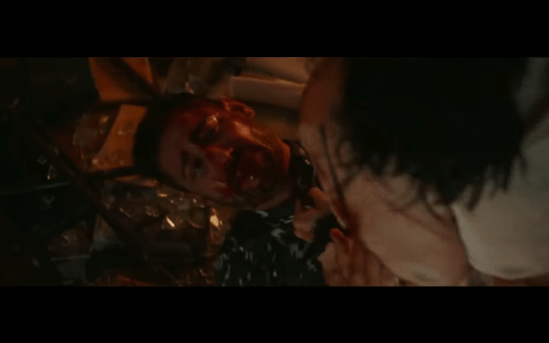
Piloting Toward a Path of Mob Hired EVIL! “Flight Risk” reviewed! (Lionsgate / Blu-ray – DVD – Digital)

“Flight Risk” Blu-ray Takes Off and Is Now Availablle to Own!

After tracking down and arresting a criminal kingpin’s accountant in an Alaskan hotel, U.S. Marshall Madolyn agrees to a plea deal with the accountant in exchange for his incriminating testimony that would lock away the mob boss for years, but before prosecution can get underway, the U.S. Marshall must get her witness to New York City.  Charactering a Cessna 208 light aircraft to escort them out of Alaska, the more-than-eccentric rustic pilot is more tirelessly inquisitive than charismatically charming toward the Marshall about having a suspect chained to the seat in the rear of his plane while also gabbing about casual, byway pleasantries and his rural, for-hire lifestyle as a pilot.  Little do Madolyn and the accountant know is that their pilot is a sadist assassin hired by mob boss and by the time they reach cruising altitude, Madolyn finds herself confined with a relentless killer and without the knowhow to fly a plane herself.  

Not since 2016 has “Lethal Weapon” and “Mad Max” actor Mel Gibson directed a film, that film being the World War II action-drama, “Hacksaw Ridge.”  Gibson returns to being behind-the-camera in 2025 with his latest venture, an aerial, hitman thriller “Flight Risk” from a contained debut big picture script by Jared Rosenberg.  “Flight Risk” strays from the normal course of being an epic feature that usually draws the cinematic eye of Gibson with being a smaller production, an intimate cast, and isolated mostly on a deconstructed light aircraft in front of what is essentially a floor-to-ceiling, 180-degree IMAX screen simulator to depict coursing through the snow-topped mountains of the Alaska Range.  Gibson produces the story along with Bruce Davey, John Fox, and John Davis in a Lionsgate presented combined company production from Davis Entertainment, Icon Productions, Media Capital Technologies, Hammerstone Pictures, and Blue Rider Pictures.

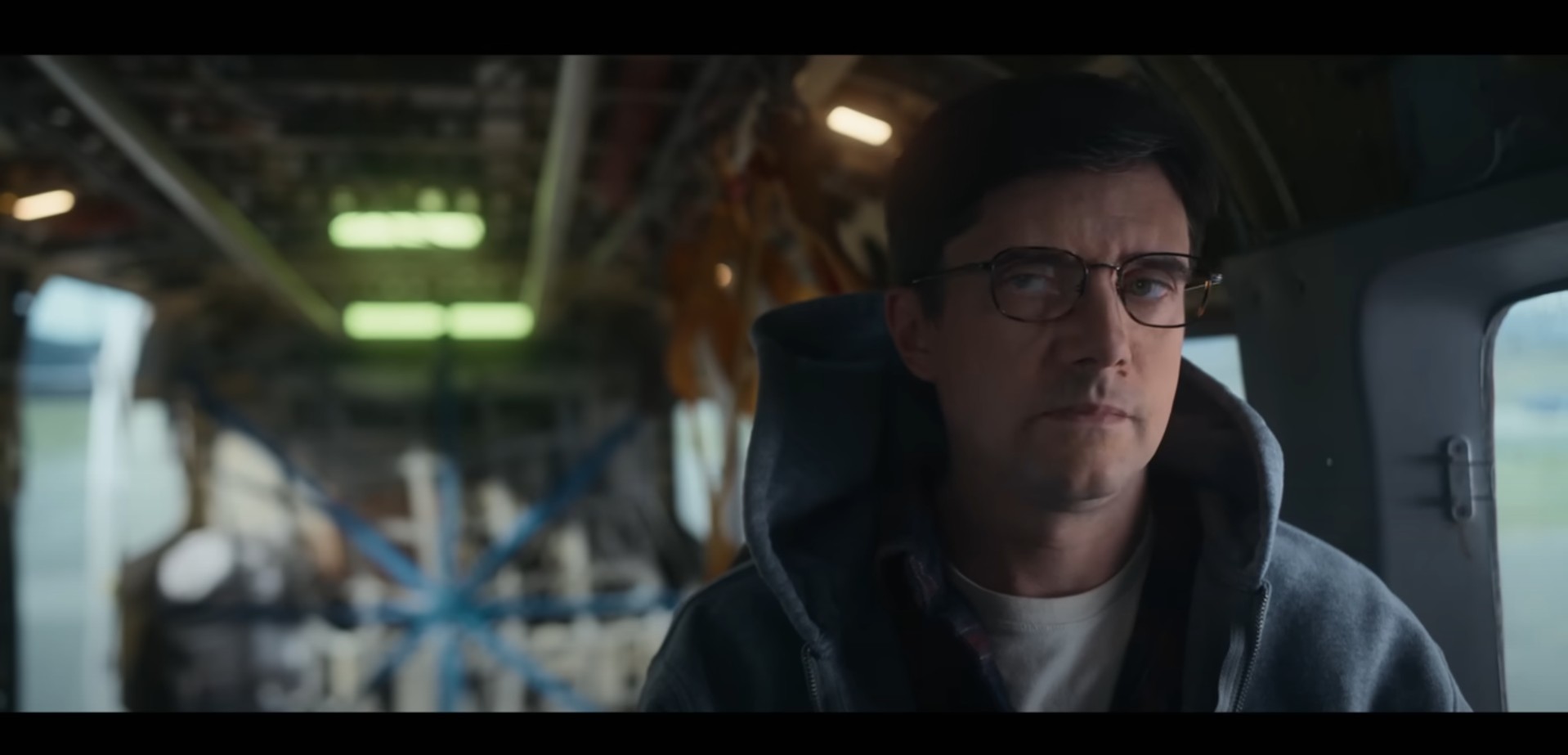
Three onscreen principals and a handful of voiceover work is all there is to “Flight Risk’s” casting with many of the scenes “high” above ground inside the tight confines of a personal aircraft to intensify the close-quartered combat with the unspoken caveat of nowhere to run, nowhere to hide thousands of feet up in the clouds.  Actress Michelle Dockery, known for her role as Lady Mary Crawley in the dynamic upstairs, downstairs period drama series “Downton Abbey,” exchanges her glittering ballroom gowns and British accent for a sidearm Glock and a flat American-beurocratic accent as U.S. Marshall Madolyn with a complicated backstory that places her back into the field after being assigned desk duty when a witness dies in her custody.  Dockery is all business and no pleasure with a retaining wall that holds all her emotions in so she can focus on the important opportunity to be back into the field.  Audiences will be thrusted right the middle of the opportunity and experience her unpleasant history being unraveled exposition as she begins to empathize and sympathize with her current witness, Winston, a skilled accountant with a harmless, passive proclivity played by with the sarcastic reflex of a frightened squirrel in Topher Grace (“Predators,” “Spider-Man 3”).  Madolyn and Winston slowly, simmering bond, merging into a fight or flight friendship out of from being an authoritative escort and detainee, is forged by fire when Mark Wahlberg’s receding hairline, eccentrically crazy, sadistic rapist of a hitman pilot attempts to restrain Madolyn and divert Winstown for his own personal pleasure on the behalf of the Mob Boss instruction.  Likely Wahlberg’s most depraved role since 1996’s “Fear,” the “Transformers” and “Daddy’s Home” actor puts forth less of his muscular tone and good looks by stepping into a balding, gum-chewing wild eye maniac, relentlessly bloodthirsty with the gift of grotesque gab, in a cat-and-mouse tit-for-tat game for the plane yoke and control.  A voice cast rounds out the rest that push the story in deception and direction with Leah Remini (“Old School”) and Paul Ben-Victor (“Body Parts”) as Madolyn’s colleagues who may or may not be corrupt and Maaz Ali (“Anxious”) as your friendly and flirtatious pilot instructor. 

An absolute different kind of project for director Mel Gibson that’s not historical, period, or epic as he takes off into unknown territory and elevating as a director who can remove himself from the bigger picture for a smaller one.  “Flight Risk” is a prime example of what Hollywood should be putting into production rather than squandering millions on grand flops but limited the budget that, in turns, limits the star power and conceding the story to saturate with substance rather than with ostentatious effects.  “Flight Risk” proved to be a modest profiting film on what is now considered a meager budget of $25 million, but a profit is a profit, and the thriller is highly entertaining and engrossing with solid performance supporting a step-by-step, linear story arc.  Granted, the film isn’t completely without flaws.  While Johnny Derango (“Fatman”) can capture the correct angles in the plane’s small, confined space and gratifying the depth with the visual screen through the plane windows, these aspects are negatively counterbalanced by visual effects that stunt the aesthetics with cheap-looking knockoffs of exteriors at the beginning and end of the film.  Fortunately, these scenes are scarce and does continue the yard forward without looking back as girth of Mark Wahlberg, Michelle Dockery, and Topher Grace vie for their moment in the spotlight with their character’s idiosyncrasies. 
The Lionsgate presented “Flight Risk” takes cue from the locomotive folktale being the little film that could, replacing the small train for a small plane and chugging, climbing up the Alaska mountain of nonstop thrills.  The new combo format Blu-ray, DVD, and Digital set from the company evokes many ways to enjoy the latest, and humblest, Mel Gibson picture.  The Blu-ray is AVC encoded, 1080p high-definition, BD50 while the DVD is MPEG2 encoded, upscaled to 1080p, on a DVD9.  In covering the Blu-ray, the picture is near perfect without compression issues faulter a landscape of whites, blues, and the spotted greeneries in between that make up the Alaska geography on the big 180’ volume screen for pseudo flight. The matte visual mixed with the angle of the cameras work to the location’s authenticity and the camera angles solidify that the illusion while the pixel range sharpens any loose ends that might occur in presentation.  Coloring and breadth of saturation diffuse fine with an organic look except for the VFX that stands out like a sore thumb.  English Dolby Atmos creates an immersive audible impression, splicing through the channels that reflect more in the back channels of Mark Wahlberg’s frantic, and sordid, diatribes from the plane’s cargo tail.  Exteriors are not as explosive around the plane as expected with the Dolby’s loss of fidelity but, to the advantage of the story, the engine him and the turbulence has an agreeable depth muffle to it in the surrounding channels and into the frontloaded dialogue, which is intelligible and without unintended equipment interference.  Also included are French and Spanish Dolby Digital 5.1 tracks and an English descriptive audio.  English, Spanish and French subtitles are optional.  Risk Management:  Making flight Risk is the standard fare behind-the-scenes cast-and-crew interviews with some raw behind-the-camera shots surrounding the genesis of “Flight Risk” and the how certain aspects of the film, such as cinematography and Mark Wahlberg’s devilish persona, are achieved.  The theatrical trailer rounds out the encoded special features.  Personally, I was not impressed with the cover art that’s on the Amaray and the cardboard O-slip with a sheen coating that puts Wahlberg front-and-center of a misleading campaign of the ruthless killer looking oddly unflappable while zipping fighter jet theatrics are composited over his midsection; the whole illustration just doesn’t speak the “Flight Risk’s” disposition.  Nothing else to note tangibly other than the 4K digital code insert in its usual slot.  Rated R for violence and language, Lionsgate Blu-ray is region A encoded and has a textbook runtime of 91-minutes.

Last Rites: “Flight Risk” cruises at a palatable attitude of flight dynamics, aerial assassinations, and the rehabilitation of broken character in Mel Gibson’s smaller, but mighty, latest feature.

“Flight Risk” Blu-ray Takes Off and Is Now Availablle to Own!

You’re Not Going Crazy. EVIL Has Snuck in Its Egg! “Cuckoo” reviewed! (Neon / Blu-ray)

Fresh Horror for the Taking! “Cuckoo” Available on Amazon!

Moving to the Bavarian Mountains can be breathtaking, relaxingly scenic, and peacefully remote.  For Gretchen, however, the involuntary move comes shortly after the death of her mother, and she’s forced to leave the U.S. with her father, stepmother, and half-sister to now live at the base of the German Bavarians where an isolated vacation resort is overseen by Herr König who has hired Gretchen’s father to architecturally design an extension to the resort’s vast campus.  Reluctant to make the best of an undesirable situation, Gretchen attempts to run away with another woman and go back to America but on the way, an accident lands Gretchen in the nearby hospital and the odd, omnipresent and oppressive sensation that has surrounded her upon her arrival begins to unravel around Herr König and the resort grounds.  Disorientating visions and sounds, entranced female guests vomiting in the hotel, and an aggressively cloaked women pursing her in the shadows, a battered and bruised Gretchen can’t convince her family of the oddities around her or the ones that have plagued her mute half-sister without warning like a flash flood but with the help of a police detective, the only other person who believes her, the two investigate the strange threat that’s closing in on Gretchen’s family.

For fans of the 2018 under-the-radar, mighty mite demonic possession film “Luz,” director Tilman Singer helms another inimitable horror that’s literally for the birds.  “Cuckoo” is Singer’s this year’s released production in which he penned the script.  His sophomore feature-length film, a plotted preservation of a quickly diminishing deadly, infiltrating species, keeps in line with his Germanic heritage by filming on site at the base of the Bavarian Mountains around the North Rhine-Westphalia region of Germany.  “Cuckoo” is a production of Neon, Fiction Park, and Waypoint Entertainment, spearheaded by producers Thor Bradwell (“Saint Clare”), Emily Cheung, Maria Tsigka, Josh Rosenbaum, Ken Kao (“Rampart”), Markus Halberschmidt, and Ben Rimmer (“Midsommar”).

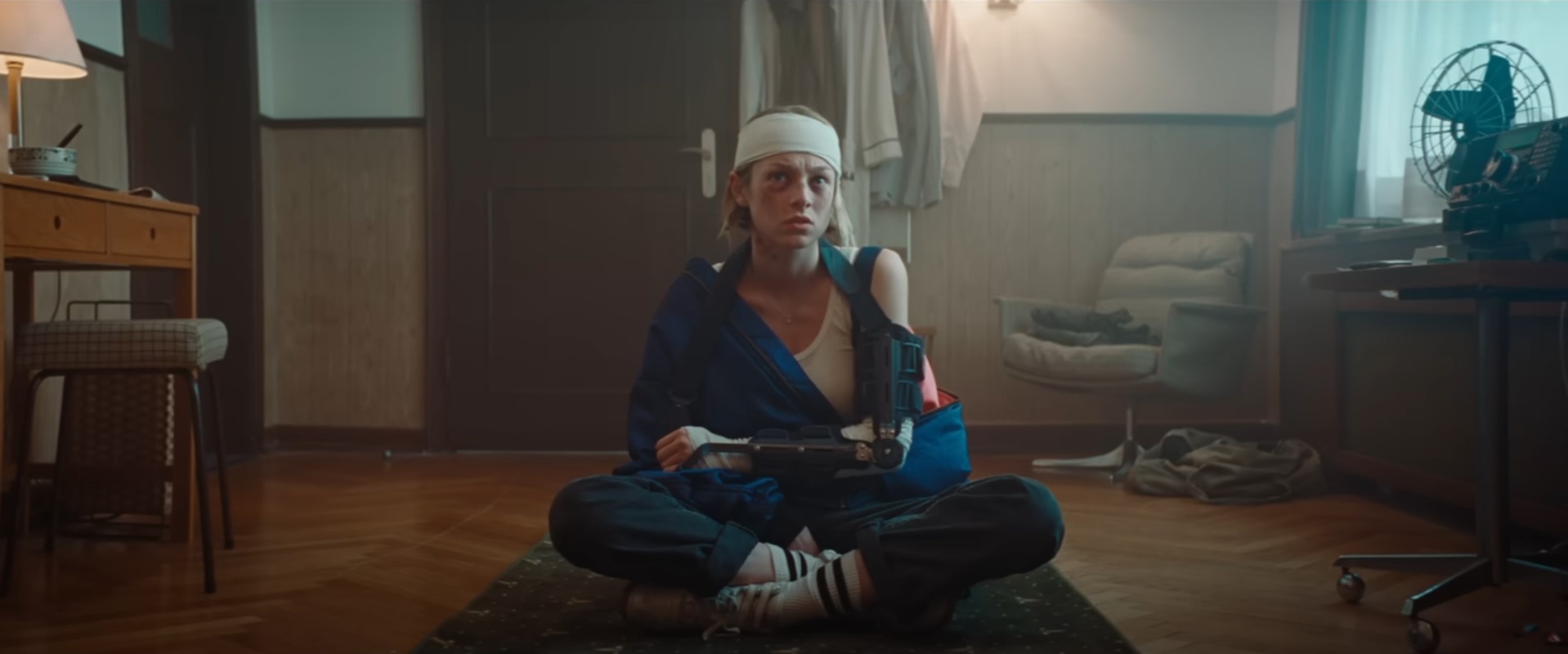
Having established himself as a refined and charming British actor in the widely popular BBC series “Downton Abbey,” Dan Stevens has slowly but surely infiltrated himself in what Lydia Deetz might describe as strange and unusual films.  Shortly after the untimely demise of the Matthew Crawley character, the principal love interest to Lady Mary (for those who know, know), Stevens jumped right into the Adam Wingard thriller “The Guest” where the then slightly over 30-year-old actor proves himself capable of portraying so much more than a stiff socialite.  As resort owner, nature preservationist, and the overall prototype of Zen in Herr König, Stevens displays another side of his deranged splits while showcasing his perfection of the German language.  Opposite Herr König in the teen heroine role is the rising star from “The Hunger Games:  The Ballad of Songbirds & Snakes” and the provocative HBO series “Euphoria,” Hunter Schafer.  As Gretchen, Schafer instills a grappling of grief for a mother she was not ready to let go, institutes steadfast judgements about her father’s new family, and impresses a level of loneliness when having to move away from familiar America to the foreign and alienating grounds of Eastern Europe which all evoke the epitome of teenage angst who can’t see beyond her music, her longing for home, and her new family aversion to see that all those negative, destructive traits innately push her away from what’s important, her family.  Herr König embodies Gretchen’s impediment to move forward while another, Henry the detective (Jan Bluthardt, “Luz”), is stitched to ground Gretchen as the past representation of events you can’t change and the anger it has over you.  Jessica Henwick (“Love and Monsters”), Marton Csokas (“Evilenko”), Greta Fernández (“Embers”), Proschat Madani, Kalin Morrow, Astrid Bergès-Frisbey (“Pirates of the Caribbean:  On Stranger Tides”), and the introduction of Mila Lieu as the mute Alma rounds out the cast.

There are no Coco Puffs to go for here in what will be Tilman Singer’s signature breakthrough hit in the cult genre.  “Cuckoo’s” unique spin on the certain genus of the titular bird is next to none as it radicalizes extreme measures to save a mimicking, infiltrating, surrogate-forcing species from extinction.  The story, which takes on the play God and find out narrative, is a perfect prefect of cutting your nose off despite your face in both the sensationalized horror element and in the rite of passage of teenager squabbles that oxymoronically favors a contrasting parallel.  “Cuckoo” falls into area of weirdness that could be an episode of the “Twilight Zone” in its earthbound peculiarity hidden from public view for decades, if not centuries, blending the once unforeseen man and animal into one and trying to keep that unity intact no matter what the natural process of survival decrees; the story goes between the shadows into its lockbox of nature’s little dirty secrets left in the dark recesses of the forgotten closet and what’s found there is unnatural, wrong, and perhaps even prehistoric.  “Cuckoo” might be too weird.  Understandably, audiences may find “Cuckoo’s” birdy thriller too intractable and maybe too, too far-fetched for a horror film that tiptoes around political hot topics, such as with the violation of women’s bodies and the pregnancy genetics that ensues.  Yet, that controversial conversation starter inside a soupy mixture of on-your-toes tension and the solid acting from Schafer, Stevens, Bluthardt, Bergès-Frisbey, Lieu, Henwick, Csokas, and Morrow develop a much needed off-the-wall and cacophonous-stirring horror that offers a new breed of horror.

The unbelievably scary ordeal arrives onto Neon’s standard Blu-ray set with an AVC encoded, 1080p high-definition resolution, BD50, presented in the anamorphic widescreen aspect ratio 2.39:1 CinemaScope.  Graded with a lower contrast, “Cuckoo’s” antiquated, perhaps wall-to-wall 70’s or 80’s veneer, elevates the finish with bolder conventional colors, enriching wood paneling, gaudy wallpaper, and the like to pop out rather than blend in.  Textures are retained in finer fabrics but appear to be lost on much of the skin surfaces with the revolving door of lighting.  Cinematographer Paul Faltz’s play on light, shadow, and depth creates tension, mood, and a lasting impression.  The lossless English (and some German, which isn’t listed) language DTS-HD Master Audio 5.1 mix provides favorable fidelity, especially when a partial of the film’s story revolves around immersive sound – Gretchen’s music, vibrating vocal sirens, Herr König’s recorder tune, etc.  Depth and range hit on the exact spatial amalgam, diffusing nicely and dynamically into the back and rear channels when scenes play out to a chase or civilly devolve into gunfire.  The second, accompanying audio option is an English Descriptive Audio 2.0 mix that provides same quantity without much of the immersive quality.  English and Spanish subtitles are optionally available.  Bonus features include the making-of “Cuckoo” with snippet interviews and behind-the-scenes look, a video diary series, on-set interviews with actor Hunter Schafer, costume designer Frauke Firl, and production designer Dario Mendez Acosta, a handful of deleted scenes, and a teaser and theatrical trailer.  Neon’s hard-encoded region A, standard Blu-ray comes in the traditional blue Amaray case with the poster art as primary cover design.  Disc is pressed with a black background and “Cuckoo” in red font.  There are no inserts or other tangible features.  The R-rated film, for violence, bloody images, language, and brief teen drug use, has a runtime of 102 minutes.

Last Rites: “Cuckoo’s” a devouringly devilish and deranged nightmare discording from the pattern to breach onto a new form of terror.

Fresh Horror for the Taking! “Cuckoo” Available on Amazon!

One Can’t Just Pray Away EVIL in “The Banishing” reviewed! (Shudder – Vertigo Releasing / Digital Screener)

Set in a backdrop of Great Britain on the very brink of world war against Nazi Germany in the late 1930s, a small English community has nearly lost it’s entire faith in the Catholic church after the last priest suddenly and mysteriously died.  When a young vicar is offered a generous stipend, the village parish, and a large estate by the region bishop to restore a congregational foothold, he brings with him his new wife and stepchild to make the house their home, but the house has a dark history that might have played a role in the previous vicar’s death and a lone, eccentric occultist urges the family to vacate the premises immediately before the house swallows them into grave danger at the haunted hands of sadistic monks, ghastly visions, and a tormented soul roaming the corridors. 

If the prim-and-proper social class structure of Julian Fellows’ “Downton Abbey” collided with the volatile and tormented spirits of James Wan’s “The Conjuring,” then Christopher Smith’s pre-wartime staged haunted house feature, “The Banishing,” would be the outcome.  The period piece horror marks the latest installment into the genre from the Bristol, English-born Smith who made a name for himself with 2004 dark subway corridor heartstopper, “Creep,” and went on to make cult favorites amongst genre fans with the workplace violence satire, “Severance,” and the medieval bubonic plague film, “Black Death” starring Sean Bean and Eddie Redmayne.  “The Banishing,” a term used as the practice within the supernatural ambit of dark magic to ward off negative spirits, is a UK feature co-written between David Beton, Ray Bogdanovich, and Dean Lines.  Maya Amsellem and Sharon Harel-Cohen serve as producers under the London-based WestEnd Films production banner with “The Banishing” marking their fifth completed feature film product and with the nearly worldwide distribution rights landing with AMC Network’s popular horror streaming service, Shudder, in partnership with Vertigo Releasing in the UK.

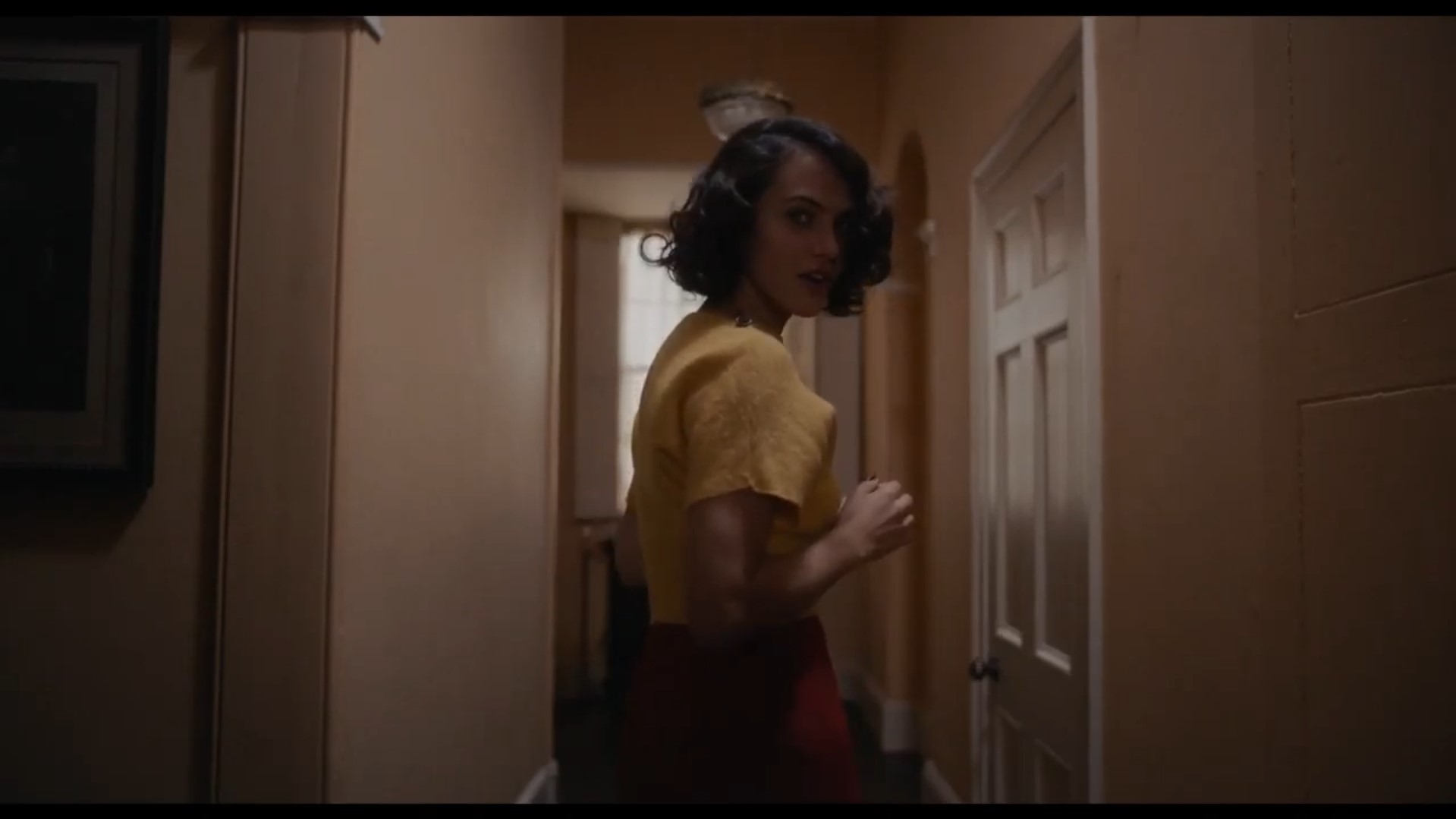
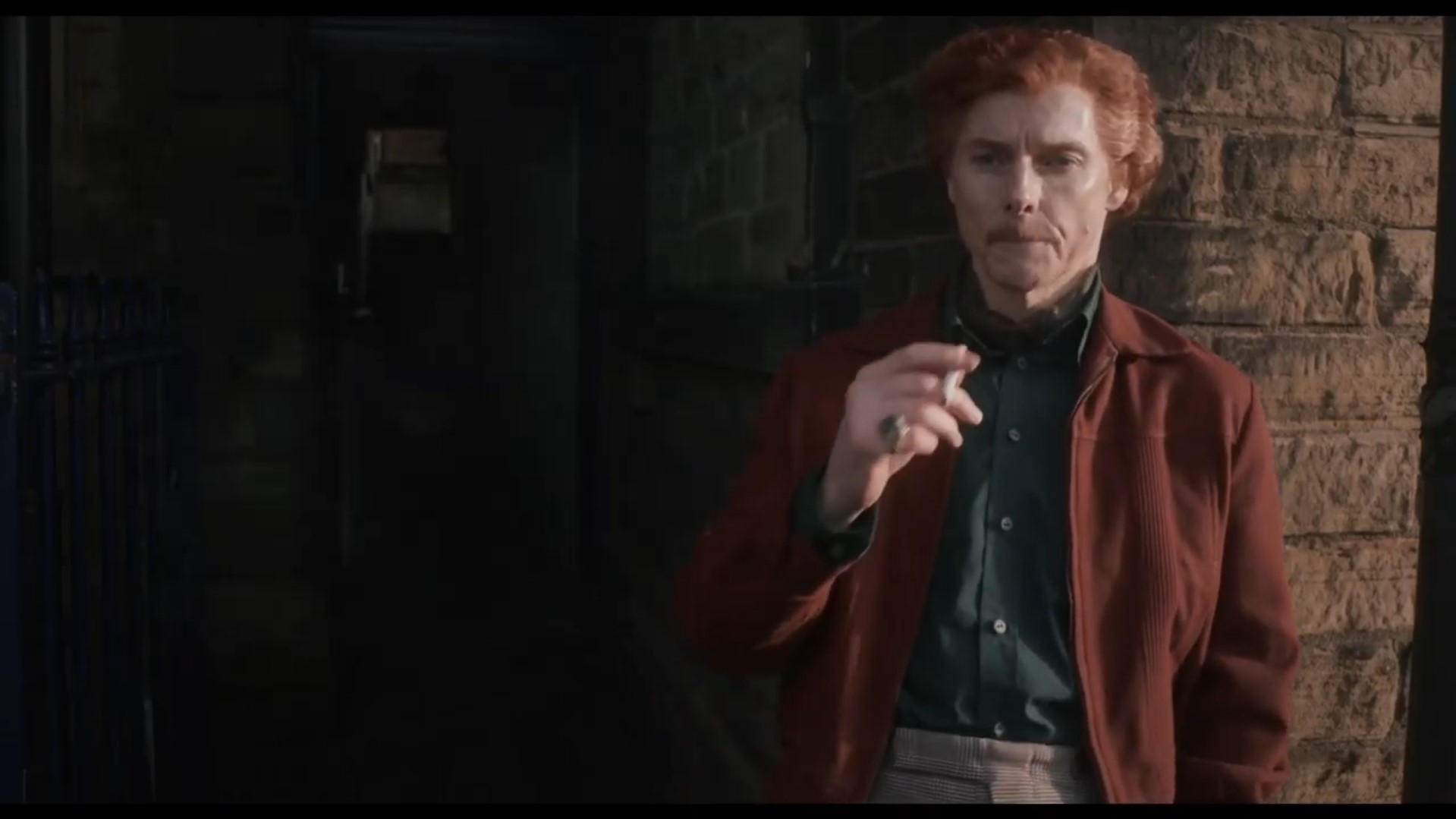
“The Banishing” revolves mainly around Marianne, the newly-wed vicar’s wife with a young girl along for the ride, played by Jessica Brown Findlay (“Downton Abbey,” “Victor Frankenstein”). Findlay endows Marianne with vitality as a woman who must meet the vicar’s standards of Godliness, but still be a strong mother to her child despite disreputable social standing. The priest Linus (Essex-born John Heffernan) lacks experience in the field of his cleric position, lending to question why the region bishop would appoint him to a muster a flock of faithful Christian followers during turbulent times. The husband and wife dynamic between Linus and Marianne is marred by dissonance backgrounds of a priest who doesn’t know to be with a woman and a woman who can’t escape her socially unflattering past. Heffernan and Findlay ignite as repellants of the same magnetic currents when the harder they try to extend their relationship, they push each other way, with Findlay giving a fervent performance. Speaking of performances, Sean Harris bares the most intriguing and rollicking local occultist. The “Mission Impossible: Fallout” actor parades around as Harry Price, a likable, straight-shooting outcast and a believer in the supernatural with extensive, and ghastly, historical knowledge on Linus and Marianne’s new home. As Price aims to extract the hapless from danger, he butts heads with a headstrong region bishop, a stern and solemn role secreted with distrust from John Lynch who has worked on a Christopher Smith film previously in “Black Death.” “The Terror” actor juxtaposes starkly against Harris as a character who dons a likeness to the clown prince of crime in costume than a dull agent man of the cloth…with secrets to uphold. “The Banishing” rounds out with a supporting cast in Adam Hugill, Jason Thorpe, Jean St. Clair, James Swanton, and Anya McKenna-Bruce as Marianne’s daughter, Adelaide.

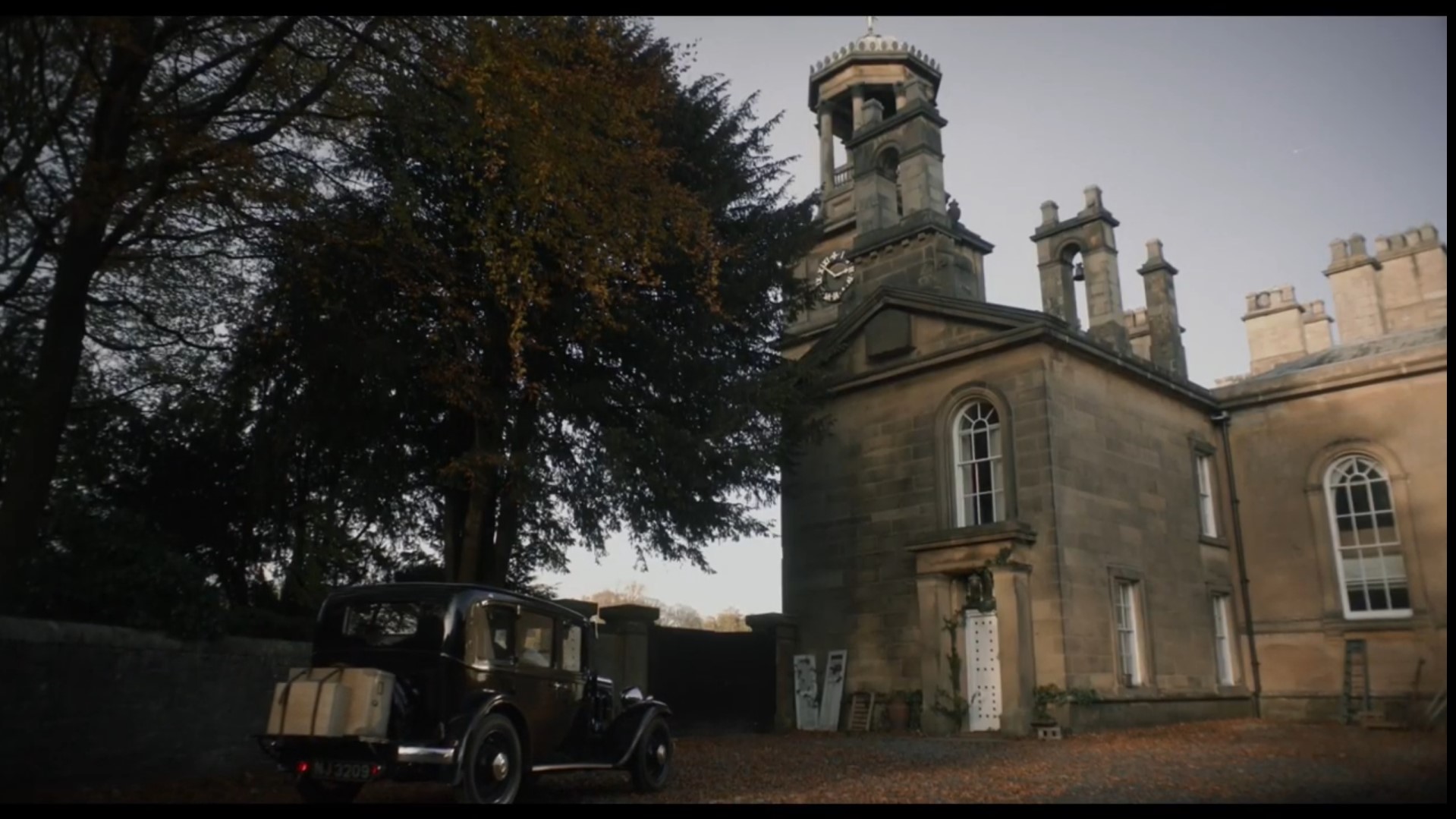
Set convincingly in a quaint, 1930s English town, Christopher Smith transports the audience back in time to the predated anxious moments before World War II that would upheave turmoil across all across Europe, but though that fretted lingering of war is set as the backdrop for “The Banishing,” and is coiled around every man who served in the first Great War that brought up more than once, the root of the narrative ultimately becomes the house Linus and Marianne have come to call their home.  Haunted house films surmise the house as a built-in principal character because of either the way the architecture affects the mental or physical wellbeing of it’s flesh and bone counterparts or if the abode is actually possessed and set to harm the inhabitants in a personification of pure evil, as such with various films of this caliber (“House,” “The Haunting,” etc,). Yet, Linus and Marianne’s estate failed to become a part of the narrative limelight despite the immense grounds that compromised of a large greenhouse and a robust library complete with fireplace and the disconcerting labyrinth of a dungeon-esque basement full of barred enclosures and close quartered corridors.  Nearly every interior shot felt like a new section of the house hat kept extending upon, what would be assumed, a grand mansion that had a longer rap sheet by reputation in being a former religious torture chamber run by sadistic monks hellbent on whipping the sin out of the mentally tormented. Smith always had an eye for the unsettling visuals and sustains that feng shui by allowing time and space to be the inner horrors of a funhouse, but doesn’t evoke clean, unadulterated terror that continues to profusely bleed into the film’s climatic cause-and-effect unraveling. There is a lack of a transformative realization and a small hurtle of sedated possession to figure out that the main presence in the house, amongst the other more malevolent presences, wants something and the characters are spoon fed each and every morsel to get them up to speed. The final scene of the bishop meeting with the Nazi regime intended to leave the story open for supernatural possibilities, but felt like a more poignant and compelling crux leading into Nazi occultism, hinted by the eccentric resident occultist Sean Harris.

Morosely dramatic and haunting, “The Banishing” is an aggressive salvo of facing shame head-on, creeping into UK cinemas and digital platforms on March 26th courtesy of Shudder and Vertigo Releasing. Director of photography Sarah Cunningham has an remarkable ability to engulf the actors in the space of the shot, making them seem diminutive to the rooms that feel like a giant hand looming overhead, and with the bare, hard lighting, the cinematography is really where “The Banishing” shines as gothic cladding without a stodgy spot to speak visible. Cunningham adds all the hallmarks of a horror film with titled angles, brilliant reds, and tight shots on tense faces to garner a more anxiety that never actually pans out by the end. The organic electro duo TOYDRUM score the 97 minute film with a single note droning hums at various pitch levels that can really get inside your head. The “Prevenge” composers set up scenes with a ill-founded fears when nothing presently visible is intended to fright. There were no bonus scenes during or after the credits, but one scene to note is Sean Harris waltzing with an uncredited woman during the opening credits that seems out of place but speaks to the aberrated decorum of his character. “The Banishing” works tirelessly to discredit shame by confronting truth and while we’re being beat over the head by the message, the overlay of horror is lost despite some brilliant and engrossing performances from Findlay and Harris who usher us through to the imperfect conclusion.

The Only Way EVIL Would Go Out With a Virgin! “Double Date” review!


Recently dumped and severely panicked around women, the prospect of ever dating again seems like a long shot to Jim. Self-assured Alex sees the opposite for his best mate as a golden opportunity for him to get Jim laid before his 30th birthday. When Alex finally coerces and assists Jim on scoring a double date with two sisters, Jim can’t believe his stuttering awkwardness actually proved fruitful, but little do Jim and Alex know that the sisters, Kitty and Lulu, are out for blood. The sisters seek a virgin to sacrifice to bring their long deceased father back from the dead and to complete their trio-family once again at the expense of Jim’s involuntary celibate lifestyle. Night clubs, fast cars, and visits to the parents take the four through a series of dark and drug fueled misadventures and the unexpected moment of falling love that makes this double date one to die for!

First dates are always inherently frightening. The idea of being alone with a stranger, who you’re kind of attractive to and trying to impress, yet don’t really know a single thing about them, can be daunting, if not paralyzing. First date in a double date is supposed to ease that overwhelming fear and take the strain off from the lack of possible interest in the other person, but for director Benjamin Barfoot’s amusing horror-comedy, “Double Date,” all bets are off and all tensions are on edge when dating goal sights are deadly different. Danny Morgan pens a comedic gem in which he stars as the bumbling virgin, Jim, joining his long time collaborating partner, Barfoot, to complete their first feature film together. The British made and produced film gives glimpses of London’s fung shui through the pubs, clubs, and overall eclectic nightlife to the aristocratic mansion homes to the likes of “Downton Abbey” resulting in a slight blend of the past and present into a well-oiled story embodied with terror and fun.

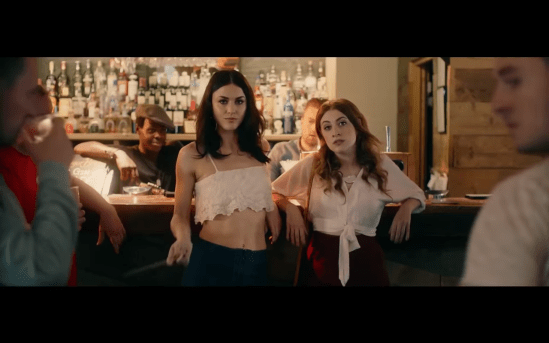
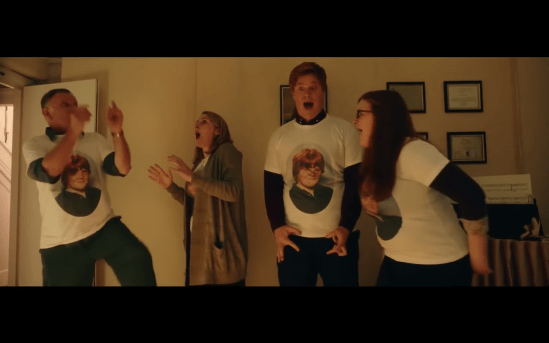
Funny man Danny Morgan stars as the awkward and blundering Jim whose plagued with fumbling qualities around women that usually leaves him somewhere in the inner circle of the friend zone. Morgan brilliant showcases Jim’s stunting inadequacies that eventually come to flower while maintaining a solid naturally slapstick presence of self-deprecation that turns into a full-blown bull in a china shop. The scene with his parents and himself singing his birthday song in front Lulu in audience, while tripping on drugs, is cathartically enjoyable and a riot of inner laughter. Morgan’s joined by “Being Human” actor, Michael Socha, as Jim’s very good friend, but all talk confident friend, Alex. Alex is certainly the yang to Jim’s yin on screen and off screen as Morgan and Socha have a certifiably fresh dynamic that makes them very entertaining to digest. Socha brings a different kind of comical energy that compliments Morgan’s dry humor that diversifies the content. In fact, all the characters bring a little something different to the table, such as with the sisters, Kitty and Lulu, played respectively by Kelly Wenham (“Dracula: The Dark Prince”) and Georgia Groome (“The Cottage”). Training like an elite athlete, Wenham takes the role to heart being a dark and beautiful villain that’s inarguably alluring as she’s cold and deadly. The Cheshire born actress, whom hands down can be the next Megan Fox, sinks her teeth into the performance and excels in the physical role that’s showcases her range of talent. Then, there’s Georgie Groome as Lulu, the timid opposite of Kitty. Also known as the girlfriend of Harry Potter’s Rupert Grint, she nails being the one in the shadows, relinquishing control mostly to Wenham for most of the film, and then slowly build character confidence and strength.

“Double Date” is a great blend of horror and comedy. The climax has this satirical and retro quality about that seems unfitting, but is stitched carefully to fit without bursting and popping a seam (or scene?) to the point of overly obtrusive. Benjamin Barfoot also has a keen eye to capture the pivotal and incandescent moments that make scenarios have more an impact, whether that being a facial expression, an awkward dance, or any kind of verbal or action exchange between characters. Doesn’t hurt that Barfoot’s rapport with Danny Morgan is a relationship riding the same director-actor level plane, similar to the dynamics between Adam McKay and Will Ferrell, with a synonymous cerebral synergy that clicks well for the silver screen.

From the independent film company who delivered “The Man Who Killed Hitler and then the Bigfoot,” Sparky Pictures releases the Screen International/FrighFest awarding winning horror-comedy, “Double Date”, onto digital, DVD, and Blu-ray come September 9th in the United Kingdom. Unfortunately, an in-depth review of the video and audio specifications will not be covered as a BD screener disc was provided, but what can be said about the soundtrack, performed by GOAT, is pure primitive gold and the appearance by Big Narstie is equally solid. Bonus material, on this check disc, included an extensive behind-the-scenes, from conception to wrap, of Danny Morgan and Benjamin Barfoot’s roller-coasting adventure on getting their film made. There’s also a commentary with cast and crew, deleted scenes, photo gallery, and trailers. “Double Date” is a true black comedy and a whole lot of fun that should skyrocket filmmakers Danny Morgan and Benjamin Barfoot toward future endeavors as a rising, powerhouse duo, contending to be the next hit in the satirical category.

Amazon has Double Date! Own it today!