When the EVIL Novice Becomes the EVIL Master. “Assault! 13th hour!) reviewed! (Impulse Pictures / DVD)

“Assault!  13th Hour” on DVD from Impulse Pictures!

A gas station attendant is beguiled by the culpable bad boy antics of a serial rapist in a red jacket. As the attendant becomes more enthralled by the sociopath’s life-altering school of assault and apprenticeship, he attempts a solo flight to turn his women victims into loving his deplorable acts of sexual misconducts. His emulation of sprouting a decadent rape fantasy fails as the connective alternative sexual experience between the powerful and the powerless only induces complete fear. Curious to how the connoisseur of forced copulation gets away with women paying him for ravishment again, the novice learner of lechery aims to seek as much knowledge as possible without hesitation and without question but a homosexual gang hunts down his master in the crimson jacket for an unspecified act that warrants retribution. Caught in the middle, the gas station attendant must fight for his life if he wants to continue the legacy of violation.

Better known as “Rape! 13th Hour,” Yasuharu Hasebe’s “Assault! 13th Hour” is a perhaps a more marketable film for many western distributors with the world rape kicking off as an exclamational in the title. One of Japan’s well-known exploitation and pinku filmmakers, having directed a slew of films with a combination of action, crime, and sexual dysphoria and kink with the Stray Cat Rock film series (“Sex Hunter,” “Delinquent Girl Boss”) as well as “Rape!,” “Secret Honeymoon: Rape Train,” and “Raping!” Yeah, I would say Hasebe had a deviant fantasy for the subject. Released in 1977, “Assault! 13th Hour” comes from the same mind of “Hausu” screenwriter Chiho Katsura and Toshiro Masuda’s “The Perfect Game,” a Criterion release film, screenwriter Yoshio Shirasaka. Now, the 73-minute narrative rapt in the idea of women throwing themselves, as well as their yen, at the attacker in a twisted reaction to forceful violation with a greenhorn being trained-to-inherit the practice is by no means as surreally horrifying as “Hausu” or as complicatedly thrilling as the gambling-gone-awry “The Perfect Game.” Still, an underlying, nagging feeling of the patriarchal power that is deeply engrained into Japanese culture can be digested with this pinku-production under the company eye of Nikkatsu Corporation, releasing the film under its pinku eiga subsidiary, the Nikkatsu Roman Porn banner, with Ryoji Ito (“Cruel High School Girls: Sex Lynch”) producing.

Now, whether “Assault! 13th Hour” is a sequel to either Hasebe’s “Rape!” or “Assault!” is not clear from this reviewer’s eyes – I have yet to see either one of those particular previously films – but there lies one commonality between all of them, Akira Takahashi. A lifer in the pinku eiga industry, Takahashi has collaborated with Hasebe on a number of films that run the gamut of exploitation. For his role of Crimson, a serial rapist and delinquent who sports a red bomber jacket, the principal predator is more mysterious in not only his actions but his backstory involving the homosexual gang boss and his two equally sapphic goons and this is where I suspect “Assault! 13th Hour” might be a follow up film as Crimson’s historical transgressions don’t come to light. Hence, the gang’s manhunt never fleshes out to a warranted chase down and the unsuspected sexual tension that produces from it between Crimson and the gang boss. Takahashi brings a confident and suave creep to the lead but doesn’t necessarily have the charisma to make Crimson stand out on his own as a memorable character. Crimson’s accomplice, and the story’s perspective primary, played by Yûdai Ishiyama (“Izo”), fits snuggly into the part of curious in his character who takes uninitiated baby steps into wanting to be a part of this cabal of beastly baroque bedfellows that can persuade Stockholm syndrome upon their victims before they zip up their pants. Ishiyama’s role provides more depth as a low-end gas station attendant with a pent-up perversion and who’s better to exploit and nurture his willingness more than his equivocal new best friend, Crimson. The story’s unpublicized character list provides the story with a nebulous pall to make a statement that this can happen to anyone and can even happen to this cast list of Yuri Yamashina, Tamaki Katsura, Naomi Oka, and Rei Okamoto.

I’m still wrapping my head around the plot’s sudden drop into mid-story without a callback to Crimson’s sordid history that weaves between his seemingly magical persuasion of perversion and his tumultuous involvement with the homosexual gang who want more than just to beat him to pulp. The chance stance Hasebe has to fashion into a comprehensible story, based off the script’s limiting section of a whole, is turned into a wildly suitable and often alternate universe viewed milieu where corruption and immorality goes without proper attention or justice. There are no detectives tracking down the rapists’ rampage or even the display of just a single police vehicle at the aftermath of the crimes. Judgements are contained within the confines of the criminal underworld from a twisted perspective of vigilante justice and, you know, it works! The one-sided standpoint immerses the viewer into a filthy, degrading, and perversely fantastical sea of immorality where lawlessness is the law, but as far as pink films are concerned, “Assault! 13th Hour” is a tame entry that doesn’t shockingly exploit the senses. Likely, that reserved jolt from the jarring material stems from decades of repetitive similar films of the same genre and/or nature and we, those fans drowning in fascination of the pink film category, might feel a little numb to its debauchery though the ending’s infringing necrophilia onto nearly every possible orifice on the victim’s body can be an eye-opener, or an eye-closer depending on your level of comfort and intrigue. Assault! 13th Hour” explores a trade far less trodden in its unusual master and pupil dynamic and subjugates any ambiguities over the blurry line between heterosexuality and homosexually with a slightly biased preconceived notion that heterosexual assault leads to viable passion whereas the counter only offers brutality and bloodshed.

Arriving onto DVD from Impulse Pictures, the XXX and erotica sublabel of Synapse Films, is the Nikkatsu Roman released “Assault! 13th Hour!” The anamorphic 1.85:1 presentation renders a respectable transfer of the 35mm film despite the noticeable age and wear of the warm, inferior negative stock that often appears dark and detailed indiscernible, unlike the stylish use of high contrast. The Japanese Dolby Digital 2.0 dual channel casts a better-than-expected dialogue track and general ambient score albeit the overplayed audio bytes for cars revs and screeching tires. The constant low whir never goes above a whisper, leaving alone the dialogue to remain clear and free of obstructions and that also goes for the absence of pops and hissing. The newly translated and removable English subtitles pace well, display without typos, and are synchronously consistent. The 1977 Japanese erotica and roughie is a feature only release for Impulse Pictures with no bonus material included. The tight and taut, rough and dirty, “Assault! 13th Hour” is a tinderbox of ferocity as well as a tender box of far out fantasies that makes this dichotomy of sexuality and violence an interesting slice of Japanese erotic cinema.

“Assault!  13th Hour” on DVD from Impulse Pictures!

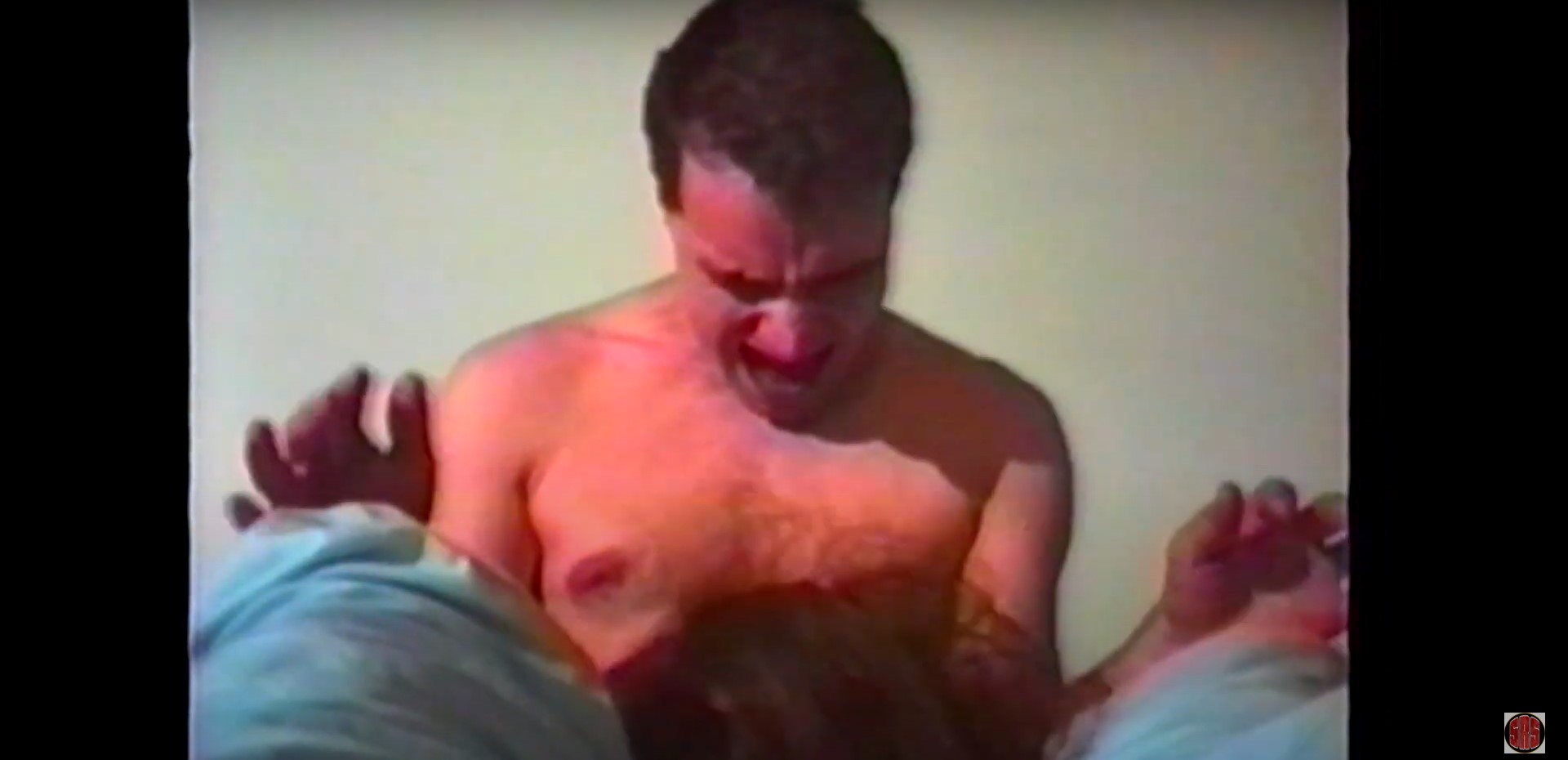
To Death Do Us EVILLY Part! “Savage Vows” reviewed! (SRS Cinema / DVD)

“Savage Vows” on DVD at Amazon.com

A fatal car crash claims the life of Mark’s wife.  Plagued by vivid nightmares of death and grief-stricken by the loss, Mark finds comfort in his closest friends who have come to console and stay with him after the funeral.  Slowly, Mark’s friends begin to thin out.  Thinking they’ve gone home or stepped out briefly, Mark continues to spend time with his remaining friends, watching horror movies, and eating fast-food hamburgers while contemplating how to handle the sorrow for the rest of his life without his wife by his side.  Other than a select few of his friends attempt to take advantage of his vulnerability, what’s really happening behind the scenes is a crazed killer is taking out his friends one at a time and while Mark continues to sink deeper into self-pity and become contentious with the greed of others, the killer mercilessly works closer to him by wiping out his entire friend network before he even comprehends what’s going on.

Let me take you back in time to the archaic and fashion disreputable (or maybe just plain questionable) year of 1995 where the hair was bigger, the cars were more manual, and where Blu-rays, DVDs, and those godawful streaming services were a futuristic glimmer in the eye as cassette videotapes were stocked the shelves. One of those physical retail locations was a brick-and-mortar store owned by Robert (Bob) Dennis who became enticed to stick his hand into the movie making machine and convinced to direct his one and only full length feature film, a shot-on-video slasher indie entitled “Savage Vows.” Bob Dennis’s then wife-now-ex, Carol Dennis, co-wrote the 80-minute script of an obscured death dealer racking up a body toll of Mark’s disputable friends who secretly despise each other and have sub rosa intentions. Shot in and around Wilkes-Barre, PA, where Dennis operated and shared ownership alongside brother Michael J. Dennis his video store, Full Moon Video (no relationship that I can deduce to Charles Band’s Full Moon aside from selling his hot horror commodities on tape), “Savage Vows” retains a two-location shoot encompassing Mark’s house and an always tight budget cinema staple cemetery for full blown low-budget honors. Gage Productions funds the project under another Dennis relation, executive producer Gage Dennis, along Carol Dennis wearing the dual hat of producer.

“Savage Vows” transposes the family affair from behind the camera into the forefront of the camera as Bob and Carol Dennis not only nurture widowed-slasher concept into a full-fledged video feature but also take on principal, yet ill-fated roles themselves while also employing Bob’s brother, Mike Dennis, and Jamiece Dennis into the background and extra fatality-fodder to fill in where needed. The scene interactions transcend through naturally as suspected with having family members mimic being mincemeat for the grotesque grinder and to put forth their best foot in the dialogue despite the rather cliched and trite rap. Though Bob Dennis and his cohort crew of closely related cast member might not be the marquee glowing luminaries of low-budget lore, there is one name, a singular cast member, that sticks out as a present-day household name in rinkydink D-movie horror. The filmmaker who has made a notorious name for himself for his schlocky and shoddy sharksploitation films, has trespassed and exploited the property of Amityville on more than one occasion, and continues to be an unfazed direct-to-video deity amongst the bedrock in the bottom of the barrel genre pool is none other than Mark Polonia, the director, who often collaborated with his late twin brother John Polonia, brought us “Splatter Farm” and has also a defacing sharksploitation rut-rack with the so-bad-it’s-drinking game good grievousness of “Land Shark,” “Virus Shark,” and, most recently, “Sharkula.” Mark Polonia has more than just the role of Adam, Mark’s best friend, in this story as the then just hitting his stride Polonia encouraged Bob Dennis to expand beyond his wishful thinking of creating a horror movie and also provided creative notes during principal photography. Just being this far down in the character-cast paragraph section, you know “Savage Vows” Armando Sposto (“Night Crawlers”) barely makes a blip on the radar as the widowed Mark, but the shame of it all is that Sposto provides fathoms of depth when juxtaposed to any other in the cast. Having just lost his beloved, Mark’s up against the wall of grief and Sposto does his damnedest to convey that without flinching as the young actor has to teeter between misery and another self-conscious emotion pivotal to the endgame. Kelly Ashton, Adam Bialek, Jackie Hergen, Grand Kratz, and Sally Gabriele make up the rest of the “Savage Vows.”

To death do us part” is the ceremonious idiom that signifies an everlasting commitment to one another. For Bob Dennis, it’s the marginally grim phrase that also drives the plot, but “Savage Vows” wanes nearly entirely from matrimony motifs, never really genetically incorporating the sacred act of bonding two people itself into its slasher anatomy.  Instead, Bob Dennis (and Mark Polonia) land on the ghastly side, or rather the latter side, of a marital life span with the untimely splitting of a union and this particular union, Mark’s marriage, ends in tragedy and therefore a gothic-cladded funeral of gloom and despair are rooted and entrenched into the story.  Though perfectly suitable to drown oneself woes, “Savage Vows” reaches further into that dispirited nature with Mark having fallen into negativism and his friends lend their sympathy with a sleepover offer of consolation. That’s where the comradeship becomes icky at best with friends who disguise their underhanded true intentions with a show of spurious sympathy and that kind of malevolence benevolence within the closeness of others mirrors itself, in a foreshadowing type of way, in the heart of the plot that lacks the pith of solid slasher kills. The kills scenes are of the run-of-the-mill stratification that slowly ascend to a not so bigger or better rehashed versions of themselves. The finale cap sets the bar a little too late in my book with a deserved kneecapping kill that simultaneously sums up “Savage Vows” skin-deep concept.

A longtime leader in resurrecting obscure SOV horror back from the 80s and 90’s analog grave, SRS Cinema does what SRS Cinema does best with a supremely graphic and retro-approached DVD of Bob Dennis’ “Savage Vows.” The NTSC encoded, region free DVD5 presents the film in the original aspect ratio of a matted 1.33:1 with a shot on video quality that’s high on fuchsia hue in what’s a warm, inflamed, infrared color palette that obtrudes in a non-stylistic choice. Certain trope-filled nightmare scenes have a catered good synth score and stay ablaze with visual terror fuel in which the hot pink-purple palette would have worked to the scenes advantage. As expected, as these imperfections add that wonderful je ne sais quoi to the shot-on-video epoch, the subpicture white noise and tracking lines are a welcome treasure trove for trashy rare cinema albeit the gargling of quality. The English Mono track never flushes or levels out with any promise due to a lack of a boom recording and far-removed mic placement. The dialogue remains boggled down also by e-interference with a slog of hissing issues, but still manages to be intelligible. Bonus features includes an 80-minute, feature length, commentary track with supporting star Mark Polonia on the phone with writer-director Bob Dennis, a bloopers reel, and theatrical trailer. Say, I do to “Savage Vows,” a love-it or hate-it, little known, SOV slasher with a can-do attitude of stab-happiness of the unprincipled so-called nearest and dearest.

“Savage Vows” on DVD at Amazon.com

EVIL Secluded is When EVIL is Most Dangerous. “Hellbender” reviewed! (Acorn International Media / DVD)

Izzy is sheltered from the outside world, living isolated with her mother in the Catskill mountains.  Izzy’s been told all her life that at a young age, she was diagnosed with an autoimmune disease that warrants her from staying away from people.  When a lost hiker stumbles upon Izzy, his friendliness and niceties inform her of his niece who lives nearby and is around the same age as Izzy.  the lonely teen, who spends most of her time rocking out with her mother in a two-person band, curiously ventures away from the safety of her home and meets the niece, Amber, a freethinker and free-spirit very opposite in comparison to Izzy’s protected life.  The interaction ignites a hidden family secret form within Izzy that ties her family lineage to witchcraft, revealing the true intentions of her mother’s overprotecting behavior and an unleashing growing pains of power coursing through Izzy’s thirst for independence. 

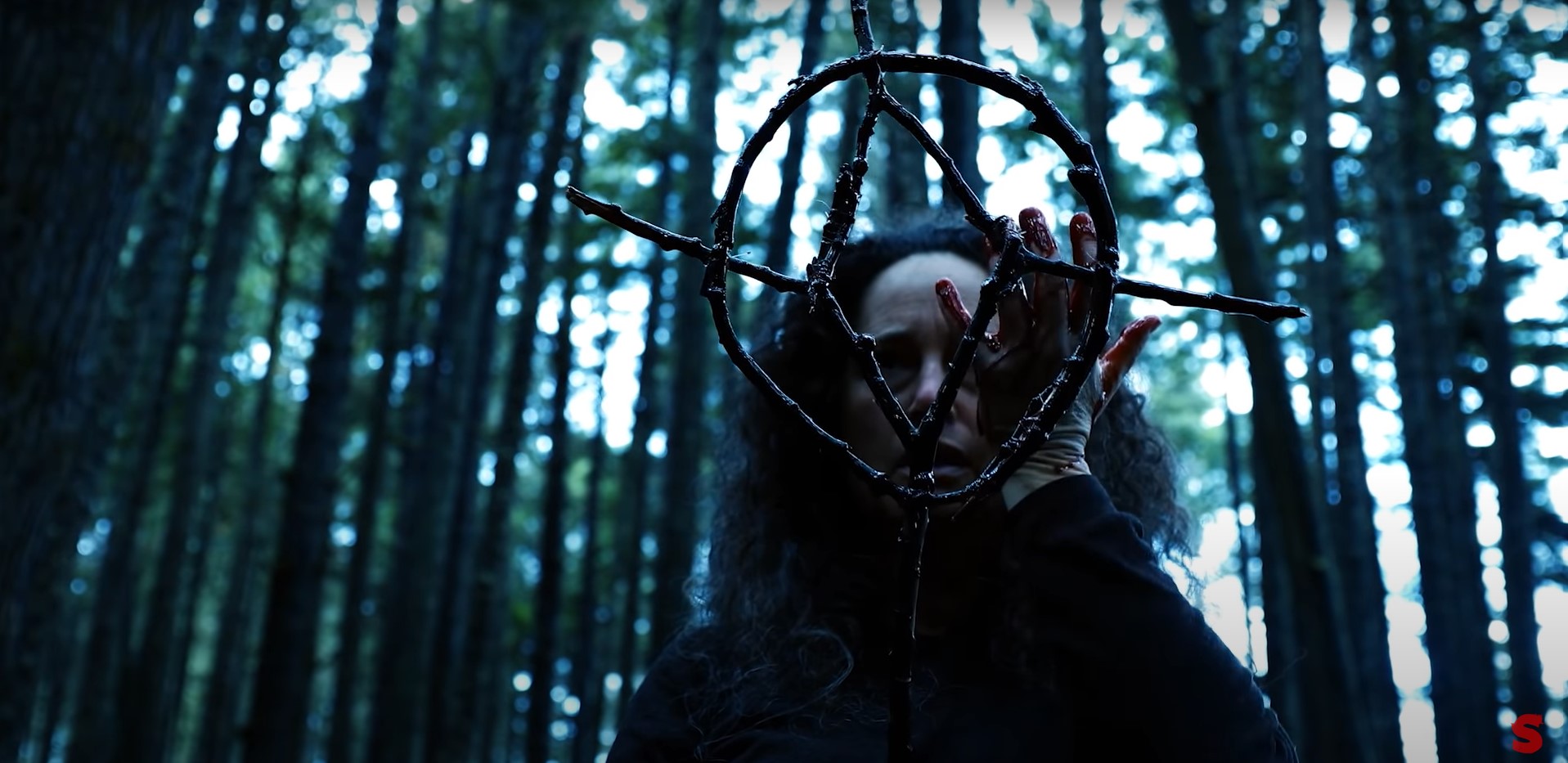
No cackling.  No broom.  No familiar black cat.  No pointy black hat.  “Hellbender” isn’t your typical witch and witchcraft reel of dark magic spells.  The family owned and operated, produced and crafted, feature film, released in 2021 and hailing straight from upper New York State’s Catskill mountains, is indie folk horror of coiled family complications in the coming-of-age aspect of a daughter finding herself outside the confines of mother’s safety net as well as the adverse effects on a child because helicopter parenting. “Hellbender” is a family affair as the writers and directors of the film are a nuclear family consisting of father – John Adams, mother – Toby Poser, and their daughter – Zelda Adams. The Adams family, as they like to punningly like to credit themselves, have collaborated, along with their oldest daughter, Lulu Adams, together since 2010 and released their first film, a drama feature from 2014 that was written and directed by John Adams and Toby Poser, known as “Rumblestrips” of essentially mother and daughters playing themselves going on one last RV trip before cannabis cultivating mom’s incarceration. Since then, the unstoppable family unit have been perfecting their craft on the indie circuit with short films, such as with the “Kid Kalifornia” shorts, and such as with their previous horror film, “The Deeper You Dig,” which became Zelda’s debut directorial. As their 6th feature film, “Hellbender” is clearly self-produced by the troupe, specifically Toby Poser who must control the family purse strings, and is a production of their own company, Wonder Wheel Productions.

Being right on the heels of watching “While We Sleep,” an Ukranian-U.S. demon-possession collaboration with an actual family playing a fictional one on screen, “Hellbender” doesn’t feel so terribly unique with its layered, dual roleplaying, but the performances in “Hellbender” are far superior with a richer, robust dynamic and better character progression that leads to terrifying results. Up in the principal forefront playing mother and daughter are mother and daughter, Toby Poser and Zelda Adams, who have made a sustainable and simple life for themselves on the mountainside.  Passing time by forming their own lo-fi garage punk band (tracks recorded and used from their actual band of the same title but with 6s replacing the Es – H6LLB6ND6R), Mother and Izzy entirely live off the land, avoiding strangers, and substituting meat for twigs and berries.  Poser and Adams deliver a real sense of kinship between a caring and shielding mother and a daughter naïve to the rest of the world in an allegorical sense of parents defending their children from the spoils of a loose culture.  Inevitably, an outsider opens the door that now can never be closed and one of two of those outsiders is played by father John Adams as lost hiker.  Subsequently, his presence spurs Izzy to another outsider which is played by Zelda’s sister Lulu Adams as the residential mountain neighbor and individualist Amber.  Zelda admires Amber’s cavalier gamut that includes accepting Zelda into her friendship circle without condition.  The feeling profoundly impacts and alters Zelda’s way of life, way of thinking, and grows the seedling of sorcery inside her.  Watch Zelda flow through Izzy’s blossoming arc is subtle, ambiguous, and slightly volatile – a frightening combination to the best degree.  “Hellbender” rounds out the cast with Rinzin Thonden, painter/model Khenzom Alling, Rob Figueroa, Shawn Wilson, Tess McKeegan, and adding one more Adams to the cast with John Adams Sr. in a cameo role.

It’s been established that “Hellbender” is classic without being conventional but does that necessarily make the film worth watching.  The answer is resounding yes.  “Hellbender” has a spartan wit of etching out enough character-driven resolve balanced with soft-pedaled special effects around the spellcasters’ craft that’s intertwined more with nature. Their special blood mixed with twigs, berries, or leaves are the special recipe for conjuring charms and incantations and while the mother’s intent is to keep on a low profile and away from people, the teen daughter who was held back from who she really is, held back from her own life even, has been rewired as the monster with a spasmodic surliness seen through her deceivingly wide smile and chipper attitude. The love and psychopathy are a symbolic combination of a stereotypical tumultuous mother and daughter relationship stemmed from being two peas in a pod. The darkness within them yearns to be free and much like a teenage girl eager to spread her wings, Izzy tastes the power of individuality on her lips and develops an incognito ruse in learning more about her powers, her family history, and all her mothers’ secrets to be what all parents fear – to be replaced by their children. “Hellbender” has an immense sense of seeing our own mortality right before our eyes with the very presence of our children and as the idiom goes that knowledge is power, Izzy plans to learn the whole ins and outs of her true self. “Hellbender” never lets up and never doubts the story with implementing a charade within a charade to keep audiences on their toes up to the fiery finale point of no return after opening Pandora’s box.

The Yellow Viel Films distributed “Hellbender” is a witches’ brew unlike anything ever concocted in the genre and the Shudder Original film has a new UK DVD release from Acorn Media International. The region 2, PAL encoded, DVD is presented in a widescreen 1.85:1 aspect ratio, has a runtime of 83 minutes, and has a certified 15 rating for very strong language, strong bloody images, violence and threat. Running at a higher level DVD9 bitrate of 8-9 Mbps, the image presentation is phenomenal for the format with no compression issues and the visual details are seamless. Catskill mountains invoke a tactile dampness throughout, and the foliage enlivens with a primary green with good contrasts against the darker brown and forestry emerald shades. The English language Dolby Digital 5.1 surround sound also has little to complain about with a maxed-out output of 192kbps that provides an unsullied soundtrack to H6LLB6ND6R’s discography. Dialogue renders perfectly as well. The only flaw is with the ambient overlays that distinctly felt exaggerated to a fault. Even when Izzy is walking through the forest, the Foley had an extra 200% crunch underneath her feet being one among the examples. Bons features included a visual FX breakdown by FX artist Trey Linsdsay that goes over layer-by-layer the visual heavy effect scenes to see how they were created, a handful of blooper scenes, behind-the-scenes footage of the Adams family shooting scenes and testing lynched dummies, H6LLB6ND6R band music videos, travelling with Wonder Wheel productions, and a short, very short, slice of film of Zelda Adam’s alter ego, Eville Adams in an odd artificial scope. Unflinching folkloric horror with a pinch of overparenting gone awry, “Hellbender” is hell-spawn defiant and a perfect, LoFi witch film that isn’t a witch film.

Night Terrors Are Not EVIL Enough. “While We Sleep” reviewed! (VMI Releasing/ DVD)

“While We Sleep” available on DVD home video at Amazon.com!

Neurologist Nina Evanko is perplexed by the unusual CAT scans of 13-year-old Cora whose been suffering from sudden onset sleepwalking after her birthday party.  Believing the CAT scan is going through calibration issue with imaging process, Nina orders another set of scans, but when the scans produce the same result and a death of another patient right in front of Cora sends her home early before Nina’s arrival to study the results, Nina convinces Cora’s parents to an at-home sleep observation to root Cora’s sleepwalking cause.  What Nina finds is far more sinister than night terrors or any other kind of parasomnia as a demon has inhabited Cora’s body with nefarious intentions.  Cora’s only hope to save her soul is her bewildered parents, a rattled neurologist, and a rogue priest but a family secret may consume everything. 

If you’re still looking to support Ukraine during the now 6 plus months Russia invasion of their sovereign neighbor, why not support the Ukrainian-U.S. collaborative cinema?  Why not start more precisely with Andrzej Sekula’s 2021 child-possession thriller “While We Sleep” set in the Ukrainian capital and flagship city of Kiev.  Sekula, known more for his work with Quentin Tarantino as a cinematographer on “Reservoir Dogs” and “Pulp Fiction” as well as “American Psycho” and “Hackers,” has quietly and seldomly helmed a handful of films over the two decades with “Cube 2:  Hyperspace” being one of them.  “While We Sleep” returns Sekula to the director’s chair for the first time since 2006 with a script by Rich Bonat and the film’s supporting costar Brian Gross, the first feature script penned by the “Jack Frost 2:  Revenge of the Mutant Killer Snowman” and remake of “2001 Maniacs” actor.  “While We Sleep” is coproduced by American Brian Gross and Kiev-Los Angeles based CinemAday productions, which include company bigwigs Rich Ronat, Yuriy Karnovsky, and Yuriy Prylypko. 

While much of the story begins with Cora and her parents (real life family of husband Brian Gross, wife Jacy King, and daughter Lyra Irene Gross) cursed by Cora’s acute and disconcerting sleepwalking disorder and moody behavior, the daily battle to understand their predicament is not left in the out of their league but most lovable hands of the parents as the film leads you to believe.  Roughly half hour into the film, the narrative switches from the convincing family perspective, despite building background on their low-band relationship troubles and move it nearly 100% to Nina’s problem-solving perspective with a hint of her own troubled past.  Kiev born and “Stranger” actress Darya Tregubova plays the neurologist too curious to shrug off the mysterious case of Cora’s abnormal scans.  Tregubova is fetching without saying but she doesn’t provide the necessary emotional weight of person who’s going through grief and loss issues from the past.  Tregubova also doesn’t convey the necessary weight toward her strong connection to Cora and Cora’s case with only a few expositional moments that hint at such.  These aspects leave Nina outside the bubble of plot events that make the character stick out as unnecessary even more with the character’s negligent professionalism surrounding the wellbeing of Cora and with the parent interactions.  Once the story butts in randomly the blacklisted priest, Father Andrey (Oliver Trevena, “The Reckoning”), with an intimate familiarity with the demon that possess Cora, we know that the story is lost as it tries to quickly and covertly wrap its grip around how to come to a head with this storyline.  You can’t have a possession film without a priest, right?  Father Andrey feels very much like a leftover thought, but Trevena tries his darnedest to sell a washed-up man of the cloth with desperation pouring from word out his mouth despite looking like an English hooligan in a pop collared leather jacket. 

“While We Sleep” has not-so-brittle bones of demonism and possession albeit lacking its own or established cultural mythos, yet there’s a disjointed nature about the story structure and plot points that just don’t make sense that crumble that coherency faster than Cora descending into the depths of demonic disorder. The opening scene is the most perplexing of all with an elaborate birthday cake that neither mom nor dad had made or bought for Cora’s 13th year. Without a care in the world, mom and dad don’t explore further who could have possibly made such a beautiful cake and little do they know, the cake, or rather the cake’s candles, are a conduit for demonic transmission into the soul. This part is never explained through the rest of the picture and, in fact, Gross or Bonat don’t touch back upon a possibility of explaining the odious presence. Much of everything is taken a face value, such as the fact Cora cuts her long hair to a pixie style without an eyelash being bat or in what’s more crtical to the plot is with Cora’s real and darkly unholy father backstory. Those facts are a shot to the brain and we’re still not understanding where Cora’s biological father fits into Cora’s space, into her mother’s space, or even into Father Andrey’s space, but you would think as important as this twist was suddenly deluged in a quick spit of point-blank honesty, the edges would be smoothed over and the picture would become clear as the holy water that was cross was spritzed with; yet, that the aggregation of aggravation of little-to-no details continues to carry out as if everything is perfectly peachy and comprehendible within the story context.

From the at-home release distributor that delivered John Travolta as “The Fanatic,” VMI Releasing, a subsidiary of VMI WorldWide, releases “While We Sleep” on DVD home video. The clear snapper cased DVD, a MPEG-2 formatted DVD5, is presented in a widescreen 2.39:1 aspect ratio with an average speed bitrate of 4-5 Mbps. You can see noticeable banding issues in the darker bedroom scenes sporadically throughout. Aside from that, the picture result is fair with more than enough detail for viewing. The English-Ukranian soundtrack is not listed on the back cover, but my SEIKI player reads two audio options: a Dolby Digital 5.1 and a Dolby Digital dual channel 2.0. Discerning the difference between two is not worth the effort as there’s only subtleties in the output. The 5.1 surround sound has obvious better capacity for multi-channeling. Optional English subtitles are available but neither one of the audio tracks available nor the subtitles offer English captioning for the Ukranian dialogue and often times, there are back and forth exchanges that are intended to carry worth behind the exchange. The subtitles just state foreign language speaking which doesn’t help at all so there’s a bit of lost in translation in the dialogue unless you happen to speak or understand East Slavic languages. The 92-minute film comes unrated but doesn’t come with any bonus material as a feature only release. “While We Sleep” only nips at attempting to be a better than average “Exorcist” akin contemporary but remains on the haphazard course of shaky character building and bumpy, unpaved developments that make only for a rocky portrait of possession.

“While We Sleep” available on DVD home video at Amazon.com!


A Sleepover With More Pillow Fight Than EVIL. “Slumber Party Slasherthon” reviewed! (Wild Eye Releasing / DVD)

“Slumber Party Slasherthon” on DVD at Amazon.com

We all know the familiar stages of a slumber party. The pillow fights, the junk food, and the all-nighter horror movie marathon that elicits amongst the room a simmering suspense that boils to bubble-popping action when even just the lightest rap at the front door can make one jump out of their seat in fear that the monster on the screen is also the monster clawing its way inside. These are all classic campout characteristics of a well-organized slumber party for a group of young high school planning a night of fun. Immerse in a string of video thrillers and with their male friends having joined the party, all fells safe during their night of revelry. That is until a manic with a high-powered, industrial drill shows up uninvited and unhinged. A night of fun quickly spirals into a night of unescapable terror just like in the horror movie marathon as they become the lumped together prey of their very own horror movie.

Slumber parties with uninhibited and skimpy-dressed teenage girls and the bedlam brought to the party by the unstoppable and unglued serial killer are a winning combination that go hand-in-hand just as well as vanilla ice cream and chocolate syrup on a classic sundae dessert. For the unofficial king of direct-to-video sequel and the despot of campy, indie horror filmmaker, Dustin Ferguson shares that perspective with his very own unique spin on the slumber party horror subgenre with “Slumber Party Slasherthon” that showcases snippets from Ferguson’s earlier movies, as well as Abel Ferrera’s video nasty “Driller Killer,” spliced into the wraparound story in what could be considered an eclectic compilation of clip anthologies with one common theme – homicidal killers. The 2012 “Slumber Party Slasherthon” is one of a handful of Ferguson’s early feature submissions before he went on a marathon of his own in the DTV market with films including some of his more recognizable titles in “Die Sister, Die!,” “Camp Blood 4 & 5,” “RoboWoman,” “5G Zombies,” and “Ebola Rex.” Under his own production and distribution label of RHR (Retro Home Remix) Home Video, Ferguson self produces the film in Lincoln, Nebraska as a one-man operation who knows showing up to a slumber party with a blood thirsty drill is better than showing up to a slumber party empty handed.

If you’re in the mood for familiar faces or recognizable names in what could be an interesting slasher trope-laden production, well you won’t have that memory jogged I know that actress moment with a cast of unknowns beyond this credit and have securely hitched their body of work to the Dustin Ferguson business model. With a next-to-nothing on the dialogue outside the marathon showreel, the performances of Nina Colgan, Tara Hinkley, Kim Moser, and Jettie Sorensen-Sticka are left to defend their acting credentials with the dual variation of a pillow fight sequence and in which one of the arrangements, intercut with the opening title credits, is shot in negative image. The brief topless nudity of one of the actresses and the frolicking of soft pillow swings are all the girth given to the principal cast, providing no arcs, no substance, and no real chance to do anything but be bit part actors in what seems like a commercial or faux trailer for Ferguson’s other films. In fact, I did read that “Slumber Party Slasherthon” was originally intended to be a fake trailer for a sequel to the “Slumber Party Massacre” line, yet somehow the project became unbuttoned from that franchise and fashioned in a way that’s more Frankenstein’s Monster than feature file, turning “Slumber Party Slasherthon” into a demo reel for Furgeson and RHR Home Video’s DTV catalogue. I couldn’t tell you who Colgan, Hinkley, Moser, or Sorensen-Sticka played in the foursome, but Breana Michell’s is distinct from the others as the girl who arrives late only to get drilled later – offscreen, of course.

A muddied-up potpourri of RHR Home Video produced and distributed enumeration of slasher films, “Slumber Party Slasherthon” isn’t as gorily galvanizing as it sounds. From beginning to end, there’s not a single ounce of a story conveyed to lure in a potentially captivating audience wanting to bestowed upon highly sexualized girls in lingerie being ripped to shreds by a lunatic over a single night sleepover. Instead, Furgeson regurgitates clips of his schlocky direct-to-video titles from years’ past, such as “Terror at Black Tree Forest” and its sequel “Escape to Black Tree Forest,” which look just as cliched and trashy as the intended feature with an over enthusiastic use of primary color filters. Other features not directed by Furgeson but are a part of the RHR Home Video assemblage of titles is “7 Down” directed by Tyler L. Schmid and, perhaps the most buoyantly intelligible and substantial film of the whole grouping, “The Diller Killer” directed by Abel Ferrera, that ironically enough clearly partitions itself from the rest of the films as a completely deranged concept not borrowed from the canon like the rest.

A part of the Raw & Extreme label, “Slumber Party Slasherthon” comes to the masses unrated on a Wild Eye Releasing DVD. The region free releasing is presented in a stretched full screen 1.33:1 aspect ratio with a variety of video problem areas. Aside from the poor, commercial grade filmmaking equipment, likely a shot on a handheld digital camcorder with a max resolution output of 720p, compression artefacts run rampant with a blotchy, and often jittery with swelled pixels, image. Despite a flat hue palette for the main story, an assortment of color filters is placed on the 3rd party films showcased as horror movie marathon fodder, whether or not the “Escape to Black Tree Forest” or “Terror at Black Tree Forest” camp powwows and kill highlights are authentically presented or not in its rehashed integration into “Slumber Party Slasherthon,” I could not definitively know. The English Stereo 2.0 mono has little to offer in shepherding any kind of storytelling design nor is there an attempt at a clean sense of clarity around a dialogue track that’s poorly edited, plagued with electronic interference, and has about the sharpness of a butter knife. Levels vary wildly in the ambient and the soundtracks also. The single redeeming quality of “Slumber Party Slasherthon” is John Altyn’s “High Roller” single that leaned on to way too hard – being used in the opening credits, first act, and in the post-credits, and post-credits music video – to excel save a little change and give Ferguson’s film flashier audio tinsel with 80’s rock-n-rock. Bonus features are about the same as expected with A/V quality with a scene selection and Wild Eye trailers, plus RHR Home Video previews of “Scared Sillies 2,” “The Wanted,” “The Devil Times Five” and an awkward two-girl sway-your-hips-in-place dance party featuring Altyn’s – you guessed it – “High Roller” single (not the official music video by the way). “Slumber Party Slasherthon” is a sleeping bag full of disappointments and is the anti-scary story told that’ll lull teenage girls right to dreamland during the slumber party pajama party.

“Slumber Party Slasherthon” on DVD at Amazon.com