Internal Evil is Subtle. “Fever” review!

vlcsnap-00001
High school classmates Pierre and Damien have just murdered a street woman inside her own apartment days before their French placement examinations. After hearing of the gruesome news, Zoe, a young optician working on the same street, recalls the two boys bumping into her, dropping a black glove on the sidewalk, and she begins to formulate her own radical theory, putting two-and-two together that the teens could be the very culprits fleeing calmly from the scene. Meanwhile, Pierre and Damien continue on with their examination studies over the Easter holiday, believing their heinous crime was not personal but of chance, making the offense not a crime at all. Zoe continues her pursuit of curiosity toward the murderers by not informing the authorities of her suspicions; instead, Zoe uses the crime to become self-aware of her fragile and stagnant relationship with her long time boyfriend while the two teens perverse over the concept of committing another murder.
vlcsnap-00004
Leave it to the French to make a bloodless and non-violent crime drama that’s more arthouse than conventional. Based on the Leslie Kaplan 2005 novel, “Fever” is the 2014 freshman film from writer-director Raphael Neal that dives sharply from the murderous act and into the internal struggles that lead Damien, Pierre, and Zoe into a turmoil path. Pierre and Damien think they both won’t be affected by their crime and that their moral conscious will remain clean on the philosophical notion that chance doesn’t warrant being unethical, immoral, or lawfully wrong. Damien basks in this belief more than Pierre, but still succumbs to the inevitable intrinsic battle. Yet, the two boys face separate inner warfare: Pierre’s frightened he’ll be caught by Damien’s nonchalant cockiness, looking over his shoulder constantly and fretting the off chance a witness has already spilled their dastardly secret to authorities whereas Damien fears that his chance theory is being blown to smithereens due in part of his ancestral legacy where his grandfather had cooperatively slain hundreds, if not thousands, of Jews during World War II because the Nazi’s ordered him.
vlcsnap-00003
Neal’s envisioning, as a director and a writer, flounders with a wishy-washy, by the waste side, telling when trying to convey the character centric story. From the beginning, Pierre and Damien’s sociopathic nature weakens from time to time with an invading moral conscience, like with in Pierre, but Damien’s difference lies with him questioning his justification of murder, but Pierre and Damien’s quiescent state about their family’s issues spots the story like a dirty window unable to view through clearly, leaving a vague and murky background and present state of mind for both characters. The twosomes’ up-and-down state of minds displays no consistence in their behaviors as they’re friends one instance, squabbling and bickering the next, then back to friends shortly after. Issues with angry and abandoning fathers, lustful mothers, and, apparently, genocidal grandfathers have deeply rooted themselves into the boys’ psyche like poisonous mushrooms kept in the dark to thrive to be eaten by mistake. Neal never relays that sense of foreboding wickedness. The same goes with Zoe as a character with really no background whose starting to go through a metamorphous, reforming her position in an unexciting relationship and developing, through subtle hints, a strangling desire after learning about to incident across from her shop. Yet, her full transformation never completes itself, placing her character, and the teens, into a volatile decline of shortcomings.
vlcsnap-00002
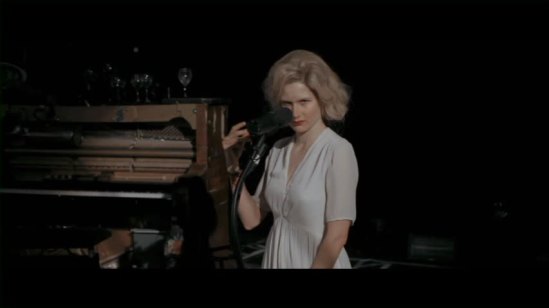
Though not too familiar with the actors themselves, their performances overshadow the film’s overall divergent plots. I was very struck by Martin Loizillon’s portrayal of Damien with the cold-heartedness that completely blankets his façade and his exerting of unorthodox spontaneity that doesn’t shy away from creating an uncomfortable scene. Pierre Moure contrasts Loizillon appropriately with a shyly frigidity, secretly yearning for more blood, Pierre Simonet. The red-headed Julie-Marie Parmentier displays the same kind of coldness reflected by the Pierre and Damien, but in actress’s own style of curiosity and intrigue with a minuscule hankering for sexual fetishes or self-morbidity. Then there’s duo lingo French singer Camille playing a role of non-fictional popular song artist Alice Snow whose hit English single, “Fever,” serves not only as the title of Neal’s film, but also symbolizes the foundation of the characters’ conflicts.
vlcsnap-00005
Artsploitation Films courteously distributes the Strutt Films’ production of “Fever” onto an unrated DVD with a sleek widescreen presentation with a 2.35:1 aspect ratio. The video’s clean with bright, Spring-like colors opposite the more customary, French influenced film noir that’s more common toward crime thrillers. The French 5.1 surround sound mix comes with English subtitles. While the soundtracks and the dialogue tracks are distinct and lively, there’s a slight error involving omitted subtitles, but the flaw only affects a petite portion of the dialogue, if you’re not tuned into French dialogues. “Fever” displays a mixture of psychological drama that mirrors the infamous Chicago crime of Leopold and Loeb of 1920 and Fyodor Dostoyevsky’s pathologic philosophical novel “Crime and Punishment.”

Click the image above to buy “Fever” from Amazon!

Evil is a Long Trip Home. “Earthrise” review!

output_2QuEEb
Earth has become an uninhabitable wasteland. The human race have resettled and colonized on the red planet of Mars. Years have past and the younger generation has never had the experience of living on Earth. Every year, a select few, those who pass multitudes of tests and reach the age of 30 years, will join the Revive Program and will travel through space on a seven day journey to Earth in order to aid in the planet’s rehabilitation of their once ancestry home. The journey between Mars and Earth is this story, a story of psychological perplexity between three travelers who get to go home for the first time.
vlcsnap-00049
“Earthrise” is the creation of writer-director-producer Glenn Payne, tackling the production limits of a space film in an independent market. Payne and his production team effectively generate the illusion of being a single speck in a vast universe without getting overly galactic (i.e. “Moon”) and widely interstellar (i.e. “Interstellar”). Yes, “Earthrise” embodies a minuscule budget that’s certainly evident, but the ambitiousness to recreate the innards of a spaceship without being too blatantly cheap gives creativity credit to the crew. The brief transitional moments outside the ship are about as good as money can afford, but still don’t quite cut the mustard with some big Hollywood blockbusters or even larger independent films.
vlcsnap-00050
Along with much of the crew, Payne’s experience mainly stems from a variety of short films with “Earthrise” being his latest full length feature out of a total of four. The three actors who portray the focus-centered characters also mostly come from a short film background. Meaghin Burke (“Trick or Treat” short), Casey Dillard (“Blackout” short), and Meaghin’s husband, Greg Earnest (also from “Trick or Treat”), portray the three protagonist Dawn, Vivian, and Marshall, voyaging to Earth. Within a non-linear story, their tensions cut through finely as an unexplained terror has overtaken, not only their flight to Earth, but their minds that visualize apparitions of people and creatures that shouldn’t be there. Giant spiders, man-eating alligators, alarming amounts of blood – just some of the psychological tensions testing the characters. Is it a form of space dementia? Or the inability to grasp leaving your home, your family, to live on another planet and not having the ability to contact anyone from home for a year, per the Revive Program’s policy? Or is it something else? “Earthrise” domes the answer fairly well until the end.
vlcsnap-00051
The sequence of events surround a near catastrophe involving a sudden meteor collision. One side of the collision tells the story prior to their insanely dangerous visions, building upon their backgrounds and delivering their soon obtained new found hope, while the other side explores their descent into madness and, eventually, the two stories meet in the middle with the major calamity. Contrasting the two sides defines, in a good light, director Glenn Payne’s editing style while still able to clearly convey the crews plight. Mise-en-scene clues were used to differentiate the catalyst, such as Marshall’s head wound or Vivian’s limp, but these details were minor enough to not pose an extravagance in order to make clear the outer edges of the story.
vlcsnap-00001
The 2014 sci-fi thriller is presented by Indie Rights Movies and MVD in a widescreen 2.35:1 aspect ratio. The details are richly sharp, drenched in a metal tone to create a ship’s inner hull racing through space atmosphere. The dual channel Dolby Digital mix is clear and balanced and purposefully isolating to get inside the loneliness of the great big infinite. Accompanying the 100 minute runtime, a couple extras include the film’s trailer and a commentary. Sci-fi on a budget, “Earthrise” is enjoyably subtle, sleekly structured, and soaked with heart and soul. Many will not be attracted to “Earthrise” and it’s slow-to-build momentum, leaving only true film aficionados and appreciators to find Payne’s work entertaining.

Join the Ranks to Stop Pollution Evil! “Doomwatch” review!

vlcsnap-00007
The Doomwatch organization was created to investigate and stop the approaching environmental harmful effects of destructive pollution. Doomwatch sends Dr. Del Shaw to the fishing village island of Balfe where only one year ago an oil tanker sank off the island’s coast, leaving behind a devastated waterfront of oil waste that annihilated a chunk coastal life. Upon Dr. Shaw’s arrival, a strange sensation of unwelcomeness overwhelms him in the close knit fishing village. Shaw’s one day visit stretches to a longer stay when his curiosity about the village’s secrets gnaw at his conscious. Though what Shaw unearths is a direct result of man-made pollution, his discovery reveals a much more frightening mutation, transforming the quiet and isolated fishing village into a violent and turmoil lot of locals.
vlcsnap-00003
The 1972 feature film “Doomwatch” was born out of the brief lived and sorely lost British television series of the same name from 1970 to 1972. Surely a familiar shelf life and fleeting path of another placed on the back burner sci-fi great, a little series known as “Alien Nation,” in which did the exact reverse strategy and spawned from a hit movie starring James Caan and Mandy Patinkin. However, “Doomwatch” sought a more practical and realistic approach that attempted to warn the public of the dangers of monumental pollution and instill a self conserving fear into the residents of Earth. The scenario is also on a smaller scale from other similar plots such as an example of one would be the 1950s testing of the hydrogen bomb that had consequently overdeveloped and mutated an oversized, fire-breathing lizard you may know as “Godzilla.”
vlcsnap-00002
“Doomwatch” isn’t full-throttle horror and doesn’t quite even board the chills and thrills train. Instead, the Peter Sasdy directed film plays out more toward a science fiction mystery that lingers and hangs on the story’s catalytic moment. Prior to the “Doomwatch” film, Sasdy did partake in directing notable horror features for Hammer Films production such as “Taste the Blood of Dracula,” “Countess Dracula,” and “Hands of the Ripper,” but Sasdy made his start in television with over a decade amount of experience working on the smaller screen. Sasdy did have some help in amongst two writers who previously had long-running experience writing for the “Doomwatch” series. Kit Pedler and Gerry Davis saw fit to put their two cent input, but the film’s script was finalized and streamlined from the relatively unknown writer of that time Clive Exton who went on to pen “Red Sonja” starring Arnold Schwarzenegger.
vlcsnap-00005
I feel like Peter Sasdy safely cradled “Doomwatch” for the public with the content being alarmingly prophetic. For a director who exposed colorful amounts of blood and fantastical and villainous inhuman creatures to the world, Sasdy had disappointingly failed to shock audiences with potential world wide devastation. “Doomwatch” could be deemed more of a workplace educational video required in the protecting of the environment and to become ISO certified. Poor Ian Bannen tried his damnedest to sell his performance as the Doomwatch’s over-caring Dr. Del Shaw, but Bannen’s character, for the most part of the film, just yelled his case (or the village’s case rather) to an unsympathetic and ignorant written fishing village that, in my opinion, deserved to wither and die out due to their lack of wanting to be cured of digesting hormone chemicals and also from the years of inbreeding that would have eventually sprouted genetic mutation as well. The “Doomwatch” cast rounds out with leading lady Judy Geeson, Percy herbert, George Sanders, and Jean Trend.
vlcsnap-00006
UK located Screenbound distributes a newly restored DVD version that’s region free with a runtime of 85 minutes. However, the copy I received is a screener disc and can’t be necessarily critiqued for the audio and video quality. If I had to answer the three important story related questions about the film’s character, the answers would be the following: Entertaining? To a degree. Horrifying? Not really. Thought provoking about the welfare of Earth? Not as powerful as intended. The PG rated Peter Sasdy directed pre-apocalyptic call to arms film “Doomwatch” flashes no teeth for a long-haul fight against global defilement, even though the writers attempted to portray the disfiguring results of others’ mindless ignorance.

Evil Spanning Four Decades! “Dangerous Men” review!

output_acdWjK
Recently engaged lovers Daniel and Mina take a trip to visit Daniel’s brother. When they stop to take in one of California’s breathtaking beaches, two vicious bikers, looking for kicks, intrude on the lovebird’s romantic getaway, looking to rape Mina but ending up mercilessly murdering Daniel. Mina’s grief turns the distraught lover into a vengeful bitch, taking the lives of all salacious and beastly men who wish to exploit Mina’s virginal beauty. Meanwhile, Daniel’s brother, a praised police detective, personally takes on the case despite his Captain’s insistence of not getting to close due to his personal connection. The detective tracks down the drug dealer Black Pepper, the head of a notorious biker gang connected to the slaying of his brother, that results in an all out war!
vlcsnap-2016-05-01-19h51m41s138
“Dangerous Men” is an action film you hate to love, being so bad it’s good. The film was the non-aborted child of Iranian born, U.S. bound director John Rad, a pseudo name, who had a life-long vision from way back in 1979 to put an eternal awesomeness on the big silver screen and, in one way or another, completed that feat no matter how long the creative process. Only 26 years stood in between John Rad and his masterpiece “Dangerous Men” from being completed and theatrically released to the public, but, low and behold, “Dangerous Men” didn’t succeed into billions or even millions of box office dollars; instead, Rad’s film gained popularity in its notoriety, gaining almost instantly cult status through a niche group of garbage cinema aficionados. By the grace of the provocative arthouse film brew masters at Drafthouse Films and their continuous begging toward Rad’s daughter, “Dangerous Men” redefines the term guilty pleasure.
vlcsnap-2016-05-01-19h52m19s3
But what makes “Dangerous Men” so irresistibly appealing? Is it that fact that Iranian born Peter Palian from “Samurai Cop” fame is the most experienced crew member on John Rad’s amateurish, if not solo performing, team? To properly answer that conundrum-filled riddle, looking at what makes “Dangerous Men” so standardly terrible would ultimately lead to the answer. For one, a prominent lead character doesn’t exist in a plot that can’t focus due in part of the two decades the film was shot that resulted in the actors or actresses not being available or unwilling to complete Rad’s work. Various characters, like Mina (Melody Wiggins) or the cop brother (Dutch Van Delsem), come and go in their respective, decade housed plot paths and like one of Drafthouse Films’s bonus features makes light, the film ends on a still frame of characters who have had less than half an hour of screen time. Secondly, the amateur acting in exposition, the cut and dry editing, and the cartoonish foley, by the also writer-director John Rad, hones straight toward gut-punching you to explode into outrageous, painful laughter. “Dangerous Men” is a serious film that’s full of wacky action and some great moments of exploitation, especially scenes involving women knees, but when all the punching and exasperating is of the identical sound bite, like in a “Street Fighter” video game, taking Rad’s film seriously is hard to fathom. Thirdly, the longevity of filming created many production goofs that mistakenly implied the decade. From props, to haircuts, and to clothes, hints of years were obvious to the naked eye. Lastly, a title like “Dangerous Men” should end on an detonative high note; instead, falls just short of a chuckle and a “WTF.”
vlcsnap-2016-05-01-19h50m03s178
“Dangerous Men” snuggly finds a spot within the realm of other bad movies not to be missed. “Troll 2,” “Silent Night, Deadly NIght 2” with the infamous garbage day line, “Leonard Part 6,” and “Jaws: The Revenge” would gladly welcome “Dangerous Men” with open arms as a peer in preposterousness. With a little over a measly $2,300 in ticket sales on opening weekend from a film that probably cost John Rad thousands upon thousands of dollars to produce and a whole hell of a lot of time to construct, “Dangerous Men” is most likely an action-packed feature you’ve never, ever heard of before. One positive remark is the soundtrack, which is also composed by John Rad, was, in my humble opinion, swanky and, well, rad – a true testament to the era and the best effort for such bad film. Unfortunately, John Rad never saw his film blossom as he died soon after the release of his masterpiece, sometime mysteriously between 2005 and 2007.
vlcsnap-2016-05-01-19h52m32s133
Drafthouse Films, in association with MVDVisual distribution, courteously releases “Dangerous Men” on a sleek not rated two-disc, 1080p 1.85:1 widescreen Blu-ray and DVD set which has a region free presentation that still manages to hold in the cigarette burns and the faded coloring in a sort of time capsule from the 80’s and 90’s. The original print looks to have been kept in good condition for an easy upgradeable and cleanable transfer. The Dolby Digital mono stereo mix is fairly clean aside from some misaligned dialogue tracks with the video and the prevalence of background noise in certain scenes of poor record quality such as the Daniel and Mina restaurant scene. Drafthouse Films doesn’t discriminate amongst the quality of their releases when considering the bonus features. A 16 page booklet featuring documented full-length interviews with director John Rad, audio commentary featuring “Destroy All Movies” authors Zack Carlson and Bryan Connolly, “That’s So Rad,” an epigram stemmed from this film, is an original documentary about the film and its initial 2005 release, an interview with cinematographer Peter Palian, Rare footage of John Rad’s appearance on local access television, and the original theatrical trailer. Quite the laundry list of extras! “Dangerous Men” is so spectacularly unspeakable and trashy it shouldn’t go unseen for absolutely anything, not even for the birth of your first born child!

If You Don’t Know Who You Are? Then Evil Does. “The Ninth Configuration” review!

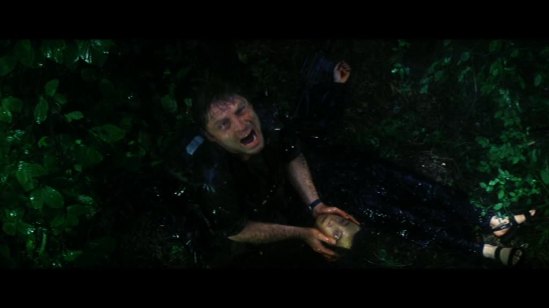
vlcsnap-2016-04-22-21h23m40s24
An insane asylum located in the North West region of the United States attempts an experimental test to root out Vietnam soldiers faking signs of psychosis. A new commanding officer, a military psychiatrist named Colonel Kane, will take the lead of the experiment. But Kane’s methods are unorthodox and Kane himself seems distant from what’s expected from him, leaving the military patients, and even some of the personnel, wondering about his state of mind. Kane lets the committed soldiers live out their most outrageous fantasies and the further his practice plays out, the more that there might actually be something terribly wrong with the new commanding colonel.
vlcsnap-2016-04-22-22h07m56s217
“The Ninth Configuration” is the big screen adapted version of William Peter Blatty’s novel entitled “Twinkle Twinkle Killer Kane.” Blatty, who wrote the screenplay and directed the film, dives back into motion pictures once again after the success of another previous adapted novel; a little piece of work you may be familiar with called “The Exorcist.” In the span of seven years, Blatty was able to cast again the versatile Jason Miller, who had portrayed a much more serious Father Karras in “The Exorcist,” as one of the leading asylum inmates in “The Night Configuration.” From then on, the hired case was forming into a formidable force of method actors including Stacy Keach (“Slave of the Cannibal God”), Scott Wilson (The Walking Dead), Ed Flanders (“The Exorcist III”), Robert Loggia (“Scarface”), Neville Brand (“Eaten Alive”), George DiCenzo (“The Exorcist III”), Moses Gunn (“Rollerball”), Joe Spinell (“Maniac”), Tom Atkins (“The Fog”), Richard Lynch (“Invasion U.S.A.”), and Steve Sander (“Stryker”). This cast is a wet dream of talent.
vlcsnap-2016-04-22-21h32m58s236
What’s unique about Blatty’s direction of this film is the non-displaying of action and dialogue off screen. Whether it’s character narration, dialogue track overlay, or slightly off camera view, the spectator, for more about half the film or perhaps even more, isn’t being directed to focus on the current action or dialogue and this creates the illusion of hearing bodiless voices or activities, as if you’re part of the ranks in the mentally insane roster. Only until the truth or catalyst is reveal is when more traditional means of camera focus is applied.
vlcsnap-2016-04-22-22h37m48s224
To make this technique work and to make it not become tiresome to the viewer, Blatty had to write some amazing dialogue and with him being a novelist and all, the dialogue was absolutely, 100 percent brilliant. Lets not also neglect to mention that with unrivaled dialogue, out of this world thespians must be accompanied to breathe life into the black printed words that are simply laying upon white pages. Scott Wilson’s and Jason Miller’s craziness is unparalleled while, on the other side of the spectrum, Stacy Keach delivers a melancholic performance that balances out the tone of the film from what could have been considered an anti-Vietnam war comedy at first glance that spun quickly with an unforeseen morph into a suspenseful thriller about the consequences of war PTSD and the affect it has on those surrounding.
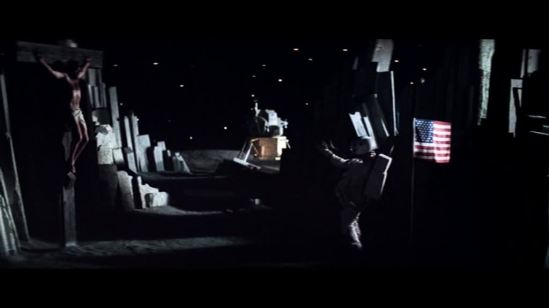
output_EezABQ
Gerry Fisher’s cinematography encompasses the Gothicism of the remote Germanic castle to where every ghastly statue and crypt-like stone comes alive like in a horror movie. The setting couldn’t be any of an antonym for a loony-bin set. Even though the film is suppose to be set in North West America, the location used was actually in Wierschem, Rhineland-Palatinate, Germany at the medieval Castle Eltz and the story subtly explains how the castle came to be in “America.” To the opposition of such a barbarically beautiful castle, the score by Barry De Vorzon (The Warriors) in the first act into the second is playful, lighthearted, and childish in an appropriate story tone, but turns quickly sinister and angry during progression, building upon the revealing climax.
vlcsnap-2016-04-22-22h09m58s160
Classic film and TV distributor Second Sight brings this cult classic onto DVD and Blu-ray in the UK. Since this was a screener copy of the DVD, I’m unable to provide any audio or video technical comments, but the screener did include the generous amount of bonus material including interviews with writer-director William Peter Blatty, and individual interviews with Stacy Keach, Tom Atkins and Stephen Powers, composer Barry De Vorzon, production designer William Malley and art director J. Dennis Washington. There are also deleted scenes and outtakes and a Mark Kermode introduction. A substantial release for Second Sight and a fine film for any collection so make sure you pick up or order this Second Sight release today!