Max believes he’s found the perfect move-in girlfriend with Evelyn: she’s nice, she’s hot, she loves sex. However, when Evelyn’s over-protective, save the planet, go vegan or go home boorish attitude becomes too much for Max to bare, he attempts to break up their dwindling relationship, but ends up accidentally killing her long after making a solid promise, in front of a mysterious satanic genie figurine, to always be with her. Max’s regrets surge him into a depressive state until he meets the beautiful Olivia, the perfect opposite sex carbon-copy of himself. Everything seems to be coming together for Max until Evelyn digs up and out from her grave and returns to him as a decomposing and clingy zombie girlfriend, picking up right where their relationship left off.

The 2014 romantic horror-comedy “Burying the Ex” is the first feature film from “Gremlins” director Joe Dante since 2009; a six-year stint that resulted in the outcome of this odd, but familiar blended genre film. Dante hasn’t kept his directorial hands too much in the horror genre pot in over two decades with the small exceptions of a “Masters of Horror” short film and 2009’s “The Hole,” the director hasn’t lost his signature touch of dishing out deadpan humor and fusing a knowledgeable palate of horror to go with it making “Burying the Ex” one of the most morbidly fascinating horror releases in the modern zombie age. Another trademark of Dante is casting a familiar face and sure enough, Dick Miller makes a cameo appearance. I swear I thought he was dead.

“Burying the Ex’s” cast is compiled of seriously underrated, but without a double awe-inspiring generating actors and actresses with the reboot of “Star Trek’s” Anton Yelchin headlining the way as the film’s main character Max. Max’s passiveness quality fits perfectly with Yelchin’s dry delivery and awkward mannerism style and Max’s passion for horror feels natural coming from Yelchin with the actor’s similar background work from “Odd Thomas” and the remake of “Fright Night.” However, aside from playing Chekov from “Star Trek,” this character is more of the same from the 26-year-old actor. Yelchin’s antagonist portraying co-star Ashley Greene, from the vampire romance series “Twilight,” marks well being the strong, opposing character against Max, portraying the snobby and overbearing girlfriend Evelyn. Though Greene is usually quite beautiful and stunning in other roles, the Evelyn character is a breath of fresh (or rotten in this case) air with a bit a sassy appeal. Greene casts an already slightly models-like thin appearance with features that strike well with the characters overall gaunt look, creating a well on it’s way decomposing zombie.

The supporting actor and actress completely round out Dante’s playfully twisted take on a stalking ex-lover. Oliver Cooper has Max’s back as his sex-crazed, exploitive half brother Travis. Cooper’s fast talking, negotiating-type personality reminisces his “Project X” work and though Cooper’s range as an actor feels limited, Travis works here as being the yang to Max’s yin. Finally, the absolutely gorgeous Alexandra Daddario’s relieves the, if any, thrilling tension and Max’s shortcomings with a quirky, adorable, and cute as hell horror-inspired malt shop owner. Though Daddario’s role might not spark a social media firestorm like her “True Detective” bare it all role, Daddario’s Olivia attempts and achieves an one-eighty, pulling off a split personality from the standard hot girl part in these types of romantic horror-comedies and showing that even the most nerdy of girls can be the girl of your dreams. Daddario is also almost unrecognizable in this role when compared to her previous works.

The script penned by newcomer Alan Trezza needs some fine tuning. This fantastic hard sell doesn’t fall to fault from with the cast as the story moves along at a roadrunner pace and fails, purposely I’m speculating, to explain the background on the satan genie statue that’s extends the root cause of Max’s problem. Not even a smidgen of background to alleviate any the tiniest inquiries of satan genie is revealed and just leaves the audience wondering just who sent the evil wish granting product. However, the subtle tongue and cheek manner of Trezza’s first feature revels in quirky contentment, leaving the horror and the comedy as equals. “Burying the Ex” shares a similar story we’ve all seen before – “My Boyfriend’s Back,” “Life After Beth,” “Warm Bodies” – but each of those tales told have a distinctive quality and a cast of a different caliber.

Since this a screener copy from UK distribution company High Fliers Films, I’m unable to review the picture and audio quality nor comment on the extras, but as far as a distributed film pickup for the company to release, “Burying the Ex” will live, and return, beyond the grave again and again and again. Dante’s romantic horror-comedy feasts on horror homage and dry wit while delivering surprisingly only little gore. “Burying the Ex” is available on UK DVD from High Fliers Films and can be purchased from most UK online retailers.
Tag Archives: dvd
Anybody and Everybody Can Be Evil! “The Summer House” review!

Markus lives the perfect life: a lucrative job in construction management, an adoring and faithful wife, and a beautiful and smart daughter about to tend a prominent English school. Yet, Marcus finds solace in a double life by living his true self as a bi-sexual man with a secret, younger male lover from one of his construction projects, leaving his wife frustrated and destructive in their foundering marriage. When Markus’s construction colleague Christopher finds himself being squeezed by the taxing agency, Marcus offers to help out a little. Christopher asks his 12-year-old son Johannes to be nice to and to spend time with Markus’s 11-year-old daughter Elisabeth in a show of good faith towards Markus’s good will. With Johannes around most of the time, Markus tries to keep grounded his uncontrollable desires for Johannes, but invites Johannes to Markus’s family’s summer house. Through the summer, Markus and Johannes form a relationship, but not everything is as it’s seems when hidden agendas and surprising outcomes could potentially destroy everyone involved.

An intense psychosexual, “The Summer House” zips straight out of Berlin from writer-director Curtis Burz who touches upon more taboo subject material than one might be able to withstand without feeling guilty, dirty, or rotten. Burz’s pen weaves through one man’s constant struggle between maintaining a barely afloat marriage to a wife he loves because of their daughter and his secretive bi-sexual life in an affair involving a much younger man. Burz also remarks on Markus’s wife Christine and her battle with near tragic depression; she’s complicit in Markus’s affair by allowing him, with only little resistance, to continue, yet Christine wants Markus to rediscover his love for her on his own. The pen continues to weave through the stories of the children, Johannes and Elisabeth. The very nature of a child feels exploited here in more ways than one, but the film’s end game takes an usual twist, one I can’t spill here without spoiling the finale fun. Burz continues to drop dark material presented and staged in a glowing-like and vividly colorful mise-en-scene throughout that would suggest happiness or perfection for all involved; however, the nagging, gloomy undertone remains behind the scenes and unseen and that’s the kind of sadistically gratifying contribution added by director Curtis Burz.

“The Summer House” is a socially controversial film without being overly in your face with it. Nothing is explicit with the subtleties being just enough to make your stomach feel uneasy and to make your jaw clench with anticipation. The scenes with Markus (the then 40-year-old Sten Jacobs) and Johannes (a certainly under 18-year-old Jasper Fuld) kept building the tension between them and Jacobs portrayed a creepy, over-anxious and over-persistent pedophile uncomfortably well whereas Fuld plays his part just as convincingly as a seemingly tolerable young boy who may or may not be curious about Markus’s intentions toward him. The vexation Christine discharges is all due in part, greatly toward, of the leading lady Anna Altmann’s performance. Altmann captures a wife in marriage limbo, looking to rekindle a broken family stuck in stalemate due to her husband’s mid-life sexual crisis while maintaining her daughter’s precociousness. Nina Splettstößer feeds off Atlmann’s motherly performance by portraying Elisabeth as quiet and intelligent, yet passive and conniving who sees her mother as someone who hates her because of how stringent her mother is toward her.

The story’s complex web becomes stickier and the spider draws even closer when Markus’s secret sleepovers become exposed, creating a twist ending not even M. Night Shyamalan could conjure up. However, the story behind Markus’s colleague Christopher and his wife Anne feels ignored and neglected. Aside from Christopher incidentally being the catalyst between Markus and Johannes, Christopher and Anne’s scenes seem unnecessary. One scene has the both adult couples seemingly in the early wine and dine stages of a swinger party, but once most of the kissing between Anne, Christopher and Christine is out of the way, the scene falls short with a quick cut to just Markus finishing off with his wife Christine with all their clothes still on. Christopher and Anne come and go in barely a handful of other scenes that don’t tie into much of the story and would have either been better if either explored further into their adventurous lifestyle to get a better understanding of Johannes or leave them out all together.

Overall, “The Summer House” is deserving of it’s numerous film festival awards and a solid release for not only Artsploitation Films, but also as a film that has been Berlin born even if the film released nearly 3 years ago. Certainly very relevant to today’s modern multi-societal problems including the dissolving of families, behavioral issues with not only pedophilia, but with depression, and to round out the pleasantries with scrofulous affairs. The Artsploitation Films, in a metaphorical broken and cracked pane glass over a solemn Markus family DVD cover, has a widescreen 1.85:1 ratio release with a German and English 2.0 audio track is accompanied with bonus features that include deleted scenes, cast and crew interviews, and a trailer; all content clocks in at around 195 minutes total – not bad all around for an independent feature.
Living Alongside Evil. “A Plague So Pleasant” review!

In the zombie post-apocalypse, the human discovered that by not firing their weapons allowed the flesh eating hordes to calm their desires, resulting in the protection of the zombie species and institutionalizing laws against the killing zombies for fear of another undead swarm attack. One of the many survivors Clay has lived in a zombie cooperation world for over a year after the initial outbreak along with his sister Mia, whose boyfriend Gerry didn’t survive, but still roams the Earth as the walking dead. With no one truly dying, the whole idea of existence becomes meaningless and where people, like Mia, won’t move on when they’re loved ones still feel very much alive. When Clay discovers his sister’s attachment to undead Gerry, he takes it upon himself to kill Mia’s zombie boyfriend, releasing a zombie swarm post-apocalypse apocalypse on the his town.

Unprecedented and gushing with rage, “A Plague so Pleasant” redefines the way audiences would view the zombie since 1968, constructing still a vicious species of man-eating undead while domesticating them to a lumbering land fixture much like the way pigeons amongst the birds. First time directors Benjamin Roberds and Jordan Reyes triumph amongst the modern zombie competition, spilling their heart and soul onto the script and onto the screen. With a story to match, a Romero-inspired social commentary zombie film held true to form by instilling normality to a post-apocalyptic world. Zombie and man living together. What was that Bill Murray line in “Ghostbusters?” “Cats and dogs living together… mass hysteria.” Clay and Mia were living a mundane life while the dead remained alive and protected, socially poking fun at how society maintain a normal livelihood with zombies: the U.S. Government made killing zombies a national felony, companies were mandated to go through a yearly undead awareness program as a formality, and there’s a guarded visitation area full of the undead much like a graveyard without graves.

Stunning cinematography added much needed life to “A Plague so Pleasant” which settles into an already over saturated zombie genre. Starting in black and white, Clay introduces his life in a offscreen monologue, conveying much of the post-apocalyptic and zombie information. The black and white symbolizes how simple and plain life has become with the living with zombies regulations. When Clay breaks the law by offing Gerry for good, thats when the movie turns to color and creating complications in a black and white life. The once unvarying and shuffling zombie nuisance goes into full berserk mode with “28 Days Later” sprinters thirsty to tear into anything with a heart beat. Only when the zombies turn calm is when life goes back to being black and white, considering the option that normality needs to be simplified to live peacefully.

The special effects by first timer Tyler Carver are a great effort clashing together a classic European Giannetto De Rossi style with Carver’s own settle flair by not being overly gruesome. There’s not an over-the-top, chart-topping special effects moment that defines the “A Plague so Pleasant,’ but there the solid effects subtly throughout satisfies. The zombies overall look are the usual stock type, yet they’re exhilarating to watch with an army of intense actors who are no doubt from the Athens, GA Halloween attraction named Zombie Farm where Tyler Carver has a connection. Not everything about the creation of a frightening zombie was accomplished as much of the audio tracks were out of sync and just too gaudy.

Actor David Chandler as Clay does a fine job portraying a bored survivor and a clueless big brother while also performing the second zombie swarm nearly without speaking during the entire engagement. Mia, played by Eva Boehnke, resembles the gorgeous Lebanese-American porn star actress Mia Khalfia with her giant nerdy glasses. Boehnke creates a free spirited, yet delusional, persona in Mia whose holding onto the past and coping the only way she knows how and that’s by not separating from her undead boyfriend Gerry. We round out the cast with Todd played by Maxwell Moody. Todd becomes the catalyst of the coming events by placing the idea of him and Mia being a couple and putting a bullet into Gerry’s rotting brain. Chandler, Boehnke, and Moody on paper are amateur actors in an estimated $1,500 budget, independent movie, but they own their performances and shine through budgetary constraints.

Another awesome release from Wild Eye releasing that would make a worthy and unique edition to a zombie fanatic’s movie collection. Don’t judge to harsh the production value with the slight aliasing, the out of sync zombie audio tracks, and the muffled off screen Clay character monologue. Instead, focus on the cinematography, the actors performances, and the genuine story telling of a socially awkward scenario. Let “A Plague so Pleasant” infect, let it sink it’s teeth deep, and let it help turn your undying attention unto a lively concept.
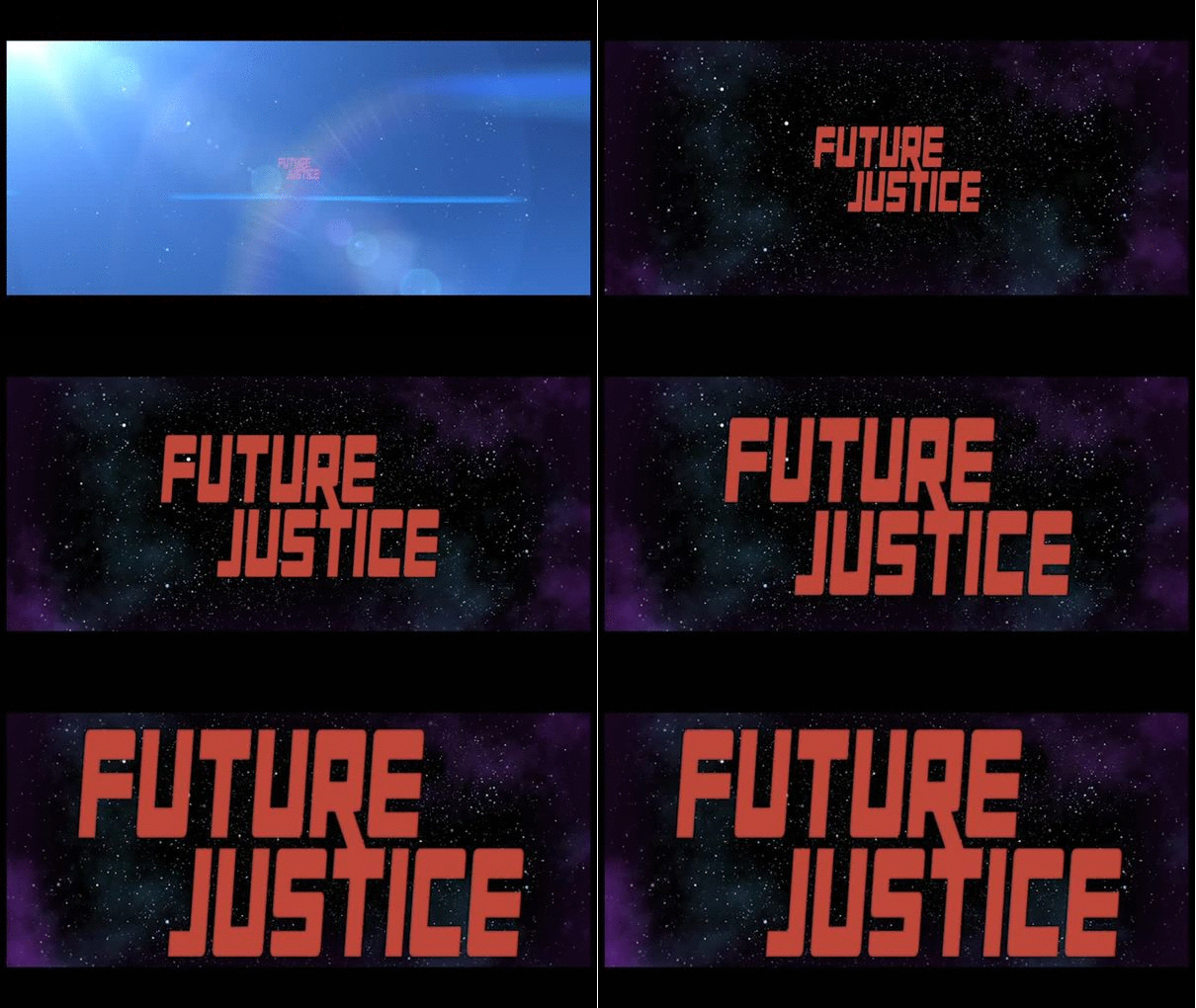
No Justice for Evil! “Future Justice” review!

After five years of cryogenic solitude, Python Diamond returns on a heavily armored military escort ship, returning from Saturn where a maximum prison holds Earth’s most dangerous convicts until their execution date. As they close in on home, Earth has gone dark, communications have gone silent, and massive radiation cover most of the populated soil. A faint signal of power draws the crew down to a manageable radioactive portion of scorched Earth where they discover a small band of people, surviving in an underground bunker and striving to live in a post nuclear fallout. The exploration of life search doesn’t go unnoticed as a violent, more dominant group of survivors seek to take the military’s possessions, if not their lives too, and when war breaks out between them, another mutated and dangerous player enters the game.

Another Richard Griffin directed project and another great example of a superbly self-reliant genre film thats sharp-witted, off-colored, and, of course, entertaining to horror and post-apocalypse fans. Though Griffin and his usual cast of cast members tackle the homage with full-brute strength, Griffin places a gently new-used spin upon each of his inspired works in the form of great absurdity that’s hard to refute or dislike no matter what genre of movie fits your fancy. His post-apocalyptic, science-fiction, horror film “Future Justice” revolutionizes the homage by stripping iconic films of their popularities and mashing them together into a very coherent and comprehensible story without seeming like a total rip off. Instead, Griffin takes the Nathaniel Sylva written story and runs with it like a powerful running back whose hugging on tight to that pigskin ball and charging like hell to the end zone for his first touchdown, treasuring that first score and making it his own unique success even though scoring touch downs has been down countless times before.

The underwhelming title, “Future Justice,” doesn’t speak much to the film’s overall enthusiastic gesture. Yet, the witnessing of gung-ho filmmakers given only an inch to work with and stretching that into a long mile, or even two, is always an amazing length. Nathaniel Sylva didn’t only write the film, he also starred as the lead character, a confident and calculating convict named Python Diamond which is a bit of a play on the John Carpenter Snake Plissken character from “Escape from New York” and “Escape from L.A.” Then, the story embarks on a motley crew, like you would see in a “Mad Max” movie, group of scavengers looking to take all and leave nothing for the rest. Finally, “Future Justice” takes an unexpected turn by introducing a radiation mutated, humanly doctored, one pissed off person-creature that hungers to seek and destroy every last living being in the underground bunker.

The successfulness of character actor Steven O’Broin’s Gazeebo, head of the blood thirsty gang, makes him ruthlessly enjoyable to watch on screen. O’Broin and Griffin have worked previously together on “Sins of Dracula;” O’Broin aspired to be similar to Vincent Price in the Hammer Horror influenced Dracula film. Michael Thurber, more notable one of Griffin’s entourage of actors and also co-stars in “Sins of Dracula,” delivers a phenomenal and intentionally excessive method acting skill that always fits into, in every which way, all of Griffin projects. Working with an estimated $20,000 budget and limited locations doesn’t translate over to O’Broin or Thurber who can transform a small production into the illusion of a bigger ordeal, causing a mind altercating effect with their viewership. “Future Justice” delivers movie magic at its finest.

Speaking of movie magic, visual effects supervisor John Dusek works along side again with Griffin and meshes a blend of practical effects with campy computer generated imagery. The result only adds to the unique charm, capturing the zany essence of this world gone dark story and running with it to take the zaniness one step further, but also respecting the Italian post-apocalyptic films of the 1980s. Exploding heads, detaching limbs, brain-splattering head shots keep the violence fresh when various effect methods are implemented and Dusek tunes right into his entire arsenal to deliver. The effects go hand-and-hand with Daniel Hildreth’s space epic score, striking the composer analogue of other Sci-Fi film greats.

The MVDVisual region free DVD release is presented an in unrated 16:9 widescreen format at a runtime of 83 minutes. The extras include a commentary with cast and crew, a short film entitled “Mutants of the Apocalypse,” and a theatrical trailer of the film. The clear picture defines the details and vividly displays the colors, especially when the mutated creature emerges. The 2.0 audio mix hinders a little in the dialogue by the overpowering score and ambient tracks, but doesn’t disrupt much at all. “Future Justice” doesn’t apologize for laying down the law by smacking action and thrills right to the face. I’d recommend this title to any Sci-Fi or horror buff in a need of a necessary relapse into the post-apocalypse.
Evil Times Out. “Reminiscence: The Beginning” review!

What if there were multiple universes and only one time line? Then, what if time breaks down? Being aware of, in theory, the coming lapse of time, Miska uses her talents in physics to calculate the days of when exactly the rare event will occur; she brings along her boyfriend Akçay and together they experience, not an immaculate and breathtaking event, but a horrifying phenomena that intertwines parallel universes and opens the door to our world to mind manipulative beings known as The Others or Shadows. When Miska misjudges the occurrence date, the lovers find themselves trapped in a vicious loop, unable to tell the difference between what’s reality and what’s a realistically terrifying nightmare.
“Reminiscence: The Beginning” is the screenplay written by musical artist and Blue Arc Studios founder Akçay Karaazmak, who also directs film and stars as, you guessed it, the male lead named Akçay. The concept of time breaking down and releasing horrifying entities is intriguing to captivate audiences, like a moth to a bright night light, toward noticing the estimated $500,000 budgeted independent feature that has an exotic filming location on the crystal clear water beaches of Çeşme, Turkey. Alternate realities have an unique appeal since the lot of such films haven’t been saturated by previously exploration and their ventures, unlike the recycled storyline of the zombie genre, can always be varied because time is tangible; we see the parallel time lines within the established stories of popular sci-fi franchises such as “Star Trek” and “Terminator”. Karaazmak’s film, his first ever venture into the movie biz, has similarities to other works such as Stephen King’s film adapted novel “The Mist” or in “Silent Hill,” the video game adapted into film where two universes collide and ferocious monsters seep into the human world, blending time and worlds into one existence. Can we expect the same type of viscera innards from Karaazmak that resulted very favorably for the other recent genre-related films?
The answer to this time bending film is: don’t waste your time. Here’s why…

On a pitch black night, with no street lights, Akçay and Miska barrel down an isolated road; their seemingly anxious and intense conversation annoyingly underwhelms, nearly beneath the wave lengths of the human ear. Miska, in the passenger seat, examines through numerous pages of physic notes and while Akçay drives erratically fast through the thickness of night, she’s communicating something to him but the dialogue track is, frankly, inaudible. The fault lies at the feet of a couple of major issues: shoddy post-production audio work as the soundtrack severely steps up to become an unintentional focus point above the dialogue tracks and actors Akçay Karaazmak and Michaela Rexova mumbling horribly through the bland dialogue due to their heavily broken English and immature acting status. Our ears inevitably have a chance to relax once the two finally reach the Çeşme beach after a near accident.

The beach scenes turn out to have just as much post-productions issues as the superficial opening. The editing work will require an heavy dosage of Dramamine pills to suspend any nauseating effects from the tirelessly and pointlessly shot and edited scenes. Karaazmak’s film feels unsure on how to convey each scene appropriately, cutting and splicing two and three second scenes together. Karaazmak’s editing process resembles something close to tossing contents of a mixed bag of options and seeing what sticks to sort of fit. Also, If I’m going camping in the natural elements of a beach, dressing the occasion might heighten Akçay’s and Miska’s characters’ authenticity; instead, the lovers, cladded in dance club clothing, doesn’t speak highly of our hero and heroine as black hole researchers seriously. Michaela Rexova, starring in her only credited film according to IMDB.com, has the beauty, but her dull persona and monotonous speech makes her instantly unlikeable to which her beauty can’t rekindle and if I would have heard the word “baby” one more time between them under that low breath of either one of them, my brain would have created it’s own timeless black hole and void itself into non-existence as if some kind of mindless suicide.

However, there are moments, brief moments, during the film’s latter that peak through the unwatchable, indigestible blitzkrieg that is “Reminiscence: The Beginning.” Surprisingly, the scenes I’m referencing satisfy some kind sexual aesthetic while managing to remain a lasting and haunting impression. In one of Akçay’s nightmarish visions, a blonde lays facedown and prone across the hall of a vacant and dark structure. She suddenly awakes, stands with only one ripped above knee stocking on, and backs against the wall, sensually moving up and down, caressing her thigh and a knife with her bloody hands, and dripping blood on the ground from the only piece of clothing covering her chest – a male’s white button down shirt stained at the abdomen. With the knife she holds in her hand, she suddenly thrusts it into her crotch and begins to masturbate. Karaazmak manages to create a visually interesting scene in a creepily sexy or psychosexual fashion and there are other just above mediocre short scenes that glimmer, but these scenes would value more as short films rather than as a whole.

Once again, Karaazmak, has his hands in another department and this time it’s with the waffling special effects. You have to give the musician credit for multi-tasking, but when one person helms many departments, the tasks become overbearing, causing multiple areas foundering as if cables from a suspension bridge are snapping one by one to the point that the bridge begins to wobble. That’s how I feel the effects played out by wobbling, but the effects are par for the limited-budgetary course as being not terribly horrific on a modest budget, but nothing stellar beyond fantastic that would be worth bragging about to promote enthusiastic interest in the film. Karaazmak majorly implements CGI to spookily distort the faces of the other-dimensional shadow people, especially when the leads meet their dopplegangers; a comparison draws from when Ash meets Evil Ash in the 1992 horror-comedy “Army of Darkness” after having buckshot spread blasted point blank into Evil Ash’s face. “I’m bad Akcay and you’re good Akcay,” if only.

Blue Arc Studios and SGL Entertainment, a well-established cult and horror distribution company, along with MVD distribution release “Reminiscence: The Beginning” on a region 1 DVD, presented in a widescreen format. Be prepared for 107 minutes of one of the few sci-fi, alternate reality, horror concoction genre film projects to come out of Turkey, but also be warned of director Karaazmak’s migraine inducing editing technique and a dialogue drowning soundtrack that might condemn the viewing ability. Will Karaazmak take “The Beginning” to the sequel level? Time is, hopefully, on our side.