
After the tragic and accidental death of their young son, Richard and Doreen escape from their painful memories by moving to a quick-sell, rundown house with their two children, Jen and Ben. The house holds a unfathomable mysterious past with the previous family disappearing without a trace, leaving many of their possessions behind in the house’s desolate rooms. Ben, who hasn’t spoken much after the untimely death of his twin brother, encounters humanoid creatures in the attic at night when they roam the house. Ben becomes unsuccessful communicating about the horrifying creatures to his parents and even his older sister, shrugging his warnings off as a sign of his continuous grief. When Richard and Doreen leave Jen and Ben home alone in order to go to all night work function, the creatures descend from their attic abode and seek to devour people they can get their hungry hands on.

“Above Us Lives Evil” is the freshman film of Jason Mills circa 2009 and transpires to be a visually interesting piece of creature feature horror cinema even though the story is a bit undercooked and the acting more than often feels like watching a robotic cluster, monotonously reading the script line-by-line. The story opens ambiguously enough with a glum looking man, sitting in his car with a young boy laying motionless at the foot of man’s front bumper while Doreen cries hysterically over him and another boy, Ben, stands in tragic shock over the dead body of his brother. The opening only connects the rest of the story by the segue of the family driving, moving away antagonistically from their tragic past, but the melodramatically written opening needs being revisited, perhaps in the third act, but doesn’t make a reappearance, missing the opportunity to explore deeper into the family’s separation, and becomes sorely adrift from the rest of story’s girth.

The story continues to plug along of a supposedly grieving family, starting a new life in a new home where we’re informed by the strange neighbors that the previous family just up and vanishes. That sums up the complete backstory revealed of the previous inhabitants. Similar types of voids also rear their ugly little heads. The development upon the creature’s existence isn’t forthright nor is there any explanation into their background, making their existence to be fixtures of the house. These human devouring beings could have been born in the house and lived in that house since the beginning of time for all we’re led to understand.

The Canadian based produced film stars 30 year old Vancouver native Nicola Elbro as the eldest sister Jen. Nicola maintains a solid performance throughout to pull off this low key creature feature and with a little elbow grease added on, I can see Nicola moving from low budget features to the major leagues of horror Hollywood. However, the rest of the cast shares similar generic performances that painfully lead us by the hand, as if we’re not-yet-ready-for-horror-movie toddlers, through the exposition of everything that could have been just simply implied. Even though being one of the more experienced actors on this project, Robert Duncan’s monotony only suffers more drastically from his dimwitted, excuse-ridden character as Nicola’s father Richard. Richard neglects his children’s immediate needs and fears, dismissing them as if they’re too young and naive to know how the world works. Combine everything said here about Richard and he becomes the worst character amongst the rest of underdeveloped characters and there are quite a few.
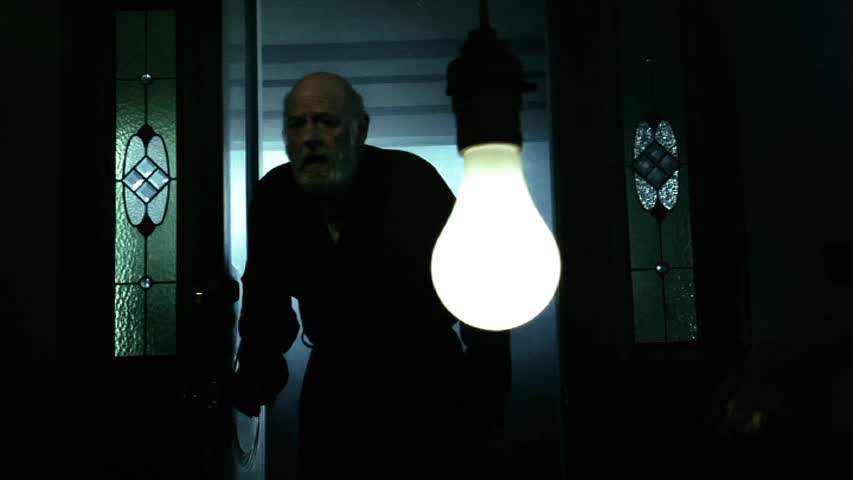
The creatures had more personality with their caveman-like gaits and ghastly limber appendages, chasing down quickly disposable characters (which inconsequentially are also the main characters). Jason Mills and his relative Simon and Johnny take on “The Strain” resembling creature roles; the Mills’ lanky builds added that extra something to the overall appearance of the creature. Jason Mills took the creature look and ability a bit further with the adjunct mandibles that cover the snake-like tentacles; the construction of this achievement is a mixture of practical effect and CGI. Usually, I’m not a big fan of CGI, but Mills strategically, and successfully at that, obscures much of the creature, hiding the full overlook in the shadows, in the quick cuts, and in the low-light. Many of the effects are obscured; the special effects team mainly uses slight CGI and a bucket of blood or two to create their desired creature attacking effect. Most of the attacks are implied or too far in a long shot, creating the allusion of vicious creature film.

The Sector 5 Films and Chemical Burn distributed home DVD release technically suffers. Digital interference plays havoc, graining certain portions of night scenes while also causing digital waves on other night scenes. The loss of frame rate during other night time moments result in an awkward slow motion. “Above Us Lives Evil,” much like the creatures, should store itself in the attic until ready to descend for blood and to be more captivating with the characters. Jason Mills and Nicola Elbro show promising attributes that can contribute to the horror community and while their contribution may not be with this particular Jason Mills film starring Nicola Elbro, I’m sure we’ll see more of the two in the near future either on another collaboration or separate projects that could, and probably should, begin to turn some heads.
Tag Archives: dvd
Movie Magic Evil Waters Down Real Evil. “House on the Hill” review!
Based on the true story of serial killers Leonard Lake and Charlie Ng, director Jeffery Frentzen (Black Dahlia) chronicles the speculated portions of Lake’s and Ng’s homicidal and psychopathic murders. Their murderous spree involved kidnapping young women, enslaving them, and eventually murdering them while also targeting their own relatives and friends, and even seizing the opportunities to abduct whole families. After Lake served in the Marine Corps, he met Charlie Ng and by the 1980s, the two men had constructed an isolated house where innocent people were brought to be tortured, ransomed, and eventually their demise at the hands of their materialistic and deviant captors.

“House on the Hill” is the Jeffery Frentzen directed and co-written with Nicole Marie Polec film that semi-documents the tragic events of Leonard Lake’s and Charlie Ng’s serial killing spree of the 1980s and incorporates actual footage of Leonard Lake speaking about his disturbing views on the world such as enslaving women and being prepared for the inevitable world apocalypse. Most of Frentzen’s movie is embellished as, like the majority of serial killer documentaries, most of what is unknown of Lake will never see the light of truth of what really happened on his ranch. The legend behind Lake and Ng states that there could have been as few as 11 murders or as high as 25; Frentzen attempts to showcase the latter by adding many fictional victims into his film to be representatives to those unknown victims who were never discovered or whose bones were severely untraceable.

However, some of the facts that are true, that we do know about Lake, didn’t quite make the cut because of Frentzen’s x, y, or z reasons. In the film, Lake’s wife is named Cat played by Rachel Devlin (Zombie Nation), but in reality Lake’s wife name was Claralyn Balazs aka “Cricket.” If Lake’s wife name is clear, why go with “Cat?” Also, Lake had constructed a bunker in the backyard of his ranch, but “House on the Hill” has a separate, well-locked shed in the backyard. Simultaneously, Frentzen’s movie has consistent filming errors that even the untrained eye can catch. Continuity glitches that are obvious (Naidra Dawn Thomson’s bra strap is in various positions between takes on a particular scene) and obvious props that are in more need of a convincing sell from the actors and to be well edited to not give the impression of false intentions. Lastly, the overly generic title doesn’t specifically speak much upon Leonard Lake and his accomplice Charlie Ng. “House on the Hill” title has no curb appeal and no real bite to entice viewership.

What I did find pleasurable about “House on the Hill” was the leads’ acting. Canadian actor Stephen A.F. Day and first feature film actor Sam Leung do an above mediocre performance of Leonard Lake and Charlie Ng. They manage to show and sell having no empathy when committing terrible acts, managing the ability to embody the evil within a killer on screen. Barring Frentzen’s epileptic editing and use of tints, lenses, and over exposers, I still was able to see the good in Day’s and Leung’s performances without the editing hoopla that attempted to make the events more dramatic, shocking, and traumatizing.

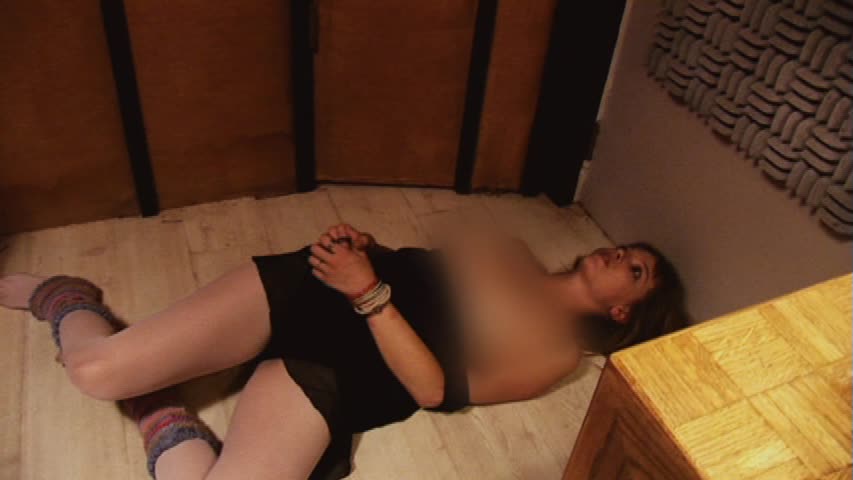
I’m a little disappointed in the distribution of this film. Not only does the jejune title leave a bleak taste, but the DVD cover doesn’t quite represent what is being sold here. On the cover, there is a dirt pathway leading up to a two story, mansion-like structure sitting on top of a hill and seemingly decayed and abandoned. On the DVD backside, a meathook pops right out at you along with a female victim strung up by her arms, screaming toward to the sky. Meathook does not make a credited or on screen appearance nor does the house in the film look like the mansion on the DVD cover. What is even more disappointing, and what I have to comes to term with every now and then, is the heavily edited cut in which “House on the Hill” was released. The DVD cover states, “Warning Explicit Content,” and does show some intense moments containing blood and torture with implied rape. ‘Some’ being the key word because I’ve seen more explicit content on the local evening news. This might be due in part of the post-production censorship which most noticeably focuses on covering up any and all nude scenes. Olivia Parrish’s topless scene was crudely censored by being blurred out and awkwardly cropped to show a low-resolution image, a forced zoom in, of her neck up as she’s being molested. The same cropping censorship goes against Laura Hofritcher’s topless scene as well during her torturous scene.
The North 40 Production film and MVD and ITN distribution DVD release doesn’t score to well for this reviewer. I’m able to look past the editing techniques, post-production effects, and unbalanced audio, but being a writer and a firm patron of freedom of speech, the censorship of the nudity and potentially the bloodletting has my blood boiling. However, even though Leonard Lake and Charlie Ng may have not been extensively covered on the silver screen or on entertainment television, I am glad Frentzen told partial of the notorious story and was able to tell his rendition of the unknown accounts.
You Shouldn’t Pick On Evil! “All American Bully” review!
Three high school friends live in an online gaming and comic book world making them easy targets for sinister bullies. When one of them, Devon (Alexander Fraser), becomes the victim of extreme bullying, the gaming friends are forced to come together and cope with the brutal and aggravated assault laid upon their friend Devon. Becky (Alicia Rose), whose had a long lasting love for Devon, plans the ultimate revenge by teasing to expose a hidden secret on the world wide web about Devon’s bully neighbor John Brooks (Daren Ackerman). The circle of violence and secrets wildly spirals out of control to an extremely car-crash of a finale that will put Devon, Becky, and John in a trio of devastating destruction.
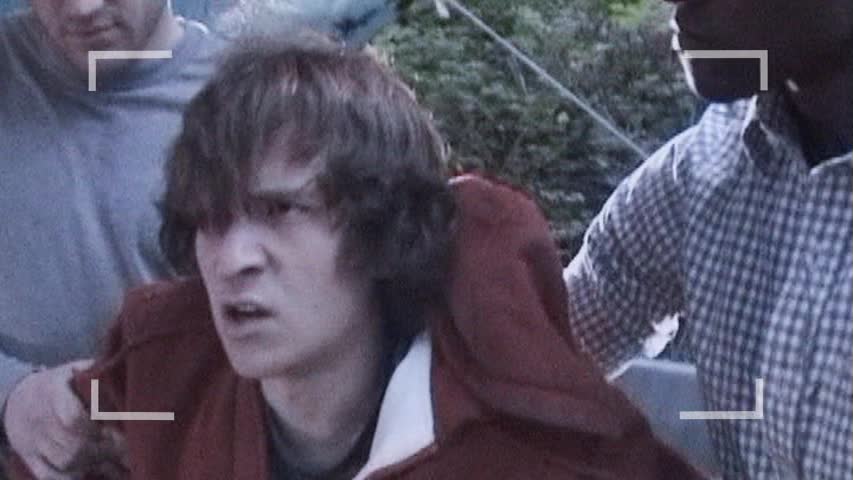
“All American Bully,” formally titled “The Innocent,” serves as not the typical bully-revenge film we’re aware of in such films as Gus Van Sant’s “Elephant” or Jason Buxton’s “Blackbird” and that creates a misleading film title, but doesn’t necessarily hurt the film’s integrity. Director-writer John Hawkins intentionally creates an unexpected twist that’ll take the film into a totally different direction. With the help of the elusive, yet recently fan-revived cult “Friday the 13th” heroine Andrienne King and the superb acting by Daren Ackerman who portrays complex character John Brooks, “All American Bully” becomes a unique hybrid with a cultural and social timeliness that will surely strike the core like a bully punching you in the gut and kicking you while you’re down all for just your lunch money.

The John Hawkins film is not solely about high school bullying, but also about mental illness and childhood abuse to which all comes to the forefront to bring the house down at the end. The repercussions from years of bullying results in kidnapping, rape, and murder. Actor Daren Ackerman’s has a wide range playing the disturbing character John Brooks by never backing down from the character’s various stages. Ackerman complete shadows his peers such as Alexander Fraser who can’t strain from a monotone tone, Alicia Rose who has range but just not enough girth, and even Adrienne King who, I felt, played an overacting Principal.
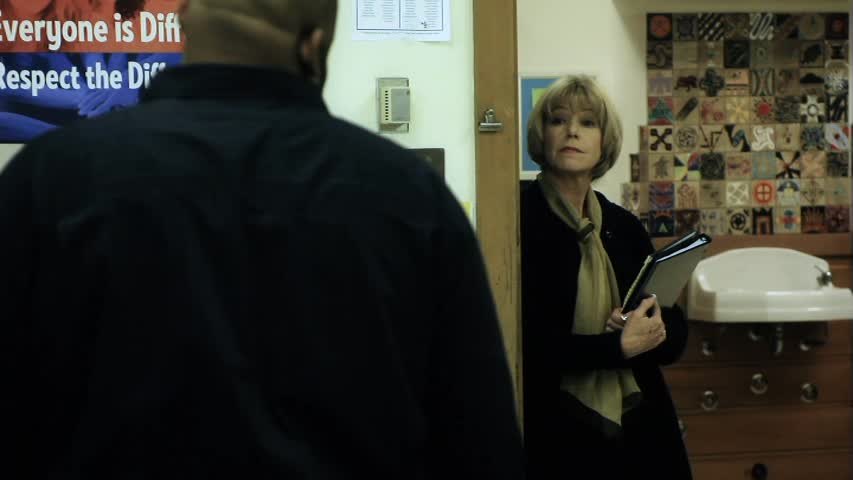
There seems to be a side story that goes unexplained to which we have to make our own conclusion. Adrienne’s Principal Kane doesn’t trust her employed teacher Mr. Taylor that’s somehow related to her son being gay. I concluded that Mr. Taylor and her son had some kind of relationship that’s not being explicitly explained and this drives Principal King unhinged, but her breakdown doesn’t feel connected to the story, feeling separate from the body and not bring the film to closure. Perhaps Principal Kane’s mental break parallel’s the psychotic break that John Brooks suffers, displaying and defining two various scenarios of pain.
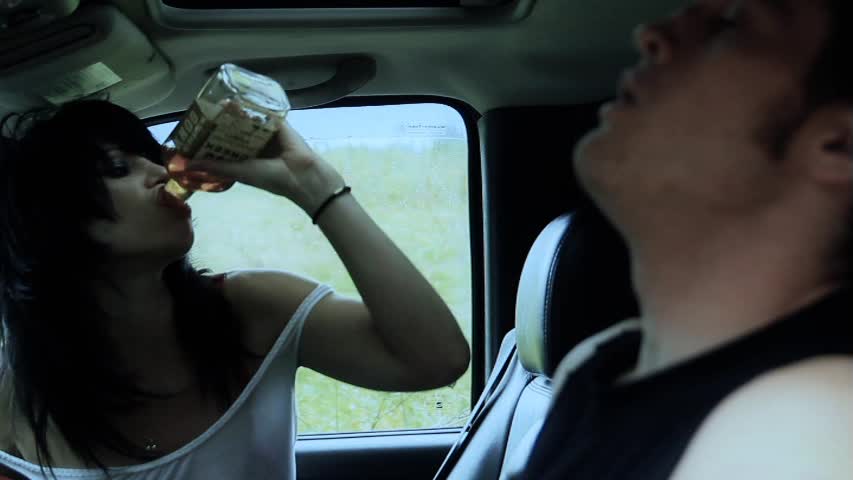
Speaking of homosexuality, Hawkins hits many gay undertones and not only with Principal Kane’s son and Mr. Taylor. There’s also a past relationship, even if only one sided, between Devon and John when they were tiny kids playing army in the woods. The overuse of the word fag becomes repulsive and that might be intended to reveal the true ugliness of the word. I had always thought fag might have faded into oblivion, especially in the film industry, but I guess in independent ventures the word still thrives to bring out the tensions and angers out of the viewers. Lastly on the topic, John becomes the plaything to all his mother’s friends and some of them being men, creating more taboo and disturbing qualities that make me think Hawkins is one warped individual. When Becky, played by an absolute beauty named Alicia Rose, and Devon actually have a heterosexual scene together, the mood becomes ruined when John gets a hold of them, to punish them, almost for being happy because his life turned out tragic and hopeless.
Forget the misleading title “All American Bully” (as I believe “The Innocent” works better) and the misleading Wild Eye Releasing DVD cover where a person gripping a firearm at their side in a student filled hallway; instead, focus on the film as a whole where the acting is solid and the direction tells a stunning story of various facets of bullying. Check out this Wild Eye Releasing DVD and also take a gander at the cast interviews as you’ll learn more about the actors backstory and how their take on bullying motivated them to create this film.
Satan’s Cult Seeks to Raise the Dead! “All Sinners Night” review!
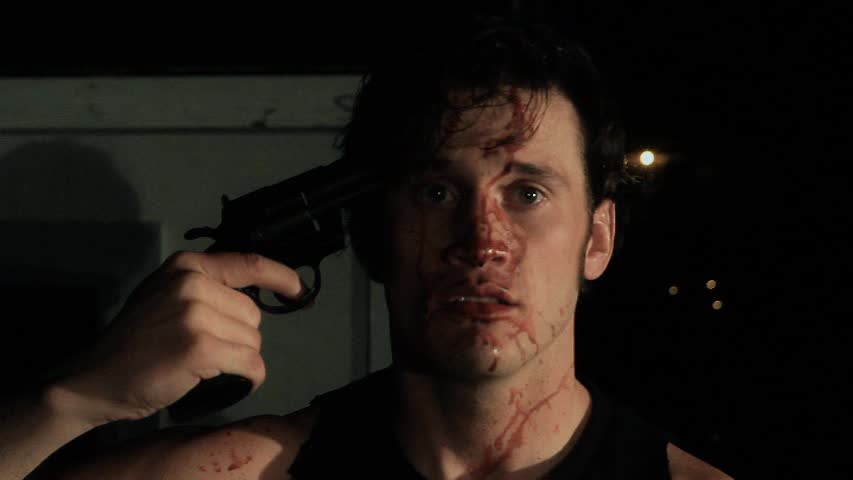
An investigative reporter witnesses right in front of him his wife commit a gruesome suicide in their bedroom. Lana searches for her lost brother whose been missing for over a year. The two combine forces in Taylorsville believing their loved one were connected to a group of satanic followers led by the Reverend Hiram Graves. When the local authorities prematurely close the case on Lana’s missing brother, Lana and the reporter seek the truth and the truth might be more deadly than they’ve ever imagined. Halloween night brings the satanic sect to kidnap five innocent and random women, five sacrificial lambs, in order to bring death back to life.

As a little piece of Independent cinema from writer-director Bobby Easley, “All Sinners Night” comes from the production company Horror Wasteland Pictures and is brought to DVD by the multi-genre distributor World Wide Multi-Media. Now, if you haven’t heard of filmmaker Bobby Easley, the company Horror Wasteland Pictures, or the distributor World Wide Multi-Media, then now you’re one step closer to being caught up on micro-budget filmmaking and one step closer to viewing lesser known film titles that you won’t normally screen at a theater or even come across in a Redbox inventory. Now, while budget films aren’t necessarily for everyone, I have to say that “All Sinners Night” isn’t the best ease-into segue, but if your mind is open and your cinematic palate is vast then Easley’s film might be right up your alley.

Easley’s film involves a satanic cult collecting female sacrifices to raise the dead has a slow, unfocused beginning that slightly picks up and gains more focus a long the way, but the momentum begins a little too late to obtain entertainment value and much of the other sorts of value, such as the film’s budget, falls right onto the finale where characters die, faces explode, and blood spills when the black magic ritual begins. The bloodletting is creative, but various scenes, which could have been explored further with death exploitation, use editing techniques to convey and imply death when in reality there needs to be more visceral visual stimulants to show the brutality and mercilessness, especially for satanic cults because they’re one of the realistic forms of horror that exist in the world today and displaying the violence on screen, making it breathe on screen, would scare people more than implied violence.

The acting is a bit clunky from the lead actors and that drag the story’s motivation down a bit. Brittany Jesse as Lana and Tom Sparx as the reporter try to build a dynamic duo that more or less fizzles and their characters are to partly to blame for their characters bring no real spark to their quest and cause of discovering the truth behind Taylorsville’s secrets. The evangelical preacher Hiram Graves played by Bill Levin has grand on screen physical characteristics to pull off a satan fanatical cult leader, but Levin’s acting doesn’t quite have the range of a twisted lord of darkness pastor and just stays on that horizontal plane throughout the film’s duration. The Texas Chainsaw Massacre’s original grandpa actor John Dugan and horror and sci-fi genre fanboy Sal Lizard headline “All Sinners Night” even though their cameo scenes are short and sweet. I found the one cameo of Indianapolis born and based horror host Sammy Terry, an Elvira type host of sorts, to be welcoming and well-fitting for the film’s gloomy nature and to be a nice shout out to the local Indianapolis horror scene. Lets not also forget about actress Sam Alford and her two courageous scenes of exploited nudity. Alford’s character is of generic and lesser value – like a Star Trek minor character labeled for certain death – and she is the sole kidnapped to bare her chest. I’m sure Easley didn’t mind shelling out a couple more bucks for the Alford’s assets.
After reading a number of reviews online about the film, the consensus on the Bobby Easley’s shooting style is that “All Sinners Night” resembles the visual stylistics of Italian directors such as Mario Bava or Dario Argento’s with their surrealistic or brooding atmospheres. I would venture more toward a duller hue with the right in your face shot-on-video style cinematography of those from such directors as Brad Sykes or Donald Farmer where as Bava or Argento focused more on vivid and popping colors and symbolic suggestions within their mise-en-scenes.

The DVD screener is presented in a 4:3 ratio with Dolby Digital 2.0 stereo mix and a 5.1 stereo mix. The full screen video, like I mentioned before as a shot-on-video style, has significant grainy interference, but the video is still watchable as if you’re watching straight from VHS quality. Not necessarily a bad thing but in today’s day and age or unless your intentions were to create a throwback, the video quality should be clean. The coloring is all off too with overused darks making certain scenes incomprehensible. The 2.0 mix and the 5.1 mix stiffens the unbalanced sound quality. Some dialogue emits too low of a range and then in the next scene the screaming is overbearing and crackling out of the speakers. The glam, goth rock or punk rock soundtrack is fairly decent, but the preference and priority should be on the dialogue or the story becomes lost without it. The disc did pack quite a few extras including a gag reel, music video from the band Dead Dick Hammer, interviews, and a trailer for the film and also :Atah Saia”.
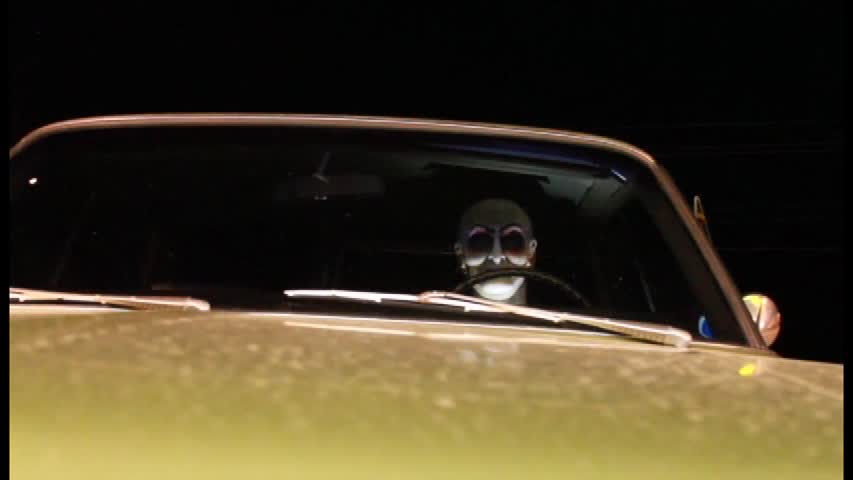
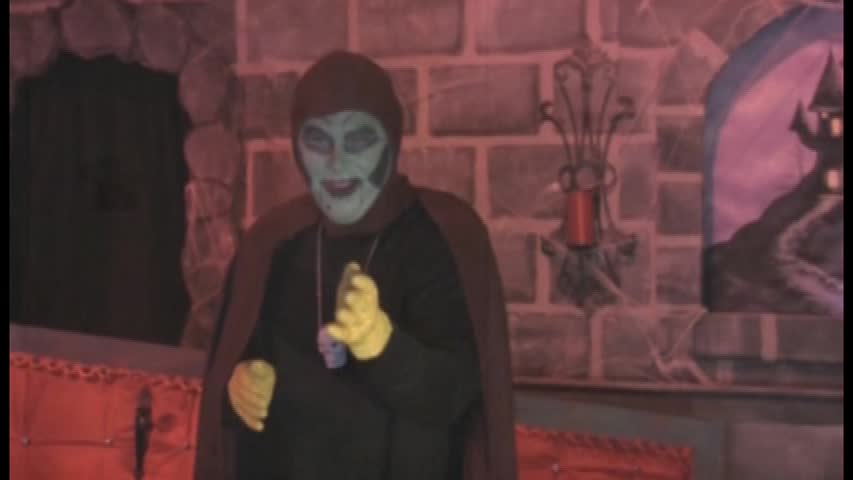
Overall, “All Sinners Night” wears a lot of masks – literally, a large number of extras wear masks as if they raided a Halloween party store, but trying to piece together a story that tends to omit key elements or strays away from trunk of the plot is difficult and, basically, one would just need to take the film for what it’s worth, the epitome of independent filmmaking. The effort of introduce homage and the effort to construct a brooding atmosphere makes the Dr. Jekyll side of me admire this film, but the technical and educated Mr. Hyde side of me can’t ignore the obtrusive flaws. In short, rent this title to be adventurous on a forlorn night.
Evil Wears a Clown Mask! “Blood Slaughter Massacre” review!
The sleepy town of Havenwood becomes rocked by the mass murder of some of the town’s most prominent residents attending a joyous celebration. When two local cops, James Fincher and Walter Cobb, first arrive to investigate the horrendous massacre scene, Fincher comes face-to-face with the maniacal killer known by the moniker of The Ripper and barely survives the night. Ten years later, a string of new murders fall upon young high school girls of Havenwood and Detective Fincher starts to piece together that The Ripper might back. To unravel why The Ripper’s ten year hiatus, Fincher must look into his and Havenwood’s past in order to find the answer and stop The Ripper from killing.
“Blood Slaughter Massacre” is a nostalgia driven slasher film with a convoluted and murky plot, but the Manny Serrano directed film manages to rejuvenate the 80’s unstoppable killing machine character in The Ripper. Heavily inspired by the John Carpenter “Halloween” franchise when considering the gloomy atmosphere of the town and Michael Myers-esque antagonist, “Blood Slaughter Massacre” originality is certainly unoriginal, yet there’s something to be said about enjoying someone’s, like Serrano’s, tribute or admiration work that sparks a bit of excitement and allows entertainment to be let in to the soul, especially in the third act when The Ripper’s homicidal chaos ensues and he lays waste to teenagers left and right. Also, the title lacks creativity and doesn’t help build a case of separating itself from the pack. Maybe, a simple title such as “The Ripper” would have honed into that old saying “less is more.”

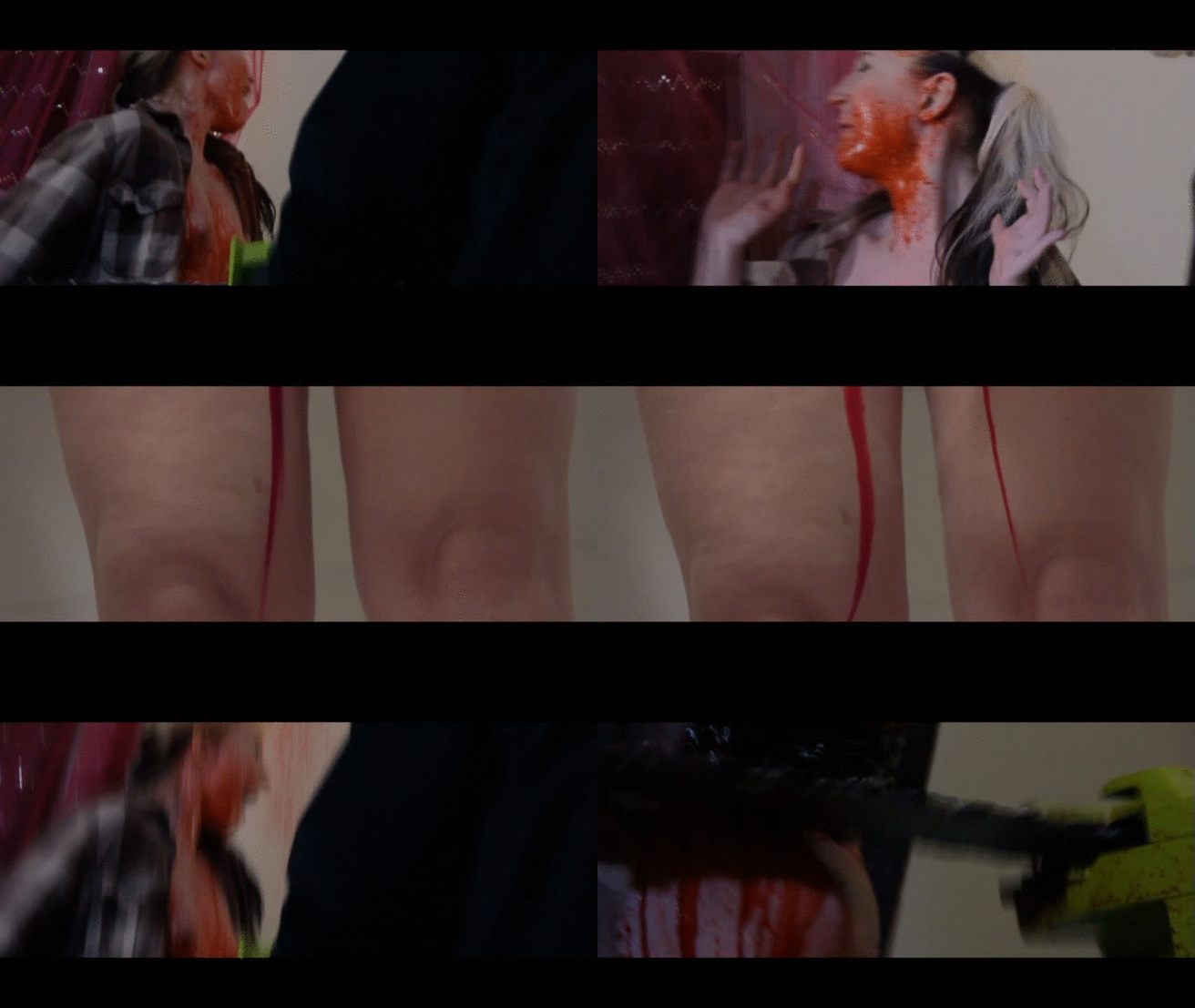
However, the blood and gore effects have sheer bite. The impressive effects for the budget give The Ripper character that desired aggressive murderer persona, warning all to stay the hell out of his way. Blood flies and flesh shreds created by buckets of bloods and well edited scenes. To showcase such effects you need a pile of bodies and “Blood Slaughter Massacre” piles high the corpses. With great kills, you need a great killer and the film’s “Shish-Kabober,” The Ripper, is a memorable slasher which can only be described as a giant fellow with an old man clown mask that displays no emotion in the hollow eyes, show’s no mercy when hovering above an easy kill, and owns a supernatural ability to be at the right place at the right time, ready to stick his blade right in the heart of his prey.

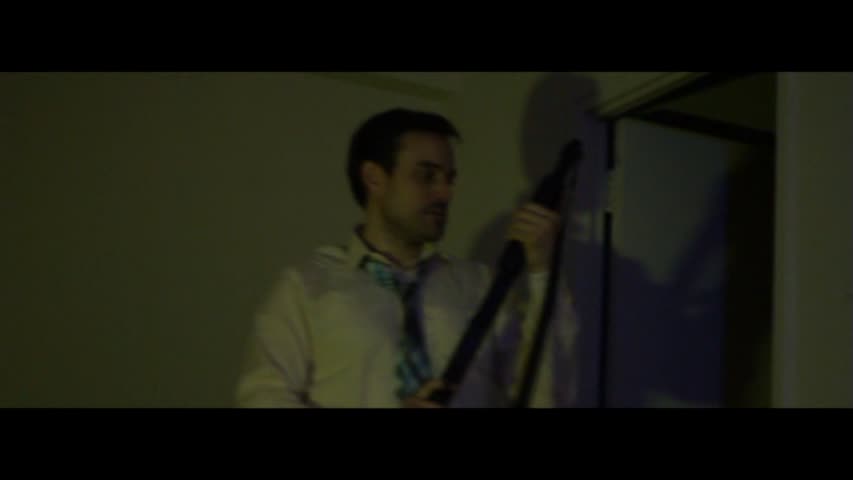
The rest of the characters didn’t stand out above The Ripper and emitted low caliber dialogue and persona all around. The acting becomes terribly melodramatic within serious and tense-filled toned scenes. Matt Cody as Fincher tried to embody a Donald Pleasence Dr. Loomis character, but Cody came off a bit to desperate in comparison and Fincher’s isn’t a strong male character able to pull off cutting down the brutal legacy that is so natural to The Ripper. The female characters with exploitive nudity, even if only for a few minutes, had more practicability because, while over stating the obvious, “Blood Slaughter Massacre” is a horror slasher movie making nudity a natural being or even a minor, disposable character. Also, many of the characters show up just to be filler for The Ripper to rip apart. Not a terrible thing, but it’s difficult to care about certain characters without being able to develop into a character we care about and in the end, all underdeveloped fillers must be six feet under ground in five or more pieces.
Technically, Serrano’s films suffers major obstacles. Scenes annoying go overboard on the grayscale with a heavy gray tint switching back-and-forth from scene to scene taking away the little coloring the film had and creating a haze blanket of the mise-en-scene as if in a dream. Continuously going in and out of focus and slight blotchy posterizing are also problematic during darker. Dark scenes and day scenes also suffer from heavy digital interference. The unbalanced audio in the 2.0 stereo mix doesn’t channel the dialogue very well, making it secondary to more inaudible parts of the film. What I can positively comment on about the DVD is the detailed cover art of The Ripper. The retro 1980s or early 1990’s feel of Wild Eye Releasing’s DVD release cover shows great promise for a film that flounders during the first two acts.
 It's Bloggin Evil!