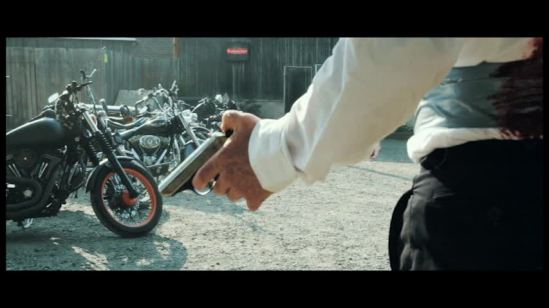
A young and beautiful butcher shop assistant succumbs to the middle-aged butcher’s sexual advancements and fantasies at the workplace after she catches glimpses his sorrow, but when the butcher ends up naked on the shop’s floor with his throat cut, the assistant becomes the number one murder suspect for an inspector who coincidently looks almost identical to the deceased butcher. As the investigation deepens into the assistant, the inspector’s solemn, solitary life blurs to an assimilation into the butcher’s and his suspect turns from being a prime target to being a crucial part of the his physical and mental altering integration into the dead butcher.

“Meat” is a powerful transcending film seismically barreling through a Lynchian structure consigned to provoke the consequences of unhappiness and the consequences of poor choices during unhappiness. Directors Victor Nieuwenhuijs and Maartje Seyferth have orchestrated a moderately expressionistic arthouse Dutch drama told in a spiraling sexual context. The meat in “Meat” and the sex in “Meat” clearly share a correlation, peppered as motifs from start to end, and the positive and negative dimensions of the two are so obscured that pinpointing the differences between them are impossible, but both are for sure the last hope for the butcher and his assistant Roxy to embody the essence of sex and meat for opposite reasons. Whereas Inspector Mann simply drags wholeheartedly through his existence, expressing his numbness toward his mundane job and harshly breaking up with his lover without an ounce of compassion. Its until the butcher’s case lands in his lap does the Inspector shows signs of life again.

If you notice that lead actor Titus Muizelaar’s dual roles have purposefully generic labels. The butcher is credited as just the butcher while the Inspector has a proper name, but the name Mann is just as indistinguishable as if the character was christened Guy. The synonym character was intended for blending, to blur their personas, and to transform one into another. To explore the transformation, “Meat” begins a parallel between the butcher who, in a metaphorical sense, has his cake and eats it too and the inspector painstakingly limps from one spot to another. A contrasting experience between the two firmly establish their individualities. Then, the film shifts gears midst a catalyst with the butcher’s mysterious death, forcing the female assistant, an uninhibited role performed uninhibitedly by Nellie Benner, to be the resilient gateway for the inspector. Third gear shifts into the inspector being more and more intrigued, if not extremely envious shown very subtly, by the butcher’s seemingly unchained facade. Each character emits an expressionless stature with a deep-rooted ugliness burrowed inside and each desire a change in their turmoiled lives, whether it’s sustaining love, seeking love, or able to love in order to battle every aspect of oppressive depression.

The uncomfortable open and intimate relationship between the butcher, Wilma Bakker’s Tiny, and the shop owner and the psychosexual workplace harassment involving the enthusiastic, video-documenting assistant filets the juicy bits from the bone with numerous innuendoes and explicit carnal exhibitions taking brazen residence within the animal blood stained walls of the butcher’s small meat market. You’ll never look at steak, pork chops, and leg of lamb the same way again! Only when “Meat” transitions into that second gear does the erotica becomes less erotic and more forced and horrifically exploitive. Scenes of undisclosed rape and of blatant genitalia speak upon that aforementioned correlation of raw meat and sex; no choice is given to the cow when the cow is killed and slaughtered for the cow’s delicious beef and the same can be said in sex as it’s taken without much consent and it’s being reaped for the benefit of others.
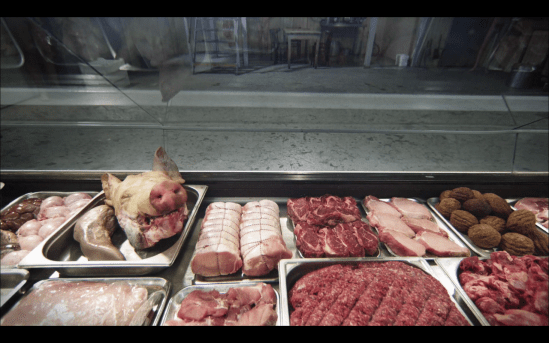
Graphically infrasexual and skewed beyond simplicity, “Meat’s” refreshingly loaded with unpleasantries and basted moistly with an outer layer of perversion that drips into an oven of thriller surreality. The Artsploitation team lives up to the moniker by, after being long overdue, crafting a home video release of 2013’s “Meat” aka “Vlees” onto DVD and on digital home video. The digital screener provided for review doesn’t give much insight into the audio and video qualities or speak to the testament of the special features. However, “Meat” is a phenomenal film that’s well-aged and ready to be rubbed, tenderized, devoured in all senses of the meaning.
Tag Archives: full frontal
The Evil Doctor is in! “Doctor Butcher M.D. (Medical Deviant)” review!

New York City hospitals are being terrorized by a crazed maniac or maniacs stealing the body parts of the deceased and local authorities are discovering the half eaten remains of torn apart bodies in the streets. When a medical orderly is caught in the act of cannibalism by nearly devouring a corpse’s heart and then commits suicide by diving out high rise window, the Doctor’s assistant and leading anthropologist Lori Ridgeway recognizes the tattooed symbol of Kito on the orderly chest, a symbol from a long forgotten tribe in the Moluccas Islands. Worshipping a cannibal God, the primitive tribe still practices the form of anthropophagy. Lori’s colleague, Dr. Peter Chandler, has been placed on a research team to root out New York City’s recent cannibal problem and when the Kito symbol clues him and his team of a possible lead, an expedition team forms to travel to the Moluccas Islands in search of the existence of inhabitants. Dr. Chandler rendezvous with a long time acquaintance, Dr. Obrero, whom has lived on the islands for years. When Dr. Obrero arranges a boat and his right hand man to accompany the expedition, Dr. Peter Chandler and team step foot into a hellish nightmare, bloodied with unspeakable and aggressive cannibal acts. Just when nothing could be worse than flesh hungry cannibals, hideously disfigured zombies frighten even the primitive locals. The island holds a dark secret and Dr. Chandler aims to unveil it no matter the cost!

Finally! The definitive 2-disc edition of Aquarius Releasing’s “Doctor Butcher, M.D.” aka the Italian cut “Zombie Holocaust,” from the Flora and Fulva Film production companies, has been released and, oh, how glorious the Severin Films release is with a super sleek Blu-ray reversible cover art – “Doctor Butcher, M.D.” title as the main cover and “Zombie Holocaust” title on the reverse side – and the high definition gore that hasn’t been gooier and oozier than ever and all in thanks to the upscaled 1080p full HD resolution transfer. Uncut with eye-gouging effects, eviscerated and mangled bodies, and packed with a slew of medical terrors and oddities, the Marino Girolami’s directed video nasty from 1980 just might get itself banned once again by the international censorship boards.

The schlock runs thick through a plot that’s eerie similar to Lucio Fulci’s Zombie (aka Zombie 2) with many of the locations and sets repurposed for the Girolami picture involving exotic land cannibalism, a mad scientist, and, you guessed it, zombies. Yet, “Doctor Butcher M.D.” rightfully receives being a detached entity, an “Annabelle” to “The Conjuring” of sorts, even when both films star Scotland-born leading man Ian McCulloch. With uncanny and grisly disemboweling special effects that turn a stomach inside out and give you a reason to make use of that barf bag provided by Severin Films as a bonus insert, some death effects didn’t go quite as planned such as, in example, when the cannibal orderly dives out a multistory window and the stunt-dummy loses an arm when crashing onto the floor. The next scene has the actor, with arm intact, lying in a pool of blood. Another scene involving Doctor Butcher and his cranium saw nearly doesn’t sell the effect when the saw itself isn’t spinning at all during close ups of a cranium cap removal. However, none of these miscues matter as the rest of the special effects trumps any other gore film of this decade.

The American bought rights to “Zombie Holocaust” were destined to be re-edited as the film had to bulk up on Americanized tastes, slightly targeting specific, well versatile audiences of New York City’s infamously sleazy and exploitive 42nd Street, which is now defunct. The additional and pointless scenes that were intercut from a scrapped Roy Frumkes’ horror anthology, “Tales That Will Tear Your Heart Out, at the beginning of the film didn’t transition seamlessly enough to cause an unfavorable reaction, but only added on to the powerful zombie train that spawned from George A. Romero and the Living Dead films. The antics of Terry Levene, an American producer and 42nd Street icon, led to guerilla marketing, an overlapping score from the late “Blood Sisters'” composer Walter Sear, and the superbly cut trailers had guaranteed butts in the seats at Levene’s, amongst others’, circuit theaters. Plus, the T&A from cult Italian actress Alexandra Delli Colli might have had something to do with putting butts in seats as well.

The story hadn’t changed much between the alternate film versions of the Romano Scandariato screenplay and the story itself is wound looser than a turn of a century Gary Busey. Thin motivations drive characters to do the stupidest things possible such as go on an expedition to a cannibal island, go to a cannibal island without state of the art weaponry and more bodies than a modern day NFL football roster, or go straying away from the safety of your group to stroll through the island’s bush alone. The obviousness is aggravating to say at the least, but omit the blatant stupidity of the characters and no one would die a horrible and gruesome death that fastens our morbid tastes to the screen. The story’s spontaneous and adventurous nature appeases thrills of a long-lost culture on an island of hell that’s ready to be explored and re-discovered and ready to taste fresh blood and organs once again.

Severin Films have outdone any previous release of the reconfigured “Doctor Butcher, M.D.” and the original “Zombie Holocaust” when discussing the video presentation. The 1080p performs at a high bitrate with a vibrant display of natural colors that diminish much of the natural grain and negative damage and exhibits finely tuned and leveled darker tones from the original 35 mm negative; a HD presentation that, and this goes without saying, naturally outperforms the the transfer from Shriek Show’s “Zombie Holocaust” DVD release in the early 2000s. The English DTS-HD Master 2.0 audio mix on “Doctor Butcher, M.D.” performs greatly without many given distortions or loss of audio while the “Zombie Holocaust” on disc two has the same DTS-HD Master option, but also gives an alternative with a linear PCM Italian only audio mix without subtitles. Walter Sear’s Stateside score and Nico Fidenco Italiano score tribute their respective nations clearly through the mastered audio mixes with Fidenco’s score surfacing here and there on the Aquarius Releasing edit. Severin Films provides an impressive list of new bonus material on each disc, with the first disc having insightful interviews with Aquarius Releasing’s Terry Levene, editor Jim Markovic, filmmaker and documentarian Roy Frumkes, “Temple of Schlok’s” Chris Poggiali, Gore Gazette editor and Butcher Mobile rider Rick Sullivan, and Gary Hertz all discussing their involvement “Doctor Butcher M.D.” and their ties to 42nd Street. The second disc focuses more on “Zombie Holocaust,” interviewing male lead Ian McCulloch and McCulloch sings “Down by the River” in another segment, FX masters Rosario Prestopino and Maurizio Trani, actress Susan Buchanan, and a look at New York City then and now piece where “Zombie Holocaust” shot certain scenes.
A Playgirl Versus the Evils of Lesbian Cults and Snooty Thieves! “Christina” review!
The following review is NSFW…

Christina Von Belle is a youthful playgirl heiress who travels through the exotic locations of Europe modeling and making love to the men of the world. Her jet-setting life screeches to a full and sudden stop when a vicious and merciless faction of lesbian guerillas, led by their determined leader Rosa who seeks to inspire young women to live a life of liberated homosexuality, kidnaps Christina for a high dollar ransom because paying for the liberation cause is quite pricey. Christina will be put through multitudes of depravity seductions to pursue the heiress that woman does not need man. As the ecstasy of her captures becomes more and more difficult to defend against, Christina jumps into action, escaping when the chance presents itself, and finds herself leaping into the arms of smugglers and thieves who seek to also use Christina’s title for a wealthy pay out. Christina’s only weapon, her only means of freedom, is her young, sensual flesh that puts everybody, even lesbian commandoes and high society smugglers, under her sultry spell.
One of Francisco Lara Polop’s (under the moniker credit of Poco Lara) last known feature films and penned by the legendary schlock writer Harry Alan Towers (under the moniker credit of Peter Welbeck), “Christina” expos a mingling cast of B-movie stars and starlets such as “Return of the Living Dead’s” Jewel Shepard. Before Shepard was a blue-haired, punk-rocking goth chick ready to be munched on by brain eating zombies, the native New Yorker stripped bare as a promiscuous woman meandering quickly through hordes of wealth and a legion of similar status men. For much of Poco Lara’s film, Jewel Shepard is damn near naked the entire time, exposing her perky breasts whenever the opportunity presents itself. The same whip-it-out concept can be attributed for nearly the rest of the female cast: Josephine Jacqueline Jones (“Black Venus”), Pepita Full James (“The Story of O 2”), Helen Devon, and Anne-Marie Jensen. The male performer counterpart understandably lacks in comparison, but rounds out nicely with Ian Sera (Pieces), Emilio Linder (Monster Dog), Tony Isbert (Tragic Ceremony), and Emilian Redondo (Black Venus).

Christina’s sexual adventures turned passionate plights purposefully lays the groundwork in attempting to pave a similar path toward the highly popular French series “Emmanuelle,” its sequential films, and it’s cheaply produced spin-offs which simply focused around the erotic escapades of a young woman seeking to enhance her sexual experience. Also akin to the “Emmanuelle” series is the fact that “Christina” is an adaptation from a series of sexually charged books printed by Playboy Press. Yet, “Christina” failed to peak interest in spawning sequel additions, despite the high production value that includes exotically breathtaking locations in France and Spain and also the impressive car, dirt bike, and horse chases. To further be pro-“Christina,” the gratuitous nudity explodes onto nearly every single scene with Jewel Shepard’s tight and slender physique causing most tongues to go limp from gawkers’ mouths, secreting saliva with hound dog anticipation for more.
Though prevalent nudity thrills, the sex scenes lack that certain special something. The longevity of the scenes seem as transient as the Christina character, leaving more of the sexual intercourse to the far reaches of the implied sector than trying to push the envelope. The lesbian moments with Josephine Jacqueline Jones and Helen Devon cut briskly away to a dream sequence where Christina faints from the intensity of her captor’s advances and in these dreams, she’s metaphorically assessing her experience with black glove cladded hands rolling cars and tanks around the curvatures of her breasts and teasing the pubic edges of her nether regions. Another dilution of “Christina” is the stunts. While I mentioned the chase sequences were a refreshing surprise for soft core erotica, the hand-to-hand combat nullifies that pleasantry. The lesbian mercenaries fight each other, literally ripping the clothes from their hard bodies, to award themselves the pleasure of guarding, and seducing, Christina while Christina fights her way to escape from their enlisted clutches; yet, the choreography is horrendously slow and bad, resulting in more of an awkward contest rather than a test of might. I will say that the actresses did, in fact, do their own stunt work.

Intervision Picture Corp. and CAV Distribution release a region free, re-mastered Blu-ray edition of “Christina” in a spellbinding Hi-definition 1080p resolution. The widescreen 16×9 presentation only adds to the HD transfer without forcing to strain the image framing and clarity. Clearly more vivid than any of the film’s at-home distributed predecessors, Intervision Picture Corp.’s improvement bares ample of detail, pops the natural coloring, and balances the blacks amongst the original print damage from minor grain to centering scratches. A few times a grey-to-blue toned sepia interludes during more closeup scenes, but the vast exteriors of locations, and for most of the film as well, share in the wealth of the image upgrade. The Dolby Digital English 2.0 mix has varying levels that, at times, sporadically lower the dialogue which might have stemmed from misplaced mic setups. No hissing or pops detected, resulting in clear and spotless finish on the tracks that smooths out the dialogue and sports a rather snazzy synth Ted Scotto soundtrack, especially during more action packed moments. Finally, no extras are included with this release.

Overall, a solid piece of lost skin-er-iffic treasure dug up for display by Intervision Picture Corp. Never in my lifetime would I have guessed that Casey from the “Return of the Living Dead” would be fully nude, nearly full time, in a unique sexploitation gem entitled simply “Christina.” The Poco Lara directed soft core film might be based off the popular sleaze reads and trashy sex novels of the same name, but ultimately “Christina” just couldn’t gain any steam powered momentum on film as it so rightfully did in bedroom fantasies, leaving the kinky-lust and the misadventures of our heroine permanently in black and white of its literature bound kin.
Want a part of Christina? Own the Blu-ray of this rare film! Purchase by clicking the Amazon link image above!
Evil Bikers Take On Unstoppable and Unthinkable Savior! “All Hell Breaks Loose” review!

The spawned from hell biker gang, Satan’s Sinners, ride the dusty roads of west coast America in search of pure virgin women for their master’s ever growing domain. As they wreak hellish havoc along the way, they ride upon newly wed couple Nick and Bobby Sue, stealing the beautiful bride away from her loving husband and leaving him for dead on the side of the road. However, the Lord works in mysterious ways as divine intervention in a form of a boorish Cowboy, who may or may not be God himself, resurrects Nick from the dead again and again to save his wife from the ultimate damnation – Satan’s beautiful virgin slave. Armed and clueless, Nick finds help wherever he can, whether by the prideful local sheriff or the alcoholic priest who performed Nick’s marriage, to stop the bikers and to reclaim Bobby Sue.

“All Hell Breaks Loose” is one of those indie films that’ll fly under the radar of the indie film circuit, scraping and clawing at the surface and trying to create a name for itself. At face value, “All Hell Breaks Loose” is a hell of fun, devilishly entertaining, and so relaxed that it doesn’t take itself too seriously. Unfortunately, those film’s qualities are the complete antonym to a box office money maker or a breakthrough independent golden nugget. I get why money won’t just flow in, though. Director Jeremy Garner’s name won’t ring any bells and has dabbled more in the special effects field than the director’s chair, which I thought his 2009 special effects work on “Melvin” was fantastic, and the screenwriter Jacy Morris, under the pen name The Vocabularist, is also an unknown with only this film under his belt. There’s strike one. Secondly, the lead actor isn’t a big name; Nick Forrest name might seem similar to “Shaun of the Dead’s” Nick Frost, but, sadly, no. But Nick Forrest plays his character of the dimwitted, pee-wee hero character well enough for be recognized and respected. The last, and final strike, is film’s recognizable headliner – “Danger” Ehren McGhehey from “Jackass” fame.

Garner’s film doesn’t need to prove one damn thing to anybody. The horror-comedy story is simplicity thats surrounded itself with undying love, badass demon bikers, and God’s wish-washy methodology; there’s no symbolism or underlining message that suggest otherwise and there’s not much explanation here or there about the particulars of the Satan’s Sinner’s mission or why in that particular region they choose to run amok. Viewers looking for an untamed experience will just want to see the Bikers dish out violence and pain and see Nick die a horrible death over and over again. Even though Garner didn’t dip his hands into conducting the effects for his Sophomore film, Izzy Combs, Ray Kelley, and Steven Strop team up to pull off some amazing lunacy with the limited budget effects that get gory without being over-the-top and ridiculous.

Aside from a pipsqueak-to-a partial demi-god hero in Nick Forrest and “Danger” Ehren portraying a demon biker with an Elvis Presley obsession, the rest of the cast, like the Satan’s Sinners, is a motley crew of talent ranging from twenty years of B-movie experience in Todd Robinson to a slew of undiscovered actors, especially in the biker gang with Hunter O’Guinn, Joshua Lee Frazier, and Tommy Hestmark with leading lady Sarah Kobel Marquette as the damsel in distress while being undressed.

Wild Eye Releasing summons from the underworld “All Hell Breaks Loose.” The unrated, 92 minute feature might have cheesy and cheap DVD cover art, but the entertainment value speaks volumes. The release contains bonus features that contains an informative director’s commentary, a couple of deleted scenes, and trailers. Overall, give “All Hell Breaks Loose” a chance or two or three, just to be completely sure that you understand that what you’re about to see will be utter chaos that’ll make the Waco, Texas shooting look like a little girl’s tea party with her favorite stuffed animals.
Gun Woman vs. Evil! “Gun Woman” review!
A determined doctor pledges revenge after his wife fell victim to a crazy, sadistic, cannibalistic, sex-fiend killer. Known by only the Mastermind, his quest lures him to buy a junkie from an underground trafficking organization and trains her, without given her a choice, to be an lethal assassin. The Mastermind teaches her hand-to-hand combat, how to handle a handgun, and even how to survive surgical procedures in order to have the mechanical parts of a handgun implanted into various portions of her body and then abstract the bulky pieces when the time is right. The dastardly plan for assassination comes to fruition when the Mastermind’s target makes his rounds at a necrophilia and cannibalistic business called “The Room” where Gun Woman feigns her death to infiltrate and carry out the hit.

“Gun Woman” is an insane Japanese action-thriller concept from the mind of a relatively new director Kurando Mitsutake. From this reviewer’s point of view, Mitsutake’s film is much more tame compared to the other numerous Japanese’s extreme and unthinkable plot lines. Basically, the Japan film industry produces three solid genres that hover around outside the realm of their mega-popular Japanese Adult Video and Pinku markets: Dramatic noris involving a various range of characters from gangsters to samurais, the Americanized popular ghost films such as Ringu or Ju-on, and the outrageous, ultra-violent films, spreading amongst various sub-genres from action to horror. “Gun Woman” suits the latter category with it’s necrophilia, super-soaking blood, rape and torture, cannibalism, and the odd jobs of the reproductive body parts. Remember when I said that “Gun Woman” is the fairly tame?

The Maxam produced film stars the ever gorgeous actress Asami of “Machine Girl” fame. You may remember my last Asami film review for the Pink Eiga released “Prison Girls” starring the once former JAV actress turned phenomenal B-movie heroine. Asami’s uncanny ability to conform to any role heightens the film’s viewing and enjoyable factors and “Gun Woman” is the epitome of B-movie schlock, almost as if her role as Gun Woman was made just for Asami. Alongside Asami are Kairi Narita as the Mastermind and Noriaki Kamata as the heinous sex-fiend only known as Hamazaki’s son. Narita towers over Asami with a strong muscular face, proving to be a powerhouse character even though the Mastermind character is partially crippled. Kamata possesses such a freaky super thin, yet muscular build with defined facial features that his role as a necrophiliac, a cannibal, and a rapist-murderer wouldn’t be so far from the truth if bumping into Kamata randomly on the street.

While Asami’s character might be the heroine of the film, “Gun Woman” surely feels like an anti-woman film. Many of the female roles, no matter how minor, are subjected to some sort of abuse. Hamazaki’s son rapes and strangles various American women while also raping and killing the Mastermind’s wife. The Mastermind himself kidnaps an innocent woman and uses her as a tool to create a lethal weapon in Asami. Even Hamazaki’s female body guard doesn’t get a chance to have one line in the entire film, does really nothing at all, and ultimately meets her end and I can’t help but wonder why even have this character at all if the character serves so little a purpose? Like I aforementioned, Asami might be this kick-ass, gun-toting, deadly femme-fatal, but her mission for revenge isn’t even her mission for revenge; its the Mastermind’s and he’s using her, a junkie bought off a secret organization, with given a single choice: to either kill for him or die.

“Gun Woman” markets itself as a “no-holds-barred revenge flick” and has all the makings of a cult film. Blood gushes out of gaping wounds, intense fight and gun scenes, and naked women galore grace the film’s entire presence. However, “Gun Woman’s” enticing premise isn’t without major flaws including obvious plot holes, inaccurate medical procedures, and some unbalanced acting from not the Japanese, but from the English speaking Anglo-Saxons driving the car during the outer-story. Hey, this is the movie industry where anything can happen as long as someone can think of whatever it is up and as long as someone can construct it as well. The whole premise behind the film is bogus in reality and Asami’s character might as well be a part of the IMF because her mission is impossible. To provide an example, nobody could withstand having three parts of a firearm surgically implanted into their body and then live 22 minutes later after removing the said parts by reopening the wounds to assassinate everybody in “The Room.” Other factors are involved when contemplating blood loss and time such as what if Asami is additionally injured resulting in blood loss? What if her pulse rate increases during heart-pounding scenarios causing a faster blood flow?

Show business is all smoke screens, lengthy mirrors, and customized misdirection and Mitsutake’s “Gun Woman” certainly provides just that while pushing the boundaries of taboo subjects and being, what I consider, a chauvinistic perspective against women. If a viewer wishes to suspend disbelief for 87 minutes, witness a bloody-stellar end game, and see their fair share of naked and abused women, then “Gun Woman” would be right up their mentally deranged alley. The Scream Factor (Shout Factory) Blu-ray release is presented with little digital noise interference in a 1080p High-Definition widescreen 1.78:1 aspect ration with DTS-HD Master Audio 5.1 mix with English subtitles available. I’m not sold on the Scream Factory Blu-ray cover of a closeup of Asami’s face and holding two smoking sidearms in a criss-cross way (think Kate Beckinsail on the “Underworld Evolution” DVD). This doesn’t actually represent the movie as she never really garnishes two handguns. Other releases are more accurate with a naked and bloodied Asami, aiming one handgun. Still, the release is solid and I wouldn’t discourage anybody, especially Asami fans, of a good time.