
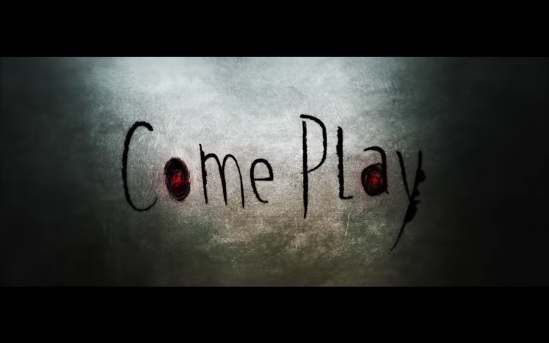
Elementary student Oliver has autism that impedes his speech, requiring near obsessive use of the phone and tablet to communicate with touchtone words as well as using the device for recreational binge watching of SpongeBob SquarePants to calm him when agitated. Unable to make friends, Oliver’s loneliness causes him to sink deeper into his devices while his parents bicker amongst themselves on the endless topic of caring, treating, and assisting with Oliver’s needs, such as speech therapy and daily routine. On another dimensional plane, looking inside-out of Oliver’s devices, is Larry, an equally lonely, misunderstood monster trying to break into Oliver’s world and take him away to be forever friends. It’s up to his overprotective mother and insouciant father to stop Larry’s aggressively desperate out reach into Oliver’s world and pluck him forever from a life of being misunderstood.
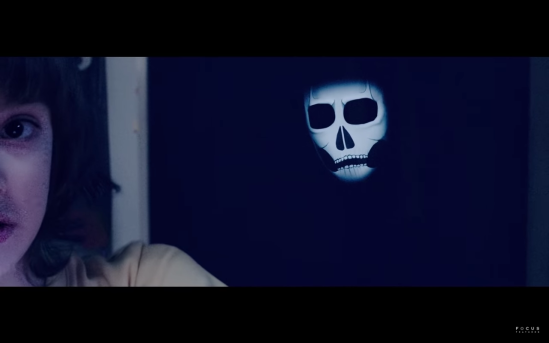
Forget the monsters lying in wait underneath the bed! Forget the monsters lurking inside the dark closet! The monster in your phone, capturing your attention span on a glossy-eyed level, should be the monster we all fear from Jacob Chase’s written and directed tech creature feature, “Come Play.” “Come Play” introduces Jacob Chase into feature filmmaking after being involved wearing multiple hats in a series of short films, spanning over in the last decade and half, with his 5-minute long short film, “Larry,” plotted out as one third shift bored parking lot attendant who discovers an abandoned iPad inside the lost and found box located in his booth and releases a disfigured titular creature that lumbers toward him after reading through “The Misunderstood Monster” children’s tale on the device, becoming the foundational work inspiring a 96 minute, fully fleshed out narrative with dangerous undercurrents of voyeurism and loneliness coinciding with an equally-hazardous theme in the detriments of being a helicopter parent, hindering the independent growth and maturity of youth. “Come Play” is a co-production of Amblin and Reliance Entertainment.
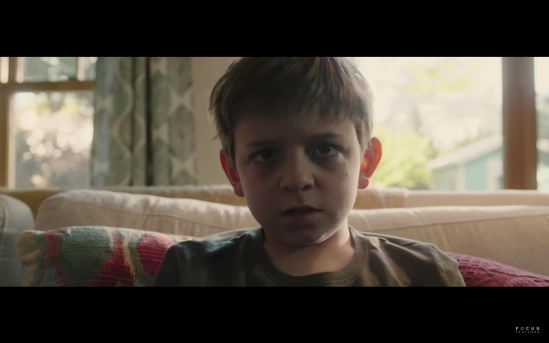
When they’re in a career hot zone, child actors flourish and grow inside a broad base of horror, being nurtured either from or by the creepy child sub-category or from or by being the unlikely hero that has the save the oblivious adults (just look at the kiddie cast of “Stranger Things” for example). Azhy Robertson falls into the latter as the epitome of innocence in playing Oliver, a young boy with autism unable to communicate clearly the monster stalking him from a stratum between two existences. “Marriage Story’s” Robertson continues to gleam versatilely as an actor who can use his imagination to not only react to a rendered behemoth creature but also submerse into the characteristics of autism and not oversell beyond what’s needed. Robertson also continues his girth toward a well-rounded career that now has a notch for horror under his broadening belt. Like many monster-plagued kid horror, the parents are always oblivious and dismissive to the situation and “Come Play” continues the trope with a pair of quarrelling parents in the midst of separation that undoubtedly adds to the extramundane energy fueling Larry’s need for Oliver. Gillian Jacobs (“Bad Milo”) and John Gallaghar Jr. (“Underwater”) butt heads sorely on one topic: Oliver. As their marriage dissolves through unspoken subtleties under the Oliver epicenter, that missed mightier connection could have been more powerful on how the split up affects the reactionary consequences of Oliver’s developmental disorder, an affect so tremendous that it componentizes Larry and his aggressive and brazen abduction tactics that are not so discreet. However there characters are perceived, Jacobs and Gallaghar modestly pack a punch in what has been laid to be the Azhy Robertson show of a vulnerable, yet smart, child versus a relentless and grotesque monster. Winslow Fegley, Jayden Marine, Gavin MacIver-Wright, and Eboni Booth round out the cast.
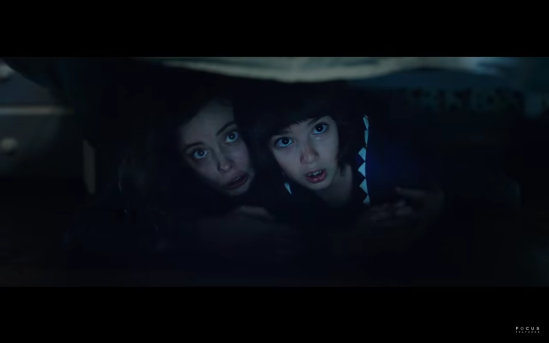
Jacob Chase has proven to be able to handle building breath-holding suspense and tension with the otherworldly plane Larry, a Slenderman-like in appearance and character inspired villain lumbering around not only in Oliver’s house, coursing through the electrical currents in his sub-plane world, but also by peering from out of closets, shying away in the darkest corners of the house, and looming around in a parking lot’s graveyard shift hours only to be perceptible through the phone and tablet camera lenses and, at times, manifesting a translucent presence that has force behind, the latter being an added side dish, transcending from Chase’s short film, to Larry’s predacious tech-manipulating arsenal when obstacles stand in the way of his BFF. Even if “Come Play’s” superlative thrills ride on the heels of potent jump scares and unnerving silence with bated breathed, hiccups do arise in a more alleviated roller-coaster that shreds holes into the well-established terror instead of nurturing the tone. Now while I understand the rating is PG-13 to secure a wider audience and, maybe, be a little lighthearted at times, an awkward diluted dread douses the credibility of the characters in strife with actions, such a scene include Oliver’s parents striking down upon his tablet with alternating hammer blows. In what almost seems like a joke with an archaic technique that old-timey railroad workers use when nailing in track spikes or when carnies – one being a clown – hammer in spokes in unison to erect the big top, the scene is just out of focus in regards to the rest of the scope and there are other scenes like these sprinkled in throughout that raises character quandary concerns. Why not just one parent whack away on the destruction of the dag’on device? A handful of the reactionary actions to protect Oliver are glazed with an unreasonable, panic-stricken defense that begs the question whether they’re fit to actually be parents, which, if looking on the flipside of the argument, might also play into more of the unbeneficial family structure that originated the Larry intrusion. Speaking of originating and the monster, Larry’s exact origins is obscured from the audiences as no plot points touch in depth upon Larry’s background and, you know what, that’s okay here; the more mysterious path is sometimes the best and, in “Come Play,” Larry’s inexplicable being as a child seducing abductor relates much more frighteningly and unfortunately in real world occurrences.
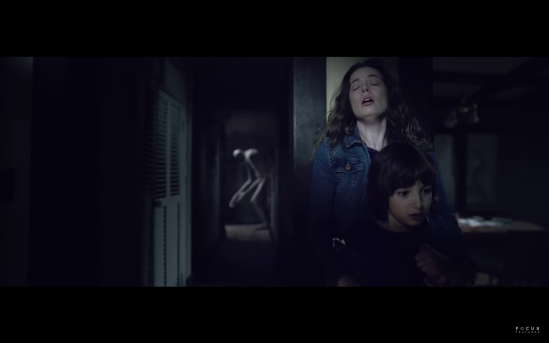
Predators come in all shapes and sizes. In this case, Larry’s atrocious presence, trying to obscure his real identity innately, symbolizes the very personalities of the real monstrous predators living among us, trolling online to prey on the vulnerable. “Come Play” is an oxymoronic subtle hyperbole that serves as a cautionary warning for parents and children molded with pure monster in the closet entertainment in mind releasing theatrically on October 30, pushed from its original July release due to COVID-19, courtesy of Focus Features. Serving as director to photographer is French cinematographer and serial shadow worker, Maxime Alexandre, who was worked with acclaimed horror director Alexandre Aja on “High Tension,” “P2,” and “Crawl.” Alexandra manipulates the space, melding wide, full and closeups, to work the perceptions toward a post-production visual design in adding Larry into the frames and honing in on the lighting to just show enough of the space to make the allusion of Larry’s presence even more ominous. The back and forth of the underused practical Larry and the mostly CGI Larry sparsely have any difference between the final product outcome. The visual effects team of Mr. X saunter with what could have been a clear disaster of composite creature imagery with all the trademarks of synthetic splicing; instead, Larry matches well to the point of an indistinguishable challenge between what’s real and what’s not. The score by the “Don’t Breathe” and “Evil Dead” remake’s Roque Banos does the job to subversively infiltrate the security earmuffs to wring your cochlea to an inch of its life, but doesn’t resonate with you much more than the length of the film; however, Larry’s clicking and snapping of his appendageal joints and his guttural clatters emanate vicinity apprehension, as if the audiences can hear the dun dun hook as a tall tale sign of a circling shark in the water. Sound design is half the fun in the film as the monster is more than half there when it’s on screen. No bonus material accompanied the release and there were no bonus scenes during or after the credits, but I’ve included Chase’s short, “Larry,” below for your own comparison and enjoyment! “Come Play” boosts many unsavory themes between the parameters of technology and children underneath a mask of a faceless friend willing to frighten and fight anyone into submission to obtain complete, domineering companionship to end his chilling fairytale story.
Larry: Short Film


 It's Bloggin Evil!