An EVIL Taxi That Requires Your Baby for Payment! “Black Cab” reviewed! (Acorn Media International / Blu-ray)

Anne has lingering reservations about getting back together with cheating boyfriend Patrick but half-heartedly agrees to take him back and even merry him.  The announcement comes as a surprise to dinner friends, including Anne’s best friend Jessica, but before talking out the situation that clearly has the two women upset, Anne is eager to leave and return to her home.  The embattled couple jump into a cab driven by Ian, a gabby cabby prying into the couple’s heated discussions.  When Ian drives down a dark alley and stops to retrieve a map from the trunk, Anne and Patrick realize they’re locked inside the cab.  A returning Ian reveals his true intentions with a purpose still ambiguous why the couple has been abducted but a desperate Ian will do anything, even kill, to get what he loves back from a wistful countryside spirit, and he needs disordered Anne for a trade. 

Should have taken an Uber.  “Black Cab” is the 2024 British abduction and supernatural horror-thriller from serial television and made for TV movie director Bruce Goodison, with a career credits that specializes mostly in tales of international military conflict and British murder mystery, and a screenplay by “Reawakening” writer-director Virginia Gilbert, incorporating into the relationship couple’s discordant flame a sliver of kidnapping, electrical prodding torture, and a desperate act inside the context of an old ghost tale as well as inside the English’s famous hackney carriage of black taxis, using the popular public mode of transportation as a device to market the film’s story for the sordid cab driver.  Filmed in the city of Manchester and the surrounding greater area, the Shudder exclusive presented film is produced by Jan Roldanus of Stolen Pictures and executively produced by Sony International Pictures’s former strategic producer Lucy Robison and current producer Michaela Fereday.

When a moviegoer familiar with actor Nick Frost runs through a mental checklist of the actor’s filmography, comedies like “Hot Fuzz,” “Shaun of the Dead,” “Monster Family,” and “Paul” come to mind with the often lighthearted, sometimes heart wrenching or darkly humorous, storylines in the presence of physicality and fun, done nearly most of the time alongside Frost’s usually entourage and friends, actor Simon Pegg (“Star Trek,” “Run Fatboy Run”) and director Edgar Wright (“Shaun of the Dead,” “Last Night in Soho”), but Frost has been frequently rooted at the base in horror, science fiction, and, well frankly, genre films in general, with the perfect examples being the aforementioned with shoot’em up polizias, zombies, classic monsters, and an Earthbound alien features.  Frost’s comedic genius is all about timing and the way he carries himself jovially and nonchalantly through tough situations, but Frost can also use those same qualities and twist them to enact a man of deeply troubled anguish behind a masked funny face and viperous wit.  That’s his role in Ian, a cab driver with the gift of gab but turns on a dime with forced aggressive intent to take what he needs from Anne, emoting her character’s already internalized troubles with now a threatening abduction conflict from actress Synnove Karlsen (“Last Night in Soho”).  While Anne is poised as can be in the situation, her disagreeing fiancé Patrick has little-to-no merit as a character being a bit of a bully, cheat, and coward.  Luke Norris (Poldark) gives his best unpleasant rendition of a dirtbag white male with misogynistic issues, but the poorly written aspects of Patrick never fully amount to anything but a weighted towline and an extra body to do what what Ian thinks best with.  Tessa Parr and Tilly Woodward make up the rest of the cast. 

“Black Taxi” subsidizes good suspense over the supernatural calling cards that slowly, yet continuously, shows Anne through an emotional struggling, involving a rather vocally rambunctious boyfriend in Patrick, as well as building the tension inside the cab by hinting at its unusual state of tinted windows, child locked doors, and a more than nosy driver, mostly gone unnoticed by Anne and Patrick due to their bickering and heated love life, or lack thereof.  The first two acts slowly feel out where this story is aiming to drive the audience as Ian’s true intentions are well covered and contained and not fully delineated by the baby clues Ian hints at along the way.  There’s an elemental theme of family and protection, loss and heartache, and how that torment is divergently depicted by both the lead principals Ian and Anne, with the latter being more at a crossroads of choices whereas Ian has already made his choice and it’s one he won’t or can’t come back from.  The third act is mostly where the supernatural factors come into play with the infamous haunting of Mabel Hill, a fiction road supposedly paranormal charged with the ghost of a woman who lost her baby fleeing an abusive relationship and continues to search for the child through bypassing passenger vehicles.  The third act is also where things get murky under the black and white essence of Ian’s motivations as the Ian, Anne, and the ghost are nebulously intertwining on Mabel Hill in some sort of supernatural netherworld dimension that plays mind tricks and is foggy with phantom, falling apart at the seams to support a porous ending.

“Black Cab’s” fare is prenatally pricy in this new release from Acorn Media International and presented as a Shudder exclusive. The UK release is AVC encoded, 1080p high-definition, BD25 that renders a softer image quality that, in all fairness, was already foggy and murky being set in the darkness of the English countryside, presented in a widescreen 2.35:1 aspect ratio. Lots of shadows and silhouetted surroundings drowns out the delineated city structures that blend to the spooky forest as the focus is significantly on the interiors, the cab and the abandoned hotel, and not even those highlighted inmost sets solidified specifics. There’s quite a bit of banding from compression and that’s not to be surprising given the format size and the profound amount of tenebrous tone. Textures along Frost’s dressed-in-black casuals or in contrast to Karlsen’s cocktail outfit that’s more nightgown than ritzy, they’re just not there to extensively define Ian and Anne other than being the epitome of differing the dark and light of loss. “Black Cab” has more of a cityscape than a landscape though the story heavily hits upon Mabel Hill as ghost central and yet lacks the elucidation as well as the finer points to flesh out the haunted area. The ghost too is more a cheap visual effects trick than the implementation of palpable practical patience with an overlaid layer of overexposed blues and whites over top the actress to be then augmented into the scene for ethereal effect. The English language DTS-HD 5.1 surround mix is a better outfit, more so in the clean and clear dialogue exchanges between the trio of Nick Frost, Synnove Karlsen, and Luck Norris but does whittle down to the Nick Frost exposition hour when his vague maligned venture is made with more understanding through his broken man diatribes and Anne just sitting and listening as any good abductee would do to avoid saying or doing the wrong thing. Light atmosphere hubbub caters to just that with the night, likely late, shoots inside the city and rural settings but the localized car actions, taser zaps, and character efforts are effective enough to entice a palpable action. English subtitles are optionally available. Acorn’s releases are not chockfull of special features, and “Black Cab” harbors the same slimmed down supplements with a behind-the-scenes gallery. The UK release has a slightly thicker than normal Blu-ray Amaray with an encompassing composition of a rearview mirror peering Frost and a shadowed Karlsen in the fear of the mirrored frame while a ghost hovers above the presumed Mabel Hill Road. UK certified 15 for strong threat, horror violence, domestic abuse, and very strong language, “Black Cab” is hard encoded for region B playback only and has a runtime of 87-minute runtime.

Last Rites: “Black Cab” starts off as an unpredictable ride of mystery and suspense that quickly loses gas to keep up with the swerving supernatural vehicle.
How Far Will Three Detectives Go to Stop Evil? “Memories of Murder” (Neon / Digital Screener)

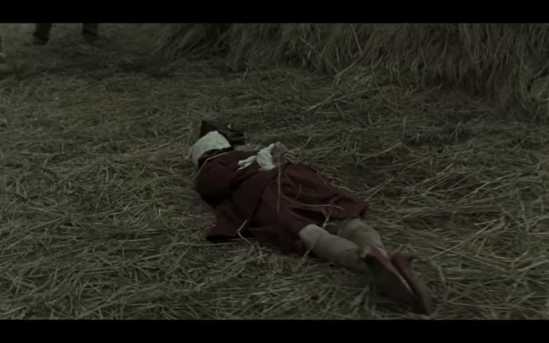
Two impractical detectives of the Gyunggi province of South Korea investigate a pair of rape and murder cases involving two beautiful and unrelated women found with their hands bound behind their backs, gagged with a rock tied into their mouth, and with their panties covering their heads.  Known around the province for their torturous interrogation tactics, the detectives bully a mentally handicap young man and the local pervert into confessing to the heinous crimes, but when a Seoul investigator arrives into the village, drawn in by the curiosity and coincidence of the murders, a larger scale serial rapist and murderer, calculating his every move, is unearthed, connected by series of events leading the small police force to reevaluate their handling of the murders that have become more gruesome than the next with every victim. 

Before his inevitable recognition from the 2019 Academy Awards for his socially skewed hierarchy thriller, “Parasite,” that historically won Best Picture, Directing, International Film Feature, and Original Screenplay categories, even before his breakout success amongst fans of the horror genre with the creature feature, “The Host,” and an introduction into the American film market with another social class commentary, the dystopian standoff that was “Snowpiercer,” starring the Captain America portrayer himself, Chris Evans, filmmaker Bong Joon-ho had an eye for crafting his vision on camera and a knack for nerve-shredding storytelling as a writer in the early 2000’s with his 2003 sophomore feature, a crime drama entitled “Memories of Murder.” Originally known as “Salinui chueok” and written by director, the film is an encryption of a murder mystery encoded from the real life serial crimes in the Hwaeseong province in the 1980’s, Bong Joon-ho’s film takes place in 1986, and renders an engrossing story structured like a modern day Jack the Ripper emerging out of the unpleasant anecdotes of Korea lore stirred with themes of consequences as a result of careless failures and the inadequacy of effort no matter the analyzed angle.  CJ Entertainment, Muhan Investment, and Sidus serve as production companies of this somber sleuth mystery.

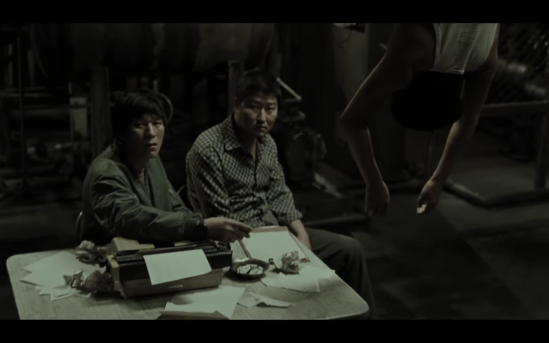
Despite their different methods of interrogations and investigation pursuits, the story hammers down on the three detectives’ across the board search for a methodical killer rather than a killer’s betokening perception of events as the detectives, individually flawed with ill repute and personally challenged, separately come unglued, make mistakes, and suffer the consequences of their public inanity, but when they click in harmony and rally on the same page, the truth almost hops into their laps rather than at a snail’s pace stemmed from internal competition for apprehension success. Song Kang-ho has played the constant, the unparalleled keystone, in Bong’s two decades of film credits, beginning his collaboration with the acclaimed director in “Memories of Murder” as the province’s ineffectual blowhard detective, Park Doo-man. With a deadpan stare, Song Kang-ho debones the Park Doo-man to his rudimentary base, a waggish con artist in an officer’s casual attire, and the actor defines Park’s arc so clearly, distinctly, and with ease that you can actually see Park Doo-man’s soul just become utterly crushed by not only the tough case but also when it’s clear that he must separate himself from his partner Cho Yong-koo (Kim Roe-ha) after a foolish bar fight of steadfast conviction and begin to accept his counterpart rival Seo Tae-yoon (Kim Sang-kyung) to no longer be the buffoon when bodies continues to pile up. “Memories of Murder” round out with Song Jae-ho, Byun Hee-Bong, Ko Seo-hie, Park No-shik, and Ryu Tae-ho.

In the battle to be top cop that nabs the worst criminal the province has ever seen, a disastrous paradox thwarts their oath to protect and serve the community as the two detectives, in their haste for swift justice, don’t see eye-to-eye on issues of evidence and actual detective work with a levelheaded outside investigator putting his foot forward delivering a working, if not more rational, model of a killer’s mind.  The innate detective, Park Doo-man, relies heavily on the circumstantial from gossip, relayed by the province investigator’s soothing nurse who he’s also seeing romantically, to superstition, visiting expensive shamans and claiming to have supernatural sleuth abilities himself, in order to cheat corners in hoping the information will present itself like an elegantly wrapped gift with a bow on top.  At the other end is the outsider, detective Seo Tae-yoon, from the metropolis area of Seoul and the big city detective, who sees more of these types of crime in his urban backyard, conducts a factual investigation based off research and relying on experience that gives him intuition into how the killer thinks.  Clarity in the contrast concedes more so when the third detective, another province resident, Cho Yong-koo, refuses to change his ways of brutal violence and torture as he continues his flying kicks right into the chests of suspects whereas his partner, Park Doo-man, relaxes his greed for admiration when the number of deceased women becomes unnerving and public trust in law enforcement rapidly diminishes; the reality sets when his counterpart, Seo Tae-yoon, produces results closer to an arrest based on fact.  Bong Joon-ho’s approach at the beginning would not be a conventional one that mingles rape and murder with the bumbling antics of a small town police force that’s outrageously zany at times.  The zaniness comedy subsides and is replaced with an air-letting dismal outlook of vulnerability and powerlessness in making little-to-no headway into a case that keeps getting grislier and grislier with the killer not inserting objects into his female victim’s vagina.  Trusting the system is even more disquieted so when the most latest and reliable crime solving techniques in the mid-1980s, from America none-the-less, proves to be astonishingly inconclusive, making the case seem like a no-win situation that then reverts back to the idea that sometimes even the most careful and meticulously handled cases, without the use of force, are not solvable. 

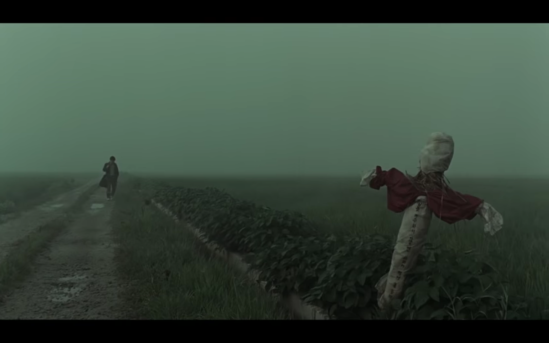
The powerful knuckle-biter “Memories of Murder” rattles with anxious tension and is chartered gracefully through the unrivaled eye of Bong Joon-ho.  Now making it’s grand return exclusively to theaters nationwide October 19th and 20th, “Memories of Murder” will be exhibited digitally remastered for U.S. audience for the first time since it’s initial release since 2003 courtesy of a partnership between Neon and Fathom Events.  The limited theatrical running with include exclusive content and a post-screening conversation between Bong Joon-Ho and “Shaun of the Dead” and “Hot Fuzz” director, Edgar Wright.  Since I’m unable to compare the digitally remastered with the initial release, all I can say is that the film presentation appears steady, tight, and clean with Bong’s sepia tone to incept a memory fragment of the past and shot to entice an unfathomable crime drama captured as beautiful gaslit dissonance between background societal unrest, the case at hand, and the audiences’ unsuspecting role as the potential suspect. The screener provided is a digital screening link and might appear different in a theater sitting. The English subtitles were clearly visible with some minor errors in spelling. Again, this might vary in theaters. There were no bonus material on this screener, but, remember, that the limited run event on October 19th and 20th will have the exclusive bonus content and the Wright and Bong conversation. Unforgettably wrung with wraith-like anecdotal properties, “Memories of Murder” can be labeled as Bong Joon-Ho’s exemplary film, even better than his current work that won him an Oscar.

A Child’s Toy Masks a Hidden EVIL! “Kaleidoscope” reviewed!


Just released from prison after 15 years and living alone in a high capacity apartment building, Carl is anxious to finally go onto a date after a long time of solitude. Mild-mannered and quiet, he manages to strike up a date with an uncultivated young woman named Abby who takes a strange, if not alluring, interest in Carl’s humble lifestyle, but when his estranged mother, Aileen, arrives back into his life, Carl’s seemingly perfect date comes crashing down into millions of pieces and old feelings of hate and urges for substance return to a warping fold. The lust and youthfulness he feels for Abby is replaced with fear and anger as reality bends on the verge of breaking as the past and present collide to an unfathomable finale.

The first thought that pops up about director Rupert Jones’ 2016 film, “Kaleidoscope,” is to instantly relate this film to the Dutch sex wave film, Wim Verstappen’s “Blue Movie,” because of a major structural similarity that’s important to both films, is essentially an inanimate character, and is a looming presence despite the “Blue Movie” being an erotic film and “Kaleidoscope” a suspenseful psychological thriller. Both movies feature a monolithic motel-esque apartment building complex in which both house the feature character, a former inmate, and the complex becomes part of the story where as Michael in “Blue Movie” runs his pornographic business and Carl interacts with the building as an obstacle to hurdle or a contributing factor to his problem. “Kaleidoscope” marks Rupert Jones’ sophomore feature directorial and his debut as the credited writer that lightly placed notes of hinting at a Roman Polanski picture.

Toby Jones is sorely an underrated actor. The versatile supporting English actor has been underused since non-fictional performance of Truman Capote in “Infamous” that was crudely undermined by the late Seymour Hoffman’s titular role in “Capote” of nearly the same year more than a decade ago. However, Jones maintains a presence both in Hollywood and the indie circuit with the latter honing in on a film about a man with severe mother issues and Jones nails a browbeaten and tortured soul performance perfectly. The mother issues come courtesy of “Hot Fuzz’s” Anne Reid as a intrusive and sickly, yet superior matriarch to Carl’s whimpering passiveness. Reid’s somehow manages to pull off being manipulative and sweet in one single persona and bespoke the relationship between mother and son with the mixing water and oil. In the middle of Carl and his mother’s love-hate dynamic is a third person of an unequivocally different persona, making a trifecta of clashing personalties. Abby, played by Sinead Matthews (“A Serial Killer’s Guide to Life”), brings a little jovial pleasantry to a dark cerebral tale. Rounding out the cast is Karl Johnson, Joseph Kloska, and Cecilia Noble.

So how does a child’s toy factor into Carl’s descent into madness? The cylinder device creates optical illusions, usually in a colorful spectrum and mirroring pattern that refract when spun in a circular motion and looking at a light source to illuminate the effect. The experience is fantastical and Carl, browbeaten by not only the criminal system, but also by his family, uses it as a means of escape, an allegorical path of avoiding darkness in his life and a way to advert the melancholy that is his existence. Even his date with Abby is a gloomily skewed as she has ulterior motives to further push Carl to a metaphorical breaking point. Yet, he’s at peace with his assumed childhood toy in the handful of scenes he’s using it which recalls the image of his father; a joyful moment that’s ironically the sore point of most of his tribulations. The Kaleidoscope could also symbolize seamless duality as Carl has difficult establishing what’s real and grasping the hardline of time. Rupert Jones subverts linear and conventional storytelling magnificently to not only put Carl in a twisted world, but also throwing the viewer into chaos along with him.

Sparky Pictures and IFC Midnight presents Rupert Jones’ psychological asphyxiation thriller and Stigma Films production of “Kaleidoscope” onto UK region 2, PAL DVD home video. The DVD image is presented in a widescreen, 1.78:1 aspect ratio, on a DVD9 and the digital quality, like always, is a unfathomable well of picturesque with crisply defined shades of black combined with some variant lighting techniques to tell Carl’s current mood. “Kaleidoscope” touches more on the natural skin and coloring, but does use some dry yellow tinting and some visual effects to embark on the once penitentiary patron’s mental break journey. The English language Dolby Digital 5.1 surround sound audio mix has multi-channel sensitivity utilizing all channels to jar the senses even more and to, seemingly, weaponize Mike Prestwood Smith’s chaotic score to take the state even further. Dialogue has supremacy and clarity. Bonus features includes a standard array of extras in the cast and crew commentary, trailer, photo gallery, and storyboards. “Kaleidoscope,” like in the toy’s changing patterns, shatters hope only to rejoin it back together to then shatters it again in Rupert Jones’ heated and confrontational tale of mirthless character and taxing parental abuse affecting one soul’s chances of normalcy and redemption into society even in the face of societal kickbacks.

Planning a Jailbreak off an Evil Corporation’s Island Prison! “Escape from Absolom” review!


In the year 2022, Special Forces solider, Captain Robbins, is court martialed for putting a bullet in the head of his commanding officer. After escaping two maximum security prisons and a record of rebellious activity, a corrupt and power hungry warden of the Lactivus prison ships Robbins off to an off shore island called Absolom, where prisoners can roam free with no chance of escape due to 24/7 surveillance by Satellite and rocket launcher armed helicopter gunships surrounding the island perimeter. Island prisoners separate into two factions: the Outsiders and the Insiders. Each with the respective camps, the lawless Outsiders overwhelm the Insider’s numbers by 6 to 1, leaving the small manned community in constant fear of attack and pillage by the Outsider’s merciless leader, Walter Marek. When the insiders learn than Robbins has faced Marek and lived, they take the former solider into their community, but Robbins sole desire is to escape off the condemning rock and with the help of a few good men from the Insiders’ camp, the chances of escape and survival are greater together as long as Marek and his band of starving cutthroats don’t seize the endangered community first.

“Escape from Absolom,” also known as simply “No Escape” in the U.S., is a Martin Campbell directed action film from 1994 that’s futuristic and violent, fun and thrilling, and kitschy without being too cheesy. Campbell, who went on to direct not one, but two, James Bond films, begins a base of epic action that’s toweringly ambitious and pulled off nicely with the stunts and the editing. Based off the Richard Herley novel “The Penal Coloney,” the script is penned by Michael Gaylin who puts pen to paper to scribe a playful, passively aggressive dialogue, but fun and energetic on a the same coy lines of other high visibility action films. Gaylin was able to conform to a story that has no dynamic with the opposite sex in one of the few films that exhibits a rare all male cast.

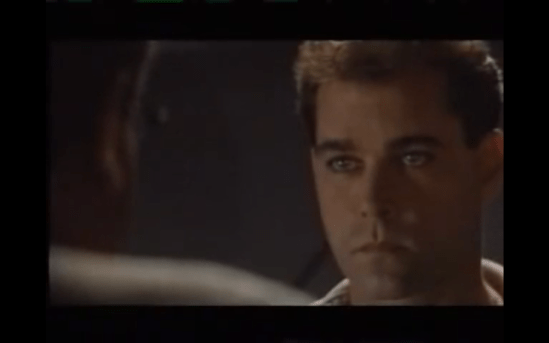
“Goodfella’s” star Ray Liotta finally got his time to shine as the butch and badass action hero that is Captain Robbins, a highly skilled special forces solider and killing machine whose pragmatic intentions, at first, are hard to read. The cockiness overtop a well-cloaked deadly skill set works to the advantage of the blue-eyed actor for New Jersey. Opposite Liotta is Stuart Wilson (“Hot Fuzz”) as Walter Marek, a 7-year island lifer with dreadlocks and nose bridge piercings to match his psychotic leadership. Wilson does psychotic just fine, but the look resembles John Travolta’s atrocious attire from Battlefield Earth. Lance Henriksen, One of the most recognizable legendary genre actors, has a more serene approach in being a mentor and the leadership figurehead of the Insiders camp when compared to conventionally eccentric, sometimes maniacal performances, but Henriksen has a mellow side to him that conveys are very affectionate kumbaya approach, but any personality compared to Stuart Wilson’s internal rampage would be a stark contrast. “Ghostbusters'” Ernie Hudson has his role as security office in the Insiders camp and the sole black man of the film, for obvious reasons, stands out, but Hudson just adapts to anything you put him in though the Michigan born tended to sway toward the thrilling fantasy/sci-fi genre in the height of his career. Rounding out the cast is Kevin Dillon (“The Blob” remake), Kevin J. O’Conner (“Lord of Illusions”), Don Henderson (“The Ghoul”), Ian McNeice (“Dune”), and Michael Lerner (“Maniac Cop 2”).

All things considered, “Escape from Absolom” is a torrent men-in-prison extravaganza that’s one part Sylvester Stallone “Judge Dredd,” one part Chuck Norris “Missing in Action,” and, as a whole, an endangered brand of droll entertainment. Speaking of Stallone, Ray Liotta did it first as a character who is an expert at escaping the inescapable maximum security penitentiaries and instead of Arnold Schwarzenegger and Dave Bautista as contentious, yet supportive allies, the friendly, yet solidly statured Ernie Hudson and Lance Henriksen share Liotta’s Captain Robbin’s unquenchable lust for freedom, even if it to provide unsheathe exposition of the unethical corporate penal system practices. Far from being a perfect film and extremely blantant on a no underlying message, Martin Campbell undoubtedly has a fine tuned niche of capturing the casual eye with large scale action sequences and an affable character allure.

Umbrella Entertainment releases “Escape from Absolom” on a region-all Blu-ray, presented in 1080p, widescreen 16:9 aspect ratio. The coloring is phenomenally remastered and stable compared to previous transfers. There are times when depth becomes two-dimensional or flat, skewing the picture noticeably, but the overall picture quality is spectacular in the vast amount of Australian landscapes and even in the night scenes that show hardly any enhancing, such as sharpening or contrast. The English DTS-HD Master Audio 2.0 track is laid out nicely with audible poise and precision balance. Dialogue is prominent while explosions have just the right amount of oomph under an exact LFE recipe. The release sports other language Dolby Digital audio tracks such as a German 2.0, Spanish 2.0, Italian 2.0, and a French 2.0. Optional English SDH subtitles are available. Bonus material includes a two part making of featurette from around the production of the film with interviews with cast and crew, four TV spots, trailer, and a reversible cover. Runtime is 118 minutes. Martin Campbell’s “Escape from Absolom” is dystopian dynamite, explosive and aggressive with a flare for enjoyable banter amongst defined and diversified characters inhabiting an utopian island of mostly societal scum.