No EVIL Gets Left Behind! “P.O.W. The Escape” reviewed! (Ronin Flix / Blu-ray)

“P.O.W. The Escape” on Blu-ray at Amazon.com!

Colonel James Cooper’s moto is no one gets left behind.  The seasoned P.O.W. extraction officer volunteers for a politically spearheaded suicide mission to save Vietcong American captives before a cease fire treaty ends the war, effectively turning the P.O.W.’s into M.I.A. and possibly never heard from again.  As the U.S. Airborne Colonel expected, the mission of rescue results in a complete fiasco of resources and being empty handed of prisoners as the enemy suspected an imminent attack.  Cooper becomes a P.O.W. alongside the men who set to rescue but that doesn’t deter the determined officer to plan his escape, but before detailing out a route out, the camp’s warden Captain Vinh has alternative plans for his prized captive in all of North Vietnam.  Vietcong headquarters wants to retrieve the Colonel in two days for public execution but Capt. Ving seeks a better life outside his country and accumulates the K.I.A. and P.O.W.s valuables plus in addition to stealing gold bars form his country in order to relocate him and his family to the U.S. but on his terms with a perilous journey across enemy lines with all the P.O.W.s in order for no one to get left behind.

The Carradine name is one of the most recognizable names in Hollywood with David Carradine the most famous, behind his father John Carradine, with his highly successful television series from the mid-70s, “Kung Fu.”  A part of “Kung Fu’s” success was due in part of the decade itself where kung fu films were a peak popular with rising star Bruce Lee.  A decade later and still in the shadow of that breakout series with a made-for-television movie, Carradine breaks into another rising type of films that trades in hip-throws and round house kicks for M1 assault rifles, Huey helicopters, and the jungles of the Vietnam war.  And coincidently enough, Vietnam actioners were made popular by another martial artist with “Missing in Action” starring Chuck Norris.  Carradine’s venture into the America’s shame frame being exploited for personal gain is P.O.W. The Escape, a rip-roaring and explosive do-or-die war caper from first time director Gideon Amir and penned, and re-penned, by Jeremy Lipp (“The Hitchhiker” TV series), James Bruner (“Invasion USA”), and “Deadly Sins” co-writers Malcolm Barbour and John Langley.  Also known as “Attack Force ‘Nam” and “Behind Enemy Lines,” the Philippines doubling Vietnam production is produced by Yoram Globus and Menahem Golan as a Globus-Golan Production.

The Late Carradine epitomizes stone-faced patriotism as the exfiltration expert Colonel Cooper.  Showing hardly any emotion except for a handful of scenes that call for it, or else Cooper would be a full-scale unempathetic sociopath, Carradine gives his best harden American warrior as well as an indestructible combat commando where a barrage of bullets whizz around him, explosions don’t impede his health, and an army of Vietcong are no match for the Colonel’s American flag draped, M60 machine strapped fighting spirt in an uphill battle of certain death.  Its farcically funny to behold but that was the traditional one-man-army paradigm back then and, to an extent, still is even today to give audiences as gung-ho and impossibly invincible hero.  Cooper leads a bunch of weary P.O.W. troopers on the brink of becoming lost in wartime politics and only three out of the bunch are highlighted throughout the misadventure toward safety with those roles’ boots on the ground by Steve James (“McBain”), as the order-following Sgt. Johnston, Phillip Brock (“American Ninja”) as wise-cracking know-it-all, good soldier Adams, and Charles Grant (“Witchcraft”) as the maverick Sparks who initially goes against Cooper’s plan.  Sparks is likely the most interesting and complex character with an internal conflict having set into his own path of escape dedicated on selfishness and greed only to feel the tremendous weight of guilt and burden of his fellow soldier while on the bed of a half-naked, North Vietnamese prostitute.  The last major principal is actually a Captain, that is Captain Vinh, played by one of the most recognizable faces in Japanese cinema history, Mako, of Arnold Schwarzenegger “Conan” fame as the Akiro the Wizard.  Understanding Vinh’s motivation hardly musters conclusively on why he wishes to defect his country and why he needed Colonel Cooper to accomplish it.  Perhaps Vinh’s undergoing hate for his own country was lost in the editing room as the film is noted to have gone through multiple re-writes, edits, and additional post-production shoots.  “P.O.W. the Escape” fills out the cast with Daniel Demorest, Tony Pierce, Steve Freedman, James Acheson, Ken Metcalfe, Ken Glover, Rudy Daniels, and Irma Alegre.

For Gideon Amir’s first picture, this Vietnam vehicle is an action-packed romp.  Never letting up on the accelerating peddle, especially with Cooper’s blank determination to get all the men out of the arm struggle before a treaty wraps up the conflict and leaves his charge in casted away in the arms of the enemy, what Amir accomplishes at the behest of his influential producers wonders how this high-value production ever made it past post without being a completely incomprehensible mess.  There lies choppy moments of editing that puts into question it’s original concept even if one isn’t aware of the film’s narrative conflictions.  What ensues is not a traditional rally and escape from a torturous, inhuman enemy camp that one can’t abscond from so easily; instead, the narrative becomes an escapade of itinerant provides various difficult scenarios that split up the group, sees internal turmoil, and propels desperation to get to the friendly Huey’s with their very lives, but doesn’t see Cooper come under threatening fire as he spurts off short rifles rounds and takes out a handful of Vietcong at once with one scene reminiscent on a particular World War II hero charging up hill and taking out a whole German squadron alone with a machine gun.  Audie Murphy, If remembering accurately, but instead of sustaining any projectile wounds, Cooper thrusts forward unscathed while those G.I.s he’s trying to recover and rescue perish in an inescapable firefight.  Carradine’s stoicism throughout the life profit and loss campaign doesn’t match Cooper’s liberation maxim that forces “P.O.W. the Escape” into an impassive, often times comical, attitude with the story’s central character.

Director Gideon Amir and David Carradine tempt their hand at the Vietnam vamoose now on a Hi-Def Blu-ray forged by Ronin Flix through way of Scorpion Releasing’s 2019 HD transfer of the previous MGM print.  The widescreen 1.78:1 aspect ratio presented feature fails to capture impeccable clarity of acme perfection with approx. half the frames wilted away with artefact de-escalation of details. Half the scenes look great with a semi-serious saturation of color, a few of facial and foliage details come out, and textures have tactile range at times, but the film’s glass is only half full within a darker dilution of speckled splotches. The English DTS-HD 2.0 master audio mix relays a fair enough dialogue consignment with comprehensible clarity and is utterly clean but lacks punchiness with a flat as a David Carradine’s poker-face facade. With a robust range of gunfire, explosions, and modes of transportation, especially going through the mucky and miry jungles of war-torn Vietnam, the film definitely needed a stronger suit of sound but was ultimately discharged without dullness. English subtitles are available. Special features include three on-camera interviews with Director Gideon Amir, screenwriter James Bruner, and stunt man Steve Lambert discussing their particular involvement in pre-and-principal shoots, some of the process woes, and how exotic the opportunity was to work internationally and with David Carrine. The film’s original trailer rounding out the special features block. Physically, the Ronin Flix release comes in a standard Blu-ray snapper with an action-packed and commandoed David Carradine blasting off his rifle like in a Ghana-esque illustrated movie poster. Inside, the lack of insert and reversible cover art leads our eyes straight to the disc art that’s the same as the cover, cropped down to fit in the circumference. Rated PG, that is rated 1986 PG with strong war violence, strong language, and nudity, the release is region A locked in playback and has a runtime of 86 minutes. A campy commando campaign capitalizing on the success of the Vietnam prison camp subgenre, “P.O.W. the Escape” could be much worse for wear as a solid action flick fierce in delivery yet fickle in substance.


“P.O.W. The Escape” on Blu-ray at Amazon.com!

Never Poke Isolated EVIL. “Darkness in Tenement 45” reviewed! (Wood Entertainment / Digital Screener)

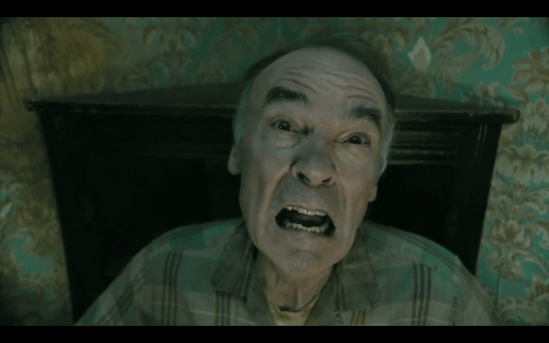
In an alternate reality of the 1950s, the Soviet Union has obtained components for long range biological weapons that threaten United States’ borders.  New York City has been declared as a tangible target and the city is evacuated of all residents, but one tenement, number 45, remains occupied, boarded up by the frightened tenants to shield themselves from the biological threat and from a possible USSR invasion.  Cut off from the outside world and running low on food and supplies, the building’s owner, Felix, ventures outdoors to forage what’s left on the streets of NYC, leaving Martha in charge of the dilapidated building, the anxious children and the terrified adults.  Martha’s adolescent niece, Joanna, arrived just before the evacuation; a measure taken by Joanna’s mother due to her daughter’s “darkness” of violent outbursts, but Joanna’s darkness conflicts with Martha’s authoritarian leadership leading up to a faceoff between children and adults in already tense surroundings.

In August 2017, production finished on “Darkness in Tenement 45.”  In 2019, a Kickstarter campaign was launched to complete the post-production of the Nicole Groton written and directed psychological thriller based off fear and intimidation in the context of a Red Scare backdrop.  As her breakthrough feature film, Groton probably couldn’t have imagined that the release of her quarantine isolating and germ warfare agog could have coincided right in the middle of a current pandemic climate of self-quarantining anxiety and globally enforced lockdowns.  Yet, “Darkness in Tenement 45” can be viewed a sentiment of triumph in a time of actual worldwide darkness for a film with a crew that is comprised of primarily women and with a cast that favors the majority of dialogue roles also for women.  Groton supports her own cause by contributing as producer under her production label, A Flying Woman Productions, a North Hollywood, California based indie picture production company.

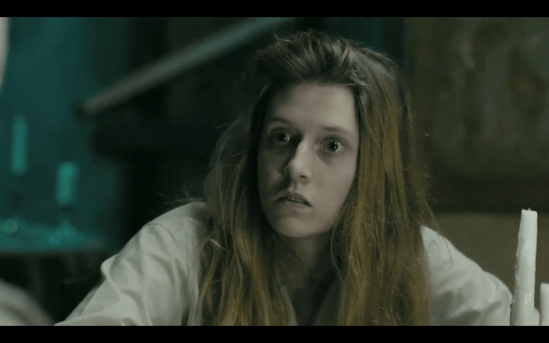
While there might be a contingent of characters that could easily be in the vying for lead, Nicole Tompkins is the discernible “darkness” descriptor in the “Darkness in Tenement 45” title.  The Texas-born actress has developed a little darkness of her own in her career corner being a principle lead in the 2018’s nightmares of the netherworld, “Antrum:  The Deadliest Film Ever Made” and also landing a voice role of one of survival horror’s most renowned heroines, Jill Valentine, in the remake of “Resident Evil 3” video game released this year.  Now, Tompkins scales the identity range as a damaged young woman sheltered in place from the elements of war only to be stuck as an afterthought amidst toxic authority that could endanger all tenants, creating a boiling tension culminating into a volatile climax with Martha, a role drenched with an unapathetic interest in children’s opinions, especially from the unstable ones.  Martha is played sardonically by “Blood of Drago’s” Casey Kramer with a seething disdain for anything that isn’t in her interest.  Overall, the performances and characters are grounded enough to development the story along it’s simple narrative lines, but not everything support character, who are supplemented with individual portions of the story pie, are well bloomed to sate their character.  For instance, Tomas, the youngest child of the building owner, Felix, has an undisclosed autistic side him and becomes obsessive with the breast of one of his older sisters, and while that plays out in Groton’s themes of partisan power when Tomas is given authority over his sisters from his venturing father, because of their innate Latina patriarchal culture, Tomas’s motivations fall short of really being dug out from the undercurrent context as an individual arc.  Same kind of broke off development can be said with Emmy Greene and Joseph Culliton’s characters as fellow adults who blindly follow Martha’s do-as-I-say mentality like lemmings toward their self-destructions.  The cast rounds out with a wide range assortment of children and adult actors that include David Labiosa (“The Entity”), Melissa Macedo (“Blood Heist”), Keyon Bowman, Marla Martinez (“Blood of Ballet”), and Anthony Marciona (“Invasion U.S.A.) who provides more of a 1950’s white man NYC accent true to the era.

Revolving around the theme of isolation, “Darkness in Tenement 45” operates under the similar structure of John Carpenter’s “The Thing” by establishing a group of people cutoff from the rest of the world trying to survive a different kind of infection and the antagonist alien, represented as the darkness in Groton’s film, is the villain that tears the remaining survivors apart from the inside, metaphorically in the house instead of their bodies in this case.  “Darkness in Tenement 45” is by no means on tenterhooks or as a molecularly gruesome as John Carpenter’s classic re-imagining of an actual 1950s film, but the basic principles of the story present plenty of suspicion, hegemony, and stir craziness to go around, fueling the dreams and anxiety to Joanna’s snowballing psychosis redlining toward critical.  While I feel that the performances and wardrobe are not the best representation of the 1950s time period, the Caitlin Nicole Williams’ production design shoulders much of that responsibility.  Williams, who worked as the second unit production designer on the satirical-slasher “Dude Bro Massacre III”, creates a delineable vividness out of a bare bone lined tenement setting, appropriate for the depicted social class and period, while exuding the crude shiplap finish that fits the narrative, adding confinement and angst to the space.  “Darkness in Tenement 45” is Groton’s groundbreaking effort that dishes out this disorder of a safe haven in dismay; yet, the story pulls plot point punches that should have landed to knockout a more effective thriller that touches importantly upon the very livelihood and fate of each individual tenant in an alternate universe wartime backdrop.

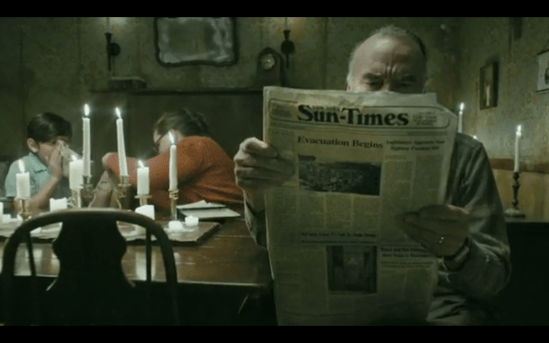
On the biggest day of every four years, as anxiety-riddled clouds loom over the entire nation as we all wait in the shadows with bated breath of who will be the next President of the United States of Election Day, Wood Entertainment has embraced another kind of tense darkness with their release of “Darkness in Tenement 45” onto various digital platforms, including iTunes; Amazon; Vimeo, Xbox, Google Play, iNDEMAND, FandangoNOW, and more. Continuing the praise of the female-led thriller is with the Carissa Dorson cinematography that deposits two shot styles of the conscious and subconscious. When awake, Joanna and the others are engulfed in a hefty, deep dark and light wood brown scheme that compliments the slummy environment of their tenement. When asleep, Joanna is rendered in a softer image to resemble the hazy or airy atmosphere of her dreams. This style is also complete with a medium scaled purple-pink tint often associated with the hallmark callings of a 1970s-1980’s foreign supernatural horror. Dorson never intertwines the two styles, giving clarity to Joanna’s conscious and subconscious state without going deeper into the character’s easily agitated and short fuse temperament, while also setting up some neatly framed shots that make things look bigger or more menacing than they appear, such as the overly boarded up entrance door or the candle lit supper table that becomes a point of contention. Flashes of incubus imagery and the dissonance of gearworks clanking around an unhinged mind give “Darkness in Tenement 45” a morsel of allure amongst the thematical discord of breaking the chains of restrained individualism and overprotecting those with a firm hand from self-harm and while the film might not be pitch perfect, the spirit is strong in the vanguard of female-driven filmmaking.

“Darkness in Tenement 45” now available for rent on Amazon Prime!

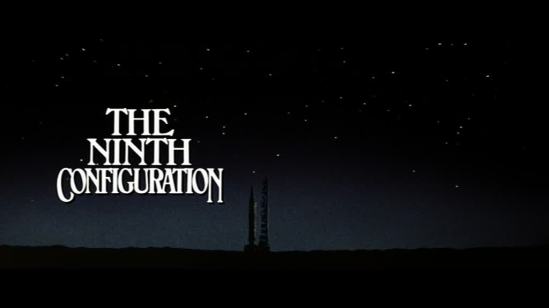
If You Don’t Know Who You Are? Then Evil Does. “The Ninth Configuration” review!

vlcsnap-2016-04-22-21h23m40s24
An insane asylum located in the North West region of the United States attempts an experimental test to root out Vietnam soldiers faking signs of psychosis. A new commanding officer, a military psychiatrist named Colonel Kane, will take the lead of the experiment. But Kane’s methods are unorthodox and Kane himself seems distant from what’s expected from him, leaving the military patients, and even some of the personnel, wondering about his state of mind. Kane lets the committed soldiers live out their most outrageous fantasies and the further his practice plays out, the more that there might actually be something terribly wrong with the new commanding colonel.
vlcsnap-2016-04-22-22h07m56s217
“The Ninth Configuration” is the big screen adapted version of William Peter Blatty’s novel entitled “Twinkle Twinkle Killer Kane.” Blatty, who wrote the screenplay and directed the film, dives back into motion pictures once again after the success of another previous adapted novel; a little piece of work you may be familiar with called “The Exorcist.” In the span of seven years, Blatty was able to cast again the versatile Jason Miller, who had portrayed a much more serious Father Karras in “The Exorcist,” as one of the leading asylum inmates in “The Night Configuration.” From then on, the hired case was forming into a formidable force of method actors including Stacy Keach (“Slave of the Cannibal God”), Scott Wilson (The Walking Dead), Ed Flanders (“The Exorcist III”), Robert Loggia (“Scarface”), Neville Brand (“Eaten Alive”), George DiCenzo (“The Exorcist III”), Moses Gunn (“Rollerball”), Joe Spinell (“Maniac”), Tom Atkins (“The Fog”), Richard Lynch (“Invasion U.S.A.”), and Steve Sander (“Stryker”). This cast is a wet dream of talent.
vlcsnap-2016-04-22-21h32m58s236
What’s unique about Blatty’s direction of this film is the non-displaying of action and dialogue off screen. Whether it’s character narration, dialogue track overlay, or slightly off camera view, the spectator, for more about half the film or perhaps even more, isn’t being directed to focus on the current action or dialogue and this creates the illusion of hearing bodiless voices or activities, as if you’re part of the ranks in the mentally insane roster. Only until the truth or catalyst is reveal is when more traditional means of camera focus is applied.
vlcsnap-2016-04-22-22h37m48s224
To make this technique work and to make it not become tiresome to the viewer, Blatty had to write some amazing dialogue and with him being a novelist and all, the dialogue was absolutely, 100 percent brilliant. Lets not also neglect to mention that with unrivaled dialogue, out of this world thespians must be accompanied to breathe life into the black printed words that are simply laying upon white pages. Scott Wilson’s and Jason Miller’s craziness is unparalleled while, on the other side of the spectrum, Stacy Keach delivers a melancholic performance that balances out the tone of the film from what could have been considered an anti-Vietnam war comedy at first glance that spun quickly with an unforeseen morph into a suspenseful thriller about the consequences of war PTSD and the affect it has on those surrounding.
output_EezABQ
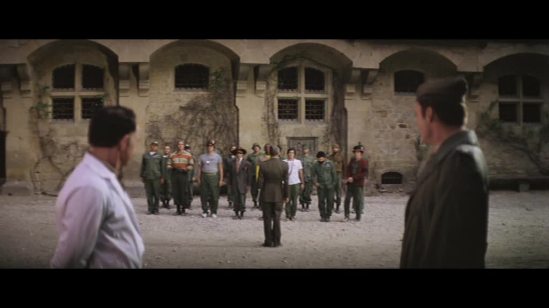
Gerry Fisher’s cinematography encompasses the Gothicism of the remote Germanic castle to where every ghastly statue and crypt-like stone comes alive like in a horror movie. The setting couldn’t be any of an antonym for a loony-bin set. Even though the film is suppose to be set in North West America, the location used was actually in Wierschem, Rhineland-Palatinate, Germany at the medieval Castle Eltz and the story subtly explains how the castle came to be in “America.” To the opposition of such a barbarically beautiful castle, the score by Barry De Vorzon (The Warriors) in the first act into the second is playful, lighthearted, and childish in an appropriate story tone, but turns quickly sinister and angry during progression, building upon the revealing climax.
vlcsnap-2016-04-22-22h09m58s160
Classic film and TV distributor Second Sight brings this cult classic onto DVD and Blu-ray in the UK. Since this was a screener copy of the DVD, I’m unable to provide any audio or video technical comments, but the screener did include the generous amount of bonus material including interviews with writer-director William Peter Blatty, and individual interviews with Stacy Keach, Tom Atkins and Stephen Powers, composer Barry De Vorzon, production designer William Malley and art director J. Dennis Washington. There are also deleted scenes and outtakes and a Mark Kermode introduction. A substantial release for Second Sight and a fine film for any collection so make sure you pick up or order this Second Sight release today!