

EVIL Rides Murderously on the “Highway to Hell” reviewed! (Visual Vengeance / Blu-ray)

“Highway to Hell” on Blu-ray from Visual Vengeance!

Prison escaped, serial killer Toby Gilmore treks across the Midwestern terrain killing innocent people to take what he needs to retain his freedom.  City photographer Fran Tucker travels to the countryside to visit her family.  When the two collide, Fran is taken hostage after Gilmore shoots a man down on a road rage whim and he keeps her alive because of his loneliness inside a jail cell for years.  As the bodies pile up on Gilmore’s path toward freedom, the keen photographer will use ever clever trick in her repertoire to get away from a maniacal, yet steely, murderer with no sympathy, no remorse.  Sheriff Earl Dent stopped Gilmore once before and regrets not finishing the killer off when he had the chance.  Now, Dent won’t make the same mistake twice as he’s hellbent on stopping Gilmore once and for all before anyone else falls victim to Gilmore deranged acts of violence. 
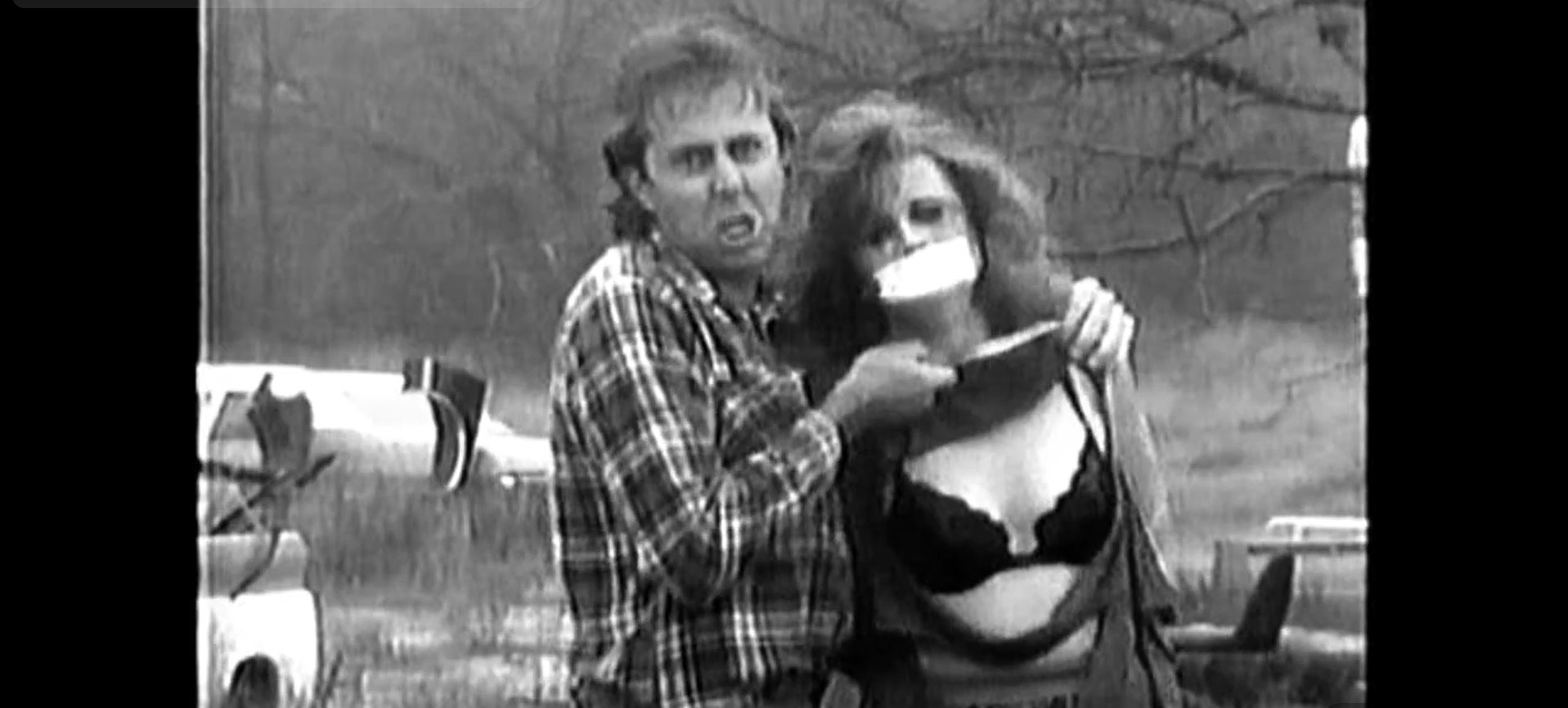
“The Abomination” and “Ozone:  The Attack of the Redneck Mutants” filmmaker Bret McCormick strays outside the supernatural confines of horror and into a different kind of terror with an escaped prison and serial killer on the loose, titled “Highway to Hell.”  McCormick helms the 1990 release thriller under the pseudonym of B.A. Jenkins with writer Gary Kennamer penning his debut screenplay.  The story was set on the same near by set locations as “The Abomination” and “Ozone:  The Attack of the Redneck Mutants,” such as in the Poolville, Texas area as well as Dallas, Texas.  If you’ve seen all three of McCormick’s films, you may recognize some of the locations in the same shot angle.  McCormick also produces the film but also in a pseudonym of Max Raven, a regular alias used the aforenoted productions.  Mars Film serves as the production studio for the low budget, regional thriller.
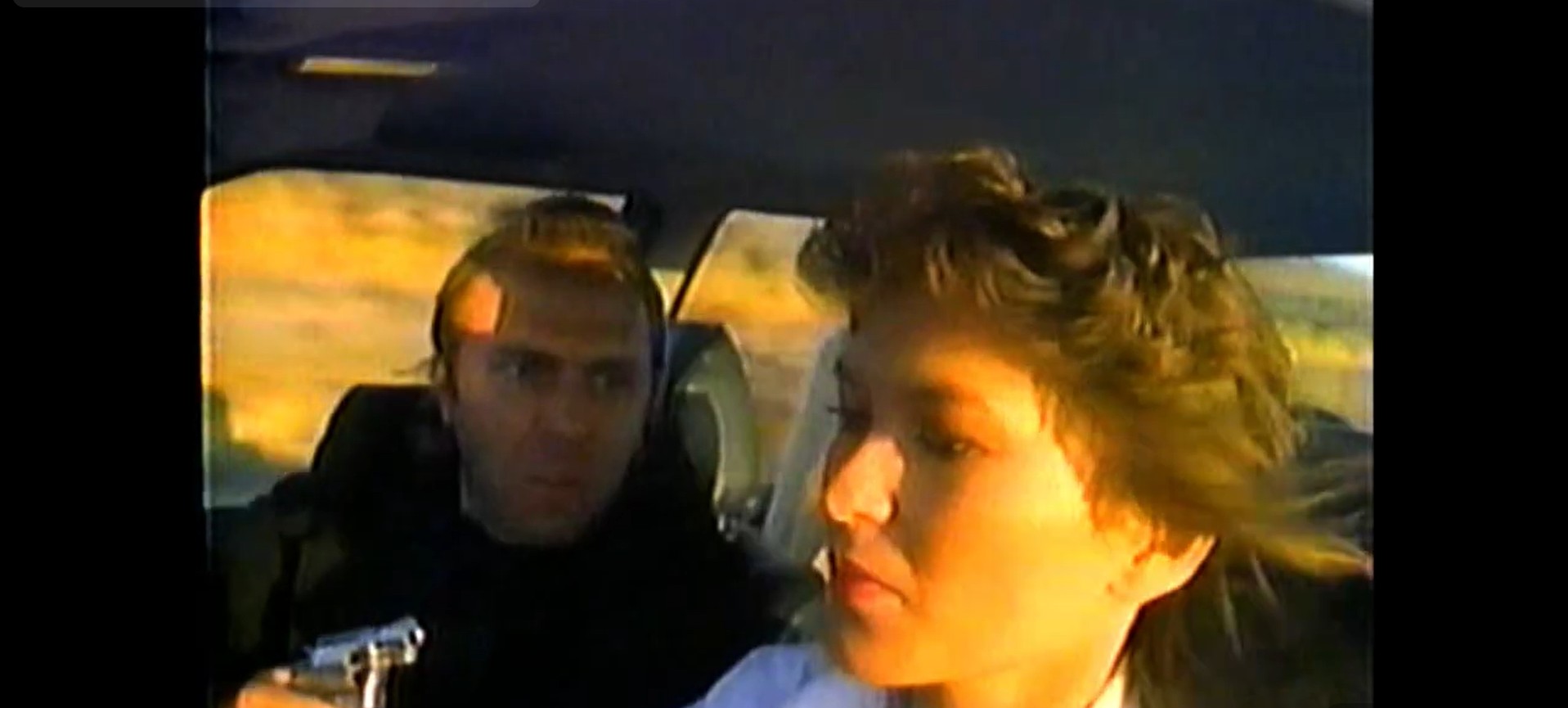
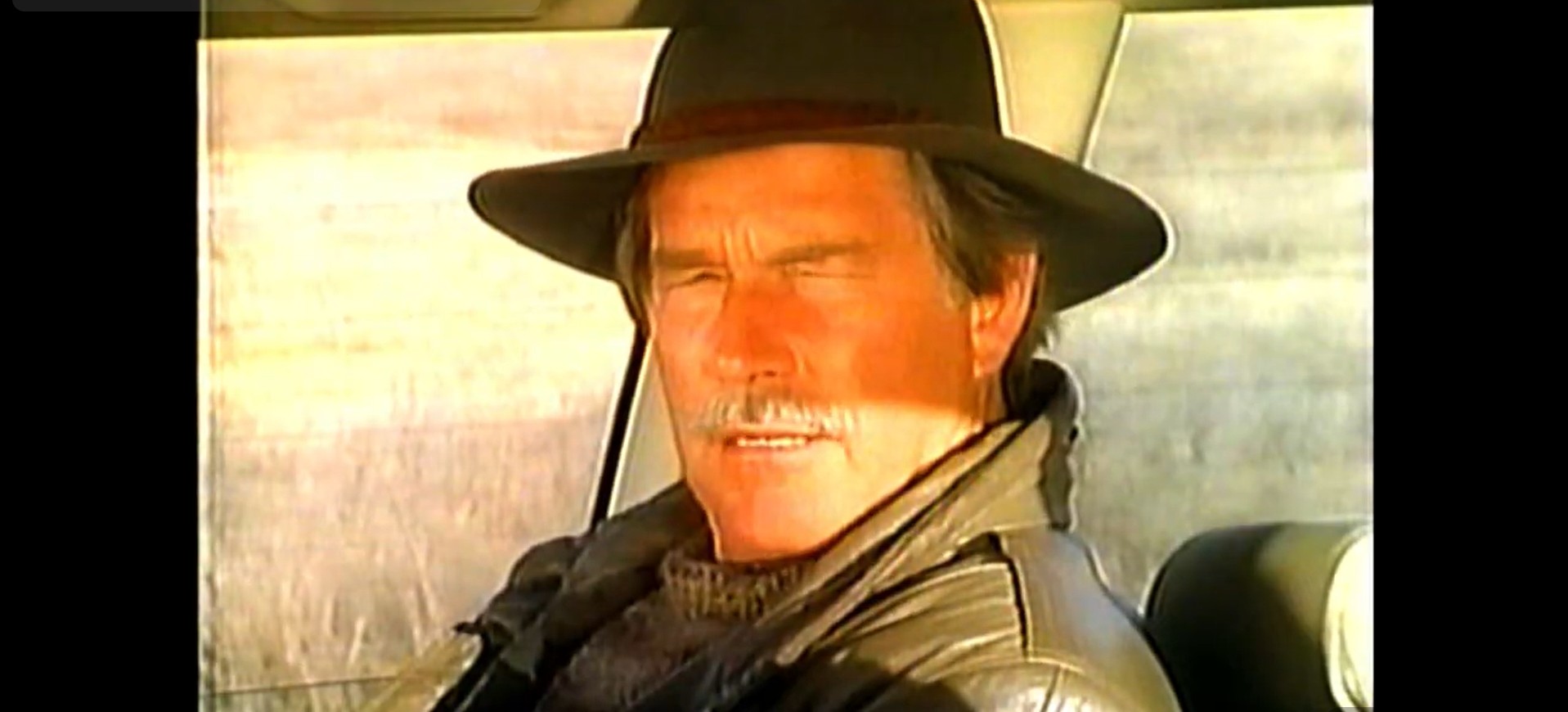
Aside from a large supporting cast of Gilmore whim fodder, a murder spree that’s shows no discrimination, “Highway to Hell’s” cast is chiefly three principal characters, all beginning with Toby Gilmore’s escape from prison involving using stolen jail keys, killing a guard, pilfering the guard’s gun, and absconding on foot through the western landscape.  “Reanimator Academy’s” Benton Jennings, who has since “Highway to Hell” has found success as working up through the minor roles of eclectic of projects, had free reign to mold serial killer Toby Gilmore and the result is a generously entertaining dose of controlled chaos as Gilmore quirks and tics as he runs across the parched Texas land provide insight to his mental mindset but Gilmore is no dummy when he’s calculating next steps with hostages that ultimately benefit his survival.  His guard corpse looted snub-nosed pistol becomes an extension of his madness as he uses it to takeout anyone who puts a pinky toe in his path.  Up against him, his main arch nemesis, is Sheriff Earl Dent, played by an American action star mostly notable for his roles in Italian cinema, such as “Ninja Commando” and “Orgasmo Nero” to name a couple plus with a major role in U.S. “Evil Spawn” with John Carradine.  Harris and Jennings share very little scenes together and the ones they do share are in flashback of Gilmore’s apprehension, one that the Sheriff regrets not putting a bullet in between the killer’s eyes instead.  The other Gilmore antagonist Fran Tucker, an unfortunate photographer on her way to see her family caught in the middle of Gilmore’s escape.  Blue Thompson (“The Abomination,” “Ozone:  The Attack of the Redneck Mutants”) provides Fran’s beauty that strikes Gilmore’s perverse chord after his long jail time stint, providing him the only reason to keep her alive, but Fran isn’t one to backdown and give up her life so easily as she is involuntary thrusted into a misadventure of carnage and death  with no one coming to save her. 
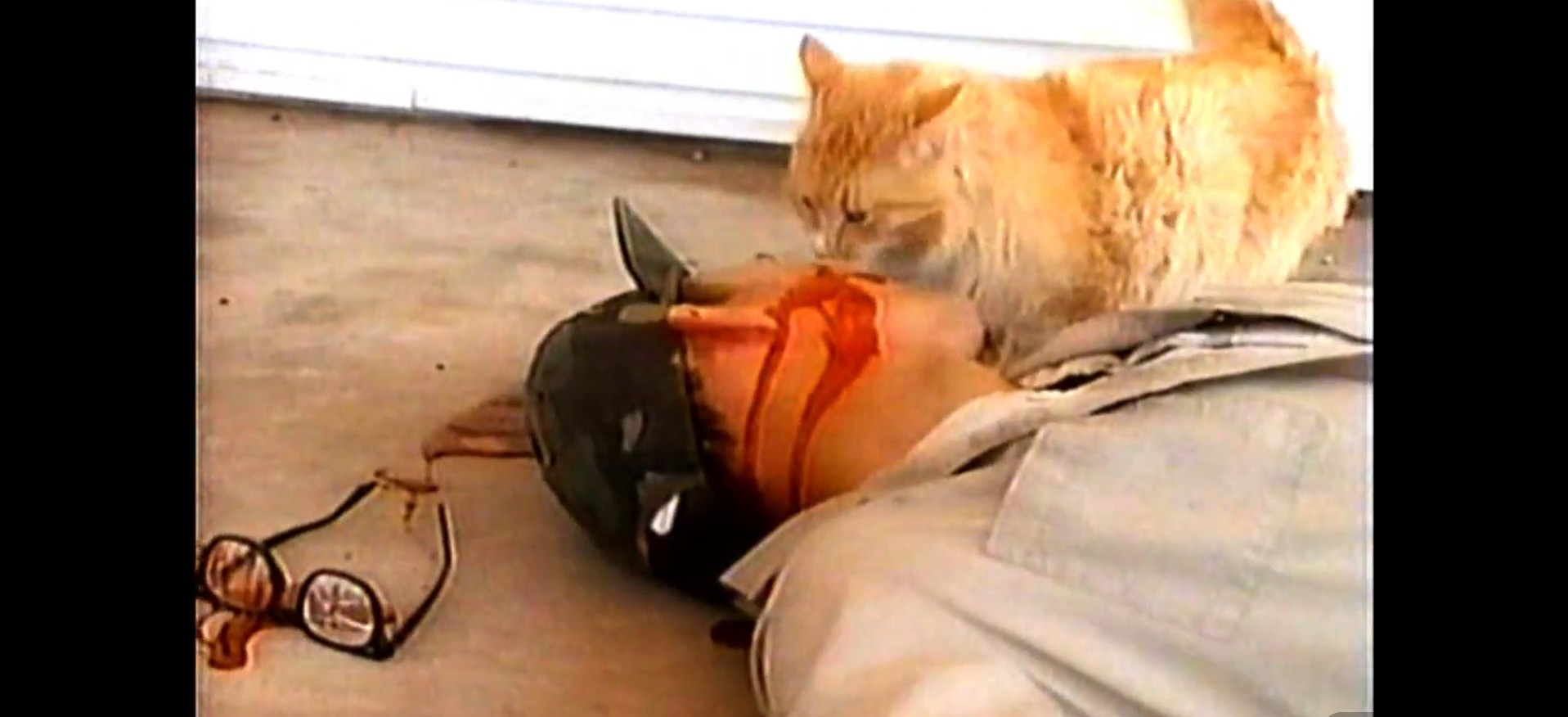
Anchor by Benton Jennings horridness and traversal storyline, “Highway to Hell” doesn’t become stagnant because of its independent and minute budget.  The editing, performances, locations, effects, and overall story are more coherent than not without mostly any confounding measure. There are a couple of plot holes that could have been addressed to sate the quizzical audience, such as how did Toby Gilmore end up with jailhouse keys?  Or how he was able to explode motor vehicles with one shot of his puny revolver handgun?  Gilmore must have been one crack shot.  Yet, the sensationalized key points and action add mystery and cult film nodes to McCormick’s ambitious westernized highway thriller that pits good versus bad, morality versus justice, and insanity versus sanity.  Crackerjack editing from Gregg Phillips and stylistic measures by McCormick salvage any misgivings about the budget or special effects in what is a competent and coherent, yet strangely fascinating, terrain and terror tensioner that has little representational or metaphorical value but high on entertaining merit. 
Visual Vengeance highlights another Bret McCormick Texas hoedown of horror and exploitation with “Highway to Hell” on a new Blu-ray transfer.  The AVC encoded, 1080p resolution, BD50 uses the original SOV tape master and what it lacks in saturation, as tapes usually do, makes up for in quality with a near flawless image quality for a magnetic tape.  Details are not terrible defined, typical of a tape, but there is great delineation and discernibility with all objects in screen.  As mentioned, hues are muted because of analog limitations and the inability to touchup the tape itself.  If a digital transfer was made, doesn’t look like much was done to touch up the color, and perhaps has purposefully retained its analog aesthetic, presented in a full frame 1.33:1 aspect ratio.  The LPCM stereo 2.0 English track offers a dual channel ranged output that has clean and clear dialogue with no issues of hissing, crackling, or any other vocal obstructions.  Overall truck lacks vigorous opportunity within the action context, such as gunshots and explosions, but, again, keeps with the original presented elements of a retro SOV exploitation.  Optional English subtitles are available.  Visual Vengeance delivers another jampacked Blu-ray full of special features that include an audio commentary by Bret McCormick, an interview with McCormick, interview with actor Richard Harrison Red Hot Asphalt, interview with Blue Thompson Road Trip, interview with screenwriter Gary Kennamer Writing a Road Map to Hell, interview with actor Tom Fegan, an image gallery, Gary Kennamer directed movie “Redneck County Fever” from 1992, Bret McCormick interview on Kennamer’s “Redneck County Fever” film, an interview with Kennamer on his movie, a commentary rack with McCormick and Kennamer on “Redneck County Fever,” Kennamer interview on his film, and other Visual Vengeance trailer previews.  Inside the Blu-ray, there’s a stick-your-own, retro VHS sticker sheet, a folded mini-poster with original art, and a reversible cover sheet with new art from Jolyon Yates as well as the original VHS artwork on the reverse side.  The Blu-ray comes in a clear Amaray case sheathed inside a limited-edition O-ring slipcover with more new illustrated artwork almost in a Ghana style fashion.  The 90-minute film is unrated and has region free playback. 

Last Rites: My personal favorite of the Bret McCormick catalogue, “Highway to Hell” is a SOV that’s simple yet effective with its western veneered thrills and a maniac making his will to ride-or-die freedom.

“Highway to Hell” on Blu-ray from Visual Vengeance!

No EVIL Gets Left Behind! “P.O.W. The Escape” reviewed! (Ronin Flix / Blu-ray)

“P.O.W. The Escape” on Blu-ray at Amazon.com!

Colonel James Cooper’s moto is no one gets left behind.  The seasoned P.O.W. extraction officer volunteers for a politically spearheaded suicide mission to save Vietcong American captives before a cease fire treaty ends the war, effectively turning the P.O.W.’s into M.I.A. and possibly never heard from again.  As the U.S. Airborne Colonel expected, the mission of rescue results in a complete fiasco of resources and being empty handed of prisoners as the enemy suspected an imminent attack.  Cooper becomes a P.O.W. alongside the men who set to rescue but that doesn’t deter the determined officer to plan his escape, but before detailing out a route out, the camp’s warden Captain Vinh has alternative plans for his prized captive in all of North Vietnam.  Vietcong headquarters wants to retrieve the Colonel in two days for public execution but Capt. Ving seeks a better life outside his country and accumulates the K.I.A. and P.O.W.s valuables plus in addition to stealing gold bars form his country in order to relocate him and his family to the U.S. but on his terms with a perilous journey across enemy lines with all the P.O.W.s in order for no one to get left behind.

The Carradine name is one of the most recognizable names in Hollywood with David Carradine the most famous, behind his father John Carradine, with his highly successful television series from the mid-70s, “Kung Fu.”  A part of “Kung Fu’s” success was due in part of the decade itself where kung fu films were a peak popular with rising star Bruce Lee.  A decade later and still in the shadow of that breakout series with a made-for-television movie, Carradine breaks into another rising type of films that trades in hip-throws and round house kicks for M1 assault rifles, Huey helicopters, and the jungles of the Vietnam war.  And coincidently enough, Vietnam actioners were made popular by another martial artist with “Missing in Action” starring Chuck Norris.  Carradine’s venture into the America’s shame frame being exploited for personal gain is P.O.W. The Escape, a rip-roaring and explosive do-or-die war caper from first time director Gideon Amir and penned, and re-penned, by Jeremy Lipp (“The Hitchhiker” TV series), James Bruner (“Invasion USA”), and “Deadly Sins” co-writers Malcolm Barbour and John Langley.  Also known as “Attack Force ‘Nam” and “Behind Enemy Lines,” the Philippines doubling Vietnam production is produced by Yoram Globus and Menahem Golan as a Globus-Golan Production.

The Late Carradine epitomizes stone-faced patriotism as the exfiltration expert Colonel Cooper.  Showing hardly any emotion except for a handful of scenes that call for it, or else Cooper would be a full-scale unempathetic sociopath, Carradine gives his best harden American warrior as well as an indestructible combat commando where a barrage of bullets whizz around him, explosions don’t impede his health, and an army of Vietcong are no match for the Colonel’s American flag draped, M60 machine strapped fighting spirt in an uphill battle of certain death.  Its farcically funny to behold but that was the traditional one-man-army paradigm back then and, to an extent, still is even today to give audiences as gung-ho and impossibly invincible hero.  Cooper leads a bunch of weary P.O.W. troopers on the brink of becoming lost in wartime politics and only three out of the bunch are highlighted throughout the misadventure toward safety with those roles’ boots on the ground by Steve James (“McBain”), as the order-following Sgt. Johnston, Phillip Brock (“American Ninja”) as wise-cracking know-it-all, good soldier Adams, and Charles Grant (“Witchcraft”) as the maverick Sparks who initially goes against Cooper’s plan.  Sparks is likely the most interesting and complex character with an internal conflict having set into his own path of escape dedicated on selfishness and greed only to feel the tremendous weight of guilt and burden of his fellow soldier while on the bed of a half-naked, North Vietnamese prostitute.  The last major principal is actually a Captain, that is Captain Vinh, played by one of the most recognizable faces in Japanese cinema history, Mako, of Arnold Schwarzenegger “Conan” fame as the Akiro the Wizard.  Understanding Vinh’s motivation hardly musters conclusively on why he wishes to defect his country and why he needed Colonel Cooper to accomplish it.  Perhaps Vinh’s undergoing hate for his own country was lost in the editing room as the film is noted to have gone through multiple re-writes, edits, and additional post-production shoots.  “P.O.W. the Escape” fills out the cast with Daniel Demorest, Tony Pierce, Steve Freedman, James Acheson, Ken Metcalfe, Ken Glover, Rudy Daniels, and Irma Alegre.

For Gideon Amir’s first picture, this Vietnam vehicle is an action-packed romp.  Never letting up on the accelerating peddle, especially with Cooper’s blank determination to get all the men out of the arm struggle before a treaty wraps up the conflict and leaves his charge in casted away in the arms of the enemy, what Amir accomplishes at the behest of his influential producers wonders how this high-value production ever made it past post without being a completely incomprehensible mess.  There lies choppy moments of editing that puts into question it’s original concept even if one isn’t aware of the film’s narrative conflictions.  What ensues is not a traditional rally and escape from a torturous, inhuman enemy camp that one can’t abscond from so easily; instead, the narrative becomes an escapade of itinerant provides various difficult scenarios that split up the group, sees internal turmoil, and propels desperation to get to the friendly Huey’s with their very lives, but doesn’t see Cooper come under threatening fire as he spurts off short rifles rounds and takes out a handful of Vietcong at once with one scene reminiscent on a particular World War II hero charging up hill and taking out a whole German squadron alone with a machine gun.  Audie Murphy, If remembering accurately, but instead of sustaining any projectile wounds, Cooper thrusts forward unscathed while those G.I.s he’s trying to recover and rescue perish in an inescapable firefight.  Carradine’s stoicism throughout the life profit and loss campaign doesn’t match Cooper’s liberation maxim that forces “P.O.W. the Escape” into an impassive, often times comical, attitude with the story’s central character.

Director Gideon Amir and David Carradine tempt their hand at the Vietnam vamoose now on a Hi-Def Blu-ray forged by Ronin Flix through way of Scorpion Releasing’s 2019 HD transfer of the previous MGM print.  The widescreen 1.78:1 aspect ratio presented feature fails to capture impeccable clarity of acme perfection with approx. half the frames wilted away with artefact de-escalation of details. Half the scenes look great with a semi-serious saturation of color, a few of facial and foliage details come out, and textures have tactile range at times, but the film’s glass is only half full within a darker dilution of speckled splotches. The English DTS-HD 2.0 master audio mix relays a fair enough dialogue consignment with comprehensible clarity and is utterly clean but lacks punchiness with a flat as a David Carradine’s poker-face facade. With a robust range of gunfire, explosions, and modes of transportation, especially going through the mucky and miry jungles of war-torn Vietnam, the film definitely needed a stronger suit of sound but was ultimately discharged without dullness. English subtitles are available. Special features include three on-camera interviews with Director Gideon Amir, screenwriter James Bruner, and stunt man Steve Lambert discussing their particular involvement in pre-and-principal shoots, some of the process woes, and how exotic the opportunity was to work internationally and with David Carrine. The film’s original trailer rounding out the special features block. Physically, the Ronin Flix release comes in a standard Blu-ray snapper with an action-packed and commandoed David Carradine blasting off his rifle like in a Ghana-esque illustrated movie poster. Inside, the lack of insert and reversible cover art leads our eyes straight to the disc art that’s the same as the cover, cropped down to fit in the circumference. Rated PG, that is rated 1986 PG with strong war violence, strong language, and nudity, the release is region A locked in playback and has a runtime of 86 minutes. A campy commando campaign capitalizing on the success of the Vietnam prison camp subgenre, “P.O.W. the Escape” could be much worse for wear as a solid action flick fierce in delivery yet fickle in substance.


“P.O.W. The Escape” on Blu-ray at Amazon.com!