EVIL Rides Murderously on the “Highway to Hell” reviewed! (Visual Vengeance / Blu-ray)

“Highway to Hell” on Blu-ray from Visual Vengeance!

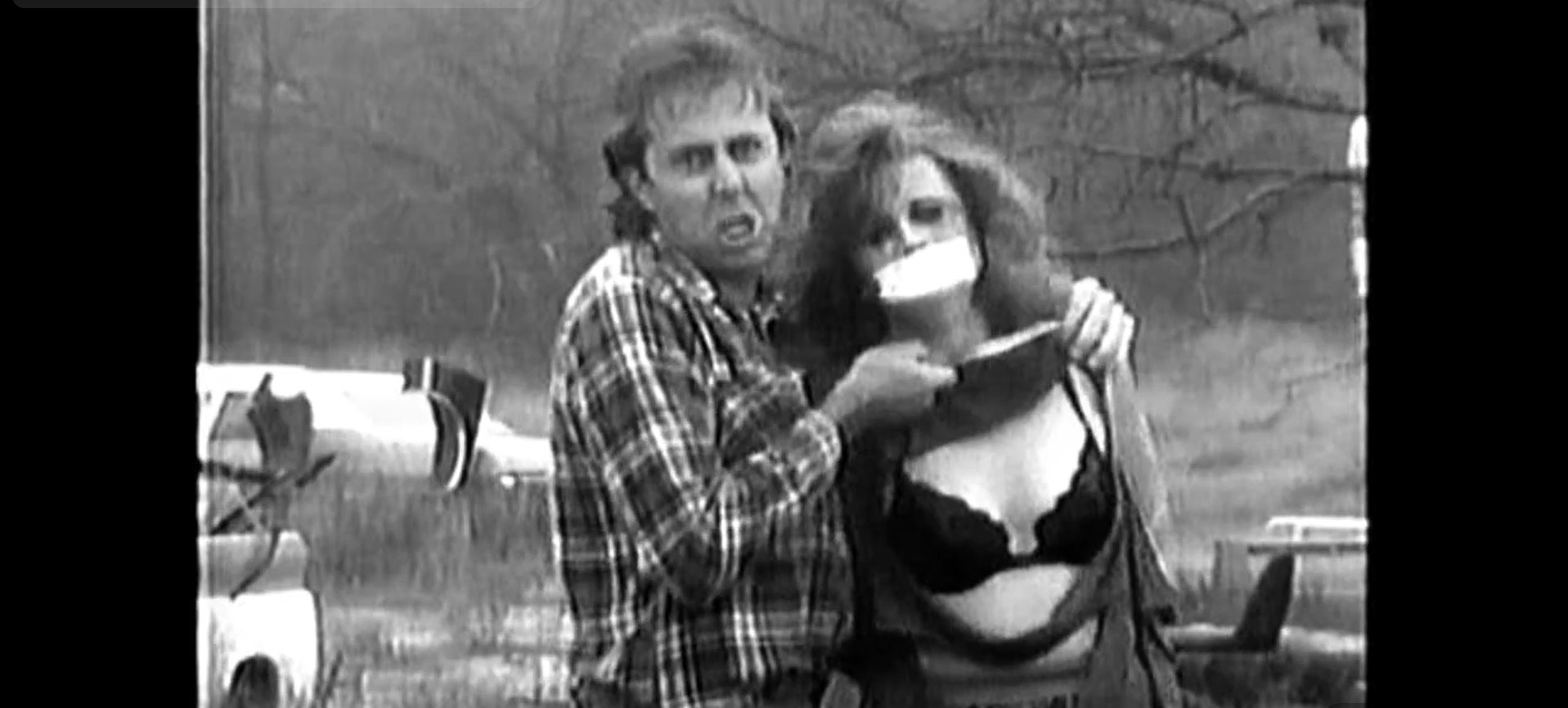
Prison escaped, serial killer Toby Gilmore treks across the Midwestern terrain killing innocent people to take what he needs to retain his freedom.  City photographer Fran Tucker travels to the countryside to visit her family.  When the two collide, Fran is taken hostage after Gilmore shoots a man down on a road rage whim and he keeps her alive because of his loneliness inside a jail cell for years.  As the bodies pile up on Gilmore’s path toward freedom, the keen photographer will use ever clever trick in her repertoire to get away from a maniacal, yet steely, murderer with no sympathy, no remorse.  Sheriff Earl Dent stopped Gilmore once before and regrets not finishing the killer off when he had the chance.  Now, Dent won’t make the same mistake twice as he’s hellbent on stopping Gilmore once and for all before anyone else falls victim to Gilmore deranged acts of violence. 
“The Abomination” and “Ozone:  The Attack of the Redneck Mutants” filmmaker Bret McCormick strays outside the supernatural confines of horror and into a different kind of terror with an escaped prison and serial killer on the loose, titled “Highway to Hell.”  McCormick helms the 1990 release thriller under the pseudonym of B.A. Jenkins with writer Gary Kennamer penning his debut screenplay.  The story was set on the same near by set locations as “The Abomination” and “Ozone:  The Attack of the Redneck Mutants,” such as in the Poolville, Texas area as well as Dallas, Texas.  If you’ve seen all three of McCormick’s films, you may recognize some of the locations in the same shot angle.  McCormick also produces the film but also in a pseudonym of Max Raven, a regular alias used the aforenoted productions.  Mars Film serves as the production studio for the low budget, regional thriller.
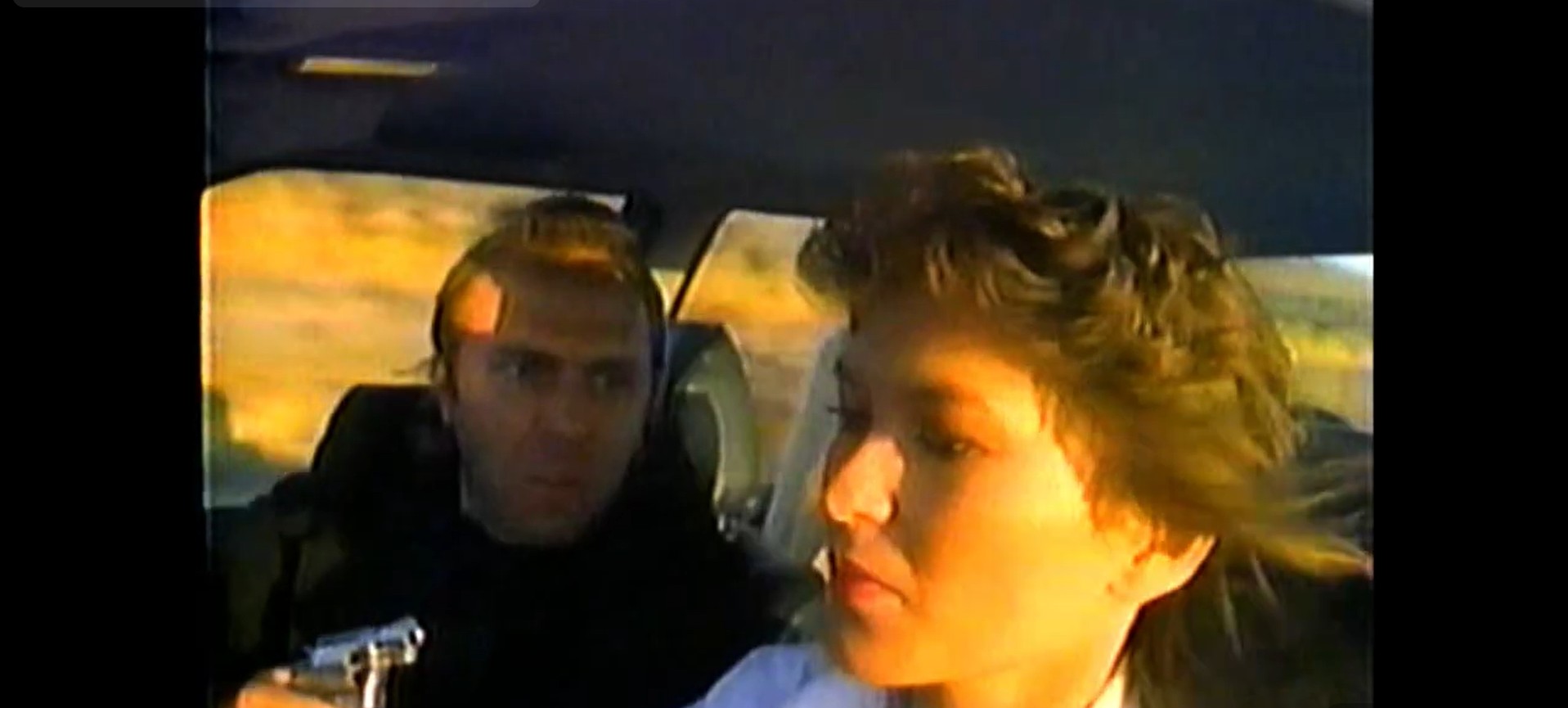
Aside from a large supporting cast of Gilmore whim fodder, a murder spree that’s shows no discrimination, “Highway to Hell’s” cast is chiefly three principal characters, all beginning with Toby Gilmore’s escape from prison involving using stolen jail keys, killing a guard, pilfering the guard’s gun, and absconding on foot through the western landscape.  “Reanimator Academy’s” Benton Jennings, who has since “Highway to Hell” has found success as working up through the minor roles of eclectic of projects, had free reign to mold serial killer Toby Gilmore and the result is a generously entertaining dose of controlled chaos as Gilmore quirks and tics as he runs across the parched Texas land provide insight to his mental mindset but Gilmore is no dummy when he’s calculating next steps with hostages that ultimately benefit his survival.  His guard corpse looted snub-nosed pistol becomes an extension of his madness as he uses it to takeout anyone who puts a pinky toe in his path.  Up against him, his main arch nemesis, is Sheriff Earl Dent, played by an American action star mostly notable for his roles in Italian cinema, such as “Ninja Commando” and “Orgasmo Nero” to name a couple plus with a major role in U.S. “Evil Spawn” with John Carradine.  Harris and Jennings share very little scenes together and the ones they do share are in flashback of Gilmore’s apprehension, one that the Sheriff regrets not putting a bullet in between the killer’s eyes instead.  The other Gilmore antagonist Fran Tucker, an unfortunate photographer on her way to see her family caught in the middle of Gilmore’s escape.  Blue Thompson (“The Abomination,” “Ozone:  The Attack of the Redneck Mutants”) provides Fran’s beauty that strikes Gilmore’s perverse chord after his long jail time stint, providing him the only reason to keep her alive, but Fran isn’t one to backdown and give up her life so easily as she is involuntary thrusted into a misadventure of carnage and death  with no one coming to save her. 
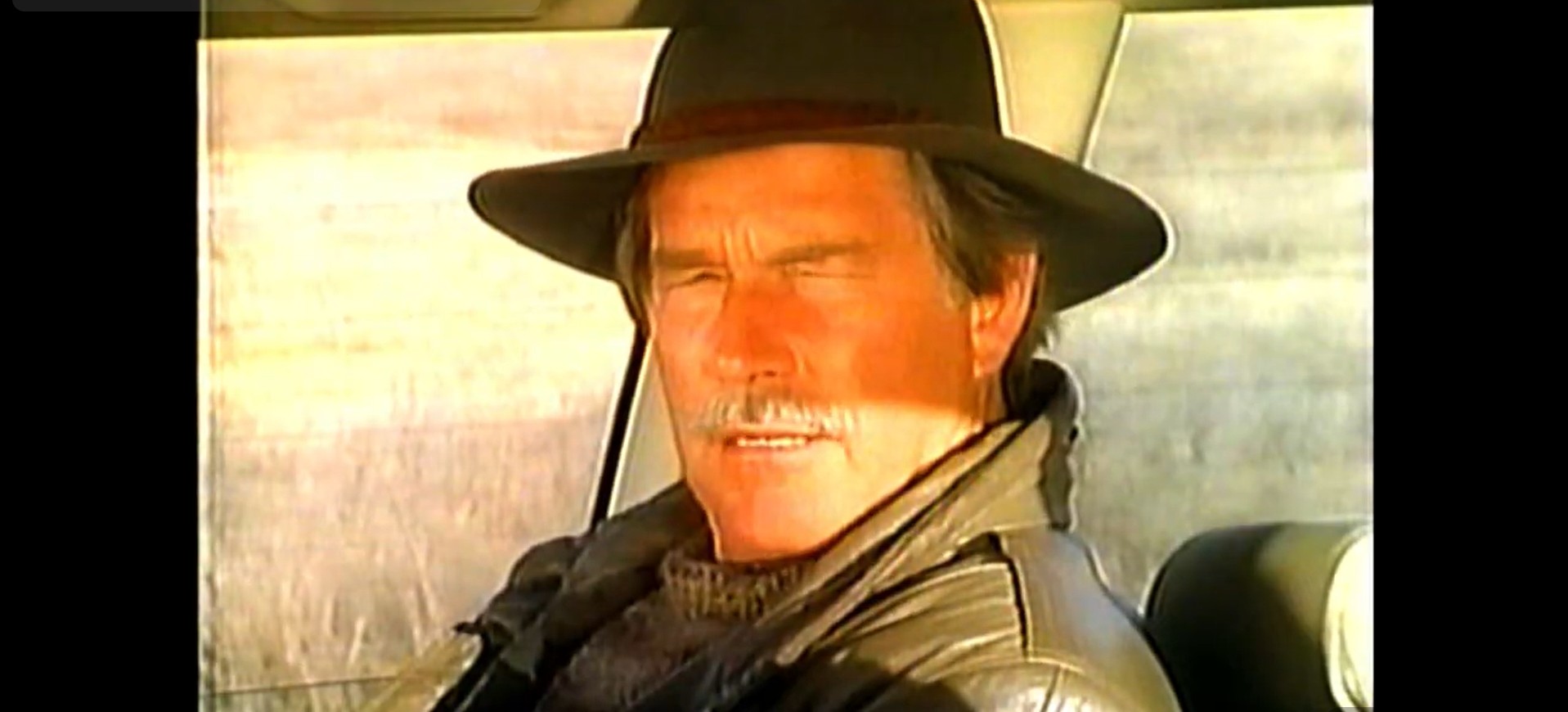
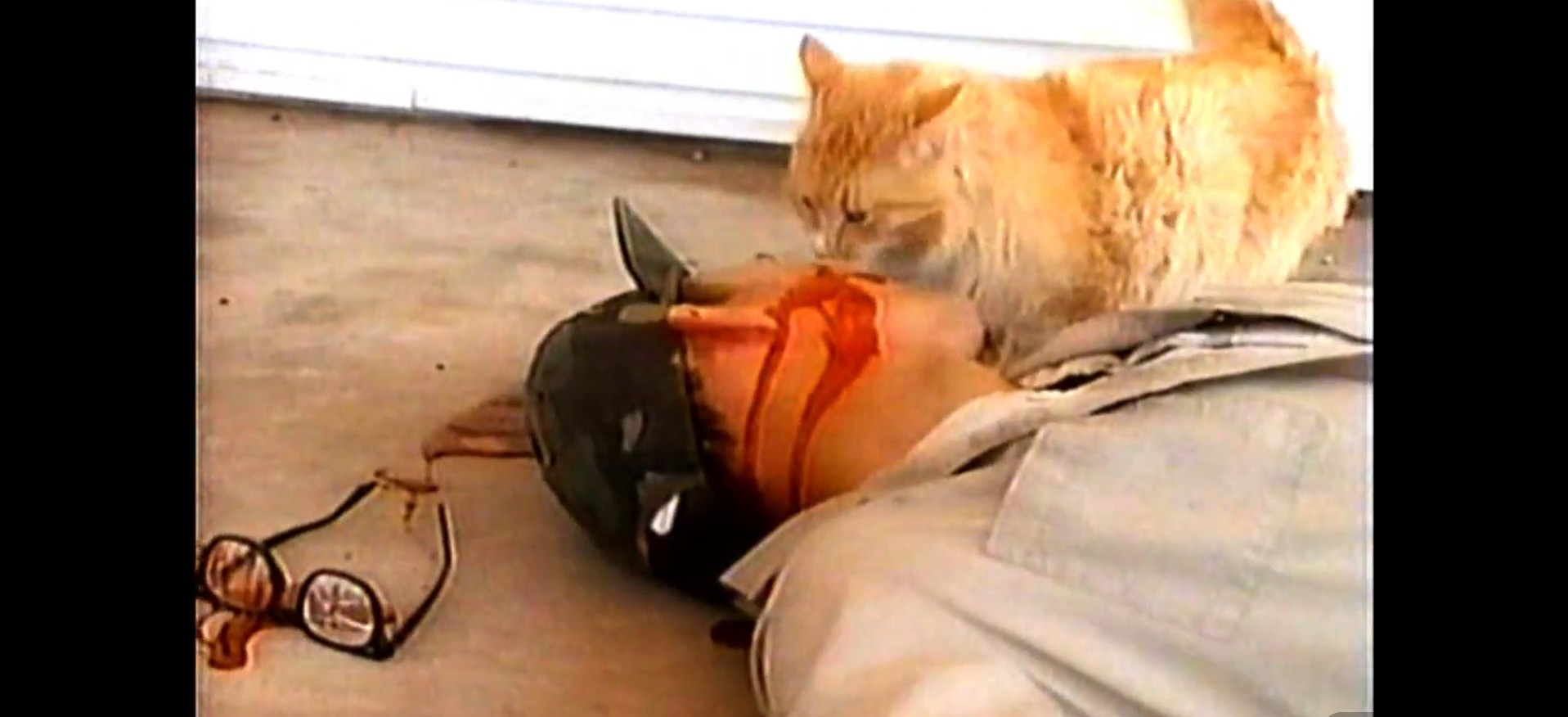
Anchor by Benton Jennings horridness and traversal storyline, “Highway to Hell” doesn’t become stagnant because of its independent and minute budget.  The editing, performances, locations, effects, and overall story are more coherent than not without mostly any confounding measure. There are a couple of plot holes that could have been addressed to sate the quizzical audience, such as how did Toby Gilmore end up with jailhouse keys?  Or how he was able to explode motor vehicles with one shot of his puny revolver handgun?  Gilmore must have been one crack shot.  Yet, the sensationalized key points and action add mystery and cult film nodes to McCormick’s ambitious westernized highway thriller that pits good versus bad, morality versus justice, and insanity versus sanity.  Crackerjack editing from Gregg Phillips and stylistic measures by McCormick salvage any misgivings about the budget or special effects in what is a competent and coherent, yet strangely fascinating, terrain and terror tensioner that has little representational or metaphorical value but high on entertaining merit. 
Visual Vengeance highlights another Bret McCormick Texas hoedown of horror and exploitation with “Highway to Hell” on a new Blu-ray transfer.  The AVC encoded, 1080p resolution, BD50 uses the original SOV tape master and what it lacks in saturation, as tapes usually do, makes up for in quality with a near flawless image quality for a magnetic tape.  Details are not terrible defined, typical of a tape, but there is great delineation and discernibility with all objects in screen.  As mentioned, hues are muted because of analog limitations and the inability to touchup the tape itself.  If a digital transfer was made, doesn’t look like much was done to touch up the color, and perhaps has purposefully retained its analog aesthetic, presented in a full frame 1.33:1 aspect ratio.  The LPCM stereo 2.0 English track offers a dual channel ranged output that has clean and clear dialogue with no issues of hissing, crackling, or any other vocal obstructions.  Overall truck lacks vigorous opportunity within the action context, such as gunshots and explosions, but, again, keeps with the original presented elements of a retro SOV exploitation.  Optional English subtitles are available.  Visual Vengeance delivers another jampacked Blu-ray full of special features that include an audio commentary by Bret McCormick, an interview with McCormick, interview with actor Richard Harrison Red Hot Asphalt, interview with Blue Thompson Road Trip, interview with screenwriter Gary Kennamer Writing a Road Map to Hell, interview with actor Tom Fegan, an image gallery, Gary Kennamer directed movie “Redneck County Fever” from 1992, Bret McCormick interview on Kennamer’s “Redneck County Fever” film, an interview with Kennamer on his movie, a commentary rack with McCormick and Kennamer on “Redneck County Fever,” Kennamer interview on his film, and other Visual Vengeance trailer previews.  Inside the Blu-ray, there’s a stick-your-own, retro VHS sticker sheet, a folded mini-poster with original art, and a reversible cover sheet with new art from Jolyon Yates as well as the original VHS artwork on the reverse side.  The Blu-ray comes in a clear Amaray case sheathed inside a limited-edition O-ring slipcover with more new illustrated artwork almost in a Ghana style fashion.  The 90-minute film is unrated and has region free playback. 

Last Rites: My personal favorite of the Bret McCormick catalogue, “Highway to Hell” is a SOV that’s simple yet effective with its western veneered thrills and a maniac making his will to ride-or-die freedom.

“Highway to Hell” on Blu-ray from Visual Vengeance!

Don’t Mess with Texas Unless You’re EVIL Going Up Against “Shanghai Joe” reviewed! (Cauldron Films / Blu-ray)

East Doesn’t Just Meet the West, It Kicks It’s Ass in “Shanghai Joe!”

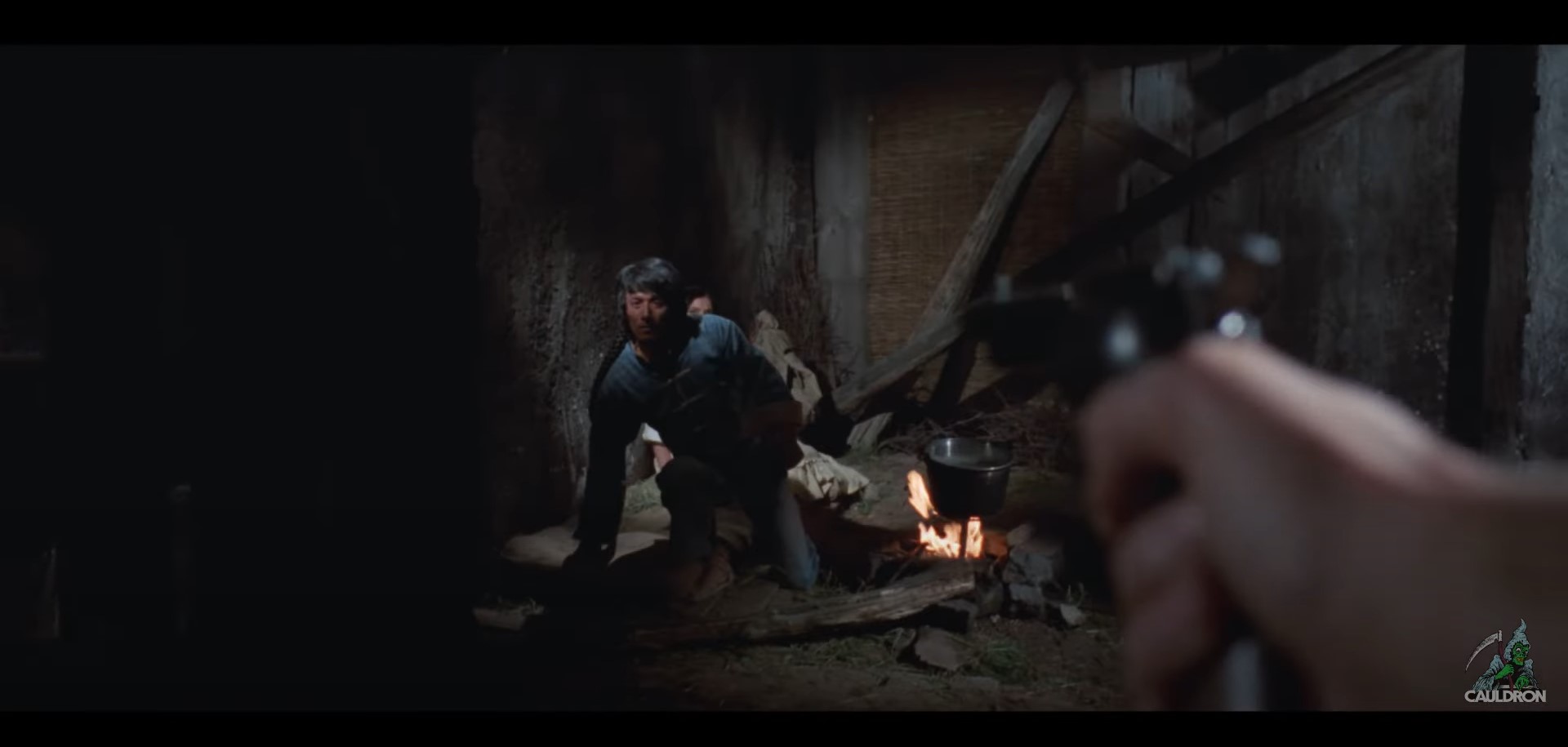
A Chinese immigrant arrives into San Francisco looking to begin a life as an American cowboy.  Met with extreme prejudice, he pushes forward to avoid the Western stereotypes of his race by taking a stagecoach to anywhere Texas in order to become a true-to-form Cowboy.  Mocking monikered Shanghai Joe, even in Texas Joe is met with bigoted resistance in every way and in every exchange with the locals despite his uncanny fighting, intellect, and horse-riding skills that are far superior to his meanspirited rivals who think of him nothing more than a dumb foreigner.  When Joe become inadvertently involved with human traffickers and slave owners of downtrodden Mexicans, Joe aims to set things right against an oppressive and murderous rancher named Spencer who runs the entire region.  Spencer knows his usual hired posse can’t match the supernatural abilities of Joe and hires out the $5,000 bounty to the four most cunning and ruthless killers that will seek Joe’s head as well as possibly commit other atrocities to him for the sole joy of it.

The sun rises on the dawn of the East Meeting the West with “Shanghai Joe” at the center   of subgenre.  The Italian made spaghetti western helmed by “Nightmare Castle” and “Nazi Love Camp 27” director Mario Caiano who exhibits what happens when an unstoppable force hits an immovable object as quick hands and feet of the Asian East combat with the quick gunslinging showdowns of the American West.  Penned by Caiano alongside Carlo Albert Alfieri (“Sodoma’s Ghost”) and Fabrizio Trifone Trecca, credited as T.F. Karter, “Il mio nome è Shangai Joe” or “The Fighting Fists of Shanghai Joe,” as the film is originally entitled in Italian, keeps true to the graphic and vehement violence that ultimately lacked from the U.S. Western and sought to bring a martial arts foreigner into the fold of brute and barbarity as Kung-Fu flicks were up-and-coming with the rise of Bruce Lee and the Italian wanted a piece of that cinematic success without having to spend a fortune of turning sets appear oriental when already built saloons, corals, and spittoons were a plentifully available from previous films.  Producers Renato Angiolini and Robert Bessi serve under the production companies Compagnia Cinematografica Champion (“Torso”) and C.B.A. Produttori e Distributori Associati (“Emergency Squad”).

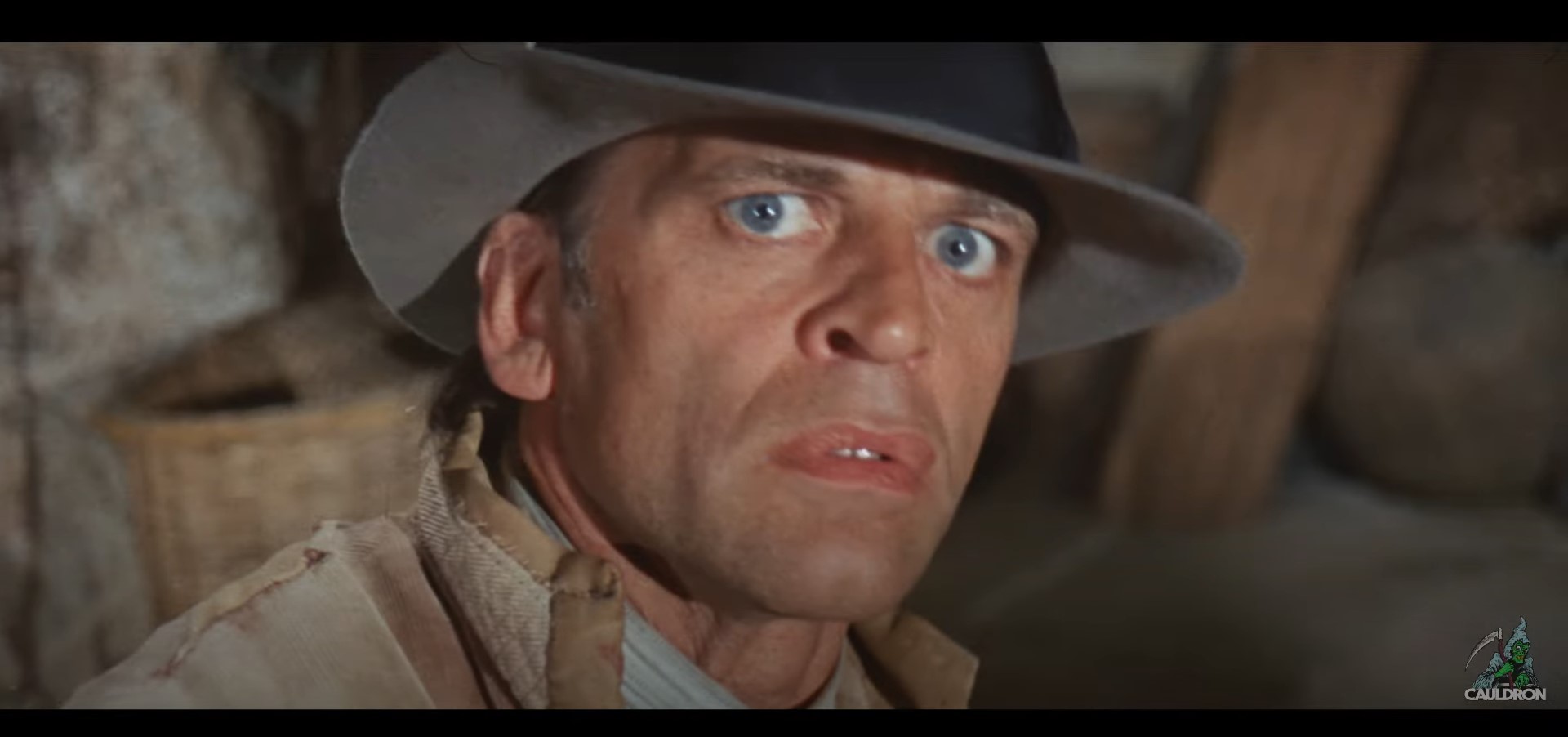
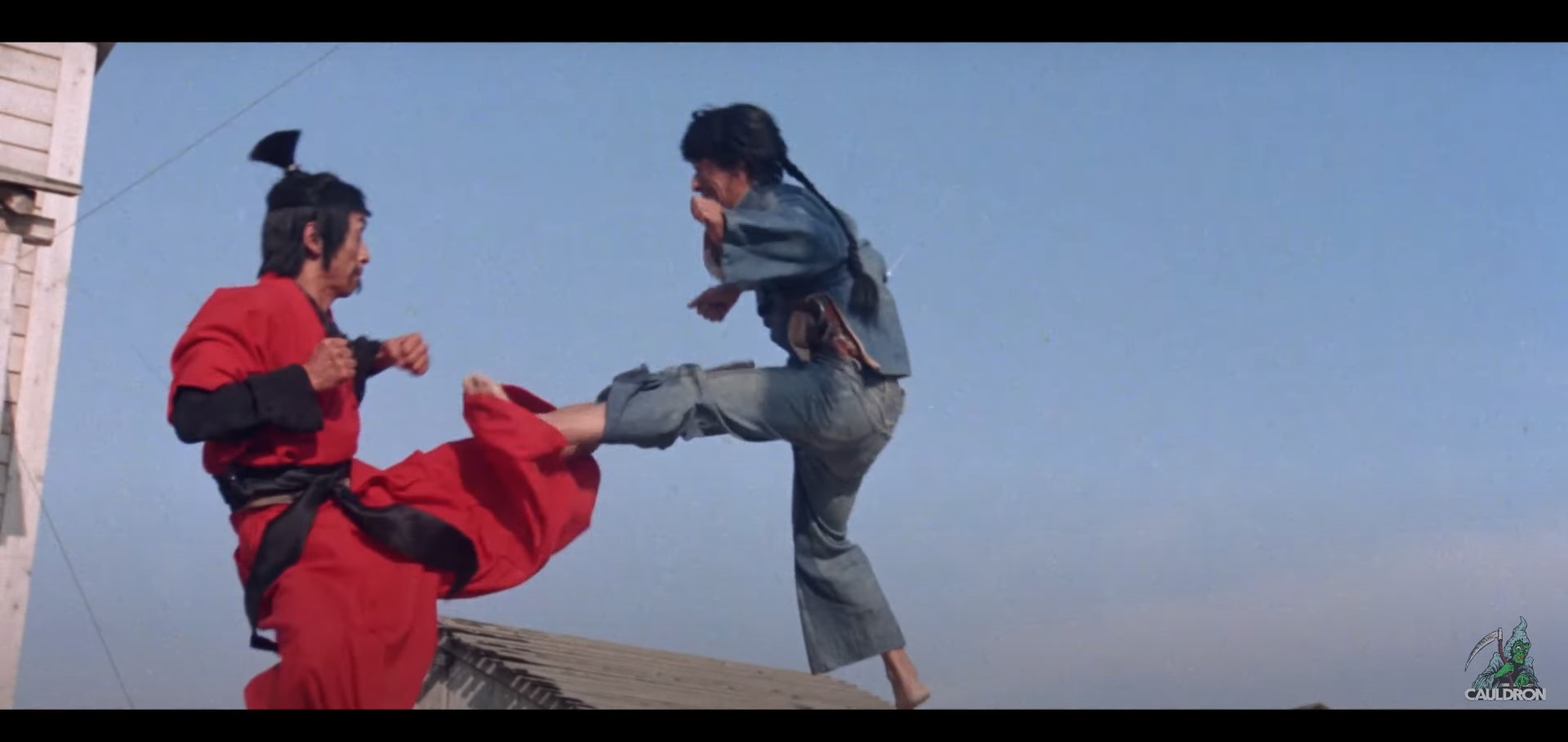
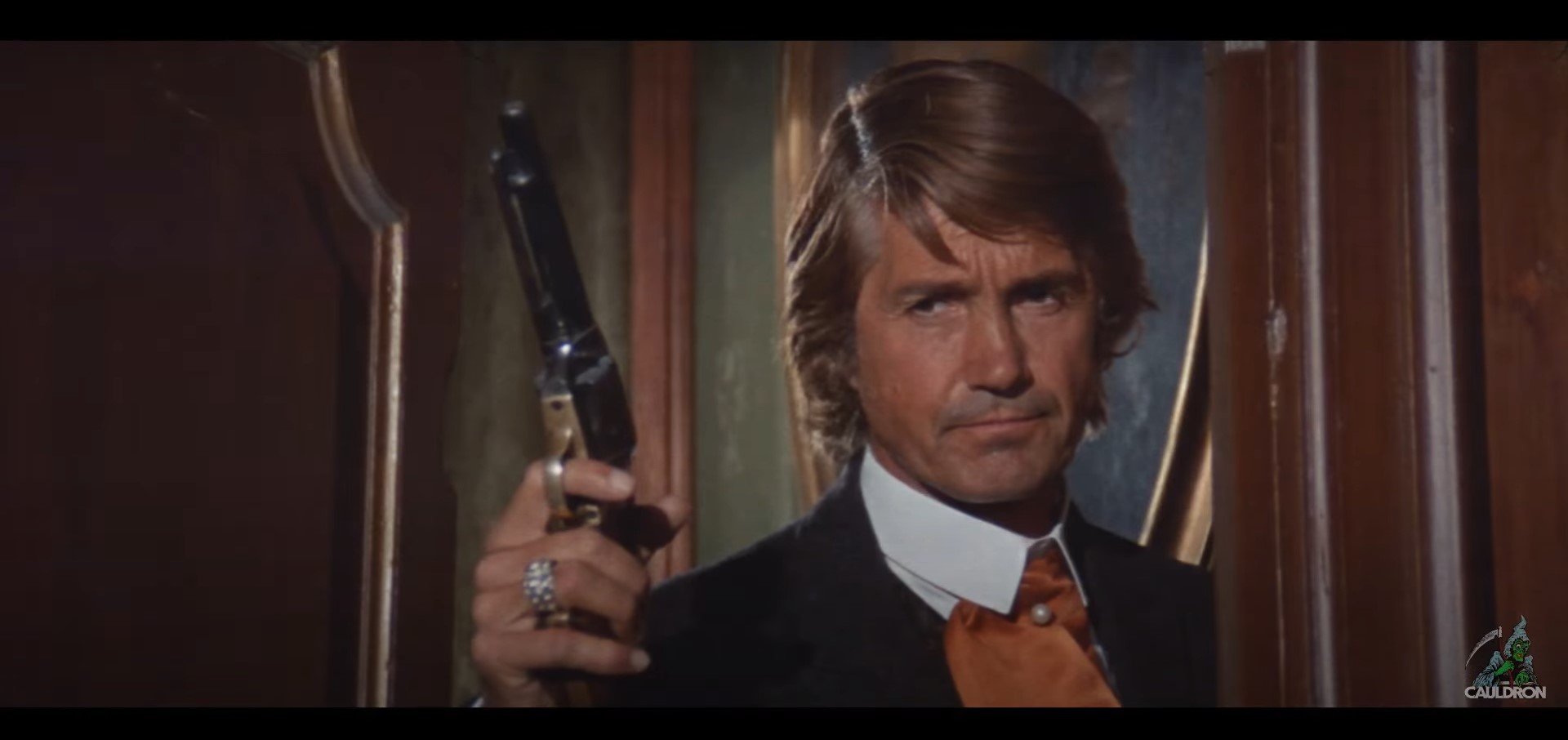
Leave it to the Italians to make a Western set in Texas and to have protagonist Chinese hero be played by a Japanese actor.  Performing under the stage name of Chen Lee, the Aichi, Japan born actor’s real name is Myoshin Hayakawa and he plays the role of Chin Hao, a nomadic Chinese immigrant, taught the rare fighting ways of an ancient martial arts, travels to America in hopes to reside in the American dream.  Lee’s certainly a presence on screen in his quiet and reserve composure but equally as self-assured and as competent to take on the worst-of-the-worst in the exploitative West where law has yet to reach it’s firm grasping hand.  Lee lands fight sequences with fierce finesse, though perhaps not on a Bruce Lee level, but does it so with his own distinct style of chopsocky flair with laws of physics breaking gliding through the air and tremendous accuracy in all areas of throwing weapons, even hyperbolizing his Yo-yo as a coconut splitting, head-cracking weapon.  When not wiggling his way out of impossible no-win situations with smarts and strength and when it comes to the interests of romantics, Chin comes to find solace being twisted into a paired fate with Mexican national Christina, played by Italian actress Carla Romanelli (“Lesbo”), after saving her father from being executed. As if destined to fall in love at first sight, the two outlanders are in each other’s embrace but before anything could be commutated by any sense of the term, head honcho rancher Mr. Spencer (Pierro Lulli, “Django Kill… If You Live, Shoot!”) hires out assassins to relieve him of a troublesome Shanghai Joe. The killers are just as colorful and individualizes as the titular character with quirky personalities and traits that make them indubitably daunting by their mere nicknames: Pedro, the Cannibal (Robert Hundar, “Cut-Throat Nine”), Burying Sam (Gordon Mitchell, “Evil Spawn”), Tricky the Gambler (Giacomo Rossi Stuart, “The Night Evelyn Came Out of Her Grave”), and Scalper Jack (Klaus Kinski, “Nosferatu the Vampyre). The eclectic bunch of Western-horror tropes level out Shanghai Joe’s uncanny abilities with their own big penchants for demise but the actors behind the characters also have bigger personalities, especially Kinski who is only in the film for a few scenes but is second billed in both before and after credits. “Shanghai Joe” fills out the cast with Dante Maggio, Andrea Aureli, George Wang, and another Japanese actor and martial arts master, Katsutoshi Mikuriya, as the showdown villain trained in the same ancient combat arts as Chin but turned his back against the teachings’ moral principles for his own greed.

Plot pointed by a series of bad case scenarios to showcase Shanghai Joe’s superior skillset as not only a fighter, but also an intelligent, almost con-like, mentalist as well as being good at just about everything else, the film is laced with repetitive derogatoriness from all races except white.  “Shanghai Joe’s” indelicacies, coupled with graphic, moderately bloodied violence, adds to the laundry list of idiosyncrasies of this unique old West spectacle.  The Caiano and team’s scripted narrative exacts the epitome of the label the Wild West where the unexplored, uncultured, and uncivilized country gives way to lawlessness and opportunity, especially the latter at the expense of others.  Joe becomes a beacon of moral hope, a foreigner who seeks, by way of a semi forced hand, to correct the system from within using his rare training only as a position of defensiveness or to right a terrible injustice.  Caiano has the eye to make a legitimate Italian spaghetti western that hits all the hallmarks and the director can also fashion a two-prong narrative with a unified purpose that builds up the hero first with a series of outlaw confrontations before immersing him into a rigorous roughhouse recruited by the rotten rancher.  While each face-off spars differently, Caiano letting the actors build upon and have fun in their villainy, the ultimately take the place of the tip of the spear antagonist, rancher Stanley Spencer, who doesn’t get what’s owed him by the roll of the end credits.  The high-flying combat wires, that you can plainly see during the air time fight sequences, and the personal and frame stylistic choices of the actors and Caiano tend to distract viewers from the unfinished business, concluding on a satisfactory note that what we just experienced was felicitously violent, engrossingly entertainable with appealing characters, and just waggish enough to provide levity amongst the harsh racism and the aforesaid brutality. 

“Shanghai Joe” is a must-have, must-see Italian Western for the subgenre aficionado and, luckily, Cauldron Films delivers the 1973 film onto Blu-ray for the first time ever in North America. The AVC encoded BD50 is presented in high definition, 1080p, with a widescreen aspect ratio of 2.35:1 of a 2K restoration scan from the original 35mm negative. Cauldron Films’ restoration is a labor of love for an atypical western of the obscure nature with a generous tactile intensification to bring the warm dust of the tumbleweed West down upon the anomalist Asian in a blue Tang suit and pants with a conical hat. A few and very faint scratches are the only issues observed that come and go as quickly as they came, but the there’s a nice richness to the coloring, a natural grain, and zero compression issues or unnecessary enhancements detected. The DTS-HD Master Audio 2.0 mono comes in two options – An English dub and an Italian dub. Preferably, I went with the English dub over the Italian despite “Shanghai Joe” being an Italian production. For one, Myoshin Hayakawa spoke English which you can tell by reading his lips so the English track paired better. Secondly, the Italian track is quite orotund to the point of losing some minor ambient detail as well as not feeling to be a part of the whole package team. Slight hissing at times during dialogued scenes but the clarity comes through with the decent dub pronunciations and the chopsocky ài yas are often repeated in the same audio tone and level in every evasive or attack flight by Joe but is not ostentatiously annoying. “Marquis de Sade Justine’s” Bruno Nicolai and his twangy score, channeling his best Ennio Morricone, has great purpose as “Shanghai Joe’s” main theme that rowels up and shapes Joe’s hero role. English and English SDH subtitles are available. The special features include an interview with Master Katsutoshi Mikuriya on how he was approached for the role and the martial artists also discusses the fight sequences in Samurai Spirit, film historian Eric Zaldivar puts together a visual essay with the topic East Meets West: Italian Style, an audio commentary by Mike Hauss from “The Spaghetti Western Digest,” the original trailer, and an image gallery. The physical portions of the release include a translucent Blu-ray snapper with a reversible cover art featuring two stylishly illustrative posters in contrast to the simple disc art of the red “Shanghai Joe” title set upon a black background. The early 70’s feature comes not rated, has a runtime of 98 minutes, and is region A locked. “Shanghai Joe’s” singularity scores high on the limited East meets West subgenre novelty but certainly aces as a versatile Kung-fu period piece with ridiculously good fight scenes, a handful of callously charming characters, and a disparaged hero, who embodies the good in all of us, you can gladly cheer for from beginning to end.

East Doesn’t Just Meet the West, It Kicks It’s Ass in “Shanghai Joe!”