
A Pact Plans EVIL Revenge on Crime Fighting Heroes! “Royal Warriors” reviewed! (88 Films / Blu-ray)

“Royal Warriors,” a Revenge Tale, Now on Blu-ray from 88 Films!

Hong Kong police inspector boards a Hong Kong bound plane on return from her vacationing in Japan.  She meets Michael Wong, the plane’s air marshal, as well as her across the aisle seat mate, Japanese native, Yamamoto, a retired cop returning to Hong Kong to retrieve his wife and daughter and retreat back to Japan to start their new life.  Also on the plane, an escorted criminal being extradited to Japan for prosecution.  When a criminal accomplice takes the plane at gunpoint, Michele, Michael, and Yamamoto spring into action and thwart an aero catastrophe with the two terrorists dead.  After celebrating their success of saving many lives, the heroic trio begin to depart their separate ways when suddenly Yamamoto’s car explodes with his wife and daughter inside.  The assassination attempt puts a target on the backs of all three of them as two war veterans swear vengeance for their slain combat brothers from the airplane hijacking.

“Royal Warriors,” also known in other parts of the world as “In the Line of Duty,” “Ultra Force,” and “Police Assassin,” is the 1986 Hong Kong police action-thriller from “Web of Deception” director and “Once Upon a Time in China” director of photography, David Chung.  Stephen Chow’s regular screenwriter Kan-Cheung Tsang, who penned Chow’s “Kung Fu Hustle” and “Shaolin Soccer,” as well as “Magic Cop” and “Intruder,” reteams with Chung on their sophomore collaboration following the comedic-crime film “It’s a Drink!  It’s a Bomb!” starring the Hong Kong humorist John Sham, and a denotes a shared three-way perspective of protagonist principals while simultaneously providing sympathetic seedlings for the principal antagonists who though are coming wrongdoings and murdering up a storm of people, a wartime conflict bond between them holds them a higher level of honor between close brothers in arms.  Dickson Poon and D&B Films produce the explosive and hard hitting with prejudice venture with John Sham (Remember him from earlier?) and Yiu-Ying Chan, serving as associate producer.

Michelle Yeoh plays Michelle Yip, the level-headed chopsocky cop returning from some rest and relaxation only to wind up on a dish best served cold “Royral Warriors” for Yeoh, who then under the less recognizable moniker Michelle Khan, is the risk-it-all action film for the actress still in the earlier days of her what would be a prolific international career.  Her breakout hit “Yes, Madam,” saw both Yeoh and also then newcomer Cynthia Rothrock punch and kick into silverscreen success as unlikely onscreen partners to take down a crime syndicate.  In the Yeoh’s next film, she rides solo but only in the actress category, being a third of the good guys, yet holding her own as a strong female, lead between another prolific Asian cinema actor Michael Wong (“Tiger Cage III,” “Dream Killer”) playing essentially himself as Michael Wong (not a typo), the plane air marshal turned love sick puppy for Hong Kong’s tough cop Michelle Yip, and yet another prolific Asian actor whose career in Japanese films started well before Yeoh and Wong and has been rising internationally amongst the ranks of American cinema in Hiroyuki Sanada (“Sunshine,” “Mortal Kombat”) playing retired officer Yamamoto, a revenge-seeking justifier on those responsible for killing his family.  The level of how these three come together in a post-incident instantaneous bond borders an idealistic way of an extreme shared experience.  Yeoh and Sanada offer a cool, collective approach with degrees of vindictive separation with a layer of compassion thinly in between with Wong providing calculated lighthearted measures of chasing Yip with infatuated eyes to break any kind of monotonous, stagnant composure between the other two, yet they’re seemingly different lives, connected ever so vaguely by being around law enforcement one way or another, doesn’t seem to thwart an instant relationship immediately after the plan incident.  What’s also odd, especially with Yamaoto, is there is more background to the villains of the story than there is with him, providing rewarding elements for reason why the two men are hunting down Yeoh, Wong, and Yamamoto and seeking deadly revenge.  Ying Bai, Wait Lam, Hing-Yin Kam, and Michael Chan Wait-Man are the pact-making, behind-enemy-lines soldiers of some unknown war from long ago who neither one of them will turn their back on a combat brother in need.  Through a series of none linear flashbacks, a union of honor between them is made and while respectable and moral during war, that pact turns rotten overtime outside the context of global conflict, suggesting ever-so-lightly toward a combat shock issue between the four men that builds a bit of sympathy for them even though blowing up a mother and child and shooting to shreds a whole lot of nightclub patrons in their misguided revenge runs ice through their veins.  Peter Yamamoto wears his sleeve on his shoulder and there is this uncertainty with his character, and his wife too, that something is amiss, creating a tension that goes unfounded and sticks out.  “Royal Warriors” rounds out the cast with Kenneth Tsang, Siu-Ming Lau, Jing Chen, Reiko Niwa and Eddie Maher.

As part of the In the Line of Duy series, a strict criterion needs to be met:  Police Action, check.  Martial Arts, check.  A Level of High Intensity, check.  And a Female Heroine, check.  “Royal Warriors” meets and exceeds the bar with another bar, a no holds bar, of spectacular stunt work done by the Hong Kong standard way of action now, think later which looks phenomenal on camera and the resulting footage.  Hoi Mang’s martial arts choreography showcases a fast-striking combinations that cut traditional sparring with melee improvisation dependent on the surroundings, moving the action left-to-right, top-to-bottom by never staying in the same place and expanding the field of play with collateral damage of bystanders and family.  A couple of components are missed between that focused innocence and whiplash of violence.  For example, the playfully amorous affections between two of the characters are not poignantly shattered like precious stained glass when one is suddenly offed.  There are other examples of once a downspin cataclysm occurs, the aftershock of loss and change does not rear its ugly head.  “Royal Warriors” just pushes forth, continuing pursuit, in a rage of retribution and righteousness. 
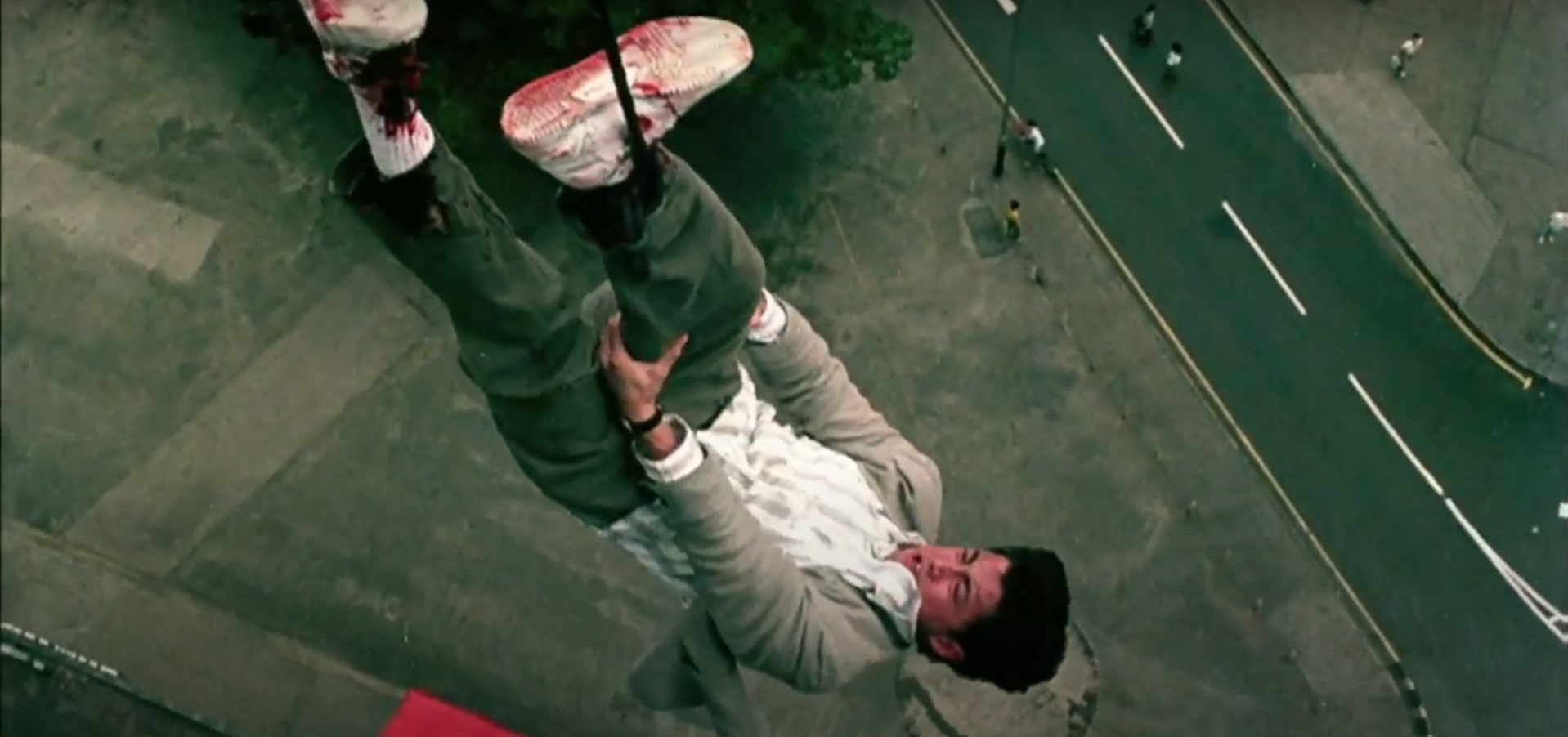
88 Films releases “Royal Warriors” onto an AVC encoded, 1080p high definition, BD50, presented in the film’s original widescreen aspect ratio of 1.85:1.  If you own the “In the Line of Duty” four film boxset, the version in the boxset contains the same transfer as this standalone, standard version that stuns with a new 2K restoration from the original 35mm print.  When I say this restoration stuns, I mean it.  A clean-cut natural gain, color balanced saturation, and with all the detail trimmings laud 88 Films’ work, as such as with the rest of their higher definition catalogue in the older Asian film market.  Range of atmospherics challenge with a different lighting scheme and mise-en-scene cinematography, such as the pink and purple warmth of a nightclub glow or the brilliantly lit restaurant ferry boat.  Skin and texture tones cater to a slight darker pastel but is consistent through-and-through without appearing to unnatural.  The restoration does have a positive to a fault, revealing stunt equipment during the fast-paced fighting, such as the exterior stone ground turning bouncy with creases when Yeoh vault kicks one of the Japanese yakuza members to the ground.  The release comes with four, count’em four, audio tracks:  a Cantonese DTS-HD 2.0 mono theatrical mix, a Cantonese DTS-HD 2.0 alternate mix, an English dub DTS-HD 2.0, and an English dub DTS-HD 5.1.  Of course, I go with the theatrical mix to comply with the original fidelity as much as possible with any films using ADR for an immersive experience within the original, intended language.  the 2.0 mix keeps a midlevel management of the voluminous aspects to bombastic range but never muddles or mutes the tracks.  Dialogue comes out clear with a microscopic static lingering way deep in the sublayer but, again, has negligible effect on the mix.  Special features content includes an audio commentary by Hong Kong film expert Frank Djeng, missing airplane inserts which are spliced out shots of an inflight plane exterior, and the Cantonese and English trailers.  The standard edition comes pretty standard but does feature the new character compilation artwork of Sean Longmore on the front cover with the reversible sleeve featuring the original Hong Kong poster.  The disc is individually pressed with Michelle Yeoh doing what she does best in most of her films, kick butt.  There are no inserts or other tangible bonus content.  88 Films’ North American release comes with a region A encoded playback, not rated, and has a runtime of 96 minutes.

Last Rites: 88 Films’ “Royal Warriors” Blu-ray release captures Hong Kong cinema impeccably with monumental stunts, hard-boiled police work, and permeates with color, detail, and a cleanly, discernible audio mix. In the Line of Duty, “Royal Warriors” is the first, and foremost, cop crusading caper that began it all.

“Royal Warriors,” a Revenge Tale, Now on Blu-ray from 88 Films!

Romance and Chinese Boxing Don’t Equal EVIL and That’s Okay! “Gorgeous” reviewed! (88 Films / Blu-ray)

Fall in Love with “Gorgeous” on Blu-ray at Amazon.com!

Bu believes in true love.  The young Taiwanese girl, with immense positivity, travels from her small fishing village of Jibei to the big city of Hong Kong after discovering a bottle containing a romantic note floating in the sea.  When Bu is let down by the originating sender, a gay makeup artist in an attempt to use fate and fortune to bring back an ex-lover, she strikes up a friendship with him which leads to a wealthy business owner and Chinese boxing enthusiast C.N. Chan who serendipitously comes into her life.  With a well-known reputation of being a rake, Bu pretends to be a prominent ex-lover of a notorious crime boss in order to not be taken advantage of as she slowly falls for Chan’s playful charm.  A longtime rival businessman causes conflict by driving a wedge between Bu and Chan as fight training intensifies after losing to his rival’s hired professional fighter and Chan loses sight of what’s really important in life – happiness.  

International martial artists superstar Jackie Chan makes his debut on our little boutique review blog for his Hong Kong cult film, the 1999 romantic comedy with stellar fight sequences, “Gorgeous.”  “Forbidden City Cop” writer-director Vincent Kok teams up with Yiu Fai Lo and the “Rush Hour” star to pen a new kind of story for the stuntman and martial artists that would put a roundhouse kick of insecurities onto any action star’s chin.  Based on the Ivy Ho (“The Accidental Spy”) story, “Gorgeous” involves more than just punches, kicks, and high-flying antics with a comedy romance story about two very different people and perspectives finding commonality in unflinching happiness, joy, and love.  Jackie Chan does comedy very well but the comedy in “Gorgeous” is half non-physical, which the action star has mastered the craft by integrating into his physical model.  “Gorgeous” is a production of Golden Harvest Productions and is produced by Jackie Chan and then Golden Harvest president the late Raymond Chow.

Obviously, you can’t have a Jackie Chan movie without high-level martial arts action.  In the same breath, Jackie Chan wanted to give his Asian fans another movie after the tremendous success of “Rush Hour” that sent the longtime East-adored icon into global stardom.  Thus, “Gorgeous” was born, developed, and rewritten to add Jackie Chan as the lead character, playboy and business tycoon C.N. Chan, alongside costar Shu Qi of “Sex and Zen II” and “The Transporter” with Jason Statham.  As Bu, Qi develops a starry-eyed longing for unequivocal romance that you can only find in fairytales and storybooks as she is confronted by the puppy dog eyes of the local fishing boy proclaiming his love for her only to be rejected by Qi’s downplayed naivety that makes her appear to be the village simpleton.   Yet, the character is surrounded by a carefree comedic mom-and-dad of beer-drinking restaurant owners, Sung-Young Chen (“Hello Dracula”) and Elaine Jin (“The House That Never Dies”).  As a flirtatious couple of Bu’s hopeless romanticism driven by the signs and kismet and Chan’s all-business, no-play waning for a girl to be childlike to bring out the dormant happiness inside him, Jackie Chan and Shu Qi manage to never close that gap to fully immerse themselves as onscreen love interests in their 80’s structured amorous narrative and go get’em montage.   Where “Gorgeous” charisma lies is with Chan’s mano-on-mano dual with Jackie Chan’s hired member of his stuntman team, Brad Allan.  The former Australian gymnast and Chinese circus acrobat has a towering magnetism about him despite only standing 5’4” tall, shorter than Jackie Chan.  The fight sequences between the two nimble men with incredible speed and form, mirror each other with precision in their own individual styles, garner some the best one-on-one choreographed bouts ever to hit the screen and to be felt by the audiences with hard-hitting throws.  While the impact of the Chinese boxing is palpable, Chan and Allen pepper in lighter moments of great physical comedy that take the intensity down a notch in a welcoming reprieve from solemn combat.  That solemnity in Allen’s character is greatly received and adds to his magnetic appeal that doesn’t make the mercenary fighter a bad guy though hired by the antagonist (Emil Chau, “Super Cop 2”) of the story; instead, Allen’s fair without pulling punches and without dirty tricks, as he mentions to Chan to avoid, and we end up rooting for both men’s dignified square up being battled not in a square ring.  Tony Leung Chiu-wai (“Internal Affairs”), Ken Lo (“Holy Virgin vs. The Evil Dead”), Tats Lau (“Dating Death”), Richie Jen (“Tales from the Occult”), Siu Wai Cheung, and “Kung Fu Hustle’s” Stephen Chow costar.

While “Gorgeous” may not be evil in the least for our conversational liking and our in-depth coverage with its abundance of lighthearted goodness, romanticized ideals, and slapstick comedy, the turn of a century film has cult qualities with shoddy 90’s effects, intricate fight choreographies, and eclectic, eccentric performances that make the Hong Kong-Taiwan product standup and standout to be noticed.  The fight sequences alone swallow much of the attention and overwhelm a rather flimsy passionate plotline between C.N. Chan and Bu in what stirs between feels more platonic than desire.  “Gorgeous” attempts, and succeeds to a version of a successful end, a theme about positivity and happiness and how that brightness can be diminished by deceits, workaholism, and distracting contentions, sucking the joy from out of life and spitting out a solitude bitterness without any kind of understanding of how it all happened.  We see this more in the dynamics of business rivals Chan and L.W. Lo, two childhood friends driven apart by their subjective comparisons as they try to top one another, culminating from their back-and-forth to see who is the best at everything into the realization that their bond was ultimately worth more than success at material things.  This enriching theme, plus Jackie Chan’s stunt team work, pushes asides the infatuation glop of Chan and Bu’s playful childlike intimacy that just seems to slip through your fingers, unable grasp traction to be interesting enough.

“Gorgeous” receives an 88 Films’ 2K overhaul with a Blu-ray upgrade from the original film materials of the Hong Kong & International versions of the film, delivering two cuts in high definition 1080p and presented in an anamorphic widescreen 2.35:1 aspect ratio.  The AVC encoded BD50 offers plenty of room for “Gorgeous” to look, well, gorgeous on hi-def with a vibrant, spotless transfer of the 35mm shot print.   Coloring is consistently stable and rejuvenated for a fresh picture image; no one-off blips or glitches on the grading in sight on this very azure and teal toned production.  Despite holding two features and a handful of extras, the dual-layered single disc offers no hint of compression issues, creating a smooth beginning to end viewing.  The Hong Kong cut comes with a Cantonese DTS-HD 5.1 MA while the International Cut comes with the same as well as an English DTS-HD 5.1 dub track.  For authenticity purposes, the original native language is always the preferred choice and the Cantonese track on the HK cut simply shines with an orotund dialogue track, robust milieu and ambience, and a blended bubbly and businesslike score whenever the mood hits by Dan-yee Wong.  Balanced and kept in the check, neither track overtakes the other with a timely parallel consonance.  The newly translated English subtitles are paced well with error-free transcription.  Special features include Shy Guy – Andy Cheng, a member of Jackie Chan’s stunt team, discusses the rise of Brad Allen as well as note on the stunt team in general and Jackie Chan’s success at the time of “Gorgeous,” an interview with director Vincent Kok on Chan’s unfamiliar territory into romantic comedies, an archived making-of “Gorgeous” with raw and behind-the-scenes footage and interviews, “Gorgeous” music video in Cantonese and Mandarin, and the Hong Kong and International trailers.  The limited edition slipcover feature is a cardboard o-slip with illustrative art from 88 Films graphic artist Sean Longmore overtop a 2 to 3 millimeter thicker Blu-ray snapper to house the 32-page color booklet with daily set report of “The Accidental Spy” by writer Matthew Edwards and behind the-scene photos, a dual-sided mini-poster of Longmore’s slipcover art and the original poster one-sheet, a disc pressed with the image of Shu Qi smiling, and reversible cover art with the original poster one-sheet and a couple of “Gorgeous” stills joined together on one half.  Each cut is drastically different in length with the international cut heavily trimmed at 99 minutes while the HK cut keeps unedited at 2 hours.  Both features are not rated and are both have a region A and B playback with C untested.  Jackie Chan has always been a pillar of entertainment and “Gorgeous” is no exception to the rule.  88 Films refreshes the now 24-year-old film with a new, exciting transfer and physical package that commits one of the best fights in cinematic history to hi-def.

Fall in Love with “Gorgeous” on Blu-ray at Amazon.com!