Under an Urban Club Scene, EVIL Horrors Connect Us All. “Flesh City” reviewed! (Wild Eye Releasing / DVD)

“Flesh City” Yearns for Connection on DVD!

An insomnious city pulsates with an industrial soundtrack and claws cantankerously at denizens without pity. Under one of the raging night club scenes, enamored raver Vyren follows the beautifully alluring Loquette, an inspiring electronic DJ, down into the club’s labyrinth of old stone corridors. Their coquettish play becomes the monitored study of Professor Yagov, a glowingly cadent and mad experimenter of anthropology. The two lovers are drugged and abducted by the Yogav with the intent of genetic mutating the couple’s anatomy that renders Vyren’s hand displaced with a bulbous nub and Loquette impregnated with an ingestible sludge. What becomes of their affliction insidiously infects the entire city population with a flesh tentacle curling through the city’s underground sewer and drainpipe infrastructure in what amasses to a single connection of brain-invading techno-horror.
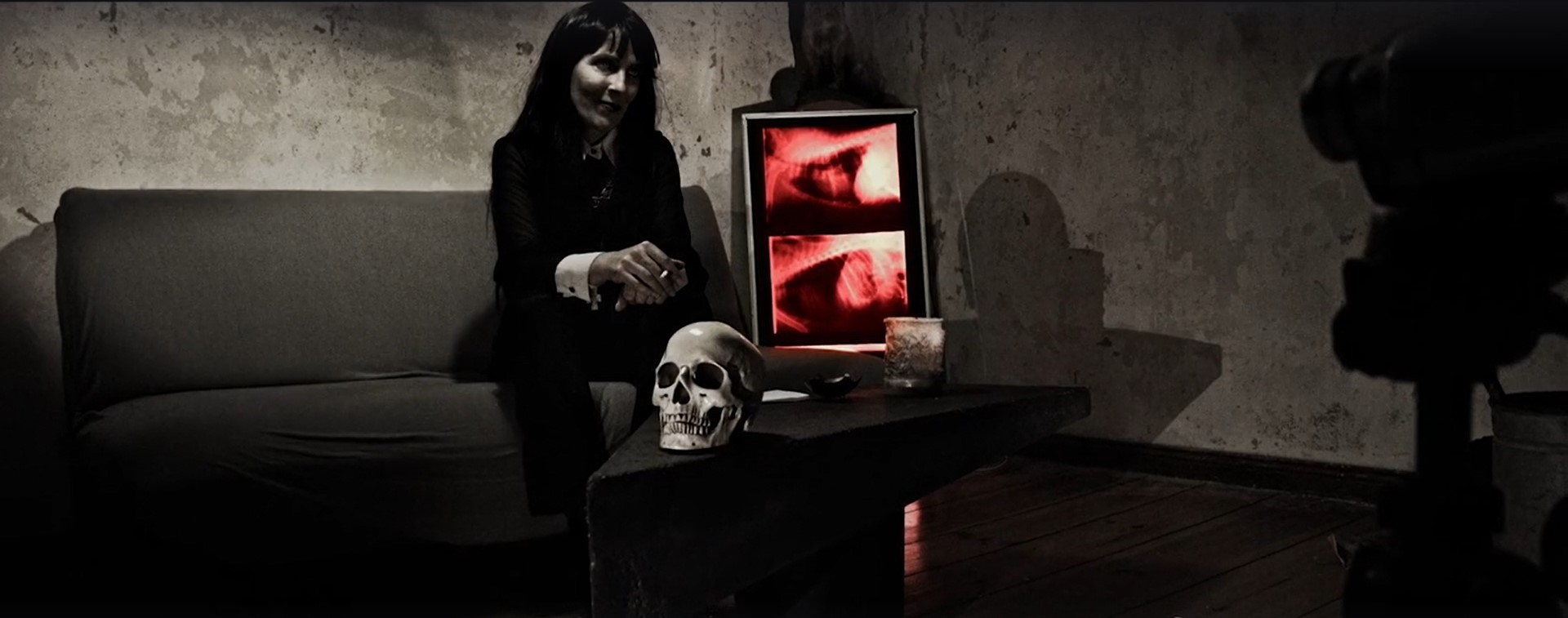
“Flesh City” annexes our individuality for the sake of connective solidarity conveyed in an electronically infused and alternatively aesthetic experimental film from Germany’s own jack of all independent media and artistic trades, Thorsten Fleisch. The 2019 released feature is Fleisch’s first and only written-and-directed full-length film depicting his feverish analog avant-garde, reflecting the filmmaker’s menagerie of orthodox-shredding short films, video art, and written and produced music. Overseeing “Flesh City’s” cinematography and special effects, Fleisch has complete and utter autonomy of the visuals to obtain a harshly discordant image melody edited together, which Fleisch also manages, into an agglomerate of acetic aesthetics to shock and stress the audio and visual cortexes. Once under the working titles of “Berlin Blood” and “Zyntrax: Symphony of Flesh,” “Flesh City” is entirely shot in Berlin, Germany, produced by the director and United Kingdom producers Arthur Patching and Christian Serritiello, and is a feature of Fleischfilm and Tropical Grey Features.

One of the film’s coproducers and musical artists, Christian Serritiello (“Streets of East L.A.”), is at the front lines of “Flesh City’s” afterthought cast of characters with Vryen as essentially the naïve and lured-in Alice chasing the white rabbit Loquette, played by Eva Ferox (“Love Songs for Scumbags”), down the twisted rabbit hole of a cellar dwelling doctor.  I say afterthought because the characters take a backseat to Fleisch’s contortion of reality and the analogical subtext generated by Fleisch’s love for analog anomalies, using them as supporting pawns to carry out his visceral vision of vitality.  Music videos, psychedelic montages, and grotesques images of beetles absorb screen time like formless or arthropodal principals.  Even Professor Yagov (Arthur Patching”) is obscured by a rainbow shimmer, never visually seeing his face as an individual seemingly between two dimensions.  “Flesh City” is a very multiverse, multidimensional nightmare-scape of unconventional color that has culminated from Fleisch’s imaginative idiosyncrasies over the years and that’s what being intently showcased here with more evident display of a less-character driven, shapeless story within the technical aspects of the DVD release where the soundtrack drowns the dialogue into a muffled deaf tone, like any good loud music venue would subdue.  “Flesh City’s” urbanites fill out with Marilena Netzker (“Love Songs for Scumbags”), Shaun Lawton (“Possession”), Denis Lyons (“German Angst”), Anthony Straeger (“Call of the Hunter”), Maria Hengge (“Love Songs for Scumbags”), Helena Prince (“12 Theses”), and Thorsten Fleisch in a Max Headroom meets Total Request Live-like host role of Quantum 1337.

“Flesh City” will not be everyone’s approx. 90 minutes of how to spend their time choice.  The experimental film will only speak to a few select souls with a filmic affinity for Lynchian peculiarities, Terry Gilliam’s bold fantasy, David Cronenberg’s body horror, and a hellish capriccio along with an eclectic music palate for noise rock, henpecking alternative, and strident industrial bass.  I wouldn’t go as far as saying Fleisch’s film is akin to nails on a chalkboard but can be boisterously unpleasant to the ears at times while, in the same breadth, be stimulating visually, even if that stimulation may induce a photosensitive epileptic seizure.  Fleisch’s non-traditional narrative design splices in music videos from various underground and indie artists with him providing introduction as an illusionary host in a virtual world, breaking up the Vyren and Loquette’s post-punk-adelic core quandary with a teetering melodic cacophony of feedback rock electronic, a hostile rhythm, and bizarre lyrics and visuals.  Fleisch pushes the taboo envelope with not only liberal nudity, to which Germans are very at ease with their body image, but also within the unconfined stylistic creativity of multi-formats that razzle-dazzles like the innards of radiant plasma globe; the Tesla coil electrons that’s drawn to your conductive flesh won’t hurt you but provide a feeling of captivated wonder.  Yet, don’t expect to be thrilled in a traditional predator-and-prey sense as “Flesh City” appeals more to our disconnect from each other and how to reconnect must be through some kind of inclemency. 

Likely to transmit under the radar, “Flesh City’s” biomorphic body horror arrives onto unrated director’s cut DVD home video courtesy of cult and independent distributing label Wild Eye Releasing in association with Tomcat Films.  The DVD5 presents the transfer in a widescreen 2.35:1 aspect ratio with varying levels of image quality due to different types of equipment and methods used to create Fleisch’s tripped out vision that contains, but isn’t limited to, black and white, color, stylistic lighting, analog equipment, digital equipment, stock footage, and so forth.  This mishmash movie makes for divisible degrees of signal quality that can be look crystal clear in one scene and then heavy noise interference the next, but the overall clarity is remains stable without any scenes being rifted because of visual vagueness.  The audio comes in two formats:  a English Dolby Digital 5.1 surround sound and a English Dolby Digital 2.0.  Frankly, the original English dialogue track is feeble under the tremendously potent soundtrack and sound design that makes comprehending Vyren and Loquette subterranean exchanges under the industrial rumble of the score virtually impossible to discern.  Even Quantum 1337’s cyber-stutter chat softly introduces us into his world, essentially leading the blind into a mound of musical mania. Bonus features only include other Wild Eye Releasing trailers with the physical aspects of the DVD come with a misconception cover art that has a terrifying gaunt and fleshy, humanoid creature front and center, but that creature doesn’t exist in the film until maybe at the climax that’s nebulously discernible at best what viewers are supposed to see. Inside the standard DVD snapper, the disc art is pressed with the same front cover image but with no accompanying insert. The region free disc features the unrated film with a runtime of 84 minutes. “Flesh City” is a delicacy of distortion, but the Thorsten Fleisch film is an acquired taste that general audiences won’t have taste for but, then again, general audiences are not Wild Eye Releasing’s target audience, now are they?

“Flesh City” Yearns for Connection on DVD!

EVIL Moves in When Sister Goes Missing! “Sister Tempest” reviewed (Darkside Releasing / Blu-ray)


“Sister Tempest” – on Blu-ray home video at Amazon.com

Private school art teacher Anne Hutchinson faces an alien tribunal on the set of circumstances surrounding the sudden disappearance of her younger sister.  Anecdotally going through the chapters of her life, beginning with her parents perishing when the sisters were young into growing up in a confrontation household between the sisters’ warring personalities to Anne’s desperate search for her younger sister after an ugly fight one night.  Still reeling from the abrupt disappearance, a new student joins her class that ensues a sudden fascination from Anne.  When the student shows up one night at Anne’s house, unloading woes of being kicked out of school due to lack of funds, Anne offers sympathy and suggests staying in her sister’s room that’s now been vacant for some time, but Anne’s new roommate hides a secret as she must feed on raw meat to combat of a body-covering boil sprouting illness.  Little does the art teacher know that there’s a connection between her sister’s disappearance and her former blood-thirsty pupil that will shock her very core.

What happens when a promise to another person can’t be kept because that person’s will and commitment is so strong it’s becomes a severe fault?  From an not from this world alien perspective, the contradictory and irrational nature of humankind has a profoundly illogical pattern to it that bears hardly any understanding to an unlike mind.  There’s fragility to interpersonal relationships and to the people devoted to those relationships that force unforeseen, sometimes fatal, consequences when expected coherency and harmony turns into irrational chaos from seemingly arbitrary means.  This is how Joe Badon’s genre-bending “Sister Tempest” expresses that conundrum of curious conscious with a surrealistic sci-fi-horror-drama that teeters on the edge of deadpan.  The 2020 released “Sister Tempest” is the second written-and-directed feature film from Badon, following his 2017 experimental horror “The God Inside My Ear,” which falls upon similar “Sister Tempest” lines of emotionally distress-induced bale.  Filmed in New Orleans, Louisiana, “Sister Tempest” is a produced by Badon, editor/sound designer Joseph Estrade, Dustin Rosemark (“Inferno”) and cinematographer Daniel Waghorne with visual effects artist Clint Carney (screener of “Dry Blood”) and Miles Hendler serving as executive producers.

After a series of prefacing introductory and non-linear story scenes, Anne Hutchinson, a debut feature role for New Orleans based actress Kali Russell, sits in negative space wearing an orange jumpsuit and being introduced to her alien tribunal council.  Dazed and confused, but not totally in shock and frightened about being in the presence of otherworldly extraterrestrials, Anne recounts events surrounding the disappearance of her sister, played by Holly Bonney (“Bird’s Eye).  As sisters, a defined line between the older responsible and the younger immature is contentiously formed between Anne and Karen as they deviate from earlier promises after their parents’ untimely death to take care of each other.  Through Anne’s retelling of her life, her mother, though hard and disciplined, had a conditioning care that burdened the eldest child with a sense of duty and care at a young age and this really is no different from most firstborns who shoulders already a ton of responsibility regardless in taking on even more when the parents are no longer around.  You love them to death is great idiom that rings true in Badon’s subversive-cinema standards tale when the sisters can’t see eye-to-eye on matters and there’s a loss of connection, accountability, and gratitude that the audience can relate to.  For much of the picture, Holly Bonney takes a backseat to Kali Russell’s spiraling disconnect that affects her relationship with love interest Jeffrey the Janitor (Alex Stage, “Eat Brains Love”) and new life-entangling pupil Ginger (Linnea Gregg).  The latter Greg played character has a little more layers to peel back that involves directly with Anne.  Ginger’s is venom in disguise as vampire of sorts who requires raw meat and to keep her human appearance intact.  There’s a representational duality in Ginger, reflecting both a monstrous quality and a sweet innocence that ties into Anne personally and into the search for the sister.  “Sister Tempest” rounds out the cast with Clint Carney (“Dry Blood”), Lucas Boffin (“Return to Sender”), Andre LaSalle (“The God Inside My Ear”), Cami Roebuck (“Children of Sin”), and Sarah Rochis.

“Sister Tempest” has a foundational design we’ve all likely seen before with breaking points, dualities, and downhill-racing mystery unfathomable to the naked eye, but the Josh Badon story inexplicitly feels different from the others.  Perhaps because of Badon’s unconventional storytelling style that throws the normal perceptions for a loop, literally and figuratively, with a 50’s-ish callback to science fiction films or its glamour of 70’s-ish British horror in color and macabre or an unsane mixture of both. I’m not going to sugar coat “Sister Tempest” as an easy to follow, low-hanging fruit film that simple, straight-forward, and is everybody’s cup of tea. That would be a waste of peddle spiel. There’s a zaniness quality that can’t be ignored that surrounds the principal Anne character as if she’s experiencing an ersatz world normally. Some would say that Anne’s caught in a maelstrom, or tempest, of unclear thought and her ordeal is catalytically charged by the work and the love that is poured into her sister’s wellbeing only to be thrown back into her face. Badon has a flair for the unusual, an eye for the odd, and can extravasate an uneasy air from a capsule of seemingly randomized happenstance and beyond the already preternatural events to aggregating the wayward tension.

“Sister Tempest” is the very definition of independent movies with a take it or leave it spellbinding archetype that’s unlike anything ever seen before. You can bear witness to Joe Badon’s mesmeric madness and melancholy with a brand-new Blu-ray from Darkside Releasing. Presented in two aspect ratio formats, a 2.39:1 and 1.33:1, the screen really runs the side-to-side gamut. Image quality shows zero sign of issues from the high-definition digital video, shot on a 4K black magic pocket cinema camera. The blacks are deep and rich as well as the coloring through Daniel Waghorne’s versatile cinematography involving gel lighting, color reduction, and spotlighting. The English language 5.1 surround sound shows no sign of slowing down this A/V wonder with clean and lively multi-audio tracks that come through every channel definitively. Bonus material includes an audio commentary with the director, produces, and actors, a blooper reel, a deleted scene, and trailers for Darkside releasing surreal and giallo films. “Sister Tempest” Lynchian style is not going to please the masses, but it’s certainly the wildest ride in the theme park of contemporary indie cinema.

“Sister Tempest” – on Blu-ray home video at Amazon.com

Nothing Says EVIL Like a Woman Scorned! “Revenge” reviewed! (Second Sight / BR Screener)


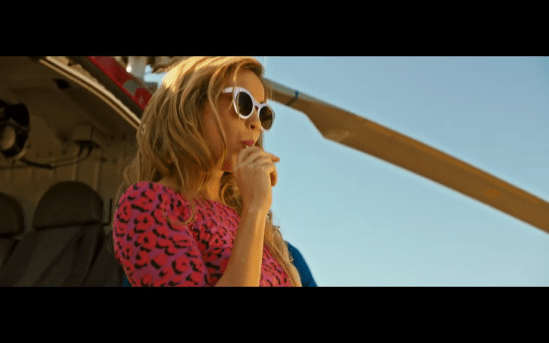
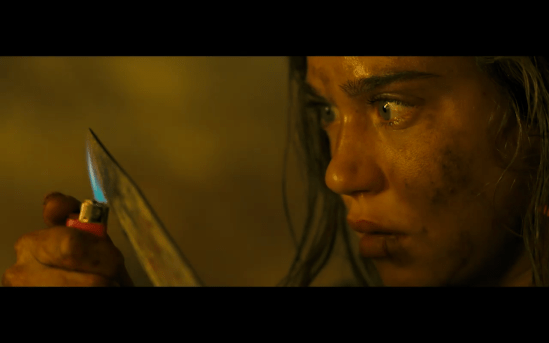
Richard, a wealthy businessman, and Jen, his young, candy arm mistress, helicopter in onto Richard’s desert retreat house. While his wife and children are at home, Richard plans to spend his time away relishing a pleasurable weekend that involves relaxing by the outdoor firepit, swimming in the infinity pool, being sultry with Jen, and do a bit of hunting along the mountains, canyons, and riverbeds. When Richard’s associates, Stan and Dimitri, arrive a day early, a party filled night rapidly ensues, but events turn sour when Jen is brutally attacked the next day and Richard plans to snuff out the scandal before it unravels to ruin him. Unwilling to cooperate with a coverup, Jen is nearly murdered by her three attackers only to arise like the rebirth of the Phoenix, igniting a vengeful fire inside her as she uses everything she has at her disposal to finish what they started.

In a day and age when the slightest bit of a woman’s attention can explode into a vile reaction of testosterone warped misguidance and it’s the woman who is shamed as the accosted criminal being barked at aggressively by the unequivocal fearful and condemning voices of the male species, it’s movies like Coralie Fargeat’s action-packed “Revenge” that symbolizes woman’s resiliencies against men’s efforts in a show of violent force that’s “First Blood” without John Rambo, but rather with a scorned princess for retributive capital justice. “Revenge” is the French filmmaker’s first full-length penned and directed feature film that’s one gritty and bloody grindhouse vindictive sonovabitch, a pure punch to the throat, and a direct message to misogyny everywhere. Filmed in the Morocco desert during Winter, the small cast is swallowed by the vastly arid landscape of transfixing cruelty, a synonymous parallel to the feat the heroine Jen is drawn to task. It’s also a feat that Fargeat managed to salvage to finally release a rape-revenge thriller backed by a conglomerate of production firms and financiers to stand with a film from a first time director whose treatment offers up maltreatment of women, such as the rape, along with the savagery, the concept of revenge, and ridiculous amounts of blood. M.E.S. Productions, Monkey Pack Films, Charades, Logical Pictures, Nextas Factory and Umedia are just to name a few of the production companies to be supporting capital.

With a role embodying the symbolic brutalization of physical and mental rape, a role of complete loneliness in a fatal skirmish against their attackers, and in a role forsaken in the face of death only to be reborn from the ashes of their former self, Matilda Lutz’s fully charged capacity to tackle such a demanding performance is beyond praiseworthy, scrapping the timid traits from Jen’s ravaged glossy persona and replacing with a rigid exterior ready and willing to combat to the death. The Italian born Lutz has to go through a metamorphosis and refashion Jen to be able to differentiate from her more bubbly first half self as the easy kill or the disposable male plaything. In a twisted turn of events, Jen’s mortal adversaries have every advantage to douse out Jen’s existence: gear, guns, vehicles, clothes, water, fuel, numbers, etc. Yet, despite all the advantages, the desert, much like Jen, is unforgiving as it is bare. Richard (Kevin Janssens), Stan (Vincent Colombe), and Guillaume Bouchede (Dimitri) exude the utmost confidence their grip around Jen’s throat. Janssens’ fortifies as the rigorous cutthroat, a misogynistic philanderer, determined to save his own skin no matter the cost while Colombe’s Stan is a retracting coward with regretful impulses. Colombe’s brings the comedy to a grimly tale and positions Stan to be the teetering villain tarnished by his guilt of nearly killing Jen, but never apologizes to being the catalytic rapist that initiates the whole debacle. Bouchede supplements with his divestment to charm as the overweight, do-nothing witness to save Jen from Stan’s seizing urges. As Dimitri, Bouchede stalls his typical niceties to be the silent violator who can open up the flood gates of aggression when transgression warrants it.

“Revenge” has an ultra-violent and super-synth finish chapping with multiple motifs of a rebirth theme and supplies a hefty bloodletting of incorporeal measures. Knocking it out of the park in her first feature film, Fargeat’s cauterizes the unnerving serious tone with alleviated black comedy of the bloodiest kind. The roundabout endgame chase comes to mind, involving a frazzled Jen and a wounded, but indomitable Richard in a merry-go-round of a shotgun standoff is some of the best editing work of fast and ferocious content I’ve seen in some time while still able to vitalize a transparent sense of what’s occurring. However, not all the slick editing is flawless. Some minor inconsistencies in the editing are noticeable and while these moments of lapse are not detrimental or pivotal to the story, they reflect Fargeat’s challenges of making a hyper-stylized action-thriller in her freshman full-length feature. In a sense, everything Fargeat’s deploys positions “Revenge” into a surreal tonality, glamorized for those thirsty for blood gushing in a canyon-vast desert bristled with rape and payback where a mere four players in this ebb and flow game of killer combat chess can effortlessly locate each other, but one can always find their prey by following their blood trail, another motif that continues to pop up that speaks metaphors of their life blood is the very object gives them away in the end.

Giving the limited edition treatment that it deserves, Second Sight Films’s Blu-ray release of “Revenge” is a mouthwatering narcotic of raging cathexis and while the Blu-ray BD-R can’t be technically critiqued, the LE release offers HD 1080p transfer of the original, 2.39:1 aspect ratio and sports an English language DTS-HD Master Audio 5.1 mix. While Fargeat might be inspired by Lynchian themes, the cinematography work by Robrecht Heyvaert also resembles “Pitch Black” director David Twohy’s films with making something small larger than life and a particular chase scene involving all four characters at the edge of a canyon stroke a familiar chord with Twohy’s “A Perfect Getaway.” There were Second Sight Films’ exclusive bonus features included on the disc, featuring new interviews with director Carolie Fargeat and star Matilda Lutz (entitled “Out for Blood”) an interview with Dimitri actor Guillaume Bouchede (entitled “The Coward”), a interview with Robrecht Heyvaert (entitled “Fairy Tale Violence”), a new interview with composer Robin Coudert and the synth sounds of “Revenge,” and a new audio commentary by Kat Ellinger, author and editor of Diabolique. The release is sheathed inside a rigid slipcase featuring new artwork by Adam Stothard as well as a poster and a new soft cover book with new writings by Mary Beth McAndrews and Elena Lazic Overall, “Revenge” received a monster packaged release ready for the taking on May 11th. “Revenge” destroys toxic masculinity and breathes a vindictive hope from the fiery embers of rebirth and destruction.