

Popular horror screenwriter Grafton Torn wakes up screaming in a hospital room and suffering from amnesia, unable to recall how he ended up lying face down at the bottom of his stairs. His special effects friend, Deter, offers Grafton his woodsy cabin, isolated from town, to relax from the extreme nightmares that plague him. Soon Grafton’s nightmares become a blur between dream and reality, constantly causing him to question his sanity when movie prop objects go missing, unexplainable mental blackouts, and visions of people brutally murdered. Grafton must sift through the bitter memories of his separation with his wife Cat and ghastly manifestations of horror to seek the truth of his insanity or he’ll die trying.

I spent my New Years Eve night with Bill Oberst Jr. and his performance in the horror-thriller “Deadly Revisions” was better than gazing at explosively colorful fireworks. While the rest of the drunkard world partied stupidly away, counting down the year’s end, “Deadly Revisions” had been summoning me with a familiar “Evil Dead” cabin in the ominous woods gracing the front cover art. Honestly, I wasn’t expecting much from the Gregory Blair directed film because of the SGL Entertainment distribution company whom usually acquires and distributes low-end independent horror that’s generally amiss favorably. And even though that ominous front cover cabin in the woods wasn’t exactly ominous in the actual movie, this SGL production deemed to be a diamond in the most dirtiest of roughs; a shining example proving that all is not what is seems.

Just the mere name Grafton Torn sounds like name of a Bill Oberst Jr. character role, but the character seemed even keeled and intelligently acute to his surroundings which doesn’t usually fit the bill of Bill’s unusual characters. Just in recollecting previous films, Oberst played numerous zany characters such as a crazed werewolf in “Werewolf Rising,” a zombie news reporter in “Zombie World,” and a murderous child rapist in “Krampus: The Christmas Devil.” Though Oberst portrays lunacy frighteningly well, he outperformed his other more enthusiastic roles with Grafton Torn by composing himself properly and being more reactive to the possibility of insanity.

Where in the world did Gregory Blair come from? Blair certainly has a talented eye for the horror genre or at least an inspired taste to shape and mold a familiar setting with horror fans. The latter is more likely with minor characters suggestively named after horror icons; such characters are named Nurse Voorhees (Jason Voorhees reference) and Doctor Myers (Michael Myers reference). With no previous directorial credits to his name, “Deadly Revisions” is the freshman film for Blair under the direction and penmanship categories. Well edited, great angles, and quality effects contribute to a well received viewing. The long time actor also had a minor role in the film and helped produce the film in conjunction with PIX/SEE Productions, capturing a few awards during “Deadly Revisions” two-year journey to home video, including a win for Best Narrative Feature at the Los Angeles Movie Awards and Best Screenplay at the Terror Film Festival.

The story will keep one guessing and, technically, the ending goes unforeseen. Blair’s puzzling horror-thriller produces bluffs upon bluffs upon bluffs, manufacturing an unpredictable and murky ending. Blair quickly jabs in minor hints to the finale that don’t TKO until the end and his writing scheme and direction puts the unwitting protagonist Grafton, and the unwitting viewer, in a whirlwind state of total confusion and distressing fear that’s highly valuable for a film with restricted independent capacities. Even though “Deadly Revisions” took shape in 2013, the DVD didn’t hit shelves until 2015 and I can frankly state that “Deadly Revisions” has one of the best narratives I’ve seen this past year in independent horror.

“Deadly Revisions” makes the 2015 underrated list for sure. Technically and entertainingly, the Gregory Blair and Bill Oberst Jr. collaboration models a damn good thrilling story. Don’t be fooled by the generically tacky DVD cover art; instead, make the effort go forward with this reviewer’s positive recommendation and be pleasantly surprised and delightfully terrified. If a negative comment had to be made about this film, the DVD quality could use some work with the darker digitally shot scenes. Posterization and noise clout much of the night time scenes, annoying creating a speckled blob effect that briefly causes narrative loss – a familiarity with the likes of SGL Productions.
Tag Archives: MVD
An Evil Bouquet of Purgatory. “Flowers” review!

Six dead women relive pieces of their previous mucky lives embodied in one seamless soul that’s trapped in the literally gory innards of their serial killer’s home. Forcibly held in the limbo of a filthy purgatory, each woman find themselves in a different, and extremely hellish, part of the house and each carry the same gruesome autopsy laceration across the front of their chest, crudely stitched together and coming apart at the seam ready to pop open their insides at any moment. Unknown to why their confined, an ill-fated reason develops at the end of the maze’s demented journey through the home made of severed body parts, decorated with pieces of human tissue, filled with decomposing bodies, strewn with ghastly entrails, and drenched with blood.

Director Phil Stevens composes an avant-garde horror story orchestrated with no dialogue what so ever through the duration and spatially effective in close, uncomfortable quarters . Certainly unique from anything else I’ve ever witnessed, “Flowers” doesn’t apologize for being overly gory and disgusting, pursuing a stomach-churning reaction from all allegoric angles. Slip-and-sliding through the murderous muck and goop, each of the six dead women seem hysterically unfaded, yet more intriguingly curious to their surroundings, even if that means putting their hands through a tonnage of viscera and ripping their own flesh open. Indie films like Phil Stevens’s “Flowers” will never catch the eye of most mainstream audiences and will never know of their existence, but a few lucky viewers, like myself, get to experience the surreal work from the horror underground. Fans of Marlan Dora’s “Cannibal” or Jörg Buttgereit “Nekromantik” will revel in “Flowers’s” grisliness and gloomy nature.
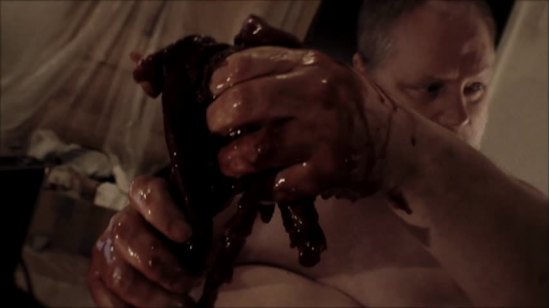
The cast is made up of six alternative lifestyle women, each one credited only as Flower 1 through 6, and take up a particular different segment and sprinkled into their story is their merciless and necrophiliac killer, only credited by the name The Exile. In sequential order, the Flowers are played by Colette Kenny McKenna, Krystle Fitch, Anastasia Blue, Tanya Erin Paoli, Kara A. Christiansen, and Makaria Tsapatoris and the killer is played by Bryant W. Lohr Sr. The majority of the actresses take on more than their literal roles in the movie. The physical body horror effects are applied by Anastasia Blue and Krystle Fitch to create open wounds across the actress’s chests and the uncleanliness costumes and wardrobes are provided by Makaria Tsapatoris, whose experience has been from the 15 year participation of the horror season attraction Eastern State Penitentiary in Philadelphia.

The abstract story is intensively focused on the women’s lives rather than their slaughterer The Exile. Their stories are personally tragic as if the Flowers are trying to purposefully or unintentionally ignore real life by way of drug abuse, prostitution, or both. Each actress has to put forth extra effort in their silent performances as dialogue is nonexistent and they’ve successfully compel themselves to act out the scenario, working with their surroundings and being, well, dead. The Flowers may not seem frightened of their killer’s house made of guts, but the Flowers are definitely disgusted, nearly tossing their insides in a few putrid cladded rooms. You may not want to eat while watching some of the segments. Very little is known about The Exile, a very large, but well kept man with a hankering to kill the gutter girls, bathe in their guts, and, sometimes, have sex with their gut-exposed dead body.

“Flowers” is available in two DVD editions, a standard one disc which is reviewed here and a three disc limited edition set, from Unearthed Films and distributed by MVDVisual. The technical video is presented in a widescreen 1.85:1 aspect ratio with a 2.0 dolby digital audio and, frankly, the two channel audio is all “Flowers” needs with no dialogue or major sound effects as a poetic soundtrack guides with harmony mostly through all of the audio work. The image quality is detailed and vividly enticing, but the colors are intentionally dull and for darker scenes that create ebony silhouettes that are practically not visible or coherent; these scenes only deter for only the first 20 minutes of crawling through the house’s bloody undercarriage and won’t ruin the remainder. For only the disc one edition, extras are fairly good with interviews with The Exile actor Bryant W. Lohr Sr., an audition tape of Makaria Tsapatoris, behind the scene stills, an isolated FX track, and commentary tracks with director Phil Stevens and associate producer “Ravage’s” Ronnie Sortor. I recommend the grotesque “Flowers” to any horror fan without a weak stomach and a mind for the abstract!

A Video Diary of Evil. “The Death of April” review!

Megan Mullen, freshly out of college life, feels a strong urge to pick up and move from her comfortable California family home to the new surroundings of New Jersey. She can’t explain her why to move, but she quickly finds an apartment in East Rutherford where she settles in easily, creates a video journal for her friends and family back home, begins her new job as a school teacher, and gains a wonderful boyfriend. Everything seems to be going perfect for Megan until unexplainable, seemingly paranormal, acts happen in her apartment: doors open and close mysteriously, objects move on their own, and her soul doesn’t feel like her own. As she continues to her video journal, she further believes her apartment was once rented by April, a young girl similar to Megan who ended up brutally murdered and found on a riverbank, and that she is haunting her. This is Megan’s story told through a documentary revealed by her friends and family to the supernatural speculation of what causes Megan’s torment and downfall.
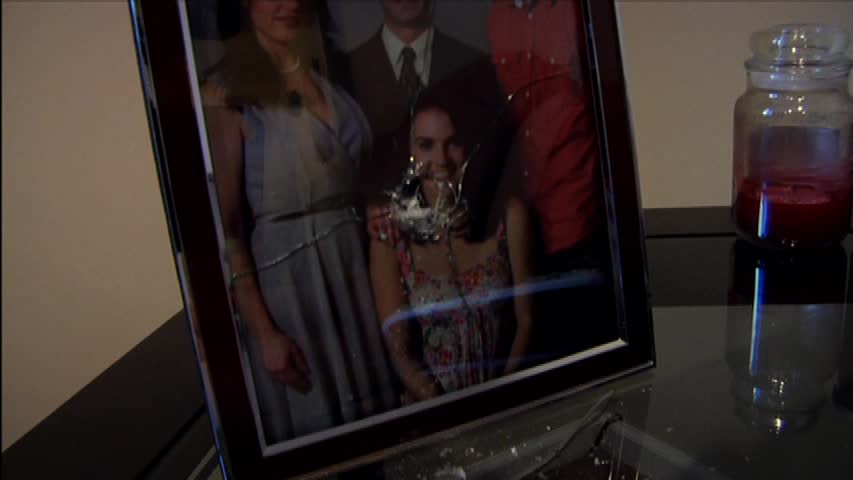
In the spirit of new releases on or around horror’s big night of Halloween, Director Ruben Rodriquez’s 2012 paranormal mockumenatry “The Death of April” comes to life on for the first time on DVD from MVDVisual. Similar to the “Paranormal Activity” series, the pseudo documentary about a dangerous, abode dwelling spirit or spirits bombarding their supernatural havoc upon helpless inhabitants. While the release time is appropriate and has a modest appreciation for creepy atmospheres, “The Death of April” fails to bring something new to the genre table and I can’t see the easily overlooked “The Death of April” being the catalyst to spark more interest in a ghostly genre that becomes overpopulated, by the major studios, during the month of October.
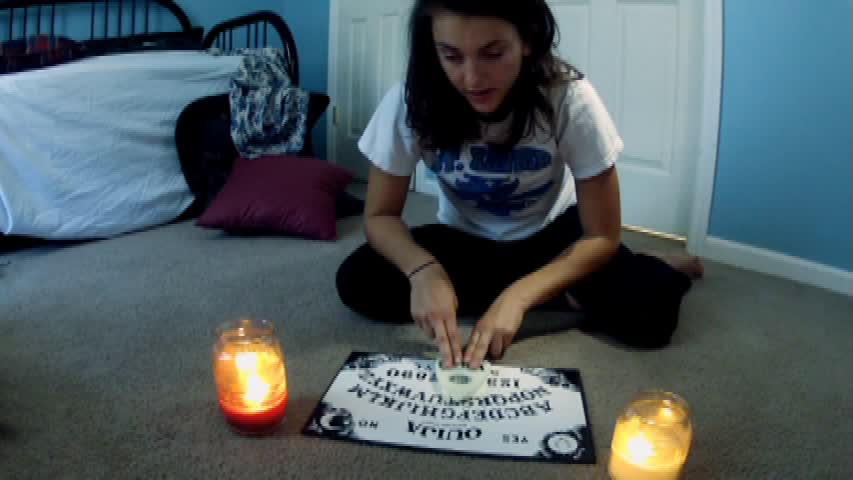
Backed finically by the Mojo Creative Group that was founded by Ruben Rodriguez, the mockumentary introduces a modest talent of actors and actresses including Katarina Hughes as Megan Mullen. Hughes, in her first feature film, delivers the much needed energy to a slow, stagnant script, but the contrast exaggerates Katarina’s overzealous happy-new-girl-moving-to-a-different-coast attitude. Her co-stars Adam Lowder as her brother Stephen Mullen, The Knick’s Chelsea Clark as her best friend, RayMartell Moore as her boyfriend Tim, and Stephanie Domini as her mother, who by the way looks almost the same age as Megan, sold their story, their take, of Megan’s downward events. That being said, Lowder, Clark, Moore, and Domini couldn’t lift the script out of the deep trenches of the uninteresting and mechanical motions.
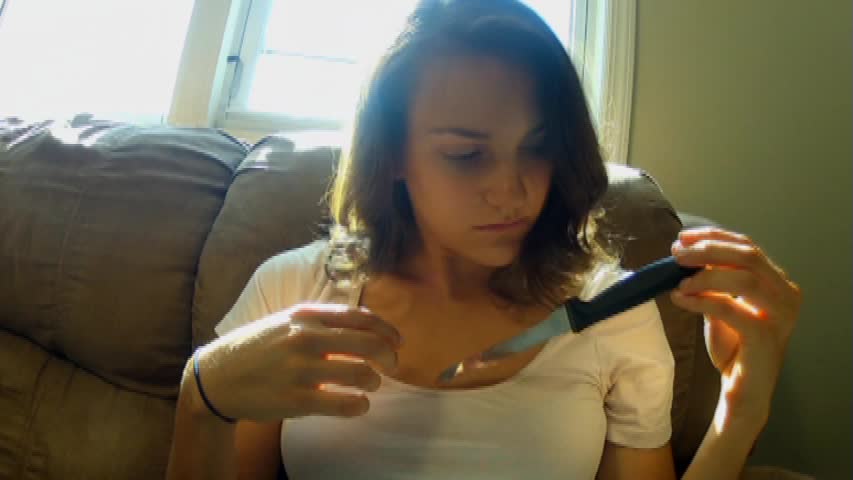
The script, which was also written by Ruben Rodriguez, could be considered to contain two interpretations, one literal and the other more concealed. The more literal interpretation is my least favorite of the two. Megan’s family constantly disowns the fact that she might actually be haunted by an apartment spirit; in fact, her family and friends negatively pelt her with denials and accusations, never once considering Megan’s theories of an aggressive April spirit. This is where the script becomes redundant as Megan’s brother Stephen and also her mother Stephanie reiterate over and over about how close their relationship with Megan was and how she had firm family roots in California and also proclaim the excuses of how she’s looking for attention or not coping with a new surrounding very well. Rodriguez’s script suffers by not displaying alternate ways in exploring how her family and friends should handle Megan’s paranoia or paranormal problem. Even when they’re is undeniable video proof with the video starting to distort and capturing uncontrollable movements from inanimate objects, nobody believes Megan and that would drive anybody to the loony bin. The second interpretation with, perhaps, a more underlying metaphor is that Megan is slowly going nuts. Her brother Stephen does mention her previous slightly creepy issues with Megan before her big impulsive move to the east coast. Almost like her impulsiveness and her energy-filled antics seemed manic and her sanity practically dissolved when she moved thousands of miles away from her support group in California. Megan’s mind could have invented April and her family, knowing that she’s had weird issues in the past, chalks this up to just being another mental issue. Of course, the video diary proof, even with her brother and friend witnesses, nearly excludes the second theory and that her “desire” to move far away from her family stems from April pulling her in that direction.
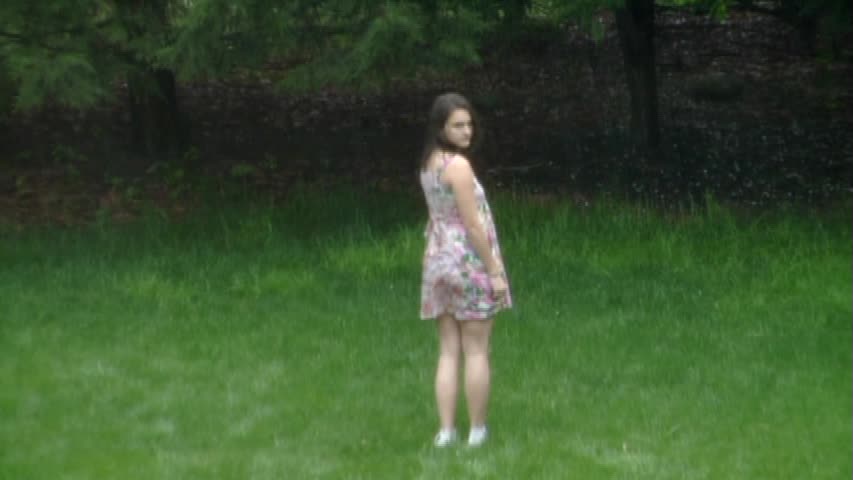
“The Death of April” won’t make waves on the PKE meter. The picture quality of the MVDVisual and ITN distribution DVD release looks clean considering that most scenes had intentional video quality posterization and distortion for the web and home video diary appearance. The front cover art is slightly misleading with a foreboding, rundown gothic style house in the background when actually Megan lives in a sectioned off duplex apartment in a suburban neighbor of a New Jersey home that doesn’t look necessarily evil at all. Also, who I’m guessing is spirit of April on the front cover with a Ouija board in her clutches sports sexy booty denim shorts as if to lure a certain audience to the release. We’re not sold on “The Death of April” as too many before it’s time have come across and planted their seed and sprouted firm in place.
Evil Reeks in an Old Magician’s Mansion. “Death’s Door” review!

A young group of people are mysteriously texted an address for an unknown party. When they arrive, the address takes them to a dilapidated mansion with innards displayed as if time has ceased to exists. When the group tries to leave, all the doors to the outside won’t open, condemning them to the horrors of a magician’s vengeful spirit and his very large and frightening assistant who looms around the mansion’s endless corridors. As the group continues to butt against each other in distress and disbelief, one-by-one they fall victim to the magician’s gruesome parlor tricks behind every door and the only way out of the mansion may be dependent on their families’ legacies.

With a premise similar to the 1999 remake of “House on Haunted Hill” where a group of people are mysterious invited to a creepy house and end up in a death trap, I wouldn’t say director Kennedy Goldsby’s “Death’s Door” aka “The Trap Door” is entirely, 100 percent unique. In fact, much of the film is undeniably the same compared to William Malone directed remake, yet less entertaining and without an all-star cast and a vaster budget. “Death Door” lures with the headliners of more attractive and experienced stars with the Jamaican-born movie and television actor Obba Babatundé and the “Friday” franchise actor, and overall a big, badass monster of a man, Tommy “Tiny” Lister. Yet, like most smaller projects, I’m sure Obba’s and Tiny’s handful of scenes were the majority of the budget pie, leaving a few dollar bills at the bottom of the barrel for special effects that were desperately needed for a film about a ghoulish magician.

The effects were completely inadequate and can’t even equate to the same stature used for “House on Haunted Hill.” Off screen deaths, quick edits and cuts, camera angles, shoddy CGI, the over use of red tints, shaky camera, flash backs, and a prop skeleton tried to sell plausibility when really just added to absurdity. Aside from the lackluster effects, the Goldsby penned script logically doesn’t flow and fails to develop acts. While seeking for an exit, separate groups of characters aimlessly wander the house, trying door after door, and then the next scene could be one of those characters mixed in with another separate group, creating some continuity confusion. Also, much of the script settles to a stagnate, housing an unnecessary long montage of the group being bored, napping, looking glum, or walking from one part of the room to another. To put the cherry on top, a random nude scene is oddly inserted into a montage into the magician backstory portion. There’s no telling who the naked breasts belong to or why they’re naked to even begin with as the exploitive and titillating shot crops out the head and the setting is awfully generic, not placing the body in any familiar surroundings related to the mansion.

I will say that very few of the acting skill sets were not at a total loss. The fast-talking, wise-crackin’ Bruce played by Chico Benymon was entertaining; the character’s angst-fllled stand-up-comic style character goes against the grain, fleeting any ideas of ghosts or any form of malevolency. Tommy “Tiny” Lister is always top notch. The big man doesn’t even have to say a word and he’s downright menacing, even if his character, Jomo, stuffs emotionless Latina’s into tight spaces and fails to soil the pants of the mansion’s guest when quietly walking around them. Sarah Wagenvoord, who I was hoping had the mysterious naked breasts scene due to her massive…well, you know, should have played a more prominent role du in part to her character’s outcome. Actors Michael Bernardi, Felix Ryan, and Danielle Lilley maintained an average performance through a mirco-budget production. The rest foundered to capture any kind of terror or despair or just even trying to be a normal character, overacting the parts as if trying to put passion into reading straight from the script.

The video quality of the MVDVisual DVD comes with hardly any flaws in the video stock or any loss in the natural coloring. The stereo audio is a bit unbalanced between the LFE and the dialogue tracks, deducing to some loss dialogue over the pounding hammering sounds. The extras includes the Kennedy Goldsby directed music video of “Shorty Wassup” by Hip-Hop artist Sizzol Pop. The last piece of bonus material is a behind-the-scenes featurette from the actual haunted house set where the crew has personal encounters with the spirits. “Death’s Door” is a fools gold, a trap, that promises deadly snares, haunting ghoul, and many scares. The ending comes to a complete halt with only tall tales of what might have dastardly happened to most of the characters in the rickety mansion. I would recommend far better old mansion spook stories.
No Justice for Evil! “Future Justice” review!
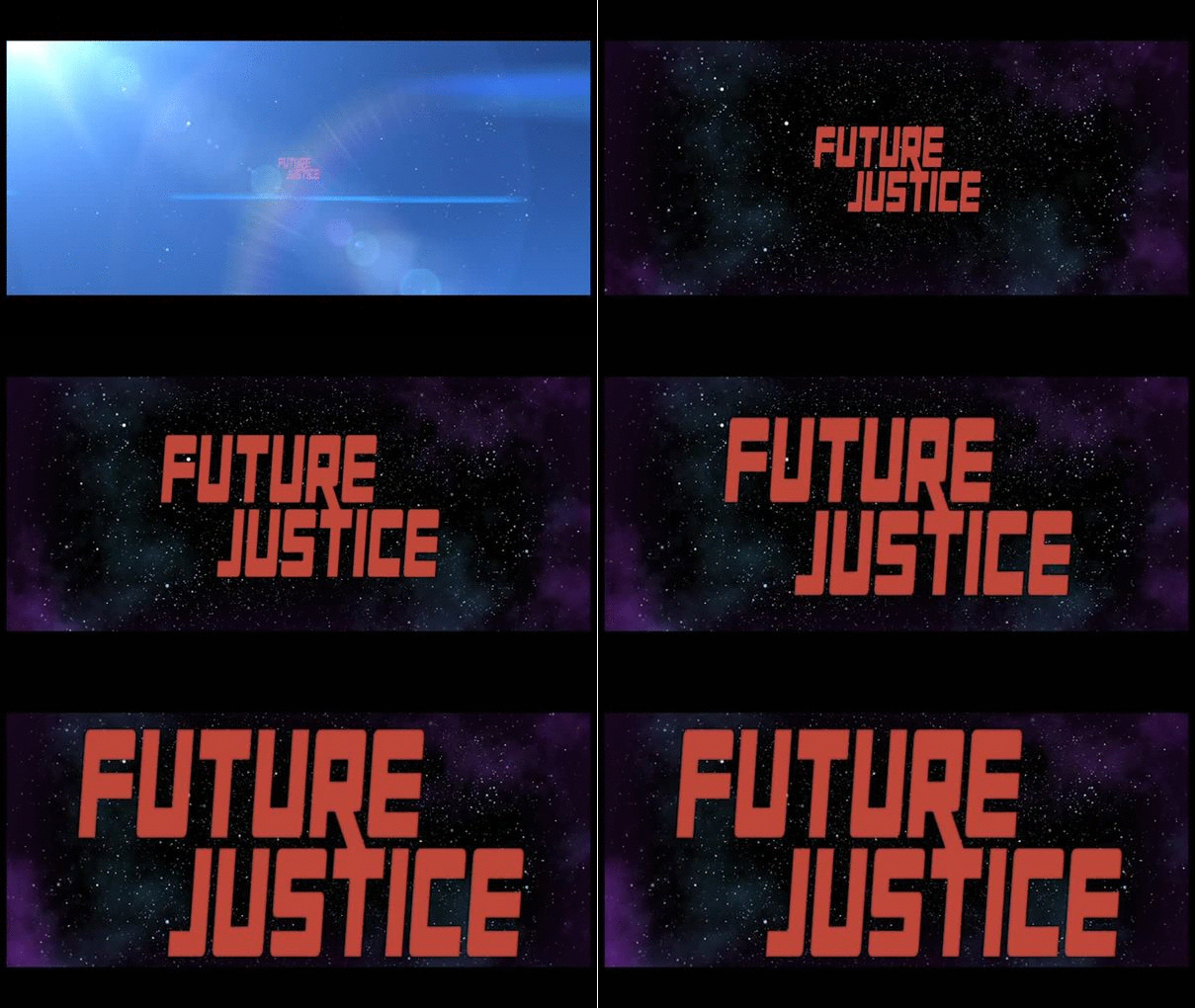
After five years of cryogenic solitude, Python Diamond returns on a heavily armored military escort ship, returning from Saturn where a maximum prison holds Earth’s most dangerous convicts until their execution date. As they close in on home, Earth has gone dark, communications have gone silent, and massive radiation cover most of the populated soil. A faint signal of power draws the crew down to a manageable radioactive portion of scorched Earth where they discover a small band of people, surviving in an underground bunker and striving to live in a post nuclear fallout. The exploration of life search doesn’t go unnoticed as a violent, more dominant group of survivors seek to take the military’s possessions, if not their lives too, and when war breaks out between them, another mutated and dangerous player enters the game.

Another Richard Griffin directed project and another great example of a superbly self-reliant genre film thats sharp-witted, off-colored, and, of course, entertaining to horror and post-apocalypse fans. Though Griffin and his usual cast of cast members tackle the homage with full-brute strength, Griffin places a gently new-used spin upon each of his inspired works in the form of great absurdity that’s hard to refute or dislike no matter what genre of movie fits your fancy. His post-apocalyptic, science-fiction, horror film “Future Justice” revolutionizes the homage by stripping iconic films of their popularities and mashing them together into a very coherent and comprehensible story without seeming like a total rip off. Instead, Griffin takes the Nathaniel Sylva written story and runs with it like a powerful running back whose hugging on tight to that pigskin ball and charging like hell to the end zone for his first touchdown, treasuring that first score and making it his own unique success even though scoring touch downs has been down countless times before.

The underwhelming title, “Future Justice,” doesn’t speak much to the film’s overall enthusiastic gesture. Yet, the witnessing of gung-ho filmmakers given only an inch to work with and stretching that into a long mile, or even two, is always an amazing length. Nathaniel Sylva didn’t only write the film, he also starred as the lead character, a confident and calculating convict named Python Diamond which is a bit of a play on the John Carpenter Snake Plissken character from “Escape from New York” and “Escape from L.A.” Then, the story embarks on a motley crew, like you would see in a “Mad Max” movie, group of scavengers looking to take all and leave nothing for the rest. Finally, “Future Justice” takes an unexpected turn by introducing a radiation mutated, humanly doctored, one pissed off person-creature that hungers to seek and destroy every last living being in the underground bunker.

The successfulness of character actor Steven O’Broin’s Gazeebo, head of the blood thirsty gang, makes him ruthlessly enjoyable to watch on screen. O’Broin and Griffin have worked previously together on “Sins of Dracula;” O’Broin aspired to be similar to Vincent Price in the Hammer Horror influenced Dracula film. Michael Thurber, more notable one of Griffin’s entourage of actors and also co-stars in “Sins of Dracula,” delivers a phenomenal and intentionally excessive method acting skill that always fits into, in every which way, all of Griffin projects. Working with an estimated $20,000 budget and limited locations doesn’t translate over to O’Broin or Thurber who can transform a small production into the illusion of a bigger ordeal, causing a mind altercating effect with their viewership. “Future Justice” delivers movie magic at its finest.

Speaking of movie magic, visual effects supervisor John Dusek works along side again with Griffin and meshes a blend of practical effects with campy computer generated imagery. The result only adds to the unique charm, capturing the zany essence of this world gone dark story and running with it to take the zaniness one step further, but also respecting the Italian post-apocalyptic films of the 1980s. Exploding heads, detaching limbs, brain-splattering head shots keep the violence fresh when various effect methods are implemented and Dusek tunes right into his entire arsenal to deliver. The effects go hand-and-hand with Daniel Hildreth’s space epic score, striking the composer analogue of other Sci-Fi film greats.

The MVDVisual region free DVD release is presented an in unrated 16:9 widescreen format at a runtime of 83 minutes. The extras include a commentary with cast and crew, a short film entitled “Mutants of the Apocalypse,” and a theatrical trailer of the film. The clear picture defines the details and vividly displays the colors, especially when the mutated creature emerges. The 2.0 audio mix hinders a little in the dialogue by the overpowering score and ambient tracks, but doesn’t disrupt much at all. “Future Justice” doesn’t apologize for laying down the law by smacking action and thrills right to the face. I’d recommend this title to any Sci-Fi or horror buff in a need of a necessary relapse into the post-apocalypse.
 It's Bloggin Evil!

