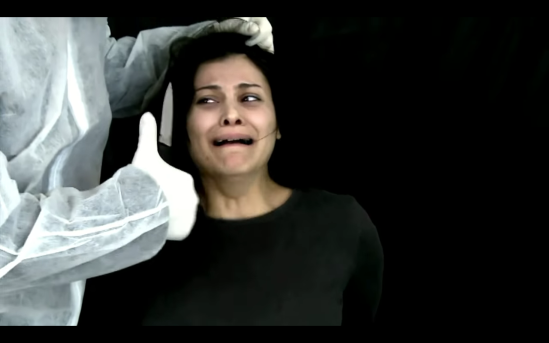
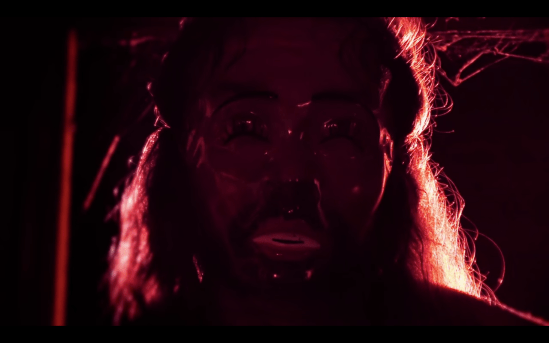
Visiting home on break from UCLA, Angelica visits her close friend, Emily, at her parents’ secluded country home. With nothing else better to do in the small rural town just outside Los Angeles, the two teenage girls set off early to attend a local rave deep within the woods at the reluctance of Emily’s overprotective parents and to kickstart what could be a drink and dance fueled night, they aim to push the limits and find a drug pusher to score ecstasy as the first priority to make a dull party fun. They run into Swan who promises the best ecstasy as he leads them to his cabin away from the rave. What Angelica and Emily find is themselves caught in the middle of a ploy by a sadistic gang lead by the ruthless Chaos, whose wanted in 4 states for his barbaric and merciless methods and looking for something fun to play with and torture. The cat-and-mouse game with the girls makes an interesting turn when the gang arrives at Emily’s parents’ house when their van breaks down and the parents suspect them in Emily’s sudden disappearance, veering the night into unreserved chaos.

“Chaos” is the intended true love song remake to Wes Craven’s 1972 sadistically vile “The Last House on the Left” that’s co-produced by Marc Sheffler, who play Junior Stillo in Craven’s film, and, at one time, Krug himself, David Hess, was attached to the project. “Chaos’s” conception is the brain child of Steven Jay Bernheim and David DeFalco, with the DeFalco wielding the hammer of writer and director, and the pair have collaborated a few years earlier on another DeFalco directorial, a comedy horror entitled “The Backlot Murders.” In the eyes of the filmmakers, the amply charged exploitative “Chaos” shares more in common with the original “The Last House on the Left,” despite having no official connection other than the ties with Marc Sheffler, and that the more commercialized remake of the same original title, released four years after “Chaos” in 2009 by Universal Pictures Home Entertainment (UPHE), lost that raw camerawork and visceral storytelling that depicted the abhorrent human malevolency that’s capable from within us all. “Chaos” is essentially a self-funded project from Steven Jay Bernheim’s Bernheim Productions.
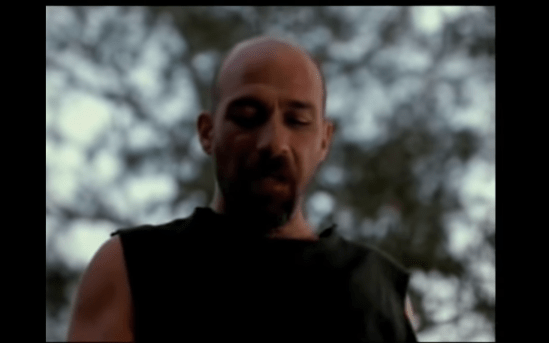
Though Sage Stallone, the late son of the iconic action movie star, Sylvester Stallone, receives front cover bill due to, in perhaps, his name alone, but the film is called “Chaos” which centers the story around the “Heat” and “Laid to Rest” actor, Kevin Gage. In some kind of cosmic circumstances in regards to recent events, before the Kelly Preston settled into married life with John Travolta, she was once wedded to Gage, marking “Chaos” as a timely film from 2005 and a just so happened upon my lap occurrence for this review. Yet, Gage, a seemingly giant of a man with a resemblance build toward WWE/WWF’s legendary Bill Goldberg, utilizes his intimidation appearance, transferring all the good and gentleness that’s described of him from fellow costars into a pure embodiment of evil whose misogynistic, bigoted, a killer, and just a downright bad guy giving way a testament to the character’s adverse moniker. Gage brings to the table a formidable tone, viperous wit, and a clean cut brutality in the most sordid and unforgettable ways that makes him stick out as portraying one of the most inhumane villains in the last 15 years of the cinematic universe. Chaos’s infamy is by ingenious design from the Marc Sheffler and David DeFalco collaborations who, along with the actors’ faux backstories, meticulously craft each of the gang’s personalities. Sage Stallone’s Swan seems like a similar parallel version of Sage in reality as a chain-smoking, reserved individual sans the perverse context. “The Love Witch’s” Stephen Wozniak is a complimenting character that offerings a different personality with Frankie and Frankie’s feels like a two-bit slime ball with long, greasy hair, an unkempt beard, and a scrawny figure but can produced an evil that’s step or two back from Chaos; Frankie is a character you’ll love and you’ll love to hate, making Wozniak’s performance singular and one of the best in the film. Then, there’s Daisy, the only female of the group though more butch than delicate, and Kelly K.C. Quann (“Baberellas”) adds a dose of Southern inhospitality to Daisy’s brutish beauty. “Chaos” rounds out with a bunch of victims; hell, everyone’s a victim, but the cast includes Deborah Lacey, Scott Richards, Maya Barovich, Chantal Degroat, Ken Medlock, and Jeb Barrows.

“Chaos” absolutely equates toward the unflinching callous themes from “The Last House on the Left” of violence amongst various degrees of people, youthful ingenuousness, and systematic racism with the latter being extremely relevant and on point, years earlier, of the current social climate in America. Yet, with any remake, “Chaos” yearns to stand on its own by instituting an unmeasurable sense of graphic violence that will churn stomachs, advert eyes, and belly-up the throes of disgust. For a good portion of “Chaos,” the exploitation narrative is fairly run-of-the-mill, damn near walks the same line as Craven’s story, with a sadistic gang kidnapping two young women for their own amusement only to then wander unknowingly into the arms of retributive parents, but two scenes sticky out and go beyond the course of customary exploitation fodder and into necrophilia, mutilation of body parts, and a perverse way to kill another human being with such tactless intentions that the act makes the other gang members splay questions, doubt, and fear amongst their faces. The film opens up with a written warning, not so much on the intense scenes themselves, but resembling more of a public service announcement for parents that what you’re about to see does and will happen to the youth of land, but these shocking scenes are just that, for shock value, and that a small percentage of people partake in such grisly matters. “Chaos” is violence upon violence, leaving no room for conscious absolving resolutions in the unofficial capacity of a remake that pungently separates itself with extreme violence and that’s saying something considering Craven’s visceral first course.

As the bestow flagship release of Dark Force Entertainment, “Chaos” arrives onto a deluxe special edition Blu-ray in association with Code Red and distributed by MVDVisual. Transferred through to a 1080p, high definition scan, from the original 35mm negative, complete with extensive color correction, and presented in a widescreen, 1.78:1 aspect ratio. “Chaos” doesn’t look very chaotic anymore in regards to the image quality; instead, the before stardom cinematography by Brandon Trost (“Lords of Salem” and “Halloween” remake) creates the voyeuristic position of the audience is now visually distinct with stable color markers that are more in tune with the premise’s raw approach. The English language dual channel stereo mix renders softer than desired, especially in the first act as Angelica and Emily converse through the woods. The teenagers dialogue are nearly mumbling on their rave trek with depth issues perplexing their relation to camera. Range seems to be well faceted: rustling leaves through the woods, the clank-clunks of a rustic van, the ground skirmishes. All seem to exude exact decimals of their intended value. Even the firing of firearms has a pleasantry about it. The special features include brand new interviews with co-producer Marc Sheffler, who goes in-depth pre-production and production while also touching upon his other interests before concluding with director David DeFalco and a man in a banana suit making an appearance and offering up dick jokes, and actor Stephen Wozniak with a fountain of information about his time on production, his fellow cast, and about the filmmakers as he is being interviewed in front of a locomotive museum. I love the absurd, obscurity of it all. The bonus material rounds out with commentary from the director and producer as well as the original theatrical trailer. The lewd and radical “Chaos” has engrossing roots of violence that burgeon into realm of rarity or, if not, into sadomishsim extended by the filmmaker’s deepest darkest desire, but what’s transpires on screen is difficult to look away from which begs the question, is it morbid curiosity or is there something far more sinister within us all?
Tag Archives: MVDVisual
EVIL’s Madcap and Meshuga Rabbit Hole! “Frankie in Blunderland” reviewed! (Wild Eye Releasing / DVD)

Frankie is the epitome of underachiever living in small, scummy, suburban house with an antagonistic and obtruding houseguest, Tommy Spioch, indisposed to ever new living accommodations and a brash Katie, Frankie’s wife, who loathes every fiber in his body, but reaps the benefits of his income. Fed up with how the way things are, Frankie impulsively decides to do something about by trying to kill Spioch, but when Spioch kidnaps Katie, Frankie wusses out on his freedom from their oppressors and pines to find Katie by hitting the streets. Frankie encounters the strange and unusual as well as the macho confrontational characters along the way, involving a spider with human face, a homeless man with paradoxical wisdom, naked fairies, Mormon aliens, and a hideous marionette-like boy.

In the midst of writing this review, Lewis Carroll is probably rolling over six feet underneath his English gravestone with the bastardized fantasy-comedy variation of his classic literary tale of “Alice in Wonderland with the 2011 released film, “Frankie in Blunderland,” from director Caleb Emerson (“Die You Zombie Bastards!”). Emerson, who is also a frequent editor for “Tosh.0,” helms the pretzeled script written by the late Marta Estirado, who passed away before the official release of the film, but “Frankie in Blunderland” is the Spanish-born writer’s debut screenplay twisted with browbeating cinema anarchism while juxtaposing circumstantial life defeat with an adventitious urge to be better despite the odds. Shot mainly in the greater Los Angeles area of Echo Park and Eagle Rock, “Frankie in Blunderland” is an Emerson funded, low-budget project that courses the weird and unnatural, a pair of descriptors that aren’t so abnormal on and off the streets of Los Angeles.

After assisting his editor skills with “The Gruesome Death of Tommy Pistol,” which was starred, produced, written, and directed by Tommy Pistol himself, Emerson locked down Pistol, whose credited under his real name of Aramis Sartorio, to be the titular character, Frank Bellini. If you’ve been audience to any of Tommy Pistol’s *cough cough* porn, you’re well aware of the male performer’s more-than-professional uninhibited nature to do anything on screen. The same uninhibited nature transcends out of adult industry and into the off-Hollywood narrative as Satorio unloads a wide array of unbridled range that allows Satorio to not only be a despondently enfeebled and sheepish Frankie, but also extend to his self-assured Tommy Pistol persona on the latter half of the character arc. Thea Martin and Brett Hundley (“The Trek”) play Katie and Tommy Spioch respectively as the adverse versions of Frankie’s wife and best friend. Katie and Tommy sincerely embark on the utmost effort in making Frankie feel like a worthless wanker by belittling him continuously on every whim he allows Katie and Tommy to get away with while they also stir the lobotomizing love triangle with their own sidebar skirmishes and much like the Lewis Carroll’s “Alice in Wonderland,” every character that shows up in “Frankie in Blunderland” is antagonistic to one and another in a bizarre battle royale of an irritational reality. The colorful characters continue with performances by David Reynolds (“House of 1000 Corpses”), John Karyus (“Poultrygeist: Night of the Chicken Dead”), Caleb Emerson, Gio Paloma (“Dawn of the Head”), John Christopher Morton (“Girls Against Boys”), Vincent Cusimano (“Blade the Iron Cross”), John Brookbank, Bryan Planer, Sadie Blades, and special appearances by “Slime City Massacre’s” Debbie Rochon as a human-spider and Evan Stone as a well-endowed fairy.

Like a full-feature skit from Eric Wareheim and Tim Heidecker, “Frankie in Blunderland” will activate your receptive inertia dampeners, slowing your comprehension down to the point of a snail’s speed on what exactly is going on with Frankie and his misadventures through an alternate reality of the real world all the while encountering the obscure and abnormal characters along the way, rekindling that trippy, if not hallucinogenic, sensation one gets when watching any other bizarre renditions more faithful to the Lewis Carroll’s classic but with more dry wit and blood. While I feign to know all the answers about the meaning behind Estirado’s outlandish script, I’m truly at a loss for words at understanding it, a feel much of the cast has also stated, and to interpret “Frankie in Blunderland” is to be a perceptive cinematic aficionado disconnected for reality, but from what themes I think I do perceive, Frankie reverses course on moral obligations for self-importance to become a quasi-anti-hero in bizarro world. For much of the film, Frankie is tormented, internally and externally, as he subsequently beats himself up over the abuse he meekly swallows from wife Katie and no-so-best friend Spioch and as act one continues to punish the mildly manner Frankie, there comes a point where Frankie is a glutton to own his maltreatment, learns to evolve from it, and becomes one with the disparaging masses in order to be part of the salt-in-the-wound collective that attempt to beat into submission or just downright destroy those unlike them, seen with characters like the loafer Mike West, the unsightly disjointed puppet boy, and a doughy-soft security guard named Peanutch, whereas a fem-bot, Maggie Robot, whose secretly a robot posing as a woman, can simulate into the natural order of the Blunderland society. When Frankie begins to thrash against and degrade these said characters is when he ascends beyond his suicidal thoughts and shoving aside his timid nice guy persona for more turbulent attitude toward life. If this speculation is anywhere near being accurate, then “Frankie in Blunderland” is a revolutionary view of unorthodox measures to rise up above despair in a day of stupidity enveloped by a ludicrous satire.

Perhaps not very extreme, but certainly raw, “Frankie in Blunderland” lands onto DVD under the Wild Eye Releasing sublabel, Raw and Extreme, and distributed by MVDVisual. The re-released Wild Eye Reelasing DVD is presented in a widescreen, 16:9 aspect ratio, housed with a new illustrated artwork liner that’s akin to the Ghana hand-drawn posters and, more than like, keeps with the first pressing’s lossy compressed image and spastic image jittering shifting between different levels of picture and detail degradation. The vapid coloring devours any story-telling vibrancy, leaving the scenes seemingly lifeless and aesthetically devoid, especially when Frankie has his loopy, unconscious discharge of repeated scenes and avant garde imagery after passing out thinking he killed Tommy Spioch. The visual effects are almost cut and paste crude, but add to the chaotic charm of Frankie’s living nightmare. The stereo dual channel audio mix is equally as lossy noticeably muffled by the compression, leaving also a faint and lingering hum through the 82 minute duration. The position of the dialogue remains even, if not behind, the ambient and soundtrack audiophiles and without any depth and range to compensate the lack of gusto, dialogue is lost in a lackluster limbo of lame and loitering linguistics. On a microbudget of this level, don’t expect in depth special features, but considering the content, I’m happily surprised of what’s available which includes a Caleb Emerson director’s commentary, cast and crew interviews with Aramis Sartorio, a peculiar interview with Thea Martin, and director Caleb Emerson, along with six teaserettes which are short clips from the film, and rounding out with Wild Eye Releasing trailers. “Frankie In Blunderland” is a labor of love for Marta Estirado and a sure fire way to kill a couple of brain cells in this degradingly funny demoralizing epic.
Pray EVIL Isn’t This Cruel. “Suffering Bible” reviewed! (Sub Rosa Studios/DVD)

Welcome to the Suffering Bible, a collection of violating and gory interpreted religious allegories digging into stark contrasts of sin and piety and illuminating the darker side of these allegories with a lacerating gruesome perspective. These short stories include the internal strife of a psychopaths strong urge for forbidden lesbian companionship with the contentious, bigoted teachings of finding forever friends inside God’s eyes, a visceral performing depiction of the Incredulity of St. Thomas, an extreme mortification of the flesh, the prideful consequences with a Devil’s pact, and the murderous portrayals of lost souls needing redemption into God’s good graces.

Right in time for the Easter holiday, where Jesus Christ has risen back from the dead for our salvation, comes Davide Pesca’s written and directed “Suffering Bible” of sinfully derived tales of reverent and irreverent perfervid images. The Italian made and produced anthology that’s a contexture of stories is forged together with a wraparound story of the Adam and Eve in the Garden of Eden apologue. “Suffering Bible” begins with a title card excerpt, Tear thy neighbor as thyself, from an unknown storyteller named saamang Ruinees with a skewed version of the second commandment, Love thy neighbor as thyself, subtly denouncing the evils in popular religious culture and then slithering them, not so subtly, into the shorts of those suffering at behest of the bible. Pesca’s shock efforts have come across ItsBlogginEvil.com’s radar once before with another short framed macabre tale, “Hemophobia,” from Artsploitation’s home distributed release of “A Taste of Phobia” anthology and “Hemophobia” is and feels more commercialized with less than salutary toward mutilation and variety body meat, but the filmmaker does fly on a parallel body horror plane and has had his shorts featured alongside with fellow Italian auteur and shock director, Domiziano Cristophario (“House of Flesh Manniquins,” “Red Krokodil”) with a more rudimentary, analogue-video-feel approach. “Suffering Bible” is self-produced by his independent production and distribution company – Demented Gore Productions.

Being an Italian made cast functioning on the performances grounds of a heel budget writing up about “Suffering Bible’s” actors and actresses past credits, influences, methods and so on is proving to be a challenging task. Most of the cast is comprised of alternative, half-naked women, such as Nicola Fugazza and Mary Rubes who are the sole credited on IMDB.com. Rubes, an erotic model, becomes “Suffering Bible’s” inadvertent poster girl that graces the Sub Rosa Studio’s DVD cover and static menu as her seductively deceptive solo performance of body and genital self-mutilation is the most unsettling story revolving around mortification of the flesh. Rubes has previously worked with Pesca on a 2017 short film entitled “Fame de Vampira,” which also co-stars Beata Walewska. Both Rubes and Walewska sizzle in the Italian action scene with “Rage Killers” by director Roger A. Fratter, who co-directed “Fame de Vampira.” As you can see, a casting inner circle is starting to form, but that’s the extent of the network with Simon Rocca, Simon Macleod, Catlin Strange, Pate Douce, Paolo Salvadeo, Emilio Stangalini, Paolo Borsa, Emanuela La Neve, Chiara Digonzelli, and Marilena Marmo.

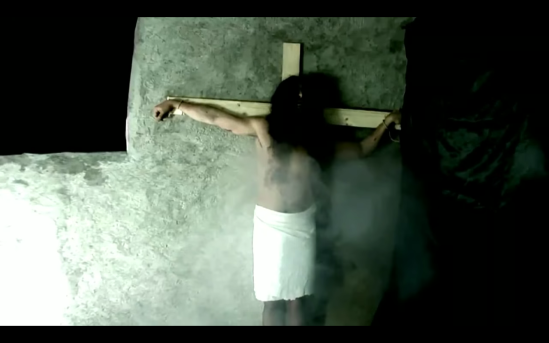
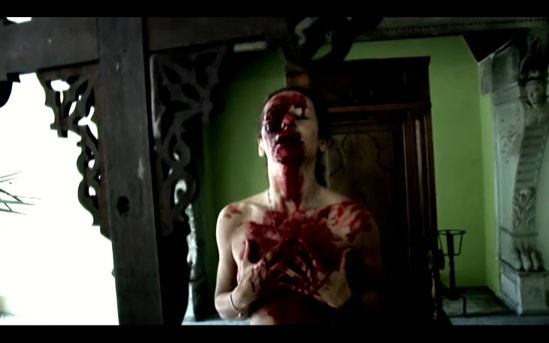
On the surface, “Suffering Bible” has a unwieldly, pigeonhole affect that places the impervious shutters around one’s peepers and thinking cap for the pleasures of gore and nudity that run continuously rampant, but Davide Pesca has a connect-the-dot vision that aims to unveil the worst of religious culture, using graphic imagery in a reverse psychological and divinity experience that’s wildly novel inside a less commercialized parameters and the more I stew on this film, the more I like it. Without this review not seeming to be a theoretical paper on Davide Pesca and the “Suffering Bible,” examples of the filmmaker using gore as the pain and suffering vessel for those struggling to be closer to God can be modeled from the first short, “My Only God” aka “Friends Forever,” in which a woman stitches herself to her now dead friend to be closer to her, as if their friendship, which was severed insinuated by the dead woman, will continue in the afterlife. Same can be said about the last, if not more potently gristly, short, “The Redemption of Last Souls,” where a druggie, a terminal ill person, and a homeless man who has lost family connectivity have nothing left to lose, have lost faith, and seek redemption through being chair strapped subjects of a snuff film. While “My Only God” and “The Redemption of Lost Souls” caters to the barbaric rite of celestial passage, Davide Pesca’s specialty falls more within the lines of body horror as the filmmaker has saturated himself in the infatuation of the Body Modification culture, reflected in his “St. Thomas” and “In The Name of The Father” that include Doubting Thomas reaching protractedly into a crucified Jesus’s side slit and include the extreme mortification of the sinful flesh – eyes, breasts, and clitoris – by a devout devotee.

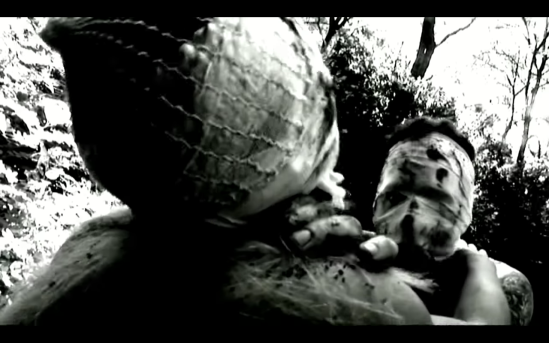
“Suffering Bible” is a throwback moxie livid on sin and body destruction and it’s a title coming to you on DVD home vide like a disastrous, break faith, miracle from SRS Home Video and MVDVisual. Though listed as a retro release by SRS, “Suffering Bible” released in 2018, shooting over the course of a few years prior more than likely, with a combination sepia-color approach and the result outputted a strained and digitally cursed image of a widescreen, 1.78:1 presentation that suffers from severe compression artifacts in conjunction with digital interference. The errs are absolved by the very label of a throwback “erotic art house horror” gracing the retro, faux-VHS DVD back cover. The single channel stereo has limited flexibility with some ostentatious, if not laughable, Foley work. Aside from a little dialogue in two of the shorts, “Suffering Bible” takes a vow of silence and speaks volumes in actions alone; this creative choice, along with some probable glitch art, saves much of the technical woes already plaguing Pesca’s stain on profane. The robust grunge-brood style of OKY’s prolong guitar distortions, delicate strum and percussion echoing, and reverse melodies bedazzles in a cathartic relief that no dense, run of the mill metal band is attached to the soundtrack. Special features include a short interview with Davide Pesca, which turned out to be more of a behind-the-scenes look at handful of shorts for the film, a lengthy ultra violent and gory showreel for Pesca’s “Tales from the Deep Hell,” and SRS trailers. More grimly poetic than sleazy gore-porn, the book of the “Suffering Bible” can open eyes to the unsettling infernal of holy virtue with transfixing horrid death rooms.
The Analogies of the EVIL that Plagues Us. “Hole” reviewed! (Wild Eye Releasing / DVD)

Three peoples’ lives become coiled around the unfortunate state of death with each experiencing individual variations of the concept. The recently released convicted felon, Ed Kunkle, faces reality on the brink of insanity as his past demons vilify his temperament in the direction of total carnage. Befriended by Kunkle is Eve Adams, a single mother who struggles to cope with her infant son’s untimely murder that happened right under her watch. Assigned to the Adams Boy’s case is detective Bodie Jameson who struggles with own malevolent urges brought upon by the unsurmountable cases of grisly homicides that come cross his desk while he also tracks down a child killer. Their differences connect them, looking into their future to rediscover the past that molded their disheveled lives into fateful affairs with death.

Over the course of three years between 2007 to 2010, auteur filmmaker Joaquin Montalvan directed and assembled a gritty glimpse into the grubby windows of condemned souls with the 2010 released “Hole,” produced by his own independent production company, Sledgehammer Films, and co-written with his longtime collaborator and wife in life, Eunice Font. “Hole” is Montalvan’s third horror feature following 2002’s beleaguered with loneliness thriller “Adagio” and psychological horror, “Mobius,” which was released the year prior in 2009, plus also behind a string of documentaries. Montalvan’s an optically surreal storyteller basking in a rich and unorthodox story and color palette that revives originality bobbing in an heaving ocean of lemming horror.

“Hole” is comprised of showcasing three stories from three tormented lives. One of those lives, the mentally unfit Ed Kunkel, gorges on being the centric force that thrives the other two into a descendant hell. The late Paul E. Respass tunes into Kunkel’s manic polarity as a person who can be extremely mild mannered and pleasant then explode with caustic abrasiveness and ugly torture. Respass’s shoulder length, wavy hair, graying goatee, and iron contoured face gives him a Charles Manson appearance that goes good with crazy. Behind closed doors Repass’s Kunkle breaks with sanity slaughtering his mother lookalikes as a result of mommy issues, but when conversing with Eve Adams, Kunkle’s maintains an upright keeled temper. Teem Lucas, who like Respass has worked with Montalvan previous, subdues the abnormal imbalance with a normal person’s reactionary response to loss and heartache when Eve Adams copes with the murder of her young child. In the middle these two extremities, detective Bodie Jameson’s work seeps into his psyche, fluctuating between irrational and rational thoughts. Another actor in Montalvan’s corral, Jim Barile, who looks more like a 70’s hippie than a detective, has the hardest performance of them all of slipping into a terrifying unknown mindset while maintaining status quo in work and romantic relationships. Barile’s role isn’t well recieved, flying mainly under the radar with an underperformed and pointless conclusion to detective Jameson right and wrong affliction. Charlotte Bjornbak (“Camera Obscura”), Katherine Norland (“Cannibal Corpse Killers”), Alina Bolshakova (“Dead End Falls”), Dennis Haggard (“Cannibal Corpse Killers), Theresa Holly (“Legend of the Hillbilly Butcher”), Micki Quance, Gavin Graham, and Char Frost (“Someone’s Knocking at the Door”) co-star.

Right away, a strong sense of resemblance washed over me when viewing “Hole.” The lead actor, Paul Respass, and the overall texture felt already acquainted with my visual cortex nerves. My suspicions were justified and my sanity was cleared as I have seen “Hole” before in a later film entitled “Legend of the Hillbilly Butcher,” another Joaquin Montalvan flick featuring Respass as a delusional manic. Yet, “Hole” is one of those films that after the credits role, hasty judgements should be chewed on, reflected upon, and recollected for a second analysis. Hell, you might as well just re-watch it all over. The thing with Montalvan is is that his brand has trademark cognizance on such a level that even if “Hole,” released in 2010, and “Legend of the Hillbilly Butcher,” released in 2014, instinctually ride the same wave, they ultimately compare as individual projects with a distinct personality and artistic flair. For instance, “Legend of the Hillbilly Butcher” denotes more of an homage to early exploitation films and “Hole” puts more stake into societal system failures, even if borrowing from the likes of Ed Gein with the killer wearing a flesh mask and sewing up a fleshy garment. Both films hark about mental illness, but one glorifies the act for the sheer sake of carnage fun and the other considers it a collateral damaging symptom of a broken justice structure. Another difference to note is “Hole’s” three-way non-linear narrative that moves like the Wonkavator from “Charlie and the Chocolate Factory” in every way imaginable and can be daunting to keep up.

Out of the depths of obscurity comes “Hole” distributed on DVD home video by MVDVisual and Wild Eye Releasing under the Raw and Extreme banner. Presented in a widescreen, 1.78:1 aspect ratio, Montalvan and his D.P. R.T. Norland, brightly bedazzling with every shade of matte box and some slow motion, play the field utilizing various techniques to tap into Ed Kunkle’s disorienting madness. Using backdrops like the ghost town of Bodie and the spiritual sanctuary (or bohemian commune) of Salvation Mountain, Montalvan’s able to cast an aberrant vision out inside an independent means. There are some points of posterization, details are softer than desired, and blacks lose composition with blocky noise so there are some drawbacks to the encoding. The English language dual channel audio mix pairs about the same as the video with spliced competing facets that tend to offer come-and-go range and depth. Scream queen moments go into feedback mode during Ed Kunkle’s kill mode, losing the ideal quality via unsound mic placement. Dialoge is okay being on the softer side with some background noise being flowing in and out between the audio edits, emitting a static effect around the dialogue and then cut out when not the actors are not speaking. The bonus features are aplenty and informative with a Montalvan commentary track, an extensive mack of documentary that fine combs every pore of the film that includes interviews with cast and crew, Ed’s Journal segment conversing about the backstory on Ed Kunkle’s perverse family and killed friends portraits and souvenirs, as well as trailers. Bloodhounds will want more from Ed Kunkle’s shed of horrors, but what director Joaquin Montalvan has fashioned threads madness with a neglected mental heath system while polishing a a shiny three prong, moviegoer narrative with blood, body parts, and butchery.
Danzig’s EVIL Stank All Over This One! “Verotika” reviewed! (Blu-ray, DVD, CD / Cleopatra Entertainment)

Three sordid, macabre tales straight from the controversial pages of Glenn Danzig’s Verotik comic line that slips into the surreal lurid dimension of obscure stories of a subconscious half-human, half-spider manifestation with a sexual appetite and a morbid desire to break the necks of women of the night, of a disfigured and mysteriously alluring stripper who seeks out beautiful women nightly to crudely remove their faces with a knife and overlay their once perfect skin on top of her face as she adds them to her collection of facial distinctions, and, lastly, of a bloodthirsty medieval countess known to her subjects for exquisite beauty and grace emanated by the blood baths of her virginal female subjects.

Legendary metal musician and songwriter Glenn Danzig has been a symbolic (Anti-)God that inspired other metal bands and fans over for more than 40 years, birthing perhaps the original, and still more popular, horror-goth punk bands to ever set the black lit stage, the Misfits in the late 1970’s. Outside his illustrious musical career, Danzig owns Verotik, a comic book publisher, that’s a portmanteau derived from “violent” and “erotic,” geared toward adult-themed material and inspired by his fascination with horror. In comes “Verotika,” a three short film anthological horror feature penned by Danzig and is his director debut while in collaboration with powerhouse musical recording label, Cleopatra Records, under their cinema label, Cleopatra Entertainment. Co-producing alongside Danzig is James Cullen Bressack, whose heavily been the created force behind the affectional indie found footage horror “2 Jennifer” and “From Jennifer” films, and Bressack associating collaborator, Jarrett Furst.

Keeping with the “Verotika’s” motif of scantily cladded women and the elements of horror, each story is driven by a female lead portrayed by actress who’ve established themselves with a scream queen presence, have enter the entertainment industry by way of X-rated programming, or are fresh faced with the presumptive hypothesis that the role secured was for their voluptuous assets. Ashley Wisdom is one of those endowed actresses that fit the latter category. The Instagram model and fling of Glenn Danzig becomes a shoe in for the lead of Dajette in the first segment, “The Albino Spider of Dajette.” Wisdom’s cringing faux French accent and rigid manner doesn’t wholly dilute from her bustier attributes that include prosthetic eyeballs for nipples – all part of Dajette’s character – and fairs better than Scotch Hopkins’s (“2 Jennifer”) absurd Albino Spider of grim free verse prospects inside a stiff, stingy mockery of a humoresque spider. Optimistically, the episodes only go up from her with the following tale ”Change of Face” that follows mystery girl, “12/12/12’s” Rachel Alig, hunting down and slashing off the faces of beautiful women for her collection. Alig is a palpable psychopath amongst a sea of overzealous, conventional orchestrated character types that sells a noir, or hints at a giallo, loom that sensualizes as well as sexualizes a salacious one-person schismatic view of beauty. However, the grand finale saves the best for last with Verotik’s more diabolical and foundational brutal transgressors, Drukija: The Countessa of Blood. Without so much of a setup or without expositional bookends that dive into backstory, conflict blossoming, or even resolution, Drukija’s a voyeuristic chronicle that exhibits the day in a life of a abhorrent ruler soaked in virgin blood with Australian actress Alice Tate fulfilling Drukija’s iron spike studded crown. Numerous scenes linger with Tate just bathing in blood or checking her sangre-moisturized skin in a three-way mirror to just extenuate the picking and choosing of daughtered victims, gleaming of deity-hood inside the eye’s of her maniacal maiden hand, and, in her spare time, amasses decapitated heads of the slaughtered young women as keepsakes. Yet, Kayden Kross dignifies that porn stars can get into the silver screen market, well, at least in Danzig’s irregular one. The director and starlet filmmaker hosts an outer edge story as the witchy-gowned and demonically unholy Morella who introduces each segment in between. Sean Kenan (“My Trip Back to the Dark Side”), Natalia Borowsky, Emma Gradin, with special cameo appearances by Caroline Williams (“Texas Chainsaw Massacre II”), Courtney Stodden, and a number of women from the porn circuit like Kross, such as Bobbi Dylan, Katrina Jade, Emma Hix, Aalyiha Hadid, and Veronica Ricci.

I’m all for the forging of industry realms when comic meet the big screen with adaptation and love Verotik’s edgy eroticism and hyper-violence mantra, but “Verotika’s” pulpy irregular narrative meter coursed a perplexing devolved sojourn through our visual cortex, leading us pleading for a bigger, better version of Danzig’s auteur dreamscapes. Verotik’s a fire and brimstone optical narrative from the illustrated pages that speak volumes of profligate and vivid avant-garde characters and unlimited violence that tremendously lose that tailor-made authenticity when translated to the screen. Danzig’s free-form script works with music symbiotically; for together, the strums and riffs glue together disassociating dialogue to a unison of harmonics, even if Danzig’s prefers harsher rock melodies. For the musician’s first dance with directing, Danzig deserves props creating a gory, pulpy, and colorful piece of his subsequent profession. Yet, there’s always room for improvement in his technique, such as Danzig’s fascination with the zoom feature on the camera. The edit cut is almost too rough for swallow with no segue equilibrium between shots that result in some obvious cue acting and I’m usually a fan of Vincent Guaustini’s work, but his Albino Spider suit, in which the other four arms out of the three sets were fastened together, rolled back years of good effects work.

True to form, Cleopatra Entertainment offers a staggering release for Glenn Danzig’s “Verotika” in a triple-format Blu-ray/DVD/CD release distributed by MVDVisual. For this review, the Blu-ray was covered and the transfer is released in a widescreen, 2.35:1 aspect ratio, shot on an Arri Alexa anamorphic lens camera. The enormity of color schemes offers a wide variety of tints, especially in “The Albino Spider of Dajette,” but revert to more a natural tone for “Change of Face” and “Drukija: Countess of Blood” with stable details inside and outside the black. Slightly hazy (or maybe just smokey?) at times, but the 1080 does too good of a job to see all the nonexistent pores on the ripped off faces in “Change of Face.” The English language Dolby Digital 5.1 surround sound audio mix that, again, has a lossy quality from Cleopatra Entertainment, a sub-label of a major music recording company. The surround faintly register ambient audiophiles inside the channels whereas Danzig’s rock solid and eclectic soundtrack offers more, just a notch more, LFE oomph quality to boost into all areas. The CD renders around the same lossy quality. Bonus features include a trailer, a slideshow, and, of course, the compact disc featuring a new track from Danzig and also features tracks by Ministry, Pink Velvet, Studio 69, and Switchblade Symphony. Like a bizarro “Red Shoes Diaries'” episode, “Verotika” bares no shortage of nudity that’s interlocked with well-nigh arbitrary violence spread-eagled in a gnarled cinema anthology of surreality that lied festering inside Glenn Danzig’s head.