

A Church youth group voluntary attends a Saint Christopher’s Catholic Middle School weekend cleanup before the school’s much needed reconstruction and restoration. As soon as they start with the sweeping, dusting, and polishing, three demon nuns, let to suffer behind an enclosed brick wall by a child molesting priest, unleashes their vengeful wrath, a gift from their new lord and savior, the devil, to whom they’ve sold their soul. Quickly, one-by-one the volunteers fall to the flesh hungry demonic nuns, using their sins against them, and extracting their souls for hell bound eternity. The select few to survive the ordeal of nuns will come face-to-face with Satan himself where praying for mercy will get them nowhere and is the same as burning in hell.

Director Richard Griffin once again pushes down the throttle to wrap the shooting of an entire movie in a matter of days on another lightweight budget. “Flesh for the Inferno” had a 9 day shoot with, and no surprise here, Griffin hiring some of his entourage of talented actors and actresses. The stage actors employed are always remarkable to watch; the underrated Michael Thurber, even in a toned down performance, is such a joy to watch with his adaptable skill set to jump into the shoes of any role in any film. The same can be said about the co-leads, Jamie Default and Jamie Lyn Bagley, who easily adjust into various roles from one Griffin film to the next. However, to my surprise, Griffin’s works with new faces, such as Ryan Nunes, Andrew Morais, and Kevin Michael Strauss, whom fit into his homage work of European possession horror. Then, there’s the talented Aaron Andrade who puts any other actor’s portrayal of Devil to shame.

Griffin and long time collaborator and cinematographer Jill Poisson purposefully softens the lens to give the photography a dreamlike or surreal state to mimic the iconic European director styles such as from Mario Bava or more in tunely with Lucio Fulci and though this respectable style was succesffully achieved and did contribute to the Bava or Fulci level of cinematic and atmospheric charm, the haziness was a bit overbearing, almost closing in on the actors within a modified frame of dominating clouds. The effect mostly shadows from what I noticed, right off the bat, the recognizable set from a previous Griffin film, “Future Justice,” sporting a new coat of paint and constructed with new, or new-ish, set pieces to create the Catholic school locale.

Screenwriter Michael Varrati churns out a script in less than a week to give Griffin much time as possible on a location rented much longer than needed. Varrati has written remarkable natural banter between opposition, connected, and flirtatious characters and does well with the dynamics for a quickly progressing story where shit hits the fan, crossing over into act two, in a matter of minutes. Its the dialogue, however, that slightly over saturates “Flesh for the Inferno” and it’s demonic, habit-wearing nuns. Fully engaged conversations between the nuns and the unlucky survivors cross over into theological debates rather than leading into a sacrilegious and unholy curse. Though at times, scenes like the one with Michael Thurber chasing his own tail in a Groundhog Day movie-type scenario was well placed in the story and well shot, even if little-to-no dialogue was present.

“Flesh for the Inferno” was suppose to be Griffin and his crew’s all out gory effects movie the homage attuned director has ever filmed. Yet, I can’t help but feel as if the opportunity was bobbled to recreate a “Demonia’s” bloodshed. The John Dusek effects were simply effective though, catering to all the film’s intention and needs to pull off a nasty nunnery narrative. The Timothy Fife soundtrack isn’t necessarily Fulci inspired as well that perhaps resemble more of a Goblin and Ennio Morricone blend and that’s highly more notable.

Scorpio Film Releasing and MVDVisual distribution together created and distributed another fantastic film that’s graced with retro-sleek cover art, like always, and I’m always impressed by director Richard Griffin’s capability to turn low budget horror into a formidable admiration of the old days of all kind of horror. Griffin and his entourage are on a whole separate level than their counterpart in their Hollywood doppleganger Eli Roth. The MVDVisual DVD looks sleek with a 16:9 widescreen presentation for the 79 minute feature. Bonus material is limited, but informative, that includes a crew commentary, cast commentary, and the film’s trailer.
Tag Archives: MVDVisual
All Evil Breaks Loose! “Mansion of Blood” review!

Pretentious millionaire Mason Murphy hosts the largest and sexiest lunar eclipse party in the close knit community of River Ridge. Murphy renovates the old Mayhew estate, home to the mysterious disappearance of the wealthy Mr. Mayhew in 1926, as the party’s extravagant setting. One of the young party goers is also a practicing partaker of witchcraft and when she attempts to summon upon the spirit of her dead boyfriend to ask about whether he bought a winning lottery ticket or not just before his death, she accidentally aligns all things evil right as the eclipse takes place, trapping the oblivious guests in a nightmarish twilight zone that includes black bat demons, Civil War ghosts, lawn ornament zombies, bar tending vampires, and a slew of maniacal murderers.

Director Mike Donahue’s “Mansion of Blood” is a horror-comedy of an ambitious narrative that was doomed during the middle of production, resulting in a shameless, mishmash heap of a film. From what I’ve read from various article sources, “Mansion of Blood” came to a screeching production halt due in part of a sexual assault claim from an actress or two. The complaint was against the film’s headlining star, Gary “Lethal Weapon” Busey. Are we really surprised here? Busey, who suffered permanent brain damage in 1988 after a motorcycle accident, has sustained from his wild and crazy, sometimes delusional, antics that raises many eyebrows through almost the last three decades. The film’s crew was so fed up with Busey that he was actually fired and massive re-cuts and re-edits caused the story’s downward slope. Aside from the Busey debacle, executive producer and one of the film’s stars Tom Tangen is rumored to have screwed over the film’s investors, leaving director Mike Donahue high and dry.
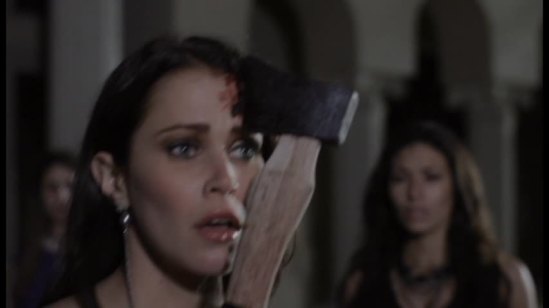
Honestly, I strongly feel “Mansion of Blood” never came an inch off the ground. I get that the film is a horror-comedy in a slapstick sub-genre, but the story is in total shambles. Numerous characters and their individual stories are diluted to the point of being a suffering and aggravated attention deficit disorder. The severely choppy editing, the unbalanced dialogue and ambient audio tracks, and the oafish acting throughout only piles on top of an already high mountain of sadness. And even though I have a soft place in my heart for Busey and his sheer lunacy, in life and on film, his performance as the malicious party host Zachariah was, dare I say it, surprisingly stale. Only a few handful of scenes of Busey’s floating, grinning head faintly superimposed as a ghost or a spirit or as a something are uniquely guilty pleasurable. Not all has failed as the film’s other star, “Star Trek: Voyager’s” and “Innerspace’s” Robert Picardo, attempts and succeeds at a good performance as the party’s caterer who ends up almost being poisoned by his chef wife, played by Lorraine Ziff.
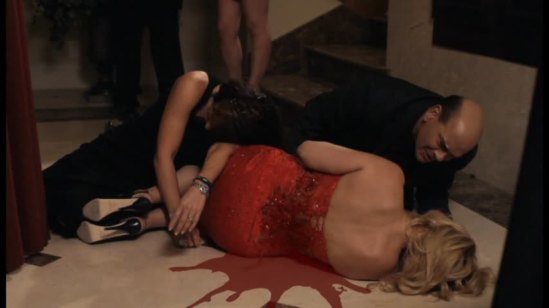
Again, I’m well aware that “Mansion of Blood” is a horror-comedy, but the no budget special effects couldn’t be any more offensive to our intelligence. The “demons” were extras in black face and black leotards with a dark cape and plastered with exuberantly adhesive bat ears. The computer generated lunar eclipse was near 1950’s animated cartoonish. These effects bog down the quality of the film, turning a potential Sci-Fi channel movie spoof to a more of an obsolete, outdated, and cheesy and campy schlock that could be deemed worthy of being presented on Mystery Science Theater 3000. Instead of solidly funded practical and computer generated special effects, Donahue leans firmly on the hard bodies of young (and some slightly older such as Lorraine Ziff) actors and actresses. The naked bodies of upcoming scream queen Mindy Robinson and the industry versatile Dustin Quick are two to name just a few who pair up with the rock hard abs of Kyle Clarke and Frank Mora Jr. One would think Jennifer Tapiero, Sarah Alami, and Tegan Webster would be the group of main characters that would develop and expand throughout the duration since they’re stories begin in a diner, but their characters become junk roles that fizzle into into oblivion and tangents are created for non-setup characters.

“Mansion of Blood’s plethora of characters is too much to handle, especially when the film tries to go in numerous directions that doesn’t give Donahue’s motion picture any direction. The story and script flounders as the legs are cut right from underneath both of them. I empathize that the Gary Busey and the rumored Tom Tangen issues might have derailed this project that categorizes this film into the scrap-to-salvage scenario similar to prior films like “Bad Meat” and “Old 37.” Tom Cat Films and MVD bring “Mansion of Blood” to retail shelves and I encourage those brave enough to venture into the film to remember this particular review because when the credits begin to roll and the popcorn is down to the last few underdeveloped kernels, you will know somewhere in the sands of time and space that I’ll be whispering in the ears of your mind, “I told you so.”
An Evil Bouquet of Purgatory. “Flowers” review!

Six dead women relive pieces of their previous mucky lives embodied in one seamless soul that’s trapped in the literally gory innards of their serial killer’s home. Forcibly held in the limbo of a filthy purgatory, each woman find themselves in a different, and extremely hellish, part of the house and each carry the same gruesome autopsy laceration across the front of their chest, crudely stitched together and coming apart at the seam ready to pop open their insides at any moment. Unknown to why their confined, an ill-fated reason develops at the end of the maze’s demented journey through the home made of severed body parts, decorated with pieces of human tissue, filled with decomposing bodies, strewn with ghastly entrails, and drenched with blood.

Director Phil Stevens composes an avant-garde horror story orchestrated with no dialogue what so ever through the duration and spatially effective in close, uncomfortable quarters . Certainly unique from anything else I’ve ever witnessed, “Flowers” doesn’t apologize for being overly gory and disgusting, pursuing a stomach-churning reaction from all allegoric angles. Slip-and-sliding through the murderous muck and goop, each of the six dead women seem hysterically unfaded, yet more intriguingly curious to their surroundings, even if that means putting their hands through a tonnage of viscera and ripping their own flesh open. Indie films like Phil Stevens’s “Flowers” will never catch the eye of most mainstream audiences and will never know of their existence, but a few lucky viewers, like myself, get to experience the surreal work from the horror underground. Fans of Marlan Dora’s “Cannibal” or Jörg Buttgereit “Nekromantik” will revel in “Flowers’s” grisliness and gloomy nature.
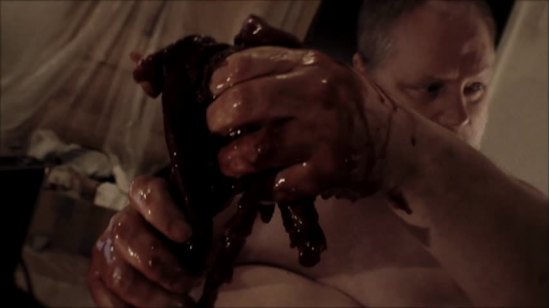
The cast is made up of six alternative lifestyle women, each one credited only as Flower 1 through 6, and take up a particular different segment and sprinkled into their story is their merciless and necrophiliac killer, only credited by the name The Exile. In sequential order, the Flowers are played by Colette Kenny McKenna, Krystle Fitch, Anastasia Blue, Tanya Erin Paoli, Kara A. Christiansen, and Makaria Tsapatoris and the killer is played by Bryant W. Lohr Sr. The majority of the actresses take on more than their literal roles in the movie. The physical body horror effects are applied by Anastasia Blue and Krystle Fitch to create open wounds across the actress’s chests and the uncleanliness costumes and wardrobes are provided by Makaria Tsapatoris, whose experience has been from the 15 year participation of the horror season attraction Eastern State Penitentiary in Philadelphia.

The abstract story is intensively focused on the women’s lives rather than their slaughterer The Exile. Their stories are personally tragic as if the Flowers are trying to purposefully or unintentionally ignore real life by way of drug abuse, prostitution, or both. Each actress has to put forth extra effort in their silent performances as dialogue is nonexistent and they’ve successfully compel themselves to act out the scenario, working with their surroundings and being, well, dead. The Flowers may not seem frightened of their killer’s house made of guts, but the Flowers are definitely disgusted, nearly tossing their insides in a few putrid cladded rooms. You may not want to eat while watching some of the segments. Very little is known about The Exile, a very large, but well kept man with a hankering to kill the gutter girls, bathe in their guts, and, sometimes, have sex with their gut-exposed dead body.

“Flowers” is available in two DVD editions, a standard one disc which is reviewed here and a three disc limited edition set, from Unearthed Films and distributed by MVDVisual. The technical video is presented in a widescreen 1.85:1 aspect ratio with a 2.0 dolby digital audio and, frankly, the two channel audio is all “Flowers” needs with no dialogue or major sound effects as a poetic soundtrack guides with harmony mostly through all of the audio work. The image quality is detailed and vividly enticing, but the colors are intentionally dull and for darker scenes that create ebony silhouettes that are practically not visible or coherent; these scenes only deter for only the first 20 minutes of crawling through the house’s bloody undercarriage and won’t ruin the remainder. For only the disc one edition, extras are fairly good with interviews with The Exile actor Bryant W. Lohr Sr., an audition tape of Makaria Tsapatoris, behind the scene stills, an isolated FX track, and commentary tracks with director Phil Stevens and associate producer “Ravage’s” Ronnie Sortor. I recommend the grotesque “Flowers” to any horror fan without a weak stomach and a mind for the abstract!

A Video Diary of Evil. “The Death of April” review!

Megan Mullen, freshly out of college life, feels a strong urge to pick up and move from her comfortable California family home to the new surroundings of New Jersey. She can’t explain her why to move, but she quickly finds an apartment in East Rutherford where she settles in easily, creates a video journal for her friends and family back home, begins her new job as a school teacher, and gains a wonderful boyfriend. Everything seems to be going perfect for Megan until unexplainable, seemingly paranormal, acts happen in her apartment: doors open and close mysteriously, objects move on their own, and her soul doesn’t feel like her own. As she continues to her video journal, she further believes her apartment was once rented by April, a young girl similar to Megan who ended up brutally murdered and found on a riverbank, and that she is haunting her. This is Megan’s story told through a documentary revealed by her friends and family to the supernatural speculation of what causes Megan’s torment and downfall.
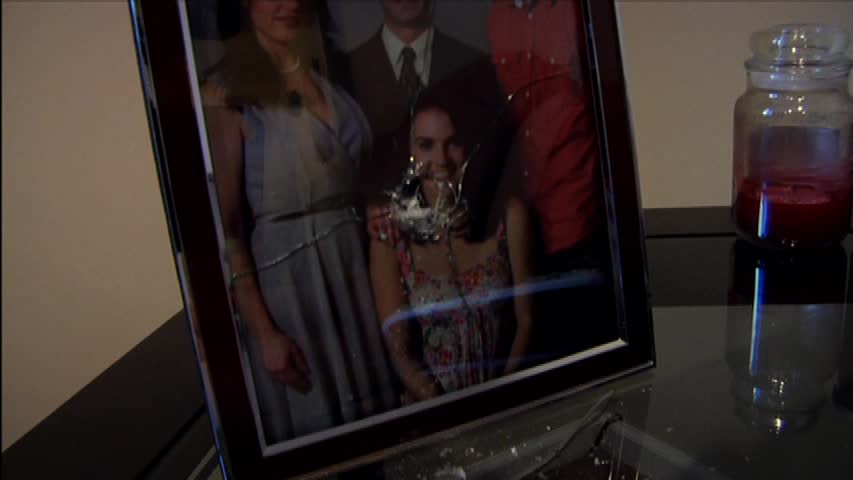
In the spirit of new releases on or around horror’s big night of Halloween, Director Ruben Rodriquez’s 2012 paranormal mockumenatry “The Death of April” comes to life on for the first time on DVD from MVDVisual. Similar to the “Paranormal Activity” series, the pseudo documentary about a dangerous, abode dwelling spirit or spirits bombarding their supernatural havoc upon helpless inhabitants. While the release time is appropriate and has a modest appreciation for creepy atmospheres, “The Death of April” fails to bring something new to the genre table and I can’t see the easily overlooked “The Death of April” being the catalyst to spark more interest in a ghostly genre that becomes overpopulated, by the major studios, during the month of October.
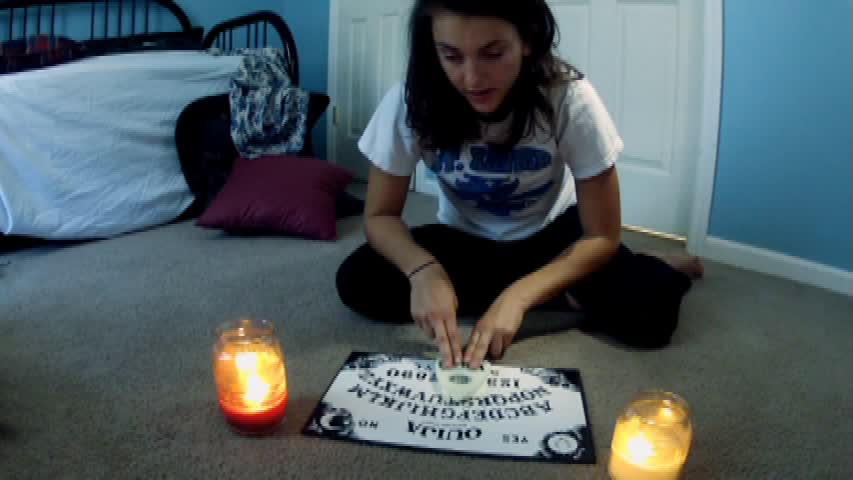
Backed finically by the Mojo Creative Group that was founded by Ruben Rodriguez, the mockumentary introduces a modest talent of actors and actresses including Katarina Hughes as Megan Mullen. Hughes, in her first feature film, delivers the much needed energy to a slow, stagnant script, but the contrast exaggerates Katarina’s overzealous happy-new-girl-moving-to-a-different-coast attitude. Her co-stars Adam Lowder as her brother Stephen Mullen, The Knick’s Chelsea Clark as her best friend, RayMartell Moore as her boyfriend Tim, and Stephanie Domini as her mother, who by the way looks almost the same age as Megan, sold their story, their take, of Megan’s downward events. That being said, Lowder, Clark, Moore, and Domini couldn’t lift the script out of the deep trenches of the uninteresting and mechanical motions.
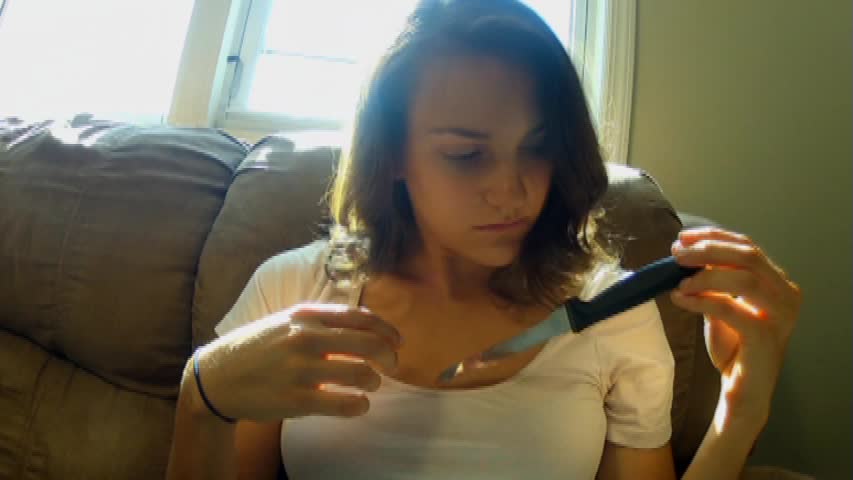
The script, which was also written by Ruben Rodriguez, could be considered to contain two interpretations, one literal and the other more concealed. The more literal interpretation is my least favorite of the two. Megan’s family constantly disowns the fact that she might actually be haunted by an apartment spirit; in fact, her family and friends negatively pelt her with denials and accusations, never once considering Megan’s theories of an aggressive April spirit. This is where the script becomes redundant as Megan’s brother Stephen and also her mother Stephanie reiterate over and over about how close their relationship with Megan was and how she had firm family roots in California and also proclaim the excuses of how she’s looking for attention or not coping with a new surrounding very well. Rodriguez’s script suffers by not displaying alternate ways in exploring how her family and friends should handle Megan’s paranoia or paranormal problem. Even when they’re is undeniable video proof with the video starting to distort and capturing uncontrollable movements from inanimate objects, nobody believes Megan and that would drive anybody to the loony bin. The second interpretation with, perhaps, a more underlying metaphor is that Megan is slowly going nuts. Her brother Stephen does mention her previous slightly creepy issues with Megan before her big impulsive move to the east coast. Almost like her impulsiveness and her energy-filled antics seemed manic and her sanity practically dissolved when she moved thousands of miles away from her support group in California. Megan’s mind could have invented April and her family, knowing that she’s had weird issues in the past, chalks this up to just being another mental issue. Of course, the video diary proof, even with her brother and friend witnesses, nearly excludes the second theory and that her “desire” to move far away from her family stems from April pulling her in that direction.
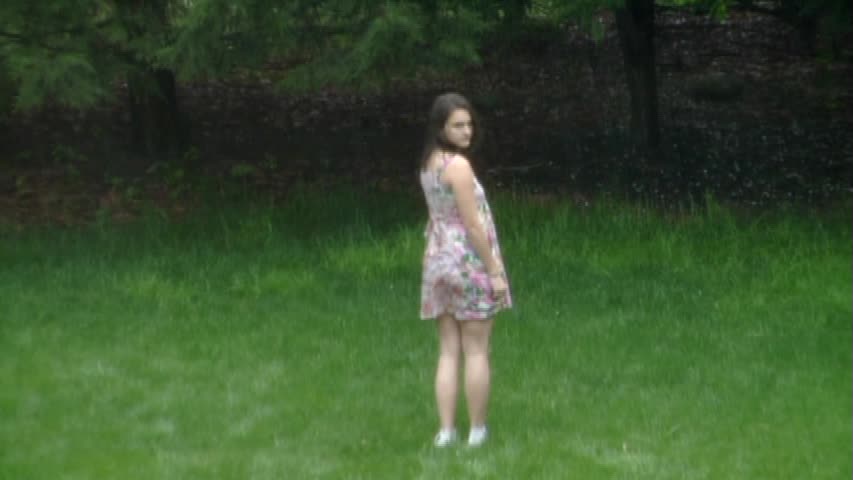
“The Death of April” won’t make waves on the PKE meter. The picture quality of the MVDVisual and ITN distribution DVD release looks clean considering that most scenes had intentional video quality posterization and distortion for the web and home video diary appearance. The front cover art is slightly misleading with a foreboding, rundown gothic style house in the background when actually Megan lives in a sectioned off duplex apartment in a suburban neighbor of a New Jersey home that doesn’t look necessarily evil at all. Also, who I’m guessing is spirit of April on the front cover with a Ouija board in her clutches sports sexy booty denim shorts as if to lure a certain audience to the release. We’re not sold on “The Death of April” as too many before it’s time have come across and planted their seed and sprouted firm in place.
Evil Reeks in an Old Magician’s Mansion. “Death’s Door” review!

A young group of people are mysteriously texted an address for an unknown party. When they arrive, the address takes them to a dilapidated mansion with innards displayed as if time has ceased to exists. When the group tries to leave, all the doors to the outside won’t open, condemning them to the horrors of a magician’s vengeful spirit and his very large and frightening assistant who looms around the mansion’s endless corridors. As the group continues to butt against each other in distress and disbelief, one-by-one they fall victim to the magician’s gruesome parlor tricks behind every door and the only way out of the mansion may be dependent on their families’ legacies.

With a premise similar to the 1999 remake of “House on Haunted Hill” where a group of people are mysterious invited to a creepy house and end up in a death trap, I wouldn’t say director Kennedy Goldsby’s “Death’s Door” aka “The Trap Door” is entirely, 100 percent unique. In fact, much of the film is undeniably the same compared to William Malone directed remake, yet less entertaining and without an all-star cast and a vaster budget. “Death Door” lures with the headliners of more attractive and experienced stars with the Jamaican-born movie and television actor Obba Babatundé and the “Friday” franchise actor, and overall a big, badass monster of a man, Tommy “Tiny” Lister. Yet, like most smaller projects, I’m sure Obba’s and Tiny’s handful of scenes were the majority of the budget pie, leaving a few dollar bills at the bottom of the barrel for special effects that were desperately needed for a film about a ghoulish magician.

The effects were completely inadequate and can’t even equate to the same stature used for “House on Haunted Hill.” Off screen deaths, quick edits and cuts, camera angles, shoddy CGI, the over use of red tints, shaky camera, flash backs, and a prop skeleton tried to sell plausibility when really just added to absurdity. Aside from the lackluster effects, the Goldsby penned script logically doesn’t flow and fails to develop acts. While seeking for an exit, separate groups of characters aimlessly wander the house, trying door after door, and then the next scene could be one of those characters mixed in with another separate group, creating some continuity confusion. Also, much of the script settles to a stagnate, housing an unnecessary long montage of the group being bored, napping, looking glum, or walking from one part of the room to another. To put the cherry on top, a random nude scene is oddly inserted into a montage into the magician backstory portion. There’s no telling who the naked breasts belong to or why they’re naked to even begin with as the exploitive and titillating shot crops out the head and the setting is awfully generic, not placing the body in any familiar surroundings related to the mansion.

I will say that very few of the acting skill sets were not at a total loss. The fast-talking, wise-crackin’ Bruce played by Chico Benymon was entertaining; the character’s angst-fllled stand-up-comic style character goes against the grain, fleeting any ideas of ghosts or any form of malevolency. Tommy “Tiny” Lister is always top notch. The big man doesn’t even have to say a word and he’s downright menacing, even if his character, Jomo, stuffs emotionless Latina’s into tight spaces and fails to soil the pants of the mansion’s guest when quietly walking around them. Sarah Wagenvoord, who I was hoping had the mysterious naked breasts scene due to her massive…well, you know, should have played a more prominent role du in part to her character’s outcome. Actors Michael Bernardi, Felix Ryan, and Danielle Lilley maintained an average performance through a mirco-budget production. The rest foundered to capture any kind of terror or despair or just even trying to be a normal character, overacting the parts as if trying to put passion into reading straight from the script.

The video quality of the MVDVisual DVD comes with hardly any flaws in the video stock or any loss in the natural coloring. The stereo audio is a bit unbalanced between the LFE and the dialogue tracks, deducing to some loss dialogue over the pounding hammering sounds. The extras includes the Kennedy Goldsby directed music video of “Shorty Wassup” by Hip-Hop artist Sizzol Pop. The last piece of bonus material is a behind-the-scenes featurette from the actual haunted house set where the crew has personal encounters with the spirits. “Death’s Door” is a fools gold, a trap, that promises deadly snares, haunting ghoul, and many scares. The ending comes to a complete halt with only tall tales of what might have dastardly happened to most of the characters in the rickety mansion. I would recommend far better old mansion spook stories.
 It's Bloggin Evil!

