Clay Riddell just landed in Boston after scoring a huge deal in New York involving concepts for his graphic novel. With all the cellphone charging stations occupied, Clay calls his estranged wife from a pay phone to speak with his son, but when the landline severs communications, that’s when it started. People on their cellphones turn into Phoners, murderous maniacs who tear through anyone in a destructive path mindless insanity. Clay, in the midst of panic, bumps into subway train conductor Tom McCourt and fight their way out of the city, barely escaping with their lives. Fleeing a burning Boston overran by Phoners, Clay is determined to track down his family in New Hampshire with the help of Tom and two teens, Alice and Jordan, but the Phoners are not just absentminded anymore as individuals start to flock together exhibiting the beginning signs of their telepathic network lending to something far more sinister than just temporary mayhem.

“Cell” is the feature film adaptation to Stephen King’s novel of the same title and reunites John Cusack with Samuel L. Jackson once again since their last costarring venture of King’s book-to-silver screen production of “1408.” King shares screenplay credits with Adam Alleca, who co-penned “The Last House on the Left” remake in 2009, and with “Paranormal Activity 2” director Tod Williams at the helm. From the first inkling of a “Cell” movie, back with Eli Roth was attached, the excitement couldn’t be contained as I read the Stephen King novel and was captivated by the unique story of mixed and varied human emotions and the uncontrollable yearnings to be a part of the collective through being electronically connected that ultimately becomes mankind’s undoing.
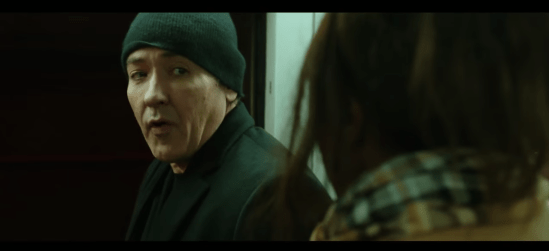
However, “Cell” was heading in the direction of certain doom from the moment Roth unattached himself from the project, sending “Cell” into the annoyance of limbo until a production company conglomerate formed to pull “Cell” from it’s stagnant state and attached Williams to direct. Yet once again, King’s beloved story goes into the throes of uncertainty with distribution after filming wraps in 2013. 2016 comes and Saban Films, along with Lionsgate , distributes “Cell” theatrically and within the home entertainment market respectively.

After all the monumental problems, I personally wanted to “Cell” to be one of the most entertaining and frightening horror films of the modern age, but as fate would have it, the Williams’ film disappoints. An film adaptation of a King novel needs more minutes to cover the story’s girth and “Cell” lacked pages of warranted minutes to be a full tell all for Clay, Tom, and the Raggedy Man. Portions of the novel were translated to the screen, but for the majority of the film, a rushed version of the story debuts to silver screen audiences that loses the book’s essence and dilutes character development, such as with Raggedy Man who has a sizable role in the book, but the character in Williams’ movie barely scratches the surface with being just a figurehead for the Phoners and not the collective’s soap box looming leader. The film started out great with intense chaos at Boston airport, pictorializing to life the Phoners from the King’s book with pinpoint precision, but from there on, the story’s time span goes vague whereas the book stretches out the length of time. Only a matter of two or three days does it seem the survivors jump from Boston, to the school, to the bar, to the story’s final location of Kashwak, but in reality terms and in the amount of devastation and character portrayal, weeks have passed.
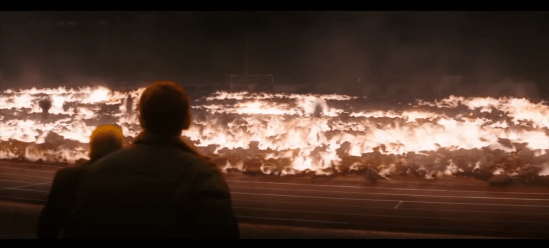
The ending has been rewritten from a surprisingly mixed reaction to the book’s and yet, the unravelling of the finale does more than convolute matters when Clay finds his son. There lies almost a dual ending where one’s interpretation can be the film’s own storybook ending. Stephen King’s “The Mist” had an ending that, when compared to Frank Darabont’s totally new ending for the film, was totally inferior to Darabont’s and I feel like that’s the stage that was trying to bet revisited here with “Cell” and it just missed the mark completely. Not all changes are for the worst. Character Tom McCourt, whose white in book, went to Samuel L. Jackson who absolutely fits the role without question, nailing PTSD stricken McCourt with little emotion but with untapped hurt. If I ever had to choose an middle aged white actor for the role of Clay, John Cusack would be my first and only choice even before casting began for the film. I do feel like having a white Raggedy Man was purposefully steered away from social sensitivities with an antagonistic young black male in a hoodie. The cast rounds out with Isabelle Fuhrman, Owen Teague, and Stacy Keach (“Slave of the Cannibal God”).
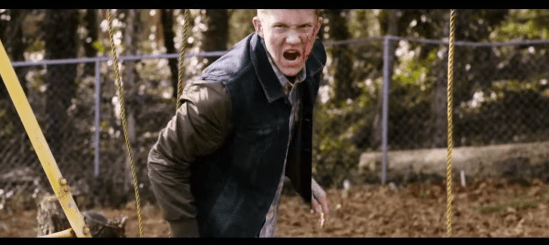
The digital visual effects were so poorly constructed and composited that I’m not surprised “Cell” didn’t have a longer theatrical run. The book had a number of jaw-dropping visuals the imagination could run with and now with seeing the depictions of those visuals on screen, they seemed seriously slapped together in such haste to where the devastating sensationalism turns inane and bland. King’s apocalyptic story warrants Hollywood scale effects, but received a few levels below that bar, failing to deliver major catastrophe on a world ending scale to the likes of “War World Z” or to cleverly style the film through a smaller medium such as George Romero accomplished with this first three “Living Dead” films.
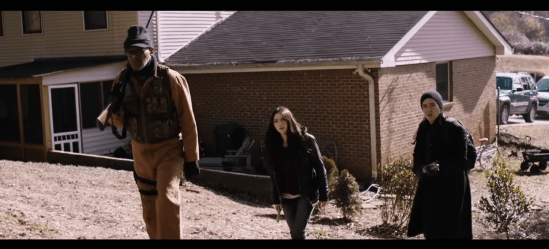
Lionsgate’s Blu-ray release is presented in widescreen 2.40:1 aspect ratio and the 1080p Hi-Def resolution becomes a disadvantage that clearly outlines the quality of the effects. The English 5.1 DTS-HD master audio is par for the course, but slightly in-and-out with dialogue that’s difficult to balance. The 98 minute feature’s bonus features includes an director’s commentary and “To Cell and Back: The Making of the Film” which is redundant if you’ve read the novel. Bottom line is if you’re fan of Stephen King’s novel, you’ll be sorely disappointed with Tod Williams’ “Cell” that’s nothing more than a long awaited entertaining rated-R apocalyptic horror with obsolete effects and with star-studded names attached to this Stephen King story adaptation.
Tag Archives: novel
Ancient Evil: “Carrie” review (2013)
This 2013 horror film featuring Chloë Grace Moretz, unbeknownst to me when I watched this, is a remake of Stephen Kings’ 1976 film Carrie (which further derived from his 1974 novel of the same name).

Above: “Tampon scene”
(This is the scene in which Carrie begins her first ever period. She absolutely freaks out and bizarrely has no idea that this is a completely natural occurrence. She screams and spreads (period) blood everywhere. Instead of helping her, her fellow classmates prefer to throw sanitary towels and tampons are her.)
I didn’t plan to watch this film, I just happened to stumble upon it on Netflix one night. I had a come over completely absent-minded and didn’t realise at first that it was a remake. I haven’t seen the original yet but I know Stephen Kings style and that it is a widely-known film, successfully kick-starting Stephens’ career. I love Chloë Grace Moretz in both Kick-Ass 1 and 2 because she performs her role flawlessly, seemingly born to play a bad-ass. This is the reason I put the film on with no hesitation. Chloe plays Carrie, a young girl who has a manically religious mother (Julianne Moore) and is constantly ostracized by her fellow students.

This is Carrie just after she unleashed hell and killed the majority of her school year. She was voted prom queen but her wonderment soon turned to disbelief when she was covered in pigs’ blood. Her path of destruction continues.
The film focuses entirely on Carrie being a victim of severe bullying (and of course her bizarre mother and their uncertain relationship). Throughout the film she is being viciously bullied and much to her surprise she discovers she has the power of telekinesis. Her powers are gradually used for evil until a prom night prank forces her to unleash all of the sinister and hellish destruction she can manage. She further kills her mother and herself. I was hugely disappointed with the film and I am amongst thousands who believe this film was a colossal mistake. Although Chloe definitely delivers in the blood-shedding scenes, she hasn’t shown me that she’s capable of playing a vulnerable character. Her timid scenes are not convincing at all, to say the least. The fact that they altered the storyline so Carries powers are shown over time totally dissipates the suspense of the entire film. A story about a teenage girl who doesn’t fit in, many people can relate to this… but that doesn’t make us like it. I can’t really comment on whether it was bad casting or a bad re-make because I just don’t know. I also don’t know why in the final scene Carrie reveals to Sue Snell (Gabriella Wilde) that she (Sue) is pregnant with a girl. Telekinesis is the ability to move objects without physically touching them. I don’t know the explanation they’d give for her having physic powers too. In conclusion I do suggest you watch it to make your own opinion but this comes with the warning for you not to expect much.
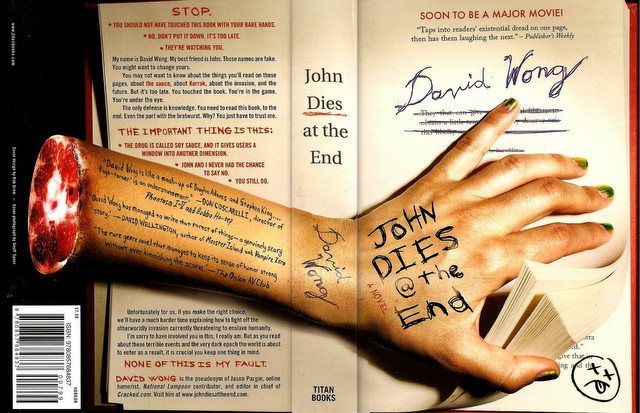
Half-Assed Evil Exorcists! “John Dies at the End” Book Review
Jason Pargin, under the pseudonym name David wong, is a major success stories that inspire all of us hopeful writers. Pargin, a low on the totem poll data entry administrator, is the brains behind the insanely clever, notoriously witty, and devilishly deranged novel “John Dies at the End.” Without even an English degree to his name, Pargin wrote short stories that turned into a full fledged novel solely by word of mouth from total strangers. Eventually Pargin was contacted by Phantasm director Don Coscarelli and as soon as Pargin blinked, a movie was adapted from his story and the rest is hisory.
“John Dies at the End” revolves around David Wong, a video store clerk whose life isn’t exactly that excited, but when he discovers the “soy sauce” from a homeless Rastafarian Wong and his friend John are sucked into the massive plans of an alternative reality species that has their sights on enslaving humanity in the name of their leader “Korrok.” Only Wong and John can see the truth because of the “soy sauce” and while others live their daily lives, Wong and John prepare for battle the only way they know how – with boom boxes, flame thrower water guns, and Molly the bomb eating dog.
Pargin’s novel will be a treat that you’ll never ever in your life read something similar like it again. Somehow able to paint a perfect picture with his colorful use of dictionary, Pargin certainly knows how to make silly scary and fun. The pages just kept turning as if I was hooked on the “soy sauce” and was warped, like a “Star Trek” hyper drive, into an other world universe. The randomness of scenes with Wong’s first person version of events can only be described as batshit nuts with a hint of nihilism. Once you add his friend John into the mix, it’s a whole different story as John is a colorful character with classically hilarious one liners and a mind like a 13 year old boy ready to take on the world.
I’m one those people who watched the Don Coscarelli movie first before reading the book and I did this before with Stephen King’s novel The Mist and so far, I’m not disappointed with my ass-backwards way of doing things. Of course, the novel will always have more than a movie adaptation, but damn did Coscarelli bring Wong’s world to life and light and I do believe that the writings of Pargin are so vivid and clear that this made Coscarelli’s job easy.
“John Dies at the End” is a must read. It isn’t the latest best seller as the book’s been out since 2007, but this horror comedy will make you laugh and thrill you into thinking about the possibilities of our universe.
“I Saw The Devil” and “I Know What You Did Last Summer” on the Remake/Reboot Chopping block!
Just when you think it’s safe to go back into the theater, another remake and reboot news bit rears it’s ugly little head. Two pieces of news bits delivered today spilling the beans that “I Saw The Devil” and “I Know What You Did Last Summer” will be being redone for a second time around.

“Oculus” director Mike Flanagan is in reports to write and produce the “I Know What You Did Last Summer” reboot which the story is based off a Lois Duncan novel. My question is why remake reboot this at all? This film, starring a gorgeous Jennifer Love Hewitt, was a major success in the wake of Wes Craven slasher game changer Scream back in 1997 and then spawn two more not-so-successful sequels. The story revolves around a group of teens who accidentally kill someone and then are hunted down by a man with a hook afterwards.

Kim Jee-woon’s “I Saw The Devil” is the other film that made remake headlines today in which Adam Wingard and Simon Barrett will bring the film to life…in America I’m sure. Wingard is set to helm and Barrett will be penning the project about the fiance of a special unit cop being murdered by a vicious psychopath. Hellbent on revenge, the cop is determined to hunt down the killer no matter the cost and the line between good and evil are sub-sequential. I’m a fan of Wingard and his style of horror and thrills, but I’m not so keen on remaking foreign movies for American audiences for the sake of those who can’t stand to read subtitles and this kind of situation just screams that instance.
No word on any dates yet, but I’ll keep my eyes open and see what comes across my desk.
Book Review: D.A. Stern’s “Black Dawn”
Discovering ancient gyms in the literature world is like finding $5 in your pocket that you didn’t know you had. The feeling is a rush, an enlightening feature that emits from your soul making you glow with enjoyment. That feeling is so powerful because that means there lies hope and there lies new prospects, in all walks of life, out there for all of us. Coming across D.A. Stern’s novel “Black Dawn” in a second hand book store was a great find amongst the vast rows of books because of the novel’s timeless nature, something we’re all in fear of coming one day, the apocalypse.
“Black Dawn” follows multiple story lines of people, some good of heart and some not so much, when two waves hit. The first wave knocks out all electrical devices much like an E.M.P. does. The second wave sends a rush of anger into the bowels that makes people want to rape, rob, and kill. The story lines eventually connect to a finale that involves awaking an ancient, world ending entity.
Released in October of 2001 (yes, now I feel old), “Black Dawn” could have been read today or thirty years ago and still have the same affect. Why? Part of the agelessness of this book due to the author’s writing style. D.A. Stern’s style is blunt, to the point, and without mercy. Some critics might consider it dry and bland. In hindsight, Stern’s articulation of the events, jumping back and forth from story to story, would have been mass confusion if done in a more colorful, descriptive manner. Just tell me a character was shot and that convey’s the character’s death or seemingly death; this type of writing is perfect for “Black Dawn’s” as it lays down a serious tone.
Also, Demons never seem to go out of style. Though Stern never labels the undead creatures as demons, the idea that a character is killed and then resurrects to doing the bidding of an evil, soon-to-be-awakened threat spells out Demon from afar. The apocalypse happens in stages and so does the outing of each villain and hero creating a grip on your eye balls so you can’t look away from the words that tell how the events unfold.
Certainly a good read and a fast read. Quick, easy, and to the point but still giving you the edge of insanity, fear, and horror which is always refreshing especially since this novel is 13 years old. D.A. Stern wrote a couple of Blair Witch sequel novelization: “Blair Witch:: Graveyard Shift” and “Blair Witch: The Secret Confession of Rustin Parr”