Bestiality. Borowczyk Pushes the Boundaries with EVIL Themes. “The Beast” reviewed! (Blu-ray / Umbrella Entertainment)

“The Beast” Available on Umbrella Entertainment’s Beyond Genre label at Amazom.com

Marquis Pierre de l’Esperance, a French lord on the brink of financial ruin, is able to swing a deal before the death of the well-off English tycoon Philip Broadhurst. Under the conditions of Broadhurst’s will, his daughter Lucy must marry I’Esperance’s introverted, and equestrian obsessed son within six months after his death. Lucy, and her aunt Virginia, travel deep into the French forest to the deteriorating chateau to do a first ever meet and greet between the two soon-to-be married. Marred by centuries old local legend of a lustful beast who sexually defiled the Lady of the estate’s family lineage, I’Esperance aims to restore order by marrying into fortune and leave old cockamamie tales behind him. Yet, Lucy can’t shake vivid and stimulatingly graphic dreams of the romping woman and beast, leading to speculation whether the legends are true or not?

Certain types of filmmakers push the limits and exude their provocative talents to blur the lines between arthouse cinema and pornography. Those same filmmakers would argue that arthouse cinema and porn are, in fact, nearly one in the same if complimented with an intriguing story full of subversive subtext sure to outrage the status quo. Walerian Borowcyzk is one of those auteur artists basking in the absurdity and the arousing aspects of his films. The Polish writer and director wrote and helmed “The Beast,” aka “La Bête,” a one-part sex-comedy and one-part fantastical horror that is one-whole bizarre beyond our wildest dreams. “The Beast” was once considered to be a part of Borowcyzk’s short film collection of erotic stories known as “Immoral Tales;” however, the short film shot was scrapped from the project and then reimplemented into a full-length feature with outer rim narrative built around it’s very thematical essences of bestiality and the corruption of man due to woman’s virtue, the latter inspired by the French novella “Lokis” by Prosper Mérimée. The France originated film was produced by Anatole Dauman under the French studio, Argos Films, which produced much of Borowyczk’s work.

“The Beast’s” ensemble cast play intrinsic notes toward the fullest extent of the narrative’s shell machination as well as the saturation of eroticism from the grifting lord l’Esperance to the chateau’s only manservant, who when not answering his Lord’s beck and call, is fooling around secretively and lustfully with I’Esperance’s daughter. Veteran actor Guy Tréjan unearths the very ill-humored presence of a struggling lord seeking to reclaim fortune and glory to his estate and family. Most of the time, we feel sympathy for I’Esperance’s inability to catch a break, but on the deeper, darker scope, I’Esperance hides many truths, keeps many secrets, and even black mails his uncle, Duc Rammendelo de Balo, played by legendary actor Marcel Dalio (“Super Witch of Love Island”), making the lord a villain of his own haphazard design. I’Esperance’s nitwit and reclusive son Mathurin is played by Pierre Benedetti, who has worked with Borowcyzk later his career in “Immoral Woman.” Not much of Benedetti is profoundly showcased, leaving much of Mathurin in the dark despite being a principle figure in the plot as the husband-to-be for the aspiring romantic Lucy Broadhurst from “Le diaboliche’s” Lisbeth Hummel. Hummel, along with 1995 “Castle Freak’s” Elisabeth Kaza as Lucy’s aunt Virginia, are supposed to be affluent English women travelling to France in order to settle future marital affairs with the I’Esperances, but Hummel and Kaza have such thick accents that no matter how proper their English may be, there’s still present the French and Hungarian elocutions in their English dialogue. Hummel does capture Lucy’s free-spirited, free-form sexuality so inclined by Borowcyzk as the director envisions her as the clairvoyant trigger that unsheathes an age-old curse to light, but Hummel is not the only participant in “The Beast’s” amativeness with Hassane Fall, Pascale Rivault, Julien Hanany, and sex-symbol Sirpa Lane (“Nazi Love Camp 27,” “Papaya: Love Goddess of the Cannibals”) paving a more perverse course with illicit affairs, object sexuality, and, of course, bestiality. Though none of these aspects were more than disturbing in comparison to Roland Armontel’s version of a local priest setting an uncomfortably affectionate dynamic with two of his alter boys that Borowyczk focused and lingered on when the chief characters have left the scene.

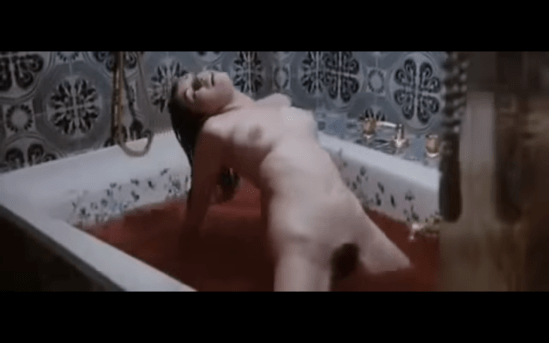
Trying to understand Walerian Borowyczk’s “The Beast” is akin to trying to understand the wanton complexities of the human psyche. In all its whirlwind of implications, “The Beast” is heavily and artfully abstract in a non-abstaining manner as sultry desires, no matter how forbidden, are the superior playthings utilized for Borowyczk’s totality of storytelling. The uber-sexual graphic tale invests little into the imagination with vivid imagery of genitalia in all shapes and sizes in organic and mythical forms. Yes, there is a lengthy opening scene of horse copulation with emphasis on each of the bulbous male and female’s sexual organs. Yes, there is also a satirical creature chase that transforms into a frolicking romp between a human woman and a dog-bear creature with a miniature representation of an erect horse member ejaculating like a geyser without an end. The excessive vehemence towards sex is Borowyczk’s gift to the audience toward feeling a flurry of mixed emotions from being a little bit peed, to a little bit put off, to even a little bit strangely turned on all in one sitting. Though sex is unusually celebrated in “The Beast,” the beast itself is also the representation of perversion, an animalistic and libidinous savage horndog lusting after the chastity of virgin women that’s allegoric to spoiled bloodlines and cursed households in a path of ruinous destruction, especially in the downfall of a crumbling aristocracy. Borowyczk injects and interjects comedy to lighten the socially disturbing atmospherics of paraphilia and the social consequences that follow.

As part of their Worlds on Film:  Beyond Genres banner, Umbrella Entertainment releases Walerian Borowczk’s “The Beast” as volume #13 on a region free, 2K scanned Blu-ray in full 1080p High Definition.  Presented in the original aspect ratio of what once was the European theatrical standard widescreen 1.66:1 aspect ratio, the 35mm transfer provides a relatively clean viewing free of aging and blemishes albeit the innate agreement of healthy amount of grain that comes standard with celluloid film stock.  While color grading definitely looks non-existent in the release, a once over would have sharpened the image immensely from the slightly flat and natural color scheme.  The tri-lingual French, English, and Italian DTS-HD Master Audio 2.0 mono track is a compressed version from the 2015 Arrow Film’s Blu-ray release with an uncompressed LPCM 2.0 audio.  Virtually no difference in the lossless audio with also no difference in the synchronizing between visual and audio elements.  Dialogue runs smooth and clear with little-to-no hissing or pops and the same can be said about the more than adequate ambient track, the lively French Harpsichord piano soundtrack, and even the outlandish foley of beast sounds through the limited parameters of the two channeled output.  Special features pale in comparison to previous Blu releases, but are none-the-less impressive including 16mm behind-the-scenes, archival documentary footage in the making of “The Beast,” an introduction by film critic Peter Bradshaw, a featurette of Borowczyk’s beast sketches, letter of confidence to the producer, and a treatment to a potential sequel that never materialized The Frenzy of Ecstasy, an philosophical interview with the director Walerian Borowczyk, the director’s biography, a still gallery, and theatrical trailer.  Illustrator Simon Sherry designs new and exquisite cover art for the cardboard slipcover and snapcase cover that perfectly represents the tone of the story.  The cover art is also reversible with Hispanic poster art and praising critic reviews and quotes.  The release is certified R18+ for high level sexual themes and sex scenarios. “The Beast” is an upfront, artful, and confrontational film about bestiality and sexual corruption bred to challenge the formulaic narrative with a call of unbridled seduction and a flamboyant flare for a firm erect furry.

“The Beast” Available on Umbrella Entertainment’s Beyond Genre label at Amazom.com

Bikini-Cladded Revenge on a Small Time EVIL Crime Syndicate! “Rondo” review!


Disturbed and dishonorably discharged Paul finds solace at the bottom of a glass bottle. As Paul falls deeper into dire depression with drugs, the drink, and cigarettes, Jill, his sister, lays down some ground rules while he crashes on her couch. At her advice and insistence, Jill schedules a psychological appointment for him and the doctor recommends sex as a release and not just any old sex, but the behind-the-doors, underground, Freak-a-leak kind of kinky encounters. Paul joins two other men in a high rise condominium, receiving instructions on how to treat and mistreat an affluent man’s wife, but Paul becomes the witness to an organized murder party and flees for his life, barely escaping the clutches of his captors, and returning home to his sister Jill to tell her everything. The only problem is, the killers know his address and now their business becomes a family affair loaded with straight razor slashing, crowbar bashing, and automatic weapon firing mayhem.

“Rondo” is an icy revenge thriller with bullets and blood galore from writer-director Drew Barnhardt. The “Murder Loves Killers Too” director reinvigorates a pulp noir approach into the independent film market that invokes woman power through all sorts of masculinity muck. Breanna Otts and Gena Shaw flourish as the anti-leading lady by wielding large assault rifles and being the kingpin of killers amongst a bunch of kneeling and broken men. “Rondo” is also about family, believe it or not. Whether bound in endless love or broken beyond repair,the theme of taking care of your own blood comes to the forefront, but before you go showing your kids, “Rondo” takes family to hell and back and then back to hell again for a rough ride of riveting vileness and hard-on revenge.

“Rondo” doesn’t necessarily have a lead character. In act one, the voice over utters over the pitiful existence that is Paul (“Galaxy of Horror’s Luke Sorge) who, at the persistence of his sister, tries to step outside the path of destruction by stepping into a sex den at the advice of a radical, and very pregnant, psychologist. The voice over is curiously used since pertaining to the fact that the narration, provided by Steve Van Beckum, becomes nearly Paul’s inner monologue by the end of his tenure. Act two transitions into a father and daughter reunion and then revenge plotters. No voice overs accompany the two, but Jill (“Westworld” and “SWAT” actress Breanna Otts) and her father Sam (“Rage of the Mummy’s Michael Vasicek) have an exposition fest involving what ifs and to dos. Sam felt to be a wasted character; an escaped VA patient returning to his children for revenge that doesn’t quite grow from there. On the other hand, Jill extends into act three as the sole protagonist and her thirst for vengeance is clunky and clanky, stirring up a halfcocked plan in the belly of the beast that happens to work in her favor and in our favor too as Otts ends up in lacy underwear in an episode of boobs and bullets. “Rondo” rounds out with Ketrick ‘Jazz’ Copeland, Reggie De Morton, Gena Shaw, Kevin Sean Ryan, Grant Benjamin Leibowitz and introducing Iva Nora in her first role and first nude scene.

Conceptually, Barnhardt’s tale of ravage savagery rouses out from the cobwebbed conventional anecdotal pathways and while “Rondo” might be a tale that’s rarely been told, apprising the plot into maturity bid Barnhardt with a far more difficulty, leaving to squash the answers to far more questions at the roll of the end credits. One of the more puzzling questions is why does the voice over only narrate for Paul? Kicking off with a voice over that explains Paul’s downtrodden life, then transitioning quietly into Paul’s inner thoughts, and then disconnected completely that literally leaves a punctuation question mark hover just over our scalps. There’s also the question of how deep this criminal organization roots in society? How did Cassie, wife of the barbaric boss Lurdell, get to assimilate herself into positions of power to influence poor souls to become meat for the grinder.

Artsploitation Films distributes an American bloodbath with “Rondo” onto DVD home video. The not rated release is presented in a widescreen, 1.77:1 aspect ratio, and despite some banding, the picture quality spruces a fine package with natural lighting and little-to-no filter use. The Dolby Digital 5.1 Surround Sound pitches perfectly without some much of a hiccup. Range and depth are fine, though the film isn’t necessarily a heavy hitter with action, and the channels are level amongst the LFE gun blasts in the cap your ass finale. Bonus features include a director’s commentary, deleted scenes, selected music commentaries with composer Ryan Franks, and an exhibition of the gritty pulp cover art and lobby cards set to a musical score. “Rondo” is a cult indie classic through the venomous teeth of white-collar Americanisms and a torrent of human immoral inclination that relentlessly shows no mercy scene after scene.

Own “Rondo” on DVD today!

Evil Gets a 4K Digital Transfer! “Ichi the Killer” review!


Three hundred million yen and Yakuza boss Anjo have disappeared without a trace. Anjo’s most deadly and most sadomasochistic enforcer, Kakihara, and the rest of the Yakuza gang embark on a torture-riddle search and rescue to find their missing boss. After unrightfully torturing and mutilating a rival Yakuza leader, Kakihara learns through a trail of mayhem of a fierce killer known as Ichi and after being exposed to Ichi’s grisly handiwork first hand, a usually stagnant and emotionally detached Kakihara becomes stimulated and eager to go one-on-one with a formidable foe like Ichi, who could possibly bestow upon him gratifying pain to feel something other than emptiness. Ichi’s eviscerating destruction isn’t totally in his control as the sexually-repressed and candidly disturbed overall nice guy is being coerce through psycho-manipulation by Jijii, an old man seeking retribution against the Anjo gang. With blades projecting from his shoes and his skill at martial arts, the timid Ichi becomes the ultimate killing machine when brainwashing takes him over the edge into a hysterical fit of rage that leaves guts and blood to paint the floor and walls.

Perhaps director Takashi Miike’s finest work, the 2001 Japanese blood bath “Ichi the Killer” is a must own for any film aficionado teetering on the razor wire between crime dramas and gory action flicks that might be on the viewing docket for then night, but certainly a must-see for all film lovers at some point in time. Miike’s stone cold, chaotic style of filmmaking embraces the story’s unwavering havoc that blisters with ruthless brutality between two very different, black and white characters with one thing in common – being good a killing. Based off the manga penned by Hideo Yamamoto and from the adapted screenplay by Sakichi Sato, Miike crafts the most disturbing elements of mankind and brings them to the forefront in a simple story of revenge. On one side, there’s Kakihara, a scarred-face Yakuza enforcer with a very rich violent history to the extent that he’s become numb to his own existence in the world and then there’s Ichi, a reclusive cry-baby stemmed from being mentally fed graphic bulling stories of battery and rape in a memory built upon languishing lies. Vastly different, well-written characters opposite the spectrum and both are good at dealing death, but one aims to dish it out and the other yearns to stop his carnage, and that compelling core element is immensely fluffed by extreme violence in a way that only Miike can deliver it.

But for a film like “Ichi the Killer,” Takashi Miike had a little (hint of sarcasm) help from his gifted cast in making this project a cult success. Before this actor was Hogun in the Marvel Universe’s “Thor” franchise, Tadanobu Asano shaped up the psychotic enforcer Kakihara and the usually dark featured Asano reconfigures his appearance to put life into the character who sports blonde, wavy hair, a frothy complexion, and small hoop piercings at the corners of his lips to keep the slits from opening to expose the entire gaping jaw which is used as a defensive weapon. Opposite Asano is the Tokyo born Nao Ohmori who perfectly subjects himself to being a wimpy human shell with an explosive inner anger. The two men have only a small amount of screen time together and that requires them to build their character’s standout personalities. Complimenting their performances is an amazing support cast, including Shin’ya Tsukamoto (“Marebito”), Miss Singapore 1994 Paulyn Sun, Hiroyuki Tanaka, and Suzuki Matsuo.

“Ichi the Killer” is simply magnificent where it vulgarly touches upon various themes, mostly human flawed that also destines opposing counterparts together. Aside from the graphically realistic violence, Miike’s film hits upon other attributable tangents, among them some are just being plain gross, but these aspects are undeniably important to the story. Themes ranging from sexual suppression and female inferiority to sadomasochism and severe obsession top the charts in a heap of motifs throughout. Accessorial blood and other bodily fluids are extravagantly portrayed, spraying across the room with jettison entrails or dripping from potted plants to a cloudy puddle below during in a voyeuristic rape scene, to get the clear sense of an adult manga inspired chockablock exploitation and crime drama.

Well Go USA presents “Ichi the Killer” on Blu-ray in a newly restored 4K digital transfer of the director’s cut; a task undertaken by Emperor Motion Pictures in 2017. Presented in a widescreen 16:9 (1.85:1) aspect ratio, the film starts off with a blurb about the history of this particular digital restoration and transfer that asserts director Takashi Miike’s approval for release. Well Go USA’s rendering resembles much of the previous Tokyo Shock Blu-ray with subtle differences such as a slightly more aqua tint to the picture coloring and also much like it’s other Region A Blu-ray counterpart, a bit of noise is present in the restoration, but still the better detail of the two. The Japanese stereo 5.1 DTE-HD Master Audio surround sound has an bombastic soundtrack, but dialogue remains on the softer side where relying on the English subtitles is crucial. No issues with timing or accuracy in the subtitles. Surprisingly, the only extras included on the Well Go USA release is an audio commentary with director Takashi Miike and manga artist Hideo Yamamoto, still gallery, and the trailer that undercuts this releases’ purchasing value and might as well hunt down for the out of print Media Blasters Blu-ray, if extras are a must. Even still, “Ichi the Killer” has been resurrected in North America again and the release technically sustains growth amongst the mass of releases around the world. The lack of special features is disconcerting, especially being a restored director’s cut, but “Ichi the Killer” can stand on it’s own as a gracefully sanguinary masterpiece. Look for the Blu-ray to hit retail and online shelves March 20th!

Get Ichi the Killer today on Blu-ray!

]

All Evil Wants is to Make Art! “Bag Boy Lover Boy” review!


Albert’s just another lowly speck among the multifaceted masses of New York City. The lonely street hotdog vendor barely scrapes by in what could be considered a life, earning next to nothing to keep him on life support in the city that never sleeps. To impress a beautiful girl, a girl of his dreams, Albert accepts a position offered to him by an eccentric photographer and hopes to learn about creating art with a single click of a photographic camera, but Albert becomes the obsessive fixation of the photographer’s next breakthrough exhibit. Albert’s simpleton nature and the photographer’s edgy intensity pushes the aspiring artist to lure women into offbeat modeling sessions in the away photographer’s NYC flat. When he can’t retrieve the inspirational art out of his models, a frustrated Albert goes to extreme lengths to ensure his art is performed to his particular, elementary taste.

“Bag Boy Lover Boy” is the 2014 inaugural feature film debut of director Andres Torres who is one of the few directors out of countless others able to resuscitate the compellingly frightful grit of New York City long ago. I’m talking about the era of pre-Rudy Guiliani New York City in the 1980’s where graffiti splayed walls and the blue fluorescent of dilapidated charm was present on every grid blocked street. Torres, along with co-writer Toni Comas, supplements one of a kind character personalities very appropriate to inhabit the sinister ladened Big Apple. Characters who aren’t dolled up or even genuinely beautiful. Those characters who are easy on the eyes don’t have the inner soul to match, residing in them an defect of some sorts that makes “Bag Boy Lover Boy” feel all too real.

Jon Wächter, a director-actor with behaviors not too alien to that of his character, centers himself as that very bag boy, lover boy of Albert, the awkward citizen with a one track mind and living to fulfill no dreams, hopes, or goals. Wachter owns his role by giving no hints of aspiration to fortune or achievement until Albert meets the cynical Ivan, appropriately casted with New York City-based actor Theodore Bouloukos, is able to hone in on the streets’ muckiest ground level and incorporate a Ron Jeremy charm that’s shrouded sleazy, but devilishly smart. Ivan draws out of Albert a simple interest, a hope to create art through photography, but Ivan has other, more prosperous, plans for the gullible nitwit as model in his own artwork. Albert’s mind focuses solely on photography and not modeling, placing Ivan in a rather haste position to con his centerpiece with poor words of self-worth advice and filling Albert’s head with misogynistic directions when Ivan goes through his rather rough motivational spiel during shooting gigs. Albert then can’t separate reality with his newfound dream that puts “models,” played by Teena Byrd (“Ninja Versus Vampires”), Sarah O’Sullivan, and Adrienne Gori, in harms path. Kathy Biehl, Karah Serine, Tina Tanzer, Marseille Morillo, and Saoko Okano make up the rest of the cast.

What I found most interesting in Torres film is Albert’s perception of himself. After a couple of, what he thinks are successful, shoots with the women he lures and drags up to the Ivan’s flat, Albert perceives himself as this eminent rockstar, exhibited very boisterously in a fantasy scene within Albert’s dingy one room apartment. What’s really ironic about the whole story is that Ivan honestly could deliver every bit of the wealth, women, and respect he promises to Albert and with these promises, he could obtain Lexy, the girl he hopes to win over, but with such a narrow mind, unable to go beyond to foresee a positive future, Albert self-destructs into infamy with only some non-permissive nudity polaroids to show for it. Torres and Comas Shakespearean-like comedic tragedy concept is a consistent conundrum for each and every one of us, not just the slow and low like Albert, but for us who think in the short term, despite whether what we accomplish now might not be a desire or may not be our sole purpose in life. Even peering into Albert’s erratic, overly-exaggerated, if not visually stimulating, mind stories are not to different from what perhaps the rest of us experience.

Severin Films presents the EXU Media production of “Bag Boy Lover Boy” for the first time on DVD and Blu-ray home video. The region free, not rated, gorgeously illustrated Blu-ray is presented in full HD 1080p. The image quality boasts vibrant colors and really exemplifies the naturally gross visual aspects of New York City streets. Various skin tones come out nicely unfiltered and untouched, especially the pasty Wächter and the olive skin of Tina Tanzer, with only brief moments of filters to accentuate subversive content. The dual channel English stereo isn’t half bad. Even though English is not Jon Wächter’s first language, the Sweden-born actor’s dialogue is clear and coherent. The rather mixed bag soundtrack and the Barbara de Biasi score have boastful fidelity and remarkable clarity. Extras include a meaty audio commentary from director Andres Torres, Theodore Bouloukos, and editor Charlie Williams, The Student Films of Actor Jon Wächter: “Got Light” and “The Never-Starting Story,” and the film’s trailer. “Bag Boy Lover Boy” is surrealistically realistic while being slightly exploitive and courageously risky. A satirical film with the proper fortitude to challenge our judgements about life and the paths chosen while leaving an uncomfortable aftertaste of profligate opportunities. Torres also leaves with us a film that we’ll never forget.

Buy “Bag Boy Lover Boy” at Amazon!

Never, Ever Climax With Evil! “Female Vampire” review!


A cursed countess has returned home to the Madeira Island. Countess Irina Karlstein has an insatiable thirst, deadly to any man or woman she’s comes in content with on the scarcely populated island. By day and night, the beautiful mute countess, wandering the terrain more than half naked, enjoys the islet’s amenities, including sucking the blood, or the sperm, out from her erotically hypnotized prey and zapping their life essence right at the point of climax. Discredited Dr. Roberts and a mystical blind Dr. Orloff aim to track down the creature practicing vampirism, despite the local authorities unwillingness to aid them and wishing to debunk the outlandish theory. Amid the rising death toll, the countess unexpectedly falls in love with an aspiring writer on holiday and she fears her curse, her hunger, her need to be filled will consequently overtake the love she has bestowed upon the writer.

Classic European schlock from the greatly candid and voyeuristic director Jesús Franco, “Female Vampire” goes by many interesting titles, just like Franco himself who also has a cache of various, widely used monikers. “Erotikill.” “Loves of Irina.” “Lustful Vampires in Sperm Frenzy.” These are just the tip of the enigmatic iceberg that is of the English titles associated with Franco’s film with “The Bare-Breasted Countess” and “Female Vampire” the better suited for the version reviewed by Its Bloggin’ Evil. Oh, did I forget to mention there are multiple cuts and versions of this film? The 1975 sleazy vampire flick has numerous renderings from an XXX version with sexy-time vampire scenes to a 35-minute reduced cut where many of the sexually graphic material has been removed and more of the horror either remains or second, more conservative, takes are introduced. Whether “Female Vampire” is a good film or not ultimately determines to be an unnecessary factor as Franco’s film can be rather an interesting case study in how one story or, in this case, one reel can be reworked and reconstructed to emit a completely different sensational perceptive.

Barcelona born actress Lina Romay exposes herself as the Bare-Breasted Countess Irina Karlstein. Her striking dark features and piercing eyes make her resemble your typical lady bloodsucker and with vampires being naturally attributed with strong sexuality and influential powers, Romay doesn’t need the omitted dialogue as she instills beauty, sex, and power into the body and the expression of her character. The untrained actress leads by being an extrovert, uninhibited by conventional proprieties, and Romay wins at being Countess Irina Karlstein just by naturally being herself. Her longtime collaborator and future husband, Jess Franco, had developed, whether intentionally or not, this role for his free-spirited companion and, as well, stars himself as the inquiring Dr. Roberts. As the countess’ love, cult genre favorite Jack Taylor brings his tall, dark attributes to be a soft spot for the unquenchable cursed and an Amazonian built Anna Walican gets hanky-panky as a islander journalist with Lina Romay in a sensual scene of unchained lust. Alice Arno (“Justine de Sade”), Monica Swinn (“Hitler’s Last Train”), Luis Barboo (“Conan the Barbarian”), and Jean-Pierre Bouyxou round out the cast surrounded by Romay’s eroticism.

On the outside, Jess Franco directs like the utmost perversity, deep-seeded with gratuitous nudity and filled with revamped versions of the same scene. On the inside, “Female Vampire” is tragic love letter with Countess Irina Karlstein’s wretched curse stretching beyond her power. Her curse is more than just yearning from blood (or semen), but also an ache of the inability to be sexually gratified. Even when her victims are dead, she continues the carnal ritual of graphic grinding, tantalizing touching, and manic masturbating. Aside from being mostly nude throughout the entire feature, and if not, semi nude through a see-through blouse, Lina Romay’s perfectly shaped apple bottom is constantly upended, flaunting her pheromones in more way than one, with each conquest more exposed than the other.

Screenbound Pictures has released “Female Vampire,” aka “The Bare-Breasted Countess,” as one of the first United Kingdom DVD titles from the new Euro cult label, Maison Rouge, who specialize in Euro trash and sleaze. I was offered a DVD-R screener and can’t comment on the quality or the bonus features, but with release, with excellent cover art, contains two versions of the film: the highly erotic version with as much body part exposure as one can handle and the “Erotikill” which has alternate scenes and less sleaze. The main feature dons no blood, except the countess in a blood tub, and allows Countess Karlstein to roam in sunlight, non-typical traits of the conventional vampire and as the “Erotikill” version still lets the countess be exposed to ultraviolet rays, there’s more blood that’s more than enough to barely gentrify the horror genre. “Female Vampire” is an usual bird of love and lust, a perfect example of Jess France’s body of work, in an awful take on an iconic horror villain legend.