Sara, a desperate young mother, infiltrates a secret facility workplace under the false pretentions of becoming an employee of the critical janitorial department. After losing custody of her adolescent daughter Jenny in court, the child becomes misplaced when her custody awarded father, an employee, loses Jenny in the facility that’s conducting unusual activity involving the building’s light energy source. With everyone on constant edge and under the powerful and dangerous influence of the light, including her very organized and unstable employer, Sara is able to find a sympathizer in the head janitor and by exploiting his mental map and valuable knowledge of the building, Sara goes deeper into the structural bones of a nightmarish reality where evil lurks in the shadows and not everything is what it seems.

“Feed the Light” is a H.P. Lovecraft inspired sci-fi horror directed and co-written by indie filmmaker Henrik Möller with Martin Jirhamn sharing the co-write. The gothic tale stems from the Lovecraft short story “The Colour Out of Space” that tells the tale of a meteor crash landing in the hills near Arkham, Massachusetts, poisoning and deforming all the living creatures nearby that creates chaos amongst the locals. The light, that never dulls, becomes the driving force of everything malevolent and that carries over into Möller’s film, but isolates the setting to a dilapidated building instead of a natural landscape and focusing more on the people inside rather than vegetation or livestock as the Lovecraft short story builds upon. Originally shot in color, Möller thought best to suck the color out from the reel and produce a mostly black and white film, sprinkled with color at strategic moments, that would convey the importance of the ever-present light and interpret a far more dramatic effect to play out; a decision I whole-heartedly agree because if laced with color, much of the abandoned warehouse setting would be a monotonous eye-sore. Instead, black and white enhances the light’s presence, makes it almost seem to stand out amongst the greyscale, and give way to more inspirationally vibrant hues when they are revealed.

For Henrik Möller, this is the director’s first dive into feature films and for the filmmaker whose better known for his shocking shorts, “Feed the Light” doesn’t water down the deranged, creative machine that just steam-plows through a 75-minute runtime and still managing to be mechanically sound to comprehend the Lovecraftian tone. Lina Sundén fills the lead shoes as Sara and Sundén embodies complete innocence and bewilderment when her characters goes forth into this strange facility, but doesn’t show much fear as if a mother’s determination is her driving force to go beyond being what frightens her. Alongside Sundén is Martin Jirhamn, who you might remember me saying he co-wrote the script, as the sympathizing janitor. Jirhamn has collaborated on many of Möller’s shorts, feeling comfortable taking on the challenge of a full length feature by taking on more of a scripted role that has a face with two sides. Rounding out the cast of memorizing characters are “Not Like Others'” Jenny Lampa as an authoritarian boss of the facility who tries to keep Sara from going on Indian Jones and the Raiders of the Lost Ark in the basement and Patrik Karlson otherwise known as the VHS-Man and Jenny’s father in the film.

“Feed the Light” has undertones beyond that of Lovecraft. The story feels nearly anti-establishment, a surreal and extreme look at how doing the same job, in the same office, staring at the same fluorescent lights can make one loose one’s humanity. The boss is a strict enforcer of the rules and doesn’t shrug at the thought of one of her employee’s burning out as long as the job gets done, but it’s not burning out that’s the problem. The light symbolizes obedience and control, turning those with a soul into mindless workers. There’s an unseen power embodying them such as with the dog man, played by Morgan Schagerberg, who, literally, sounds and acts like a canine that just happens to have glittery dust goo ooze out of it’s anus. Yup, weird. “Feed the Light” is jarringly weird, but also laminates into the prospect of hidden doom that’s very similar to the truth is out there concept reveled in the “X-Files.”

The Severin sub-label, Intervision Picture Corp., usually subjects us to older projects, but embraces newer indie films such as Henrik Möller’s “Feed the Light” and with the help of CAV Distributing, Möller and “Feed the Light” can be exposed to every house hold on Earth as a region free Blu-ray in 1080p full Hi-Def. The full frame is a staple of Intervision and doesn’t necessary cause any distress over cropped images. There is a fair amount of interference, but again, only enhances the indie labels reputation. Other than that, the image is fine laid under a Swedish language dual channel audio track that’s well balanced with a brooding industrial soundtrack by Testbild, a Möller familiarity. There are two extras accompanying the feature: one is a making of featurette and the other is an interview with the director, Henrik Möller. “Feed the Light” is a science fiction oddity chocked full with surreal depictions and nightmare creatures with a Lovecraft base and a passionate director’s otherworldly view of how light and color powerfully dictate our everyday lives.
Tag Archives: Severin
A Double Bill of Evil! “Murderlust” and “Project Nightmare” review!

During Sunday’s services, a calm and confident Steve Belmont heads the Christian Sunday school youth class and seeks to be the permanent director of the Church’s suicide crisis unit that’s coming to the end of the planning stage. On Sunday’s, Steve performs as the model citizen whose ready to serve and give back to his community. During the rest of the week, the horse race track security guard can barely sustain societal worth, arriving late for work, constantly drunk, and has disdain for people being a speed bump in his path to greatness. All Steve Belmont has in life is the potential director’s job and his thirst, his unquenchable thirst for strangling women and dumping their bodies in the excessive heat of the Mojave desert. The local newspapers label his killings that of at the hands of the “Mojave Murderer” and his lust for killing call girls and young women runs a thin line alongside his Sunday best and when he begins to trust a Church regular, Steve’s mistakes begin to catch up with him.

“Murderlust” is the first feature on the Intervision Picture Corp’s double bill DVD release from director Donald Jones and writer James Lane. The 1985 suspenseful horror-thriller comes to DVD for the very first time and doesn’t just boldly display a story of another run of the mill serial killer but does so with remarkable performances and a body of work that’s well crafted. Lane pens the center character focus on Steve Belmont and his delusion of power, being an overwrought sociopath with a belief he’s better than everyone else, and Belmont’s brazen lures to secure helpless victims is nothing short of a con artist’s trait. The ability of convincingly seducing the congregation to his benefit provides him pseudo mystical powers that pull the blinds over their God fearing eyes while he continues to slack through a meager life and holds tightly his reign of terror near the Mojave. Basically, in Belmont’s mind, he is God.

Eli Rich plays Steve Belmont, who can only be described as a twisted blend between Michael Beihn and Nick Offerman, and Rich canisters Belmont’s psychopathic tendencies in an terrifying performance of exact realism. Not many films can pull off the on and off switch of a serial killer, even Patrick Bateman in “American Psycho” was sensationalized, but the relatively small time actor produced a manufactured fearful reaction. Rich splits Belmont into two personalities while still managing to be contain a menacing aurora to feed audiences with dread, fear, and suspense and while Rich might be doing more than just one public service for his community by picking up and strangling local street walkers, Belmont never transitions into that role of the likable anti-hero as he manages to forthrightly ostracize himself from friends and family. As Steve’s square statured and responsible cousin Neil, Dennis Gannon epitomizes the upstanding citizen character, but maintains a soft spot for his unscrupulous next door neighbor cousin. Rochelle Taylor’s role is something of a love interest for Steve, who can’t bring himself to kill her even when the opportunity is present, but the one film and done actress Taylor can’t bring “Murderlust” to the promise land with an overzealous portrayal of an eager beaver, love struck Church girl that doesn’t fit the bill of Belmont’s world.

After a couple of quick Mojave Murderer victims, one including the scene illustrated for the DVD’s front cover with a topless and unchaste Ashley St. Jon, Steve, along with the flow of the story, banks into a suppressive funk. The narrative’s pace slows when Steve attempts to organize his life around his murderess hobby, turning the suspenseful thriller into a drama segment that is more or less of a laundry list on how to obtain rent money for an aggressive landlord, until the demand to hunt tugs heavily at his pant leg and he can no longer ignore the urge. “Murderlust”, despite the captivating title, is nearly a bloodless horror thriller. Steve uses his signature method of strangulation, leaving smartly no blood trail, and only at the finale does blood spill when Steve deviates from his unsympathetic hunt, kill, and dump program.

Woodland campers and best buds Gus and Jon wake up to discover their gear has been shredded and dispersed. They’re soon pursued by a frightening force of unknown origins. Lost and hungry, the two friends stumble upon a mountain cabin where cabin owner Marci shelters them for a night. Rested and resupplied, but haunted by their dreams, the two continue on foot in search of a town; instead, they become split up and Gus finds himself in the bizarre belly of a government facility that’s conducting an experiment and root of Gus and Jon’s predicament. Gus must confront the inner workings of his mind and take back control of his thoughts or else all that he knows, his friendship with Jon, and all that he desires, his passion for Marci, will soon be lost to the unchecked government secret known only as Touchtone.

The second film on the double feature, “Project Nightmare,” starkly contrasts in genre with “Murderlust.” “Project Nightmare,” otherwise known as “Touchtone,” is a science fiction thriller piggy backing as a bonus feature and the 1979 conduit for confusion showcases how scarily surrealistic director Donald Jones can achieve. An odd film that materializes shortly after Gus and Jon’s plight begins and doesn’t let up the enigmatic ambiance as the audience will surge deeply into the rabbit whole. Even though told linearly, “Project Nightmare” feels, in fact, like a nightmare, peppered with sporadic scenes of uncomfortable imagery and repetitive ambient noises and soundtrack that jar the senses. Jones’ direction and style denotes an appeal of black and white scenes, but, in color, the film works better to give an ominous a stimulating visual and without that color, the story just wouldn’t work.

Charles Miller and Seth Foster star as the baffled and lost campers Gus and Jon. They’re joined by Elly Koslo, as Marcie, and Harry Melching, as Carl the government scientist, who provide indifferent character roles or just products of the imagination to support the dreamlike atmosphere. As a whole, the actors’ dynamic was obsoletely rigged but in an unsettling Lynchian fashion causing your eye balls to stay with the scenes. “Project Nightmare’s” experience will make you feel you’re watching a film much older than produced with the costumes, the language, and the wood paneled elevator and granted that Jones’ isn’t big budget, but the director was able to deliver with the minuscule budget available to fruition a sci-fi odyssey.

Intervision Picture Corp has a snazzy, two-headed snake in “Murderlust” and “Project Nightmare” presented in full frame 1.33:1 aspect ratio with a single channel Dolby Digital mono track. The original prints looks great with “Murderlust” slightly heftier in the cyan department during it’s 98 minute runtime. The single channel had better luck with the 74 minute runtime in “Project Nightmare and “Murderlust” had moments of softness where dialogue became a strength in exercising one’s hearing. Both issues listed didn’t hinder the final product; in fact, I’m quite pleased with the end result on both features. “Project Nightmare” has a natural presence that’s appeasing and “Murderlust” blankets itself warmly in, well, the associated Mojave desert. The bonus content on the Intervision release include two audio commentaries with writer-producer James Lane. The “Project Nightmare” commentary has partial audio. In conclusion, “Murderlust” might not be this tour de force of bloodletting hookers. The sheer realistic characteristics of a serial killer among us are more alarmingly exploited and continue the terrifying ordeal with “Project Nightmare,” a sci-fi sensory conundrum overloaded with spastic psychological terror from the Golden Age of film.
Murderlust
Canada’s Evilest Alien Movie…Ever! “Phobe” review!

Sergeant Gregory Dapp, A lone wolf space cop, travels lightyears to Earth, ordered to hunt down and capture one of the universe’s deadliest and sought-to-extinction creatures, simply called a Phobe, before the extraterrestrial being reproduces on a massive, world obliterating scale. This particular species has wiped out all of Drapp’s special Phobe hunt and destroy unit and were thought to have been blotted out off the face of his planet until one lands on Earth. Drapp must team up with Jennifer, a local high school girl caught in the middle, to help capture the Phobe before spreading it’s seed for world domination.

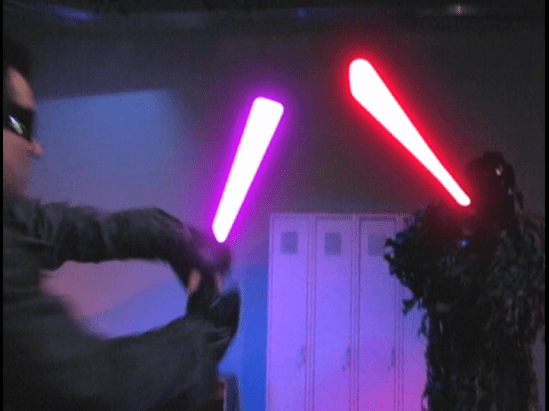
“Phobe: The Xenophobic Experiments” is an extremely ambitious sci-fi action film from Canada. Directed by Niagara, Ontario filmmaker Erica Benedikty, the 1994 film had a ultra-micro-budget of only $250 to cast a two-world, space odyssey complete with light-saber action and a behemoth amount of laser fodder. Being a slave to nearly no financial backing, “Phobe” had to manage without shame and roll with the flawed punches and, somehow, obtained popularity when broadcasted at a television station with which Benedikty was associated even when the film had to be diluted down to PG content. Fast forward 22-years later, Intervision Picture Corp. releases the aspiring director’s DIY fantastical vision in a glorious and plentiful remastered DVD edition.

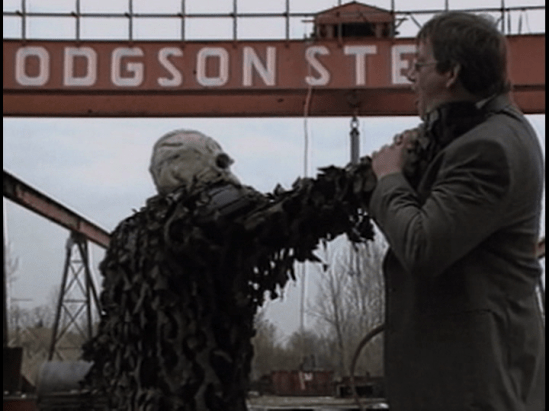
The Benedikty written and directed alien action feature pulls inspiration from many admired blockbuster sci-fi films including some potent familiarities, such as a revamped form of the alien from “Predator” who stalks with heat vision and blends in with camouflage or the dazzling lightsaber duels from the epic saga that is “Star Wars,” creating an endearing homage from a knowledgeable science fiction enthusiast with a dedicated cast and crew during a year long shoot. The Ontario filmmaker scribes her hero as not necessarily the hunter, but as the hunted because as soon as Dapp lands his ship and saves Jennifer’s life from a Phobe laser (a roman candle blast), Dapp and Jennifer spend the entire night on the run, never challenging the being until forced to do so and the structure harps upon a plot similar to “The Terminator” with a “Battlestar Galatica” villain presence.

Rostered completely with unknown local actors, John Rubick stars as the mullet sporting, Phobe asskicker Sgt. Gregory Dapp who bolts into light speed with a very John Belushi appeal set upon the shoulders of a calm and candid Rubick demeanor throughout the entire Phobe capturing and Phobe egg destroying ordeal. Dapp’s semi quasi love interest Jennifer, Tina Dimoulin, blankly unconditionally follows Dapp into certain utmost danger. The Dapp and Dumoulin combo are Earth’s last hope against the Merv Wrighton’s portrayal of an invading, combat-ready, ultimate killing machine species. Wrighton’s tall and broad shoulder stature ideally constructs an intimidating antagonist being ultimately unraveled by a very inanimate casted mask with no texture or any kind of cosmetic makeup whatsoever and that highly resembles a toothless ivoried skull.

“Phobe” won’t be palatable to every sci-fi devotee’s intergalactic taste. Only a microscopic niche fan base will greatly appreciate the tongue-in-cheek fashioned computerized imagery, the depth scale modeling, and the automaton deadpan acting that establishes “Phobe” as cult material and Severin’s InterVision Picture Corp. label does right by this small time Canadian film by remastering the original video elements and supplementing the DVD with a vast amount of bonus material. The video quality presented in a full frame 1.33:1 aspect ratio is as good as it’s going to get with the inconsistencies of magnetic tape from a camcorder as the darker scenes are, at times, hard to visually construct because of the digital noise, but the Dolby Digital 2.0 stereo audio quality is quite balanced and clear. The laundry list of bonus material includes an audio commentary from writer-director Erica Benedikty, the first feature film from Benedikty “Back in Black,” “The Making of Phobe,” Q&A with cast and crew, original FX shots from the 1995 broadcast version of “Phobe,” outtakes, and “Phobe” theme performed by Gribble Hell. Whew, that’s a lot of extras. To sum up the experience, “Phobe” is campy sci-fi schlock with stellar intentions and with tons of heart made of grenade tomatoes (this reference will make sense once you see the film) all while breaking the DIY mold.