
Wake Up and Get Lost in the EVIL Flowers. “Terror Firma” reviewed! (Dark Arts Entertainment / Blu-ray)

“Terror Firma.” The First Dark Arts Entertainment TItle Now Available!

Having no place to go during the middle of an unexplained, national Marshall Law event where citizens must remain indoors or else face imprisonment, Lola bunks in with her fellow adopted brother Louis and his bizarre tenant Cage. Though Lola and Louis have not seen each other in years, they quickly bond to deflect Cage’s peculiar persona that has honed in on Lola. After receiving a government issued drop shipment of food, Lola discovers a seed packet wedged in between the boxes. Her curiosity sows a single seed that results a hole in the ground next day, a hole that produces a jelly that conforms to their individualized favorite flavors, and they become addicted to its intoxication, but when Louis disappears, seemingly trapped between dimensions and communicating underneath an alien flower where the hole use to be, Lola is stuck alone with Cage who’s more and more becoming twisted by the transcendental jelly.
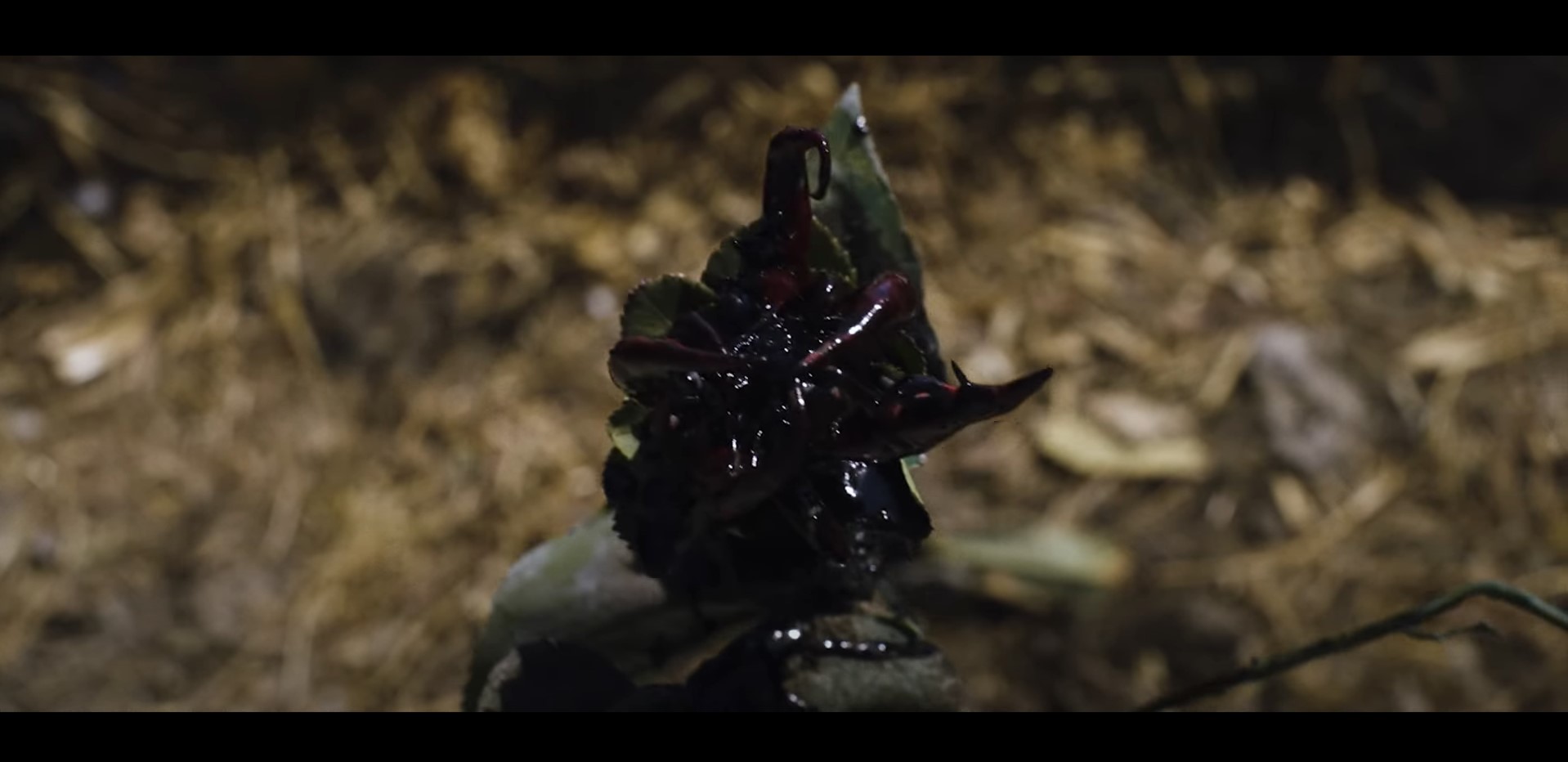
A pun play on the idea of terra firma, defined as the Earth’s ground or surface, “Terror Firma” is a prismatic and cosmic hell hole of a psychological and interdimensional thriller from writer-director Jake Macpherson. Macpherson, a regular music video director of photography and a short film filmmaker, debuts his 2023 feature film with a broader, elephantine story under a bantam budget, reduced to a singular location, and uses the idea of terra firma as the basic premise for natural Earth horror blended with the pandemic confinement of COVID-19 in which the story was conceived and how that isolation acceptance, thralldom from authoritarian instruction, and broken family bridges originate the internal dysfunctions outward toward a destructive, maddening outcome. “Terror Firma” is a production of the Los Angeles based Capture Theory company with Macpherson, John Angeli, Forrest Clark, Theo Linder, Katie Mamie, and Bryan Wilson serving as mostly first-time producers.

Keeping in line with a low-cost production, the story takes root at mostly one location, Lou’s rundown, multi-story house with creaky old floors and compact rooms, extending the location beyond the walls and into the house’s minute front yard where a pile of dirt with a strange jelly hole metamorphizing into an even stranger looking flower becomes the catalyst of weirdness.  Thai-American actress Faye Tamasa is Lola, the weary sister of Louis, played by Burt Thakur, who invites her to come stay with him during the beginning of a nationwide shutdown of unexplained purpose.  Lola and Louis, both once orphans and adopted by the same parents, haven’t seen each other in years and have rarely spoke.  Repeated motifs of isolation, such as the extension of their orphanage, and an awkward disconnect between them display their relationship instable without having an obvious clash to outright scream incompatibility between the two who don’t share bloodline but grew up together.  There’s still an affection quality between them but it is damaged.  And, then, in comes the third wheel that becomes the wedge between Lola and Louis’s relationship rekindling.  Cage, a dodgy spiritual pseud and played with monotonic sleaziness by Robert Brettenaugh (“Strange Blood”), interjects his numinous nonsense as a façade to impress Lola but as Lola sees right through him, Cage diverts his attention to the Jelly that drops the façade and unleashes his true spirit, a sociopath with an obsession.  The trio works to relay a significance in loneliness and isolating desperation in a sensationalized, supernatural way in finding a pathway through the lockdown blues.   Rounding out the cast with a small role that wouldn’t even be considered turning the trio into a quartet is Max Carpenter as a former love interest to Lola.

Not to be confused with or have any similarities to Lloyd Kaufman’s 1999 burlesque slasher titled “Terror Firmer,” Macpherson’s debut is born and bred out of the woes of a global pandemic by formulating a fantastical escape from the reality as we knew it before everything went into an abrupt lockdown.  The sudden stoppage of the world and social gatherings certainly began a snowball effect of emotional distress, some more external than internal that gradually drew to head an uneasy amount of stir crazy.  For the trio of roommates, and like most of us during the beginning of the lockdown, we’re excited and thrill for a break in the norm but as time marches on, those you’re stuck with without anywhere to go is an unusual alienating feeling.  “Terror Firma” expediates the sullied sensation to cosmic proportions with gateways to upside down worlds that mirror our own and develop cultish acolytes to the Jelly’s mystical powers.  Granted, no much of Jake Macpherson’s story makes a whole ton of sense and is very open to interpretation, but one possible avenue I’ve concluded is that the Jelly is a convenient, sweet-tasting poison that one can easily fall for its pseudo-tranquility and limitless euphoria to solve all our immediate problems as a quick fix but ultimately it’s our will and the power within ourselves to reconnect, re-establish, and revitalize what’s missing from ourselves.  Macpherson’s hallucinogenic rabbit hole of a thriller is an abstract course on preservation of relationship and connections while overwhelmed with obstacles.

Prominent genre filmmaker Brian Yuzna, well-known for his behind-the-camera roles on Stuart Gordon’s “Re-Animator” and “Dolls,” as well as his own directorial credits “Society” and “Beyond Re-Animator” to revolutionize the way we see horror in the 80s and 90s, teams up with John Penney, writer of staple cult classic “The Kindred” and “Return of the Living Dead III,” to form a new at-home physical media label known as Dark Arts Entertainment.  “Terror Firma” is the first title to be released by the joint partnership with MVD Visual for distribution.  The AVC encoded, 1080p high definition, BD50 houses the widescreen, 2.39:1, aspect ratio presented blossoming madness.  Picture image varies with the refracting coloring within the polychromatic lenses and in contrast to the post grading of a slightly coarse tone.   Yet, that isn’t to say quality is subpar and we’re treated to a fine digital image compressed without compromising the encoding on a double layered disc.  The English LPCM Stereo 2.0 offers a lossless reproduction of true audio fidelity and while not be a powerful mix course isolated layers through individualized channel outputs, “Terror Firma” isn’t necessarily powerful in range.  There’s only a handful of psychedelic moments of discord tunes and notes to emphasizes the crossing between dimensions and a few minor key moments to evoke fear out of Cage’s madness but other than that, “Terror Firma” specializes mostly in exposition and silently witnessed moments.  Dialogue is clean, clear, and prominently placed with depth dialed in where needed, especially when Lou begins to speak beyond the plane.  English subtitles are available for the feature only.  Inside the bonus material, a second version, an extended director’s cut, of the film is available and does not have the subtitle option.  Also included is Jake Macpherson’s commentary with main feature, a behind the scenes gallery, and the theatrical trailer.  The maiden Dark Arts release package is standard fare with a traditional Blu-ray casing containing no inserts or other tangible material ride alongs.  Release cover art leaves enough to the imagination to be lured in with Faye Tamasa crawling through a dirt hole and coming upon the alien flower.  The not rated feature has a runtime of 84 minutes and is encoded region free.

Last Rites:  “Terror Firma” is a bold first impression for not only writer-director Jake Macpherson as his debut full-length feature film but also for Brian Yuzna and John Penney inaugurating their distribution label with a film that might not strike a likeable chord with most but will certainly leave a relatable lasting impression on us all. 

“Terror Firma.” The First Dark Arts Entertainment TItle Now Available!

Open Up Your Mind to EVIL! “Conjuring the Beyond” reviewed! (DVD / Breaking Glass Pictures)

“Conjuring the Beyond” on DVD at Amazon.com!

Divorced and left to wallow in her own self-pity, Wanda Fulcia moves into her brother and wife’s house but her inability to secure a job and act responsible has proved difficult with her hosts as she continues to ask for favors, such as borrowing her brother’s car to drive to a paid sleep study in the middle of a nearly deserted small town.  Dr. Pretorious, the head clinician of the study, seeks to hypnotize his four, sleep paralysis unaffected, participants to open their portion of the brain to produce night terrors and sleepwalking in order to treat the condition.  What the participants are really opened to is a nightmare state of being paralyzed while aware of an old, animalistic hag surveying them as they lie powerless to move.  At dawn, they all convey recalling the same dream and realize one of them is missing.  The recorded video shows the missing participant sleepwalking from his room without a trace of where they’ve gone.  The next night, the ordeal repeats itself and another member of their party goes missing.  Wanda and those left must uncover the mystery behind their night terrors before they back to sleep again. 

Borrowing from the tall story superstitions that sleep paralysis was the work of demons while also plucking ideas from Stuart Gordon’s perceptually other-dimensional horror film, “From Beyond” and James Wan’s spirit-investigating “The Conjuring,” Calvin Morie McCarthy writes and directs his own unofficial, unauthorized, and unsanctioned sublevel spinoff with “Conjuring the Beyond.” The Vancouver, Washington born 30-year-old filmmaker has been through his fair share of direct-to-video horror refuse, even etching himself into the running joke of “Amityville” titled cheapies with his entry “The Amityville Poltergeist” that has garnered a general public rating of 2.2 on IMDB.com. That low score doesn’t tarnish our objective goal to look at “Conjuring the Beyond” impartially without the blatant cash-in title affecting our sound judgement because, trust me, we’ve seen our lion’s share of reused, reworked, and rehashed titles. The film marks the first 2022 release for McCarthy and is produced by Chad Buffet of the Renton, Washington based special effects and props company, Raptor FX Studio, along with Joe Dietrich’s co-created company 7th Street Productions with McCarthy and Richard Wolff of Breaking Glass Pictures who distributes the film with an at-home release.

At the heart of the story is Wanda Fulcia played by Victoria Grace Borrello in her feature film debut. The Loyola University graduate of the arts, Borrello offers a new face and a serious craft performance toward a recently divorced person who has become lost in themselves. Wanda’s written to be entrenched into any kind situation that befalls her whether be with her own troubles of self-discovery or the beleaguering troubles of a cerebral doorway opened to let a malevolent entity into her subconscious. Who opened that mental gateway is the potentially guileful psyche-physician, Dr. Richard Pretorious. Pretorious, as all horror fans know, is a homage to “From Beyond’s” Dr. Edward Pretorious, the main antagonist who used a machine called The Resonator to expand a person’s mind into other dimensions. “Mutant Vampire from the Planet Neptune’s” Steve Larkin certainly does not portray the diabolism in her version of a Pretorious Doctor but there is this underlining itch that can’t exactly be scratched regarding the character’s true intentions. This unfinished business happens between both Wanda Fulcia and Dr. Richard Pretorious and that takes away from completing well-rounded characters who never see themselves cross that arc finish line. Essentially, both are stuck in a disappointing stasis of unfulfillment, and their morals and their emotional baggage are carelessly left to the wind. I found the secondary principals more impressive and a little more understandable with tidbits of themselves being dropped like breadcrumbs through the variable time on screen. Cocky boxer Porter (Jon Meggison, “The Haunting of Ravenwood”), a tarot card floozie Margo (Jax Kellington, “Cross Hollow”), and midwestern drunkard Theo (Tim Coyle, “I Need You Dead!”) are the other three participants of the sleep study and each provide a unique image that continues to keep us interested and where they possible might end up retired on the runtime scale. Neil Green, Erik Skybak, and Chynna Rae Shurts as the skulking Sleep Demon.

With an amusing banter of well-written dialogue, a passable night terror demoness, and a nodding homage or two to a couple of horror powerhouse films, “Conjuring the Beyond” has scrappy potential to be something a touch more than just a capitalizer of better and already completed novel ideas. “Conjuring the Beyond” ends like an unfinished thought that asks more questions than provides answers in its thematic night terror framework. Shurts’ Sleep Demon is sorely underused and mostly not present to be invoking scares from the feature. Shurts is cladded on a budget but well adequate to eerie up the antagonist enough with fake long nails, fake gnarly teeth, and a dark shawl or robe attire that slinks and creeps in-and-out of alert sleep paralysis patients. McCarthy also dives into another theme of shared experiences or mutual dreams that then send a shiver of petrifying terror zipping through a collective’s inner being. More precisely in that theme is one’s person’s affliction affects or infects the surrounding others; we also see this at the beginning with a Wanda’s brother Nick and his wife negatively feeling Wanda’s ability to rebound from an ugly divorce. However, not all scenes make complete sense. The prologue of a man trembling in his bed and watching the Sleep Demon slither into his room before snatching him from his bed is detached from the trunk of the story much like a dead branch lying next to not it’s tree provenance. Yes, the branch part of a tree, just not this tree. Other aspects of the film also don’t make much sense or lack explanation is the participants who disappear reappear as sleep walking zombies under the control, possession, or will of the Sleep Demon and to what purpose is far from being seen.

“Conjuring the Beyond” evokes images of demons and terror onto a DVD home video from the Philadelphia based, provocative independent film distributor Breaking Glass Pictures.  The MPEG-4 encoded DVD5 is a NTSC, region 1, unrated U.S. release presented in a CinemaScope widescreen 2.35:1 aspect ratio.  The lossy codec compression appears to sustain a relatively good picture throughout the 90-minute runtime with little-to-no banding or issues and toned-down artifacts concentrated more so around darker scenes around the delineation of objects in the background. Noticeable post-production issues don’t go unnoticed when the visual effect of compositing CCTV footage on a computer screen was left undone and so there is a scene where the sleep study participants and Dr. Pretorious are huddled around a laptop staring at a blank, black screen while providing commentary on the disappearance of a fellow member of their group. The lossy English dual-channel stereo mix offers a mediocre, yet still strongly inclusive, audio output that has slight issues maintaining consistent decibel levels at times. Dialogue can sound muted at times or distant and then suddenly be more robust in the same breath. English subtitles are available if opted. Depth and range work well with the fear atmospherics and environments. The release is feature only with only a static menu on the DVD that’s encased in a normal black snapper case with egregiously deceptive artwork of a woman floating above her bed; no floating happens in the film. Perhaps less misrepresentative if titled something more original, “Conjuring the Beyond” holds tightly to the coattails of other iconic horror films but tweaks the story just enough to tease a fresh take toward the unharnessed and terrifying dimensions stemmed by the power of the mind.

“Conjuring the Beyond” on DVD at Amazon.com!

This Bundle of EVIL has a Dirty Diaper! “Baby Oopsie” reviewed! (Full Moon / Blu-ray)

“Baby Oopsie”  The Baddest Baby in Town on Blu-ray!

Who would have thought that playing with dolls could be deadly.  Sybil Pittman certainly didn’t think so as she hosts her internet streaming doll vlog showcasing her collection of pint sizes doll babies most of which Sybil has restored back to life…literally.  When a mysterious package arrives with the battered and stitched together head of Baby Oopsie, a severely bullied and neglected Sybil locks herself in the basement to work tirelessly on repairing Baby Oopsie’s head and mechanical body that includes, unbeknownst to Sybil, one special gear under a satanic spell to for collecting souls.   Baby Oopsie, the once pride and joy of Sybil’s restorations, has been resurrected from the toy junkyard and aims to claim the lives of Sybil’s tormentors to sustain it’s own diabolic animation.  When all of Sybil’s adversaries are eliminated, Baby Oopsie still requires lives to live and turns on Sybil’s friends and Sybil herself that becomes a battle to the death.

Full Moon knows how to run and market a good product that can last a lifetime and they continue to stroll through their finely tuned niche of deranged doll other pint-sized psychos to this very day with brand new produced features hitting the physical and streaming retain shelves in 2022.  Following the success of “Don’t Let Her In,” one of those new features aforementioned, is the return of the evilest rug rat known to infant kind, Baby Oopsie, from the “Demonic Toys” universe.  William Butler, who I fondly remember playing sweet country boy Tom being blown up and having his corpse feasted on in Tom Savini’s “Night of the Living Dead” remake, continues his long-standing tenure with Charles Band and Full Moon that began in 1986, under the Charles Band Empire Pictures company production and Stuart Gordon directed “From Beyond,” with a new written-and-directed feature “Baby Oopsie,” a concentrated, standalone spinoff of “Demonic Toys.”  This isn’t Butler’s first go-around with the go-go-ga-ga-gut your guts dolly as the filmmaker helmed “Demonic Toys 2:  Personal Demons” in 2010.  Charles Band and Butler produce the film with regular Full Moon executive producer Nick Blaskowski under the Full Moon Features in association with Candy Bar Productions.

Viral sensation the McRib Queen versus demonic toy Baby Oopsie. Stand up and character comedienne, Libbie Higgins, debuts in her first feature headlining role as Sybil Pittman, the repressed and intimidated vlogging doll queen living in abusive hell with tyrannical stepmother after the death of her beloved father. Higgins, who has an Onlyfans page for only $8 a month for all you obsessed fans out there, adorns a wig, glasses, and meme cat sweaters to get into the head of Pittman’s secluded world and where outsiders browbeat her into a reserved submission and wishful thinking only provides little comfort returning the hurt played out internal sadistic fantasies. For her breakout role, Higgins transcends her comedienne persona and into an anxiety-riddled outcast wretched by life’s punches and horror-struck by a doll that walks, talks, and kills like a macho-sadist. Before going head-to-head with the berserk Baby Oopsie (voiced by newcomer Jill Barlett), Sybil is caught between the devil and a saint with her brash, overbearing, stepmother played by Lynne Acton McPherson (“Improbus”) and the attentive and caring subletter played by Marilyn Bass, who tries very hard to be Full Moon sexy and skin-revealing without showing the camera too much. Her “best friend” Ray-Ray tips the scales toward believing in Sybil’s beauty and craft, befriending the doll queen despite her large radius of shunning those want to get closer to her, such as the mailman or the gardener, because of the depressive self-pity. Yet, Ray-Ray brings to the light and so does the actor who portrays the upbeat Hey Hunny sassy-mouth in TikTok and Youtuber influencer Justin Armistead. Armistead is magnetically chipper onscreen compared to Higgins story-obliged monotone placidness that balances out quite nicely the duo’s vanilla and peanut-butter-marshmallow swirl relationship. “Baby Oopsie” is full of character and characters, rounding out it’s smorgasbord of victims and supports with Diane Frankenhausen, Shamecka Nelson, Joseph Huebner, Michael O’Grady, Michael Carrino, Christopher J. Meigs, Tim Dorsey, and Josephine Bullock.

Set and filmed in Cleveland, Ohio at the proclaimed Full Moon estate, a 60’s-70’s anachronous house with many rooms becomes the playground setting for “Baby Oopsie,” the cast, and the crew. The location that reflects an era no longer modern, a dated obsoletism, to match Baby Oopsie’s classic and ideal bald-bald in a night gown form. However, normal Baby Oopsie also comes with that grotesque, malformed face that only a doll obsessed mother could love and would cause the toughest of horror fans to fear in their pants in on glance at the augmented representation of a human infant. It’s the creepy old doll look you definitely don’t want to see sitting in a dark corner blankly staring at you.  Of course, the special effects are not the classic Full Moon stop motion you see with the “Puppet Master” flicks as “Baby Oopsie” deals in tangibility with a bait and switch editing between the number of diverse molded Oopsie dolls created by special effects supervisor Greg Lightner (“Corona Zombies,” “Don’t Let Her In”) that include an open mouth and sneering face or a set of glowing eyes to provide a sense of evil.  Oopsie fits right into Sybil’s down on her luck story that is nicely compact and complete for an indie horror quietly but surely touches upon Sybil’s life in various key scenes, such as the gardener who hangs around because her father was much beloved or how much Sybil is despised at work between the dragooning, nitpicking, and strict boss and the snickering colleagues that look down at her.  Butler’s sweet-and-salty route delegates a fine line between her friends and foes that make the stakes clear when Oopsie decides impulsively to go off the bad-guy only rails. “Baby Oopsie” is far from cute and cuddly. “Baby Oopsie” is closer to being ugly and uncouth as the prime and pinnacle sequel of anthropomorphic toy horror in today’s Full Moon toy chest of films.

Spinoffs have become the new favorite amongst audiences, “Baby Oopsie” even pays a sideswiping jab to “Annabelle” of the “Conjuring” universe, and while we see a lot of spinoffs in television, the concepts and ideas are beginning to spill more frequently for filmgoing fans and, as such, “Baby Oopsie” is reborn onto her (or is it him? or it?) own Blu-ray home video from Full Moon Features. The region free, high-definition release, presented in a widescreen 1.78:1 aspect ratio, is the epitome of digital recording without much of a single critique or compression issue. Inundated with a more realism than stylism presence in front of the camera with the exception of a few edited in art renditions of satanic imagery, Butler and cinematographer Josh Apple apply a clean, high-resolution coating that undeniably very familiar to Full Moon’s repertoire. What’s also a motif straight out of Full Moon’s bag of goodies in the carnivalesque score. The Dolby Digital 5.1 surround soundtrack raises the volume on the Fred Rapoport and Rick Butler above a superseding level that swallows the English dialogue at times. You really want to absorb Jill Barlett’s vulgarities as Baby Oopsie but need to fight the soundtrack to do so during key moments when Oopsie’s profanity-laden Tourette like behavior kicks in. The release also comes with a second audio option with a Dolby digital 2.0 stereo. Bonus features include a behind-the-scenes featurette with cast and crew interviews on their experience making the film and poking fun at each other at times in a well-edited jest, a Videozone featurette that’s essentially a mini panel with producer Charles Band, director William Butler, and stars Libbie Higgins, Marilyn Bass, and Lynne Acton McPherson taking a break in the midst of filming to talk about their characters, to talk about the film itself, and for Band to plug his streaming service and new projects, there’s a mini-featurette All Dolled Up! that has Libbie Higgins in character, Justin Armistead self-recording in his bathroom, like on TikTok, and Baby Oopsie announce the winner and runner-up’s of a contest to win a Full Moon prize package. Bonus content rounds out with Full Moon trailers. The Blu-ray comes unrated, and feature has a runtime of 78 minutes. “Baby Oopsie” is not the addendum to the profane book of “Demonic Toys” but rather an extenuating chapter that opens the door for all the misfit and maniacal toys to one day have their own independent rampaging furtherance that are likely already drafted, budged, and ready to shoot at a moment’s notice.

“Baby Oopsie”  The Baddest Baby in Town on Blu-ray!

Herbert West Receives a New, Evil Release! “Re-Animator” review!


Third year medical student Dan Cain is on the verge of graduating from the New England Miskatonic University Medical School. That is until Dr. Herbert West walks into his life. Learning all he can from neurologist Dr. Hans Gruber in Zurich, Switzerland, West eagerly enrolls as a student at Miskatonic to viciously dismantle, what he believes, is a garbage postmortem brain functionality theory of the school’s grant piggybank Dr. Carl Hill while West also works on his own off the books after death experiments with his formulated reagent serum. West takes up Cain’s apartment for rent offer and involves Cain in a series of experiments that lead to reviving the old and the fresh dead. The only side effects of revitalizing dead tissue is the unquenchable rage and chaos that urges the recently revived to rip everything to shreds. Things also get complicated and people begin to die and then revive when West and Cain’s work becomes the obsessive target of Dr. Hill, whom discovers the truth and plans to steal West’s work, claiming the reagent serum as his own handiwork while also attempting to win the affection of Dr. Cain’s fiancee and Miskatonic’s Dean Halsey daughter, Megan Halsey, in the most undead way.

A vast amount of time has passed since the last time I’ve injected myself with the “Re-Animator” films and I can tell you this, my rejuvenation was sorely and regrettably way overdue. Stuart Gordon’s impeccable horror-comedy, “The Re-Animator,” is the extolled bastardized version of Mary Shelley’s Frankenstein without direct references and begins the ghastliness right from the initial opening prologue and never wanes through a fast-paced narrative of character thematic insanity and self-destructing arrogance with hapless do-gooders caught in the middle of undead mayhem. Producer Brian Yuzna financially backs Charles Band’s Empire International Pictures distributed 1985 film that’s based loosely off the H.P. Lovecraft 1922 novelette “Herbert West-Reanimator.” From a bygone novelette to an instant cult favorite amongst critics and fans, “Re-Animator” glows vibrantly like it’s reagent serum embodied with reality-buckling entertainment and grisly havoc displayed through the silver screen adapted form. Umbrella Entertainment has released a two-disc collector’s set, the first volume on their Beyond Genres label of cult favorites, and this release, with various versions, will include the allusive 106 minute integral cut!

From his first moments on screen holding a syringe to over three decades of pop-culture films, comics, and social media presence, nobody other actor other than Jeffrey Combs could be envisioned to be the insatiable Dr. Herbert West. Combs is so compact with an explosive vitality that his character goes beyond being a likable derivative of a Machiavellian anti-hero. Narrowing, dagger-like eyes through thick glasses on-top of small stature and a cruel intent about him makes Combs an established horror icon unlike any other mad doctor we’ve ever seen before. Bruce Abbot costars as Dr. Dan Cain, a good natured physician with a penchant of not giving up on life, but that’s where he’s trouble ensnares him with Dr. West’s overcoming death obsession. Abbott’s physically towers over Combs, but his performance of Cain is softly acute to West’s hard nose antics. Abbott plays on the side of caution as his character has much to lose from career to fiancée, whose played by Barbara Crampton. “Re-Animator” essentially unveiled the Long Island born actresses and made her a household name who went on to have roles in other prominent horror films, including another Stuart Gordon feature “From Beyond,” “You’re Next,” and the upcoming “Death House.” David Gale rounds out the featured foursome as the detestable Dr. Carl Hill. Gale embraces the role, really delving into and capturing Dr. Hill’s maddening short temper and slimy persona; a perfect antagonist to the likes of Combs and Abbott. The remaining cast includes Robert Sampson (“City of the Living Dead”), Carolyn Purdy-Gordon, and Peter Kent.

The “Re-Animator” universe is right up there with the likes of Sam Raimi’s “The Evil Dead.” Hell, there is even a line of comics that pit the two franchises together in a versus underlining. Unfortunately, “Re-Animator” is frankly nothing without the franchise star Jeffrey Combs, much like “The Evil Dead” is nothing without Bruce Campbell even though we, as fans, very much enjoyed the Fede Alvarez 2013 remake despite the lack of chin. Gordon’s film needs zero remakes with any Zac Efron types to star in such as holy role as Dr. Herbert West. That’s the true and pure terrifying horror of today’s studio lucrative cash cow is to remake everything under the genre sun. Fortunately, “Re-Animator” and both the sequels have gone unscathed and unmolested by string of remakes, reboots, or re-imagings. Aside from a new release here and there, such as Umbrella’s upstanding release which is fantastic to see the levels of upgrades up until then, “Re-Animator” has safely and properly been restored and capsulated for generations to come.

Umbrella Entertainment proudly presents the first volume of the Beyond Genres’ label with Stuart Gordon’s “Re-Animator” on a two-disc, full HD 1080 Blu-ray set, presented in a widescreen 1.77:1 aspect ratio. A very fine and sharp image quality that maintains equality across the board with minuscule problematics with compression issues, jumping imagery on solid colored walls for example, but the issues are too small amongst the rich levelness of quality and when compared to other releases, Umbrella Entertainment’s release is a clear-cut winner. The English DTS-HD master audio puts that extra oomph into Richard Bands’ score that’s heavily influenced by Alfred Hitchcock’s “Psycho,” adding a pinch of chaotic gothic charm to the macabre story. Dialogue is balanced and upfront, but there isn’t much prominent ambient noise to put the dialogue off-kilter. Special features on the first disc include the 86 minute unrated version of “Re-Animator,” audio commentaries from director Stuart Gordon, producer Brian Yuzna, and stars Jeffrey Combs, Barbara Crampton, Bruce Abbott, and Robert Sampson; there’s also a “Re-Animator Resurrectus” documentary, 16 extended scenes, and a deleted scene. The second disc includes the 106 itegral cut along with interviews with Stuart Gordon, Brian Yuzna, writer Denis Paoli, composer Richard Band, and former Fangoria editor Tony Timpone. Plus, a music analyst by Richard Band, TV spots, and the theatrical trailer. All this and a bag of corpses is sheathed inside a remarkably beautiful encasement with a seriously wicked custom slipcover desgin by illustrator Simon Sherry. There’s also reversible Blu-ray casing cover art with previous designs incorporated. H.P. Lovecraft would be extremely flattered and proud on how Umbrella Entertainment not only enhanced the film adaptation of his classic tale of macabre, but also with how diabolically attired the release is distributed. A true horror classic done right!

Free Your Soul With the Evil Mad Doctor! “The Soultangler” review!


Experimental doctor, Anton Lupesky, invents a controversial drug that can free a human soul from its vessel and travel through into the lifeless eyes of a corpse, possessing the body to reanimation. The only side effect is grotesque hallucinations that are so horrible, few survive the experience. After a stint of missing persons and a string of mysterious deaths at the Whitebriar Institution, Lupesky is fired from his position, banned from the medical board, and brought up on criminal charges. His acquittal sparks him to embark on a journey overseas to continue his radical medical experiments, away from regulations and tremendous oversight. The doctor returns six months later for far superior medical innovations in America and begins practicing again in his own basement with the unscrupulous help from a couple of lackey acolytes that leaves Lupesky’s supply of “patients” not in short demand. One reporter keeps investigative tabs of the good doctor as she suspects a connection between him and her father’s death at Whitebriar and when her and her friends starts to snoop around, Lupesky has no choice but to use any means necessary to thwart her investigation, even if that means secretly administrating the drug to her in hopes that her soul can fly with his – if she survives.

Thirty years ago, “The Soutangler” hit the cinema market. A low-budget gruesome mad scientist flick with a penchant for some fantastically grisly practical special effects. The 1987 shocker was directed by Pat Bishow, penned by John Bishow and Lance Laurie, and shot on location on Long Island, New York. The Do-It-Yourself and Lovecraftian macabre does a bit of soul-searching to find resurrection from the video graveyard. Luckily, Bleeding Skull! Video and the AGFA come to the rescue with a chock-full of extras release that digs up the Bishow’s lost creation, dusts it off, cleans it up, pats it on the butt, and sends it back out into the world onto DVD home video. “The Soultangler’s” niche envisioning goes against the grain of traditional filmmaking, bordering experimental, but definitely a must-see for those interested in existentialism horror: the removal of free will to be replaced by another’s.

Pierre Devaux stars in his only credited as the mad Dr. Anton Lupesky that resembles along the lines of a Dr. Herbert West from that little known trilogy of the H.P. Lovecraft inspired “The Re-Animator.” With a wiry frame, stringy shoulder length hair, and government-like issued classes, the very animated Pierre Devaux casts the ideal character whose maniacal and perverse in his medical malpractices. The only one willing to stop the Lupesky’s experiments is investigating journalist Kim Castle of The Daily Chronicle. Castle, played by Jane Kinser, is about as ferocious as her beautiful as an aggressive reporter, unwilling to stop to unearth the truth of her father’s tragic death. Kinser’s not much of an onscreen force to reckon with as she’s quite timid, but she manages to hold her own up against Devaux wild eyed lunacy. Rounding out the cast is Bob Cederberg as a Carl the drugged addict henchman, Louise Millman as a loyal minion to Lupesky, and Tom Ciorciari as Castle’s concerned friend who battles the zombified corpses embodied by Dr. Lupesky.

While a strong appreciation exists from the outstanding attention to detail with the decayed bodies and the explicit violence in the finale that nightmarishly flourish in a heap of ghastliness, the rest of the film is as disjointed as the dismembered bodies in Lupesky’s basement of horrors. Despite being submersed in various talking head scenes that divulge significant backstories between Dr. Lupesky and Kim Castle, the story struggles to keep the straight line focus, swerving erratically between subplots and the main premise. Castle’s horrific dreams of aggressive zombies loosely makes a connection other than prepping Castle’s subconscious when ingesting Lupesky’s soul freeing drug. The story of Dr. Simpson also flounders to the waist side with her and Dr. Lupesky’s love affair, the only women he would even consider getting close to and not slaughter for his own amusement.

“The Soultangler” arrives onto full-bodied, graphically illustrated DVD from the B-movie collaborators Bleeding Skull! Video and the American Genre Film Archive (AGFA) and distributed by MVDVisual from the original 1″ master tapes. Shot on 16mm, but edited on video, “The Soultangler” has a SOV experience in it’s original aspect ratio of a full frame 1.33:1. Quality varies from the source material, including some tracking and edge flare issues, but overall a solid transfer with a sizable color palette that includes tints, natural skin tones, and visceral dream sequences that show little-to-no sign of diminishing. Stereo mono track does the job despite poor mic placements to get the full girth of dialogue. HypnoLoveWheel’s indie synth/rock soundtrack has more popularity on the B-level than in the mainstream music, but serves “The Soultangler” with broad depth to solidify a wedge between “The Soultangler’s” whimsical charm and the Gothicism that is Stuart Gordon’s “Re-Animator.” Bonus features include, for the first on any release, the Unseen 62 minute alternate director’s cut, a commentary track with director Pat Bishow, behind the scenes footage, trailers for “The Soultangler” and “Dead of Night Town,” music video for “wow” by HypnoLoveWheel, and liner notes by Bleeding Skull’s Zack Carlson. Conceptually, “The Soultangler’s” premise oozes originality and creativity involving soul transformations through the portal eyes of a dead body and that’s simply brilliant and what today’s horror genre certainly craves. Constructionally, Pat Bishow couldn’t push the momentum to pickup the pace to overripe an engaging story, but the climax, out of left field, unsheathes a bloodbath of ultra-stellar, DIY proportions!

At Amazon, The Soultangler, Right now!