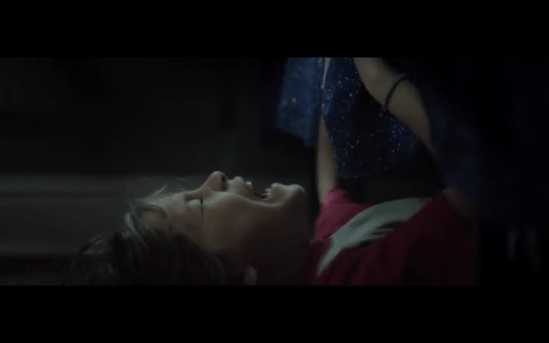
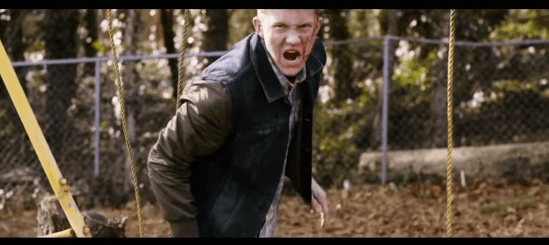
A Bond of Friendship Formed Over an EVIL Annual Contest. “The Long Walk” reviewed! (Lionsgate / Blu-ray)

“The Long Walk” on Blu-ray for the Holidays!

Over a decade ago, a divisive civil war nearly tore the United States of America apart, leaving in it’s wake a country on the brink of financial ruin and its place in the world behind other nations.  To help heal the nation back into an industrial superpower, an annual long walk was enacted to be a show of encouragement, an act of bravery, and to instill a sense of duty and production amongst the citizens of America.  Voluntary participants of young men, one from each state, must walk continuously at 3 ore more miles per hour with a military escort.  Last man standing will be bestowed a large cash prize and granted one wish of their choosing.  Those unable to continue their trek at the required pace will be issued three warnings before being gunned down, punching out their ticket.  Home state’s Ray and Georgia’s Peter form a bond on their walk that’ll test not only their friendship but their will to live in hopes to change the contest’s cruelty.  

“The Long Walk” has itself been on a long walk to being adapted on film from the first official novel by the prolific and renowned suspense writer Stephen King under his pseudonym of Richard Bachman.  I’ve italicized official because the late 60’s novel wasn’t published and released until 1979, five years later after “Carrie” was published in 1974.  Through the hands of George Romero and Ridley Scott, neither could materialize a filmic rendition of what is considered his most grim work.  That is until “Constantine,” “I Am Legend,” and “Hunger Games” director Francis Lawrence came along, acquired the rights, hired “Strange Darling’s” JT Mollner to script the project, and produced perhaps the most disturbed dystopian film of 2025.  “The Long Walk” feature is a collaborative production from Spooky Pictures, Electric Lady, and Miramax, is produced by Steven Schneider, Francis Lawrence, Roy Lee, Cameron MacConomy, Rhonda Baker, Ellen Rutter, and Carrie Wilkins, and has been given executive producer Stephen King’s blessing for minor, yet impactful, creative control.

“The Long Walk” courses with a young but up-and-coming cast with a veteran icon bringing up the rear as coxswain spurring the unpleasant action.  “Licorice Pizza’s” Cooper Hoffman, son of the late Philip Seymour Hoffman, and English actor David Jonsson whose just came off his part in a big science-fiction horror franchise with “Alien:  Romulus” from last year.  Together, Hoffman and Jonsson play the central characters of Ray Garrity and Peter McVries, two young men who formulate a bond while voluntarily participating in the annual deadly contest that traverses for hundreds of miles through heartland portions of an undisclosed state.  Right from the get-go, Ray and Peter hit it off as the check in for the contest simultaneously upon arrival with the story quickly introducing and discerning a select sundry of other walkers that are either in it to make friends, be an in-it-to-win-it antagonists, or be a formidable indifferent with a spectacular end to their ticket or otherwise arc toward either direction.  In these walk-along parts are Ben Wang, Charlie Pummer (“Moonfall”), Joshua Odjick, Tut Nyuot, Roman Griffin Davis, Garrett Wareing (“Independence Day:  Resurgence”), and Jordan Gonzalez supporting the Ray and Peter narrative with their own in-state regionalism and dialect backstories and motives for sacrificial strutting, which their exit that much more poignant.  Then you have Mark Hamill, who needs no introduction, in a performance on a totally different plane of existence than the young man walking for their very lives.  Blind to compassion and stern on his belief sacrifice is necessary for the greater good of the nation, Hamill as no nonsense brass, known only as The Major,” is a mythical figurehead initially held in high esteem and awe or overall indifferent amongst the young men.  All except one with Ray being the firm outlier of contrarian using passive aggressive measures that build to an endgame goal.  Sporting large aviators, green fatigues, and occasionally holding and firing a sidearm, Hamill’s method ways really come alive within The Major’s gung-ho disposition inside an authoritarian America.  Judy Greer (“Jurassic World”) and Josh Hamilton (“Dark Skies”) round out the cast as Ray’s parents. 

No matter how grim “The Long Walk” spans the 108-minute runtime, the story isn’t necessarily all bleak.  While the time period is unknown and the war that has seemingly divided the nation goes unsaid, one can assume the decade is late 1960s to early 1970s based off the military fatigues and weaponry, the dialect and slang vernacular, and the outer shell of the world with clothing, cars, and storefronts that speak to a simpler time where no cell phone exists, transmitter radios are the news and music, and the presence of any modern-day convenience lost amongst the vast fields and deprived brick-and-mortars of small town America.  Yet, the story walks along the lines of some alternate, dystopian reality, pre-dating a “Hunger Games” like contest involving the permanent elimination of young people in effort to better society.  Fortunately for “The Long Walk,” director Francis Lawrence directed “Hunger Games” and that gives him a leg up on the tone this adaptation needed for the big screen but although the two share a similar theme, the differences between them are vast with “The Long Walk” set in a past instead of a future dysphoria, objects and places are established and grounded by reality rather than creative fiction, and the violence is by far the grislier.  Often, violence can be gratuitously supplemental and unaffecting but Lawrence’s intention to show closeup executions contrasts with weight against the boys’ bond building during their fear and their ambition test.  With every explosion of brain matter and bits of flesh the stakes are real and the tension is thick even if the panic is subdued amongst the walking competitors.  Yet, with every ticket punched, that tightness starts to show signs of shuttering in conjunction with fatigue and that carries on for miles.  Much like the film adaptation of Frank Darabont’s “The Mist,” the ending for “The Long Walk” has been altered from the novel with prior Stephen King approval and while “The Mist” absolutely shatters all the hope with tons of despair and irony in a blaze of glory ending where one’s heart drops like a cannonball in the ocean, “The Long Walk’s” finale barely fizzle to make the same impact and can even be said to be a predictable modern moving ending. 

“The Long Walk” puts one foot in front of the other toward a new Blu-ray release from Lionsgate.  The AVC encoded, high-definition presentation in 1080p, is stored on a BD50 with a widescreen 1.39:1 aspect ratio.  Sharp detail in the small percentage desaturated picture offers a mid-20th century America air along with the costuming and production sets and locations.  Fabric textures result better in sweat-induced cotton Ts overtop a variety of muted shaded pants and solid army fatigues while the rest of the landscape has a green, brown, and tan landscape of a scarce Midwest, harnessing widescreen and medium shots for the open terrain that equally freeing and beautiful yet also confining and harsh in the grim, dystopian contest; however, the textures take a back seat to the chunky bits of exploded flesh, blood, and brain matter splattering either in gray and painted asphalt or spreading amongst the wind.  While the detail doesn’t provide all the gory bits and pieces there’s enough there to really cause alarm from within.  The English Dolby Amos is the primary English track for best to enclose the immediate space surrounding the 50 State participates feet hitting the pavement and the escorting military convoy tank and wheel tracks.  Gun shots are jolting that tear into the audio senses in step with the graphic nature of the scene of apathetic militaristic executions.  There are curious post-execution sounds from the blood pooling on the street in what sounds like a continuous gush of blood that hits the side channels; its an odd action for sound to take audible shape, especially in scenes that are not an extreme close up but rather materialize out of medium shots.  Dialogue is perfectly suitable in the conversational piece between the young men and the gruff Major.  Other audio format choices include a Spanish Dolby Digital 5.1 and a French Dolby Digital 5.1.  There are also an English 2.0 descriptive audio and subtitles in English, Spanish, and French.  Special features include feature length documentary Ever Onward:  Making the Long Wal” with crew – such as director, writer, and DP – and cast – including Cooper Hoffman, David Jonsson, Garrett Wareing and more – interviews discussing the depths of “The Long Walk” from A-to-Z, from it’s previous adaptation concept rights held in limbo down to the individual character mindsets.  Two theatrical trailers are the only other special features encoded.  Lionsgate Blu-ray Amaray case is encased a O-slipcover with straightforward (pun intended) artwork that’s also on the case artwork.  The digital copy leaflet is inside for digital moving watching pleasure.  The 108 minute film is encoded region A and is rated R for strong bloody violence, grisly images, alcohol, pervasive language and sexual references. 

Last Rites: An intense and somber America born out of division and fear is a reverse reality, an alternate take on what could have been or could be soon, as “The Long Walk” glorifies sacrifice as a scapegoat for national pride, strength, and the greater good in a warped sense of authoritarian rule and industrial encouragement.
“The Long Walk” on Blu-ray for the Holidays!

To Do EVIL or To Do Good? “Men of War” reviewed! (MVD Visual / Blu-ray)

“Men of War” are Men now in High Def! See It Here!

Living like a pauper on the frozen street of a snow Chicago, ex-special forces soldier Nick Gunar has no desire to return to his former life, but when he’s referred a mercenary job to visit an island off the South China sea, he’s assured by the man that referred him, his fatherlike former colonial, that there will be no bloodshed in his all for show and intimidation situation that needs more finesse than firepower.  His mission is to assemble a team and negotiate with armed persuasion to get the unwilling, combative locals to sign over the rights to a mineral rich underground cave system.   Gunar’s expected confrontation turns out to be a small village of unarmed men, women, and children, peacefully refusing to sign over their land for excavational exploitation of their ancestral home.  While Gunar weighs his morality, a second team lead by Gunar’s more ruthless brother-in-arms, Keefer, sets to make sure the job is completed one way or another. 

Set off the coast of Thailand, “Men of War” is the 1994 U.S. mercenary action film that induces the ethics and morality question of armed-to-the-teeth hired guns against a small village of mostly helpless residents going to sit with an honorable conscious.  Perry Lang, actor in such films as “Teen Lust,” “The Hearse,” and “Alligator” who then turned director in the early 90s, helmed his sophomore picture after directing Catherine O’Hara in “Little Vegas” four years prior.  “Men of War,” which had a working title of “A Safe Place,” is penned by a trifecta of writers in “The Howling’s” John Sayles, “Demon Knight’s” Ethan Reiff, and Reiff’s longtime screenwriting partner Cyrus Voris.  Seasoned writers and an upcoming director garnered studio funds by Moshe Diamant and Stan Rogow to take a chance on the abroad militant-action subgenre that was dwindling at the time of the mid-90s.  Mark Darmon Productions Worldwide, in association with Grandview Avenue Pictures, served as coproduction studios with Arthur Goldblatt, Andrew Pfeffer, and David C. Anderson producing.

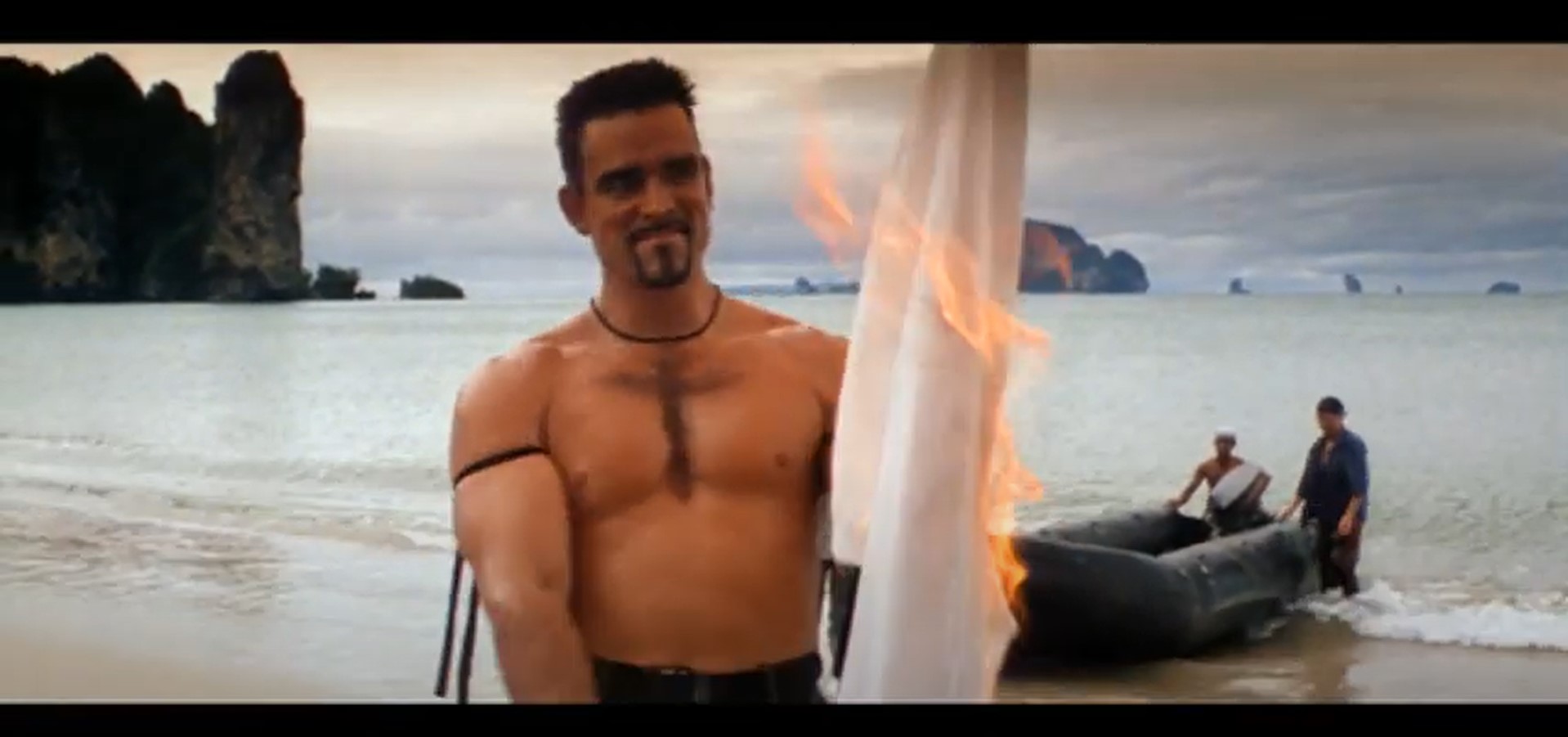
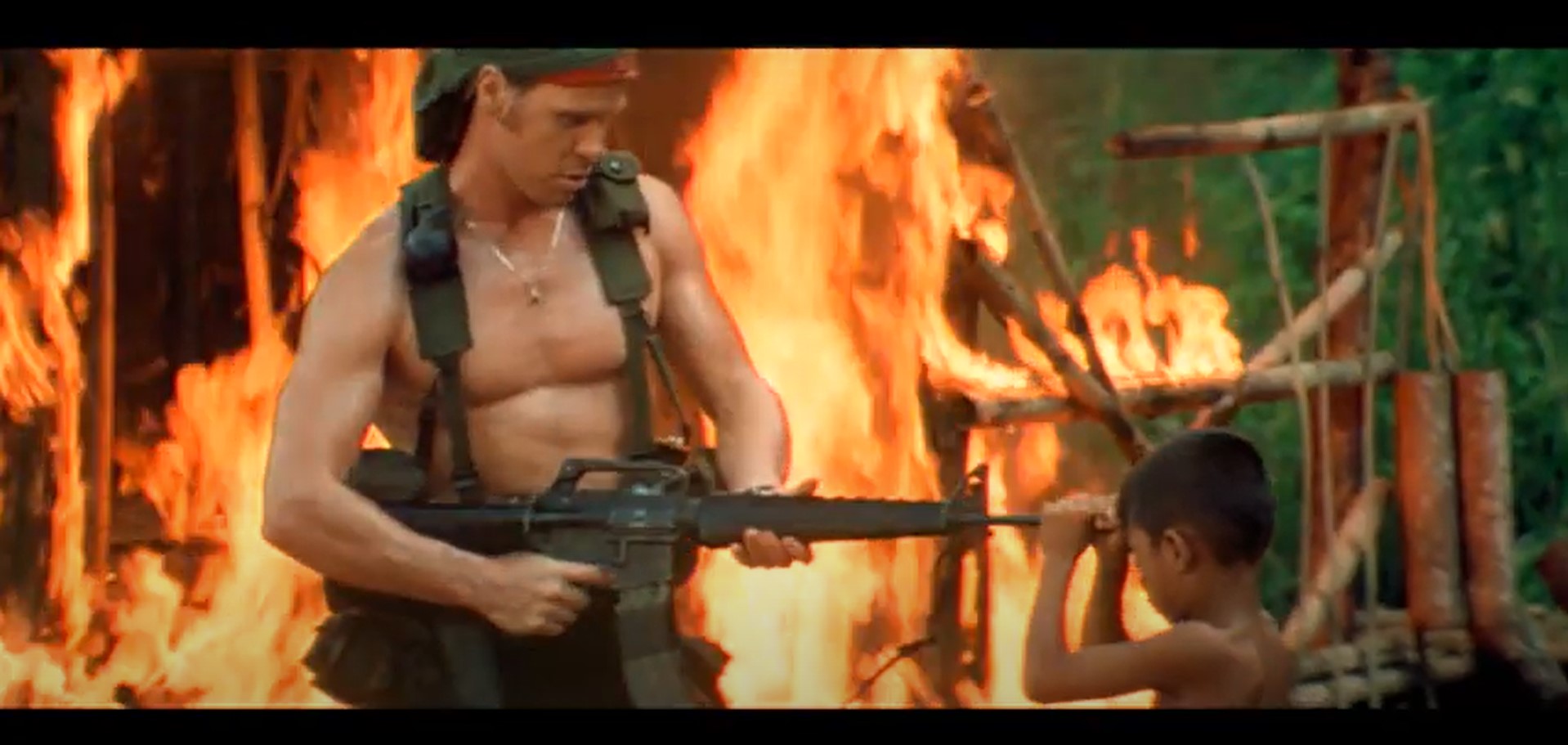
The big name that attracted financial support and give the title a boost was Dolph Lundgren who, at that time, was one of the biggest action stars of the late 80s into the 90s with “Rocky IV,” “Masters of the Universe,” “The Punisher,” and “Universal Soldier” all under his 6’ 3” Swedish, muscular frame topped with blonde haired and gentle blue-eyes.  Lundgren tackles his next role as conflicted mercenary looking to get out of the game all together as former special forces soldier Nick Gunar.  Perhaps one of the more complex roles Lundgren has portrayed in his career, Gunar fights the uphill battle of a pressurized existence that always leads him back to what he does best, being a soldier of fortune.  Yet, the well-trained combatant’s heart has softened and changed to not be an elite killer anymore and his new mission, assigned to him by venture capitalist Lyle (Perry Lang) and Warren (Thomas Gibson, “Eyes Wide Shut”) and referred by Colonial Merrick (a true typecasted bad guy in Kevin Tighe of “K-9”), will put his trained tactics and newfound compassion to the test.  However, for obvious cinematic reasons, things will not go as smooth as Gunar obliviously hopes with nudges from a diversely skilled team of assembled gung-ho comrades, deceived by those he’s trusted, and antagonized vehemently by an unstable, former fellow special forces brother-in-arms Keefer, played by one of my favorite Aussie actors, the late Trevor Goddard (“Mortal Kombat,” “Deep Rising”).  Lundgren usually brings with his large and imposing self to the table with every role he slips into, but Gunar feels different partly because of two very different reasons:  Gunar lacks defining confidence and maintains the fierce façade to keep the assignment afloat under the aforesaid pressures, but Lundgren doesn’t look physically all there as he appears hunched over for a better part of downtime scenes.  “Jurassic Park’s” B.D. Wong plays the village wisecracking’ spokesperson Po who welcome Gunar and his team’s arrival with respect and with a little humor.  Wong’s cavalier style for Po works to cut tension and to showcase the natives as peaceful and unassuming but steadfast in their beliefs.  “Embrace of the Vampire’s” Charlotte Lewis, as Loki the the native island single mother and love interest to Lundgren, is the second credit name of the film yet has perhaps the shortest screen time of all the characters that fill out “Men of War” with Tony Denison (“Wild Things 2”), Tommy “Tiny” Lister Jr. (“The Fifth Element”), Thomas Wright (“Tales from the Hood”), Tim Guinee (“Vampires”), Don Harvey (“The Relic”), and Catherine Bell.

Cast ensemble of familiar faces makes “Men of War” easier to digest when considering the threadbare sensical plot.  If taking the trouble to hire mercenaries to negotiate the signature surrender of property, the company investors might as well have used extreme force instead of finesse as the good Colonial Merrick suggests to Gunar.  “Men of War’s” setup is not very sexy to establish a radical rational to plot against the native denizens, fast-forwarding and skirting through the first act’s purposed goal and recruitment of characters is sullied by that dilution of plot device.  The recruiting montage is what hurts the most that shows Gunar travelling across the globe to handpick past acquaintances for his team, but the history markers are not in place to establish characters behaviors, past or present undercurrents, or anything that really ties them together or tears them apart which eventually happens when a line in the sand is drawn.  Even Keefer’s neglected volatile bad juvenile behavior is crucified by zero backstory substance.  “Men of War” bravely relies on the future to flourish and does so quite well by creating a dichotomy between a paid duty and a moral deed, especially when falling in love with a native girl is involved.  Explosions, bullets, and various kinds of melee skirmishes rock the story’s intended searching for inner peace theme and there’s no shortage or pulled punches with the pyrotechnics or squib-popping gunplay.  Perry Lang and producers make no qualms about the product their peddling by offering a detonating spectacle on a wafer-thin plot to razzle-dazzle on the silver screen and that’s okay. 

Coming in as title number 62 on the MVD Rewind Collection, a boutique banner for MVD Visual, is “Men on War” on a new Blu-ray release that’s an AVC encoded BD50, presented in a widescreen 2.35:1 aspect ratio and high-definition 1080p. This one looks pretty darn good for a 2K scan of a well-kept 35mm film. Picture retention shows just how clean as a whistle it is with no sign of a damaged original print. There also appears to be no issues with compression, such as banding or macroblocking, to gunk of visuals in what is a clean sweep of texturized objects from skin to fabric, even the island jungle setting has a rich green and a variety of sedimentary rock and soil to a real organic coloring that creates the tropical paradise around as seen on vacation brochures. When cinematographer Rohn Schmidt (“The Mist”) does go for more aesthetic, “Men of War” turns into panoramic escapism brilliant with warm colors and a composition too impressive for the likes of a picture teetering between being a B- and A-lister. The English language dialogue comes with two lossless audio options: A DTS-HD 5.1 surround sound and a LPCM 2.0. An explosive film requires free range fidelity and “Men of War” and its sound design package prowls the ambit of discharging and cannonading that hit fast and hard. Dialogue runs through-and-through clean and clear without interrupt or folly against it, as well as being layered properly to have heavy volley suppress the dialogue to a muffled scream. The score of Gerald Gouriet (“Grand Tour: Disaster in Time”) has a pretense of a militaristic stanza that wonders into an idealistic romance choon which downgrades to a pedestrian level at times but there’s also a hint, or even possibly sampling, of Alan Silvestri lurking in the mix from the score of “Predator” when Lundgren stealthily storm the beach with his team. A Spanish 2.0 stereo is available and English and Spanish subtitles are available for toggle. For the MVD release, Perry Lang provides a new, from his living room introduction. The remainder of the special features are archival pieces, such as An Unsafe Place: Making Men of War, a brief doc with Dolph Lungren enthusiast Jérémie Damoiseau going over the genesis of the film, raw footage and dailies from the feature, a photo gallery, and the theatrical trailer. If looking for tangible collectibles, you’re in luck because, like most of the MVD Rewind Collection catalogue, “Men of War” comes with a cardboard O-slipcover with printed faux VHS rental stickers and a mini folded poster of the slipcover image tucked inside. The clear Amaray Blu-ray mirrors of slipcover and has a reversible composition. Region free with a 103-minute runtime, the MVD release is not rated.

Last Rites: An ensemble of colorful characters spearheaded by the towering Dolph Lundgren and shot in the serenity beaches of Thailand lends “Men of War” to be a luxury good of the cinematic armament rhubarb and the presentational transfer by MVD, on their Rewind Collection, breathes fresh and favorable for a solid screening of campy chaos.

“Men of War” are Men now in High Def! See It Here!

A Child’s Dreams Can Conjure Evil! “Before I Wake” review!

screen-shot-2017-01-07-at-3-14-59-pm
Grieving parents, Jessie and Mark, aim to heal the deep wounds of the tragic and accidental death of their young son by fostering an orphan boy named Cody. After the mysterious death of Cody’s mother and having been through two concerning foster parents prior to Jessie and Mark, Cody strives to be the most sweet and loving child to his new and pleasant foster parents, but Cody has a dark secret that keeps him up at night. When Cody falls into a dream state, his subconscious imagination manifests his awe-inspiring dreams and even his worst nightmares that become deadly with the presence of the malicious Cranker Man, a dream shadow who can pluck anyone into disappearance that happens to be near the slumbering boy.
screen-shot-2017-01-07-at-3-14-23-pm
“Before I Wake” director Mike Flanagan labors over all that is supernatural, churning out more than his fair share of specter-centered storied films including “Absentia,” “Occulus,” and the more favorable sequel to “Ouija,” entitled simply enough “Ouija: Origin of Evil,” that was produced alongside “Before I Wake” in 2016. Flanagan’s knack for suspenseful tall-tale horror doesn’t pigeonhole the Salem, Massachusetts born director into producing the same terrorizing story over-and-over and while “Before I Wake” has undoubtedly a few heart-pounding horror elements, fantasy more than so strong arms the genre into a branding submission. If I may be so bold by comparing “Before I Wake” to Guillermo del Toro’s “Pan Labyrinth” might be committing, perhaps, blogger career suicide, but the draw to resemblances can’t go ignored with what “Before I Wake’s” Cody creates from his overly stimulated dreams is much more familiar to what “Pan Labyrinth’s” Olivia character imagines when she escapes the horrors of a war bred sadistic maniac, if even only in a diluted version of events.
screen-shot-2017-01-07-at-3-14-52-pm
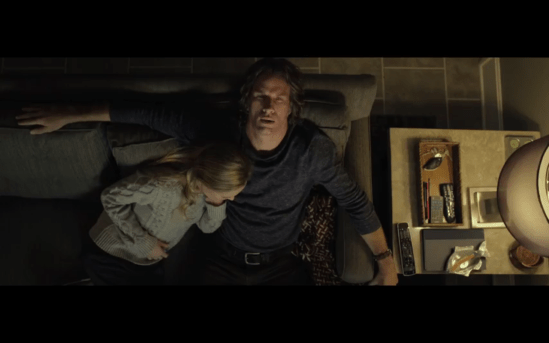
“Superman Returns” actress Kate Bosworth headlines with co-star Thomas Jane (“The Mist,” “Deep Blue Sea”) as the unwitting foster parents who are forcing themselves back into the parenting game. I specifically was not coming to terms with Bosworth’s performance as Jessie; her facial expressions and body language, along with her tone and line deliveries, were too lifeless with rigidity and repetitiveness. So much so that I compared Bosworth to Suzanne Cryer’s impassive Laurie Beam character from HBO’s “Silicon Valley.” Unless the inexplicable amount of grieving has voided her of all emotion, like the Borg drone from “Star Trek: The Next Generation,” the role of Jessie is written with a variety of mood driven circumstances that start with her insomnia, to her willingness to not leave their home, to being carelessly exploitive with Cody. Being a fan of Thomas Jane since 2004’s “The Punisher,” I might be a bit biased, but Jane had more range with the ability to switch back-and-forth between mixed attitudes and sentiments, making the dynamic between Jane and Bosworth clunky and awkward. To round off the trio of main actors, you might recognize the pint sized actor playing Cody as Jacob Tremblay from the 2015 Oscar Winning Brie Larson film “Room” portraying an innocently pitiful dreamer with an unquenchable thirst to be loved.
screen-shot-2017-01-07-at-3-14-56-pm
The Flanagan and Jeff Howard co-authored storybook script, intentionally or not, borrows heavily from psychoanalyst Sigmund Frued’s dream interpretation theory that wishful fulfillments are more common in children. Previous day activity, or day residue, has influential properties on a child’s dream, much like with Cody in this story, and Cody’s dreams are written to be an exaggerated fruition, fulfilling his desires and illuminating his emotions to the brightest or the darkest extent. Like many other films that involve the misunderstanding of children, adults Jessie and Mark blindly understand all the possibilities of Cody’s uncontrollable gift, exploiting Cody’s powers for their own greed. I did find that I love Jane’s Mark character as he tries to show Jessie the errors of her reasoning as he’s a bit of a kid himself, living vicariously through Cody with the video games and with the pizzas as if husbands, or men in general, are actually children at heart. Cody’s gift becomes a power struggle with Mark caught in the middle and the consequences of this struggle result in being the catalyst to unify Jessie and Cody as a strong bond between Mother and Son. Men totally receive the shaft in this picture where both dominant adult male figures are reduced to a forgotten or humbling state, left behind because mother knows best when it was really mother who dismantles the situation.
screen-shot-2017-01-07-at-3-14-57-pm
“Before I Wake” is a boogeyman fable of sleepless nights that independent Canadian distributor Mongrel Media presents on Blu-ray for the first time anywhere in North America on a home entertainment platform come January 10th. The film has been in a distribution limbo since U.S. theatrical distributor Relatively Media filed for bankruptcy, but, luckily for fans of the supernatural genre, Mongrel Media obtained home video rights. I was provided an online screener link, forcing my hand to not comment on the specs of the Blu-ray audio or image quality nor touch upon the bonus material, but what I can state is that the spin on the dream killer won’t stop here with “Before I wake.” Dreams, like conceptions of outer space, are vast with unlimited, unconstrained content that surrealist director Mike Flanagan has only partially tapped into by exploring the dangerously innocent perceptions fabricated from a child’s abstract mind.

Evil’s Calling… “Cell” review!

screen-shot-2016-10-06-at-9-04-17-pm
Clay Riddell just landed in Boston after scoring a huge deal in New York involving concepts for his graphic novel. With all the cellphone charging stations occupied, Clay calls his estranged wife from a pay phone to speak with his son, but when the landline severs communications, that’s when it started. People on their cellphones turn into Phoners, murderous maniacs who tear through anyone in a destructive path mindless insanity. Clay, in the midst of panic, bumps into subway train conductor Tom McCourt and fight their way out of the city, barely escaping with their lives. Fleeing a burning Boston overran by Phoners, Clay is determined to track down his family in New Hampshire with the help of Tom and two teens, Alice and Jordan, but the Phoners are not just absentminded anymore as individuals start to flock together exhibiting the beginning signs of their telepathic network lending to something far more sinister than just temporary mayhem.
screen-shot-2016-10-06-at-9-01-05-pm
“Cell” is the feature film adaptation to Stephen King’s novel of the same title and reunites John Cusack with Samuel L. Jackson once again since their last costarring venture of King’s book-to-silver screen production of “1408.” King shares screenplay credits with Adam Alleca, who co-penned “The Last House on the Left” remake in 2009, and with “Paranormal Activity 2” director Tod Williams at the helm. From the first inkling of a “Cell” movie, back with Eli Roth was attached, the excitement couldn’t be contained as I read the Stephen King novel and was captivated by the unique story of mixed and varied human emotions and the uncontrollable yearnings to be a part of the collective through being electronically connected that ultimately becomes mankind’s undoing.
screen-shot-2016-10-06-at-9-20-28-pm
However, “Cell” was heading in the direction of certain doom from the moment Roth unattached himself from the project, sending “Cell” into the annoyance of limbo until a production company conglomerate formed to pull “Cell” from it’s stagnant state and attached Williams to direct. Yet once again, King’s beloved story goes into the throes of uncertainty with distribution after filming wraps in 2013. 2016 comes and Saban Films, along with Lionsgate , distributes “Cell” theatrically and within the home entertainment market respectively.
screen-shot-2016-10-06-at-9-02-05-pm
After all the monumental problems, I personally wanted to “Cell” to be one of the most entertaining and frightening horror films of the modern age, but as fate would have it, the Williams’ film disappoints. An film adaptation of a King novel needs more minutes to cover the story’s girth and “Cell” lacked pages of warranted minutes to be a full tell all for Clay, Tom, and the Raggedy Man. Portions of the novel were translated to the screen, but for the majority of the film, a rushed version of the story debuts to silver screen audiences that loses the book’s essence and dilutes character development, such as with Raggedy Man who has a sizable role in the book, but the character in Williams’ movie barely scratches the surface with being just a figurehead for the Phoners and not the collective’s soap box looming leader. The film started out great with intense chaos at Boston airport, pictorializing to life the Phoners from the King’s book with pinpoint precision, but from there on, the story’s time span goes vague whereas the book stretches out the length of time. Only a matter of two or three days does it seem the survivors jump from Boston, to the school, to the bar, to the story’s final location of Kashwak, but in reality terms and in the amount of devastation and character portrayal, weeks have passed.
screen-shot-2016-10-06-at-9-03-17-pm
The ending has been rewritten from a surprisingly mixed reaction to the book’s and yet, the unravelling of the finale does more than convolute matters when Clay finds his son. There lies almost a dual ending where one’s interpretation can be the film’s own storybook ending. Stephen King’s “The Mist” had an ending that, when compared to Frank Darabont’s totally new ending for the film, was totally inferior to Darabont’s and I feel like that’s the stage that was trying to bet revisited here with “Cell” and it just missed the mark completely. Not all changes are for the worst. Character Tom McCourt, whose white in book, went to Samuel L. Jackson who absolutely fits the role without question, nailing PTSD stricken McCourt with little emotion but with untapped hurt. If I ever had to choose an middle aged white actor for the role of Clay, John Cusack would be my first and only choice even before casting began for the film. I do feel like having a white Raggedy Man was purposefully steered away from social sensitivities with an antagonistic young black male in a hoodie. The cast rounds out with Isabelle Fuhrman, Owen Teague, and Stacy Keach (“Slave of the Cannibal God”).
screen-shot-2016-10-06-at-9-01-43-pm
The digital visual effects were so poorly constructed and composited that I’m not surprised “Cell” didn’t have a longer theatrical run. The book had a number of jaw-dropping visuals the imagination could run with and now with seeing the depictions of those visuals on screen, they seemed seriously slapped together in such haste to where the devastating sensationalism turns inane and bland. King’s apocalyptic story warrants Hollywood scale effects, but received a few levels below that bar, failing to deliver major catastrophe on a world ending scale to the likes of “War World Z” or to cleverly style the film through a smaller medium such as George Romero accomplished with this first three “Living Dead” films.
screen-shot-2016-10-06-at-9-20-59-pm
Lionsgate’s Blu-ray release is presented in widescreen 2.40:1 aspect ratio and the 1080p Hi-Def resolution becomes a disadvantage that clearly outlines the quality of the effects. The English 5.1 DTS-HD master audio is par for the course, but slightly in-and-out with dialogue that’s difficult to balance. The 98 minute feature’s bonus features includes an director’s commentary and “To Cell and Back: The Making of the Film” which is redundant if you’ve read the novel. Bottom line is if you’re fan of Stephen King’s novel, you’ll be sorely disappointed with Tod Williams’ “Cell” that’s nothing more than a long awaited entertaining rated-R apocalyptic horror with obsolete effects and with star-studded names attached to this Stephen King story adaptation.

Buy “Cell” on Amazon! Cusack and Jackson reunite!

Half-Assed Evil Exorcists! “John Dies at the End” Book Review

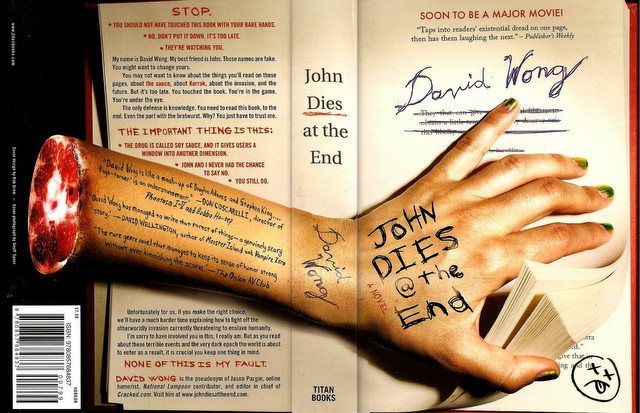
jdatebook

Jason Pargin, under the pseudonym name David wong, is a major success stories that inspire all of us hopeful writers. Pargin, a low on the totem poll data entry administrator, is the brains behind the insanely clever, notoriously witty, and devilishly deranged novel “John Dies at the End.” Without even an English degree to his name, Pargin wrote short stories that turned into a full fledged novel solely by word of mouth from total strangers. Eventually Pargin was contacted by Phantasm director Don Coscarelli and as soon as Pargin blinked, a movie was adapted from his story and the rest is hisory.

“John Dies at the End” revolves around David Wong, a video store clerk whose life isn’t exactly that excited, but when he discovers the “soy sauce” from a homeless Rastafarian Wong and his friend John are sucked into the massive plans of an alternative reality species that has their sights on enslaving humanity in the name of their leader “Korrok.” Only Wong and John can see the truth because of the “soy sauce” and while others live their daily lives, Wong and John prepare for battle the only way they know how – with boom boxes, flame thrower water guns, and Molly the bomb eating dog.

Pargin’s novel will be a treat that you’ll never ever in your life read something similar like it again. Somehow able to paint a perfect picture with his colorful use of dictionary, Pargin certainly knows how to make silly scary and fun. The pages just kept turning as if I was hooked on the “soy sauce” and was warped, like a “Star Trek” hyper drive, into an other world universe. The randomness of scenes with Wong’s first person version of events can only be described as batshit nuts with a hint of nihilism. Once you add his friend John into the mix, it’s a whole different story as John is a colorful character with classically hilarious one liners and a mind like a 13 year old boy ready to take on the world.

I’m one those people who watched the Don Coscarelli movie first before reading the book and I did this before with Stephen King’s novel The Mist and so far, I’m not disappointed with my ass-backwards way of doing things. Of course, the novel will always have more than a movie adaptation, but damn did Coscarelli bring Wong’s world to life and light and I do believe that the writings of Pargin are so vivid and clear that this made Coscarelli’s job easy.

“John Dies at the End” is a must read. It isn’t the latest best seller as the book’s been out since 2007, but this horror comedy will make you laugh and thrill you into thinking about the possibilities of our universe.

jdategif