Stranded and Terrorized, Longtime Friends Must Confront Their Own EVIL Past! “The Boat” reviewed! (Breaking Glass Pictures / DVD)

Kee Your Enemies Close but Your Friends Even Closer! “The Boat” Now Available on DVD

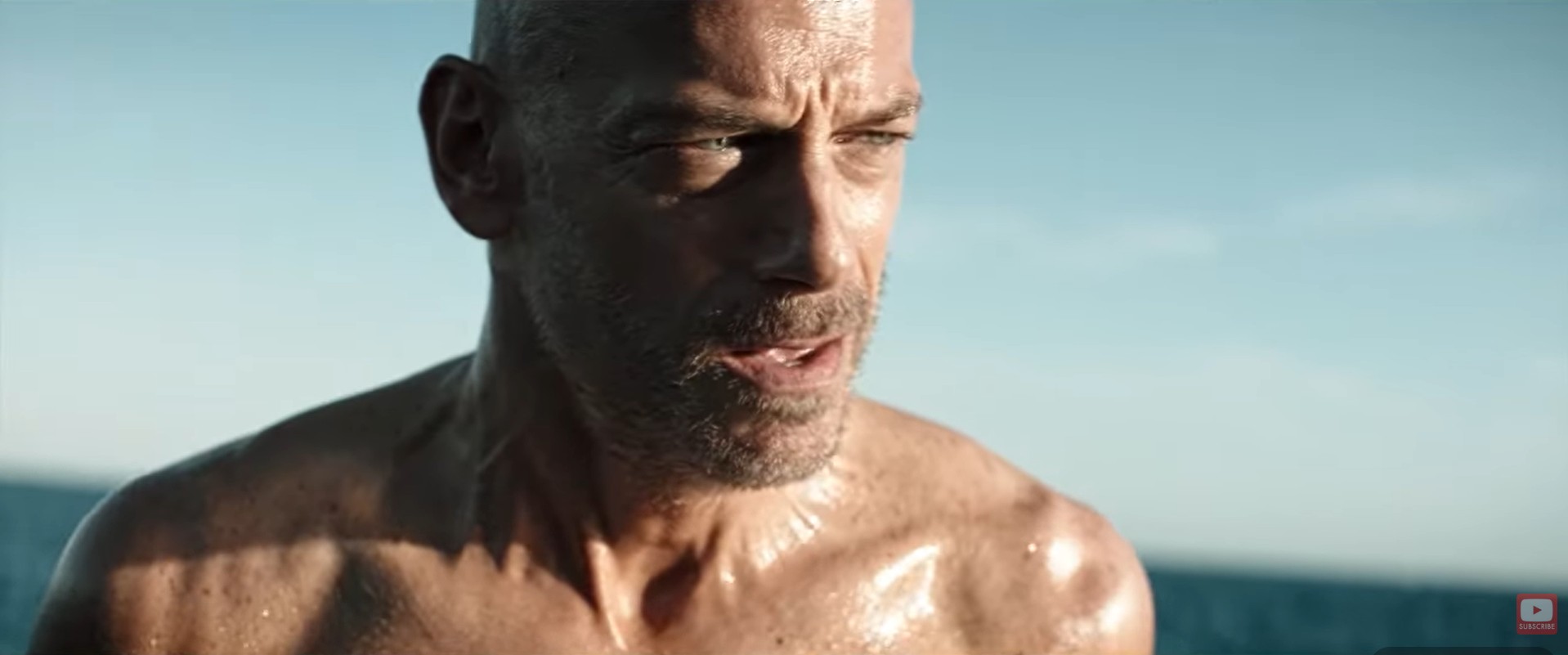
Three well-off couples party on a luxury, personal yacht for a holiday getaway and to celebrate Enrico’s birthday.  Sizzling romance, boozy-filled dancing, and smoking weed relaxes the group on the calming waves as the party goes through into the night but when morning comes, they find themselves coming out of a stupor and in the middle of the ocean with the yacht having been sabotage and adrift with no food, water, or means of communication.  A mysterious voice comes over a hidden walkie-talkie poised to punish those onboard in a plight of revenge for a past transgression involving them all and expose the groups’ dark secret kept from each other.  Tensions rise and their tormentor slowly unveils the truth through a series of chastising games that turn the tide on the group’s closeknit friendship for the worse but not everything is what it seems that’ll shed a light of truth on certain ill-conceived perceptions of the past.

Waking from a party-filled night that can’t be remembered and quickly realizing there’s something inherently wrong about the situation, no land in sight with the yacht drifting further out into the ocean, is a sweat-inducing nightmare scenario that has immense palpable fear with a person’s severe disconnect from land and, to make matters worse, all the life-sustaining supplies and modern day conveniences have strangely vanished.  That’s the primal premise setup for the mystery-thriller “The Boat,” a 2025 released Italian-made film from director Alessio Liguori (“In the Trap,” “Shortcut”) and a trio of writers in Gianluca Ansanelli, Nicola Salerno, and Ciro Zecca.  Filmed just off the port of Piano di Sorrento and in the Amalfi Coast, including the illusion of open water scenes, “The Boat” is a Lotus Production, a subsidiary of Leone Film Group, and Rai Cinema feature under producer Marco Belardi and executive producer Enrico Venti.

Reviewing Marco Belardi and Enrico Venti’s producing film repertoire suggests that the duo have hardly tasted tension and experienced thrilling tenterhooks with a more comedic, period piece, and melodramatic works that revolve around the tough, sometimes scathing, human dynamics.  The cast resembles similarly in their credentials, using the melodramatic, soap opera feigns of being hurt, lost, confused, and damaged inside a tight group of longtime friends getting together for a holiday only to find that maybe they’re not so good friends after all, definitely not good people, harboring hazardous secrets.  Diane Fleri (“Ghost Track”) and Filippo Nigro (“Deep in the Wood”) play the epitome of a wealthy yacht owning couple, the reoccurring nightmare plagued Elena and her breadwinning husband Flavio, Alessandro Tiberi (“The House of Chicken”) and Marina Rocco are the fast-lane lovers Federico, the filmmaker, and Claudia, a social media influencer, and Marco Bocci (“Caliber 9”) and Katsiaryna Shulha (“Hypersleep”) play unemployed birthday boy Enrico with his much younger, new girlfriend Martina make up the struggling confounded stranded on a boat.  The once carefree, ready to party friends fall quickly from a standard of grace by a mysterious man radioing from a nearby boat, instructing and commanding them under his thumb with his own set of terms and in a position of authority by holding all the cards as they slept off the hidden sedative, and soon after, they’re perfectly perceived lives are craved in two from a superficial shell of money laundering, betrayal, and murder.   Eduardo Valdarnini (“Bad Habits Die Hard”) helms the calculated antagonist with a plan but his character isn’t kept faceless as first introduced and has his intentions unmasked way too early, running the impact of what naturally would have been a twist moment where it all clicks and makes sense his reason for retribution.  Valdarnini’s depth is in focus, a clear means with a strong case for a longstanding grudge, but the targeted friends rapidly decline into spineless and spiritless absorbents of their fate and are willing to roll over for reside or kill over an emotionally distraught act despite the situation they’re in, both not fitting the narrative bill 

“The Boat’s” strength resides mostly in the first act setup of each couple’s time together before boarding the yacht with tidbit hints of their idiosyncratic lives and their private opinions of each other.  This establishes personas and mindsets that become, or at least should have become, important later to test their surface laid out bond.  The second act transitions from partying the night away into a quickly devolving situation the next morning, discovering their boat adrift and no supplies left on board in apparently robbery.  By now, the tension is high and not set internally amongst the friends as their bewilderment extends to the audience who are too looking for answers.  Only when the mysterious voice over the radio comes a calling do the third act fail to secure a clean sweep of next level thriller.  There’s little-to-no fight in the mostly pampered elite apart from Enrico who only fits in because of his allotted friendships with the other passengers and he brings in the only outsider, his young girlfriend Martina, to which his friends casually mock the age difference behind his back further clueing us in on their true colors, but even Enrico’s fight is reserved for more diplomatic head-way with a man with a vendetta, especially with a gun pointed at him, but his explanation of involvement in past events is too easily taken to heart by the opposition rather than be questioned for its validity.  This leaves an opening of hope and sacrifice that ill-fits the story’s framework and causes an unlikeable situation based either on truth or the mattes of the heart, both of which are never challenged to the extent they should be in a crusade to bring down the affluent guilty.

Sailing up to DVD is “The Boat” from the Philadelphia-based label Breaking Glass Pictures.  The single-layered MPEG-2 video codec on a DVD5 provides a less than crystally defined picture quality in it’s 720p standard resolution, available for converted upscale.  Presented in a widescreen 2.35:1 aspect ratio that truly engulfs the anamorphic image with isolating oceanic oppression, “Orgy of the Dead’s” Mirco Sgarzi’s ability to retain depth without it being washed away in the vast waters creates anticipating moments of visual stimuli with the example being Flavio sitting solo in a life raft with the mysterious man cruising toward him in the background, an iconic culmination of objects in one frame that can be seen in “Jaws 2” when the shark moves in for the kill on a stationary Sheriff Brody holding a powerline while sitting in a raft.  As mentioned, details are shaky at best with objects often appear fuzzy around contouring lines and darker areas are chalky, but the image is more than suitable enough for DVD image delineating.  “The Boat” comes with a mostly Italian, some English PCM 5.1 Surround Sound audio mix that’s cinematically balanced between a forefront and clear dialogue track and a background of diegetic and non-diegetic of ocean grabs, such as waves splashing, distant gull calls, and the roar of a high-powered boat engine.  “Here After’s” Fabrizio Mancinelli’s score doesn’t have an inspiring bone in its ocean body with a route low-key pulse score; it fails to instill that alone enthralling alchemy of being lost at sea with a maniac great-white-circling and looking for blood.  English subtitles are available for selection and while they pace well, there are a couple of infractions on the translation that won’t ruin the visual picture or transcription.   Special features include only a photo gallery and a trailer with the DVD houses inside a standard Amaray case with an aerial pictorial that provides a strong lured interest.  The region 1 DVD comes not rated and has a runtime of 94 minutes.

Last Rites: “The Boat” sails a nautical knot of secrets to reveal not all old friends are faithful and true with a past that eventually catches up to them. The waters will be tested on this newly released Breaking Glass Pictures DVD.

Kee Your Enemies Close but Your Friends Even Closer! “The Boat” Now Available on DVD

An Ice Fishing Contemplation Becomes Interrupted by Kidnapping EVIL! “Dead of Winter” reviewed! (Vertigo Releasing / Blu-ray)

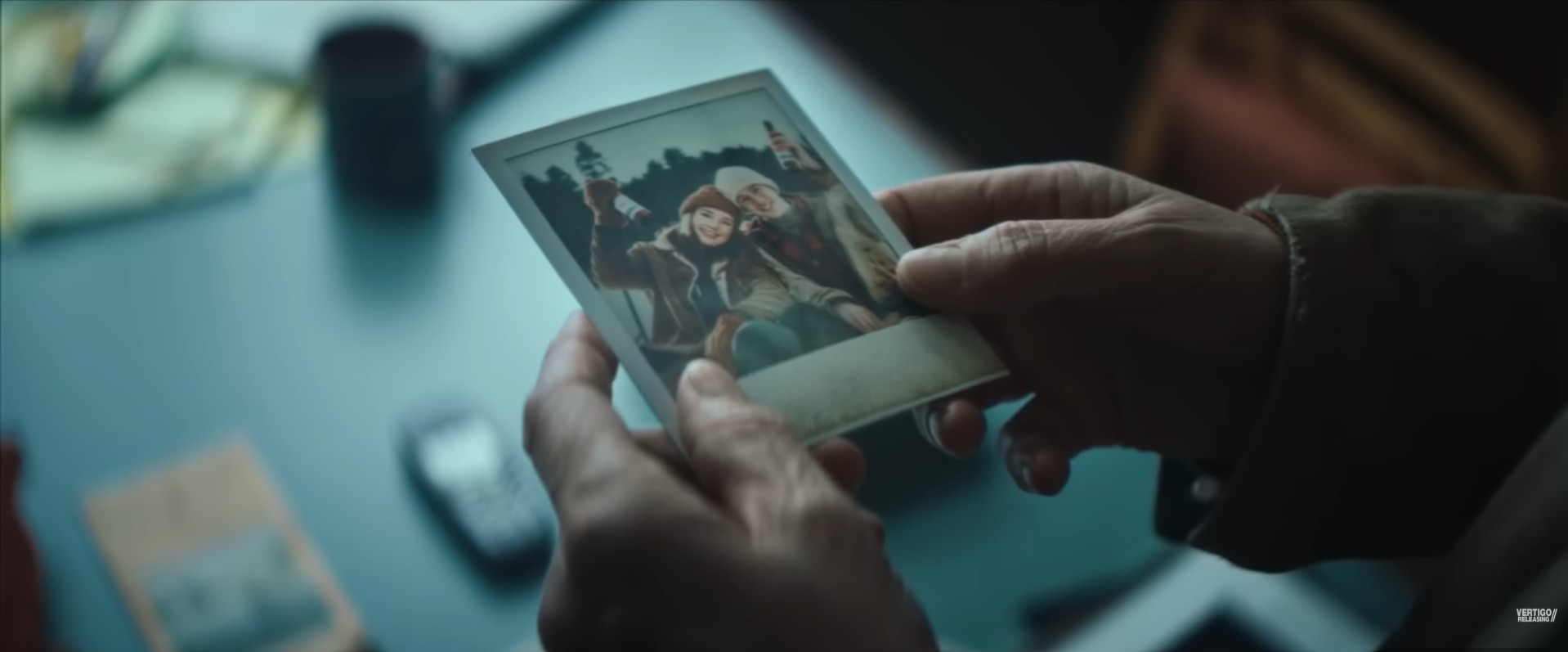
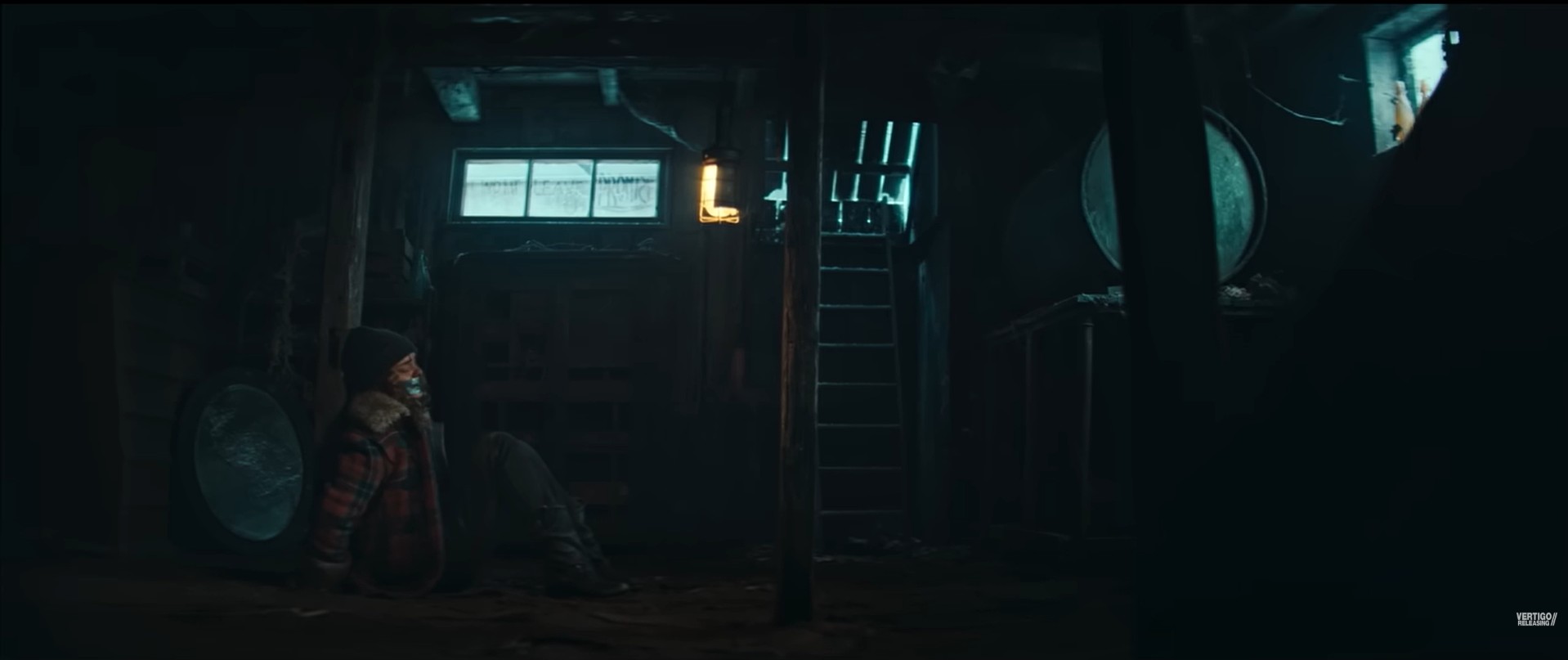
After the death of her husband, long time Minnesotan Barb travels to the snow covered, frozen over Lake Hilda to ice fish, the spot where her and husband had their first date.  When asking for directions from one of the few people she’s seen in hours, she inadvertently interrupts the kidnapping of a young girl by a husband and wife with an illegal self-preservation plot.  With help hours away, Barb knows she must do all that she can, push the limits of herself, to help the young girl escape the clutches of a determined woman who will stop at nothing and do anything to keep her desperate plan intact and moving forward.   Two against one seems like impossible odds but Barb is determined to keep her promise to the girl tied up in the basement and soon to be murdered for the one thing the wife, the lady in purple holding the rifle, needs. 

A transfiguration of one last goodbye during sudden loss into a destiny of saving a life brings chills to the bone in Brian Kirk’s snowy thriller “Dead of Winter.”  The 2025 released film is the latest feature length film from the “21 Bridges” director from a collaborating script between actor Dalton Leeb (“One Day Like Rain,” “Feeding Mr. Baldwin”) and composer Nicholas Jacobson-Larson (“Wildcat,” “Leave the World Behind”) in what would be the writing duo’s first screenplay as individuals and as a duet.  Koli, Finland doubles for the fictious Lake Hilda in the coldest parts of an upper Midwest winter that’s ever fleck of the season with snowcapped trees, drifts of snow, and a frozen lake, an overall sense of frigidity that reestablishes reference back the film title.  The Finnish, Germany, and U.S. coproduction from the company partnership of Stampede Studios, Augenschein Filmproduktion, Leonine Studios, Zweites Deutsches Fernshen, MMC Studios, Crafthaus, and Wild Bunch Germany is produced by Quirin Berg, Max Conradt, Cloe Garbay, Jonas Katzenstein, Greg Silverman, Maxmilian Leo, Max Widerman, Cosima von Spreti, and Bastian Sirodot. 

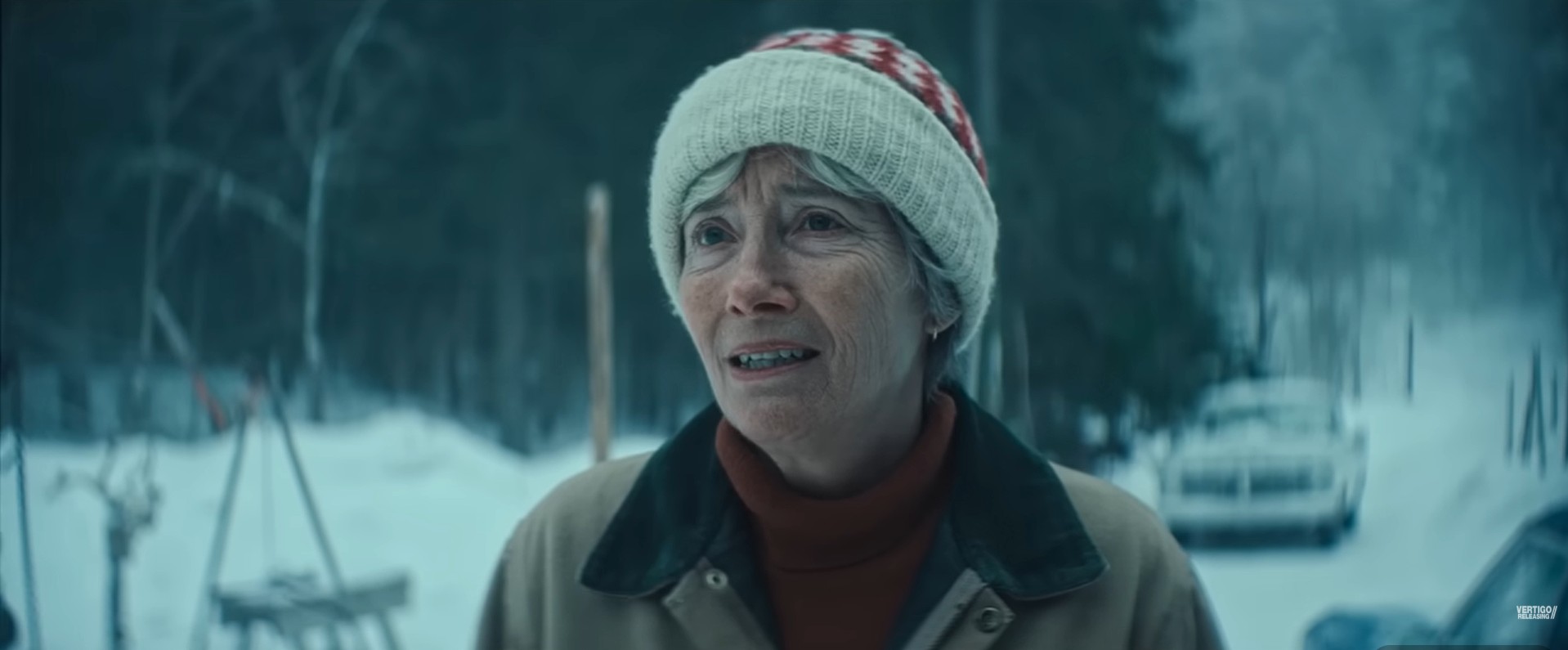
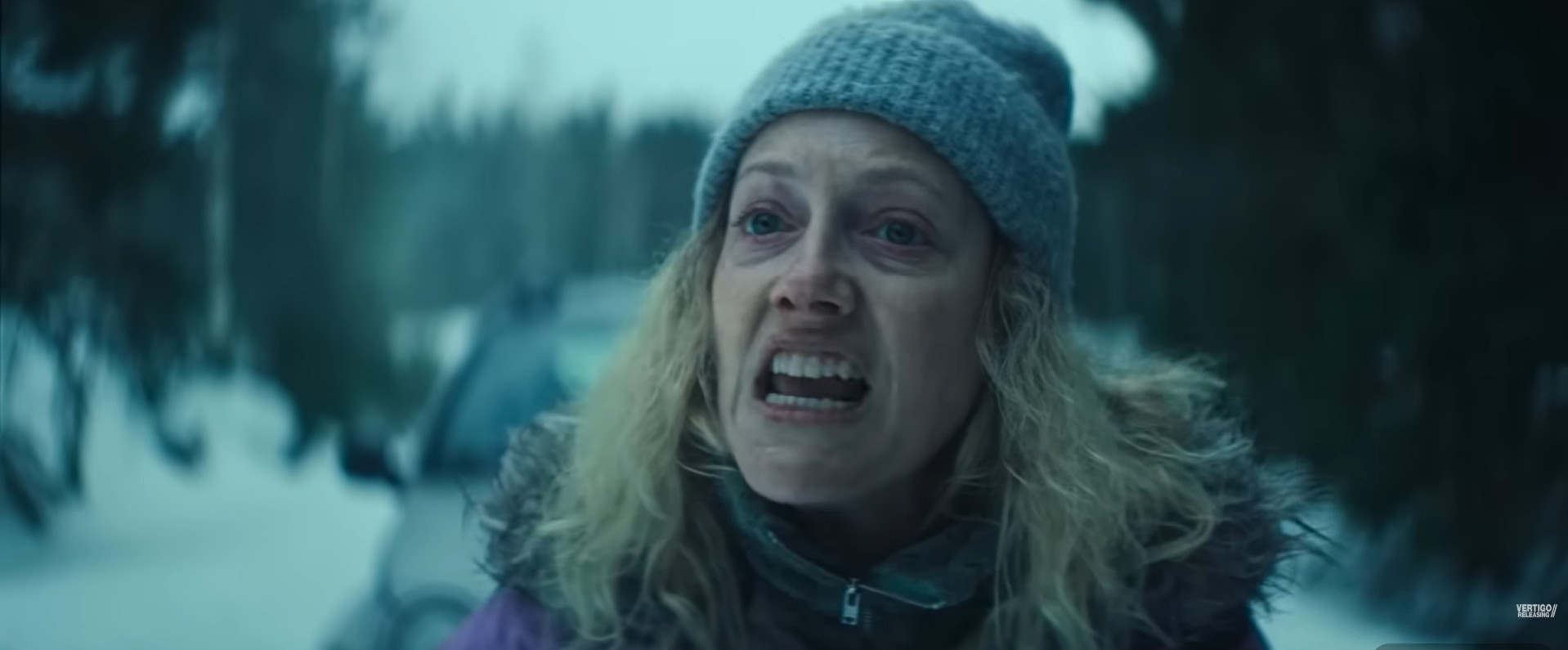
Two-time Oscar winner Emma Thompson finds herself in a tan mechanic suit driving up a frozen lake in the middle of nowhere and coming across a kidnapping.  The English actress, fondly known for her dramatic period pieces in “Howard’s End” and “Sense and Sensibility,” develops Minnesotan attributes for her role as Barb, a smalltown woman who lost the love of her life, a husband for decades, now on the precipice of letting him go for good by spreading his ashes into the lake where they first courted, as part of his last request.  While going through the emotional catalogue of reminiscent flashbacks and teary-eyed loss, Barb’s distracted by young woman, hands tied, and being held at gunpoint by a kidnapping hisband and wife.  While their names are never divulged, only credited as Camo Jacket for the man and Purple Lady for the woman, their scheme is not lost upon them as they are very aware of the dangers that confront them.  The only difference is the danger they face is dichotomized, Camo Jacket sees the immorality and the punitive measures of kidnapping someone for harm but does it anyway to save Purple Lady whose mortality is at stake with a terminal illness.  “Companion’s” Marc Menchaca doesn’t wear the pants in the dynamic in doing his wife’s bidding but the fear, the reluctance, and the sense is there enough to where it becomes pitiful to what he’s reduced as a man and as a husband whereas “Jurassic World’s” Judy Greer is an unstoppable monster with calculated intent who will stop at nothing, and I mean nothing, to get the young girl’s healthy organ.  Hearing Thompson in a Minnesota accent is not terribly jarring but it’s carries with it enough of a zing that it doesn’t suit her well but her character Barb’s tough as nails without exuding an equal presence as such and resourceful inside a mild panic veneer when coming inches away from death every time her and Purple Lady’s path cross.   “Dead of Winter’s” remaining cast sees Laurel Marsden (“The Pope’s Exorcist”) as the kidnapped girl in a role that doesn’t have any depth compared to Barb’s overdrive depth, Emma Thompson’s daughter Gaia Wise and Cúán Hosty-Blaney as young Barb and her husband Karl, and Brian F. O’Byrne (“Bug”) and Dalton Leeb as two hunters caught in the middle.

There’s something to be said for these genre types where an unfortunate, regular pedestrian is thrown into a forced hero position.  There’s an extra something when the setting is snow-covered and isolated with limited, what’s-on-your-person resources.  Barb’s very well written to be that exact person as if she was destined to be, maybe even lead by Karl’s hand, to be a young girl’s savior.  The root cause for the kidnapping is a bit of a far stretch with an illegal and clandestine medical procedure held out from being completed until Camo Jacket and Purple Lady can setup a pop-up surgical tent over the iced lake, a concept that often feels longwinded through the whole ordeal, but this gives Barb the opportunity to make constant fools of the kidnappers by sabotaging gear and setting up traps that cause they enough harm to make the cold by an extreme factor and delay them enough to attempt rescue.  Kirk misses a few important editing and factual elements that put blights on the authenticity and the performance of an otherwise competent action-thriller.  Barb scouts, hides, and runs around an area with less clothes than her counterparts and perhaps Barb’s lifelong residence in the extreme cold of Minnesota has acclimated her body but for this long period of time without being indoors would, shielding from the outside elements, would have taken a toll on anybody.  There are also some editing issues, such as a flame shown before the fire start in the next scene, in a blatant miss of continuity.  Barb’s flashbacks of her past life with Karl are active and sporadic throughout which feels out of place with a contemplative activity when time of slaving someone’s life is of the essence and the threat is always near.

Vertigo Releasing releases elderly woman tenacity and determination to do what’s right in “Dead of Winter,” now available on Blu-ray.  The UK release is an AVC encoded, 1080p high-definition, BD50 presented in an anamorphic widescreen 2.23.1 that captures the majestic of a winterized Minnesota (aka Finland) with extra wide shots and creating immersive depth.  Despite all the snow, there’s no whiteout here with a higher contrast to define shapes amongst the powdery white stuff, such as the tall tales, hillside terrains, and the man-made objects that stick out in the back and foreground without losing focus or delineation.  Textures are nicely crisp around the edges and on the body to get a full sense of each character’s attire – which is important for credit classification – and the environment surrounding.  There are select scenes of superimposed effects, such as when people go under the frozen lake and into the water, that appear more angelic in the slowed down moment of dramaticism that denote a very polished stylistic choice in what too is a stark contrast against a harsh winter landscape.  There’s also a purposeful desaturation of color that juxtaposes against Barb’s flashback scenes that are more brilliant with the colors and softer lighting to recount Barb’s happier days.  Skin tones and details appear nature with an extra wrinkle or two on Emma Thompson’s face to make her appear more midwestern rugged.  The English language 5.1 DTS-HD Master Audio is accompanied by a second encoding, a 2.0 LPCM Stereo.  The surround sound mix is the preferred option here that captures the reverberations of a snow-scape through the side and backchannels.  The gunfire really comes through with a pop and a directional sense.  Every effect hits the intended marker with clarity and has a vigorous impact while Volker Bertelmann’s synch-harrow score weaves into and out of the action and the reminiscing moments.  Dialogue is clean and without issue, and though I made a negative remark of Thompson’s Minnesotan accent, it’s not, in fact, that terrible but does feel unnaturally off as it contents with her classic British English.  English SDH subtitles are available.  Extras include a making-of featurette and the theatrical trailer.  The Vertigo Releasing physical set is also just as simple with a standard Amaray case with a battered and bruised weary Emma Thompson in character on the front cover.   There is no reverse side image on the sleeve insert, no other physical extras, and the disc is pressed with the same front cover design.  The UK certified 15 feature, for strong language, threat, violence, and injury detail, has a runtime of 98 minutes and is region locked on B. 

Last Rites: “Dead of Winter” ices the filmic competition with a tundra-sized unlikely hero thriller who never looked for trouble, but trouble finds her in a fit of righting wrongs kismet. The standard Vertigo Releasing Blu-ray is just that, standard, but the film itself embraces the cold elements with stark winter harshness and an even colder organ heist.

EVIL Does Not Sit and Rollover. “Good Boy” reviewed! (Visions Home Video / 4K UHD Blu-ray)

“Good Boy” Now Available on 4K UHD Blu-ray from Visions Home Video

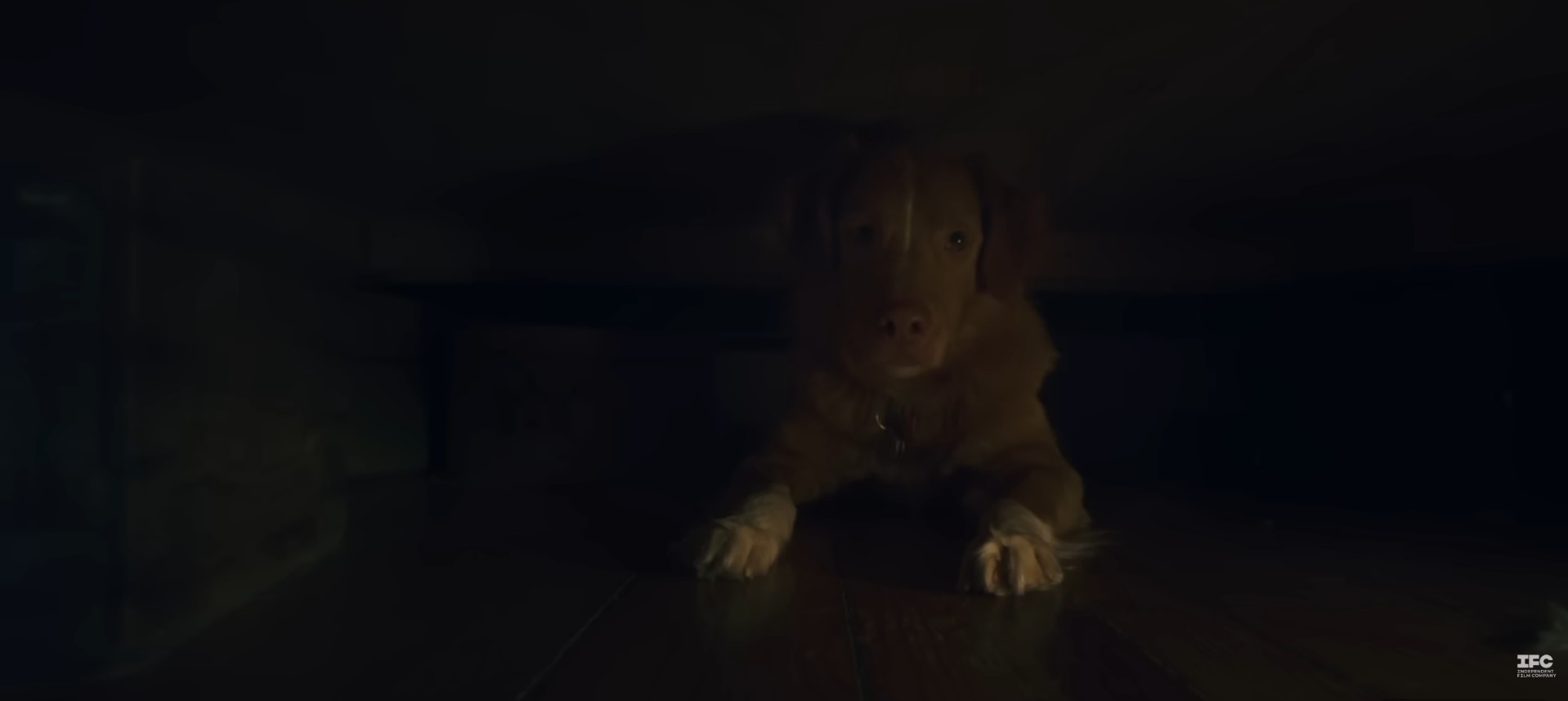
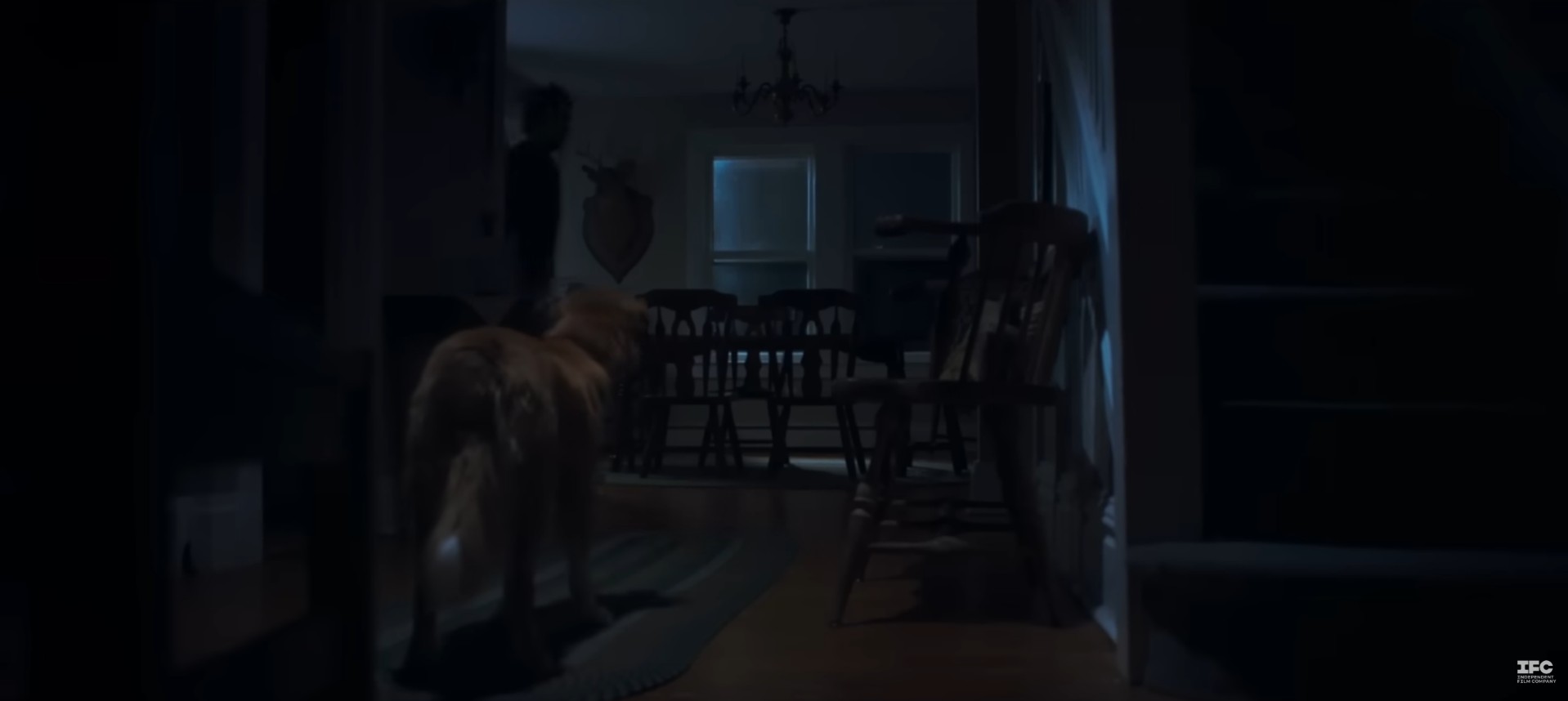
Indy is a good boy, a loyal nova Scotia Tolling Retriever pet and friend to his owner Todd who’s had him since being a puppy.  When Indy senses trouble, a troubling shadowy figure lurking and following his owner, he tries to do all that he can to protect the one he loves the most.  Struggling with a chronic illness, Todd retreats to his grandfather’s isolated cabin deep within the woods for a little rest and relaxation after a medical scare that put him in the hospital.  Indy senses the supernatural force has followed them away from the city and into the rural family home.  As the presence moves about the house, moving closer and closer toward his friend, Todd’s chronic illness becomes increasingly worse, and Indy’s nightmares bend reality as the shadow begins to take a horrifying shape.  Todd’s disease has him nearly incapacitated and unaware of the dangers that surround him, leaving Indy as the last line of defense against the looming dark force that wants to take him.

Pet owners rejoice!  A horror movie with a story from the perspective of its star, a dog.  The 2025 supernatural thriller “Good Boy” has Indy, the then 8-year-old dog’s real name, headlining the film, directed by Indy’s owner Ben Leonberg, horror short filmmaker with such recent credits as “The Fisherman’s Wife” and “Dead Head” from within the last decade.  Leonberg also wrote the script alongside Alex Cannon and took over three years to make due to the complexity of working with untrained animal actors, a task that’s easier said than done, to accomplish Indy’s character narrative from his point of view, and, of course, the rigorous A-to-Zs of creating a feature length film. Leonberg coproduces “Good Boy” with Kari Fischer and Brian Goodheart.  “Good Boy” is a self-referential studio made film with the company name called “What’s Wrong With Your Dog?”

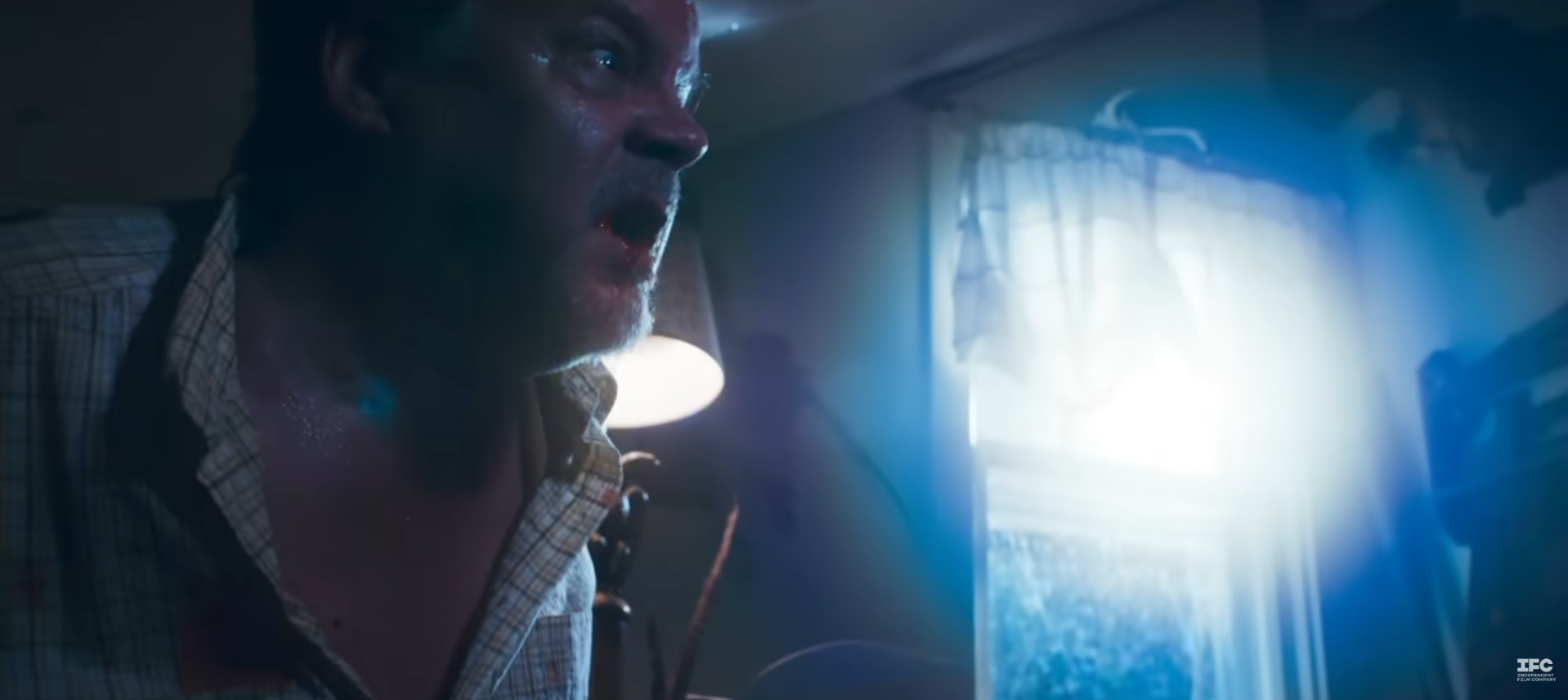
If casting an animal with a hesitation stillness and pensive piercing eyes, Indy is the four-legged fur baby on the short list.  This specific Nova Scotia Tolling Retriever, a breed known for his hunting qualities and retrieval of gunned down carcass and not acting, is an untrained thespian by all means but has a multitude of expressions that work toward the menacing supernatural sense of dread and uneasiness.  When Indy stares into a dark corner, it’s shadows expanding slow across the walls and floors, the stare does convey concern.  When Indy cries and whimpers in apprehension of being left alone or his owner unaccompanied outside the house, those high-pitched cries and frantic movements from window-to-window bring narrative tension to unsafe separation from man and his loyal best friend-protector.  It’s clear that director Ben Leonberg treats his star pup with star focus, providing a dog-level perspective view that incepts and evokes a reaction just like any human character.  This applies even to the interactions with Todd (Shane Jensen) and his swaying, emotional reactions working through his own ebb-and-flow pain of a mysterious illness that plagues him.  Our first scene with Todd has him sitting motionless on the couch, in the dark, and drooling blood from his mouth in an indistinguishable view of his face, a motif amongst all human characters in frame to keep the focus on Indy’s facial Rolodex of emotions.  We never do know what’s wrong with Todd, whether be cancer, organ failure, or perhaps even the supernatural’s malevolent exposure, but it’s made clear he’s on death’s door in more ways than one.  The only human face shown is through the VCR playback of Todd’s grandfather and it’s the unique bone structure of horror friend Larry Fessenden (“Habit,” “Jakob’s Wife”) who often seems to be in, in some way, shape, or form, in a number of Shudder distributed films recently.  Arielle Friedman and Stuart Rudin bring up the small cast rear. 

“Good Boy” is simply not a novel concept.  There have been a few animal centered and perception movies throughout the decades, to name a few we start with “Babe,” the loveable little pig who finds friendship with a barn spider, then there was the tearjerking one with an orphaned bear cub who hitches to an adult male to avoid game hunters in “The Bear,” and, lastly, “Homeward Bound” was an adventurous return home with human voiceovers for two dogs and one cat team.  The element “Good Boy” does differ from those aforesaid examples.  Aside from giving Indy a voice, the non-personified canine is dropped into an intensely atmospheric horror framework that removes the safety net of having opposable thumbs and the misunderstanding between man and animal that makes the tense situation that much more riveting when Indy can’t express to his human the danger that lurks.  There’s a heavy theme of animal sensing danger or something amiss with someone carrying an unseen disease, that disease in “Good Boy” manifests as the shadowy figure that acts like the harbinger of death, or to the dark tune of a grim reaper, lying-in-waiting and eventually reaching for Indy’s human pal, Todd.  In this concept is the tragic downhill of Todd and the heartbreaking care Indy tries to protect and care for his unsuspecting master but in between all of that concern and drive for Indy is a steady fear something isn’t right, looking past Todd’s ailment toward a showier threat that, to an extent, plays like a device of ignorance for Indy, one that truly distracts him for the real danger plaguing Todd that bets the question, do dogs cope with trouble by creating a diversion? 

Visions Home Video, a premium home media label from UK’s Vertigo Releasing, retrieves “Good Boy” for a UK-Ireland 4K UHD Blu-ray release that’s supported on a HEVC encoded, 2160p ultra high-definition, BD100.  Through surreal nightmares, inky darkness, and graded with primarily dark gray and bluish tones, “Good Boy” faces images challenges with an indie production attempting to instill atmospheric fear and subtle bumps in the night.  That challenge is ultimately met its match with DolbyVision that’s able to decode those type, often blocky, negative spaces and darker color scheme in its high dynamic range.  Texturing works to fiber explicate Indy’s golden coat but much of the other details are kept in the dark as Indy’s, with his coloring, is represents almost like a bright spot amongst the color palette, even Todd is obscured in darkness, rain, or mist, but the details that do show do emerge.  Two English audio tracks are encoded with a 5.1 DTS-HD Master Audio and a LPCM 2.0 Stereo.  In regard to the surround mix, back and side channels diffuse the atmosphere non-diegetic sounds to create an immersive environment of a creaky old house pitter-pattered by rain and gusts of wind.  Coupled with the front work dialogue and the forceful jump scare moments creates a cinematic bubble that puts viewers right into the dark and stormy eeriness while sitting in their living room, if the viewer has the appropriate audio setup.  Dialogue is clean, clear, and prominent albeit ambiance tries to nudge it out of the way at times to but unsuccessfully.  Minor instances of depth of Indy, or even the presence, scurrying about the house have leveled balance in what is mostly a still air progression of Indy’s voiceless communication efforts. English is the only available subtitles. Special features include a making-of featurette Making an Indy Film and the theatrical trailer. There are more attractive physical features within Visions Home Video’s black and silver two-toned cardboard O-ring slipcover that leans into the shadow motifs. The same image art is also on the Scanova one-sided sleeve but inside, in the insert, is a double-sided folded mini poster with the same art plus an additional design. There are also four post cards with stills from the feature. The UK 15 certified release has strong horror and bloody images in its brisk 72-minute and region free runtime.

Last Rites: In horror, animals are mostly the perceptive ones, able to see and sense danger that can’t be seen with the human naked eye, and Ben Leonberg captures that phenomena through a fear-induced illness metaphor, one that lies and waits until terminal lucidity knows there’s no escaping the inevitable. Not even man’s best friend can stop it.

“Good Boy” Now Available on 4K UHD Blu-ray from Visions Home Video

A Bond of Friendship Formed Over an EVIL Annual Contest. “The Long Walk” reviewed! (Lionsgate / Blu-ray)

“The Long Walk” on Blu-ray for the Holidays!

Over a decade ago, a divisive civil war nearly tore the United States of America apart, leaving in it’s wake a country on the brink of financial ruin and its place in the world behind other nations.  To help heal the nation back into an industrial superpower, an annual long walk was enacted to be a show of encouragement, an act of bravery, and to instill a sense of duty and production amongst the citizens of America.  Voluntary participants of young men, one from each state, must walk continuously at 3 ore more miles per hour with a military escort.  Last man standing will be bestowed a large cash prize and granted one wish of their choosing.  Those unable to continue their trek at the required pace will be issued three warnings before being gunned down, punching out their ticket.  Home state’s Ray and Georgia’s Peter form a bond on their walk that’ll test not only their friendship but their will to live in hopes to change the contest’s cruelty.  

“The Long Walk” has itself been on a long walk to being adapted on film from the first official novel by the prolific and renowned suspense writer Stephen King under his pseudonym of Richard Bachman.  I’ve italicized official because the late 60’s novel wasn’t published and released until 1979, five years later after “Carrie” was published in 1974.  Through the hands of George Romero and Ridley Scott, neither could materialize a filmic rendition of what is considered his most grim work.  That is until “Constantine,” “I Am Legend,” and “Hunger Games” director Francis Lawrence came along, acquired the rights, hired “Strange Darling’s” JT Mollner to script the project, and produced perhaps the most disturbed dystopian film of 2025.  “The Long Walk” feature is a collaborative production from Spooky Pictures, Electric Lady, and Miramax, is produced by Steven Schneider, Francis Lawrence, Roy Lee, Cameron MacConomy, Rhonda Baker, Ellen Rutter, and Carrie Wilkins, and has been given executive producer Stephen King’s blessing for minor, yet impactful, creative control.

“The Long Walk” courses with a young but up-and-coming cast with a veteran icon bringing up the rear as coxswain spurring the unpleasant action.  “Licorice Pizza’s” Cooper Hoffman, son of the late Philip Seymour Hoffman, and English actor David Jonsson whose just came off his part in a big science-fiction horror franchise with “Alien:  Romulus” from last year.  Together, Hoffman and Jonsson play the central characters of Ray Garrity and Peter McVries, two young men who formulate a bond while voluntarily participating in the annual deadly contest that traverses for hundreds of miles through heartland portions of an undisclosed state.  Right from the get-go, Ray and Peter hit it off as the check in for the contest simultaneously upon arrival with the story quickly introducing and discerning a select sundry of other walkers that are either in it to make friends, be an in-it-to-win-it antagonists, or be a formidable indifferent with a spectacular end to their ticket or otherwise arc toward either direction.  In these walk-along parts are Ben Wang, Charlie Pummer (“Moonfall”), Joshua Odjick, Tut Nyuot, Roman Griffin Davis, Garrett Wareing (“Independence Day:  Resurgence”), and Jordan Gonzalez supporting the Ray and Peter narrative with their own in-state regionalism and dialect backstories and motives for sacrificial strutting, which their exit that much more poignant.  Then you have Mark Hamill, who needs no introduction, in a performance on a totally different plane of existence than the young man walking for their very lives.  Blind to compassion and stern on his belief sacrifice is necessary for the greater good of the nation, Hamill as no nonsense brass, known only as The Major,” is a mythical figurehead initially held in high esteem and awe or overall indifferent amongst the young men.  All except one with Ray being the firm outlier of contrarian using passive aggressive measures that build to an endgame goal.  Sporting large aviators, green fatigues, and occasionally holding and firing a sidearm, Hamill’s method ways really come alive within The Major’s gung-ho disposition inside an authoritarian America.  Judy Greer (“Jurassic World”) and Josh Hamilton (“Dark Skies”) round out the cast as Ray’s parents. 

No matter how grim “The Long Walk” spans the 108-minute runtime, the story isn’t necessarily all bleak.  While the time period is unknown and the war that has seemingly divided the nation goes unsaid, one can assume the decade is late 1960s to early 1970s based off the military fatigues and weaponry, the dialect and slang vernacular, and the outer shell of the world with clothing, cars, and storefronts that speak to a simpler time where no cell phone exists, transmitter radios are the news and music, and the presence of any modern-day convenience lost amongst the vast fields and deprived brick-and-mortars of small town America.  Yet, the story walks along the lines of some alternate, dystopian reality, pre-dating a “Hunger Games” like contest involving the permanent elimination of young people in effort to better society.  Fortunately for “The Long Walk,” director Francis Lawrence directed “Hunger Games” and that gives him a leg up on the tone this adaptation needed for the big screen but although the two share a similar theme, the differences between them are vast with “The Long Walk” set in a past instead of a future dysphoria, objects and places are established and grounded by reality rather than creative fiction, and the violence is by far the grislier.  Often, violence can be gratuitously supplemental and unaffecting but Lawrence’s intention to show closeup executions contrasts with weight against the boys’ bond building during their fear and their ambition test.  With every explosion of brain matter and bits of flesh the stakes are real and the tension is thick even if the panic is subdued amongst the walking competitors.  Yet, with every ticket punched, that tightness starts to show signs of shuttering in conjunction with fatigue and that carries on for miles.  Much like the film adaptation of Frank Darabont’s “The Mist,” the ending for “The Long Walk” has been altered from the novel with prior Stephen King approval and while “The Mist” absolutely shatters all the hope with tons of despair and irony in a blaze of glory ending where one’s heart drops like a cannonball in the ocean, “The Long Walk’s” finale barely fizzle to make the same impact and can even be said to be a predictable modern moving ending. 

“The Long Walk” puts one foot in front of the other toward a new Blu-ray release from Lionsgate.  The AVC encoded, high-definition presentation in 1080p, is stored on a BD50 with a widescreen 1.39:1 aspect ratio.  Sharp detail in the small percentage desaturated picture offers a mid-20th century America air along with the costuming and production sets and locations.  Fabric textures result better in sweat-induced cotton Ts overtop a variety of muted shaded pants and solid army fatigues while the rest of the landscape has a green, brown, and tan landscape of a scarce Midwest, harnessing widescreen and medium shots for the open terrain that equally freeing and beautiful yet also confining and harsh in the grim, dystopian contest; however, the textures take a back seat to the chunky bits of exploded flesh, blood, and brain matter splattering either in gray and painted asphalt or spreading amongst the wind.  While the detail doesn’t provide all the gory bits and pieces there’s enough there to really cause alarm from within.  The English Dolby Amos is the primary English track for best to enclose the immediate space surrounding the 50 State participates feet hitting the pavement and the escorting military convoy tank and wheel tracks.  Gun shots are jolting that tear into the audio senses in step with the graphic nature of the scene of apathetic militaristic executions.  There are curious post-execution sounds from the blood pooling on the street in what sounds like a continuous gush of blood that hits the side channels; its an odd action for sound to take audible shape, especially in scenes that are not an extreme close up but rather materialize out of medium shots.  Dialogue is perfectly suitable in the conversational piece between the young men and the gruff Major.  Other audio format choices include a Spanish Dolby Digital 5.1 and a French Dolby Digital 5.1.  There are also an English 2.0 descriptive audio and subtitles in English, Spanish, and French.  Special features include feature length documentary Ever Onward:  Making the Long Wal” with crew – such as director, writer, and DP – and cast – including Cooper Hoffman, David Jonsson, Garrett Wareing and more – interviews discussing the depths of “The Long Walk” from A-to-Z, from it’s previous adaptation concept rights held in limbo down to the individual character mindsets.  Two theatrical trailers are the only other special features encoded.  Lionsgate Blu-ray Amaray case is encased a O-slipcover with straightforward (pun intended) artwork that’s also on the case artwork.  The digital copy leaflet is inside for digital moving watching pleasure.  The 108 minute film is encoded region A and is rated R for strong bloody violence, grisly images, alcohol, pervasive language and sexual references. 

Last Rites: An intense and somber America born out of division and fear is a reverse reality, an alternate take on what could have been or could be soon, as “The Long Walk” glorifies sacrifice as a scapegoat for national pride, strength, and the greater good in a warped sense of authoritarian rule and industrial encouragement.

“The Long Walk” on Blu-ray for the Holidays!

Football, God, Family, and EVIL! “Him” reviewed! (Universal Pictures / Blu-ray)

“Him” Collector’s Edition Now Available from Universal Pictures!

Cameron Cade’s father has been firmly preparing his son to be a football GOAT since Cam was a young boy.  Inspired by the 8-time champion Isaiah White, star quarterback of the Saviors, Cam had trained and played through the years and ranks to be the game’s next promising rising superstar athlete.  When a mascot-dressed manic derails Cam with a head trauma-induced attack, Cam takes a step back from competing in the football showcase but receives hope when he receives an invitation from the Saviors to work with Isiah White at his isolated training camp deep in the desert.  Before long, a dream-come-true turns into a terrifying nightmare as the training sessions go deeper into something far more sinister and Isiah’s greatness may be contributed to unnatural forces bound by limited contracts.  How far and how much will Cam have to sacrifice to be the best football player ever and to live up to his idolized hero before the game and those who control it swallow his own soul. 

Jordan Peele, once skit comedian with Keegan-Michael Key in “Key and Peele” turned provocative social commentary director of such films as “Get Out” and “Us,” produces the next potshot at cultural critiquing with 2025 released “Him,” a football themed psychological horror that puts sacrifice for the game over family, intensifies the pressures of equating performance with success, and a misguidance from fatherhood/mentorship that intends on grooming a young person into superstardom.  “Him” is the sophomore feature length film for Justin Tipping who also cowrite the script along with Two-Up Productions cofounders Skip Bronkie and Zack Akers as the first major movie release for the company associated with Peele’s Monkeypaw Productions that not only produces his Peele’s own films but also invests into minority-driven projects, such as “The Candyman” remake, “Monkey Man” with Dev Patel, and Spike Lee’s the “BlacKKKlansman.” 

At top bill of “Him’s” roster is an established comedian, writer, and producer with an even more well-established and famous last name.  Marlon Wayans’s breakout project was the sketch comedy TV show “In Living Color” that also highlighted and rocketed the career of Jamie Fox and Jim Carrey but was also considered a family affair as Marlon’s siblings, Shawn, Kim, Keenan Ivory and Damon Wayans, cohosted with him the African-American centric comedy show.  In “Him,” Marlon plays the 8-time champion quarterback for a football team that is as venerated as his character Isiah White playing for the Saviors.  Wayans, known for his comedic role stints in favorites “Don’t Be a Menace to South Central While Drinking Your Juice in the Hood,” “Scary Movie,” and “White Chicks,” has a surface scratched darker side to his onscreen personas that leave him no stranger to a role like Isaiah White that’s dispassionate yet ferocious – his drug addiction role in  “A Requiem for a Dream” is one of those examples.  Opposite Wayans is the strong, muscular facial features underneath soft, piercing eyes of Tyriq Withers.  The then mid 20-year-old is in peak physical condition for his rising star quarterback Cameron Cade under the pressure cooker of family, agents, and a football league that expects greatness on every level.  Withers’ recent principal parts in perceptively pointless and under-the-radar remakes of classic cult films, “Don’t Tell Mom the Babysitter is Dead” and “I Know What You Did Last Summer,” didn’t elevate the Florida born actor into the spotlight, preparing him for an upcoming lead in a more visible original psychological horror themed around one of America’s favorite sports, but Withers meets the challenge with a promising performance for his promising character that makes “Him” standout above the rest and being his biggest role of his career catalogue.  Wayans and Withers battle out with testosterone trumping into a gray area of occultism that’s not so unlikely from the reality of professional sports.  The principal leads are supported by an eclectic supporting cast of eccentric oddities of the isolated training camp with Julia Fox (“Presence”) as Isiah White’s fast-and-loose, high-end wife Elise, standup comedian Jim Jefferies as White’s personal athletic physician Marco with baggage regrets, Tom Heidecker (“Us”) as Cade’s hype manager Tom, Indira G. Wilson (“The Perfect Host”) as Cam’s mother, and Richard Lippert (“Scare Us”) as the saviors behind-the-scenes owner. 

“Him” came and went from its theatrical run so fast it feels like only yesterday trailers were being played on commercial breaks and on online previews, denoting Justin Tipping’s movie offering not finding a significant audience for the anti-pro sports treatment of players message.  That’s what “Him” powerfully engrosses with is an anti-football message of dog-eat-dog cruelty that cannibalizes itself for what’s best of the sport and discard those who give the sport it all once their eliteness has been completely emaciated, as if the sport is a vampire and drains their athleticism through the carnivorous canines of fans, team, and ownership.  Tipping and his cowriters integrate religious and Roman motifs that relate the gridiron as Church or the blood of the GOAT coursing through another that offers divine playing sacrifice and supremacy while certain aspects of the film regard the football fields as coliseum with players being gladiators with even the finale reenacting scenes similar to that of “Gladiator.”  Along with those strong imageries, iconographies, and representations, Tipping’s linear telling of the story feeds off the phantasmagory and being on the edge of experimental that, in turn, puts into question Cameron Cade’s reality as everything he experiences from the ominous weirdness pulsating his path forward in football to the macabre training and cultish indoctrinations of Isiah White’s desert training camp don’t come about until Cam’s whacked over the head with a long handled and ornate hammer.  Then, the question becomes, is Cam in dead and a warped purgatory?  Is Cam hallucinating?  Or is Cam actually experiencing the darker side of a game he’s been bred to believe in and be the best at.  All of those existential and surreal components overload “Him’s” highbrow and social commentary horror that will fly over the audiences’ head like pre-game ceremony fighter jets. 

“Him” arrives onto a collector’s edition Blu-ray and digital combo set from Universal Pictures.  The AVC encoded, 1080p high-definition, film is stored on a BD50, ensuring room for a visually and audibly stimulating tryout of pigskin piety.  Infused darker tones of shadows, Brunswick greens, and plenty variations of brown from the football to the desert located training camp, there are a very few contrasting moments that embolden cinematographer Kira Kelly (“Skin in the Game”) to emerge out from the hefty draping shadows that obscure much of the compounding and confounding irrationality of the insular football fanaticisms.  Kelly utilizes an array of long to closeup shots from different scenes or even the same scene to throw off the balance and provide depth when needed for the moment.  In addition, the same moments can be implanted with a personal bubble of surrealism through Cameron’s perception of events, never leaving other characters to define the atmosphere or the behaviors that are inherently set by the principal lead character, who or who may not be suffering from an intense concussion untreated unintentionally by the internal turmoil of family politics.  Detailed textures and skin tones have organic qualities, and the X-ray vision has seamless segue with all its intensified bone crunching hits.   “Him” is presented in a widescreen 2.39:1 for an extra stretch of spherical sighted surroundings that work to enclose on Cameron the deeper he’s in with the mentor’s program as well as to fully embrace his destiny with obstinance in the grandest of finales.  The Blu-ray has encoded four audio option a with English Dolby Atmos, a Dolby Virtual Speaker 2.0, a Spanish Dolby Digital Plus 7.1, and a French Dolby Digital 7.1.  All options offer extended reach into the audio localization areas of the compressed, multiple channel formats, and even the DVS adds a little extra to throw sound inside a three-dimensional space which is important for “Him’s” haunting and bizarre oneiric structure.  The Atmos provides more depth and richer lagniappe effort where it comes with Cameron’s perceptive discords of racing arguments and whispering inceptions.  Dialogue is clean and clear throughout, and no issues imposed on The Haxan Cloak aka Bobby Krlic’s subtle descent of a score.  English, French, and Spanish subtitles are available.  Bonus contents include feature commentary with director Justin Tipping touching upon production areas and the cast to create his footprint as a movie artist, an alternate ending, a removed end credits scene, a handful of deleted scenes, two deconstruction of scenes on how they’re made, Becoming Them looks at Tyriq Withers and Marlon Wayans transformation into elite athletes, The Sport of Filmmaking featurette offers a behind-the-scenes look at production of “Him,” and the Hymns of a G.O.A.T. has composer Boby Krlic’s detailing the elements in creating his movie score for the film.  The collector’s edition also comes with a digital code insert to stream or download from anywhere on any device.  The physicality of the collector’s edition is more to the tune of a play fake that doesn’t allow the release to run with an overloaded package.  Instead, Universal laterally passes with a cardboard slipcover with an embossed title for some smooth font texture.  Instead, the standard VIVA case houses the same artwork as the slipcover without the raised lettering and the disc is translucently pressed with the title and film and format technical credits.  “Him” has a runtime of 97 minutes, region A encoded playback, and is rated R for strong bloody violence, language, sexual material, nudity, and some drug use.

Last Rites: If you’ve ever thought professional sport players were commodities before, “Him” brings the blitz of putting football above it all by bringing divine blood, sweat, and tears into a cult of sadists and stardom.

“Him” Collector’s Edition Now Available from Universal Pictures!