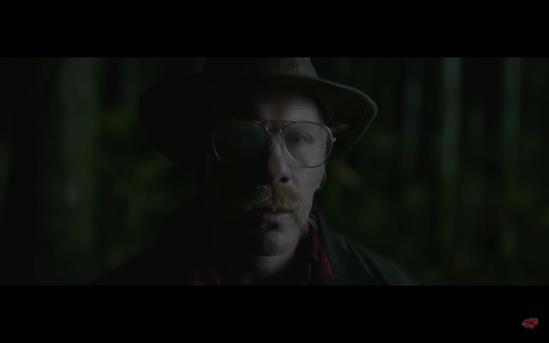
A Major Book Deal Isn’t Worth This EVIL. “Writer’s Block” reviewed! (Gravitas Ventures / Digital Screener)

Skip Larson has become a one hit wonder in the literary field.  The aftermath of his initial work, a best seller success, has never again been duplicated as Larson’s wretched and dispassionate heart and mind hit an unscalable writer’s block that can’t afford to pay the ever mounting bills.  When a stranger approaches him at one of his dismal book signings, an opportunity presents itself to meet serial best-selling novelist, Chester Everett McGraw, at his private ranch where Larson has to decide whether to sign McGraw’s rigorously partisan and severe contract for wealth, prestige, and a chance to co-author McGraw’s next big novel after being cut off from the outside world for six months or walk away from everything without penalty and return to his mundane life struggle.  Larson agrees to McGraw’s extreme terms and begins working chapter after chapter on McGraw’s next literary masterpiece, but as the days turn to weeks and each draft is ridiculed and critically trashed, an irritated Larson itches to leave but the snake-tongued McGraw, his brutish bodyguard, and even the beautiful maid, who has suddenly taken a liken to him, keep tortuously motivating him back to novel drawing board whether he likes it or not. 

Putting pen to paperwork with a looming deadline on the horizon is already stressfully hair pulling, but when the cold steel of a gun muzzle is pressed against your sweaty temple, the pressure grows tenfold to get the creative juices flowing before the contract is up in Jeff Kerr and Ray Spivey’s co-written and directed 2019 exploitation thriller, “Writer’s Block.”  The independent feature is the second collaborated project between Kerr and Spivey following their 2016 documentary, “The Last of the Moonlight Towers,” about the obsolete street illumination system, the last of its kind, of electric light towers in Austin, Texas.  Continuing the trend of holding their filmmaking shop in their home state but not exploring non-fictional antiquated monolithic engineering marvels, the directing duo concentrate their Texas-based shot film toward being a cinematic turn-pager saturated with perfidious suspicion and crackpot characters that keep the road toward a clandestine endgame alluring and mysterious, unfolding in a similar regard to that of its general context of an exceedingly multifarious murder mystery novel.  Kerr and Spivey’s Sharp Town Productions serve as the attached production company.

Kerr and Spivey shop locally when choosing their downtrodden literary hero, Skip Larson, plagued with a wretched past and the desirable callings of the bottle.  The filmmakers settle on “Fear the Walking Dead’s” Craig Nigh who can sell smartass with the best of them and be as tough as nails when push comes to shove.  On paper, Larson’s a forlorn gambler risking his chance at life by accepting a seemingly glamorous, one-in-a-life, game-changing deal by a fellow writer he admires, but with a number of fishy, tall-tail signs of deception and corruption by McGraw and his goon, Digger, Larson can come off naïve, especially when he sticks around still after his free will fractures under physical violence and threatened to be shot.  The oppressive McGraw obviously has an ace up his sleeve in his proposed partnership with Larson and, never once, feels sincere in building Larson’s library with his dreams.  I found Mike Gassaway’s performance as McGraw to be one-note.  “The Next Kill” Gassaway tussles with sly intentions of a manipulative best-seller author, devolving into an unintentional weaker ranch obstacle that dwindles down McGraw to be more of a façade behind the true game being played against an unwary Larson.  Though McGraw as the brains, the cowboy hat wearing former oil rig worker, Digger, provided much of the muscle whose anxious temperament kept him from seeing the final stages of McGraw’s malevolent game.  Chris Warner finally lands a principle role that isn’t a short lived bit part that’s labeled Flatbed Driver or Prison Guard.  Instead, Digger Haskell seems like a teddy bear good old boy that Warner can inherently step into without having to get lost in a new persona and Warner fleshes out Digger’s hasty disdain in how the slow progression keeps him for enjoying what he loves to do best – being a hired goon – but the character rarely established a definitive connection of servitude toward McGraw other than the notable writer taking the oil rig injured man under his wing, causing some unresolved character development.  Cataline is perhaps the most underwhelming character as the immigrant house cleaner who falls in love with Skip Larson.  Played by Jeannie Carter-Cruz (“Sasquatch!  Curse of the Tree Guardian”), Catalina bashfully wills herself around the house, not really cleaning much in the audiences scope of her profession, and becomes discreetly entangled with the struggle writer for unknown reasons she herself couldn’t explain, leaving her, and Carter-Cruz, exposed in an under-seasoned character course. Katusha Robert, Avery Lewis, and Natasha Buffington rounds out of the cast.

“Writer’s Block” shoves an easily relatable theme of success never comes easy right into audiences’ laps as Skip Larson’s humiliation exhibits as much through literary famed Chester McGraw’s browbeating tactics ranging from verbal assaults to unwanted sexual persuasions. Not by McGraw. That would be gross. Yet, in essence, the actual frustration condition of writer’s block for an author in any facet is akin to the sensation of conquering in what seems the impossible. Once Skip Larson tips the odds into his favor, the woebegone writer’s line graph to success skyrockets off the chart after a bit of tough love motivation stemmed by McGraw and his boot camp, side-hustling ranch. However, “Writer’s Block” suffers from the titular misgiving in the form of pacing irregularities, a loitering third act, and a paper thin Skip Larson backstory that only dabbles into his post-family tragedy alcoholic stupors and his peradventure subversive dealings with his gangster cousin. The gangster cousin tangent is by far the most offshoot subplot underlined only in flashbacks and at the finale that introduces a character that has seemingly never been a functional part of the story but is pivotal in Skip Larson’s corner. The crux of the story’s issues is that it tries to incorporate too much whereas the basic building blocks, the pure premise, would have sufficed and have been modestly more successful if stuck to instead of throwing a curve ball of horror into the macabre construction of McGraw’s collective work of best sellers as trophies that becomes synonymous with his obsession for hunting, if not more so conquering, the wild game he annihilates.

When a wordsmith’s mental typewriter stalls and the hands hang still with fingers dangling above the alphanumeric keys, waiting for inspiration to flow through the very fingertips that provide financial stability and creative vigor, use the Gravitas Ventures released “Writer’s Block” as a tool to unstick the tacky words, pry open the oppressive blockade of the expression dam, and let the flood of literature be unbridled. Released earlier this month on November 3rd, “Writer’s Block” is now available on VOD and streaming platforms, such as Amazon Prime Video, Apple TV, Fandango Now, and Google Play as well as all major cable and satellite platforms. The 98 minute film is shot in the capable hands of Alex Walker who stays put mostly in natural lighting, swerving almost unnoticeably at times into various colored lighting (mostly blue or purple) and utilizes the story’s drone to capture effective aerial shots. There were no bonus features included with the screener nor were any bonus scenes during or after the credits. “Writer’s Block” is a tousle survival-thriller careening toward a grisly surprise that requires a little more spick and span shaping for a grittier exploitation.

Own “Writer’s Block” on Prime Video!


Never Poke Isolated EVIL. “Darkness in Tenement 45” reviewed! (Wood Entertainment / Digital Screener)

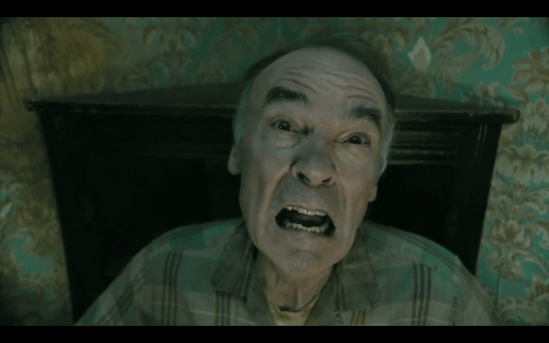
In an alternate reality of the 1950s, the Soviet Union has obtained components for long range biological weapons that threaten United States’ borders.  New York City has been declared as a tangible target and the city is evacuated of all residents, but one tenement, number 45, remains occupied, boarded up by the frightened tenants to shield themselves from the biological threat and from a possible USSR invasion.  Cut off from the outside world and running low on food and supplies, the building’s owner, Felix, ventures outdoors to forage what’s left on the streets of NYC, leaving Martha in charge of the dilapidated building, the anxious children and the terrified adults.  Martha’s adolescent niece, Joanna, arrived just before the evacuation; a measure taken by Joanna’s mother due to her daughter’s “darkness” of violent outbursts, but Joanna’s darkness conflicts with Martha’s authoritarian leadership leading up to a faceoff between children and adults in already tense surroundings.

In August 2017, production finished on “Darkness in Tenement 45.”  In 2019, a Kickstarter campaign was launched to complete the post-production of the Nicole Groton written and directed psychological thriller based off fear and intimidation in the context of a Red Scare backdrop.  As her breakthrough feature film, Groton probably couldn’t have imagined that the release of her quarantine isolating and germ warfare agog could have coincided right in the middle of a current pandemic climate of self-quarantining anxiety and globally enforced lockdowns.  Yet, “Darkness in Tenement 45” can be viewed a sentiment of triumph in a time of actual worldwide darkness for a film with a crew that is comprised of primarily women and with a cast that favors the majority of dialogue roles also for women.  Groton supports her own cause by contributing as producer under her production label, A Flying Woman Productions, a North Hollywood, California based indie picture production company.

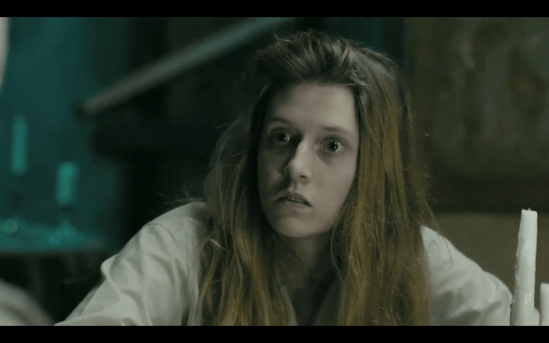
While there might be a contingent of characters that could easily be in the vying for lead, Nicole Tompkins is the discernible “darkness” descriptor in the “Darkness in Tenement 45” title.  The Texas-born actress has developed a little darkness of her own in her career corner being a principle lead in the 2018’s nightmares of the netherworld, “Antrum:  The Deadliest Film Ever Made” and also landing a voice role of one of survival horror’s most renowned heroines, Jill Valentine, in the remake of “Resident Evil 3” video game released this year.  Now, Tompkins scales the identity range as a damaged young woman sheltered in place from the elements of war only to be stuck as an afterthought amidst toxic authority that could endanger all tenants, creating a boiling tension culminating into a volatile climax with Martha, a role drenched with an unapathetic interest in children’s opinions, especially from the unstable ones.  Martha is played sardonically by “Blood of Drago’s” Casey Kramer with a seething disdain for anything that isn’t in her interest.  Overall, the performances and characters are grounded enough to development the story along it’s simple narrative lines, but not everything support character, who are supplemented with individual portions of the story pie, are well bloomed to sate their character.  For instance, Tomas, the youngest child of the building owner, Felix, has an undisclosed autistic side him and becomes obsessive with the breast of one of his older sisters, and while that plays out in Groton’s themes of partisan power when Tomas is given authority over his sisters from his venturing father, because of their innate Latina patriarchal culture, Tomas’s motivations fall short of really being dug out from the undercurrent context as an individual arc.  Same kind of broke off development can be said with Emmy Greene and Joseph Culliton’s characters as fellow adults who blindly follow Martha’s do-as-I-say mentality like lemmings toward their self-destructions.  The cast rounds out with a wide range assortment of children and adult actors that include David Labiosa (“The Entity”), Melissa Macedo (“Blood Heist”), Keyon Bowman, Marla Martinez (“Blood of Ballet”), and Anthony Marciona (“Invasion U.S.A.) who provides more of a 1950’s white man NYC accent true to the era.

Revolving around the theme of isolation, “Darkness in Tenement 45” operates under the similar structure of John Carpenter’s “The Thing” by establishing a group of people cutoff from the rest of the world trying to survive a different kind of infection and the antagonist alien, represented as the darkness in Groton’s film, is the villain that tears the remaining survivors apart from the inside, metaphorically in the house instead of their bodies in this case.  “Darkness in Tenement 45” is by no means on tenterhooks or as a molecularly gruesome as John Carpenter’s classic re-imagining of an actual 1950s film, but the basic principles of the story present plenty of suspicion, hegemony, and stir craziness to go around, fueling the dreams and anxiety to Joanna’s snowballing psychosis redlining toward critical.  While I feel that the performances and wardrobe are not the best representation of the 1950s time period, the Caitlin Nicole Williams’ production design shoulders much of that responsibility.  Williams, who worked as the second unit production designer on the satirical-slasher “Dude Bro Massacre III”, creates a delineable vividness out of a bare bone lined tenement setting, appropriate for the depicted social class and period, while exuding the crude shiplap finish that fits the narrative, adding confinement and angst to the space.  “Darkness in Tenement 45” is Groton’s groundbreaking effort that dishes out this disorder of a safe haven in dismay; yet, the story pulls plot point punches that should have landed to knockout a more effective thriller that touches importantly upon the very livelihood and fate of each individual tenant in an alternate universe wartime backdrop.

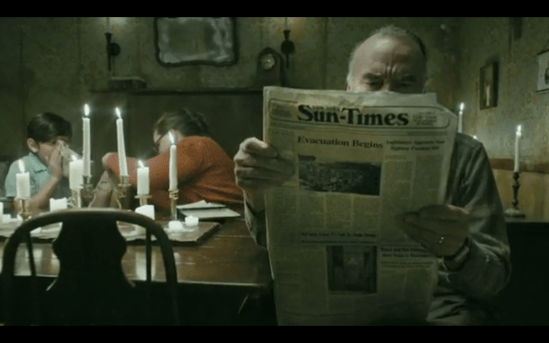
On the biggest day of every four years, as anxiety-riddled clouds loom over the entire nation as we all wait in the shadows with bated breath of who will be the next President of the United States of Election Day, Wood Entertainment has embraced another kind of tense darkness with their release of “Darkness in Tenement 45” onto various digital platforms, including iTunes; Amazon; Vimeo, Xbox, Google Play, iNDEMAND, FandangoNOW, and more. Continuing the praise of the female-led thriller is with the Carissa Dorson cinematography that deposits two shot styles of the conscious and subconscious. When awake, Joanna and the others are engulfed in a hefty, deep dark and light wood brown scheme that compliments the slummy environment of their tenement. When asleep, Joanna is rendered in a softer image to resemble the hazy or airy atmosphere of her dreams. This style is also complete with a medium scaled purple-pink tint often associated with the hallmark callings of a 1970s-1980’s foreign supernatural horror. Dorson never intertwines the two styles, giving clarity to Joanna’s conscious and subconscious state without going deeper into the character’s easily agitated and short fuse temperament, while also setting up some neatly framed shots that make things look bigger or more menacing than they appear, such as the overly boarded up entrance door or the candle lit supper table that becomes a point of contention. Flashes of incubus imagery and the dissonance of gearworks clanking around an unhinged mind give “Darkness in Tenement 45” a morsel of allure amongst the thematical discord of breaking the chains of restrained individualism and overprotecting those with a firm hand from self-harm and while the film might not be pitch perfect, the spirit is strong in the vanguard of female-driven filmmaking.

“Darkness in Tenement 45” now available for rent on Amazon Prime!

How Far Will Three Detectives Go to Stop Evil? “Memories of Murder” (Neon / Digital Screener)

Two impractical detectives of the Gyunggi province of South Korea investigate a pair of rape and murder cases involving two beautiful and unrelated women found with their hands bound behind their backs, gagged with a rock tied into their mouth, and with their panties covering their heads.  Known around the province for their torturous interrogation tactics, the detectives bully a mentally handicap young man and the local pervert into confessing to the heinous crimes, but when a Seoul investigator arrives into the village, drawn in by the curiosity and coincidence of the murders, a larger scale serial rapist and murderer, calculating his every move, is unearthed, connected by series of events leading the small police force to reevaluate their handling of the murders that have become more gruesome than the next with every victim. 

Before his inevitable recognition from the 2019 Academy Awards for his socially skewed hierarchy thriller, “Parasite,” that historically won Best Picture, Directing, International Film Feature, and Original Screenplay categories, even before his breakout success amongst fans of the horror genre with the creature feature, “The Host,” and an introduction into the American film market with another social class commentary, the dystopian standoff that was “Snowpiercer,” starring the Captain America portrayer himself, Chris Evans, filmmaker Bong Joon-ho had an eye for crafting his vision on camera and a knack for nerve-shredding storytelling as a writer in the early 2000’s with his 2003 sophomore feature, a crime drama entitled “Memories of Murder.” Originally known as “Salinui chueok” and written by director, the film is an encryption of a murder mystery encoded from the real life serial crimes in the Hwaeseong province in the 1980’s, Bong Joon-ho’s film takes place in 1986, and renders an engrossing story structured like a modern day Jack the Ripper emerging out of the unpleasant anecdotes of Korea lore stirred with themes of consequences as a result of careless failures and the inadequacy of effort no matter the analyzed angle.  CJ Entertainment, Muhan Investment, and Sidus serve as production companies of this somber sleuth mystery.

Despite their different methods of interrogations and investigation pursuits, the story hammers down on the three detectives’ across the board search for a methodical killer rather than a killer’s betokening perception of events as the detectives, individually flawed with ill repute and personally challenged, separately come unglued, make mistakes, and suffer the consequences of their public inanity, but when they click in harmony and rally on the same page, the truth almost hops into their laps rather than at a snail’s pace stemmed from internal competition for apprehension success. Song Kang-ho has played the constant, the unparalleled keystone, in Bong’s two decades of film credits, beginning his collaboration with the acclaimed director in “Memories of Murder” as the province’s ineffectual blowhard detective, Park Doo-man. With a deadpan stare, Song Kang-ho debones the Park Doo-man to his rudimentary base, a waggish con artist in an officer’s casual attire, and the actor defines Park’s arc so clearly, distinctly, and with ease that you can actually see Park Doo-man’s soul just become utterly crushed by not only the tough case but also when it’s clear that he must separate himself from his partner Cho Yong-koo (Kim Roe-ha) after a foolish bar fight of steadfast conviction and begin to accept his counterpart rival Seo Tae-yoon (Kim Sang-kyung) to no longer be the buffoon when bodies continues to pile up. “Memories of Murder” round out with Song Jae-ho, Byun Hee-Bong, Ko Seo-hie, Park No-shik, and Ryu Tae-ho.

In the battle to be top cop that nabs the worst criminal the province has ever seen, a disastrous paradox thwarts their oath to protect and serve the community as the two detectives, in their haste for swift justice, don’t see eye-to-eye on issues of evidence and actual detective work with a levelheaded outside investigator putting his foot forward delivering a working, if not more rational, model of a killer’s mind.  The innate detective, Park Doo-man, relies heavily on the circumstantial from gossip, relayed by the province investigator’s soothing nurse who he’s also seeing romantically, to superstition, visiting expensive shamans and claiming to have supernatural sleuth abilities himself, in order to cheat corners in hoping the information will present itself like an elegantly wrapped gift with a bow on top.  At the other end is the outsider, detective Seo Tae-yoon, from the metropolis area of Seoul and the big city detective, who sees more of these types of crime in his urban backyard, conducts a factual investigation based off research and relying on experience that gives him intuition into how the killer thinks.  Clarity in the contrast concedes more so when the third detective, another province resident, Cho Yong-koo, refuses to change his ways of brutal violence and torture as he continues his flying kicks right into the chests of suspects whereas his partner, Park Doo-man, relaxes his greed for admiration when the number of deceased women becomes unnerving and public trust in law enforcement rapidly diminishes; the reality sets when his counterpart, Seo Tae-yoon, produces results closer to an arrest based on fact.  Bong Joon-ho’s approach at the beginning would not be a conventional one that mingles rape and murder with the bumbling antics of a small town police force that’s outrageously zany at times.  The zaniness comedy subsides and is replaced with an air-letting dismal outlook of vulnerability and powerlessness in making little-to-no headway into a case that keeps getting grislier and grislier with the killer not inserting objects into his female victim’s vagina.  Trusting the system is even more disquieted so when the most latest and reliable crime solving techniques in the mid-1980s, from America none-the-less, proves to be astonishingly inconclusive, making the case seem like a no-win situation that then reverts back to the idea that sometimes even the most careful and meticulously handled cases, without the use of force, are not solvable. 

The powerful knuckle-biter “Memories of Murder” rattles with anxious tension and is chartered gracefully through the unrivaled eye of Bong Joon-ho.  Now making it’s grand return exclusively to theaters nationwide October 19th and 20th, “Memories of Murder” will be exhibited digitally remastered for U.S. audience for the first time since it’s initial release since 2003 courtesy of a partnership between Neon and Fathom Events.  The limited theatrical running with include exclusive content and a post-screening conversation between Bong Joon-Ho and “Shaun of the Dead” and “Hot Fuzz” director, Edgar Wright.  Since I’m unable to compare the digitally remastered with the initial release, all I can say is that the film presentation appears steady, tight, and clean with Bong’s sepia tone to incept a memory fragment of the past and shot to entice an unfathomable crime drama captured as beautiful gaslit dissonance between background societal unrest, the case at hand, and the audiences’ unsuspecting role as the potential suspect. The screener provided is a digital screening link and might appear different in a theater sitting. The English subtitles were clearly visible with some minor errors in spelling. Again, this might vary in theaters. There were no bonus material on this screener, but, remember, that the limited run event on October 19th and 20th will have the exclusive bonus content and the Wright and Bong conversation. Unforgettably wrung with wraith-like anecdotal properties, “Memories of Murder” can be labeled as Bong Joon-Ho’s exemplary film, even better than his current work that won him an Oscar.

An Elite, EVIL Assassin Loses Herself as the “Possessor” reviewed! (Neon / Digital Screener)

Tasya Vos is the top professional assassin employed by a hire-for-murder agency who uses surgically implanted brain transceivers to insert agents’ consciousness into a person’s body who can get close to their intended kill target. The no contact procedure has been successful with some severe drawbacks, such as the potential for slipping out of your own identity in being, in one way, a part of many distinct personalities. When Vos’s next assignment is to insert herself into the mind of the soon-to-be son-in-law of a powerful tech CEO, her individuality begins to crumble, losing her grip as the primary inhabitant of the body. The commingled souls share thoughts and memories and when Vos takes a backseat in a body that’s no longer under her control, her life becomes vulnerable to a confused and unhinged man seeking vindictive measures to evict the assassin from his mind.

Like an existential extension of his father’s career, writer-director Brandon Cronenberg’s foothold within sci-fi horror is anchored by functional practicality, substantial social commentary, and a knack for exhibiting cynical undertones in his sophomore film, “Possessor,” a gripping tech-thriller avowing the soft-pedaled ambiguous identity and corporate invasiveness. “Possessor” is the blood soaked corrosion of individualism that strips morality and replaces it with unapologetic nihilism in a film that feels very much David Cronenberg’s “eXistenZ” merged with Paul Veerhoven’s “Total Recall” with that plug-and-play dystopian coat of paint that’s being brushed over the quickly disappearing free will. Studios involved in the making of “Possessor” include Rhombus Media (“Hobo with a Shotgun”) and Rook Films (“The Greasy Strangler”) in association with a WarnerMedia division company, Particular Crowd.

“Possessor’s” leading lady, Andrea Riseborough, is no stranger to idiosyncratic roles in equally atypical films having starred in “The Duffer Brothers'” “The Hidden” and played the titular character in the avant-garde horror, “Mandy,” across from Nicholas Cage; yet, from her experience with big-budget studio films, such as “Oblivion” starring Tom Cruise, the English actress felt the uneasy atmospherics to be pressurizing and uncomfortable Riseborough has thus exceled with films such as Cronenberg’s “Possessor” that’s pivots into an alcove just off the main halls of horror and science fiction. Riseborough looks nothing like herself from “Oblivion” by sporting a stark white hair on top of a thin frame, which could be said to be the very counter-opposite of what a typical, bug-budget assassin should look like, but Riseborough delivers stoic and uncharitable traits of a character on the brink of losing herself. Christopher Abbot delivers something a little more chaotic when his conscious retreats back into the depths of his psyche only to then seep back into his mind where he stumbles to catch up on current events. The “It Comes At Night” Abbott disembodies himself not once, but twice, becoming an avatar for Tasya Vos to play, picking up where Abbot’s Colin left off, and then Abbot has to regain control, splicing Colin back into the cockpit where Tasya commands the yoke. The dueling dispositions cease being unique as one attempts to control the other in a mental and corporeal game of chess, confounding audiences of who is in control during certain scenes, especially when Colin goes into a blackout murdering spree of people Colin himself knows and trusts. As a puppeteer moving a marionette, pulling as an influential strings behind company lines, is Girder, a poker-faced agent head seeking the absolute best in the company’s interest, who finds her thimblerigger in Jennifer Jason Leigh. Leigh, whose experience with David Cronenberg’s “eXistenZ” brought a high level of cognizance to “Possessor” having been an cerebral deep virtual reality trouper previously, folds in the nerve of any level of management that would guilt someone else into doing the work necessary to get the job done. Girder opposes Tasya’s external humanity in a silent, but deadly manner by appealing to the killer instinct in Taysa, letting red flags of the out of body experience fly by the waist side that ultimately wears away at her star pupils moral conscious and turn her into a stone cold killer. “Possessor” cast fills out with Tuppence Middleton (“Tormented”), Kaniehtiio Horn (“Mohawk”), Rossif Sutherland (“Dead Before Dawn 3D”), Raoul Bhaneja, Gage-Graham Arbuthnot, and “Silent Hill’s” Sean Bean in a worthwhile role just to see if his role will succumb to a typical doomed Sean Bean character as the undesirable tech CEO.

Its safe and sufficient to say that Cronenberg’s “Possessor” is not a feel good story; the amount of tooth-chipping, eye-gouging, and throat stabbing gore takes care of any hope and ebullient energy that one could misperceive. Yet, while the disgorged grisliness stands on it’s own, Cronenberg possesses a factor of tropes that multiply the film’s bleak, icy landscape inhabited by unpleasant characters that ultimately seek and destroy the little good exhibited. The obvious theme is the disconnect from one’s own identity. Tasya Vos mental capacity nears the breaking point being an inhabitant of numerous bodies and with each callous, bloodletting assignment, Vos’ indifference for the things she should hold dear strengthens immensely drowns in the persona of another person and the psyche breaking acts of violence. Her latest assassination attempt even blurs the lines of her sexuality as her feminine body parts merge with Colin’s masculinity in one of the craziest sex scenes to date. Colin’s individuality is too threatened but from Vos’ intrusion, equating the quiet, strange behavior to a sudden vagary toward a person’s dejection, being estranged from their own life, on the outside of “Possessor’s” alternate reality of science fiction’s hijacking of one’s brain. On the subject of intrusion, a not-so obvious theme, but certainly has a strong motif, is the severe invasion of privacy. Vos’ spying on Colin and his lover for personality intel, Vos’ inspection of the entire Colin body while inside inhabiting him, and the data mining of Sean Bean’s character’s tech company, which pries itself through the optics of people’s computer cameras to garner information, such as the fabric of window curtains in this case, divulge an uncomfortable message that privacy is a luxury we are unable to ever grasp. There’s even a scene where Vos, in Colin, becomes a voyeuristic participant of a couple’s explicit sexual intercourse during data mining work hours. Despite the breadth of technology that are brimming near our fingertips today, “Possessor” has a very analog approach with dials and switches of seemingly antiquated electronic circuits, thus rendering the story grounded in nuts and bolts rather than being lost in the overly saturated and stimulated advanced tech. Beguiling with a somber serenade, “Possessor’s” a highly-intelligent work of diverse, topical qualms seeded by years of body horror and existentialism and is released into a world that’s perhaps not ready to come to terms with much of the themes it will present.

Come October 2nd* to select drive-ins and theaters, “Possessor” will be distributed uncut by Neon, implanted in the midst of horror’s biggest month of the year. Since not a physical release as of yet, the A/V attributes will not be critiques, but the film is presented in 1.78:1 aspect ratio and is under the cinematography direction of Karim Hussain, who has previously worked with Brandon Cronenberg on his debut film, “Antiviral.” Hussain adds rich two-tone coloring for a symmetry of sterilization that is, essentially, white and black with every shade of both in between tinted slightly with a dull hue on the spectrum and with the blood being that much more graphically illuminated against the backdrop. There are moments of composites that could render a person disabled with epilepsy, so be warned. The audio is a smorgasbord of a jarring ambience and soundtrack, adding to “Possessor’s” fluxing turmoil, but the dialogue discerns a little less sharply across; there was difficulty in understanding characters’ monologues or discourse who came across mumbling through scenes of fuzzy earshot. There were no bonus materials to mention nor were there bonus scenes during or after the credits. Perhaps the best movie you won’t see this year, “Possessor’s” an impressive follow up feature that reaches out beyond the outlining border of a vast and prolific filmic shadow looming over the filmmaker, but Brandon Cronenberg contrives new vitiated wonderments and is capable of casting his own umbra that would eclipse to throw light onto his soon to be seen cathartic body of work.


* Release date correction (9/29/20)

Defy EVIL to Live! “Alone” reviewed! (Magnet Releasing / Digital Screener)

Six months after the suicide of her husband, Jessica struggles to cope living in the city that holds too many fond memories of her once happy life with her husband.  Jessica packs her things and quickly drives out to the wilderness, separating herself from the city as well as her unsupportive parents.   On the road, she encounters an incessant man following her every track before violently kidnapping her and hiding her away in a bare room of an isolated cabin deep within the woods.  Her escape opposes her not only against a calculating captor hot in pursuit, but also against nature’s unforgiving elements, showing little mercy to Jessica’s dire and desperate getaway. 

From eluding the flesh hungry, running zombies of Syfy’s “Z-Nation” and Netflix’s “Black Summer,” director John Hyams has us fleeing once again for our very lives against a more realistic monster in his upcoming abduction thriller, “Alone.” Screenwriter Mattias Olsson takes a backseat from directing “Alone,” which is a remake of his written and co-directed 2011 Swedish film, “Gone,” paralleling the premise about a woman fleeing a family tragedy only to be followed and kidnapped by a man driving a SUV.  Shot in Oregon’s silvan outskirts, “Alone” is a survival thriller with emerging themes of taking back one’s life in more ways than one and no more running from an unbearable past built into a conceivable terror situation that has unfortunately been a common episode all over the globe.  “Alone” will be the second feature film produced under Mill House Motion Pictures, under the supervision of founders Jordan Foley and Jonathan Rosenthal, the latter having a small role in the film, and is also a film from a second Jordan Foley company, Paperclip Limited, who has Lisa Simpson voice actress herself, Yeardley Smith, as one of the active partners, and, lastly, in association with XYZ Films.

The up and coming young actress, Jules Willcox (“Dreamkatcher”) stars in the lead of Jessica who hasn’t have a friend in the world, alienating herself from her former life and her parents with a sudden escape to the Oregon wilderness.  The physically demanding role withstands the brunt of constant attack, whether from Marc Menchaca’s unnamed assailant character or the natural elements of the forest that include from the massive rapid rivers and torrential rains to the smallest of roots that spear her bare feet while on the run.  Willcox also brings to the role an indistinct mindset, jumbled with the lingering and complicated suicide of Jessica’s husband, paranoia, and an instinctual reaction to survive, especially through Willcox’s eyes that arch from fear to fortitude.  To really envelope Willcox in that unwarranted fear of harm and pushing her character into the unknown of the adversarial complex that is mother nature is Marc Menchaca as a conniving creep looking to do as much pleasurable damage on his bogus business trip as possible.  Menchaca also looks the part, resembling an out of place 70’s-80’s serial killer with round thin-framed glasses and a moderately bushy handlebar mustache overtop a sturdy frame.  Now while these attributes are not indicative to just serial killers, they sure as hell work well on screen to really sell the intensity that Menchaca delivers as a faux Ned Flanders type nice guy, a sheep in a wolf’s clothing so to speak, who acts a lure against his prey before venomously striking.  The small cast rounds out with Anthony Heald of the Anthony Hopkins “Hannibal” films in a small, yet uncharacteristic, good guy role as a hunter caught in the middle of Jessica’s situation.

While suicide might be the catalyst that compels Jessica to drive into the middle of nowhere, Matthias and Hymans only utilize the power theme as an instrument against Jessica’s psyche.  Jessica runs and hides from polite and comfortable society, but the recently widowed soon discovers that she can’t outrun her past as she hits a perverse wall constructed in the form of a man of sordid pleasures and sociopathic tendencies.  Her kidnapper becomes, in a way, her therapist who, at one point, pins her to the ground and scrolls through the personal photos on her tablet, forcing her to talk about her husband up to the point of his death, and consistently throughout the film that his actions were cowardly, removing the blame from her and onto him while emphasizing her tremendous guilt for not seeing the signs earlier.  “Alone” blossoms a wildly curative dynamic that encourages Jessica to then defend herself and her husband’s memory by standing up against not only the man’s relentless chase, but also her guilt.  The thick Oregon setting becomes a security blanket, sheathing her endless dismay, but the forest is actually does more harm than good for Jessica.  Only when does Jessica steps into a wide clearing of lumberjacked tree stumps does hiding from all the pain and torment become no longer an option as she makes her last stand against her attacker, unloading her fear, anger, and guilt upon the man by exposing him as an oppressive killer. While immersed in watching, “Alone” will deprive oxygen from your body that’s desperately gasping to fill your lungs with air in every harrowing chapter, but “Alone” is a breadth with a throng of digging out of despair overtones and a conduit for self-repair that’s unraveled symbolically through the afflictions of bona fide sadism.

“Alone” rises above the call of arms against predatory men in this thrilling remake from John Hyams, releasing into Theaters and VOD on September 18th from Magnet Releasing. The rated R, 98 minute feature will not have the A/V specs critique due to the digital screener, but Federico Verardi (“Z-Nation”) grasps the elegant threat of the woods by using drone shots to shoot the very tippy-top of the swaying trees that conceal the ground, as if obscuring the atrocity being committed below, and applying low-contrast to make insidious hard shadows against green lush that turn beauty dark and deceitful. *Director John Hyams has noted the rapid’s scene where Jessica temps fate to escape her pursuer was practical and performed by stuntwoman Michelle Damis and though looked a little off around the Jessica’s unsubmerged profile as she’s whisked away down the river, the effect is 100% legit. “The Pyramid” and “Becky’s” Nima Fakhrara scores a low-impact tremble for most of the feature with Jessica’s running through the woods is accompanied an equally low-impact drumming, letting the ebb and flow of resonating forest ambience engulf much of the soundtrack to solidify it as a correlative character; even the end credits is purely nature’s ambient noise. Since “Alone” is a brand new feature, there were no bonus material or bonus scenes during or after the credits. “Alone” knicks the core of vulturine power, but turns the tables toward more feminist revelation to fight and take back one’s life.

*Correction: Previously stated the rapids scene was CGI.