

“The Beast to Die” on Limited Edition Blu-ray from Radiance Films!
Former war journalist, Kunihiko Date, stabs a veteran police investigator to death. He then uses the detective’s revolver and guns down three, after hours casino employees in cold blood and steals the day’s earnings. Date’s seemingly random acts of violence and theft from a respected war journalist and photographer are not just random acts but part of a methodical plan for an upcoming heist of a bank in Tokyo’s Nihonbashi district. Casing the bank’s security, personnel, and layout, Date’s perfect plan has one hitch; Because of the bank’s size and bustling busines, he’ll need a little help. By chance, he comes across Tetsuo Sanada at an annual school alumni dinner with his closest friends who have a violent run-in with Sanada as their antagonistic waiter. Seeing the same potential disregard for life and disdain for existence conventions, Date approaches Sanada and mentors him under a nihilistic wing. Now with a plan and an accomplice, Date’s violent holdup can move forward but to what end is the length of his sociopathic carnage.

“The Beast to Die,” aka “野獣死すべし, Yajū shisubeshi,” is the intense and violent noir-thriller from Japan, directed by “Dead Angle’s” Tôru Murakawa and a script by Shoichi Maruyama (“The Triple Cross”). The 1980 released feature would be Murakawa and Maruyama’s second feature length production together behind 1979’s “The Execution Game,” the second film of a trilogy known as “the Japanese Game Trilogy is a visceral yakuza tale of a kidnapped hitman unable to escape the criminal underworld. “The Beast to Die” is a step away from the Japanese gangster film; instead, focuses on the interpretation of war trauma, the cynical views of precious life, and has subtle presences of U.S. big brothering, asexual themes, and coarse, unforgiving violence at the highest level of sophisticated society. Adapted from the Haruhiko Ôyabu novel of the same name, the written origin mirrors the vehemency of visual art with the film produced by Haruki Kadokawa (“Virus”) and “The Resurrection of the Golden Wolf’s” Mitsuru Kurosawa and Tatsurô Shigaki under the Toei Company and Kadokawa Haruki Jimusho.

Undoubtedly one of the best sociopathic performances of our lifetime, “Horror of the Wolf” and the Japanese Game trilogy’s Yûsaku Matsuda is a cool, awkward, and, if not, plotting cucumber amongst the masses of jovial and hustling Tokyo denizens. There’s a serenity about Matsuda’s Kunihiko Date that’s unparalleled, represented by blank stares, a patient demeanor, and precise movements that come in stark contrast in the film opener where Date takes down four people in one night in a show of murderous inexperienced bravado. Even in the thick of combative survivalism, there’s only objective goal in his sweat infused brow and focused eyes while others gesture and make an invitational show of his attack or of their pleas for mercy. Date becoming lost in classical music is a formidable way of grounding himself, not only from the high of excitement and thrills of killing, but also a way to retain sanity in the notes, an aspect he quickly unravels from when not exposed to classic music for an extended period. Oppositely, Tetsu Sanada is full of pent-up anger as if he’s constantly hitting his head on the wall aiming to break free of the surroundings that confine his wild tiger attitude, yet Takashi Kaga (“Isle of the Evil Spirits”) maintains a personal struggle lock on the full emergence of Sanada as Kunihiko’s equal. This dichotomy between the anger and tranquility of two sociopaths is immensely palpable that leads to a purposeful instability in a number of areas – hesitation and certainly, the sweat-inducing fear and the cooled fearless, and, eventually, the relationship’s ultimate internal destruction. Thrown into the Kunihiko and Sanada tango is a potential love interest in the puppy-eyed Asami Kobayashi (“Sixteen Years Old: Nymphets’ Room”) and her shared classical music and tenderness connection with Kunihiko and a happenstance Detective, played with casual approach by Toshie Negishi (“The Rapacious Jailbreaker”), being in Kunihiko’s consciously aloof presence as a pressuring force that suspects something between something off with Kunihiko and the murder of his detective colleague.

“The Beast to Die” explores various themes around the indirect damage of post-war trauma and living and feeling like an outsider of the what’s consider the normal societal collective, but there’s another avenue to look down when consider Murakawa’s villainous protagonists. Kunikhiko Date may have been scarred by war, but his mind always had an inkling for bloodthirst, sated through the images of a photographic lens that captured the horrors of global conflict from military losses to the collateral damage. Upon his return to Japan, Date had lost the exciting sensation of death that has exceled his rationality beyond being Godlike, able to take life without conscious due reproach. Sanada, in a way, is similar in his radical viewpoints but Date finds him more talk than action, held behind the line he has yet to cross unlike Date’s journalistic meatgrinder and his self-drive to kill the detective and casino workers. As far as vices go, neither men have an appetite for sex: Kunikhiko watches a sex worker masturbate with little interest and his connect with Reiko doesn’t go beyond the gazes into each other’s eyes and Sanada’s fortunate relationship with his girlfriend provides him with well-off opportunity in money, business, and romance but because she dapples in rendezvous with a U.S. sailor, Sanada finds himself engrossed with spite. Both men become essentially sexually impotent with seeing red, in anger and in blood, replacing that primal need or ravenous appetite. The last scene between the two men becomes a crucial turning point in their cruel comradery as the forceful sex act with an unconscious woman sends the other unravelling their partnership for good. “The Beast to Die” is a cynically cold narrative without regard for human life in the traumatizing belief one can surpass the omnipotent Gods by ending the existence of others.
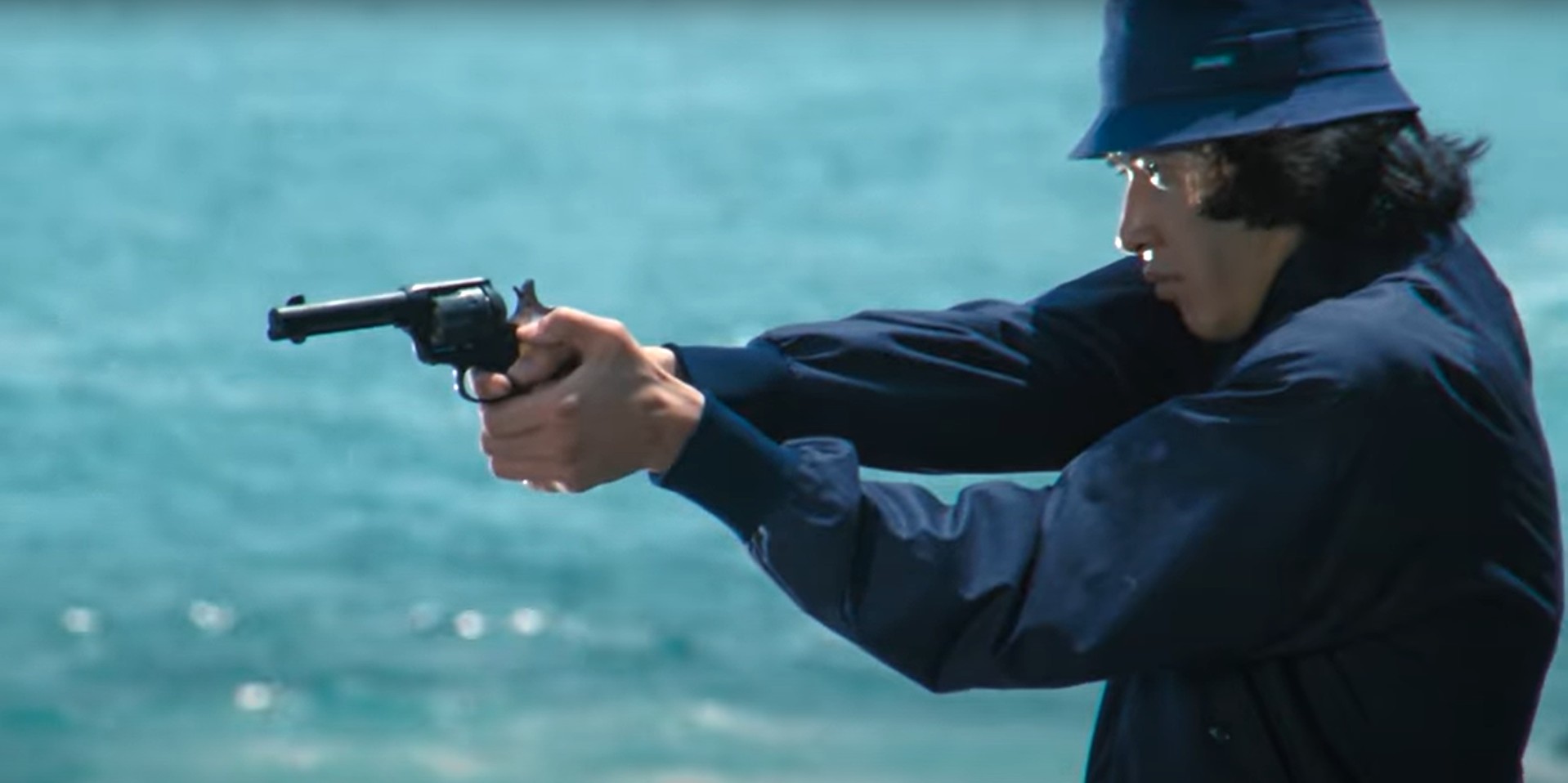
A compelling dark thriller relatable to contemporary trauma feeding mentally warped violence, “The Beast to Die” arrives onto a limited-edition Blu-ray from Radiance Films. The UK label produces a Kadakawa Coprporation-created digital 4K restoration transfer from the original and pristine 35mm print. AVC encoded onto a BD50 and presented with 1080p high-definition resolution in a 1.85:1 widescreen aspect ratio, this Stateside edition is the picture of health with a rich palate that’s stark with contrast. Skin tones and textures, as well as fabrics, emerge into perspicuousness without missing or dropping a beat. Negative spaces and shadows enshroud appropriate with the keyed lit dim levels. The grain is pleasant, stable, and natural and there are no real issues with the print itself, withstanding the test of time. The uncompressed Japanese PCM 2.0 Stere track offers a reasonably ample sound design and fidelity with post-production dialogue, foley, and ambience recordings that creates some mismatch and distancing space between the action and atmosphere audio and the character diegetic dialogue. There are no rough patches to mention within the audio recordings, producing more than fine discernible quality to the technical threshold. Japanese to English translator Hayley Scanlon provides newly translated English subtitles that are spotless in the Blu-ray’s world premiere with English subtitles. Limited to 3000 units, Radiance offers exclusive special features, including new interviews with director Toru Murakawa, screenwriter Shoichi Maruyama, and a film critique and analysis from novelist and screenwriter Jordan Harper. The newly commissioned artwork by TimeTomorrow revamps with a new look and layout on the classic, original poster art as the primary Amaray front cover with a reversible side housing an alternate rendition. There are new and archival essays and archival in the limited edition booklet with 27-pages of color stills, a Tom Mes Yusaku Matsude: Lost Rebel essay from 2004 showcasing the art and films of the lead actor, a new Tatsuo Masuto essay Shadow of the Beast, cast and crew acknowledgements, and transfer notes and Blu-ray release acknowledgements. Encoded with a region A/B lock, Radiance Films release has a runtime of 119 minutes and is not rated.
Last Rites: Radiance Films’s limited edition run of “The Beast to Die” is immaculate in every aspect – filmically, technically, packaging – and is an important piece of Japanese culture and cinematic criterion.


 It's Bloggin Evil!