20-Years or More Incarcerated is No Match for Tenacious EVIL! “The Rapacious Jailbreaker” reviewed! (Radiance / Limited Edition Blu-ray)

Break From Your Cage With This New LE Blu-ray of “The Rapacious Jailbreaker”

Masayuki Ueda is nabbed after murdering a drug dealer’s girlfriend during a botched meeting.  Ueda faces a 20-year prison sentence for his crime but after being processed, nothing can change his mind nor his determination to escape.  Willing to sacrifice blood for freedom, Ueda escapes and visits his lover in Kobe for a quick conjugal stop and money only to be caught again when he returns, tacking on additional years to his sentence.  His next escape plan joins forces with two other inmates and, again, his route to freedom is cut short when a brothel visit, while laying low in his sister’s village, turns into a violent brawl with another patron and the authorities round him up in the aftermath, adding more years to his sentence.  While incarcerated, Ueda must kill rival gang bosses who threaten him.  By now, Ueda’s sentence is up to 40-years, and not to be defeated by the prospect of a long term sentence, Ueda has one more desperate attempt for freedom, putting his life on the line.

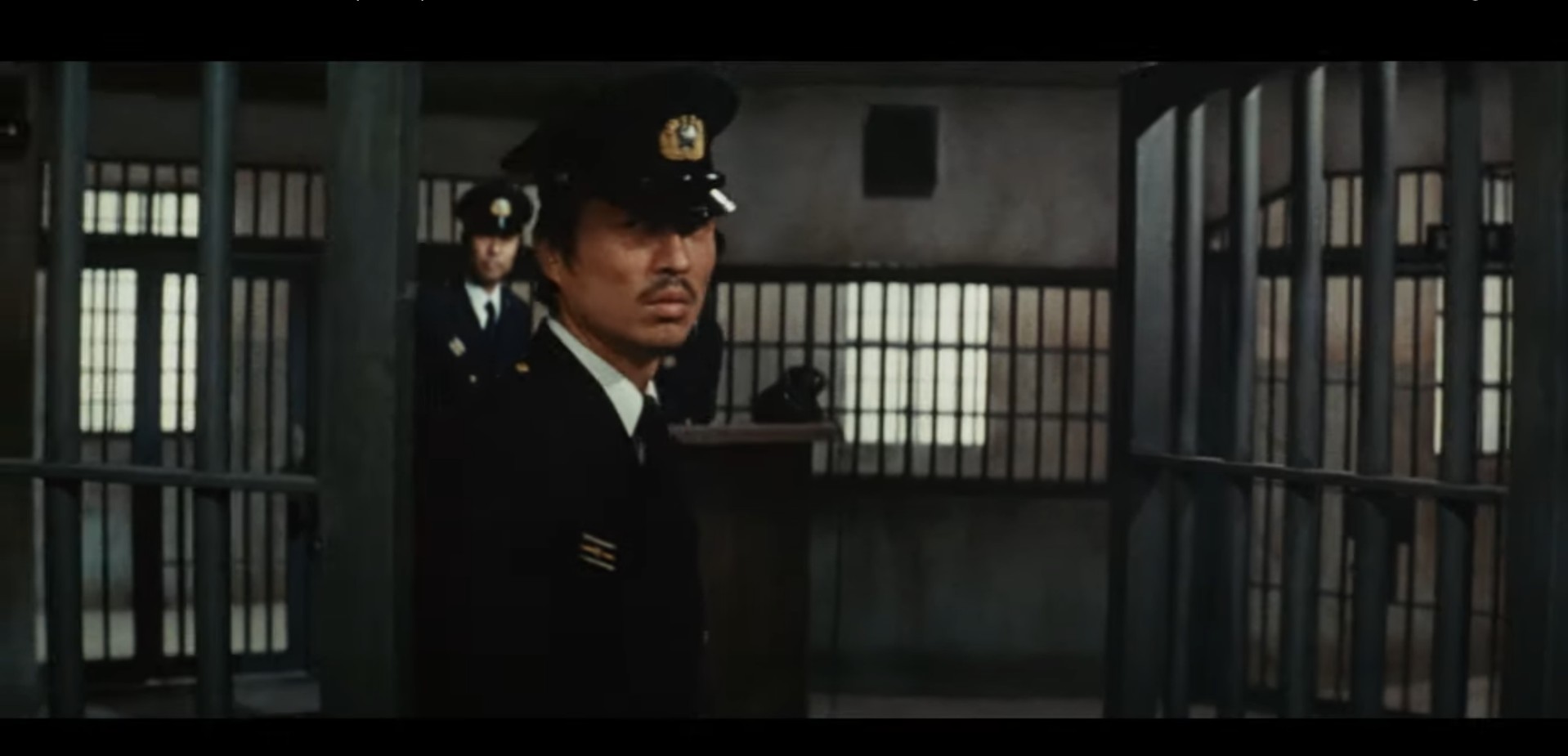
“The Rapacious Jailbreaker,” aka “Escaped Murderer from Hiroshima Prison” or “脱獄広島殺人囚,”is the crime black comedy from one of the Toei Company’s aggressively eclectic and paced directors Sadao Nakajima (“The Kyoto Connection,” “Female Ninja Magic”).  The prolific yakuza and exploitation filmmaker takes the Tatsuo Nogami (“Father of the Kamikaze”) script, centered on an incessant career criminal hellbent on not spending his days in prison, and runs with it, fashioning the smidgen stitchwork of a nonfictional individual into the post-War World II, American occupation of Japan and adds inner teetering and play-by-play thought narration and the always welcoming gallows humor amongst the exploits of a stubborn felon.  Gorô Kusakabe (“Hell,” “The Red Silk Gambler”) produces the production, which is part of an unofficial Sadao Nakajima trilogy along with “Shimane Prison Riot” and “The Man Who Shot the Don.

Hiroki Matsukata, a prolific yakuza actor from the 1960s to the 1980s with such credits as “Survivor of the Massacre,” “Dangerous Trade in Kobe,” and “Battles Without Honor and Chivalry,” breaks intermittently through the gang wars and boss-laden wall of tattooed violence and varying levels of respect that’s inked the individualized stories’ skin with “The Rapacious Jailbreaker” as the titular lead character under the character’s God-given name of Masayuki Ueda, a tenacious criminal personality type with yakuza-like transgressions of drug peddling and black market trade.  However, Ueda is not a criminal without honor, even if he’s a little rough around the edges, as his loyalties lie with those who are loyal to him: a fellow partner in crime he didn’t rat out, his suffering wife (Yōko Koizumi ), his sister Kazuko (Naoko Ohtani, “Apartment 1303”), and also those who help him escape, such as  Tatsuo Umemiya’s (“Spoils of the Night”) brazen law challenger Yuji.  Yuji and Ueda match well in traits, both eager to test and take risks going against a rather lax authority grain.  Aside from the opening montage of prison routines depicting minor torture from the guards, you don’t get the sense the prison guards have much domination or enough aggressiveness to match the kind of zeal the inmates have to either run a sneaky scheme or take them on toe-to-toe to get what they want, as we see with Yuji’s disgracing efforts against the warden in order to obtain rights that are quickly dismantled by the warden’s reneging, but at the cost of his humiliation.  Matsukata never wavers or deviates from Ueda’s singular drive, layering intensity overtop his thin film of civility with every additional time added to his sentence that eventually goes beyond four decades, but you can see it not only in Ueda’s resolute eyes but in Matsukata’s as well that nothing will stop him from escaping.  The film fills out with Hiroshi Nawa, Gorô Ibuki, Tatsuo Endô, Shigeru Kôyama, Hideo Murota, Harumi Sone, and Akira Shioji in various rolls of yakuza, fellow inmates, and those crossing Ueda’s path in the outside world.

Staying on the theme of Ueda’s loyalty, which is incredibly beyond reproach given his heinous crimes, there’s something to be said for his commitment to be free as a bird but also to the people who do right by him, no matter the circumstances. His wife pledges endless loyalty despite his flaws and felonies, his estranged sister welcomes him with food and shelter, and his opening criminal accomplice provides him a weapon before thanking him for not ratting when Ueda was apprehended by police. There’s an underlining code of respect and duty intertwining the utter most wicked and those blood relations in the field of collateral damage. Ueda’s responsibility for his actions never wanes, never deflects, and never becomes a weight of guilt as the only object, or maybe even obsession perhaps, on his mind is to escape prison and make quick, easy money. His loyalty does come at a fault when his trust reaches into the weeds, especially amongst those he’s already collided head-vs-head against, such as the former head of the black market beef butchers who turns on Ueda for false promises, but it’s in that one and only instance that everything becomes clear, much more to the audience than perhaps Ueda himself, is that in order to remain just out of arms’ length of the law, he must walk his path alone as depicted at the finale moments. The post-World War II American occupation time period has an interest facade to “The Rapacious Jailbreaker’s” context. In fact, the American presence is rarely present at all with Ueda feeling the squeeze mostly in-house within the Japanese penal system with the Americans only rearing their heads in obstacle of his escape attempts in a negative light: Ueda’s standoff against Japanese officers, who won’t shoot him surrounded by a crowd in fear and respect of bystanders, comes to a quick surrender when the Americans, who are perceived to shoot on sight no matter the circumstances arrive on the scene or when his fellow escapee tries attempts to befriend American forces in a military truck only to be runover and killed without remorse or even a slow down. These seemingly insignificant instances spoke volumes against the American occupation as a non-character in Ueda’s tale of total resistance that, one that either represents the American cold passive care of the Japanese under their rule or switch the ironfisted from Japan to America to favor a more lenient system of control.

Radiance Films’ transatlantic “The Rapacious Jailbreaker” lands in the U.S. for the first time on any format, and first on this particular format globally, with a new limited-edition, AVC encoded, 1080p high definition, 50-gigabyte Blu-ray. The dual layer allows for steady color timing and pristine picture quality image that’s leans into its attractively grained 35mm stock and presented in its original widescreen aspect ratio 2.35:1. The original print, transferred into HD from the Toei Company, is nearly faultless with only minor instances of vertical scratching around the theater scene in an otherwise near clean and clear element print. Nakajima’s lower contrast allows for softer coloring and the touch points on Radiance’s treatment showcase a more relaxed but harsh grayish blue with surrounding aspects from the prison’s hoary cement floors and walls to the prison’s steely cell bars and the prisoner’s blue attire. The uncompressed Japanese language PCM mono track offers clearcut dialogue and ambient markers with a clarity on both fronts that render an intelligible layered track without any compromising issue. Kenjirô Hirose (“The Last Dinosaur”) brings a 70’s cop-and-crime swanky score with undertones of traditional Japanese Hyōshigi, the striking of sticks to create that brief and stark crack sound. New translated English subtitles are available, pacing well and are error-free. Encoded special features include a visual essay by film critic Tom Mes and an audio commentary by yakuza film expert and Sadao Nakajima historian, Nathan Stuart. Radiance’s limited-edition set comes in a clear Amaray case with a reversible cover with original and new artwork, the latter commissioned by layout designer Filippo Di Battista (primary). Also included is an obi stirp with the release’s contents, technical specs, and film plot. Limited to 3000 copies, the release comes with a 23-page black and white booklet with stills, an essay Escape as Vocation by Earl Jackson, and a 1974 review by Masaharu. The 97 minute feature comes region A-B locked and unrated from the UK label.

Last Rites: “The Rapacious Jailbreaker” is hardboiled tough as nails while being a series of comedic follies that make this tenaciously titled story of one man’s pursuit of freedom a breakout hit.

Break From Your Cage With This New LE Blu-ray of “The Rapacious Jailbreaker”

EVIL is a Game Invented by Child and Ran by Clones! “Terminus” reviewed! (Blu-ray / MVDVisual Rewind Collection)

“Terminus” is a Win for the Rewind Collection! Buy it Here!

Super genius boy Mati programs an artificial intelligence RV known as Monster to trek through adversarial armed forces infested territory in a long-haul driving competition to reach Terminus where the winner will receive their weight in gold.  The Doctor, a mad cloning scientist who created the child, aims to subvert the government with Mati’s and the rest of his “unborn” clones under the malicious intentions of his superior named Sir.  When the lone driver Gus, an American woman competing in the game, is imprisoned and subsequently murdered by a ruthless Major after Monster unusual malfunction, Gus is able to pass along the Monster’s accessibility password to her inmate and lover Stump, a compassionate, for-the-people rebel against the military cruelty.  For his love for Gus and to do what’s right, Stump reluctantly joins Monster and a slaved orphan girl to finish the game while the boy genius Mati observes innocently from Terminus, but Doctor and Sir have other plans to use their clones and Monster to subvert government control.  

As you can tell from the synopsis alone, the French-German coproduced, science fiction dystopian actioner “Terminus” makes about as much sense as jumping out of an airplane without a parachute – an exhilarating ride without any understanding from a safety cushion.  Director Pierre-William Glenn, who was born at the height of Nazi-occupied France in 1943, helms the dystopian, futuristic picture from a script cowritten between Alain Gillot, Glenn and Patrice Duvic’s modifications, and Wallace Potts addition of English dialogue.  Glenn, whose main profession is a cinematographer, with a prior 1987 select filmography including “Death Watch,” “The Murdered Young Girl,” and “Wheel of Ashes,” removes his eye from the camera viewfinder to being incorporated into all aspects of the production for one of his first feature length films.  Anne François produces the film that was shot much in the landscapes and studios of Bavaria and Hungary under the European coalition of production companies of Initial Groupe, Les Films du Cheval de Fer, Films A2, CBL Films, and Cat Productions.

The script calls for and delivers color characters in a science fictional scope of subversive intentions, mad science, lone wolves, flawed good guys, mysterious pasts, unjustified brutality, and other varietal traits that run the gamut in this wild and untamed neo-revenge and sense of duty narrative.  For Pierre-William Glenn, he likes to color outside the lines, shading layers with precise measure to flesh out their nature, such as with Stump, a bleeding heart, anti-violence, maverick unwilling to see the impoverished and innocent violated by authoritative rule, played by French rock-n-roll singer and actor Johnny Hallyday.  Stump’s story stretches from how he lost his hand to his reasoning for joining the fight for Terminus unlike his companion Gus embodied by a notable American actress, “Indiana Jones and the Lost Ark’s” Karen Allen.  Gus’s is specifically pointed out as American, perhaps only in the U.S. cut, but her background or reason why she plays the game is ultimately lost or never provided in the cryptic conversations she has with stump during their incarceration intimacies.  We don’t even know why Gus is finitely taken out of the game by the callous Major (Dominique Valera) by either the eluding to the Major’s men gang-raping her or just severing her legs.  Again, very cryptic.  Allen co-headlines with the then up-and-coming “Das Boot” breakout star and Berlin, Germany born Jürgen Prochnow donning three roles, beginning with the head villain and red kimono-cladded Sir and his two clowns, the boy-genius creating “Doctor” and his more brutish field task rabbit Little Brother.  “Robocop 2’s” Gabriel Damon plays whiz kid Mati, designer of the game and of Monster whose being manipulated by Sir as a guinea pig for a super army of super smart clones like himself.  Julie Glenn, daughter of director Pierre-William Glen, brings up the rear as slave girl Princess.  While Julie is no princess Leia joining the rebellion, the young actress is kept mostly quiet without much dialogue to give the gradually important character silent with only a couple of defining narrative moments that save the day.  

“Terminus” has the componential makings of a surreal science fiction fantasy with a “Mad Max” tarpaulin overtop a “Flight of the Navigator” dominant core involving an A.I. Monster truck as a sanctioned, and calculating, entity guiding a path through the onslaught of roll caged government vehicles that drive about as good as Stormtroopers shoot.  Clones are at the precipice of usurpation and the international game of drive hard and fast becomes a ploy for the genetic deception, but Glenn can never really harness that energy at the heart of “Terminus’s” well-built special effects, fascinating characters, set locations and production designs that evoke a failed, if not futile, future.  The oppression angle loosely holds the yoke while Sir and his clones barely scratch the surface of being the true villains lurking in the shadows.  Instead, much of “Terminus” is contained around Stump and Monster’s fostering trust and solidifying the key connection between Mati and Princess and what they mean to a semisoft society.  “Terminus” is terribly lighthearted despite the story’s ugliness which is fleeting at best and audiences will not be confident in what they’re watching that have been intended for general audiences or restricted to an age limit as it all depends on which version, either U.S. or European, is viewed. 

Landing as the 66th release on the MVD Rewind Collection sublabel, “Terminus” provides two varying versions on a new Blu-ray release.  The AVC encoded, 1080p high-definition, BD50 is a collaborative release between MVDVisual and Multicom with a spectacular visual palette from a 2K scan of the original 35mm negative.  There are two cuts of the film both presented in different aspect ratios based on country.  The European Director’s Cut exhibits in the Eurpeaon 1.661 and incorporates back into the story all the edited violence and expands upon scenes with more context and accents by a whole 32 minutes, clocking in a total runtime of 115 minutes, comparatively to the U.S. version’s severely cut 83 minutes and is scene re-edited sequences.  The European Director’s Cut is slightly more compressed horizontally whereas for US audiences is more vertically but there’s no overall image loss other than the cuts themselves.  Grain appears and appeases healthily with little-to-no damage on a softer, lower contrast that brightens details but retains good textural value, especially around facial and skin features with equally organic tones.  Both cuts come with a LPCM 2.0 Stereo mix; however, the Euroean Director’s Cut is strictly French with optional English subtitles while the US Version is English with optional English subtitles.  Fun fact:  Both cuts are of the same film but two different shoots as because due to financial obligations and marketing, production had to principal shoot the same scenes in two different languages and thus is why if it looks like Karen Allen’s mouth appears to be saying the French words, she is actually speaking French.  However, both dialogues are a product of ADR so there’s some dyssynchronous between image and dialogue.  Even Monster’s voice is changed radically between the two films with a more computerized squeaky female (or child) voice in the Euro-cut and a hip-hop and slang crafted male voice that’s less robotic.  Both features handle the Stereo about as well as any front-loaded sound output could but a little more power in this track could go a long way with the explosions, crashes, and visual effect audio bytes being less emphasized and underfoot of the dialogue differences.  Encoded special features include a new video interview with Jürgen Prochnow on the film and growing up in the German/US industries, a new We All Descent – The Making-of Terminus featurette that sees interviews with Pierre-William Glenn’s now adult children Vincent Glenn and Julie Glenn, the latter had the role of Princess in the story, and archival, French dialogued, English-subtitled interviews with the director.  A photo gallery and the original theatrical trailer round out the extras.  The MVD Rewind Collections continues to provide the never-old, always-awesome faux retro encasement with a cardboard o-slipcover with artificial poster wear imagery of an illustrative composition of Johnny Hallyday, Jürgen Prochnow, and Karen Allen and a VHS sticker as the cherry on top.  The reverse cover of the primary, inside the clear Amaray case, has more colorfully alternative and little more kid friendly cover art and the disc is pressed with the plastic grooves of a VHS tape.  An unlikely reviewed PG rated release has region free capabilities to be played across the globe. 

Last Rites: Neither cut of “Terminus” outlines a clear-cut picture, but that ambivalence dotes cult and spurs disarray in parallel function that urges more from a story that wanes to the very end. At least the new MVD release is exceptional!

“Terminus” is a Win for the Rewind Collection! Buy it Here!

The Golden Ninja Warrior Turns Good Ninja Masters to EVIL! “Ninja Terminator” reviewed! (Neon Eagle Video / Blu-ray)

The Golden Ninja Warrior is the corrupt Ninja Empire’s most valued and powerful artifact with mystical powers to whomever posses it’s three pieces, granting them near invincibility against enemy attacks.  The Supreme Ninja leader displays the power of the golden bust, resembling a beastly torse and head wielding a katana, to three of the Empire’s Ninja Masters – Tamashi, Baron, and Harry.  The three Ninja Masters betray their supreme leader, each stealing a piece of the statue for their own intent and purposes.  With one piece back in the hands of the Supreme Ninja leader after Tamashi’s demise, the now crime boss Baron seeks Tamashi’s piece and will do anything, and kill anyone, to get it with the aid of his cruel right hand man Tiger Chan.  Meanwhile, Harry resigned from the Ninja Empire to reform the organization’s criminality but has been unearthed by the Empire’s Supreme leader with an ultimatum to return the pieces of the Golden Ninja Warrior.  With the help of his cocky and confident partner, Jaguar Wong, Harry and Jaguar investigate into Tamashi and his brother’s death, try and protect their surviving sister from those looking for Tamashi’s piece of the Golden Ninja warrior, and defeat any Baron or Empire warriors that stand in their way.

One of the numerous released Godfrey Ho productions in which the director shot new scenes with Caucasian, abroad actors and edited them into an pre-existing film his company owned the international rights.  “Ninja Terminator,” a bestowed title at the height of James Cameron’s highly popular cybernetic, time-travelling thriller “The Terminator,” is the 1986 Hong Kong feature that breathes new life into the South Korean,1984 released, martial arts gangster film “Uninvited Guest” as Ho splices new additional footage to create his own, half-cocked storyline for a cost-effective ninja themed film starring a recognizable white actor.  Ho writes and directs the IFD Films production that’s produced by Ho’s makeshift Ninja feature team of Betty Chan (“Ninja Strike Force”), Joseph Lai (“Full Metal Ninja”), and Steve Kam who regularly took popular U.S. tiltes and integrated them into their own for advantageous marketing.

Where to start with actors and actresses?  Two films shot in two completely different times with renamed characters and additional characters in a jumbled-up mesh of a ninja film.  Lets start with Richard Harrison, an American actor with muscles and good looks who couldn’t quite land the parts he wanted in his home country but found lead man success in other parts of the world, especially in the filmic industries of Italy (“Orgasmo Nero,” “One Hundred Thousand Dollars for Ringo”) earlier in his career and, in this case, Hong Kong (“Inferno Thunderbolt,” Diamond Ninja Force”) later in his career collaborating a handful of times with filmmaker Godfrey Ho.  For “Ninja Terminator,” Harrison isn’t a stealthy cybernetic ninja master but rather an idealistic, benevolent ninja master sporting a unique camo ninja-yoroi to, I guess, blend in around his home and urban environment…?  Still, the camouflaged attire has to be more clandestine than the hot red ninja-yorois of the Ninja Empire.  At least fellow western actor, Jonathan Wattis, as one of the three ninjas who stole a piece of the Golden Ninja Warrior statue and became a crime lord himself, donned a near traditional, black-dyed ninja garb.  Harrison and Wattis do the best they can being spliced into Jack Lam’s film “Uninvited Guest.”  Reconstructed or replayed to be named Jaguar Wong, for his character’s Jaguar fighting style, Jack Lam bests Wattis and levels with Harrison for screen time as a fellow principal lead despite the 2-3 year difference between principal photography but Jaguar fits in aptly enough into an inept chaos of a near nonsensical ninja narrative that jumps to inconclusive subplots with little connective tissue to the core plot.  Maria Francesca, Jeong-lee Hwang, James Chan, Simon Kim, Phillip Ko, Keith Mak, Tae-Joon Lee, Nancy Chan, Gerald Kim, Andrew Lee, and Eric Leung costar.

Cheaply made knockoffs and spirited, gung-ho capitalizing on popular film titles saw fists-of-fury in Hong Kong circa 1970s through the 1980s, much the same way the Italians also didn’t believe the copyright laws when they too took advantage with unofficial sequels, especially in the horror genre.  “Ninja Terminator” is obvious one of those projects and the sly Godfrey Ho manipulated the international market to garner new public interest in what is basically an old film with additional scene, a scheme done pretty much on the regular in various countries, even in the United States.  However, “Ninja Terminator” is not a good movie but rather a hilariously bad one weighed down by irrelevant offshoots to flesh out a scantily structured half-script.  With the additional scenes of Richard Harrison and the others spliced in, plus Jack Lam’s one-man army showdowns against henchmen and sub-bosses, the combat saves “Ninja Terminator” from full frontal embarrassment with competent choreographed fights, plenty of sword, ninja star, and ninja trickery play, and a fair amount of acrobatics, even if some of the scenes are just gratuitous cartwheels and flips in an ostentatious display of skill and of trying to raise the value of a low-budget production.  Granted, there are no cartwheels or flips in Jack Lam’s storyline, nor is there a single ninja, but Lam’s take-on-the-world scenes are confidently hip for the period and that is the jelly to the bold Ninja peanut butter that makes “Ninja Terminator” work on an amusingly bad level. 

Neon Eagle Video, a subsidiary label of Cauldron Films that focuses on the best of the worse of Asian cinema, scour the globe and deliver the best and authorized reproduction of “Ninja Terminator” on Blu-ray in North America, restored from a 4K scan of the original negative and presented in its proper anamorphic widescreen aspect ratio of CinemaScope 2.39:1. I must agree with Neon Video Eagle that this transfer renders the cleanest and clearest reproduction to date, likely ever, in this compilation of source materials to render a corrective, singular 4K scan. The AVC encoded, 1080p high-def resolution, BD50 offers ample storage to limit or squash any compression indelicacies on an already delicate Godfrey Ho production that’s been bootlegged to bastardization for decades. Corrected color timing sizes up the landscape, the mise-en-scene elements, and the characters too with a diffused scheme that holds firm vibrancy across an early 1980’s hip and preppy Japanese fashion. The audio is a forced English dub with an encoded LPCM 2.0 mono. The ADR definitely is seen and sounded as expected with total unsynchronized lips and dialogue, especially when the story is forged from splitting two films into one. What’s also evident amongst the three-prong, rough-and-ready sound design is the unrealistic fighting sounds, overzealous and overexerted to be more like the Hong Kong Kung-Fu movies of the decade before. The last element is the soundtrack that’s got some funk and groove in its ninja-yorois that likely borrowed and repurposed from another Godfrey Ho production to fit this particular need. Optional English subtitles are avaialble.. Special features include brand new material, including an audio commentary by Kenneth Brorsson and Phil Gillon of the Podcast on Fire Network, a second audio commentary by Asian film expert Arne Venema and Mike Leeder, an interview with director Godfrey Ho Ninja Master discussing the popularity of ninja films in the United States and the appropriation of the “Terminator” title as well as touching upon Richard Harrison and his onboarding onto the film, a second Godfrey Ho interview alongside separately dubber Simon Broad Golden Ninja Dubs discussing the quick and loose ADR of Hong Kong cinema, an interview with “These Fits Break Bricks” co-author Chris Poggiali Ninjamania, and the trailer. Neon Eagle Video’s standard release, showcased inside a clear Blu-ray Amaray, presents new artwork by graphic artist Justin Coffee. The reverse side of the cover holds the still capture composition of the original one-sheet. No insert material included, and the disc is pressed with the same Coffee illustration. The region free disc has a runtime of 90 minutes and though not listed as unrated, the film is surely such.

The First Authorized Blu-ray of “Ninja Terminator” Now Available!

Desert Rats Doing EVIL To Anyone Crossing Their Path! “Motorpsycho!” reviewed! (Severin Films / Blu-ray)

“Motorpsycho!” on a new 4K scan Blu-ray from Severin Films!

Three motorcycle hooligans on their way to Las Vegas through the Mojave Desert ride up on a smalltown Veterinarian named Cory Maddox and his voluptuous wife Gail.  A minor brush with the gang does little harm to the Maddoxes and the couple move on with their life certain the gang has moved on to the next town, but little does Cory know while on a professional checkup of a local mare, the gang invades his home and violently rapes his wife.  Hellbent for vengeance, Cory tracks their transgressive escapades through the arid landscape and comes across Ruby, a beautiful woman left for dead after her husband is gunned down and she herself being grazed by a bullet fired by the same delinquents.  The two track them down into an inescapable, unidirectional corner of the desert but with both sides facing car trouble, injury, and seeping slowly into mental instability, only one side will come out alive. 

By and large, “Motorpsycho!” is the Russ Meyer helmed B-picture that side straddles less explicit content.  The 1965 exploitational action feature, that sported less-than-speedy Honda Trials, flirted with bare-chested women, and immersed itself in light and dark innuendo, is nestled amongst two other Meyer films, “Mudhoney” and “Faster, Pussycat! Kill! Kill!,” released the same year and are showcase of unscrupulous violence and sexual content and innately sets the stage for Meyer’s bosomy and barren set movies that bestowed the former World War II photographer turned sexploitation director accolade success later in his career with the “Vixen!” branded films.  “Motorpsycho!” is co-written by Meyer and fellow “Mudhoney” writer William E. Sprague from an original idea from the screenwriters along with James Griffith (“Russ Meyer’s Lorna”) and Hal Hopper.  The Meyers, being Russ and wife Eve, produce the story in cahoots with Ross Massbaum (“Beach House”) and is produced and distributed theatrically by Eve Meyer’s Eve Productions.

The way Meyer sequences the “Motorpsycho!” story is an ebb and flow of events that culminate into a showdown and audiences, perhaps, won’t know exactly who the leads are until well into the chaos, such as with the female principal lead Ruby, a Cajun woman down on her luck travelling in a forced by necessity marriage to an older man in order ot start a new life in California, played by Haji, a Canadian dancer with a unique face and beautiful curves who caught Meyer’s eye for “Faster, Pussycat!  Kill!  Kill!”   For a new actress, Haji is impeccable and easy on the eyes while working off another first-time actor, principal lead Alex Rocco (“The Godfather”), playing vengeful veterinarian Cory Maddox.  Haji and Maddox have unquestionable sexual chemistry and tension despite their slight platonic relationship of seeking revenge as Meyer provides a great deal of sexual innuendo and reference instead, beating around the bush for the ultimate tease.  Don’t worry, “Motorpsycho!” doesn’t hang around the coquettish scene for entire duration as there’s plenty of one-on-one racy and salivating spiciness to sate sexploitation fans between the playful bedtime arousals of Rocco and on-screen wife Lane Carroll (“The Crazies”) and the playfully aggressive rape of Carroll and a fisherman’s wife a bikini-cladded large bosom.  “Motorpsycho!” has a man to woman ratio that strays from the normal Russ Meyer credits with the female cast rounding out with Sharon Lee in her usual typecasted role of a blonde bombshell and, more specifically in this story, a mare-owning flirt for Cory Maddox’s services.  While not a large breasted woman craving sex in every episodic scenario, this Meyer run has an interesting arc for the three ruffians who initially start with copasetic unity in their troublemaking fun through the Mojave only to end themselves in disbandment of backstabbing and derangement in unswerving performances from Timothy Scott (“Lolly-Madonna XXX”) as the handheld radio melomaniac, Joseph Cellini (“Beyond the Valley of the Dolls”) as a hip cat love-taker, Steve Oliver (“Werewolves on Wheels”) as their military vet leader with a stoic expression but unpredictably violent.  “Motorpsycho!” rounds out the cast with Coleman Francis (“Beyond the Valley of the Dolls”), Steve Masters, Fred Owens (“Supervixens!”), George Costello and Russ Meyer as the unsympathetic, cynical Sheriff.

Not as sordidly sleazy or insatiably randy as many of the Russ Meyer films we all know and love for their perky antics, voluptuous vixens, and zany comedy with a isolated desert town backdrop, “Motorpsycho!” is virtually nudity free in comparison to his thereafter work and shot entirely in black and white that, too, tones down the situationally shaded situations of diverging sexual overdrives that conclude around a centered focus, usually around something sexually themed.  That’s not to say just because production year is in the cinema puritanical early 60s and is in black and white does that mean the film goes without a fair amount of brief nudity as Meyer slips into a couple of nipple slipping instances and countless sideboob that would be deemed too salacious for media content harking back 60-years ago.  Innuendo has always been fair game in all sorts of production sizes and studios but couple what Meyer has done with the sexualized material with the gang violence and what you have is one of the earliest known grindhouse pictures prior to its monikered labeling in the 1970s.  Production value and authenticity floats around the low-budget spectrum with a film titled “Motorpsycho!” that spends what little funds there is to supply Honda Trials that are more the speed and look of Mopeds than motorcycles, but Meyer competently adds and edits fast paced car chases, the discharging of a single pump action rifle, and a curtain calling explosion with body prop fragmenting special effects to level up the value where it counts. 

The Museum of Modern Art and Severin Films restore and scan Russ Meyer’s “Motorpsycho!” onto a new 4K transfer from the original camera negative and encode the transfer onto a new Blu-ray release as part of the Russ Meyer’s Bosomania collection.  The region free AVC encoded, 1080p high-definition, BD25 is a perfect, snug fit for a well-endowed black-and-white feature restored to a virtually free of dust, dirt, and damage.  Meyer’s an eclectic electric editor and every transition is smooth and robust without fading reduction of quality in the rapid, rambunctious edits of his assembling panache.  Though in black-and-white, details don’t suffer from monochromic flattening and every inch of desert is captured with precision, every bodily curve is shapely contoured, and even when a resembled nights dims the lights, there’s plenty of definition of outline to let the mind do the rest of the work with textures and delineation within the presented 1.85:1 widescreen aspect ratio.  The English LPCM 1.0 track is about as expected, flat, but pumps through the single channel with great vitality and strength to be an effective, agreeable sound mix that, again, sees little-to-no distortion or interference.  Dialogue renders over clean and clearly without hissing or crackling in its ADR form with obvious but little asynchronous measure between visual and audio.  Closed captioning English subtitles are available.  Severin Films compiled special features, in association with the Russ Meyer Trust, include an audio commentary with queer film historian Elizabeth Purchell and “Malevolent” editor and filmmaker Zach Clark, archived interviews with stars Haji and Alex Rocco Desert Rats on Hondas, and the film’s trailer.  Primary red boxes in a mustard yellow background cover art with Steve Oliver and Sharon Lee providing the film’s genre caliber with fast bikes and big breasts plastically encased inside a black Blu-ray Amaray with the inside disc pressed with the same image, following suit to the previous first three Bosomania installments of “Vixen,” “Supervixens,” and “Beneath the Valley of Ultra-Vixens.”   The region free release has a runtime of 74-minutes.

Last Rites: “Motorpsycho!” is Russ Meyer convincing us he’s more than just a T&A sex hound with a 100% pure exploitation revved up with revenge, violence, and sordid sexual behavior.

“Motorpsycho!” on a new 4K scan Blu-ray from Severin Films!

Mesozoic Era EVIL and the Cavegirl Beauties! “Dinosaur Valley Girls” reviewed! (Visual Vengeance / Blu-ray)

“Dinosaur Valley Girls” Visual Vengeance Collector’s Set Available Here!

Action movie superstar Tony Markham’s relationships exploit him of his actor status as women will only surround him for even just a bit part in one of his films.  Tony continues to have reoccurring dreams of a prehistoric place where a beautiful cavewoman allures him with mysterious passion.  Unable to get the images out of his head, he visit’s a natural history museum that conjures familiarities within the dinosaur bones and cave drawings that look awfully similar to the cavewoman of his dreams.  When he wishes upon a supposed magically talisman, Tony is transported to prehistoric past where he encounters dangerous dinosaurs, brutish cavemen, and bosomy cavewomen looking for love, even Hea-Thor, the one from his nightly visions.  As Tony tries to figure out a way to return home, he finds Hea-Thor has become infatuated with the man from the future for not his movie stardom and seeks to reestablish relationships between the men and women tribes after years of loveless contention.

A time-travelling, dino-tastic romp with also a whole lot of rumps, “Dinosaur Valley Girls” is the voluptuous, velociraptor sex-comedy of the mid-1990s during the post-Jurassic Park Dinosaur craze.  Filmmaker and paleontology enthusiast Donald F. Glut combined his love for making practical movies and the inscrutable dinosaur biota together into one hairbrained comedy “Dinosaur Valley Girls.”   Glut, who established himself as a short film and television writer, especially in animation, had worked on “Spider-Man and His Amazing Friends,” “The Transformers, and even “Scooby-Doo” and “Captain America,” and then, after his feature length debut on “Dinosaur Valley Girls,” continued on to write and direct more sexploitation features, such as “The Erotic Rites of Countess Dracula” and “The Mummy’s Kiss.”  Film in mostly in the Bronson Canyon and Dinosaur Valley State Park of California and Texas, “Dinosaur Valley Girls” is produced by Kevin M. Glover (“Sisterhood of the Shewolf”) and is a production of the Donald F. Glut, Kevin M. Glover, and Executive Producer Daniel J. Mullen cohort company Glut Mullen Productions in association with Frontline Entertainment for distribution rights.

Jeff Rector, who has a classic look circa 50s or 60s in style and mannerisms, principally leads as Tony Markham, the hot flavor of the month actor within a franchise of martial arts films and is in the weeds of women yearning to be with him only in hope for a small role in one of his hit movies.  The “Hellmaster” and “Legion of the Night” actor hams up the humble, good-lookin’ good guy act with smooth as butter suaveness and silky speech that drives his dream cavegirl Hea-Thor up a Brachiosaurus neck.  Actress turned television and column journalist Denise Ames rocked out with her chest out for nearly all her filmic career before going into the celebrity news reporting profession with securing her only principal lead in Hea-Thor to head Glut’s “Dinosaur Valley Girls,” a gaggle of fed-up cavewomen who have separated from their male counterparts because of their abusive, brutish behavior.  Denise Ames (“Danger Zone III:  Steel Horse War,” “Slash Dance”) was typically typecasted as the sexy girl and as Hea-Thor, the role is no different with a big hair-don’t care, easy-on-the-eyes early woman whose half nude or topless for much of her scnees.  Glut’s comical pen plays as much into the satirist spirit as it does into the gratuitousness of a rather harmless sexploitation.  For instance, all the cavegirls have that play on stereotypical valley names like Hea-Thor with Bran-Dee (Staci B. Flood), Tor-Ree (S.G Ellison), Bar-Bee (Caree), Tam-Mee (Tammy Lee Jackson), Mee-Shell (Donna Spangler), Bam-Bee (Lauryn Vea), and Buf-Fee (Michelle Stanger).  There’s also Ro-Kell, played by the late cult actress Karen Black  (“Trilogy of Terror,” “House of a 1000 Corpses”), trying to keep her girls safe from a longing Ur-So, played by Ed Fury in a name homage role to his days playing the titular hero Ursus.  Black and Fury are fine apart but together they’re like two playful puppies enjoying each other company and making their characters be the catalyst for change Tony strives for amongst the long feuding cave people.  In the casting mix, Harrison Ray plays Beeg-Mak, leader of the semi-food monikered cavemen, the late “Blacula” actor William Marshall as a museum scientist, and softcore actress Griffin Drew (“Sex Files,” “The Blair Wench Project 2:  Scared Topless”) showing off her breast assets as Tony’s hand-and-foot, yet superficial, girlfriend.

“Dinosaur Valley Girls’ is not rocket science but it is science-fiction at its genre core with an ancient magical talisman transporting Tony to a bosomy, featherheaded, primordial time where stop motion and forced perspective dinosaurs roamed and the people population live simply in what is considered a primal culture that’s more creature than comfort.  You can see the fun Glut instills into the writing and the filming with little-to-no serious peril thrusted upon the characters in either facing off in a gender war or going toe-to-toe with an allosaurus.  Instead, Glut focuses more effort into the sexy and lighthearted campiness by theme of running gags and a love story plotline between a man and a woman from different time periods.  Does Glut explain why Tony is haunted by dreams of Hea-Thor and the prehistory.  No.  Do we need to care about that?  Nah.  Suggestive and silly sexploitation is genetically trimmed to be less tensioned and more stimulating with comedic relief and attractive nudity and “Dinosaur Valley Girls” delivers both commodities inside a lost world, fantasy-driven framework bred out of the mid-90s out from the wake of the mega blockbuster and special effects Tyrannosaur that was Steven Spielberg’s “Jurassic Park.” 

Visual Vengeance, masters of the ostentatious obscurity and understated SOV films, transport us to the past with “Dinosaur Valley Girls” on a New American debut Blu-ray collector’s release! The BD50 is AVC encoded, 1080i upconverted from 720p, transferred from the original standard definition tape elements, with the pre-film caveat of potential A/V issues to set the bar. Presented in a 1.33:1 aspect ratio, the image is a mix of 35mm and tape that produces a mixed bag of quality standard with some scenes harnessing the film grain while other scenes get a sense of the interlacing aspects of tape. The grading if often muted yellow or a warm greenish tint inside and outside caves that often indicates the yellowing effect caused by either an aging tape or poor record quality but “Dinosaur Valley Girls” is actually one of Visual Vengeance’s better looking products when considering the image. The English Dolby Digital 2.0 stereo mix offers front channel effects without seemingly too fixed. Instead, there’s plenty of distinct isolation between ambience, Foley (including non-diegetic sound effects), dialogue, and soundtrack. Ripping farts and boob-dropping boings take precedence in the layering scheme for the running gags unless there is dialogue than that’s untouched and unmolested with a clear and clean track that can take an anemic turn at times through the dual channels. Optional English subtitles are available for selection. Visual Vengeance supplies substantial supplementals with a new 2023 commentary with director Don F. Glut and director of “Lurking Fear” C. Courtney Joyner along with an archive commentary with same two. Extras continue with a 2023 interview with Dinosaur Valley Guy Don F. Glut, Don Glut: The Collection a look inside Don’s home that doubles as a dinosaur museum, deleted and alternate scenes, the Making of Dinosaur Valley Girls, a music video reel Dinosaur Tracks, Jurassic Punk film soundtrack with music and lyrics, Dinosaur Valley Girls soundtrack music and lyrics, the original storyboards, production stills, go-go dancer and model Mu Wang in Don F. Glut music videos Mu-Seum and Dance Prehistoric, original promotional trailer along with other Visual Vengeance trailers, and a PG-13 (boo) cut of the film. Visual Vengeance’s encoded animated loop menus are always a joy to just watch as well. If you want to talk about marketable physical media content, the limited o-slipcover on this collector’s set alone will turn head and catch eyes with illustrated, half-naked cavegirls running and following over as a monstrous, man-eating Dinosaur roars in the backdrop, credited to graphic artist Rick Melton. If you missed out on the slipcover, the same artwork is pressed on the Blu-ray disc and is on a mini-folded poster tucked in the insert. The clear Blu-ray Amaray case has additional, uncredited artwork that’s more sensationally adventurous than the actual film and the reverse side has the original cover art of a smiling Denise Ames as Hea-Thor pulled from previous releases. Inside is packed with the aforenoted poster plus a “Dinosaur Valley Girls” sticker, retro VHS sticker sheet, and a plotline, release acknowledgement, and Denise Ames image insert sheet. The unrated release is region free and has a runtime of 94-minutes.

Last Rites: Campy, schlocky, and plenty of T&A, “Dinosaur Valley Girls” beats out the Flintstones any day of the week with another Visual Vengeance awesomesaurus release.

“Dinosaur Valley Girls” Visual Vengeance Collector’s Set Available Here!