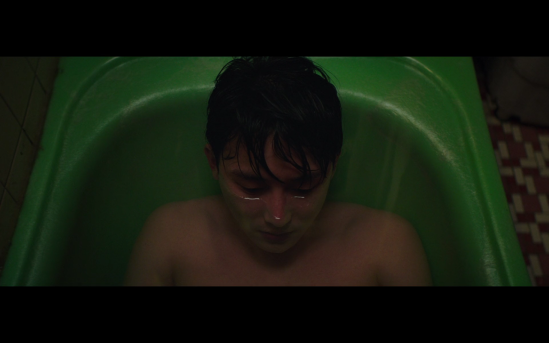
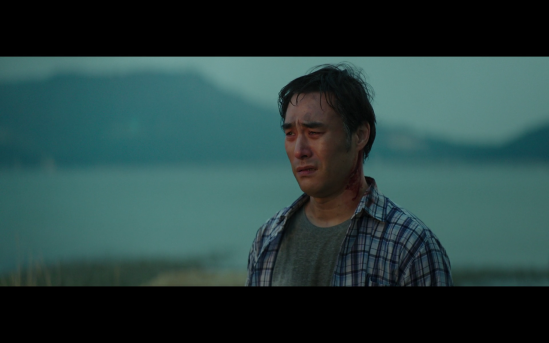
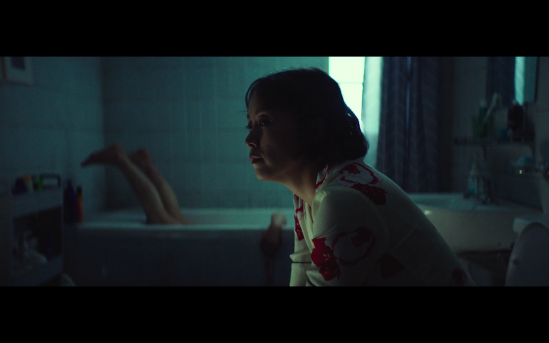
Money is the Root of All EVIL! “Beasts Clawing at Straws” reviewed! (Blu-ray / Artsploitation Films)

A middle-aged man working a meager job at a gentleman’s bathhouse finds a Louis Vuitton bag full of money when routinely checking the storage lockers at closing.  Unsure about what to do with the money, he stows the bag away in the backroom and continues a moral, yet pauper’s, life while dealing with financial and family troubles at home.  Meanwhile, a border customs agent finds himself in severe debt with an unstable loan shark after his girlfriend skates and disappears with a large borrowed sum.  With a week to come up with the money, plus interest, he calls upon his distant cousin to assist in scamming a scammer who illegally came into some money, but things go awry when an overly friendly and clingy cop begins to snoop around.  Lastly, a prostitute grinds tirelessly to work off a large debt her abusive husband continues to blame her for with night after night beatings.  She jumps into bed with a young, handsome foreigner and her eager to support female boss to off her husband and collect the insurance money.  Yet, these troubled souls find that sticking to their convictions doesn’t always bode well as the unexpected happens in a blink of an eye.

The Asian film machine has mastered the art of the crime thriller from a proven track record that began with Akira Kurosawa films, if not even before that, and has chronically grown stronger, and sometimes more peculiar, with choice stylistic elements, suggestive themes, and extreme violence that has garnered, to much disdain, Westerner attention over the last 20 years with films like Park Chan-wook’s “Oldboy” and Andrew Lau and Alan Mak’s “Internal Affairs” being Americanized with a Hollywood remake.  With that being said in an upward trend of remakes spilling over the edge, there would be no eye-brow raising surprise if the introductory film, the tri-narrative crime drama idiomatically titled “Beasts Clawing at Straws,” from South Korean filmmaker, Kim Yong-hoon, will one day grace the English silver screens in a diluted variation of a Brad Pitt featured carbon copy.  Based of the Keisuke Sone neo-noir novel of the same name, Kim Yong-hoon’s pulpy impression of against-the-wall misdeeds is dog-eat-dog dark comedy gold.  “Beasts Clawing at Straws” is produced by Jang Won-seok (“The Gangster, The Cop, and The Devil”) and is a production of Megabox Plus M films (“Zombie for Sale”) and B.A. Entertainment.

The three prong, greed-catapulting narrative converge characters separately at first and then string them linearly together when the picture becomes clearly what exactly each one of them is chasing, but every story is magnetized to a single focal point, a person under immense pressure, stress, and the malice forces that thirst for their humility, kinetically embarking on the bad choice choo-choo steaming toward the station of vary bad things.  Bae Seong-woo stars as a downtrodden Joong-man, a middle-aged man stuck in the rut of poverty with a geriatric, browbeating mother, a fatigued wife, and busting his rump in a dead end job.  Seong-woo combats himself as a man tight rope walking the thin line of ethic principles when opportunity knocks at his door, but his ill-timed strike to grab life by the balls blows up in his face in a farce of instant karma leaves him less than what he had before.  Then there’s a Tae-young, a comfortably Governmental positioned customs agent facing a different kind of hardship when his ex-girlfriend, Yeon-hee, disappears with a borrowed lump sum of a gangster’s money and he’s left on the fence.  “Illang:  The Wolf Brigade’s” Jung Woo-sung plays into the desperate stench of the superstitious and ambitious customs agent.  Slightly cradling the severity of the situation, Jung amply positions Tae-young’s dilemma that resembles spearfishing in a barrel and he’s the fish.  The last story follows the abused wife Mi-ran, played reservedly by Shin Hyun-bin as a desperate woman looking to bank her soon-to-be dead’s insurance money.  When Mi-ran is abetted by motive-dueling pair of instigators, she finds that paying her debt can be more severe than ever imagined.  While sitting back and basking in the stir-craziness of the leads’ turmoiled chaos, the best characters of the film are the supporting roles of Kim Jun-han as an intestine devouring, fanny-pack wearing henchman, Park Ji-hwan as Tae-young’s bumbling, but begrudgingly loyal distant cousin, and Jung Man-sik as a breezy mobster with a cherry, yet malevolent disposition.  Youn Yuh-jung, Jin Kyung, Jung Ga-ram, Bae Jin-wong, and Heo Dong-won round out the cast.

Non-linear yet interconnected in story, “Beasts Clawing at Straws” hawks a Tarantino layered thriller with colorful deplorables from all walks of life and luxuries.  Kim Yong-hoon nourishes the unbridled, free-for-all nature of diving into the murky, shark-infested waters uncaged and tethered with cuts of raw steaks dangling from the pelvis area in this two wrongs don’t equal a right account of mistrusting desperation and misguided optimism.  Kim’s style echoes the likes of the popular “Pulp Fiction” filmmaker along the lines of shooting techniques and a frank view of violence to tell the frantic clutching of hanging onto what is left of tattered lives and borrowed time while disavowing pure, unadulterated nihilism by at least giving characters a grain of hope.  With any non-linear, multiple moving part films, individual aspects tend to become lost in order for pacing and “Beasts Clawing at Straws” doesn’t fall into the excluded category as factors that play into the main quandary are left hanging, such as in Yeon-hee’s circumstantial results of jetting off with a mobster’s money as the assumption is there, but nothing is fully concrete in her storyline.  The same indiscernible spousal battery stemmed from Mi-ran and her husband’s severe debt that leads to transgressions beyond marital misuse isn’t privy to the audience of how circumstances come about surrounding their predicament and we’re forced to speculate and shoulder an explanation that doesn’t quite feel justified.  However, neither of the slapdash developments hinder “Beast Clawing for Straws’” steamrolling posture to get that desirable bag full of problem-solving, filthy lucre. 

Artsploitation Films delivers a stylish and avaricious South Korea crime drama with “Beasts Clawing for Straws” into the U.S. Blu-ray home video market. The not rated BD25, high-definition 1080p release is presented in a widescreen, 2.39:1 aspect ratio, and nears the epitome of flawless. Aside from the picture slightly flickering, more noticeably on solid colored backdrops, the hue palette is absolutely gorgeous with the neon lights of South Korean cities, the breathtaking silhouettes of the natural mountains adjacent to a lifelessly still lake, and the variety of settings from an airy fish house to a modern, symmetrically designed bordello denote a keen eye by Kim Tao-sung. The South Korean language 5.1 DTS-HD Master Audio surround sound couldn’t be any better with a crystal clear aptitude for strong dialogue balanced in front of a robust soundtrack accompanied by deep range of ambience from fire crackling to the faint hint of rain drops audible from inside a restaurant, solidifying the depth package as well. English subtitles are available along with an English dub track in a dual channel Dolby stereo. What’s lacking with this release is bonus material as there is virtually nothing besides four Artsploitation trailers and the film’s own theatrical trailer. Parlous and deadpan funny, “Beasts Clawing at Straws” amazes as Kim Yong-hoon’s first time effort with the technical grace and the story construction that has been a paradigm for only a handful of notable directors able to execute an impeccable result.

Own “Beasts Clawing at Straws” on Blu-ray! Click the poster to go to Amazon.com

EVIL Drugs Are Bad, Mmkay? “Beyond Hell” reviewed (Indican Pictures / Digital Screener)


A lowkey party experiments into a new drug called Changa, brought back from South America by one the friends but is no ordinary narcotic. After inhaled, Changa opens a conduit to an infernal dimension oppressively reigned by Belial, a trickster demon seeking to rule the world of man. Channeling his dark energy through the utterly wholesome Maryssa, Belial exploits her innocence to reach her friends and one-by-one their hallucinogenic and horrible deaths give way to releasing their souls to him. Once he obtains enough souls, Belial will be able to freely walk the Earth and damn everyone on the planet into servitude. Its up to Maryssa and her remaining friends to thwart Belial diabolical plans and send him back to Hell.

Is seeing disembodied, outreaching arms and shape-shifting demons covered in broken glass and tentacles to the effect of a gateway drug!? The invasively surreal and drug repercussion-themed “Beyond Hell” is the 2019, pre-apocalyptic. doom and damnation, survival thriller from writer-director Alan Murray in his first feature film production. The Cambridge, Ontario born filmmaker shoots in his home country to entertain and scare audiences with a version of religious text’s prime opposition to God, the Devil, in the form of the heavily prosthetic and dastardly theatrical Belial. “Beyond Hell” is a co-produced by Murray alongside Gavin Downes under the Dark Spirits Films banner with Don Smith, Jacqui Smith, and Christopher Lane serving as the film’s capital investments of executive producers.

“Beyond Hell” plays considerably into the slasher blueprint that aims to off, one-by-one, inept school students, whether they’re the self-stated part of the college body or, in a slight of confusion, sit in on classes and have row lockers like high schoolers, who stumble with defensives against a much darker scheme of soul extracting exploitation and world domination. Murray takes a full-on female primacy with strong heroine-performances by introducing Kearston Johansson and Natalie Jane to set aside their characters’ at-odds, find security in their flaws, and battle it out against an ancient evil. The respective roles in the goody two-shoes Maryssa and wildly eye-cutting Brook’s backgrounds are kept in a palpable line by Johansson and Jane’s drive to roleplay one-upping the other despite a petite background for character support and they’re anchored by Sebastian Deery (“Bad Dose”). The UK-born Deery plays the pursued rake, Jake, in a triangular love interest with Johansson and Jane’s characters. While Deery seemingly attempts to rein back his English accent without much success through his satisfactory presence as a level-headed, good-lookin’ guy, Jake’s acutely transforms into a wily coquet by initially buttering up Maryssa with good intentions and verbally loathe Brook for her derogatory attitude toward Maryssa only to then switch quickly to desiring a distraught Brook when Maryssa winds up in a mental institute for the criminally insane after the gruesome death of one of their friends. The off-putting dynamic pens a promiscuous casualness about these group of friends. Dominique Smith, Sean Rey, Chris Kapeleris, Shahrad Fredotti, Richard Collier, and Gavin Downes as the profaner Belial.

“Beyond Hell” conjures a sassy-mouth, wise-cracking demon, Belial, adorned in a black and white molten-rock shape skin with curved horns and rows of beaded sharp teeth, but the makeup effects, though strong in prosthetic effort, appear extremely rubbery to the point that even Belial’s teeth bend and flap when Gavin Downes tosses out sarcastic quips when ripping the souls from his victims.  This awkward stance of where our eyes and brains struggle to compute what make sense from the worst-of-the-worst of hell bound fiends is where “Beyond Hell” becomes forehead-rubbing frustrating because of how much time and application goes into the overall look of the creature that, in the end, just dips into disbelief.   The gory, but crude practical effects trend into the visual effects territory, going beyond the gates of hell to where Belial himself would be frightened by the sheer shock of shoddiness.  In one frantic scene where Brook attempts to escape Belial’s brimstone breath, decrepit arms breach a stairwell wall to grab her, but the arms, which are all of the same cut and move in the same motion, float like ghosts without ever puncturing through the drywall, or even breaking through that plane of narrative reality for that matter, that’s reminiscent of the horrendous flock of CGI birds, hovering autonomously as survivors try to whack at them in an awful reaction in James Nguyen’s “Birdemic:  Shock and Terror.”  Now, I’m not saying that “Beyond Hell” is as rough as intangible birdies behaving badly as Murray avails in manufacturing a stable low-spirited atmosphere of plague youth in between the real world and the underworld with their innocent lives hanging in the balance in a sordid enterprise off ill-will.

More laic than spiritual, “Beyond Hell” scratches the surface of narrative depth in a modest clash of “Hellraiser” meets “A Nightmare on Elm Street” from the celluloid plunging distributor, Indican Pictures. The 89 minute supernatural thriller has entered the digital platform realm, at least in the U.S., this December. “Beyond Hell” is Rhys Jones’ first director of photography venture filmed in 5K Raw on a RED Dragon that’s uninhibited in the illuminating details. While the shots are mostly natural, clearly capturing the pimples on the young actress’ foreheads, Belial is always casted in a semi-harsh blue tint to hide any part of the latex inflections and imperfections that might expose Downes even more as a man in a monochromic rubber suit. Dan Eisen and Norman Orenstein (“Diary of the Dead”) team-up to compose a single note and pennywise synth blended score that plays into a cleaved pop-glazing and survival horror video game and, can at times, be on the precipice of one of John Carpenter’s Lost Themes without evoking a soul-binding tension. Though the depth isn’t spectacularly precise and the dialogue disperses with echo at times, the range of audible effects is vast in echoing the unsettling cacophonies of a shrilling Hell, making the feature’s soundtrack and score a highlight in the rest of the mediocre quality. I applaud “Beyond Hell’s” ambitious, no holds barred concept, but the indie picture malnourishes a healthy dose of unconfined horror with bastardized acting and a haphazard flank of effects that make this Alan Murray film so bad it’s good to the very cringed tone ending.


Click Banner to Rent or Own “Beyond Hell” on Prime Video!

This Dinner Party Dishes the EVIL! “Happy Times” reviewed! (Artsploitation Films / Digital Screener)

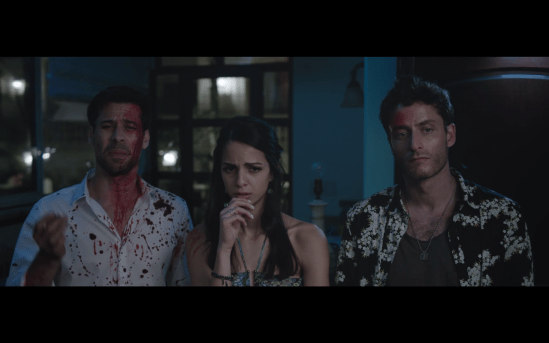
A small, but affluent, Los Angeles Jewish community dine together at a Hollywood mansion in celebration of the Shabbat.  Mixed feelings about each other compounded with mixed drinks stir the emotions of heated topics, including business ventures, religious attitudes, social statuses, marital qualms, and hidden desires.  Lines are being drawn and sides are being taken when one thing leads to another and undisclosed secrets become evident in a clash of suburban violence that pits friend versus friend, colleague versus colleague, and husband versus wife to the death. 

Director Michael Mayer reminds us that you should never mix business with pleasure with a keep your friends close, but your enemies closer black comedy entitled “Happy Times.”  The brawl of survival centered around Israel immigrants living in the U.S. is the second written and directed film from Mayer, following polar oppositely against another Israel themed, 2012 picture, “Out in the Dark,” a gay drama in the backdrop of the two rival and patriarchal sides of the Israeli-Palestinian conflict.  The only conflict in this 2019 thriller-com is of the gravely plentiful and concentrated kind inside a L.A. mansion turned battle arena that sees about as much confrontation as the war-torn Gaza strip.  Co-written with Guy Ayal, “Happy Times” is a collaboration produced by Erri De Luca and Paola Porrini Bisson of OH!PEN and, the Israeli born, Gabrielle and Tomer Almagor’s Urban Tales Productions in association with Michael Mayer’s own company, M7200 Productions.

The Israel-nationality cast can be an immersive experience and a sign of good faith casting from the filmmakers as well as a show of open diversity from the production studios that casting Hebrew speaking, Israel background actors implies a serious interest and respect embroidered into the project. Mayer, born in Haifa, Israel himself, is a breath of a fresh air of non-appropriation in a time where whitewashing can still be prevalent in the movie industry. Israel born actresses Shani Atias, Liraz Chamami, and Iris Bahr command the screen not only as Israeli women in lead roles, but as different personas that interact and keep lively the one night, single dinner party narrative. Chamani especially dazzles in the details as the dinner hosting socialite wife and mother, Sigal, who exacts an assertive Jewish woman with a cooped up attitude and a knack for handling her own while also worried about her social status, an extravagant exhibition of a screen trope that you might experience on shows like “The Marvelous Ms. Maisel” or movies like “The Slums of Beverly Hills,” enacted on point when she’s handing a frightened dinner guest, outside their Jewish circle and fleeing from the scene, tin foil wrapped leftovers with a wide menacingly unsure smile, while holding a medieval crossbow to go frag another party guest, in the plain view driveway. The wives’ counterparts are equally as Jewish and equally as prominent in the fold of the affair with Ido Mor as a unscrupulous businessman co-hosting the dinner, Guy Adler as a construction manager with money problems, and Alon Pdut as an unhappily married Ph.D engineer bothered by his fellow dinner guests’ lack of education and tact. In all, most of the characters are undilutedly snobbish with the exception of Sigal’s struggling actor cousin, Michael, played by Michael Aloni, whose magnified Hollywood liberalism deconstructs the Hebrew bible as racist and inaccurate among other colorful adjectives and becomes the catalyst that begins all hell breaking loose. Stéfi Celma, Mike Burstyn, Daniel Lavid, and Sophie Santi become the filament around the principle leads that strengthen the kill or be killed melee in “Happy Times.”

As if dinner parties weren’t already stressful enough, having to make trivial small talk, possibly acquaint or re-acquaint with unaccustomed faces, or pretend to enjoy the slop being served as food, “Happy Times” turns the internally exasperating dinner party debacle on its head with guests and hosts who are just too terribly comfortable with each other as volatile personalities explode like little active volcanos plumed to reach every corner of the house in a deadly playground for unstable, on-edge adults spewing their strident emotions and Mayer is able to maintain a layered pace with a narrative that’s snowballing quickly.  Where “Happy Times” struggles is the redline occurrences that trigger things to go very badly.  Though hardly trivial episodes between the guests, involving innocent infidelity affections or a slight practical joke stretched beyond devastating consequences, the harried moments afterwards diverge into a blown out result while more nefarious consequential revelations are held back, in after the fact chaos, and these differently graded spurs seem unbalanced, if not flip-flopped, in the story.  The characters themselves adequately course into being delightfully insane and as about as relatable as the internal frustration against our friendly-façade enemies, but there’s a part of me that personally wanted more development.  Military vet Avner, for example, exhibits symptoms of post-traumatic stress disorder (PTSD) as the horror sounds of war play in his head when under stress.  As he stares into oblivion when the rage fills into his face, especially by a nagging, browbeating wife who doesn’t seem to be aware of his condition, the subconscious killing-machine overcomes the mild-manner tech engineer.  There’s also Yossi’s opaque tax evasion scheme, Michael’s thespian struggles, and Mati, the late arriving Rabbi, who pockets money on the side from Yossi and Sigal that factor into an erratic equation that’s a mind field surprise every step of the way.

“Happy Times” relishes in unpredictable violence as a round table of feast or famine hatred in this dog-eat-dog thriller coming to you from the Philadelphia based distributor, Artsploitation Films. Slated for a February 9th, 2021 release, the unrated film will be presented in a widescreen, 2.39:1 aspect ratio, in a gorgeously rich color of a modest, natural color scheme. Kazakhstani cinematographer, Ziv Berkovich, distills a solid, yet uninspiring, photography of mostly still cam mixed with subtle steady cam, rooting firmly to particular rooms without capturing the flow of a big mansion, reducing much of the in clover luxuries of the hosts. The Hebrew, English and some Spanish 5.1 Dolby Digital mix offers well balanced layers of audio tracks with dialogue clarity and establishing good range with depth not really set up because of the close up or medium shot frames. Guy Aya;’s score offers a good blend of a violin-screeching from a murder mystery dinner theater with the inklings of traditional Israel folk sprinkled in to create an anxiety riddled brew of trouble. There were no bonus material included with the digital screener nor were there any bonus scenes during or after the credits. The best of times and the worst of times doesn’t compare to the bloodletting of “Happy Times” in a wildly amusing dark comedy with every impulsive-driven and tension-wrought scene chockfull with bated breath.

Pre-order “Happy Times” on DVD or Blu-ray at Amazom.com (Click the poster)

When EVIL Isn’t That Black & White. “Choir Girl” reviewed! (Nexus Production Group / Digital Screener)

Eugene lives a lonely, pitiable existence.  Residing with his ailing father in a slum neighborhood, his photography background captures the crime and the desolation that surrounds him, snapping pictures without ever interceding with his crime-riddled subjects, in an attempt to hold an exhibition or sell his work to a high profile magazine, Slipstream, as his ticket out of the despair that engulfs him.  When Eugene stumbles upon young teenage girls being drugged and held for prostitution, he becomes fixated on Josephine when a low-level editor, seeing her as a professional stepping stone, prods him for more pictures that evoke hope out of her situation, but when he finally intervenes, helping her escape, Eugene falls into a world of a massive prostitution ring with doctors, cops, and major organizations on the payroll and a kingpin named Daddy at the helm.  The deeper the debt placed upon him for showing compassion to Josephine, the more the lines blur on whether he’s become his muse’s lone savior or just his meal ticket out his current life.

How far will your moral principles take you to save a teenage girl when you’re locked into a no-win situation?  That’s the theme explored to a shocking sexual assault conclusion in John Fraser’s 2019 unscrupulous Australian thriller, “Choir Girl.”  Introducing Fraser’s first credited written and directed full length feature film, shot entirely in black and white, the Melbourne arthouse and a goose egg-fairytale version of “Pretty Woman” speaks volumes toward the perceived illegality of immigration, the horrors of sex-trade, and the touch-and-go balance act between doing what’s right and self-serving opportunities with a 15-year old girl’s fate dangling at the end of a line.  “Choir Girl” is produced by Ivan Malekin under his Melbourne based label, Nexus Production Group, along with Lucinda Bruce serving as co-producer.

To carry “Choir Girl” through the muck of it all, a strong performance must arduously burden the gravity of the content and Peter Flaherty astounds with an ingloriously flawed and unlikely hero, Eugene.  “The Butcher Possessions” and “KIllervision” actor masts a greasily haggard with bordering neurodevelopment issues, disheveled in his attire, and walks with a noticeable limp, made intentionally noticeable when as he walks away from characters and situations.  Though Eugene seems meek, the shutterbug aches to improve himself by seemingly exploiting others as a freelance photographer and being persistent in that pursuit until becoming engrossed into a 15-year-old prostitute’s life struggle blossoming before our eyes a rather unsettling grown man and teenage girl relationship that assumes a pedophilia ideology of adoring the child to the extent of protection, but also falls in to grooming and sexual exploitation.  The film introduces audiences to Sarah Timm, playing Eugene’s muse, Josephine, an Eastern European illegal immigrant who literally has nothing left that is her own, this including her body, when forced into sex slavery so when Eugene and other characters call her diminutively by Jo, she immediately corrects them to call her Josephine in order to keep the one thing left that is still hers, her name.  In her first feature role, and a mightily demanding role it is with the amount of discomfiture of playing essentially an abused child, the German native will have audiences overlooking the fact that she’s portraying a teenager in the sordid sultriness of sex-trafficking with crafting Josephine’s war-torn history and pre-adolescent childhood stories as always the girl in the background, the unpretty forgotten girl that blended in and no one noticed, until she’s a part of a much larger, more ferocious, uncompromising system that Daddy (Jack Campbell) dictates with CCTV live feeds of every sleazy, scummy hotel bedroom in his syndicated footprint.  The cruelty that Jack Campbell reins savors every facet of Daddy’s being on screen with an intent to be a immovable roadblock in Eugene’s advanced for progress and for John Fraser’s “Choir Girl,” the character development and personalities find justification from the cast with the exception of one, the low on the totem pole and self-absorbed Slipstream magazine editor, Polly.  Krista Vendy imposes on Polly’s rabid  narcissism with an incredibility that becomes the underbelly amongst a bloc of solid performances.  Andy McPhee (“Wolf Creek”), Lee Mason (“The Caretaker”), Jillian Murray (“Body Melt”), and Kym Valentine fill out supporting roles. 

I love the juxtaposition opening of Eugene in his dark room in the middle of photographic processing his oblivious subjects, including a drug abusing child with a hypodermic heroine needle sticking out of his arm, a blowjob being serviced between a wall and bushes, or the aftermath of man being beaten with his assailants walking away from his leveled body, and then the title fades in from black and the next scene is of a framed magazine cover with the cover title “It’s All Back and White.”  The sequence sets up perfectly the entire premise driving “Choir Girl’s” gray area circumstances that nothing substantial, meaningful, or controversial can be black and white. Plus, the entire film is shot in black and white furthering the contrivance of the theme. The gray area challenging Eugene is a tightrope walk when squeezed for payment for snatching Josephine by the amoral organization claiming property theft, making him submit to the idiom of pulling his strings like a marionette or shooting at his feet to make him dance for insatiable perverse satisfaction. Eugene rarely displays remorse in his demeanor, face, or actions for the things he does and doesn’t do when faced with adversity in a slither of sociopathic idiosyncrasy, but when outright criticized for his inaction, he’s able to right wrongs with deplorable methods like a toddler trying to mop up a grape juice spill with mother’s expensive, white dress. There’s a bit of innocence or naivety in Eugene’s mind as you can almost see the gears slowly spinning when confronted but in the defense of the man who no really gave the time of day, those gyrating mice wheels of delicate thought snuck past every contingency against Eugene surviving Daddy’s deadly game, leading to an unsavory solution that puts the viewer in an awkward spot to either avert the eyes or remained captivated to see it through.


I, for one, remained seated, steadfast to the end, hypnotized by audacity of John Fraser in his feature film directorial, “Choir Girl,” that has arrived onto Apple’s iTunes. The unrated film is presented in it’s original aspect ratio of a widescreen format and will have an English language Dolby Digital 5.1 surround sound availability. Though derided as kitschy at times, the black and white veneer works here inside “Choir Girl’s” vascular system of catch-22s and director of photography, Mark Kenfield, rides a consistent straighten arrow style with steady cam shots, decent framing, and some tracking shots without pushing the envelope in regards to angles or oscillation. There were no bonus content or additional scenes during or after the credits. “Choir Girl” sings no praises of hallelujah. Offers no solace in time of hardship. If you’re looking for a movie that touches you, then you’re in for a rude awakening as “Choir Girl” obliterates the moral standards, leaving faith outside, with a severe penance in abetting the Devil’s work, selling their soul to do what’s right.

Steamed Pork Buns Stuff With EVIL! “The Untold Story” reviewed (Unearthed Films/Blu-ray)

Wong Chi-hang brutally beats and sets fire to a fellow gambler who refuses to lend him money.  After destroying his identification card and creates a new look and identity, Wong flees Hong Kong before he can be hunted down for first degree murder and be served capital punishment for his crime.  For the last 8 years, Wong has lived and worked on the island village of Macau, running a small, but well-known, steamed bun restaurant, Eight Immortals Restaurant.  He receives inquisitive letters everyday asking about the whereabouts of the former owner, Cheng Lam, by Lam’s older brother on the mainland.  The letters force Wong to attempt manipulating lawyers into signing over the restaurant to him without Lam’s presence.  When the police discover dismembered limbs washed up on the beach, an investigation ensues that connects the body parts to a Chan Lai Chun, the mother-in-law to Cheng Lam, leading a small task force of blockheaded detectives to Wong’s restaurant where he becomes the prime suspect in the disappearances, but he won’t break so easily after being apprehended, unwilling to cooperate and confess to the whereabouts of the bodies of the vanished owner, his entire family, and a pair of workers.  Yet, what were exactly in those steam buns that made them so delicious?

Full disclosure.  I’m not too terribly familiar with Hong Kong’s rating system of Category I, II, and III, but I’ve more-or-less dabbled in the Category III (Cat III) horror and exploitation cinematic market, owning only a handful of these gruesome-and-sexually gratifying guilty pleasure full of sex, violence, and taboo concepts of titles such as “Riki-Oh:  The Story of Ricky,”  “The Chinese Torture Chamber,” and “Three…Extremes” and only “The Story of Ricky” has ever been popped into my player for recreational viewing.  Also, in my collection, is a Tai Sing DVD copy of Herman Yau’s 1993 crime-and-cannibalism graphic thriller “The Untold Story” and, frankly, I never opened it either, but when Unearthed Films sent me their new Blu-ray release to review, I’ll never be able to see chop sticks the same way again!  The eye-opening experience also screamed that I should definitely rip open and see those other films to quench my thirst for Cat III’s offensive opulence.  Based off a true story of the Eight Immortals Restaurant murders in 1985 around the Macau area, the nearly unwavering from the truth storyline parallels the Kam-Fai Law (“Dr. Lamb”) and Wing-Kin Lau (“Taxi Hunter”) co-written story in which a madman slaughters an entire family over a gambling dispute and runs their family business, the Eight Immortals Restaurant, until the police capture him, but Yau sticks more sensationalism to the already brutal notoriety surrounding the actual case with ground human barbecue steamed buns to tease with abhorrent flavor under the Golden Sun Films Distribution distribution of the Uniden Investments and Kwan Hung Films production.

“The Untold Story’s” lead man in the shoes of the maniacal, rage-filled Wong Chi-Hang is “Ebola Syndrome’s” Anthony Wong who initially thought the script was greatly unattractive.  Little did he know that his performance would be so good, so osmosis with his wide-eyed lunatic stare through the luminating pixels of the television screen, that the role would honor him with a Hong Kong Film Award for best actor; Hong Kong’s equivalent to the best actor award for an Oscar in the States.   The “Hard Boiled” actor embodies a soul of frustration and anger to rise his character up to the demented level of nihilism and heartless exploitation that unforgettably scores being the face of “The Untold Story’s” cruelty.  Yet, there is a Jekyll and Hyde complex with Yau’s film that cuts the cynicism with a risible troupe of police officers supervised by Officer Lee (Danny Lee “The Killer”).  With a beautiful foreign woman, a blatantly announced hooker, always at his side and being the sharpest detective on the force, Lee’s a contradictory, authoritative commander meshing immoral principles and duty into one while leading a four-person squad of non-initiatives comprised of three rubbernecking men, craning their gulping jugulars toward Mr. Lee’s arm-candied gals, and one tomboy woman with an affinity for Mr. Lee who struggles with being taken seriously amongst her peers as an unenticing woman in cop’s clothing.  The officers’ western names are a slither of satire to poke fun at the nicknames of tough or macho cops go by in the States with Bo, King Kong, Robert, and Bull (respectively Emily Kwan, King-Kong Lam, Eric Kei, and Parkman Wong of “Dr. Lamb”).  The cast rounds out with Fui-On Shing and Julie Lee. 

“The Untold Story’s” embittered nihilistic violence, gratuitous rape and sodomy, and steamy, mouth-watering cannibalism leverages this Cat III film as tiptop horror exploitation from the far East.  If broken down more, director Herman Yau pins and sews together a liaising three act prong story of a horrid man’s attempt at deadly stability in society and a madcap group of officers, with a penchant for police brutality and coercing confessions, bumbling their way through clues that ultimately funnel into a blended third act of magnetizing the two sides together toward a satisfying, almost faithful, ending of “The Eight Immortals Restaurant:  The Untold Story’s” purloin and murder fiction and non-fiction exploit.  Yau spares no expense for gore, serving up a platter worth the splatter of some nifty chop’em up and grind their meat into the dough effects that’ll turn stomachs as well as heads and doesn’t exude as bargain basement quality; yet, just enough gore goes uncovered to tantalize without a full onslaught tarp covering the ground of disembodied limbs and floor-splattering entrails that boil down to an overshadowing character that detracts from the cast performances as such can accompany with the more extreme Asian horror catalogue.  There’s nothing gentle about the actions of Wong Chi-Hang, but the way he’s scribed to manifest spur of the moment carnage, stemmed by the most minute disputes, and the way Anthony Wong carries and maneuvers of a monstrous villain with ease takes an esthetical point to not stray away from his, or rather his victims’, story.  “The Untold Story” is, in fact, meta-exploitation fiction of non-fiction down to the very last tasty morsel. 

In what is perhaps the epitome of Hong Kong’s Category III film index, “The Untold Story” arrives onto high definition Blu-ray courtesy of the gore and shock genre label, Unearthed Films as part of the label’s Unearthed Classics line and distributed by MVDVisual. The well preserved, near flawless transfer is presented in a widescreen, 1.78:1 aspect ratio, and the picture is a vast improvement over the slightly washed previous DVD releases though favors a higher contrast resolution that ekes trading out the details for a brighter, softer film in an overall compliment of Cho Wai-Kee’s beaming cinematography. Whether in the police station or the restaurant, fluorescent lumens light up the scenes with a sterile-driven madness. The Cantonese, Mandarin, and some English 1.0 PCM audio track denotes, without surprise, the lossy quality doddering from age and antiquated equipment, but renders well enough without the imperfections of hisses, distortions, or any vocal impediments. The option English subtitles display without error with only the issue in their breakneck pacing when attempting to keep up with reading the subtitles and the rapidfire dialogue. You basically have to skim read. The special features include commentaries with star Anthony Wong and Herman Yau, the superbly dark and traditional film score isolated for audible pleasure, commentary with Art Ettinger from Ultra Violent magazine and Bruce Holecheck of Cinema Arcana, a Q&A with Herman Yau, a featurette of the history behind Category III films of Hong Kong Exploitation Cinema, a interview with Rick Baker entitled Cantonese Carnage, and Unearthed Film trailers. There’s also an two-page insert of Art Ettinger’s write up about Hong Kong cinema and “The Untold Story.” Resilient to the test of time, “The Untold Story” benchmarks a high point in High Kong exploitation cinema, recalls the tremendous feat of performance by Anthony Wong, and displays the sheer mastery of disciplined filmmaking from Herman Yau in this unforgettable gruesome black comedy.

Must Own Christmas Gift! “The Untold Story” on Blu-ray!