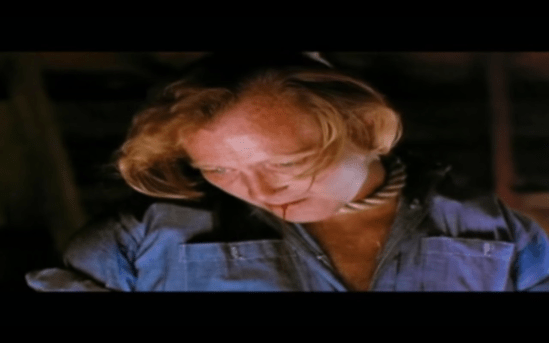
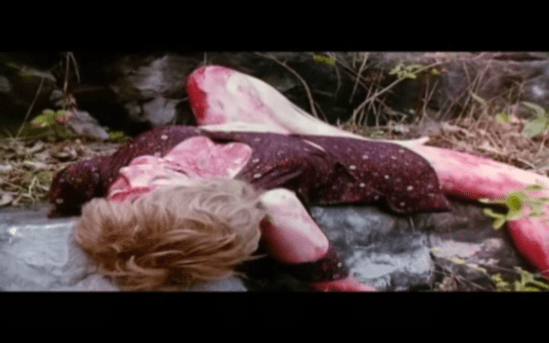
Four dark and terrifying tapes tell tales of a petrifying horror through the camera lens of various found footage assets. Whether between the bleak, grim nature of disturbed mankind or the ominous, otherworldliness of menacing creatures, each story’s ultimate objective is to expose what lies behind the scenes, to shine a light upon what lives shrouded in shadows, and to unearth what lurks in the mind’s subconscious. At first glance, the dark tapes might seem uncorrelated, but at closer examination, the tapes share a deep rooted evil that connects every afflicted recorded event and makes one think twice about their perception on reality.

“The Dark Tapes” are a formidable found footage anthology that resembles a familiar “V/H/S” layout under the meticulously constructed eyes of co-directors Michael McQuown and special effects guru Vincent Guastini (Child’s Play 3). Scripted by the anthology creator, Michael McQuown, “The Dark Tapes'” four interlocking episodes will leave inside you a paralyzing case of nyctophobia as the genre-spliced anthology has no shortage of bone-chilling creepiness; in fact, “The Dark Tapes” epitomizes the very term and with an alternate universe mixture of ghastly ghouls, ghosts, and grisliness, the extremely exhausted found footage genre might have discovered some new, and much needed, life before being on the brink of a near death extinction in this quaint independent production from Michael McQuown.

The three internal tapes, directed by McQuown, are entitled, and in this order, “The Hunters and The Hunted,” “Cam Girls,” and “Amanda’s Revenge” with Vincent Guastini’s external wrap around segment, “How to Catch a Demon,” being broken into four parts between each tape and each tape should be viewed in complete and utter darkness to achieve maximum level of pants-pissing fright. Your overworked heart will skip with long deadly pauses in between, your lungs that keep you breathing will cease to provide breath, and your mind will warp to unfavorably play tricks on your eyes from an unrivaled nightmare witnessed on “The Dark Tapes.” The full body-stopping, comatose-inducing effect can’t be accomplished without the collaborating cast that includes Brittany Underwood, Tess Munro, Stephen Zimpel, Meredith Thomas, David Roundtree, “Sushia Girl’s” Cortney Palm, Anna Rose Moore, Shawn Lockie, Jo Galloway, and Michael Cotter to just name a few.

Much is right about Michael McQuown’s “The Dark Tapes.” Always welcoming practical effects are better than most indie ran features, especially in the anthology category, and the effects can best some lower-end Hollywood productions inside eye-glueing, on the edge of your seat narrative designs that are smart, gripping, and definitely heart-stopping scary, but to be somewhat of a devil’s advocate, the acting was overall a bit stiff across the plane with an awkward uneasiness in the vary of lackluster performances and overzealous deliveries that petered scenes from reaching full potentials. Production wise, “The Dark Tapes” impress inside the sets of bland reoccurring locations, but coincide them with a vast amount of timely, well placed special effects that quickly mutate the stark locations and the uninteresting backdrops turn into vivid portraits of hell.

The Thunder Road Incorporated produced, “The Dark Tapes,” has been slated for a worldwide video on demand distribution release come this mid-April after a theatrical stint this past March courtesy of the Epic Pictures Group. VOD platforms include Google Play, Vudu, iNDemand (Comcast- Xfinity, Time Warner, Cox, Bright House & more), Dish TV, Amazon, Vubiquity (Verizon Fios, Charter, Sudden Link, Media Com &more), Xbox, Playstation, Sling TV & Vimeo. Unfortunately, I was provided with an online screener of the festival favorite and can’t necessarily comment on the video or audio qualities nor any bonus features that might be available on a home entertainment release, but I can firmly state that, visually, “The Dark Tapes” is the Haribo of horror eye-candy with the different flavors of thrilling genres in a pint-sized package and while a little tame with the cherry red graphic content, director Michael McQuown seizes the opportunity to instill an open faucet of fear rather than tease with gore and sleaze with sex. If I had to recommend a horror anthology for 2017, “The Dark Tapes” would be on the very short list.
Category Archives: Chilly Thrilly
“The Blackcoat’s Daughter” from Lionsgate in May!

Terrifying and suspenseful, The Blackcoat’s Daughter arrives on Blu-ray Combo Pack (plus Digital HD) and DVD May 30 from Lionsgate. Emma Roberts stars as a troubled young woman who embarks on a journey to an isolated prep school while two stranded students (played by Kiernan Shipka and Lucy Boynton) face a sinister threat from an unseen evil force. Praised as “truly unsettling” by RogerEbert.com, the movie premiered at the 2015 Toronto Film Festival and the 2015 Fantastic Fest. From writer-director Osgood Perkins, The Blackcoat’s Daughter Blu-ray Combo Pack and DVD will be available for the suggested retail price of $24.99 and $19.98, respectively.
OFFICIAL SYNOPSIS
Beautiful and haunted Joan (Emma Roberts “American Horror Story” and “Scream Queens”) makes a bloody and determined pilgrimage across a frozen landscape toward a prestigious all-girls prep school, where Rose (Lucy Boynton) and Kat (Kiernan Shipka) find themselves stranded after their parents mysteriously fail to retrieve them for winter break. As Joan gets closer, Rose watches in horror while Kat suffers terrifying visions and becomes possessed by an unseen force.
Lionsgate will release “The Blackcoat’s Daughter” on Blu-ray Combo Pack (plus Digital HD) and DVD May 30!
Evil Is Only Skin Deep. “The Wax Mask” review!

Set in Rome of 1912, a newly constructed wax museum, under a mysterious alchemy artist known as Boris Volkoff, stirs controversy with the showcasing of the world’s most grisly and notorious murder scenes. Two brothel customers’ debate result in the one challenging the other to spend the night at the curated museum of horror without having an ounce of fleeting fear. The next morning, the man has been found, apparently keeling over in fright, and the police are baffled, but something more sinister is afoot when Sonia, a young costume designer with a horrific past as the sole witness in the gruesome death of her mother and father in Paris 1900, becomes employed at the museum to costume the wax figures and faints when the scene of her parents’ brutal death is recreated as the museum’s new showpiece. Sonia and a reporter closely examine the museum when more people begin disappearing off the street, people who have ties with the beautiful costume designer, and learn the waxed creations are much more underneath their plastic-lifelike skin.

Before his untimely death, the Godfather of (Italian) Gore, Lucio Fulci, had been cooperating on a semi-quasi remake of Vincent Price’s 1953 thriller “House of Wax,” based on the Gaston Leroux’s novel, alongside fellow iconic Italian horror director Dario Argento (“Suspiria”) in a comeback collaboration for Fulci, but the entitled “The Wax Mask” film was evidently delayed partly in because of Fulci’s death. “The Wax Mask” was handed over by Argento, who was producing, to special effects guru Sergio Stivaletti (“Cemetery Man,” “The Church”) and months after Fulci’s death, a finished product shared very similar traits to the Godfather of Gore’s style craftily blended with more modern approaches to filmmaking was released to the public. Though tailored more toward the interests of gory special effects, Stivaletti’s 1997 film is dedicated to Fulci with the implementation of many of the director’s popular trademarks, including closeups on various eye expressions and zoom-ins on gore and the weapons before their fateful strikes, while also basking in strong bright colors in the midst of shadowy cinematography that’s typical of the giallo genre.

In such a crimson world, an elegant performance by Romina Mondello, who stars as the orphaned Sonia, has the Rome born actress bring beauty, innocence, and charm to the macabre that harbors contrasting arguments against undermining marred antagonists and she provides a breath of aesthetic liveliness amongst a narrative that surrounds itself in capturing beauty in inanimate wax figures. “Cemetery Without Crosses'” Robert Hossein embraces the enigmatic museum curator, Boris Volkoff, with struggling internal black aspirations that involve his recently acquired employee, Sonia, and Houssein is able to turn off and on that switch of longing and menacing, playing the hand of the character superbly to keep audiences guessing his true intent. Volkoff’s faithful assistant and exhibit creator, Alex, embodies creepy and morbid attributes wonderfully contributed by a relatively unknown Umberto Balli. The trifecta cast sells the ghastly science fiction that slowly builds toward the transformation of “The Wax Mask” from classic giallo to sensational mad science Gothicism with a boost of euro trashiness that’s more relative to the work of Jesús Franco or Joe D’Amato. Riccardo Serventi Longhi (“Symphony in Blood Red”), Valery Valmond, Gabriella Giorgelli (“The Grim Reaper”), and Gianni Franco (Dario Argento’s “The Phantom of the Opera”) round out the cast.

Stivaletti’s toolbox of special effects celebrate in the practicality that escalates when the cloaked killer’s metal claw literally rips terror through the hearts and souls of characters, but the glossy composite imagery thwarts realism and cheapens the already cheesy Euro horror with a laughable fire set ablaze and a slew of lampoon electricity while half naked women are strapped to a barbaric mechanized chair. The cut-rate composite won’t ruin a guilty pleasure viewing and won’t blast apart an arguably respectable adaptation of Gaston Leroux’s novel, but the script, co-written between Argento, Fulci, and “The House of Clocks'” penning collaborator Daniele Stroppa, does pull from other, interestingly enough, inspirations that one wouldn’t think would be genre compatible. The action-packed finale of James Cameron’s 1984 pre-apocalyptic, time-traveling cyborg blockbuster, “The Terminator,” makes an unexpected appearance with an endoskeleton villain donning some familiar and memorable moments from one of the greatest sci-fi films of all time.

“The Wax Mask” greatly resembles Italian horror cinema from the 1970s and 1980s spawned in the late 90s, a superb feat for a director more aligned in vocational special effects, but the jaded historical background accompanying the film places a stain on whether Lucio Fulci had much to do with the project at all. Much is speculated that Argento and Stroppa re-wrote Fulci’s original script after his death, removing much of Fulci’s atmospheric flair and adding more gore, but in the end, “The Wax Mask” instabilities are overshadowed by great practical effects, an engaging storyline, and a roster of flavorful characters. The One 7 Movies and CAV Distributing Blu-ray release is presented in 1080p. The widescreen 1.78:1 aspect ratio is the not the original 1.85:1 aspect ratio, but doesn’t constrain the image. The MPEG-4 AVC codec emits a bit of shakiness under the compression, suggesting a lower bitrate, but the One 7 Movies’ release is the best, sharpest looking transfer of the original source material with natural coloring on skin tones, vibrant shades of various colors, and shadows being exquisitely black. Four audio options are available from the English and Italian Surround 5.1 tracks to the English and Italian Stereo tracks with no accessible English or Italian subtitles in the static setup menu. Extras are slim with a handheld camera behind-the-scenes that’s solely in Italian. “The Wax MasK” is an ambitious Gothic hybrid horror that cements the memory of Lucio Fulci, pleases the gore of Dario Argento, and showcases the talents of debut director Sergio Stivaletti.
Get Video Nasty Evil With “I Drink Your Blood” review!

A pledge group of amateur, hippie Satanists on a LSD-induced drug trip have their nationwide havoc reeking voyage come to a screeching halt when their dilapidated van breaks down at an equally dilapidated small quarry town with an isolated population of 40 residents. Squatting in a vacant hotel, Horace, the clique’s leader, dangerously lets his followers indulge in their whims while under the powerful hallucinogen. Their brutal run in with a local girl causes a stir of attempted reprisal amongst the girl’s family, especially with her grandfather who aims to remove the hippies from the area, but when the elderly man is beaten up and given the a taste of LSD, a whole new can of meat pies is opened up! Looking for retaliation for his grandfather’s battering, the grandson withdraws blood from a rabid dog he killed earlier in the day and spikes the town bakery’s meat pies that were to be specifically purchased by Horace’s gang. The combination of rabies and LSD turns the deranged Satanist into foaming at the mouth and infectious killing machines set loose amid the town’s 40 person population.

Let it be known that Satan was an acidhead. That shocking phrase serves as a prelude of the horrible acts to come in David Durston’s “I Drink Your Blood.” The 1970 Jerry Gross produced exploitation and infected horror video nasty, notoriously labeled an X rating solely for the graphic violence, is a quintessential staple of Americana horror. Shot in upstate New York and based off true, and disturbing, events, Durston’s written and directed feature is a horrific tale harnessing every unspeakable evil in the unholy book: rape, drugs, murder, abortion, promiscuity, cannibalism and even touches a little upon racism. Durston flaunts a scattered-brain and raw edit that fluently rides along with the script’s crazed atrocities.

“I Drink Your Blood” never cashes in on one headlining actor to fulfill a star lead; instead, calculated characters fill the void where needed, an endearing homage attested by the structures invested by George Romero who used a similar blueprint for his pioneering, black and white horror classic “Night of the Living Dead.” Bhaskar, aka Bhaskar Roy Chowdhury, tops the credit list. The India born actor stars as the sadistic Satanist leader Horace, one of the handful of ethnic roles whose character background mingles more on the Native American side. Every so often, Bhaskar’s native accent filters through, but the actor’s devilishly brilliant performance reassures a radically raw and physical undertaking that forgiveness for such a small concern is automatically defensible. Other prominent roles were awarded to John Damon (“Blue Sextet”), George Patterson (“God Told Me To”), Rhonda Fultz, Arlene Farber (“The French Connection”), Iris Brooks, Richard Bowler, and a young Riley Mills has the rabies-revenger Peter Banner. However, another cast member, in a minor, less dialogue role, has overshadowed many of her costars in light of her legacy since then. Lynn Lowry, known for her role in George A. Romero’s “The Crazies” and more recently in Debbie Rochon’s directed exploitation film “Model Hunger” that was reviewed here at Its Bloggin’ Evil, plays a mute hippie turned rabid killer in a memorable video nasty-warranted scene involving a, then, antique electric knife, like the ones you plug into the wall.

In the glory of “I Drink Your Blood’s” sickest and most stunning special effects that include the poignantly severed limbs and heads of likable characters, a synthesizing score also gnaws at your gut-riddled nerves. During intense moments, harmless butterflies fluttering against your stomach’s inner layer, tickling your core’s coy innocence, violently alter through a bone-chilling metamorphosis, evolving into gut-busting vampire bats with razor sharp talons and flesh ripping fangs. Your whole whitewashed body will clench during Clay Pitt’s one of a kind visceral score, pitched in an ear piercing vortex during high anxiety segments such as when a diseased oppressed Horace and a shaken dam worker are toe-to-toe in a deadly standoff in the hotel’s attic. The jarring soundtrack pulses up until the end which stands as my only gripe for Durston’s film. The climatic ending has it’s formidable bubble popped when the tense scene immediate concludes while obvious questions still remain, such as what happened to Carrie, Lynn Lowry’s character, that goes unexplained?

Australian EX Films presents a monster of a high definition bundle release for David E. Durston’s “I Drink Your Blood” that includes two Blu-ray discs bundled with a VHS clamshell of the film. Inside a reversible artwork case, the first disc is an all region BD50 that stuns in a vivid 1080p in an 1.66:1 aspect ratio. Image quality maxes out with vibrant blues, yellows, and, especially, blood red, your three main colors in technicolor. The second disc gets even better with two bonus films, Del Tenney’s 1964 usual associated doubled bill feature “I Eat Your Skin” and David Durston’s 1969 erotic “Blue Sextet.” Over the course of the two Blu-ray discs, there are a slew of extras including a commentary by David Durrston and the late Bhaskar Roy Chowdhury, four never before seen scenes, video interviews with Lynn Lowry, Tyde Kierney, and Jack Damon, along with stills, poster, and home video art. You’ll also get rare footage of Bhaskar performing “The Evil King Cobra Dance”, the original trailer with two radio segments, and much, much more. Dolby Digital two-channel track vibrates constantly with forefront dialogue, hardly any disruptive damage, and well balanced levels amongst all tracks. The limited edition bundle includes a PAL formatted cassette of the original double billed films, as aforementioned, inside a reversible artwork housed clamshell. And that’s not all! Lastly, this bundle includes a Horror Hypo Needle and LSD Blotter Art tabs, featuring the artwork from “I Drink Your Blood.” Check out the image below to get an inside look. Even though “I Drink Your Blood” beats around the bush with social depravities such as gangbangs, drugs, and a quick stint of Satanic activity, this overall mega fan package from EX Films is a must own for the true video nasty collector or aggregate aficionados of unhinged horror.
Enter Into Your Darkest, Evilest Fantasies. “We Are The Flesh” review!

Struggling to survive the conditions of the outside world, a brother and sister locate shelter inside a desolated complex and stumble upon it’s strange inhabitant, a solitary middle-aged man named Mariano with a penchant for welcoming his insanity. The alcohol distilling and isolating embracing Mariano has a twisted offer for harboring the young siblings as he also puts the two to work, constructing Mariano’s trash-ridden home into a cavernous structure from taped scraps of lumber and cardboard. Mariano desperately needs them to explore unorthodox depravities upon themselves to become one with their unhinged host that forms, in more than one way, one flesh-ravenous happy family.

“We Are the Flesh,” aka “Tenemos la carne” in the original title, is an experimental art house feature from controversial Mexican director Emiliano Rocha Minter. The 2016 film harbors more than just three hermit individuals dipping their toes into a forbidden pool of acts, but also provides numerous metaphors and symbolisms that might be hard to swallow and difficult to sit through during the 79 minute runtime. “Sin Nombre” actor Noé Hernández stars as Mariano and there isn’t enough praise in the art house world from his performance that consumes his mortal being, transforming him into a well oiled psychotic machine with a blazing stare, a certifiable grin, and a defined muscular physique. Hernández steals scenes left and right from his young and novice co-stars María Evoli and Diego Gamaliel, whom are equally as brave as the more experienced Hernández in their respective roles. “We Are the Flesh” emits racy undertones by just hearing the title alone and, absolutely, lives up to the title’s very core by displaying non-simulated sex acts. Think about it. Minter’s film only has three main characters for most of the narrative and two of them are siblings. Yup, Minter went the incest route for the sake of art.

In the opening scene, heavy breathing creeps upon a black screen until the image pops open to a Mariano’s face, laboring over something. Next cut is Mariano hunched over with a high stack of baled cardboard, walking in the color tone of a dark cool blue with a slight haze engulfing him. This opening scene is one instance where Mariano is portrayed the Messiah prophet Jesus. Other religious symbolistic events that connect Mariano, who would be condemned for his actions in the Christian scope, to Jesus that occur throughout, such as being dying and being reborn, the cave aspect, the motifs of faith from the mysterious eye dropper liquid, and being the sacrificial body as if transpiring to be some sort of demented wafer during a crazed cannibal communion orgy. Of course, opening anybody’s eyes or mind to this notion can be immensely difficult and profanely sacrilegious to even spell it out in text because seeing the streaming drug use, the attempted murder, the cannibalism, and the sibling incest rule the majority of the narrative makes a case that affiliates more with an unholy antichrist rather than Christ, but I believe director Emiliano Rocha Minter, being a Mexican national and growing up in a Catholic, like the majority of Hispanics, culture aimed to blur the lines between the heavens above and the fires below and embodying them as a singular whole.

Intrinsically irrational and insatiably grotesque, “We Are the Flesh” has momentum in a colorfully abrasive form, quickly evolving from act to act with characters reemerging anew every second onscreen. What might seem as a visionless quest for the sole purpose of producing shock value can be re-construed as a message more aesthetically beautiful in man’s most detested nature. Yollótl Alvarado’s cinematic vision is absolutely dripping with gripping, mature atmospherics that are well doused in vividness while, at the same time, being despairing in a post-apocalyptic haze. The experience charges at you, pulls you into this cavernous womb, and scratches at your tender barrier lining, trying to sneakily slip into your soul. The sensation is as much unreal as the film’s avant-garde structure.

Produced by production companies Piano, Detalle Films, Sedna Films, Estudios Splendor Omnia, and Simplemente, “We Are the Flesh” is a poetic approach experimental wonder, gratifyingly brought to home entertainment fruition from Arrow Films in the United Kingdom and Arrow Films, in conjunction with MVD Visual, in the United States on Blu-ray and DVD. Between Lex Ortega’s brutal social commentary gore-flick “Atroz” and Emiliano Rocha Minter’s art house metaphor “We Are the Flesh,” Mexican filmmaking stands high and bold, unafraid to tell unapologetic stories in conservative societies; a mere taste of what’s to come, I’m positive. While recommending this type of film isn’t the easiest for status quo movie lovers, “We Are the Flesh” hopefully will expand minds, open eyes, and encourage skin-on-skin contact for the cinematic adventurers.
“We Are the Flesh” available in USA! and in the United Kingdom!