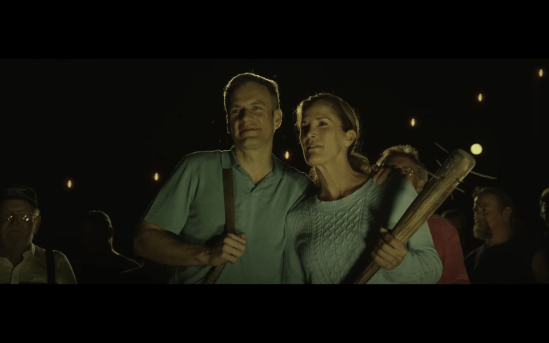
Texas 1955 – the pride of the Sawyer family was not their tattered farm, but a bloodline taste for something else – callous murder and a penchant for human flesh. Verna Sawyer sought to instill that pride into her children, especially her youngest, Jed, but when Hal Hartman, hard nose local Sheriff, learns that his daughter becomes victim of the Sawyer’s suspect nefarious carnage, he executes the law to his advantage, deeming the Sawyer house unfit for children and removes Jed from his labeled degenerate mother Verna. Ten years later, a group of teenage patients escape a mental hospital, kidnap a young nurse, and reek bloody havoc in their voyage to Mexico in an attempt to elude the very same lawman who put them away, but this time, Hartman isn’t adhering to the law, straying off his moral compass to pursue a vengeance mission against unprincipled youth that’s personally driven by Jed and the Sawyer family. Once the embattled Hartman catches up with his prey, a series of gruesome events lead to the creation and the construction of one of the most notorious killers Texas will ever see.

I love a good origin story. There’s something to be said about understanding the commencement of character, to be in the shoes of a long running icon, and to be able to sympathize with their story no matter how atrocious. Directors Alexandre Bustillo and Julien Maury’s 2017 “Leatherface” does just that with the film’s own origin enlightenment on how the chainsaw wielding, human skin mask wearing psychopath came to fruition inside a home of unspeakable brutality and influenced externally by a unforgiving society. From a script penned by Seth M. Sherwood, “Leatherface,” serving as a direct prequel to Tobe Hooper’s “The Texas Chain Saw Massacre,” briefly touches upon the preteen years to setup the catalytic road trip from hell, birthing a monster in a time of adolescence and if part of a legacy spanning over forty decades inspired by Ed Gein, the real life human skin wearing and notorious serial killer, then you damn well know “Leatherface” has to be genetically predisposed to be ultra-violent drenched in blood splatter. The French filmmaking duo, who’ve helmed 2007’s “Inside” and had directed the “Xylophone” segment in “The ABCs of Death 2,” nail the dark and gritty tone that not only breathes a gassy and exhaust fumed life into a massive flesh-ripping chainsaw, but also inflicts heartlessness across the story board into a heartfelt homage to the characters and to the story fathered by Kim Henkel and the late Tobe Hooper, both of whom were attached as executive producers.

Over the years, many actors have held the mammoth power-drive cutting tool in their hand that’s ready to chip away at flesh such as Andrew Bryniarski (“The Texas Chainsaw Massacre” 2003 remake), Bill Johnson (“The Texas Chainsaw Massacre 2”) and, most famously, Gunnar Hansen, the original Leatherface. However, I’m not going to divulge who the pubescent Leatherface is in the story because the film plays out as a who out of the group of degenerate teens is the son of Verna Sawyer, even though you can easily obtain the information in a simple click and search on Google. Instead, Sam Strike, James Bloor, and Sam Coleman portray the three escapees who are accompanied by an equally insane sociopath in Jessica Madsen and an eagerly novice kidnapped nurse by Vanessa Grasse. Amongst a sea of English actors are a pair of vets to shepherd the young cast and be the embattled bookends to the dawn of an icon. Lili Taylor (“The Haunting”) and Stephen Dorff (“Blade”) face off as Leatherface’s mother, Verna Sawyer, who butts horns with a longstanding sheriff, Hal Hartman, with a steadfast vendetta against the Sawyer family. Christopher Adamson (“Razor Blade Smile”), Nathan Cooper (“Day of the Dead: Bloodline”), and Finn Jones (“Wrong Turn 5: Bloodlines”) co-star.

Usually with a pair of directors, two different styles spawn to an end result. With Bustillo and Maury, styles merge into a seamless effort of elegant wonders. Each shot emerges a purpose to the story whether it’s painting an image of the Sawyer’s death house to pulling a one-eighty with characters, the filmmakers ability to combine each element into a single story, that has such a close knit cult following, and still manage to cinematically pull off the atmosphere, the grit, and the gory carnage of a Texas Chain Saw Massacre film is impressive. Cinematographer Antoine Sainer, whose worked previously with the directing duo on the “The ABCs of Death 2’s” segment “X,” has the ever so poised eye that’s able to well-round and solidify Leatherface’s terror tenor, particular exampled in a foot chase scene through a moonlit forest, smoke bellowing out of a growling chainsaw, and a tattered young girl bawling, screaming, and fleeing for her life from a deranged masked killer whose huffing, snarling, and growling during the pursuit.

Lionsgate Home Entertainment presents the Millennium Films produced “Leatherface” onto Blu-ray + Ultra-violet combo disc, a MPEG-4 AVC encoded disc with a 1080p resolution and presented in a widescreen, 2.38:1, aspect ratio that displays the Bulgaria landscape in a yellowish-brown, Texas-like backdrop. Details are noticeably fine that exquisitely reveal the death and destruction of the Sawyers and those who unfortunately surround the family. The English DTS-HD Master Audio 5.1 track evenly distributes and consistently a range of engrossing fidelity, ambient, and dialogue layers. Bonus material includes a play feature with an alternate ending that’s less superior in contrast to the final product, deleted scenes, and a behind-the-scenes making of that includes brief interviews with directors Alexandre Bustillo and Julien Maury, actors Sam Strike, Stephen Dorff, Lili Taylor, and others, and goes behind the scenes in creating the tone and style of “The Texas Chain Saw Massacre” while implementing their own vision. “Leatherface” forces the unsavory and unpleasant down the throats of TCM fans, jamming an attempt to exposition a futile chance to a destined maniac of cannibalistic proportions and manages to mix up the Tobe Hooper’s weathered franchise with a barbaric bruiser of a tale.
Category Archives: Evil Reviews
Evil Loves to Pursue and Kill for Sport! “Happy Hunting” Review!

After receiving a distressing call warranting a trip to Mexico, alcoholic and drug dealer Warran Novak attempts to sell half cooked crystal meth to junkies that ends in two fatalities and two armed drug pushers in hot pursuit of Warren after he steals their cash for the road trip to the border. Before entering Mexico after a tireless drive and unaware of where to exactly go next once crossed the border, the fallen military soldier rents a motel room in the rundown town of Bedford Flats, a once thriving community lush with value and tourism derived from it’s once popular hunting tradition of bison and other wildlife. Now that the wildlife has dried up, Bedford Flats has landed in a stage of an ugly depression and to keep on the tradition of hunting, the foundation of which Bedford Flats has been built, the towns people gather to conduct a merciless hunting expedition of drifters and unsavory folk. Warren and his two pursuers, plus a homeless Mexican and the town drunk, are forced to participate in the hunt as prey with only their able bodies to carry themselves across the salt flats and seek shelter in the rocky landscape just beyond, but Warren decides to fight back against the towns’ most capable hunters in a twisted game of cat-and-mouse.

Western horror has always been a fascinating subgenre with a bleak and barren landscape denizened with colorful, hellbent characters committing one of three sole acts: taking, surviving, or dying. Selective Collective and Waterstone Entertainment’s “Happy Hunting” steps ever so lightly beyond the border into the realm of modern western horror involving a deranged game of hunting and killing humans for sport backdropped mostly in Bombay Beach, California and written and directed by first time feature film filmmakers Joe Dietsch and Louie Gibson, who is one of the sons of Hollywood superstar, and who knows all about western dystopias, Mel Gibson (“Mad Max”). Louie Gibson might have learned a thing or two from his “Apocalypto” directing old man by delivering the brash ferocity and the stoned-heart, icy personas into the story and into the shot twisting an already vulnerable situation into sheer, bite-the-bullet terror.

Martin Dingle Wall delivers every shaky alcoholic tremor as drifter Warren Novak. Wall’s soft eyes, but rugged appeal justifies the 46-year-old actor as an unlikely, likable hero even though Warren will do just about anything for money and for the drink. Wall is able to tap into Warren’s subtle high intelligence and exploit it for the screen against a variety of aberrant game hunters by actors including “Devil Girls'” C.J. Baker, Michael Tipps, Kenneth Billings, and Liesel Handson of “Planet of the Vampire Women.” Dietsch and Gibson pick out one hunter to be the most versatile bad guy in Ken Lally. Lally, whose voice has captured legendary video game characters such as Mortal Kombat’s Smoke, Goro, and Shinnok, brings that malevolent tone to the silver screen as Bedford Flats all around nice guy, Steve Patterson. Of course, “all around nice guy” is an oxymoron in “Happy Hunting” because there are no such thing as nice guys in Bedford Flats, not even the crooked Sheriff Burnside (“Sasquatch Hunters'” Gary Sturm) who acts as the maestro for Bedford Flat’s great annual hunt.

What’s interesting about the film is that there is no love interest which is a rarity; instead, Warren is motivated by a mysterious phone call regarding a possible Mexican love child in the need of help. The mysterious plea over the phone line provides Warren with a purpose in this purposeless life, but that purpose is amplified by the very abrupt detour by a deranged town seeking to rid, what they consider to be, lowlife scum. Another side to Warren’s plight is that the whole sadistic game, the entire inhuman hunt, could be a figment of his withdrawal. Being a drifter and a person who doesn’t amount to much, Warren self worth goes in and out of various stages of withdrawal throughout the duration, before and during life stakes, with dropped dialogue and visible hints about symptoms of going cold turkey. Lets not forget to mention that the directors make an elucidation of Warren’s withdrawals with visions of a dead man, one in which Warren kills prior to his trek to the border, conversing with him, providing him undue advice during the predicament. Then, there’s the very end scene which shoots the likelihood of Warren’s version realism and sanity right out the window and begs the question if everything Warren went through, every struggle, and every death experienced was all inside his head.

“Happy Hunting” has been released on DVD courtesy of Umbrella Entertainment. The region 4 DVD is presented in a widescreen 2.35:1 aspect ratio that’s utterly gorgeous and stupefyingly frightening in the long and wide shots of Bombay Beach’s desert wasteland. Heavy in dusty yellow and rich in lifeless landscape, the color palette is understandably one-sided, but the merit is in the detail of every dry land crack and every minuscule dust bite being disseminated about with every action. The English 5.1 Dolby audio track has balance, range, and fidelity. Dialogue’s clear and prominent, even with Martin Dingle Wall’s slightly raspy and sluggish deliveries. A blight on the DVD is the bonus material and that goes without saying because a single extra doesn’t grace the package, constructing an anemic, film-only DVD presentation of Joe Diestsch and Louie Gibson’s first feature run. However, “Happy Hunting” re-illuminates Western horror stark with a dire need for survival during trying times and Joe Diestch and Louie Gibson have fashioned a subtle analogy of what life would be like in a supposed Trump America where the U.S.-Mexico border wall would be infact 10 feet high, “deplorable” people are axed from today’s American society, and the small rural, once thriving, communities are stuck in the past with outdated viewpoints and assumptions of how maintain existence in a world changing around them. In the end, “Happy Hunting” goes beyond Western horror into being an insightful dystopia of exploitive western survival horror.
A Frat Boy’s Obsession is Evil’s Way of Crying for Help! “Somebody Darling” Review!

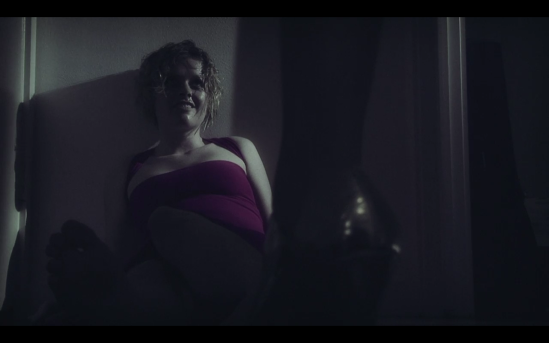
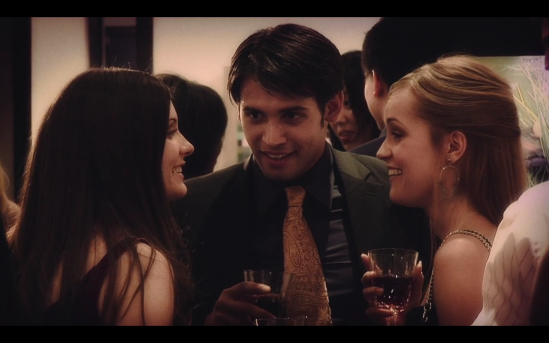
On the campus of Williamsburg University in 2006, a popular fraternity house holds an upscale house party, filled with the most beautiful students dressed in formal wear, liquored with martinis and gin and tonics, and customized to fit the luxurious lifestyle the men of fraternal brotherhood. When the fraternity president Christian Roane conducts a round around to greet guests, he catches glimpse of Sarah Stein, a coed being a good sport by giving into her friends’ urges to party greek. Christian’s unhealthy obsession with Sarah starts innocent enough, but when Sarah doesn’t take that step toward sharing the same affection, Christian’s control goes into self destruction that not only threatens Sarah, but also threatens to unearth the true and ghastly nature of the brotherhood and the brothers aim to lockdown their secret by any means necessary.

“Somebody’s Darling” is the 2016, independent drama horror from the multi-faceted filmmaker, writer-director Sharad Kant Patel, churned out from a story by Sebastian Mathews. In his directorial debut, Patel, known more for his short film work, heedfully courses through detail and treads lightly on the coattails of a sensitive social issue. His film skirts on the subject of rape culture in the American college and university setting while also touching upon sexuality complexities and severe anguish in today’s youth. Basically, “Somebody’s Darling” is a higher education dissertation on the experiences of collegiate life with a horror twist and all the along the way, Patel slowly paints Christian and his brotherhood onto a canvas of ambivalent malevolence by deconstructing Christian to quickly reconstruct him in a ravaging roundabout. Patel throughout leaves a bread crumb trail of clues that don’t make sense at first, that might lead to other conclusions, and that doesn’t explicitly genre “Somebody’s Darling” as a horror.

Christian is the film’s central focus and with a dark and brooding character, a dark and brooding soul must ride parallel and Paul Galvan intently delivers a cryptic persona. Peppered erratic is Christian obsession Sarah Stein, a run-of-the-mill coed playing darlingly enough by Jessa Settle. Then there’s the brotherhood, whom are begrudgingly split on how to action Christian’s off course fixation, consisting of a youthful lineup of white, stuck-up preppy frat boys with an actor list to match including Fred Parker Jr., “Spirit Camp’s” Matt Tramel, and Mike Kiely. Sarah also has an entourage but not as prominent and, to be honest, the brotherhood weren’t just a hair more involved, but Kristen Tucker and Cathy Baron (“The Lights”), who play Madison and Riley, hit the stereotypical college coed right on the head as the two look to score big when scouring their hot boy wardrobe and provide unnatural sexual banter toward their goody-two-shoes friend, Sarah.

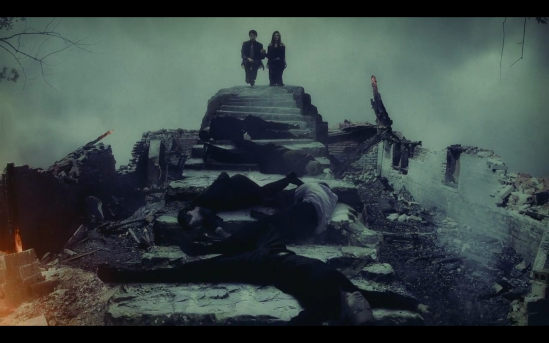
“Somebody’s Darling’s” independent genetic makeup doesn’t hide under a flashy production, but presuming an indie dramatic horror that’s more bark than bite isn’t worth wild should is the incorrect assumption as the climatic end will be attention catching. Granted, the dialogue’s overdrawn breathiness can bog down a regular popcorn viewer and turn away heads that have a disdain for immense screenplay scripture, but to comprehend the whole story and to become invested in the characters, being a viewer from start to finish won’t go in vain. Patel personal investemnt extends to much more than spitfire directions and scribing with a hand in producing, composing, editor, and digital effects with the latter being used sparsely to convey the Christian’s internal aspirations and quondam self. When effects do come into the real word, a practical, lifelike approach is taken and that intensifies the horror tenfold.

Distribber released Sharad Kant Patel’s “Somebody’s Darling” onto various streaming platforms such as iTunes, Amazon, Google Play, and Vudu on December 1st. I was provided a screener disc and can’t focus on or comment too much on the details of image or sound quality, but the disc did provide bonus material including the making of the score and behind-the-scenes in creating the dream sequence. Sharad Kant Patel’s “Somebody’s Darling” has an edgy appeal that draws you in like an unsuspecting moth to an alluring light and then zaps a fatal shock right into the nervous system as soon as the undertones are evidently a metaphor for something far more sinister.
Trippin’ on Grief Conjures Internal Evil. “Woodshock” review!

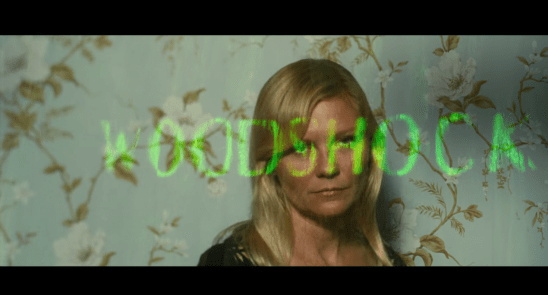
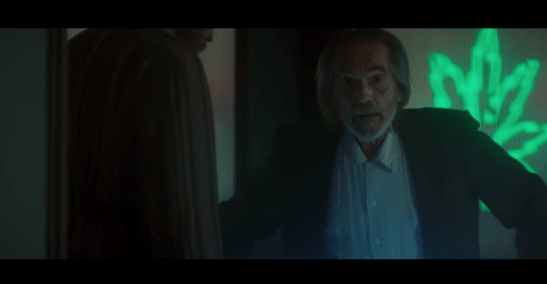
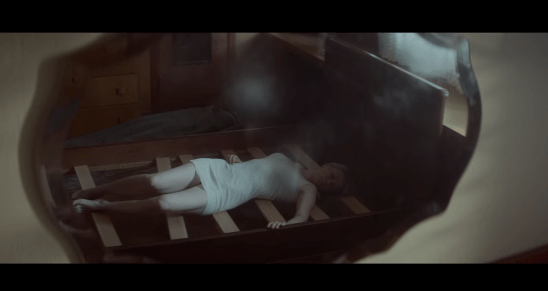
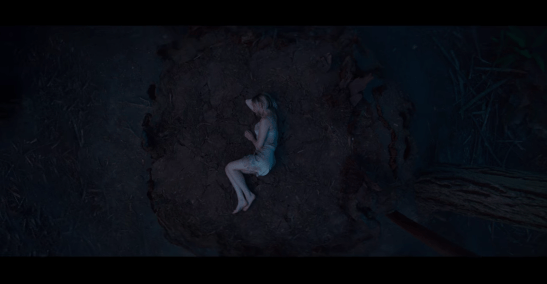
After suffering the tremendous loss of her in-home hospice cared mother, Theresa descends into an inescapable state of grief and severe isolation inside her mother’s woodland home. Stumbling through life, she manages to show up at work, a cannabis distributor in town, with the verbal encouragement from her eccentric boss, but Theresa’s mind can’t grasp the reality of the situation and loses focus resulting in another tragic loss when she mistakenly hands over fatally potent pot to the incorrect customer, subsequently a friend. Along with grief and isolation, guilt comes into the fold and she begins lighting up her own stash of mind altering cannabinoids that thrust her mindset into disjointed delusions and sleepless strolls through the forest.

“Woodshock” is the 2017 drama thriller directed by two sisters: Kate and Laura Mulleavy. Credited as their freshman film, the Mulleavy sisters embark on an internal, unhinged perspective from their main character, Theresa. With that in mind, the filmmakers’ use of nature has both a symbolic and practical substance that paints the inner workings of Theresa’s thought process. Shot on location surrounded by the giant red oak trees of Northern California puts Theresa, this tiny human being, right smack dab in the middle of ginormous towers of pure ancestral nature and unable to fathom the full scope of the trees metaphorically explores how Theresa is unable to fully comprehend the overwhelming amount of emotions she ultimately succumbs to that lead her down a darker path. Nature, whether trees, butterflies, or, more so in general, landscapes, becomes a familiar motif throughout the film with the trees being the most repetitive aspect being exhibited in numerous scenes of being harvested by loggers, stripped and stored at mills, and lingering remnants of their once intact past.

“Melancholia’s” Kirsten Dunst fully embraces the role of Theresa with her mind, body, and soul by not holding back in a role that demands more of a solitary, voiceless performance blanked with grief. Dunst nails it with ease. Accompany the Sam Raimi “Spider-Man” actress is Denmark born Pilou Asbæk as the pot dispenser shop owner Keith who conspires to work out deals with his special customers in need of once and for all ceasing the pain of ailment. The dynamic between the two is hot and cold as the sensation of tension is always present even if the dialogue is not. Asbæk’s Keith actually drives the plot, creating situations that put Theresa in a dilemma inducing pickle and he certainly takes advantage of her grief. Asbæk smug performance couldn’t get anymore complex as he portrays an arrogant, hippie-esque pot shop entrepreneur in a small Washington state town, but exhibits a softer side, especially for his friends and for Theresa, at times. Joe Cole (“Green Room”), Steph DuVall (“Scanner Cop”), and Jack Kilmer costar.

“Woodshock,” as a whole, attempts to grapple too much in the dimension of the subliminal. The Mulleavy sisters focus on symbolizing and using metaphors rather than being straight shooters to communicate Theresa’s internal struggle and between the montage of trees, the vibrant visuals, the double exposures, and various angles of a single action, there’s a choke that occurs, making apprehension hard to swallow. The siblings also display their inexperience at times. Despite completing impressive artistic visuals and able to create some slight movie magic as independent filmmakers, the directors’ choice to keep scenes from being cut and left on the editing room floor are questionable. One example would be Keith in the bar, moving his arms in a slow, locomotive motion, listening to a mellow track on the jukebox This scene is late is near the latter part of the film and doesn’t convey anything more about the character than already established with no transition scene to provide any kind of setup, background, or foreshadowing.

Lionsgate Films presents “Woodshock” onto a slip-covered High Definition, 1080p Blu-ray plus Digital HD. The MPEG-4 AVC encoded BD-25 disc has an widescreen aspect ratio of 2.39:1 that’s conventionally stable. Faint grain filters through, but this could be an intentional cinematography tactic. The English DTS-HD Master Audio track isn’t wired to pair with such slow, mellow storyline that doesn’t have a range to fully test the HD quality except for invigorating Peter Raeburn’s enlightening hodgepodge score. The dialogue track is muddled and nearly unintelligible by the overshadowing score. Bonus material includes “Making Woodshock: A Mental Landscape” that opens up Kate and Laura’s intentions in expressing Theresa as a character, their style in filmmaking, and to up sell their cast and crew. “Woodshock” is an artistic visual stimulation with no rival, but Kate and Laure’s inexperience emanates through more than their subliminal sub-contexts. Kirsten Dunst marvelously challenges herself that inarguably gives her even more of a range as an actress that only proves her ability to not be a one trick pony in and out of Hollywood.
Kebabs Made From Drunken, Evil Patrons! “K-Shop” review!

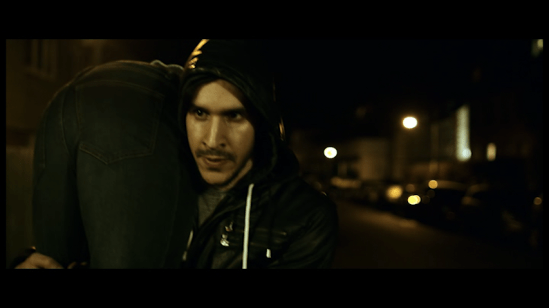
Zaki owns a small kebab shop in England’s vern own party central in Bournemouth on the South Coast. Every night, Zaki withstands the late night drunken antics of the local party goers in the hope his son, Salah, would continue his graduate studies and to also, maybe, one day own his own fine dining restaurant, but when he becomes involved in a scuffle with a late night rowdy bunch, he’s killed in a fit of alcoholic whims. Salah takes over his father’s shop, neglecting his studies, and continuing the serve the intoxicated public in his father’s memory, but when he accidentally kills one stubborn customer, he mincings his body parts into kebab meat instead of calling the police and whenever a deplorable enter his shop, he serves them the newest menu item. One sloppy drunk customer after another, Salah wages a vigilante’s war on party world, especially toward a new dance club that masks over a drug trafficking ring.

“K-Shop” is the 2016 horror from writer-director Dan Pringle in his first helmed feature that aims to explore the troublesome nature of the after party, intoxicated human plagued upon sensible people. Pringle strengthens the social commentary by implementing actual footage of drunken debauchery filmed right on England’s South Beach that range between spewing chunks onto the sidewalks to heated back and forth fisticuffs. Pringle’s script tackles that insatiable inner urge everyone has felt at least once in their life when dealing with unreasonable nightlife and that is to raise a fist against them to show how to act like a decent human being. “K-Shop,” which denotes being a double entendre for Kebab Shop and Kill Shop, takes the act one step further, introducing a cannibalistic element to the mix as Salah rids scrum from the earth by slicing and dicing them into his kebab mixture. Salah’s father, Zaki, is a Turkish refugee and him and his son are essentially immigrants that becomes another script undertone brought up the club owning, drug trafficking, all over bad guy Jason Brown.

Salah is brilliantly executed by Ziad Abaza who brings a cache of raw emotions to his character. “K-Shop’s” trailer hinted at a horror-comedy feature, but there’s nothing funny about Abaza’s Salah who seems that life is wholeheartedly against him as a downtrodden college student in a search for basic human decency and compassion. Salah is pitted against an egregious Jason Brown played by Liverpool native Scot Williams and Williams embodies and embraces being a person of high social status and fame, a person of who lavishes in luxury, and epitomizes being a slime ball. Brown’s a stark contrast against Salah who has to slave away and earn his living while Brown takes his life for granted. The supporting cast are also very interesting starting with Reece Noi as Malik who voyeuristically takes an interest in Salah’s vigilantism and who also, perhaps, shares common cultural aspects, but Malik is just a kid acting beyond his age at times and then drastically at his age at the most crucial moments during his dynamics with Salah. Another character is Salah’s potential love interest in Sarah portrayed by Kristin Atherton. Atherton provides a sweet, quiet, and intelligible demeanor to Sarah that projects onto Salah whereas other women in Salah’s life, mostly his patrons, are loud, obnoxious, and corrupt. Lastly, “Doomsday’s” Darren Morfitt instills a catalytic character in fallen from grace Chaplin Steve. There’s a bit of a confessionally staged event between Salah and Steve that offers a realization and a tale-end twist that just puts that unwanted pit into the bottom of stomachs.

Now “K-Shop” isn’t totally perfect, especially in the flow of the film. Pringle doesn’t clearly provide a timeline of progression. Between the holidays Christmas and News Years is perspectively prominent, but Salah’s calling, or mission, seems to extend weeks, if not months, and that isn’t clearly communicated. Plus, there’s slight difficulty understanding turn page moments that dilute the significance of events whether it’s through too much exposition or choppy editing. Where “K-Shop” is weak, Pringle makes up with gore and story. The gore is absolute from scorching an inebriated man’s face sizzling in a vat of hot oil to chopping up limbs with a butcher’s knife in order to make his delicious kebabs. Pringle’s conclusion is absolving, satisfying, and also, at the same time, fruitless because even though Salah makes a stand against immorality, a realization washes over him that nothing will ever change despite cutting the head from the snake.

Breaking Glass Pictures distributes “K-Shop” on to an unrated DVD home video. The DVD is presented in a widescreen 2:35:1 aspect ratio and the overall quality is stunning sporting a dark painted picture and still convey a healthy color palette even if lightly washed in a yellow hue. The’s no attempt to enhance the image as the natural color tone comes right out and off the screen and that dark gritty matter really speaks to Pringle’s capabilities to create shadows. The English Dolby Digital 5.1 audio track is surprisingly hanging around par level as, some of those key moments once spoken about, are lost in a muddled heap in the dialogue track, but there’s range and fidelity thats good on the output amongst a balanced five channel track. Bonus material includes a behind-the-scenes segment and deleted scenes plus Breaking Glass trailers. “K-Shop” is dark, gritty, and eye opening backed by a versatile lead in Ziad Abaza and helmed by newcomer filmmaker Dan Pringle, seeking to entertain and unearth our inner and deadly vigilante doppelgänger in the midst of social indecencies.