

A Church youth group voluntary attends a Saint Christopher’s Catholic Middle School weekend cleanup before the school’s much needed reconstruction and restoration. As soon as they start with the sweeping, dusting, and polishing, three demon nuns, let to suffer behind an enclosed brick wall by a child molesting priest, unleashes their vengeful wrath, a gift from their new lord and savior, the devil, to whom they’ve sold their soul. Quickly, one-by-one the volunteers fall to the flesh hungry demonic nuns, using their sins against them, and extracting their souls for hell bound eternity. The select few to survive the ordeal of nuns will come face-to-face with Satan himself where praying for mercy will get them nowhere and is the same as burning in hell.

Director Richard Griffin once again pushes down the throttle to wrap the shooting of an entire movie in a matter of days on another lightweight budget. “Flesh for the Inferno” had a 9 day shoot with, and no surprise here, Griffin hiring some of his entourage of talented actors and actresses. The stage actors employed are always remarkable to watch; the underrated Michael Thurber, even in a toned down performance, is such a joy to watch with his adaptable skill set to jump into the shoes of any role in any film. The same can be said about the co-leads, Jamie Default and Jamie Lyn Bagley, who easily adjust into various roles from one Griffin film to the next. However, to my surprise, Griffin’s works with new faces, such as Ryan Nunes, Andrew Morais, and Kevin Michael Strauss, whom fit into his homage work of European possession horror. Then, there’s the talented Aaron Andrade who puts any other actor’s portrayal of Devil to shame.

Griffin and long time collaborator and cinematographer Jill Poisson purposefully softens the lens to give the photography a dreamlike or surreal state to mimic the iconic European director styles such as from Mario Bava or more in tunely with Lucio Fulci and though this respectable style was succesffully achieved and did contribute to the Bava or Fulci level of cinematic and atmospheric charm, the haziness was a bit overbearing, almost closing in on the actors within a modified frame of dominating clouds. The effect mostly shadows from what I noticed, right off the bat, the recognizable set from a previous Griffin film, “Future Justice,” sporting a new coat of paint and constructed with new, or new-ish, set pieces to create the Catholic school locale.

Screenwriter Michael Varrati churns out a script in less than a week to give Griffin much time as possible on a location rented much longer than needed. Varrati has written remarkable natural banter between opposition, connected, and flirtatious characters and does well with the dynamics for a quickly progressing story where shit hits the fan, crossing over into act two, in a matter of minutes. Its the dialogue, however, that slightly over saturates “Flesh for the Inferno” and it’s demonic, habit-wearing nuns. Fully engaged conversations between the nuns and the unlucky survivors cross over into theological debates rather than leading into a sacrilegious and unholy curse. Though at times, scenes like the one with Michael Thurber chasing his own tail in a Groundhog Day movie-type scenario was well placed in the story and well shot, even if little-to-no dialogue was present.

“Flesh for the Inferno” was suppose to be Griffin and his crew’s all out gory effects movie the homage attuned director has ever filmed. Yet, I can’t help but feel as if the opportunity was bobbled to recreate a “Demonia’s” bloodshed. The John Dusek effects were simply effective though, catering to all the film’s intention and needs to pull off a nasty nunnery narrative. The Timothy Fife soundtrack isn’t necessarily Fulci inspired as well that perhaps resemble more of a Goblin and Ennio Morricone blend and that’s highly more notable.

Scorpio Film Releasing and MVDVisual distribution together created and distributed another fantastic film that’s graced with retro-sleek cover art, like always, and I’m always impressed by director Richard Griffin’s capability to turn low budget horror into a formidable admiration of the old days of all kind of horror. Griffin and his entourage are on a whole separate level than their counterpart in their Hollywood doppleganger Eli Roth. The MVDVisual DVD looks sleek with a 16:9 widescreen presentation for the 79 minute feature. Bonus material is limited, but informative, that includes a crew commentary, cast commentary, and the film’s trailer.
Category Archives: Evil Reviews
Don’t Leave Evil On Hold! “Serial Kaller” review

Phone sex models broadcast their televised provocatively dressed bodies over the British airways while chatting with lonely customers. During their biggest broadcasting night, all the girls and crew become purposefully trapped in the sleazy studio, making the phone sex business a dead line. Disappearing one-by-one, each model falls viciously victim to a murderous psychopath who could by one of their most disturbed and perverted fans. With the power out and the studio on shambles, the survivors attempt to escape dead air by any means possible, even if that means coming face-to-face with their stalker.

The cast full of busty beautiful women enthralled to a murderer’s maniacal impulses sounds to be a bit of good horror movie fun untamed by the restrictive harnesses of big studio conventions. Director Dan Brownlie and his producing company Brand B Corporation develops “Serial Kaller” to be the limited budget archetype of the slasher films with an inkling into the very real world of broadcasting UK’s phone sex girls or better known as simply “babe shows.” Co-writer and star of “Serial Kaller” Dani Thompson once worked in the business, and appropriately proportionately so, that sparked the idea in her for a killer loose in the bare bones, deathtrap studio of a babe show. The diminutive budget project attached some B movie talent such as Suzi Lorraine and the iconic Debbie Rochon while rounding out the cast with top heavy talent in Jess Implazzi, Aisleyne Horgan-Wallace, Suzy Deakin, and Zoe Morrell.

With all the dazzling, easy-on-the-eyes women in the cast and a sweetly promised premise coinciding, “Serial Kaller” squirms itself onto the independent slasher scene with barely a thrill to offer and a death to deem applaudable. “Serial Kaller” stands out as much as pig in the middle of a stable of horses with mediocre kills, colorless dialogue, and disjointed concept that resembles more like an unfinished thought than a complete work. Brownlie’s and Thompson’s film subtly whispers similarities to, or homages to, that of the England’s 19th century prostitute murderer Jack the Ripper, with the start of an undefinable and causeless figure stalking sinfully innocent sex workers that happen to be, coincidentally, English. Yet, somehow that hint of respect becomes lost in translation; with a title like “Serial Kaller,” one might be under the impression that phones with have a significant role in the story, such as in Bob Clark’s “Black Christmas.” In reality, the phones are just, well, phones, while the story takes a rogue route that’s far from the intentions of the title, losing the motivations and the inspirations of a modern day Jack the Killer.
The co rrelation between the model’s baleful setup and the murderer circling nearby doesn’t jive to build successful suspense and when the moment finally comes to fruition where a model is about to bite the inevitable dust, there’s no jolt of anxiety toward the situation. The kill effects, consisting of minuscule budget practical and CGI effects, fail to heighten the murderous affairs. Probably the best kill scene in “Serial Kaller” is the electrocution through one of the babe show tech’s genitals, zapping up into the girl that’s unenthusiastically grinding his crotch with her clothes on and exploding out her eye balls. Zany death, but still kind of cool, right?

My good friends at Wild Eye Releasing brought “Serial Kaller” onto DVD, presenting the feature in a director driven retrofitted 4:3 full screen aspect ratio to give homage to once praised VHS nasties. Despite the slight lean toward a grindhouse appeal in the aspect ratio, the picture quality is clean, naturally toned, and detailed. The audio goes without hiss and is well balanced. Extra content includes director’s commentary, behind the scenes featurette, and trailers. The overall, “Serial Kaller” is the epitome of big concept packaged small and can’t quite muster a snowball effect to wrangle in the much needed thrill rush to go along with the scantily-cladded women, but Brownlie’s film redeems a little with Debbie Rochon phenomenal joker-esque performance that, unfortunately, has very little screen time.
Evil’s Hairy, Foul-Smelling, and Big! “Stomping Ground” review!
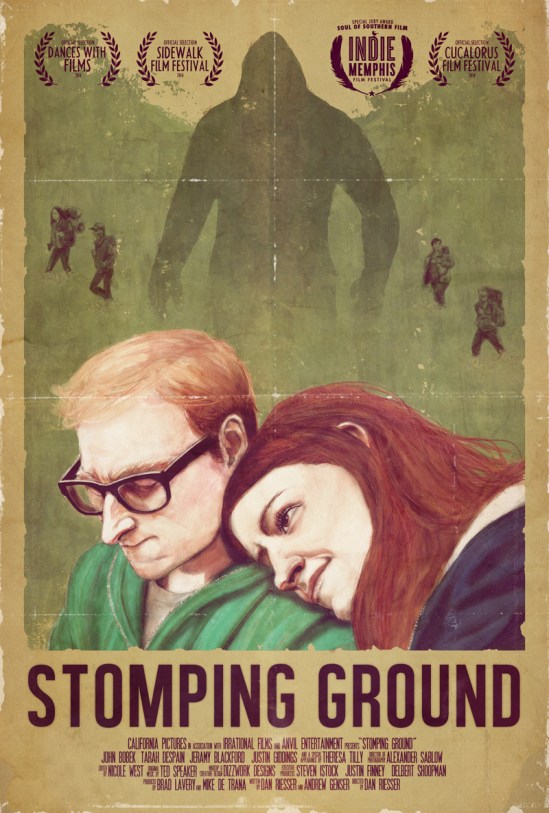
Chicago based Ben and Annie travel to Annie’s small southern hometown in North Carolina over Thanksgiving weekend. Annie reunites with high school friends Paul and Jed, who have stuck with their southern roots and tease Ben for his sheltered city life. Ben discovers more about Annie’s past through her friends such as her and Paul being at one point in time an item in high school, her being a wild party animal, and that she actually believes in Bigfoot. Jed and Paul invite Annie and Ben to a deep woods camping trip where Bigfoot has been believed to be looming about; Ben doesn’t believe in Annie’s Bigfoot obsession, but tags along to keep Paul from purposely undermining their relationship in order too get close to his at one time girlfriend. When the four go deeper into the woods, attempting ddto meet up with a couple of other friends, they soon realize something is wrong and something has been following and toying with them, but is it really Bigfoot?
Finally, a well-made simplistic, yet terrifying story about the legendary Bigfoot that isn’t disgustingly mishandled when interpreted to the big screen. Cautiously optimistic with each Bigfoot inspired film, I’m always to be horribly let down by the sheer lack of monstrous intensity, heartfelt passion, and distinctive effects the big and iconic cryptozoological creature has been displayed over the years, or even decades in fact. I did think the William Dear family-friendly “Harry and the Henderson’s” would be the sole king of the Sasquatchsploitation genre, but here, right before me, under the careful and patient eye of director Dan Riesser is “Stomping Ground.” “Stomping Ground” is one part comedy, one part melodrama, and one part thriller rolled up into a three act film school archetype that gets it’s dirty sasquatch-ian claws into the viewer’s attention from start to finish.
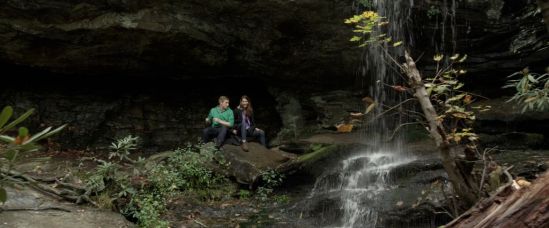
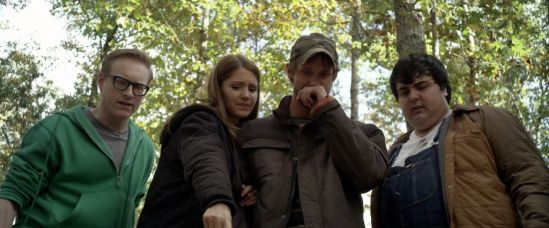
The Riesser and Andrew Genser collaborated script strongly develops the four main characters in Ben, Annie, Paul and Jed. Ben is a complete fish out of water, seeking eagerly to fit into Annie’s southern habitat and be one with it’s rowdy and rugged natives, but can’t seem to grasp, what he considers, the oddball behavior of those living below the northern hemisphere. Annie is a girl with an elusive past, according to Ben, by not letting Ben into who she formerly was, a Bigfoot believing, let-loose party girl with a love for the ourdoors, until old habits start to emerge externally in her return back home. Knowing this about Annie and with a strong attraction to his former fling, Paul seeks to disintegrate Ben and Annie’s city-living relationship, cutting their opposite-attraction bind, and get her back at whatever means possible. Jed opposites life long friend Annie where he lives for the freedom of the sticks while never letting go the cockeyed belief that Bigfoot roams the local woods. John Bobeck as Ben, Jeramy Blackford as Paul, Tarah DeSpain as Annie, and Justin Giddings as Jed deserve a round of applause for believing, and showcasing those beliefs, in their characters because if there wasn’t such a heavy character development in the first two acts of “Stomping Ground,” there might not have been such a desire to give two-shits about any of the characters, placing them in the neutrality column.
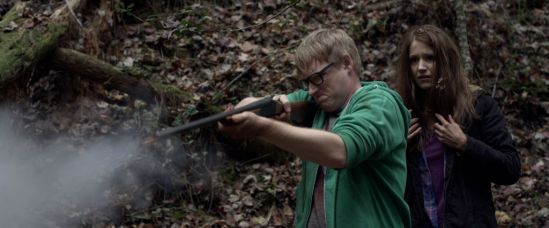
Usually with any film about the big, hairy myth, the Bigfoot effects are either jerry-built or heavily CGI dependent that reveal more of a glossy feel aftertaste than a mangy, gritty animalistic and realistic one. Not many effects were used up until when the Bigfoot made an appearance so I wasn’t quite sure what to expect and, like I aforementioned, I’m always cautiously optimistic. When Bigfoot made the on screen debut in full visibility, the matted hair, begrimed skin, tall and broad stature, and an effects accomplished atrocious face was all combined to structure a well-crafted, finely-detailed animal that could pass for a real life Bigfoot sighting without a doubt. Though the scenes are brief and obscured at points, “Stomping Ground” has a Bigfoot contender that’ll top the makeshift giant gorilla suits some actors are placed into with very little touchups and the digitally implemented gargantuan that’s over exaggerate in appearance and abilities of the Bigfoot in those other films.
I wouldn’t be doing my job if I didn’t have a gripe or two about every film I review and there are a couple of issues that deserve expressing here, even if “Stomping Ground” is an independent favorite. Shot on location in North Carolina, the woods felt more like a national park than uncharted territory as a few trail markers were seen on trees and though not necessarily expressed that the woods were uncharted, wouldn’t that still leave the question why Bigfoot has been so elusive? Yes, a few background hints were dropped in the beginning about sightings, but nothing major really split the hairs to make North Carolina the Bigfoot sighting capital of the world. The circle seemed kind of small to just the group of three – Annie, Jed, and possibly Paul. Also, the film’s ending was a bit undercooked, leaving up the air the fate status of Ben and Annie and also of the Bigfoot too. The abrupt finale emerged right when the story was becoming more and more captivating and now I feel unquenched, I feel betrayed, and I feel unsatisfied with our character’s conclusions.
Anvil Entertainment and Irrational Films co-produced the project with independent distributor BrinkVision, who also distributed the praised “Evilution,” releasing the DVD and streaming Video On-Demand on March 8th. Don’t also miss the Theresa Tilly cameo, one of original ladies of Sam Raimi’s “The Evil Dead,” as she’s cast as Annie’s mother. Though we received only a streaming copy for review, “Stomping Ground” does include other extras such as audio commentary by writer-director Dan Riesser and Stars John Bobek and Tarah DeSpain, behind the scenes featurette, deleted scenes, and the film’s theatrical trailer. We can’t comment on the video or audio quality due in part to the streaming screener copy, but the our overall impression of the film’s quality is above par as no technical errors were discovered or noticeable. Its good to have Bigfoot looking good back on the screen again.
Evil Entraps With Many Questions. “Riddle Room” review!
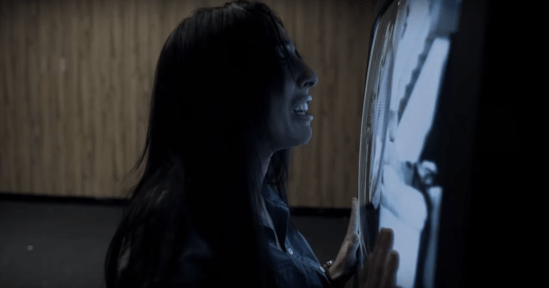
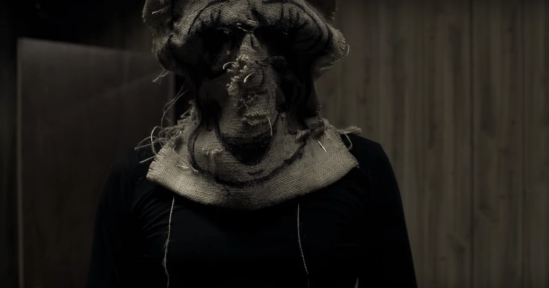
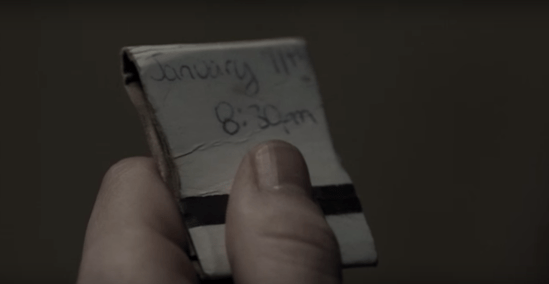
Associate professor Dr. Emily Burns is forced by two masked men into a small square shaped room, confined by four faux wood paneled walls and layered with a thin tattered carpet. Oblivious to the reason behind her sudden captivity, Emily frantically searches the room, desperately searching for clues for a potential escape and potentially why she’s been locked away. Emily also realizes she’s suffering from incapacitating headaches, fragmented memories, and she discovers has a musket size growth on the back of her neck. Her masked captors visit her often, inquiring about the date January 11th and if she’s able to complete her mentor’s work, but Emily can’t put the pieces together; she has to puzzle together the clues she discovers in the bleak room that might be her only way to truly understand her situation.
“Riddle Room” (also known as “Breakaway”) is a mystery thriller based on the clue finding, puzzle solving, race against the clock room escape concepts that are highly popular usually associated with team building exercises or a fun thing to do on any given night. Director Bryan Binder keeps the air enigmatic and unloads a blindside ending that’s a rare and unique quality for a director’s freshman feature film. The characters are with attributes of shapeshifting intrigues that aid in the mysteries or the riddles, if you will. The “Riddle Room” has everything a traditional live escape room would be fitted with: clues placed in all parts of the room, a sense of tremendous urgency, and even a countdown timer. Yet, the pressure isn’t necessarily transferred onto the captivated viewer; instead, Dr. Emily Burns puzzling predicament enthralls much of the story’s fascination.
Marisa Stober is cast as the lead character Dr. Emily Burns, who majorly is the film’s lone wolf actress, and she attempts to put Emily in a completely complexing situation, but doesn’t quite sell her solitary performance as she leads Emily along with such ease through the room’s clues and is able to easily get the quick upper hand on her captors. However, the ease in both areas might be contributed to film’s surprising, if yet impractical, twist finale, which only makes for a good movie night and not a nonfictional masterpiece. Binder wrote the screenplay as well that’s needs some fine tune polishing. Between Emily’s fragmented memory moments and when Emily’s entire story comes together at the end, some questions about Emily’s status and her arrival to the situation still go unanswered.
Breaking Glass Pictures and Vicious Circle Films distributes the first film under the Three Ring Entertainment produced credit onto DVD this February. The video quality is presented in a widescreen 16:9 aspect ratio on a dual layer compressed disc, which is kind of odd since the film is roughly 80 minutes and not very effects heavy, and is fairly clean with vivid coloring and natural tones. There’s slight selective aliasing moments on the faux wood paneled room, but doesn’t hinder the film’s overall video quality. From an audio standpoint, the English Dolby Digital 5.1 is noticeably unbalanced with much of Stober’s dialogue, specifically whispering, going unheard or lost within the Henrik Åström soundtrack. The comprehensibility from Emily’s masked captor’s monotoned produced voice puts Stober’s dialogue tracks to shame. The special features are nicely abundant with cast and crew interviews, behind the scenes featurette, cast auditions, investor scene, a bonus trailer, and a making of the “Experiment.”
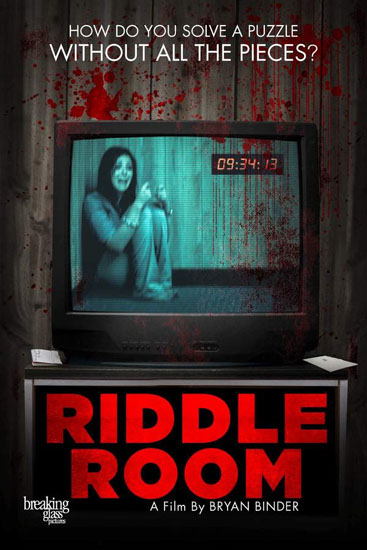
“Riddle Room” doesn’t have any thrill shortcomings, leaving the story’s beginning and end open to focus primarily on Emily’s high strung bewilderment. Even though the ending falls a bit flat, I suspect that Bryan Binder is an upcoming writer-director to keep an eye. I’d like to see a follow up sequel to “Riddle Room” under the same cast and crew to continue the development of Dr. Emily Burns, to get her status update, and to understand more of the plight. A companion piece would nicely complete Binder’s seemingly unfinished “Riddle Room” narrative, but as a standalone feature, satisfaction comes easy enough through what’s already written and recorded for this 2016 film.
All Evil Breaks Loose! “Mansion of Blood” review!

Pretentious millionaire Mason Murphy hosts the largest and sexiest lunar eclipse party in the close knit community of River Ridge. Murphy renovates the old Mayhew estate, home to the mysterious disappearance of the wealthy Mr. Mayhew in 1926, as the party’s extravagant setting. One of the young party goers is also a practicing partaker of witchcraft and when she attempts to summon upon the spirit of her dead boyfriend to ask about whether he bought a winning lottery ticket or not just before his death, she accidentally aligns all things evil right as the eclipse takes place, trapping the oblivious guests in a nightmarish twilight zone that includes black bat demons, Civil War ghosts, lawn ornament zombies, bar tending vampires, and a slew of maniacal murderers.

Director Mike Donahue’s “Mansion of Blood” is a horror-comedy of an ambitious narrative that was doomed during the middle of production, resulting in a shameless, mishmash heap of a film. From what I’ve read from various article sources, “Mansion of Blood” came to a screeching production halt due in part of a sexual assault claim from an actress or two. The complaint was against the film’s headlining star, Gary “Lethal Weapon” Busey. Are we really surprised here? Busey, who suffered permanent brain damage in 1988 after a motorcycle accident, has sustained from his wild and crazy, sometimes delusional, antics that raises many eyebrows through almost the last three decades. The film’s crew was so fed up with Busey that he was actually fired and massive re-cuts and re-edits caused the story’s downward slope. Aside from the Busey debacle, executive producer and one of the film’s stars Tom Tangen is rumored to have screwed over the film’s investors, leaving director Mike Donahue high and dry.
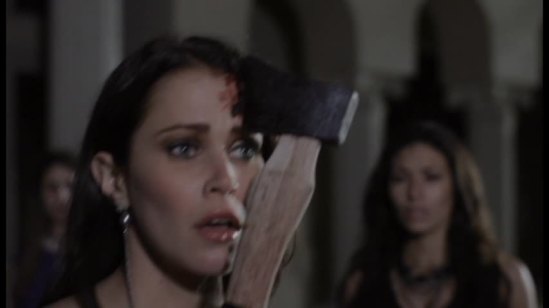
Honestly, I strongly feel “Mansion of Blood” never came an inch off the ground. I get that the film is a horror-comedy in a slapstick sub-genre, but the story is in total shambles. Numerous characters and their individual stories are diluted to the point of being a suffering and aggravated attention deficit disorder. The severely choppy editing, the unbalanced dialogue and ambient audio tracks, and the oafish acting throughout only piles on top of an already high mountain of sadness. And even though I have a soft place in my heart for Busey and his sheer lunacy, in life and on film, his performance as the malicious party host Zachariah was, dare I say it, surprisingly stale. Only a few handful of scenes of Busey’s floating, grinning head faintly superimposed as a ghost or a spirit or as a something are uniquely guilty pleasurable. Not all has failed as the film’s other star, “Star Trek: Voyager’s” and “Innerspace’s” Robert Picardo, attempts and succeeds at a good performance as the party’s caterer who ends up almost being poisoned by his chef wife, played by Lorraine Ziff.
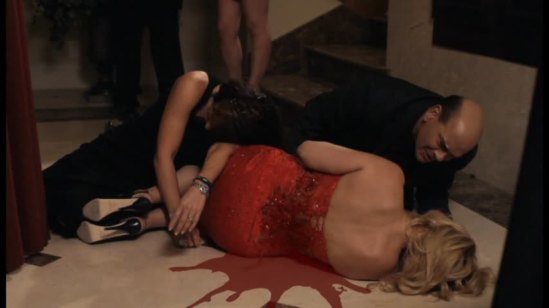
Again, I’m well aware that “Mansion of Blood” is a horror-comedy, but the no budget special effects couldn’t be any more offensive to our intelligence. The “demons” were extras in black face and black leotards with a dark cape and plastered with exuberantly adhesive bat ears. The computer generated lunar eclipse was near 1950’s animated cartoonish. These effects bog down the quality of the film, turning a potential Sci-Fi channel movie spoof to a more of an obsolete, outdated, and cheesy and campy schlock that could be deemed worthy of being presented on Mystery Science Theater 3000. Instead of solidly funded practical and computer generated special effects, Donahue leans firmly on the hard bodies of young (and some slightly older such as Lorraine Ziff) actors and actresses. The naked bodies of upcoming scream queen Mindy Robinson and the industry versatile Dustin Quick are two to name just a few who pair up with the rock hard abs of Kyle Clarke and Frank Mora Jr. One would think Jennifer Tapiero, Sarah Alami, and Tegan Webster would be the group of main characters that would develop and expand throughout the duration since they’re stories begin in a diner, but their characters become junk roles that fizzle into into oblivion and tangents are created for non-setup characters.

“Mansion of Blood’s plethora of characters is too much to handle, especially when the film tries to go in numerous directions that doesn’t give Donahue’s motion picture any direction. The story and script flounders as the legs are cut right from underneath both of them. I empathize that the Gary Busey and the rumored Tom Tangen issues might have derailed this project that categorizes this film into the scrap-to-salvage scenario similar to prior films like “Bad Meat” and “Old 37.” Tom Cat Films and MVD bring “Mansion of Blood” to retail shelves and I encourage those brave enough to venture into the film to remember this particular review because when the credits begin to roll and the popcorn is down to the last few underdeveloped kernels, you will know somewhere in the sands of time and space that I’ll be whispering in the ears of your mind, “I told you so.”
 It's Bloggin Evil!