Dark Force Rides into the Sunset with EVIL Flannel, Stirrups, and a Brothel Full of Stolen Women! “Ride a Wild Stud” reviewed! (Dark Force Entertainment / Blu-ray)

About as Obscure as They Come! “Ride a Wild Stud” on Blu-ray!

During the Civil War, the Wild West lives up to the name between advantaging exploiting gangs of bandidos running rampant alongside the Southwest terrain and the hard-pressed law outmanned and outgunned to never be able to gain apprehending ground.  One determined law man, Lieutenant Mike McDermott, has a plan to infiltrate William Quantrill’s plundering murders, thieves, and sex traffickers and take them down from the inside-out by portraying to be a likeminded criminal escaping the law.  Successfully penetrating Quantrill’s ranks, McDermott takes young Marsha under his watch; Marsha has become enslaved in Quantrill’s house of pleasure brothel, supervised by his right-hand man Bill Doolin after Doolin mercilessly guns down her father and rape and murders her older sister in a home invasion of their simple life assets.  When another of McDermott’s steady female informants is shot dead by Doolin, the lawman becomes judge, jury, and executioner on a gang of no-good Western raiders and sexual profiteers. 

A western exploitation epitomizing B-movie babes, brawls, and bad guys, “Ride a Wild Stud” surmounts as sleazy cowpoke overtop classic, 1960s Western vibes of machoism, duty, and exciting gunfights.  Profound Western film filmmaker Oliver Drake during the Golden Age of cinema (“Bordering Buckaroos,” “Deadline”) quietly transitioned from run-of-the-mill westerns to a handful of grindhouse and exploitation B-movies by the 1960s under the pseudonym of Revilo Ekard, Drake’s name spelled backwards, who produced under that credit this 1969 adult-oriented oater as well as the even saucier and scandalous “Angelica:  The Young Vixen” where the titular young woman seeks older man comforts.  “Ride a Wild Stud” is penned by the assumed husband and wife due of Rachel and William Edwards of the sex-schlocker “Dracula (The Dirty Old Man)” released the same year.  The writing pair also served as producers of the film under the production of Vega International. 

Director: Oliver Drake

“Ride a Wild Stud” is an interesting oddity of it’s time.  Usually in exploitation pictures, the lead male actor has his get busy share with the ladies but for Hale Williams, as the gang-infiltrating Lt. McDermott, there’s no hanky-panky with the actress lot.  Williams, whose role is his only listed credit, plays a respectable and honorable law-abiding man without any inkling of perversion of sensuality in his most defining John Wayne respect.  Instead, romping in the haystack is no stranger to the transgressing Quantrill gang in quite a handsy show of rough, unwanted affection with those characters unwilling to go along with the brothel or are being raided invaded elsewhere.  Frenchy Le Boyd does a lot of fondling and groping as second in command Bill Doolin along with an assortment of bandido backdrop actors really getting into the sleazy deviant role.  This sets a clear hardline of contrast between good versus evil, respect versus the disrespectable, to never blend the characters even when McDermott becomes the sheep in wolves clothing.  Josie Kirk plays as one of those unfortunate pilfered women in Marsha and is, in a way, the leading or mainstay characters Doolin’ drools over and McDermott fights for but it’s the blonde C.C. Chase as house of pleasure vet Irene who has is deeper into the dredges and is has complexities as McDermott’s informant rather than just a chest-bearing pretty face being taken advantage of and succumbing to Doolin’s woos when it fits her need.  The rest of the cast rounds out with a bunch of no-names, yet get protracted screen time for coldhearted perversities, with William Fosterwick, Burke Reynolds (“The Mummy and the Curse of the Jackals”), Helga Hanshue, Cliff Alexander, Chuck Alford (“Corpse Grinders 2”), Richard Smedley (“The Suckers”), Bill Johnson, Tex Gates, S.T. Alexander Sr. and Bob Goldfarb. 

“Ride a Wild Stud” has all the hallmarks of a typical exploitation picture with a double entendre title, unprovoked and gratuitous violence, and plenty of feminine skin.  Yet, the story leaves much to be desired.  The lawman infiltrating the criminal organization, becoming one of their own to take down from the inside out, tale is no Martin Scorsese’s “The Departed.”  In fact, the story is rather lazy akin to low-rent porn or softcore titles with a story garnish.  Focally, “Ride a Wild Stud” harnesses the men-take-want-men want mentality with rarely any Western damsel enjoying herself in the arms of musky flannel and gun-belt thrust grizzled by a scruffy 5 o’clock shadow and for the story, there’s too little progression to compel with empathy or be at the edge of your seat with intense anticipation for the in the lions’ den hero and heroines and the gunfights are grotesquely tame after the initial film opener of a multi-horseback chase gunfight.  The whole good versus bad cowboy roundup is stiffer than normal of its era heading into the time of the famed and profound spaghetti western.  The exploitation action has some noteworthy clout with busty, slender women being manhandled like a hogtying a pig at a rodeo and the ample scuffle between Doolin and McDermott might be bordering repetitive but scratches the itch of a good ole fashion fist fight, but by the telltale strum of a rhythmic and recurring guitar riff, that is when the salacious sex ensues and without that change or evolution in the score, that plays every a few minutes with another intertwinement of two bodies, not even the charge of gratuitous nudity can re-spark “Ride a Wild Stud’s” Western-exploitation mojo back on the snakebitten and dysentery-riddled Oregon trail. 

An Adult Adventure awaits in this womanizing Westerner released by Dark Force Entertainment for the first time in high-definition.  The film was originally shot in 16mm, but Dark Force Entertainment unearths the rare blown up 35mm reel for their Hi-Def transfer that produced decent picture quality from the AVC encoded, 1080p resolution, BD25.  Preserved to the extent where the 16mm could be on the fence of being native 35mm if it wasn’t for the degrading emulsion layer and the lower contrast with exterior lighting that creates washed out blacks.  There are the typical speckle blips and faint vertical scratching in the one-off scene that seems low-carb for a stock that’s vulnerable to exposure, storage, and handling elements.  Dark Force Entertainment Blu-ray back cover lists the film being displayed in an anamorphic widescreen but with a 1.33:1 aspect ratio.  This is likely a misprint as the film is definitely presented in a full frame format with no sign of a compressed image.  Color grading falls flat but is touched up enough to see some semblance of the spectrum and that’s always pleasant with an ISO 100-200 stock that doesn’t absorb contrast very well.  The English PCM mono track simply does the job handling the pale dialogue, ambient, and soundtrack layers.  Dialogue receives recognition amongst the limited array, but the post-provided scores is right behind it, breathing down the dialogue’s neck, with the incessantly low toned rhythm guitar that denotes upcoming deviant sexual encounters.  It literally sticks with you even when the credits roll and long after.  Moments in the dialogue do experience some faint crackling and muffled interference but, as well as some intermittent pops, but nothing to warrant overly critical marks.  There are no subtitles available.  Dark Force’s release is a feature only.  Physical artwork includes an illustrated action rendition that’s grindhouse include and sleazy just a smidgen inside the traditional Blu-ray Amaray.  The disc is pressed with three of the actresses in plain-looking clothes looking smug and curious from their line of sight, though we don’t really know what they’re looking at.  The region free release has a sexually coincidental runtime of 69-minutes and is rated R.

Last Rites: “Ride a Wild Stud” is the perverse cowboy caper you’ve never seen, but will watching it enrich your life? No. Will it salivate your taste for sleazy exploitation? Absolutely. Giddy-up!

About as Obscure as They Come! “Ride a Wild Stud” on Blu-ray!

Never Trust an EVIL Trucker with a Drug and Prostitute Addiction! “The Bunny Game” reviewed! (Jinga Films, Danse Macabre, MVDVisual / DVD)

“The Bunny Game” is Not for a Weak Stomach! Now on DVD!

Bunny, a prostitute on the streets of Los Angeles, subjects herself to the lowest of clientele lists looking to exploit her services with their own abusive fetishisms.  Just to get by to her next meal.   Bunny is constantly in coked out state when tricking becomes nearly unbearable.  Manhandled, abused, and unconsciously raped, there seems to be no end, and she must persevere to survive the streets, beautifying and feeding herself physical and mental nourishment to keep up strength.   When she encounter’s a trucker named Hog, Bunny’s just looking to endure another insufferable John, but Hog has other plans for Bunny, kidnapping her, driving somewhere isolated, and chaining her up deep within his trailer, and tormenting and torturing her to a different kind of no end Bunny has never experienced.  Hog’s derangement is fueled by his extreme drug use in what is not his first rodeo with working in whores for his own personal enjoyment and the girls’ own personal Hell. 

Banned in the UK, “The Bunny Game” is an extreme torture porn horror based off the real events that happened to principal star Rodleen Getsic with being abducted.  There’s not much publicly known on her own horrible experience, but the “The Bunny Game” is a baseline shockumentary written in collaboration between Getsic and filmmaker Adam Rehmeier with in the director’s chair of his debut feature film.  Rehmeier, director and cinematographer of numerous music videos and shorts, conjures up a story and a completed film with singer-actress Getsic without ever materializing an official script.  Instead, improvising and extemporizing fluff up Rehmeier’s storyboarding bullet points of where people and places should be in the narrative construct, hence why much of the story goes without dialogue, replaced with frenetic visuals and montages of recalcitrant convention.  Rehmeier co-produced the film under his company Death Mountain Productions alongside Rodleen Getsic.

For having been abducted herself and for the film to be an overemphasis of it, Getsic steps into the main role’s fishnet stockings to be the used and abused sex worker, known only in the credits as Bunny, and the role is no walk in the park or for the faint of heart.  Bunny is a self-inflicted punishing performance and mostly what you see on screen being inflicted upon Bunny is genuinely be done to Getsic which includes branding of the caduceus symbol on her back, as well as the same symbol seared into the flesh of Getsic’s friend, Drettie Page, who was game to receive much of the same for-the-story, for-the-film punishment as another victim of Hog in, supposedly, flashback sequences.  Hog is played by Jeff F. Renfro, a regular in the industry for his transportation services owning a big rig and tractor-trailer, but as the formidable serial killer Hog, Renfro brings and matches the intensity of “The Bunny Game’s” near free for all improvisation and experimentation provocation.  Getsic’s willingness to go the extra mile, from being branded, lighting scored by knife play, having her head shaved, is equally matched by Renfro’s being the recipient of being spit in the face, handling the fondling and the other physical exploitation of Getsic and Page, and being a total wild eyed, masked and shirtless, top of his lungs maniac with a mindset that’s cruel and oppressive with another human being’s life in his hands.  Dynamically, it’s a cat playing with a mouse, a deplorable show of chauvinism, and a callously cruel picture of control with the players in full control and full acceptance of their characters.  Gregg Gilmore, Loki, Curtis Reynolds, and Norwood Fisher cast a supporting line to trawl the Rehmeier, and what Rodleen Getstic refers to, monsterpiece

Rehmeier and Getsic have both been recorded stating every action on screen, aside from the excess drug and alcohol use, is 100% real.  Now, “The Bunny Game” immediately slaps viewers in the face with Bunny on her kneeds giving extended, adult industry-enthusiastic, fellatio to some unknown man only shown from his clothed backside at mid-section down to the top of the knee.  While not as sloppy as one might think despite Getsic’s vigorous efforts, the opening oral provides that provocative, eye-opening, banned-in-the-UK scene that now has snuck insidiously in the recesses of our minds and, in conjunction with the previous Rehmeier and Getsic authentic claims that never really specifying sex as one of them, audiences will wonder if what they’re subjected to is in fact a real act of oral sex.  To digress briefly, what’s the deal with movies with Bunny in the title (“The Bunny Game,” “Brown Bunny”) and oral sex?  From there, if you’re not disgusted by the voyeurism and chauvinism of sex work and misogyny, you’re digging Rehmeier’s film and hooked with curiosity tied to Bunny’s unfortunate fate, but what ensues embodies the essence of a crazed industrial music video of minor, discordance chords that produce harsh sounds and tones to envelope the choppy and cutting editing that shatters linear time, as well as the struggling soul, especially in montages of maniacal torture and onset introspective  between the punishment giver and taker in the Hog and Bunny intersection that will instill a catalytic crossroad for one of them.   There’s plenty of empathy to be had for Bunny, or maybe even sympathy if one has gone through similar abduction, torture, or has had a previous life on the streets, but the coarse nature of Hog’s slow and measured wrath can certainly be felt in the 1 hour and 16-minute runtime as revisiting Bunny for another dash of screaming, laughing, and misuse of her body and being at the hands of Hog is often on a wash, rinse, and repeat cycle of cynicism, an unavoidable problematic staleness often associated with films that do not have a shooting script, or any script for that matter.  Ideas tend to run dry and the then cornered concept is to bedazzle with nonstop bedlam but the fresh frenzy of exploitation is often fleeting and expires a lot quicker than the film’s runtime does.

A tale of street tragedy and what should be an always constant reminder that deranged killers are here, there, and everywhere, “The Bunny Game” scores high in extreme exploitation within its experimental execution.  Jinga Films, Danse Macabre, and MVDVisual bring the corrosively cuddly film back onto DVD after the original Autonomy Pictures release has been out of print for a while.  The single layer DVD5’s codec is of MPEG-2 compression and presented in 720p resolution in a widescreen 1.85:1 aspect ratio.  The achromatic black and white image stacks additional bleakness to the already soulless content with a low field of contrast creating borderless shadows but the use of handheld key lighting, aka flashlight, does create a miniscule delineation at times when under a blank of black.  Blacks succeed in being solid for the most part with only a couple instances of minor banding which is pretty good DVD compression, likely a result of the zero color to encode and decode.  The English LPCM Stereo is not a girthy mix of dialogue, soundtrack, and ambience.  Now, all three elements exist, but since “The Bunny Game” has zero script, there’s not much in the way of conversating and what’s there is prominent enough amongst the layers of industrial jarring dissonance that, at times, beats in sync with the visceral montages.  Inside the mic recording scope, ambience comes and goes based off the intensity of the scene and score but there are quieter moments to reflect on the improper handling of Bunny with Hog and the other indiscriminately disgusting Johns her life as a prostitute absorbs.  Special features include an archival Caretaking the Monster behind-the-scenes interviews with cast and crew, including actors Rodleen Getsic, Jeff Renfro, Greg Gilmore, and director Adam Rehmeier, discussin the original concept that was more aligned with Getsic’s personal abduction accounts but then evolved into something more horrifying that lead to the casting of Renfro, their isolated locations, and the realism inflicted upon Getsic as well as the teaser and theatrical trailer.  The DVD packaging is much the same as previous editions with a video aesthetic resembling black and white contrast but unlike previous releases, the cover art shows off its graphically artistic masked bunny in shackle design that speaks to the content.  The Jinga, Danse Macabre Danse, and MVD release lists this as a rated R release whereas the previous version was unrated; however, both releases have a 76-minute runtime.  A quick review suggests this “R” cut is actually the same as previous versions.  The DVD also has region free playback.

Last Rites: This game is not for the faint of heart. “The Bunny Game” tests willpower to stay through to the end, through the torture, rape, and the real violence in a one-sided acrid affair. If you can survive the brutality, this game is for you.

“The Bunny Game” is Not for a Weak Stomach! Now on DVD!

White Space Men are the EVIL Captains of the Zombie-inducing Slave Trade and Intergalactic Fast-Food Industry! “Race War: The Remake” reviewed! (Wild Eye Releasing: Raw & Extreme / DVD)

Get Caught Up in the Middle of a “Race War: The Rmeake” on DVD

Drug dealer Baking Soda is feeling the peddling pangs of dropped traffic for his crystal pure PCP.  With no one buying his smack, he and his friend G.E.D. reside back home to drink with their close fish-headed friend Kreech and sleep off the day’s failure to try again tomorrow.  Their persistence to sell puts them on the radar of a white supremacy group vending a new drug on the street, the cause for Baking Soda’s drop in sales, but their product isn’t just going to get users high, it will turn them into flesh-eating zombie slaves.  When G.E.D. is kidnapped by the group, Baking Soda and Krrech have to run through the list of suspects – Jews, Hispanics, Chinese, and others – for the source of his sale woes and to rescue his friend, guns blazing if necessary or if unnecessary, but there may be more extraterrestrial motives that haven’t yet been unearthed. 

“Race War: The Remake” is a 2012 politically incorrect, ultra-offensive spoof comedy and blaxploitation horror from writer-director Tom Martino.  A Tom Savini school graduate, te special effects artist Martino (“Dead of Knight,” “Return to Nuke ‘Em High Volume 1,” “Doll Factory”) takes helm in the director’s chair for his debut in indie feature productions with one of the wildest, crudest, and tactlessly funny comedy-horrors I’ve seen since Troma’s “The Taint.”  Set in and around Houston, Texas and the greater surrounding area with guerrilla filming in locations such as the Houston Space Center and shooting with permission at the Darke Institute’s Phobia Haunted House, “Race War:  The Remake” doesn’t have an originating film despite the title in what is considered a spoof sequel – think of examples “Dude Bro Massacre III” and it’s standalone release or the non-existent second sequel between  “Thankskilling” and “Thankskilling III.”  Martino produces his own work under his outside of Houston-based company DWN Productions that doubles in making horror theme masks, busts, and props.

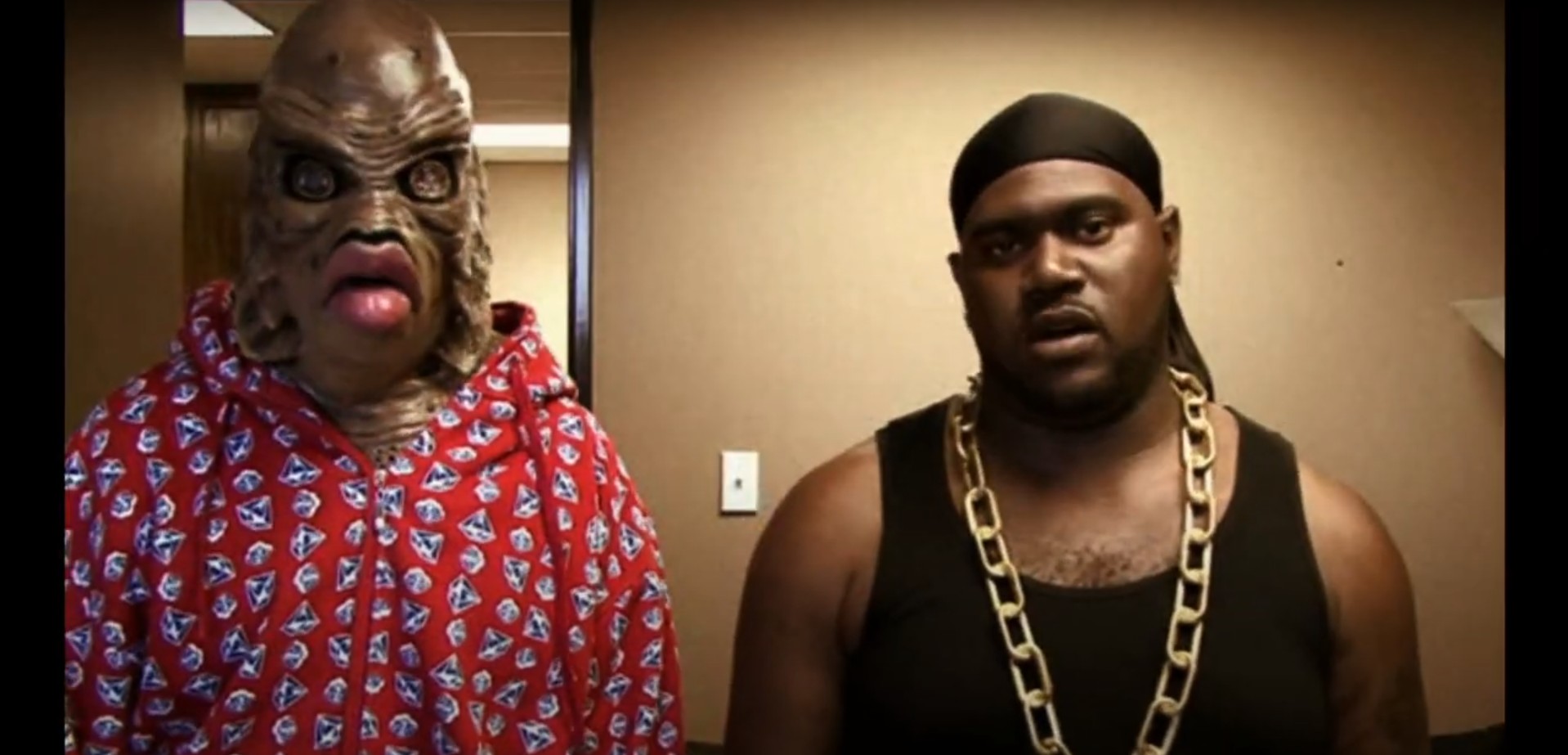
Thick-skinned actors comfortable with the narrative’s uncomfortable themes begin with Howard Calvert and Jamelle Kent as Baking Soda and G.E.D.  Calbert and Kent have become regulars in the Tom Martino catalogue of cast members for his more recent films and their humble beginnings in “Race War:  The Remake” proved their longevity to stay with the director, who is white, who wrote extensive race, gender, sexuality, and fart jokes in the context of a comedy-horror with cringy stereotypes and genuine tributes.  Calvert and Kent have great comedic timing to pull off all the zany editing, sound bites, and practical effects distaste Martino has flaming axe tosses at them to achieve his vision.  The two are joined by Danny McCarty, who would become another regular and be the visual effects supervisor for the film, dressed head-to-toe in loose-fitting urban attire to match the theme of Calvert and Kent’s black A-shirt and do-rags but his hands and face are masked to become the Creature from the Black Lagoon, aka Kreech.  Martino’s “Race War:  The Remake” isn’t just about the terrestrial races but intergalactic ones as well and we soon see that later on with the intentions of neo-Nazi white drug suppliers, led by Matt Rogers’ vulgarity in the horseshoe mustached Tex.  There are various other encountered gross stereotypes in the trio’s urban quest, such as a large nosed, greedy Jewish lawyer, Mexican luchador bodyguards, and a Pai Mei-esque Shifu speaking gibberish har har sounds and listing off popular Americanized Chinese dishes in attempt to be derogatorily funny.  With a film titled as “Race Wars:  The Remake,” the cast is mostly white and black actors poking uncouth fun with a big unconcerned and insensitive stick with Corey Fuller, Kerryn Ledet, Sam Rivas, and Coady Allen listed in the cast.

“Race Wars:  The Remake” isn’t funny, it’s stupid funny!  Having grown up in the 1980-2000s, consciously I might add, Martino’s politically incorrect and his brand of juvenile humor resonates with me, reminding me how cinema has become numb to the spoof humor.  Granted, Martino’s humor is over the top cutting, gross, and full of jest bigotry, traits that would trigger many in today’s sensitive awareness, and while cringy after a tasteless joke may result, there’ll likely be some a side of the mouth chuckle to go along with it.  On the opposite side of the spectrum, Martino tributes to references of certain popular culture icons, though slightly bastardizing some for laughs.  From Peter Jackson’s “Bad Taste,” to “Creature from the Black Lagoon,” to even “Mortal Kombat,” “Race Wars: The Remake” integrates the best parts of each these staples of pop culture and that gives his film a leg up on other offensive spoofs of the same crass caliber.  Th one negative story structure item to  highlight is the act one narrative takes a while to work the gears and get going as it attempts to setup the 40oz-drinking chumminess of Baking Soda, G.E.D., and Kreech but lags to a stagnant stall for hot second while still surround with the here-and-there gags, themed with G.E.D. homosexual tendencies and Baking Soda’s drug peddling woes on and off the streets, but once the antics pickup, there’s no stopping Martino and his filmic entourage from raining down an assault of insults. 

If you’re easily offended or put off by off-color race comedy, then Wild Eye Releasing’s “Race War:  The Remake” DVD is not for you!  For me, and those like me, unaffected by the type of uncouth spoof, Tom Martino’s debut is for you!  The Raw & Extreme sublabel’s DVD is MPEG2 encoded, 720p resolution, on a DVD5.  Presented in widescreen 1.78:1 aspect ratio, there is a breadth of visual presentation not confined within’ pillar and letterboxing but is stretched vertically that affects the already par level resolution.  Guerilla filmmaking also involves no production lighting and natural lighting is more than used here in Martino’s run around the Houston area, but one thing good about Martino’s naturally lit cinematography is its neutral set, avoiding under and overexposure.  The lesser used interiors have some tint lighting and key lighting to avoid total flat, dark outcomes but give the image a haze of hue, especially inside Baking Soda’s living room scene in the first act that sees a thin layer of red and green.  The English PCM Stereo has inconsistencies in volume.  Some scenes discern quieter than others because of the guerilla filmmaking constraints as well as just using commercial recording equipment.  However, the dialogue does land well enough for the jokes to hit and overlayed sound effects greatly lift the sound design where needed, such as with the Mortal Kombat video game sequence or with the array-spray of gunshots throughout and soundboard gag effects.  There are no subtitles with this release.  Included in the special features is Tom Martino director’s commentary, a gag/blooper reel, a behind-the-scenes reel of the gory moments, and Wild Eye Releasing trailers that include “Race War:  The Remake.”    The clear, ECO-Light Amaray DVD case houses stellar covert art illustration work by Belgium graphic artist, Stemo, with the inlaid narrative intensity and characters in collage.  The reverse side includes a gory still from one of the scenes.  The disc is pressed with the same front cover image but there are no other physical materials.  The unrated DVD runs for 95 minutes and is region free.

Last Rites:  Wild Eye Releasing re-unleashes another outrageous title on their Raw & Extreme label and the Tom Martino film is every ounce of the sentiment in it’s indie underground hokum of gore, racism, homosexuality, and aliens! 

Get Caught Up in the Middle of a “Race War: The Rmeake” on DVD

Are You Ready for EVILLLLL! “Visceral: Between the Ropes of Madness” reviewed! (Unearthed Films / Blu-ray)

Step Into the Ring with “Visceral: Between the Ropes of Madness” On Blu-ray!

A low-ranking boxer is set up with a match of a lifetime.  Quiet but confident, his manager doesn’t exactly have a faith in the underdog, constantly questioning his training with gambled money on the line.  When the boxer is beaten to a pulp in the ring, he’s immediately disowned by the unsympathetic manager and spirals out of his training and into darkness, finding murdering young women to be more pleasurable than the pain of loss and rejection.   His darkness in death incites a demon, perhaps even the Prince of Darkness himself, if the form of a half-naked woman with a distorted face and places him under her ward, forcing him into submission of pain and suffering while also commanding him to collect souls for her through his own tasting menu of torture.  The boxer’s life is told in three different stages of time on how he becomes evil’s most prized champion.

Accurately titular described, “Visceral:  Between the Ropes of Madness” pushes deviant instinct over everything else, a formidable urge to listen and adhere to those intrusive thoughts, especially after one’s lifelong goal, their most prized position, is creamed and squashed for good and forever in a humiliating way.  Writer-director Felipe Eluti uses hopelessness as pure evil’s plaything, turning a dedicated fighter being managed by Hell for the sake of not only revenge but also to fill the emptiness of the Netherworld with tortured souls.  The Chilean born and film schooled Eluti debut feature also enacts him to star as the demented boxer in a gore-soaked, ringside performance that moderately excites and intensifies with rope bondage as one of his character’s key motifs.  The extreme exploitation thriller is under the producing team of Sebastián Amenábar, Cristóbal Rivera, Andres Palma, and Daniel Vivanco.

Felipe Eluti is a one-man steamroller as the unnamed boxer leaving a laid-to-waste corpse trial in his wake.  Going virtually pantomime through the entire quasi-plotted narrative, Eluti conveys an apathy through blood and body language as well as utilizing his unsettling glare underneath different stages of head and facial hair growth from his time as a slimmed down, smooth-shaven boxer to a Curly-do’d, five o’clock shadowed, and expressionless shell of a human being.  From an outsider’s characteristic perspective, the boxer can be considered pathetic by preying down upon and torturing to kill smaller women in what is almost a result of retaliatory motivation after his brutal loss and he literally uses their bodies as his personal punching bags of stoic anger and hate.  The demon also presents itself in the form of a woman named Judas (Carolina Salles), cladded in bondage ropes, speaks in a whispery, omnipotent voice and visits him with a twisted face to represent the evil, or even the ugliness, she embodies, or the boxer sees in all his feminine victims.  Personified as a woman who tortures, beats, and verbally belittles him into a pacifistic submission only amplifies his dark crusade of soul collection.  Other than the boxer’s manager, a porn addicted, condescending loudmouth by José Manuel García, the remaining cast is filled with fleetingly visited torture victims, mostly women who are also voiceless and have little-to-no fight in them until the boxer works up to courage near the end for revenge which he can call his own, and Gabriela Aranchibia, Valentina Varela, Tamara Zuñega, Daniela Pardo, Pia Cardenas, Claudia Mena, Carolina Palacios, and Felipe Ruiz fill in those fated roles. 

While Felipe Eluti’s boxing themed gory shocker and exploitation rope-a-dope is definitely not a Rocky Balboa prime time fight film, “Visceral:  Between the Ropes of Madness” favors severe mental deterioration over an underdog beating the odds with glorifying the ultra-violence.  The strange-faced Judas pertains only to the Boxer’s vision or presence, conjured by feeding off the fighter’s anguish and indoctrinating him through pain, suffering, abuse, torture, and the most horrible like to do the demon’s bidding without resistance or fear.  The boxer’s kidnap and slasher traits shows a motif dominance over women that could possibly stem from most of the Freudian theorized root of a lot of evil doing, mother issues.  Supporting this scenario is the boxer’s visit to his mother.  Face never shown within the thicket of a deep shadow and directed toward a glowing television set, the avoided boxer seeks self-satisfaction approval and support from presumably his one and only blood relation on this planet, but the attentive mother denounces him, rejects him, and belittles his existence as the worst thing to ever happen to her just before his big match.  Eluti’s arthouse direction focuses on the boxer’s lack of love, support, and concern for his wellbeing and uses that the-world-vs-me detestation as a fuel and resupplied by his submission to Juda’s verbal and physical abuse to carry on his hate-filled and apathetic tear of women.  

Unearthed Films, a leader in producing and distributor extreme, ultra-violent and gory movie content brings “Visceral:  Between the Ropes of Madness” into the squared circle with a new Blu-ray release of Chilean production.  The single layered BD25 is AVC encoded and presented in a high-definition, 1080p resolution, with a widescreen 1.77:1 aspect ratio.  Cinematographer Tomas Smith’s approach to the content serves up stark and severe drab with a lifeless parallel to the apathy spree of the Boxer’s dark undertaking.  Heavy on grays and browns, there’s hardly any pop of aesthetic style or color but is counterbalanced by some interesting just obscure or to the side framing that ignite more imagination than having the scene spelled out for you.  There are also other interesting visuals with Judas and inside the Boxer’s mental state that don’t allow much in the way if finer details but allure to and speak of motivation and context.  The divided darkness through provides plenty of opportunities for compressions issues on a lower capacity disc compression but there’s not a whole lot to speak in way of artefacts.  The Spanish PCM 2.0 mix plays the familiar tones of an arthouse gore film by giving more stock to the soundtrack than to the dialogue.  While the dialogue is apparent despite the Boxer saying very little and Judas’s voice done in post, composer René Roco has free reign to be industrially glum above the whimpers, cries, and screams of the Boxer’s tortured women.  Ambient action is perceived post-product separation as the sounds don’t necessary match or synch in frame with the carnage and the environmental ambience is reduced to near nothing with low levels murmurs of city life stock sounds in the exterior scenes.  The English subtitles appear accurate and match well with in-scene prattle.  Extras include a commentary with director Felipe Eluti, a post-showing speech at the Cineteca Nacional’s Massacre in Xoco, Mexico City circa 2013, a behind-the-scenes gallery, and a teaser trailer.  The reverse cover liner art inside the clear Amaray case has barely safe for work primary of the mad Boxer and a bloodied woman bound in rope and a not safe for work cover that focuses on a bare-chested and rope bound Judas, both in contrasted to a deep inky void background.  There are no insert liner supplements and the disc is pressed with the same NSFW cover art image.  The not rated, region A encoded release has a runtime of 76 minutes.

Last Rites: Glorifying hopelessness through violence, “Visceral: Between the Ropes of Madness” is a round-for-round degression from failure through the dreary lens of director Felipe Eluti and his kink for rope bondage that sets forth an unstable champion amongst the maidenly defeated.

Step Into the Ring with “Visceral: Between the Ropes of Madness” On Blu-ray!

With Fame Comes Absurd EVIL Exploitation. “A Tale of Sorrow and Sadness” reviewed! (Radiance Films / Limited-Edition Blu-ray)

Limited Edition Blu-ray of “A Tale of Sorrow and Sadness” Now Available!

To compete against a rival fashion magazine who found profound success after hiring a famous gymnast as their spokesmodel, an ambitious fashion company sees potential in amateur golfer Reiko Sakuraba with her beauty, grace, and a decent enough golf game.  The only problem is Reiko has not won a championship.  The fashion company representative and Reiko’s sport’s columnist writer/manager/boyfriend Miyake strike a deal to get intensely train and mentally exhaust Reiko to be the best by the next tournament.  When Reiko outperforms the tournament’s veteran players, she instantly becomes a fashion icon and celebrity that leads to her own show for the magazine, photoshoots, and a large house in the middle of the suburbs.  Miyake’s aloof behavior continues even after Reiko’s success and while he drives her back home, he hits-and-runs a woman form the neighborhood who blackmails and guilts Reiko into letting her into the rich and famous lifestyle.  Reiko’s mental health slowly declines as pressures mounts.

“A Tale of Sorrow and Sadness” is a tale of how the sudden rise of fame and fortune can quickly lead to world of hurt through inexperience, obsession, misguided love, abuse, and the day-to-day tasks that can even burden even the most common person.  The story also represents a dichotomy between fame and the mundane.  The 1977 Japanese surreal drama is helmed by Seijun Suzuki, a filmmaker once blacklisted by the head of Nikkatsu Studios after his film for the company, “Branded to Kill,” was deemed terrible by Nikkatsu execs, and rode the filmic bench for nearly a decade until his theatrical release of the Shochiku Ltd. Released production that allowed him the freedom for artistic expression.  Also concisely known as “A Tale of Sorrow,” the Suzuki picture is written by Atsushi Yamatoya based off manga by Ikki Kajiware and produced by Yoshiki Nomura, Kenzo Asada, and Tokuya Shimada.  

Yoko Shiraki steps into the tragic golf-cleated shoes of golfer-turned-spokesmodel Reiko Sakuraba who finds herself unknowingly being exploited as object of marketable objectification.  What’s interesting about Sakuraba is she’s totally alone amongst other adults in a real cutthroat and cruel way through her trajectory of success.  In the fashion world, the magazine representative behind the concept (Masumi Okada, “The Living Skeleton”) only wants her for her beauty and success, her boyfriend Miyake (Yoshio Harada, “Lady Snowblood 2:  Love Song of Vengeance”), and even an once starstruck housewife, Kayo Senba (Kyôko Enami, “Killer Whale”) who was struck by Miyake’s car and resents Reiko’s, blackmailing her way into the superstar golfer’s life by forcing her hand to relinquish all from her worldly possessions to her mind, body, and soul.  Shiraki gifts Sakuraba the fault of inability to say no with her innocence and naivety ravaged and exploited beyond the point of no return and beyond repair but Sakuraba clings to dear life, perhaps even sanity, because of tone person that too only reacts negatively around her but since their blood reaction is thicker in the watery connections manipulating her, Sakuraba’s hand is forced to do much all of the golfing and modeling hell for her adolescent younger brother Jun (Tetsu Mizuno), a smart yet reclusive boy with off screen aggression getting into fights with school bullies stemmed likely by his sister’s constant absence.  Sakuraba’s not only a slave to external obsessions of success, image, and greed but also a slave to internal obsessions with Mikyake who deprives her of the most basic primal needs for financial gain and for manipulative control.  Kôji Wada, Shûji Sano, Noboru Nakaya, sao Tamagawa, Tokie Hidari, and Jô Shishido co-star.

“A Tale of Sorrow and Sadness” is Seijun Suzuki’s tour de force return to feature films.  A linear narrative speckled with surrealistic doses creates an unsettling and bizarre atmosphere of strongarm manipulation on the unassertive character of Reiko Sakuraba.  Her raw talent is mined and minced without much consent and pushed past mental exhaustion and collapse in what is an all too true theme surrounding the early television era of celebrity branding with esteemed figures being puppets for large scale companies in order to sell their promoted products.  Money, image, and success steer the helm without any due remorse to the elegant centerpiece of the room, driving Suzuki’s social commentary to extreme levels of misappropriation of a human person with feelings and ambitions of their own.  Instead, Reiko’s meekness is measured by Suzuki’s fabricated milieu of mistreatment represented partly in a behavioralism of semi-surrealism – Miyake’s stoic aloofness, Senba’s brazen hijack of Reiko’s fame and wealth, and even Jun’s withdraw and reclusion are all good archetype of strange conducts illegitimizing Reiko as person.  She’s dehumanized so much so she stops whatever little rationality she had to begin with and becomes a vessel of command that allowed those around to walk all over her.  Suzuki’s suburban reach toward fame theme is satirical for “A Tale of Sorrow and Sadness’s” thin blanketing of dark comedy and the filmmaker often accentuates the moments with elongated sequences, randomized bits of eccentricity, and highly stylized contrasts of sex and violence as well as commercially sensationalized imagery versus Stepford wives’ expectations.

A bleak absurdist dream, “A Tale of Sorrow and Sadness” becomes rightly a part of the Radiance obscure, high level lineup with a new, limited-edition high-definition transfer Blu-ray release.  The AVC encoded, 1080p, BD50 receives the high definition transfer from the Shochiku Corporation, who currently distributes a fair amount of Anime and since “A Tale of Sorrow and Sadness” is adapted from a Ikki Kajiware’s Manga, the film fits right in, and is presented in by Radiance in the original aspect ratio of a widescreen 2.35:1.  Radiance’s image quality surpasses expectations as visually bold in a wide variety of contrasting colors, especially in primaries of yellow and reds juxtaposed against achromatic shades of brilliant whites and deep blacks.  The original print is beyond pristine with virtually no dust, dirt, scratches, or any kind of visual impediments in what appears to be a well-preserved 35mm reel.  Skin tones appear naturally organic and textures pop in their specific fabrics inside an overlay of natural stock grain for that bare-faced aesthetic of clear based film strip.  The Japanese uncompressed mono PCM audio, again, surpasses expectations with a diverse mix through a single output that creates excellent note individualism rather than an indistinct amalgam.  The omitted compression codec provides the original audio framework comfortably upholding against the test of time without a flurry of issues in the single layer.  Hissing, popping, crackling and other types of interference are kept either suppressed or to a bare minimal in another pristinely kept transfer.  ADR dialogue clearly affixes to the images with synchronous efforts being no worse compared to other films of the era out of Japan.  The newly improved English subtitles render without error, are compositionally more-or-less within syntax range of translation, and pace nicely throughout.  Special features include a new audio commentary by film historian and author Samm Deighan, a new interview with assistant editor Kunihiko Ukai, and the film’s trailer.  The clear Amaray case contains Sam Smith commissioned artwork on an obi-strip included reversible sleeve – primary cover composition is of a live still of exhausted Reiko Sakuraba lying next to a bunker with a spirally title font and the reverse cover is more NSFW with a partially nude Reiko with boyfriend Miyake portrayed in soft, dreamy glow.  The white and red disc is pressed with eye-pleasing contrast and the inserted 31-page color booklet provides cast and crew credits, essay “Sorrow, Sadness, and the Sweet Smell of Excess” by Radiance regular contributor Jasper Sharp, an archive essay “The Realisation of a Seijun Sizuki Film” by Atsushi Yamatoya, and the Blu-ray acknowledgements. “A Tale of Sorrow and Sadness” Radiance Blu-ray has a runtime of 93 minutes, is unrated, and since Radiance is a UK boutique label, collectors and film aficionados will get the best of both worlds with a region A and B playback.

Last Rites: Seijun Suzuki’s return to theatrical feature films with “A Tale of Sorrow and Sadness” is a remarkable comeback for the ages and the decade interruption didn’t even cause a missed step for his artistic expression of exploitation and consumerism control ruining young, raw talent which is a clear-cut archetype of sorrow and sadness.

Limited Edition Blu-ray of “A Tale of Sorrow and Sadness” Now Available!