Is Your Disturbing Library This EVIL? “Reality Killer” review! (Treasured Films / Blu-ray)

“Reality Killers” Entering the U.S. Torture Porn Market! Buy it Here!

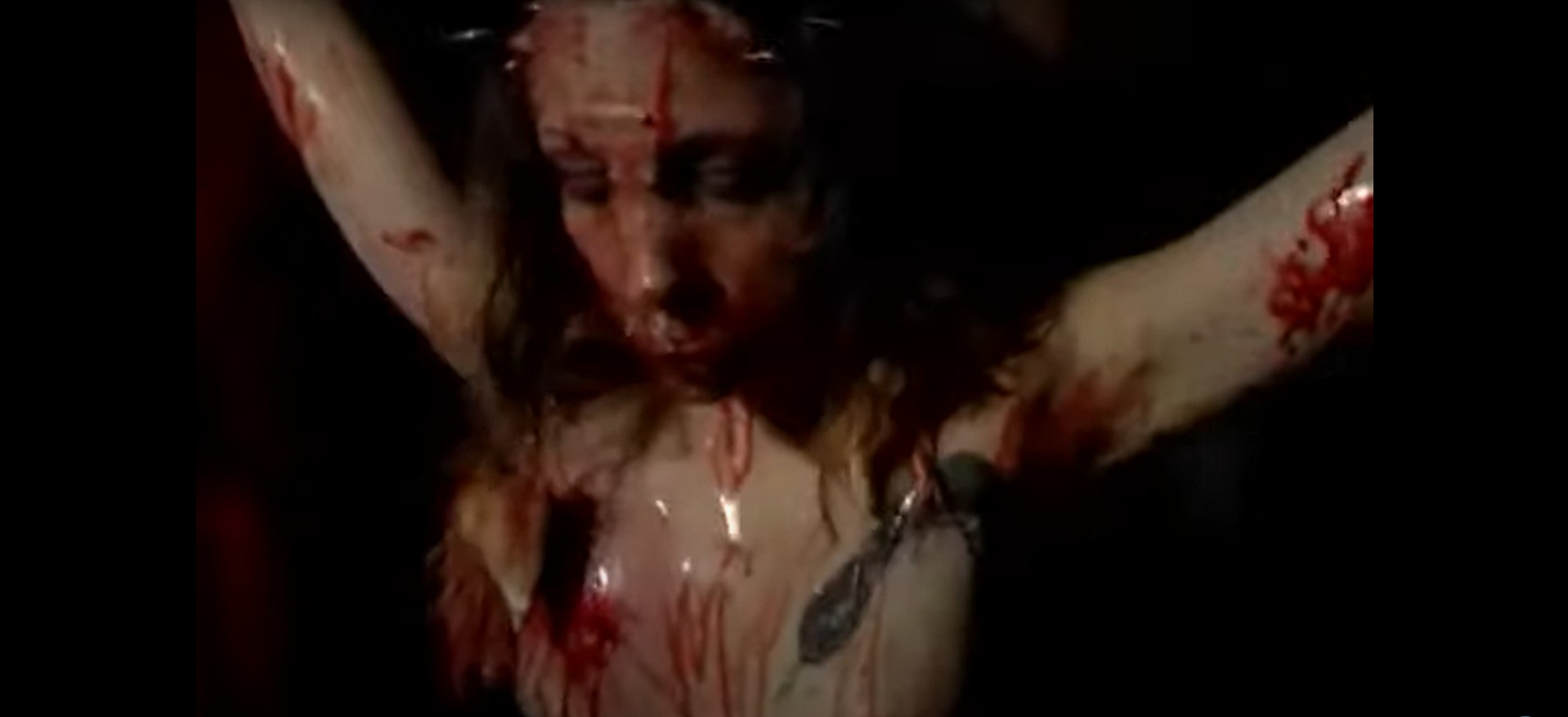
Serial killer known as “The Sculptor” narrates his obsession and love with documenting the stalking, capturing, torturing, raping, and killing of his victims.  As he watches and video tapes his next target, Mary, from afar, a woman he’s chatted with online extensively about recording home snuff movies, The Sculptor opens up his personal library of snuff movies, labeled and numbered dark web bought tape cassettes exhibiting the videoed brutal deaths of strangers by strangers for their pure sordid joy of taking another life.  An adventurous couple lure a promiscuous young girl on the promise of a threesome, a group of three masked teens take pleasure in the torture of a young woman, a couple enticement a child to their backyard pool, father and son roam the streets for call girl action and a little home invasion, and an underground, all-female rock band’s music video takes male fans to new extremes.

A title and a film unabashed and fully accepting the phrase torture porn, as if it’s a pithy elucidative to be proud of, “Reality Killers” is a shot-on-video, found footage anthology and snuff horror from 2005 helmed by “Witch Story” director and “Body Count” writer Alessandro Capone.  The Italian production contains shorts and a wraparound story that connects them together in an ugly tale of sadism, written by four aspiring, young filmmakers in Pablo Dammicco (“A Deadly Compromise”), Francesco Maria Dominedò (“Dedalus”), Volfango de Biasi (“Help!  My In-Laws Are Vampires”), and a writer simply known as Zedd with Alessandro Capone also contributing with his own screenplay while project managing filmic newcomers as they shoot mostly in Los Angeles using American actors.  Alternatively known under the title of “Project K,” the 2005 film of nihilistic sadism is produced by Eagles Pictures’ Ciro Dammicco and Pablo Dammicco and executively produced by Luca Dammicco and Fabrizio Manzollino.

“Reality Killers” is one of those rare breed films that shares a connection with pictures 70+ years it’s senior with having no after credits.  With no before or after cast credits, acknowledging the cast and their ignoble roles is a challenge to say the least.  If fact, it’s impossible.  The wraparound segment with The Sculptor has some clarifying character elucidation online connected to one of the more well-known Italian extreme violence and horror filmmakers in modern times with Domiziano Cristopharo, director of the surrealistic yet broad-stroked with intense visceral “Confessions of a Necrophile Girl” and “House of Flesh Mannequins,” in a role credited as The Monk.  However, there seems to be some melding overlap between The Monk and the large, oiled-up, and masked concentrated sadist on screen in the wraparound story, played by Valter D’Errico, in a disturbing show of vain and perverse expression.  Alongside D’Errico, in a handful of scenes of being stalked around a metropolitan city and in a naked position of vulnerability on D’Errico’s slab of slaughter, is Cristina Puccinelli (“Phantasmagoria”) playing as the aspiring snuffer enthusiast and killer as well as the online conversationalist Mary who turns prey to her own betrayal going against and essentially humiliating a masterclass maniac like the oily and masked maniac.  After that and within the shorts, none of the other actors are repeated or credited for their work that waver between being exaggeratedly overacted and staged to the point of disingenuous means and the thought of the inflicted violence that spur a subtle creepiness.

The trouble with “Reality Killers” is the inherent topsy-turvy post-production that revamped the anthological storyline with a linear outer story with an anthological storyline connected with a threadbare connected wraparound.  Initially story structured with a sheriff unearthing a library of snuff films and going through selected VHS examples of the killer’s cache with a journalist to explicate the rare breed of butcher.  The videos were also lengthier, more narratively in depth of character and plotline, and have digestible connective tissue with the main shell story that’s redesigned for a body round and glistening, conventionally narcissistic, masked chatterbox, “The Sculptor,” who’s just a physical and commanding orb of a presence in a dark and grimy setting, spouting a deluge of devilish details about his devotion to snuff filmmaking and his own contribution to the perversion.  The told tales vary in degree of both explicit violence as well as story structure as some become more glimpses than a perusal of a three act analog anecdotes to which, in all fairness, found footage, especially pulled from VHS, are only short-lived windows into the lives of others, literally short-lived.  The vignettes are mostly hyper concentrated on the gore, leaving little room for a yard to build, lengthen, and become deeper to invest audiences when the decisive moment comes to take a life with sociopathic heartlessness.  However, “Reality Killers” pales in comparison to the likes of others, such as Fred Vogel’s “August Underground” features that really hammer down on violence and gore with sickening special effects and concentrated shock.  Capone’s entry into the niche subgenre feels reversed at times, never really going for gold in the gutting of precious human life, but the film still evokes a visceral response to the extreme content. 

“Reality Killers” arrives into the U.S. market hailing from the UK label Treasured Films, squeezing itself into the ever tightening commerce of boutique distributors.  Treasured Films’ debut special edition Blu-ray is MPEG-2 AVC encoded, 1080p high-definition resolution, BD50 is presented in a 1.33:1 aspect ratio and either scanned through a VHS record or implements a VHS or commercial handheld camera filer to achieve that passé effect that’s slowly making an aesthetic comeback.  There’s not a ton of other stylistic options used in the vignettes to instill a realism effect and result while the wraparound ups the contrast and grades darkly into its grim substance, leaving attenuated tones of yellows, greens, and reds to be coloring that seep through the oily voids.  The featured presentation carries more of the filtered aspects but in the special features’ Original Production Scenes, the alternate telling of “Reality Killers” embarks on a cleaner, conventional approach in the different outer story with the vignettes either slightly less boxed in by a matte or are outright more defined.  The audio track is an English DTS-HD stereo.  Though an Italian production, the vignette actors are primarily American and the wraparound story is voiced over.  Dialogue coincides with an onboard camera mic that picks up every little detail but also captures varying degrees of volume.  Discerning clarity is, must I say, pretty excellent for the differing sub-productions without an overbearing lopsidedness that usually stems with some who don’t have the technical knowhow to engineer audio precision; each episode achieves what’s strived for without interference, or even with the physical release, compression issues.  English subtitles are available.  Special features include a new interview with director-producer Alessandro Capone From Witch Lore to Snuff Gore in Italian only with English subtitles, a new interview with coproducer Gabriele Pacitto A Killing Reality in Italian only with English subtitles, a new English language essay by Giacomo Calzoni Cutting Deep :  Mapping the Origin of Torture Porn which takes a look at films like “Saw” and “Hostel” that generated the coining of descriptor torture porn and how it influenced horror pop culture, a teaser trailer, storyboards, and an image gallery.  The Original Production Scenes I’ve mentioned previously tells a completely different story and, in my opinion, is more interesting with longer story sequences, more nudity and gore, and the first vignette is scored with music from Nine Inch Nails, specifically “Dead Souls” from The Crow soundtrack, which adds another element to the coarse-riddled subject matter.  Treasured Films standard special edition set comes in a rigid slip box with a hazed face of the masked Sculptor.  The clear Amaray case houses new Ilan Sheady illustrative, compilation cover art in all its explicit detail with the same art pressed onto the disc.  Inserted is a 31-page color booklet with film stills, Blu-ray acknowledgments, and a David Flint essay “The Forbidden Films of the 21st Century” that discusses the films banned in Britian, which includes “Reality Killers’ rejected by the BBFC.  The all-region release has a runtime of 75-minuts and is, obviously, not rated.

Last Rites: Torture porn snuff films are, for a lack of a better world, repetitive in their controversial narrative and “Reality Killers” is no exception but it’s the style choices that and effects that entertain us or makes the sweat run down our brow. Alessandro Capone’s entry to torture porn has a visceral bite but isn’t the repulsive best-of-the-worst. Yet, Treasured Films’ entry into U.S. market is remarkably unforgettable.

“Reality Killers” Entering the U.S. Torture Porn Market! Buy it Here!

Are You Ready for EVILLLLL! “Visceral: Between the Ropes of Madness” reviewed! (Unearthed Films / Blu-ray)

Step Into the Ring with “Visceral: Between the Ropes of Madness” On Blu-ray!

A low-ranking boxer is set up with a match of a lifetime.  Quiet but confident, his manager doesn’t exactly have a faith in the underdog, constantly questioning his training with gambled money on the line.  When the boxer is beaten to a pulp in the ring, he’s immediately disowned by the unsympathetic manager and spirals out of his training and into darkness, finding murdering young women to be more pleasurable than the pain of loss and rejection.   His darkness in death incites a demon, perhaps even the Prince of Darkness himself, if the form of a half-naked woman with a distorted face and places him under her ward, forcing him into submission of pain and suffering while also commanding him to collect souls for her through his own tasting menu of torture.  The boxer’s life is told in three different stages of time on how he becomes evil’s most prized champion.

Accurately titular described, “Visceral:  Between the Ropes of Madness” pushes deviant instinct over everything else, a formidable urge to listen and adhere to those intrusive thoughts, especially after one’s lifelong goal, their most prized position, is creamed and squashed for good and forever in a humiliating way.  Writer-director Felipe Eluti uses hopelessness as pure evil’s plaything, turning a dedicated fighter being managed by Hell for the sake of not only revenge but also to fill the emptiness of the Netherworld with tortured souls.  The Chilean born and film schooled Eluti debut feature also enacts him to star as the demented boxer in a gore-soaked, ringside performance that moderately excites and intensifies with rope bondage as one of his character’s key motifs.  The extreme exploitation thriller is under the producing team of Sebastián Amenábar, Cristóbal Rivera, Andres Palma, and Daniel Vivanco.

Felipe Eluti is a one-man steamroller as the unnamed boxer leaving a laid-to-waste corpse trial in his wake.  Going virtually pantomime through the entire quasi-plotted narrative, Eluti conveys an apathy through blood and body language as well as utilizing his unsettling glare underneath different stages of head and facial hair growth from his time as a slimmed down, smooth-shaven boxer to a Curly-do’d, five o’clock shadowed, and expressionless shell of a human being.  From an outsider’s characteristic perspective, the boxer can be considered pathetic by preying down upon and torturing to kill smaller women in what is almost a result of retaliatory motivation after his brutal loss and he literally uses their bodies as his personal punching bags of stoic anger and hate.  The demon also presents itself in the form of a woman named Judas (Carolina Salles), cladded in bondage ropes, speaks in a whispery, omnipotent voice and visits him with a twisted face to represent the evil, or even the ugliness, she embodies, or the boxer sees in all his feminine victims.  Personified as a woman who tortures, beats, and verbally belittles him into a pacifistic submission only amplifies his dark crusade of soul collection.  Other than the boxer’s manager, a porn addicted, condescending loudmouth by José Manuel García, the remaining cast is filled with fleetingly visited torture victims, mostly women who are also voiceless and have little-to-no fight in them until the boxer works up to courage near the end for revenge which he can call his own, and Gabriela Aranchibia, Valentina Varela, Tamara Zuñega, Daniela Pardo, Pia Cardenas, Claudia Mena, Carolina Palacios, and Felipe Ruiz fill in those fated roles. 

While Felipe Eluti’s boxing themed gory shocker and exploitation rope-a-dope is definitely not a Rocky Balboa prime time fight film, “Visceral:  Between the Ropes of Madness” favors severe mental deterioration over an underdog beating the odds with glorifying the ultra-violence.  The strange-faced Judas pertains only to the Boxer’s vision or presence, conjured by feeding off the fighter’s anguish and indoctrinating him through pain, suffering, abuse, torture, and the most horrible like to do the demon’s bidding without resistance or fear.  The boxer’s kidnap and slasher traits shows a motif dominance over women that could possibly stem from most of the Freudian theorized root of a lot of evil doing, mother issues.  Supporting this scenario is the boxer’s visit to his mother.  Face never shown within the thicket of a deep shadow and directed toward a glowing television set, the avoided boxer seeks self-satisfaction approval and support from presumably his one and only blood relation on this planet, but the attentive mother denounces him, rejects him, and belittles his existence as the worst thing to ever happen to her just before his big match.  Eluti’s arthouse direction focuses on the boxer’s lack of love, support, and concern for his wellbeing and uses that the-world-vs-me detestation as a fuel and resupplied by his submission to Juda’s verbal and physical abuse to carry on his hate-filled and apathetic tear of women.  

Unearthed Films, a leader in producing and distributor extreme, ultra-violent and gory movie content brings “Visceral:  Between the Ropes of Madness” into the squared circle with a new Blu-ray release of Chilean production.  The single layered BD25 is AVC encoded and presented in a high-definition, 1080p resolution, with a widescreen 1.77:1 aspect ratio.  Cinematographer Tomas Smith’s approach to the content serves up stark and severe drab with a lifeless parallel to the apathy spree of the Boxer’s dark undertaking.  Heavy on grays and browns, there’s hardly any pop of aesthetic style or color but is counterbalanced by some interesting just obscure or to the side framing that ignite more imagination than having the scene spelled out for you.  There are also other interesting visuals with Judas and inside the Boxer’s mental state that don’t allow much in the way if finer details but allure to and speak of motivation and context.  The divided darkness through provides plenty of opportunities for compressions issues on a lower capacity disc compression but there’s not a whole lot to speak in way of artefacts.  The Spanish PCM 2.0 mix plays the familiar tones of an arthouse gore film by giving more stock to the soundtrack than to the dialogue.  While the dialogue is apparent despite the Boxer saying very little and Judas’s voice done in post, composer René Roco has free reign to be industrially glum above the whimpers, cries, and screams of the Boxer’s tortured women.  Ambient action is perceived post-product separation as the sounds don’t necessary match or synch in frame with the carnage and the environmental ambience is reduced to near nothing with low levels murmurs of city life stock sounds in the exterior scenes.  The English subtitles appear accurate and match well with in-scene prattle.  Extras include a commentary with director Felipe Eluti, a post-showing speech at the Cineteca Nacional’s Massacre in Xoco, Mexico City circa 2013, a behind-the-scenes gallery, and a teaser trailer.  The reverse cover liner art inside the clear Amaray case has barely safe for work primary of the mad Boxer and a bloodied woman bound in rope and a not safe for work cover that focuses on a bare-chested and rope bound Judas, both in contrasted to a deep inky void background.  There are no insert liner supplements and the disc is pressed with the same NSFW cover art image.  The not rated, region A encoded release has a runtime of 76 minutes.

Last Rites: Glorifying hopelessness through violence, “Visceral: Between the Ropes of Madness” is a round-for-round degression from failure through the dreary lens of director Felipe Eluti and his kink for rope bondage that sets forth an unstable champion amongst the maidenly defeated.

Step Into the Ring with “Visceral: Between the Ropes of Madness” On Blu-ray!

Fulci Turns Back Time to Bring EVIL Back from the Dead! “The House of Clocks” reviewed! (Cauldron Films / Blu-ray)

“The House of Clocks” Delivers Time as an Illusion. Blu-ray now available!

An isolated Italian villa becomes the looting target for three thieves looking for an easy score.  Villa residents, an elderly couple, are tricked into letting them into their estate adorned with elegant clocks of all shapes and sizes but as the plane unfolds it goes awry when the imposing grounds man arrives and both homeowners are killed.  Yet, the villa owners were no saints and no ordinary couple as soon as the husband’s heart stops, the clocks begin to move counterclockwise and that’s when the peaceful villa turns into a strange nightmare where time goes in reverse and those short and long dead come back to life with wounds miraculously healed as if it never happened.  As time continues to reverse, the thieves find themselves trapped inside the house and on estate grounds being hunted down by the merciless grounds man, but the skeletons in the elderly couple’s closet will soon resurrect and be thirsty for vengeance.

“The House of Clocks” is the Lucio Fulci made-for-TV movie that never saw the light of television programing.  Deemed too gory and violent for public broadcast, Fulci’s 1989 Italian film, to which he created the concept for and the screenplay treated by the duo team of Gianfranco Clerici  of “Cannibal Holocaust” and Daniele Stroppa of “Delirium,” was shelved for many years until it’s eventual home video release because, as you can tell just from the high-powered Italian horror names attached to the project, the finished film would certainly frighten those general audiences with easy turn-of-the-knob and bunny ear-antenna access.  Also known natively as “La casa nel Tempo,” was a part of a four-film horror special surrounding a theme of the houses of doom and was a production of Dania Film and Reteitalia production companies with “You’ll Die at Midnight” and “Delirium” producers Massimo Manasse and Marco Grillo Spina serving as executive producers.

The film initially opens with Maria, the nosy for her own good housemaid, discovering two rotting corpses ostentatiously displayed in the villa’s chapel.  Why Maria (Carla Cassola, “Demonia” and “The Sect”) decides to snoop around is not explained but the act does start a chain events, leading up to elder Villa owners in Sara Corsini and her clock obsessed husband Vittorio, played by the role age appropriate Bettine Milne (“The King’s Whore”) and Paolo Paoloni (“Cannibal Holocaust”) in a lot more makeup and prosthetics to make him appear as an older man.  As mysterious senior citizens go, Milne and Paoloni are the malevolently cryptic under a façade of geniality, possessing and maintaining the corpses of their niece and nephew they’ve murdered in order to keep their wealth.  The backstory between the two pairs has vague clarity but there’s enough to keep the pistons pumping toward the crux of why the uncanny time about-face.  While, again, no sense of explanation on why time reverses, we’re under the assumption Paolo is essentially Father Time, a personification of the time concept represented as an old, bearded man with an hour glass and a scythe to represent a span from life to death.  When thieves Paul (Peter Hintz, “Zone Troopers”), Tony (Keith Van Hoven, “Black Demons”), and Sandra (Karina Huff, “Voices from Beyond”) put an end to the Corsinis, that is when time stops and reverses itself, affecting the once dead to return back to life, and creating a nightmare scenario for now three trapped thieves under the chase of not only the Corsinis but those also killed by the Corsinis as their deteriorating bodies rejuvenate into active flesh and bone as well as flesh and blood.  “The Beyond” and “Zombie’s” Al Cliver rounds out the principal cast and the overall cast with his menacingly evil, Corsini’s jack-of-all-trades grounds man with a scarred over eye and a double barrel shotgun to hunt down the thieves.

“The House of Clock’s” is quite an interesting concept without a durably designed reason for all the madnesses.  At its core, three thieves home invade an older couple for their valuable objects and accidently kill them in the process when the standoff goes bad.  With that oversimplified version of events, a hellish cog in the pocket watch gearbox links the old man’s ticker with the tons of tickers that adorn his villa home, causing a chain reaction of turn back the clock proportions to which audiences never receive a proper understanding and while this may bother a sample size few, most will find the story too weird, gory, and trepidatious tense to care in what becomes a fair-game free-for-all against all characters who don’t have an ounce of virtue.  The lot of thieves, schemers, and murders are all trapped inside time’s ill-reverse affect without a sign of slowing down and while it might seem advantageous at first for some, as time continues to revert, the worse the situation becomes as old adversaries emerge from their graves and tombs.  Fulci’s visualized gore also emerges through with the fantastic effects by Guiseppe Ferranti, including a high right through the crotch impalement.  Ferranti would also be behind the effects for two other the house of doom television movies.

“The House of Clocks” may not have been safe for television but for a new Cauldron Films Blu-ray, the Lucio Fulci film fits right in and comes in the nick of time!  Restored from a 2K scan of the 35mm film negative, the AVC encoded, 1080p high-definition, BD50 offers a visually invigorated, audibly astounding, and special features saturated release that presents Fulci’s lesser known and once previously shelved work!  Presented in a European widescreen 1.66:1, color saturation is beyond reproach with a beautifully natural grading that pops textures and objects right off the screen, adding density and tangibility to each.  Disc capacity affords the codec compression with no artefact issues in the reproducing of the encoded image that nearly replicates an ideal exhibition and appearance of a made-for-TV movie, especially in the macabre moment where extra slimy ooziness of the decaying corpses or the perforation of the servant’s crotch area is as clear as clear can get without misinterpretation.  Skin tones aren’t flared and are naturally set within a healthy, though smoother, grain layer.  The release comes with two audio mixes – a PCM English 2.0 mono and a PCM Italian 2.0 mono.  Both tracks are produced from ADR and have been scrubbed with no issues of hissing or crackling.  There’s a brilliant touch of echoing within the estate to create reverberations and a range, open quality to the exterior dialogue.  Vince Tempera’s synth piano is a ticking measure of modified vocals and integrated milieu elements with a organ tone like quality that’s ghoulishly soft.  English subtitles are optional on both mixes.  Special features include a handful of new interviews from behind-the-camera with cinematographer Nino Celeste Lighting the House of Time, composer Vince Tempera Time and Music, first assistant director Michele De Angelis Working with a Master, FX artist Elio Terribili Time with Fulci, as well as unmentioned archival interviews with actors Paolo Paoloni, Al Cliver, and Carla Cassola.  There’s a parallel audio commentary with film historians and critics Eugenio Ercolani, Nathaniel Thompson, and Troy Howarth who regularly step in to commentate on Italian horror.  Graphic artist Matthew Therrien designs an illustrative composition artwork, pulling inspiration from the film’s most iconic and chaotic moments, while Eric Lee designs the titular logo sitting pretty dead center.  The reverse side of the cover art displays a rotting hand still from the movie.  The 19th title has a clear Amaray that houses a cropped version of the front cover image pressed onto the disc, which is region free, uncut, and has an 83-minute runtime.

Last Rites: Most people wish they could turn back time. For Lucio Fulci and his penchant for beyond death, going counterclockwise in “The House of Clocks” is more frightening and deadly as time can’t be owned and controlled. Simply put, there’s just no stopping the sands of time, forwards or backwards, for the past will catch up to you and the future is mercilessly uncertain.

“The House of Clocks” Delivers Time as an Illusion. Blu-ray now available!

The EVIL is Not Just in the Virus, but Also in the Cure! “Side Effects May Vary” reviewed! (Tempe Digital / Blu-ray)

“Side Effects May Vary” From This Blu-ray Drug!

COVID-19 virus has the world masked up and social distancing in full effect with experimental vaccines being rushed toward a rollout.  For Glenn Rollins, being under the weather now for weeks still hasn’t convinced him to inject himself with experimental Government drugs meant to combat coronavirus but when wife Janelle does everything in her persuasive power to convince him to take the vaccine, Glenn reluctantly agrees to receive the shot at his doctor visit the next day.  What Glenn is given is no ordinary coronavirus vaccine, but the new Alpha-21 concoction just released for public intravenous inoculation, an rapidly tested serum that boils subjects from the inside-out.  Instead of completely exploding in a pile of blood and sinew, Glenn’s rare blood type maintains a semi-rigid form and the only way he can maintain from melting into a pile of goo is to feast on the blood and meat of the living in his zombified state.

The cult director behind “The Dead Next Door” and “Robot Ninja,” J.R. Bookwalter, returns to take a hypodermic needle stab at a world-crippling pandemic horror inspired by the COVD-19 virus and how the FDA rushed to approve emergency vaccinations on U.S. citizens in a comically satirical, gore-and-goo-filled comedy-horror.  The movie, “Side Effects May Vary,” is Bookwalter’s first film in over 20-years, the last being “Mega Scorpions” that only saw a streaming release due to a folding in the financing of a distribution deal.  “Psycho Sisters” and “Her Name Was Crista” writer James L. Edwards, who’s collaborated with Bookwalter since the very beginning of the filmmaker’s career, pens the script and also stars in the disturbing desquamation of Glenn role.  “Side Effects May Vary” is the second direct-and-writer production between Bookwalter and Edwards with the first being 1996’s “Polymorph.  As like many of Bookwalter’s films, he produces under his longstanding own indie label Tempe Digital serving as executive producer alongside Edwards producing and wife Lana Bookwalter as associate producer.

I wouldn’t call Glenn Rollins a right-wing conservative antivaxxer but, instead, Glenn’s a doubter of the vaccine’s testing measures with a range of side effects from an experimental injectable could cause from a vaccine so unproven swirling inside his head.  That’s the satirical concept Bookwalter and Edwards put into motion and deliver fully charged as mild-mannered Glenn gorges on the innards of family, friends, neighbors and strangers after unpleasantries arise from an untested product.  The likeable Rollins rears an ugliness brought upon by pressures of vaccination, especially from his wife Janelle, played by indie horror scream queen Tina Krause (“Crimson Nights,” “Bloodletting”).  Another scream queen of legendary acclamation is in on the fun with Brinke Stevens (“The Slumber Party Massacre,” “Sole Survivor”) as the saucy nosy neighbor who knows all the sexual acts by their sporty designations.  We journey from the beginnings of a substance subjugation and are wiggled into a buddy cop scenario between Glenn Rollins’ best friend and former cop turned private eye Jack Murray (Drew Foriter, “Trivial”) and his former boss and one-night-stand Chief Tom Danvers (“Floyd Ewing Jr., “Robot Ninja”) and their sudden thrust into an investigation to find Glen under their distinct impressions of his character, plus that one sexual encounter between them, makes for a good dynamic of sidetracking diversion that interrupts a constant flow, which can get stale, of formality and responsibility of chasing a killer.  The cast Sasha Graham (“Trivial”) as the prescribing primary care physician Dr. Fisher, Wendy Zier (“Trivial”), Tom Hoover (“Ozone”), and David Bachmeier (“Bathtub Shark Attack”) as the first scene test subject of Alpha-21’s explosive results. 

A relief will wash over fans to know J.R. Bookwalter is not dead in the water when it comes to directing.  A long hiatus was exactly what Bookwalter needed to get back to form after a string of mediocre horror that didn’t leave a bad taste in our mouths but wasn’t quite the standard of the Ohioan director’s carnage-laden caliber.  “Side Effects May Vary” spoke to nationwide fears during the global pandemic, in a humorously horrifying way, and even extends beyond that now historical portion of our time into the forefront of our minds that we may have not have yet seen the actual long-term effects of the COVID shots, if any.  The intention of “Side Effects May Vary” is not to instill fear, though does create a fraction of concern, but is more to the tune of exaggerated those once media covered and one-sided fears to the extreme by turning injected patients into boiling potato sacks of putrid cannibalism.  It’s pretty damn funny and gross.  To create a vibrant visual veneer, Bookwalter plays with different lighting angles and color gels of primary neon illumination that takes characters out of the real world and places them into a fantastical neon-noir that surrenders to the sexualized, the scandalous, and the scary story bits and pieces. The buddy-cop, manhunt storyline works as bodies are left as breadcrumbs for the two conflicting investigators that are on the precipice of making a final decision on Glenn Rollin’s fate while Glenn himself battles internally, both physically and emotionally, his wretched state that needs blood to slow down the process of his metaphorizing melting but his mild-manner, nice-guy identity doesn’t want to harm a soul. 

Tempe Digital castrates the COVID cure scare with an incredible liquescent comedy-horror in “Side Effects May Vary” on a director’s cut Blu-ray home video.  The AVC encoded, 1080p high-definition resolution, BD25 comes with a ton of color, contrast lighting, and a decent compression codec that makes the low-budget production appear a step or two up the upscale staircase.  The heavy neon light cuts into the skin and textural details but scenes more naturally lit, such as in the outdoors, fair better with more granular inside a digital presentation in its original aspect ratio of 1.78:1.  There are two English audio mixes available for selection and audiophile setup in a DTS-HD 5.1 Master Audio and a Dolby Digital 2.0 Stereo.  The surround sound selection has a semi-fluid dynamic that works in a contained closed to medium shot arrangement and doesn’t expand to anything beyond to warrant an immersive experience aside from a healthier fidelity of the dialogue, proximity milieu, and the gruesome creature sound effects.  Dialogue can get out of the reigned in alignment that breaks in with sparse unfiltered hissing but otherwise renders cleanly and clearly through the 81-minute runtime.  English subtitles are available.  Special features encoded are an audio commentary with director J.R Bookwalter, a Harris Theater Q&A in Pittsburgh at the Roadshow Opening Night with film guests Bookwalter, writer-star James L. Edwards, and actor Floyd Ewing Jr., a theatrical roadshow cut trailer, a teaser trailer, and the theatrical trailer. Art from the Alex Sarabia and Karl Munster collaboration gives a pulpy artistic rendition of Glenn Rollins oozing deterioration inside a clear Amaray Blu-ray with no supporting supplements other than a cropped version of the art on the disc. The not-rated, region free disc is a perfect cure for what ails you – bad indie comedy-horror done right!

Last Rites: A global pandemic killed millions of people, the silver-lining is now we can look back at that time of isolation and fear and honor those deaths with a coronavirus and rushed-cure blend act worthy of being to the likes of “Bad Taste.”

“Side Effects May Vary” From This Blu-ray Drug!

Let EVIL Give You a Hand! “The Beast Hand” reviewed! (Cleopatra Entertainment / Blu-ray)

“The Beast Hand” Grabs A Blu-ray Release! Buy it Here!

A derelict criminal Osamu Kogure finds himself back in the company of his jumped parole crime boss Akira Inui, Kogure is back to being a manipulated puppet at the whims of a conceited and aggressive Inui.  When Inui persuades Kogure to give up the whereabouts of an old, reluctant fling Koyuki Igarashi, who went through full body surgery to wipe away her past with Inui, Kogure and Igarashi are trapped by Inui’s bull-headed intimidation, forcing them into a rushed heist that ends with Korgure’s hand being severed.  A syndicate surgeon grafts a deformed, experimental monstrous limb on his wound that turns Kogure into a superhuman beast when provoked.  Now gone rogue out of the surgeon’s reach, Kogure and Igarashi are hunted down across the region by a powerful crime boss’s clan to extract the success of Kogure’s new, powerful extremity but the once timid and submissive delinquent will no longer go down without a fight. 

Taichiro Natsume, the director behind the Big Summer Psychic Team shark series, such as “Ring Shark,” “Love Shark,” and “Last Shark,” moves away from the supernaturally swimming maneater terrorizing the sands and lands surrounding the creature’s resident watering well and popping up out of the bathwater of those clutched in its curse, forgoes another shark infested entry for a monstrous transplant tentacle in his latest outrageous indie horror, “The Beast Hand,” aka “Koletise käsi,” or original titled “Kemonote.”  The Japanese film is one part science-fictional body-horror thriller and one part yakuza splatter strife and is all part penned from the mixed-up monstrosity and melancholy swirling inside Natsume’s mind with cowritten efforts from Yasunori Kasuga.  Lead actor Takahiro Fukuya wears multiple production for producing the production under his studio company Eigabatake that foots the partial budget combined with the crowdfunding remaining purse pieces to bring this splatter dream to reality. 

Takahiro Fukuya invests himself full throttle into the role of Osamu Kogure leading to his real life and role to nearly be parallel to each other as Fukuya quits his day job, spends most of his money, and, likely, leads a temporary pauper lifestyle, much like his character, in order to get his vision off the ground and into production.  Fukuya embodies the weak-minded aspects of a fragile delinquent, submissive to a much more apex predator in the recently prison released, escaped parolee Akira Inui (Yôta Kawase, “Slave Ship,” “Maniac Driver”) in a take-all, give-nothing leader position in what Inui considers is his gang, completed by Misa Wada’s objectified into sexual slavery of Koyuki Igarashi.  The pink eiga actress, of such hits as “Corpse Prison” and “Black Tears,”  has lingering anxiety and timorous defensiveness for her character’s subject of sexual and verbal abuse by Inui only for it to transfigure it into a slap-across-the-face affection for the even more cowardly Kogure in an unforgettable sex scene prior to the monstrous hand augmentation.  The second half of the story rather abruptly butts into Korgure and Igarashi’s departure of the city and into more humble means of making a go of their relationship, especially now Igarashi is months pregnant after their slappy-rollick on top of the sleeping bag sack.  Character exposition of the couple’s circumstances at this point is nonexistent as Natsume uses images and exterior shaping scenes to fabricate their current, still poor, state trying to make it work until the surgeon and the gang leader come to collect their handy work.

“The Beast Hand” embarks into different subcategories of splatter subgenre filmmaking.  Natsume certainly pays homage to the Japanese gore-and-splatter films in his own miniscule way but keeps the blood down to the minimal level allowed for labelling as such, but the filmmaker invests into the hardships of the accounted characters without unleashing too many background details or story dynamic particulars to that doesn’t allow audiences to become too involved leaving characters banally wrapped in their strife from point A-to-Z.  Instead, Natsume concenters around two sides of the story;  the first being the elegancy of Kogure and Igarashi’s unlikely and oddly misshapen relationship with scenes of beach walking, comforting, cheap meals in a humble home, and of course, the slap-happy sex scene of two belittled and downtrodden people tying one off in expressive fit of passion while the second part is more tension-riddled hearty with a yakuza hunt for Kogure’s one-of-a-kind beast hand.  Both sides balance awkwardly along a sporadically dotted line of limited detail and time passed but ultimately collide at a culminating point of a beast hand slaughterhouse when Igarashi’s safety boils up the beast from within Kogure, tracking “The Beast Hand” as a horror with to some extent a rivulet of romantism often clunky and riddled with holes. 

Cleopatra Entertainment distributes in association with Reel Suspects the Blu-ray release of Taichiro Natsume’s “The Beast Hand.”  The AVC encoded, 1080p high-definition resolution, BD25 decodes an anemic picture presented in widescreen 1.78:1 aspect ratio.  Visually, “The Beast Hand” has nothing going for it other than a clean experience with no aliasing, minor banding, and other immaterial compression issues.  The lack of color pop and the feather washed grading dampen with a lifeless aesthetic toward a Japanese splatter subgenre that’s literally soaked in a manga style or pop art.  Dialogue renders over cleanly and with clarity in a Japanese Dolby Digital 2.0 stereo that syncs timely with the forced, grammatically errorless English subtitles.  Immersive qualities are limited to the two front channels that are vigorous only during the intermittent action full of Lou Ferringo Hulk snarls and growls when Kogure goes full milky-eyed beast mode and good squishy Foley as stomachs and heads are eviscerated and sliced down.  Bonus features are typical run of the mill for Cleopatra Entertainment with a cache of trailers for the company’s recent releases.  There’s also marketing promo clips for “The Beast Hand” but in Japanese without English subtitles.  The standard Blu-ray Amaray encases a decent, and uncredited, original photoshop illustration that is, however, partly inaccurate, and awkwardly arranged with a beast hand resembling nothing like the body horror hand transplant in the movie.  The cover feels like right off the commercial printer, raw homemade art.  Inside is the same art pressed to the disc with no other accompaniments.  The region free, not rated Blu-ray has a runtime of 77 minutes. 

Last Rites: As far as J-horror goes, “The Beast Hand” has average appeal inside a strung along story and not enough absurd Japanese off-the-wall concepts and violence to stand out amongst the crowded subgenre.

“The Beast Hand” Grabs A Blu-ray Release! Buy it Here!