On Christmas day, Diane, a widowed mother, has her dysfunctional children and their families over to celebrate the festive holiday at the remote family home set in the countryside Outback. When a black cloaked stranger with a face wrapped in white cloth strips arrives at her doorstep, Diane’s good heart and generosity invites the peculiar man inside in order to not celebrate Christmas alone, but when the religiously zealot stranger reveals a letter and begins to read from it out loud, the mother of four is shocked and angered by the content and violently has him thrown out of the house, threatening him to never return. As night falls and all is calm considering the families offbeat relationship, the stranger lurks outside, waiting to seek deadly vengeance upon a family that houses dark secrets; secrets written on the pages of the stranger’s letter that connect him to Diane and her four children and he’ll stop at nothing to unearth the truth, to get the answers he desires, from Diane, even if that means slaughtering them all to pieces to get it!

“Red Christmas” is the Craig Anderson written and directed holiday classic that spills a lot of blood and sucks out completely the christmas spirit. Under the cloak of a prevalent hot and debatable topic, the social commentary aspect of “Red Christmas” blends an unapologetic slasher with turbulent subject matter that can strike chords with just about everybody, especially parents with special needs children. However, Anderson owns a black horror comedy wrought hard in exhibiting a family with unintentional aspirations to be the worst family in the world with eclectic characters ranging from religious fanatics, to closeted perverts, to pot smoking stoners, and putting them all in one house seems to bring the worst out in all of them on a day where sharing is caring and to pit them against a deadly stranger that forces them to build a malfunctioning opposing defense that works as well as a football bat.

“E.T. the Extra-Terrestrial” and “Cujo” star Dee Wallace headlines as the mother of three, Diane, and the recently awarded lifetime achievement winning actress’s exuberant strong will and determination of being a badass, kickass mother remarkably unearths Wallace’s natural killer instinct to be an on-screen protective den mother of her children played by Australian actresses Sarah Bishop as the acolyte daughter to Janis McGavin as a inconsiderate pregnant stoner. The relatively unknown Deelia Meriel played the third sister as a free-spirited artist with a dark personality. The fourth child is a key player to the plot so one of the most important roles to the story was awarded to Gerard O’Dwyer, a humanitarian actor who brings encouragement and awareness about Down Syndrome, and the actor uses “Red Christmas” as an appropriate platform to continue his ongoing fight against societal stereotypes while showing off his talent for the theatrics. “Rogue’s” Geoff Mortell and David Collins are hilarious when undertaking their respective roles of a likable laid back uncle with a penchant for the pot and a curiosity sheathed Catholic pastor unsure how to find faith in a faithless house. Rounding out the bunch is Bjorn Stewart, Anthony Jensen, Robert Anderson, and an masked Sam Campbell as the cloaked villain Cletus.

When noting the technical portions of “Red Christmas,” the practical special effects, under the Craigfx team helmed by Craig Anderson and Doug Bayne, implemented to create a mixed bag of horrible deaths is one particular aspect worth mentioning. Just enough to tease the tip of the gore hounds’ testicles while not being submersed in the super-soaked overkill that indie slashers take route now-a-days. Instead, AFI award winner Craig Anderson kept his moments of axing off characters very clean, superbly neat, and visually attractive, honing in on the maniacal killer aspirations in order to create kills worthy of more established Renaissance slasher icons and when the killing begins, Anderson makes certain heighten the tension by importing a vary of vibrantly hued filters that light up scenes like retro-colored Christmas light bulbs. When considering the character development, Cletus, visually, is jarring, like seeing the Grim Reaper in the flesh (or is it bones?), but the character’s written erratically enigmatic in a sense that most of Cletus’ brief backstory is quickly explained through flashbacks in the opening credits, leaving not enough to explain the amount of how deranged and how creepy a bloke like him is and while “Red Christmas” puts Cletus’ motivations right upfront, right on the Christmas Turkey, a subsequent question mark still lies hanging over our noggins about the full and complete story of Cletus and his ill-advised demeanor.

Artsploitation Films proudly presents Craig Anderson’s “Red Christmas” that’s currently playing in select theaters near and far and soon to be on home video come October 17th! For now, a DVD-R screener was provided for this particular review and so I am unable to comment on the audio and video quality. There were also no extras available on the screener. “Red Christmas” harnesses inspiration from other cult Christmas classics, horror and comedy alike, while tackling head-on today’s tough fiery topics like women’s rights, abortion, Down Syndrome, and how people deal with regrets in their present and past. As genre fans, October will always the Christmas month for horror and after thoroughly enjoying the dementedness of Bob Clack’s “Black Christmas” to start the night of mischief off right, make sure to pop in Craig Anderson’s psycho-cinematic “Red Christmas” to totally ring in the complete holiday fear!
Category Archives: Just fucking awesome
Sit Back. Relax. Let Evil Take You For a Ride. “The Glass Coffin” review!

Her night was supposed to be a wonderful occasion of celebration, a night to showcase her lustrous career as an established actress, a night where she was set to receive her crowning lifetime achievement award, but when the gowned Amanda stepped into a luxurious, fully-loaded limousine, the night that was to be a collective jubilee of the last twenty-years of Amanda’s life will be turned into a terror ride of unspeakable acts in the name of pure hatred. Once inside, the limousine’s inescapable locks detainee Amanda as a voice behind a voyeuristic camera commands her every subversive move and a sadistic chauffeur uses pain to thwart any of Amanda’s attempts of refusal in on an interrogation on four hellish wheels.

“The Glass Coffin,” aka “El ataúd de cristal” is a 2016 Spanish thriller from first time feature film director Haritz Zubilaga and co-written with Aitor Eneriz. From the moment Amanda steps into the limousine built like a tank, Zubilaga’s film goes from zero to sixty in a matter of minutes with thick tension and high horsepower suspense. “The Glass Coffin” is a depraved film. This isn’t a sugar-coated stuck in a glass box Hollywood thriller like “Phone Booth.” Oh no. Zubilaga and Eneriz hitch your emotions on a tow bar and drag them through the filthy muck without as so much of a care. Is this a game like Jigsaw would construct in “Saw?” No traps or snares here, but there’s an ominous shroud of mystery behind Amanda’s captor that could certainly give Jigsaw a run for his money. “The Glass Coffin,” in fact, goes more in tune with Joel Schumacher’s “Phone Booth” when considering the villain. Well, more like a Eurotrash, alternate version of “Phone Booth” antagonist anyway because aside from deriving the guilt and the sin from Amanda, there’s a sleaziness about the captor whose presence becomes more and more gothic the closer we learn more about them on top of their already extreme methods in the right-the-wrong stance.

Very similar to most films with a slim-to-no cast, like the Ryan Reynolds’ thriller “Buried, “The Glass Coffin” fits the bill as a one actor film. Paola Bontempi stars as the targeted starlet Amanda and the Canary Islands born actress musters enough courage to accept such a punishing role where her character’s humility and pride stems from a base layered motivation in not wanting to become the masked Chauffeur’s punching bag. Amanda goes from high time to gutter low in an ugly show of stripping moralities and ethics in order to reveal one true self. A pivot does occur, turning the shredding of facade into plain and simple revenge that becomes the flashy bullet points of European horror and Bontempi changes with it in one fluid motion of character revival and redemption.

The diabolical game is, well, diabolical and sincerely rich in providing an attractive story, but the film doesn’t go without it’s problems. Whether lost in the Spanish translation or just simply unexplained, an opaque mystery clouds Amanda’s captors, especially with the maniac Chauffeur and his bizarre relationship with the planning perpetrator, that puts a sour afterthought into analyzing “The Glass Coffin.” The Chauffeur was one realistic element of an intriguing conglomerate that tipped the ice berg of sinister deplorability and I was yearning for more of that; instead the game turned, the plot transformed, and “The Glass Coffin” took an approach that routed far into left field. Not a bad route to take as, like much of Zubilaga’s film, the moment had me at an astonished state as the film continued to keep me guessing what was going to occur next.

MVDVisual and Synergetic Films distributes the Basque Films production, “The Glass Coffin,” onto DVD home video. Short in giving any sort of physical or emotion breaks, the 77-minute runtime feature is presented in a vibrantly engrossing widescreen presentation and while at times soft on the auxiliary background, the image quality is flashy and sharp surrounding Amanda. Darker scenes in the tail end lose quite a bit of definition that makes eyeing the moment difficult to capture. The Spanish 2.0 stereo mix does the job and profusely invigorates the voice behind the camera, a voice made of nightmares and all that horrifying in the world. The English subtitles sync well, but I spotted a couple of typos along the runtime. There are zero extras on this release and even though a smidgen of behind-the-scenes material would have been curious to view, the film is a simple bliss. “The Glass Coffin” arches over the niceties and lands right smack into obscenity to destabilize integrity in a cruel ride of exploitation. I wanted more, the unfiltered, fully unadulterated, story of Amanda and her polar opposite antagonist, but I’ll settle for the Cliff Notes version. For now.
All Evil Wants is to Make Art! “Bag Boy Lover Boy” review!

Albert’s just another lowly speck among the multifaceted masses of New York City. The lonely street hotdog vendor barely scrapes by in what could be considered a life, earning next to nothing to keep him on life support in the city that never sleeps. To impress a beautiful girl, a girl of his dreams, Albert accepts a position offered to him by an eccentric photographer and hopes to learn about creating art with a single click of a photographic camera, but Albert becomes the obsessive fixation of the photographer’s next breakthrough exhibit. Albert’s simpleton nature and the photographer’s edgy intensity pushes the aspiring artist to lure women into offbeat modeling sessions in the away photographer’s NYC flat. When he can’t retrieve the inspirational art out of his models, a frustrated Albert goes to extreme lengths to ensure his art is performed to his particular, elementary taste.

“Bag Boy Lover Boy” is the 2014 inaugural feature film debut of director Andres Torres who is one of the few directors out of countless others able to resuscitate the compellingly frightful grit of New York City long ago. I’m talking about the era of pre-Rudy Guiliani New York City in the 1980’s where graffiti splayed walls and the blue fluorescent of dilapidated charm was present on every grid blocked street. Torres, along with co-writer Toni Comas, supplements one of a kind character personalities very appropriate to inhabit the sinister ladened Big Apple. Characters who aren’t dolled up or even genuinely beautiful. Those characters who are easy on the eyes don’t have the inner soul to match, residing in them an defect of some sorts that makes “Bag Boy Lover Boy” feel all too real.

Jon Wächter, a director-actor with behaviors not too alien to that of his character, centers himself as that very bag boy, lover boy of Albert, the awkward citizen with a one track mind and living to fulfill no dreams, hopes, or goals. Wachter owns his role by giving no hints of aspiration to fortune or achievement until Albert meets the cynical Ivan, appropriately casted with New York City-based actor Theodore Bouloukos, is able to hone in on the streets’ muckiest ground level and incorporate a Ron Jeremy charm that’s shrouded sleazy, but devilishly smart. Ivan draws out of Albert a simple interest, a hope to create art through photography, but Ivan has other, more prosperous, plans for the gullible nitwit as model in his own artwork. Albert’s mind focuses solely on photography and not modeling, placing Ivan in a rather haste position to con his centerpiece with poor words of self-worth advice and filling Albert’s head with misogynistic directions when Ivan goes through his rather rough motivational spiel during shooting gigs. Albert then can’t separate reality with his newfound dream that puts “models,” played by Teena Byrd (“Ninja Versus Vampires”), Sarah O’Sullivan, and Adrienne Gori, in harms path. Kathy Biehl, Karah Serine, Tina Tanzer, Marseille Morillo, and Saoko Okano make up the rest of the cast.

What I found most interesting in Torres film is Albert’s perception of himself. After a couple of, what he thinks are successful, shoots with the women he lures and drags up to the Ivan’s flat, Albert perceives himself as this eminent rockstar, exhibited very boisterously in a fantasy scene within Albert’s dingy one room apartment. What’s really ironic about the whole story is that Ivan honestly could deliver every bit of the wealth, women, and respect he promises to Albert and with these promises, he could obtain Lexy, the girl he hopes to win over, but with such a narrow mind, unable to go beyond to foresee a positive future, Albert self-destructs into infamy with only some non-permissive nudity polaroids to show for it. Torres and Comas Shakespearean-like comedic tragedy concept is a consistent conundrum for each and every one of us, not just the slow and low like Albert, but for us who think in the short term, despite whether what we accomplish now might not be a desire or may not be our sole purpose in life. Even peering into Albert’s erratic, overly-exaggerated, if not visually stimulating, mind stories are not to different from what perhaps the rest of us experience.

Severin Films presents the EXU Media production of “Bag Boy Lover Boy” for the first time on DVD and Blu-ray home video. The region free, not rated, gorgeously illustrated Blu-ray is presented in full HD 1080p. The image quality boasts vibrant colors and really exemplifies the naturally gross visual aspects of New York City streets. Various skin tones come out nicely unfiltered and untouched, especially the pasty Wächter and the olive skin of Tina Tanzer, with only brief moments of filters to accentuate subversive content. The dual channel English stereo isn’t half bad. Even though English is not Jon Wächter’s first language, the Sweden-born actor’s dialogue is clear and coherent. The rather mixed bag soundtrack and the Barbara de Biasi score have boastful fidelity and remarkable clarity. Extras include a meaty audio commentary from director Andres Torres, Theodore Bouloukos, and editor Charlie Williams, The Student Films of Actor Jon Wächter: “Got Light” and “The Never-Starting Story,” and the film’s trailer. “Bag Boy Lover Boy” is surrealistically realistic while being slightly exploitive and courageously risky. A satirical film with the proper fortitude to challenge our judgements about life and the paths chosen while leaving an uncomfortable aftertaste of profligate opportunities. Torres also leaves with us a film that we’ll never forget.
In a Seemingly Fresh Corpose Lies a Legendary Evil. “The Autopsy of Jane Doe” Review!

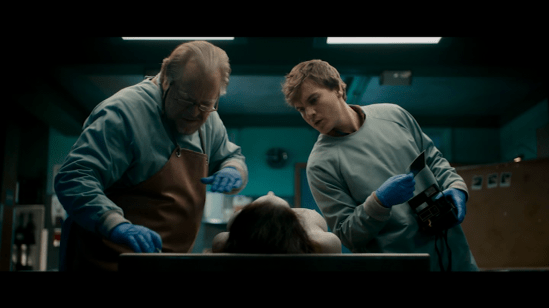
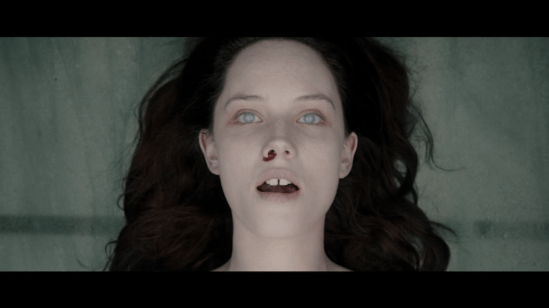
An unknown corpse of a young woman, found naked and half-buried in the basement of a home involved in a gruesome crime scene, is strolled into a small town family morgue and crematorium by a puzzled local sheriff. Without any idea who this woman is and how to explain the her presence at the scene, the sheriff wants a cause of death on his Jane Doe as soon as possible and it’s up to Tommy and his son, Austin, to investigate what caused her demise and to determine her involvement in the grand scheme of the grisly events. When the medical examiners begin to peel back the layers, each segment of the autopsy reveals impossible and unspeakable horrors underneath her cold flesh that go against their combined years of medical experience and the deeper they dig into her body, the more the autopsy room becomes a spine-tingling area as strange occurrences begin to happen to the father and son. Their only hope in stopping the ominous terrorizing presence and surviving the hell-bent stormy night is to continue the examination in order to unravel the enigma that surrounds Jane Doe.

“Troll Hunter” director André Øvredal helms a contemporary horror masterpiece with the Americana horror film,”The Autopsy of Jane Doe, that can be described as American folklore lit ablaze with modern day macabre that plays like a gruesome adult version of the children’s game Operation. Øvredal pulls inspiration from present day classical horror, including such films as the widely popular James Wan franchise, “The Conjuring,” by not embarking on an overkill journey of heavy duty effects or relying on gallons upon gallons of fake blood to sell his film. Instead, André Øvredal’s “The Autopsy of Jane Doe” is patient, subtle, and massively creepy, utilizing the dated morgue and crematorium basement setting to construct a dreadful, despairing dungeon atmosphere and focus on being very particular with every scene having a function to take advantage of the overwhelming brooding aurora and pop scare moments that can scare the pants off a mannequin. Øvredal heightens moments of complete pin-drop silence to amplify the terror and plays with camera angles that linger longer to leave an unsettling residue pooled in a spine-tingled soul.

Not only is the Ian Goldberg and Richard Naing script palm-sweaty frightening, tack on A-list actors like Brian Cox (“Manhunter”) and Emile Hirsch (“Killer Joe”) as a father and son team pitted against a dead body and “The Autopsy of Jane Doe” jumps up by tenfold as a must-see. Brian Cox is masterful as the widowed mortician whose numb to the pain of life and shock of work, making him a dedicated professional at uncovering the truth inside corpses, and he’s well companioned with Emile Hirsch, the mortician’s eagerly loving son and apprentice to the family business. The only problem is Austin doesn’t want to be a part of the family legacy, but is rooted by his continuously cloaked grieving father and you can see the struggle in Hirsch’s wish-washy character. The pair of veteran actors play off each other well being a medical super duo by conducting examination procedures and digging right into the corpse of dead, disfigured bodies like it’s just another day at the office. The gorgeous Olwen Catherine Kelly is dead on being a dead body. Though Kelly literally doesn’t move an inch for the entire runtime, her slim frame and blank facial expressions are truly haunting, if not also alluring to behold.

Immediately, my first impression of André Øvredal’s film had me stroll back to the past, nearly a decade a go to 2008, with the Marcel Sarmiento and Gadi Harel thriller “Deadgirl.” The premise of the film told the story of two high school aged boys discovering a seemingly near dead young woman in an abandoned asylum; the dead girl being played by Jenny Spain. Whereas each film have their separate horrific identities, their end games bare supernatural similarities. What also separates André Øvredal’s film from Sarmiento and Harel’s “Deadgirl” are the two protagonists; instead of two teen boys pulling hormonal hijinks on a motionless attractive female body, Tommy and Austin are strictly professional, focused on their task to answer the riddle lying inside the very fabric and bones of Jane Doe. The only gripe I can bottom barrel scrape out is how Tommy and Austin had this big ‘what if’ epiphany that becomes the very basis of the entire film and, in my opinion, felt that scene was extremely chintzy and a cop out.

Lionsgate Home Entertainment delivers “The Autopsy of Jane Doe” from production companies 42, Impostor Pictures, and IM Global onto UK DVD and Blu-ray. Unfortunately, a DVD-R screener was sent to me, resulting in no true examination of the audio and video qualities and the only extra on the disc was a Q&A with directorAndré Øvredal. Even if viewers might be able to guess the nature of the corpse – I did about halfway through – “The Autopsy of Jane Doe” is still way ahead of it’s genre brethren in being the best horror film of 2017 with an unlimited amount of sinister wretchedness that tugs at your soul strings and weighs heavy in your mind’s cache as soon as the lights go out for bedtime. I would recommend this title to anyone seeking an unadulterated horror experience.
Evil Tempts With the Body and the Heart! “Inquisition” review!

In 17th Century France, the torturous and deadly persecutions of innocent lives at the merciless hands of the almighty Church coinciding with the vast number of ill-fated deaths from bubonic plague made the medieval era a ghastly and forsaken time. Religious pursuers, known as judges, sought to unearth those who hold contract with Satan, who lustfully weaponized their bodies, and faithfully serve the dark prince and burn them at the stake after vigorous torture to obtain a must-have confession. One particular and notable judge, Bernard de Fossey, travels to a small providence to serve similar inquisition standards, but falls in love for Catherine, the mayor’s eldest daughter who holds a secret affair with a passionate lover named Jean. When Catherine’s lover is suddenly murdered, Catherine’s uncontrollable melancholy thrusts her to shift loyalties toward the alluring power of Satan in order to reveal the person behind Jean’s murder. Bernard’s trapped between his brutal crusade and the love he has for Catherine and tries to protect her from persecution by his fellow judges and from the execution stake. While many innocent claimed women and the few who confess to witchery burn alive, the judge teeters carelessly through the conclave of trials as Catherine has her blazing eyes set to destroy the person responsible for her overwhelming grief.

The one and only Paul Naschy stars and directs, in his directorial debut under the moniker Jacinto Molina, the remarkable underrated “Inquisition,” an time-piece tale accompanied with Spain’s 1970’s macabre ornamenting from the beginning credits to the aflame tragic ending. Spanish horror generally has an unusual gothic knack that can’t be emulated. With the blunt visual cues and the in your face gratuitous sleaze that manages to be naturally appropriate in the same spatial existence, Spain’s horror scene was put on the worldwide map that cordially sat itself right next to Italian’s giallo and UK’s Hammer Horror. Putting aside the budget, Spain’s underground cinematic gems flourished in a time of governmental conservatism and, to the likes of “Inquisition,” were, If I may be so bold, well equipped with scenic locations and props, scored charismatically, shot beautifully, and even maintained some provocative acting from actors and actresses all over Europe and even the world who were willing to bare it all for the project.

A buff, and rather brutishly handsome, Paul Naschy stars as the ruthless witch hunter Bernard de Fossey, but that’s not all. Naschy dons another role as the formidable and all powerful Satan in a dual-role performance of good and evil, of sorts. As de Fossey, Naschy’s chiseled, if not slightly stoic, portrayal of a pious huntsman locks in that medieval aroma while as Satan, similarly stoic but often with a devilish charm that Naschy often pulls off well under the latex and makeup. “Your Vice is a Locked Room and Only I Have the Key’s” Daniela Giordano marvelously shapes her character. The leading actress’s Italiano dark features, piercingly cold eyes, and shameless willingness to bare it all, topped with an on-off switch of ferocity, makes Giordano a powerhouse antagonist against Naschy’s de Fossey. Mónica Randall, Ricardo Merino, Tota Alba in one of her last roles, Antonio Iranzo, Julia Saly (“Panic Beats”), Tony Isbert (“Tragic Ceremony”), and Loreta Tovar (“The Sinister Eyes of Dr. Orloff”) co-star.

Supporting the remarkable cast is the incredible work of special artists Francisco Garcia San José and Pablo Pérez. These two aren’t widely known for their talent, but their grit behind “Inquisition” shouldn’t go unspoken. Naschy’s Satan wouldn’t be a glowing-eyed, skull-staff carrying Baphomet without them nor would there be that pec-tensing nipple severing during a great torture scene. There’s something very simple about San José and Pérez’s work that speaks volumes that virtually delivers in the heinous acts of the inquisition to life and that give Satan an embodiment that has inspired many films even to today. For 1976, I’m in awe of the caliber of the effects, especially being a Spanish horror film that’s notoriously inherited being low-budget.

Mondo Macabro’s widescreen Blu-ray release of “Inquisition” deserves to be one of the best home entertainment releases of the year as it’s spectacularly gorgeous with an upgrade to a 1080p transfer from the original source material. Vibrant, natural coloring charms the pants of the depth and range in the image quality from various obstacles including such as night and day scenes. For a first time director, Naschy had the eye for cinematography and capturing the moment; Mondo Macabro takes his vision a step further by reducing the grain to a minuscule amount and without completely enhancing “Inquisition” with zooming and cropping to offset source material garbage. The Spanish dialogue and English dubbed 1.0 mono track score a high bitrate with flawless integrity from the source. Extras include a audio commentary with Rod Barnett and Troy Guinn, an interview with Paul Naschy and Daniela Giordano, a retrospect on Spanish horror from the 1970’s entitled “Blood and Sand,” and a lengthy Mondo Macabro marketing trailer.

In my opinion, Paul Naschy is the greatest Spanish horror film icon ever and “Inquisition” is some of his primo work. Mondo Macabro works miracles with original source materials, one of the best video distributors of cult cinema in the business, and continues to be a leader in releasing hidden and well-known gems of the genre. Together, “Inquisition” is powerful, is scary, is gritty, is detailed, and is sexy without being campy and schlocky. The mammoth amount of production value is well worth the price of admission alone. One of my personal favorite witch hunting films from the same decade is Vincent Price’s “Witchfinder General” as it has that same barbarity in the air, those merciless persecutions that led to the anti-Church movements, and that undeniable lead actor providing a strong performance. Nothing is scarier than fact and the “Inquisition,” though just a story on paper and reel, was based off real facts and that’s the kind of horror that sears into souls.