The Old EVIL Scorpion and the Frog Tale in “Drive” reviewed! (Second Sight / Screener)


“Anything Happens in that Five Minues and I’m Yours.”  Drive Limited Edition Boxset at Amazon.com!

A solitary mechanic and movie stunt driver offers his services as a getaway driver for illicit odd jobs.  He falls for his single parenting neighbor and as the two begin their romantic affair, her ex-con lover returns from prison to reintegrate back into her and their son’s life.   When ex-con trouble brews an inescapable situation involving ruthless gangsters calling in their favor for prison protection, the stunt driver involves himself with his moonlighting work but when things go terribly wrong and he becomes a target, everyone he knows and cares for are threatened by the mobsters.  War is waged in the fast lane between the mysterious stunt driver and Los Angeles most feared gangsters for the sake of an innocent mother and her child caught in the middle.

Around 2010-2011, when I first heard of Nicolas Winding Refn’s “Drive” starring “The Notebook” and “Lars and the Real Girl’s” Ryan Gosling, I thought to myself, why would I watch this quirky comedy-romance actor drive around in a run-of-the-mill stunt car action film?  Immediately, I wrote off the film penned by “The Four Feathers’” screenwriter Hossein Amini, whose now penning the stories and teleplays of a little Disney+ streaming series you may have heard of called “Obi-Wan Kenobi.”  I now admit it, as painful to my pride as it is, that I was so ignorantly wrong about Refn’s “Drive” that has turned out to be a cult hit present day and a really good and exceptional crime-drama that’s subtle on the dialogue, high on the graphic violence, and all-around superb performances.  The script is the filmic adaptation based off American author James Sallis’s novel of the same title, keeping the neo-noir intact under of guise of muscle car predilection, and is a produced by Gigi Pritzker and Chris Ranta of Oddlot Entertainment (“Buried Alive”), Jonathan Oakes and Gary Michael Walters of Bold Films (“The Neon Demon”), Marc Platt of Marc Platt Productions (“Wanted”), and Motel Movies (“Blue Valentine”). 

To be upfront, Ryan Gosling has never been a go-to movie star for me, personally, so there might have been some psychogenic bias blocker keeping me away from the film over the last decade.  However, over the years, my pallet has grown in diversity and in tastes, chiefly because of influences in my life, and so curiosity got the better of me in wanting to explore the story of and the craft of Ryan Gosling’s character in “Drive.”  The way Gosling portrays the lead, known only as either the Driver or Kid, heavily relies on expression with minimal dialogue and lets all his emotions be poured through his eyes and body language as well as his actions in an anti-charismatic sense that, in a good way, leaves the character unassuming but still confident.  Watching Gosling’s methodical flow through the role and while having a little knowledge of the neurodivergence, it’s not difficult to see that the principal character comes off as a person somewhere on the autism spectrum and doing some post-credits research, I’m not the only one who had the same thought.  Unsociable, quiet, lack of facial expression, and obsessed with routine, especially when moonlighting as a criminal getaway driver with a set of very specific conditions, are just some examples of his behavior that point in the autism direction.  When the driver meets beautiful single parent neighbor Irene (Carey Mulligan, “Shame”), that is when we start seeing him deviate from his isolation, from his routine, and become more complex with what was previously a non-existent life, but of course as life blossoms into something new and safe, gangster obstacles rear their ugly head and the criminal in him is forced out for a head on collision.  “Ex Machina’s” Oscar Issacs is the first hurdle as the recently release ex-con dragged back into unscrupulous dealings with unsavory organized crime that climb the latter to “Hellboy’s” Ron Perlman and “Taxi Driver’s” Albert Brooks, business partners who oversee the West Coast turf. Perlman is a natural tough guy, as we’ve seen in countless works stretching over numerous decades and I would have never pictured “The In-Laws” and “Finding Nemo” Albert Brooks to be the minatory type but he does in fact have a dark-twinkle in his eye and can extract the false sense of security out of people before he jabs a fork in their eye and slits their throat…wrist….guts….yeah, his character loves to knife others. The all-star cast rounds out with Bryan Cranston (“Godzilla”) as the Driver’s mob-connected boss-friend-agent and Christina Hendricks (“The Neon Demon”) in a lowkey accomplice role that makes a gruesome, unforgettable impact.

Speaking of “The Neon Demon,” a more recent Nicholas Winding Refn film, you’ll begin to absorb the Denmark-born filmmaker’s stylistic motifs between the two films involving lingering shots, graphic violence, and the integration of electro-pop tracks into an eclectic soundtrack. Many of the scenes convey an emotion through dialogue-less scenes and the soundtrack to contrast actions speak louder than words. However, there is one radical theory of mine that I believe has a firm foundation is that everything from point A to point Z in the story is all in the Driver’s fantasy world. I know “Drive” is a movie and the need to suspend belief is important but only to an extent and depending on the quality derived from the filmmaker. Refn’s a good filmmaker, we know this, but everything the Driver experiences pitches upon pure imagination when the truth is stretched to be in his favor for the length of the feature. First example – the Driver slams into the side of another car head on, but the headlights, front bumper, and ventilation grille are all clearly intact. Second example – a tense-elevator scene involving the Driver, Irene, and a mobster assigned to take the Driver out takes an improbable turn when the Driver turns to Irene, both bathed in the sudden appearance of a spotlight, and they kiss passionately for quite a while. The moment become the perfect opportunity for the goon to blow away his target. Instead, he lets them kiss and then a close-quarter fight ensues shortly after. Third example but not last – the Driver is nearly an unstoppable force with no background to who he really is or why he is in Los Angeles, but he fights like a hardened criminal and knows how to play the organized crime game, never really have bad hand in his deck of cards, and even is given an ambiguous “Shane” ending. So, I ask again, is the beautiful girl, the ripe for the picking off gangsters, and the prodigious skillset all in his head?

I’ve clearly misjudged Nicolas Winding Refn’s “Drive” to be pretty-boy, stock-story, waste of time. Though I’m still not convinced about Ryan Gosling’s acting, like a Supreme Court Judge nowadays, I’m overturning my naive judgement and calling “Drive” a true modern day cult film hiding in plain sight, receiving new life from Second Sight films with an UK limited edition 4K UHF/Blu-ray release as well as a standard 4K and Blu-ray release. Unfortunately, this review covers only a BD-R screener so commenting on the true quality of the image and audio will not be recorded, but release specs include a new 4K master produced by the original post-production company with Refn’s approval, the UHD is presented in Dolby Vision HDR graded by the film’s original colorist, audio options include a Dolby Atmos and a DTS-HD Master Audio 5.1 with optional English subtitles, and the 4K UHD are region free while the Blu-rays are region locked encoded on region B. Standard bonus features include a new exclusive commentary by director Nicolas Winding Ren and The Guardian critic Peter Bradshaw, a feature length conversation with Refn, editor Mat Newman, and composer Cliff Martinez reminiscing about their sudden post-theatrical career success with “Drive” when the film saw more success on video, Gutting a Getaway – a new interview with Mat Newman, and 3 Point Turns – a new video essay by Leigh Singer. The limited-edition contents include a premium box set with new Driver Scorpion artwork by AllCity, a 240-page hardback book with new essays by various authors, an exclusive interview with “Drive” author James Sallis hosted by Matthew Thrift, original storyboards, stills, behind-the-scenes photos, the original Sallis novel with new AllCity artwork as well, and 7 collectible art cards. What a massive, massive haul for the film that didn’t do great in theaters due to poor financial support by investors who saw the film as a failure. The film has a runtime of 100 minutes and is UK certified 18. Don’t be like me and neglect a chance to see “Drive,” a great piston-pumping and violently beautiful crime-drama paralleled love story that deserves our time, our attention, and everything including the kitchen sink Second Sight Films pumped into the tremendous limited-edition boxset that dropped this week for release!

“Anything Happens in that Five Minues and I’m Yours.”  Drive Limited Edition Boxset at Amazon.com!

Southern EVIL Hospitality. “Girl on a Chain Gang” reviewed! (The Film Detective and Something Weird / Blu-ray)

Become Tethered to the “Girl on a Chain Gang” Blu-ray at Amazon.com!

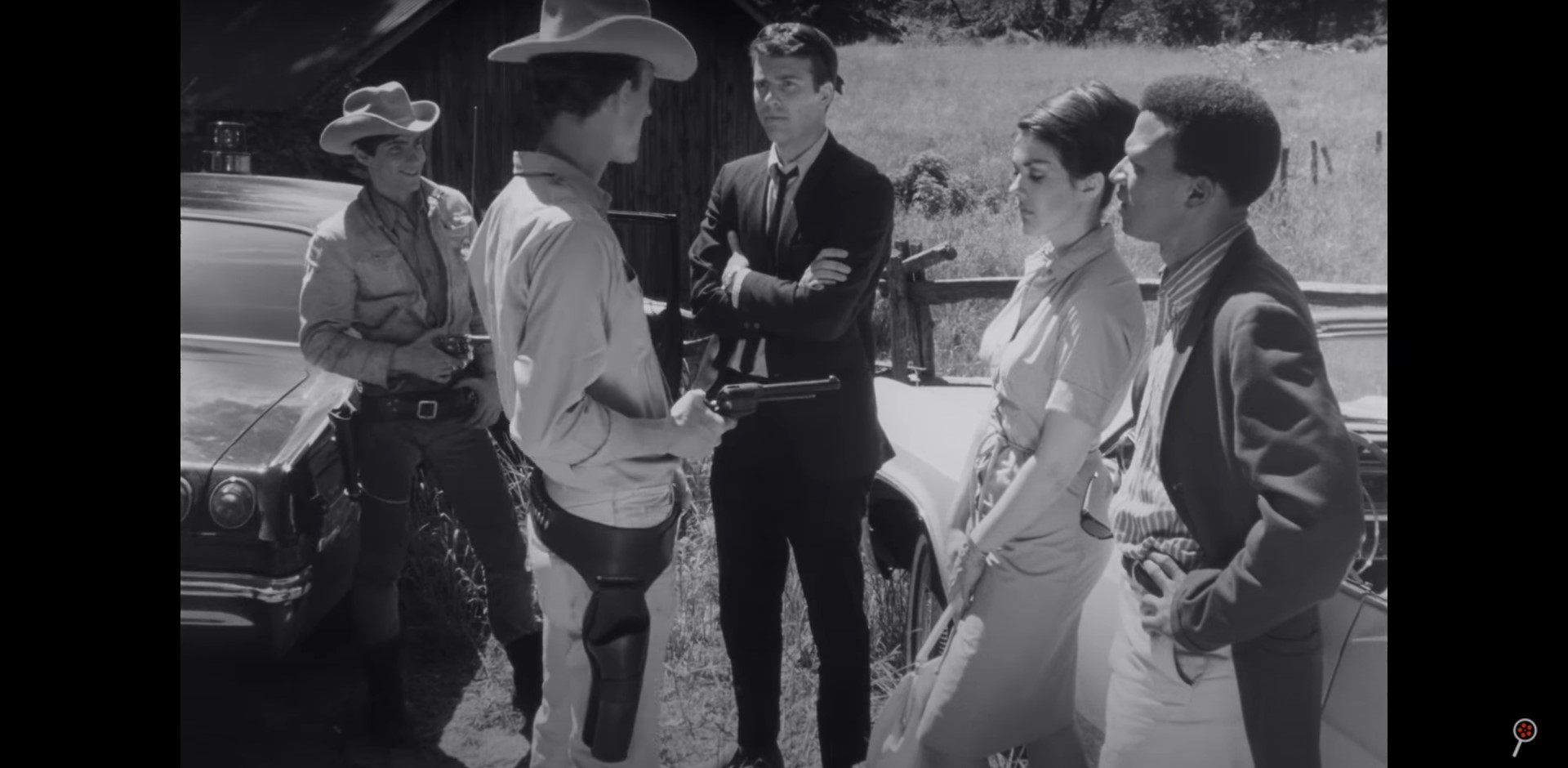
Three young Northerners travel down to the deep South city of Caron’s Landing for Civil Rights improvement on voter registration. Their convertible is pulled over by two sleazy deputies with a hankering to stick the activists with trumped-up charges and accost them with an official arrest that forces them to be before a drunk, aggressive named Sheriff Sonny Lew Wymer, Carson Landing’s very own unofficial head of the municipality between his unwavering loyal kin and those in his pocket with blackmail to gain an indefinite number of favors, for swift money-mulcting and to be the victims of Sonny Lew’s judge, jury, and execution sentencing of segregated injustice. An onslaught of abusive authority sends the lone woman of the three activists to do hard labor on a black chain gang and as she attempts to escape, she must survive Sonny Lew’s hound-led manhunt with intent to shoot-to-kill.

Hard to believe that we still live in a society where the surface level racism has improved over the centuries but systemic racism remains a vein-slithering and venomous asp prevalent still in not only public society but in education, justice system, and, well, just about everywhere you can think of and films like Jerry Gross’s “Girl on a Chain Gang,” though ostentatiously sleazy and exploitative as the title sounds, would still ring smidgens of truth profoundly, yet subtly, engrained across the nation even though the Gross’s film was released over half a century ago in 1966 when that pure hatred and ugliness was at peak efficiency, especially in the deep Southern U.S. The producer from New York City who promoted “I Drink Your Blood” and “Son of Dracula,” with Ringo Starr nonetheless, found a knack in presenting exploitation in his directorial feature debut – “Girl on a Chain Gang.” Originally called “Bayou” before a title and script rework, the Dan Olsen original story was penned by Gross and shot more locally to the auteur in Long Island, New York. Nicholas Demetroules cowrote the edgy-for-its-time script full of malversation under the Jerry Gross Productions banner with a logo that looks the hell of a lot like Warner Brothers.

Part of “Girl on a Chain Gang’s” suffocating sleaze success is due in part to William Watson’s rotten-to-the-core, corruption performance as the devilishly intelligent and despicable Sheriff, Sonny Lew.  The “It’s Alive III” actor, who made a name for himself in indie westerns as mostly playing a character on the wrong side of the law, debuted his forte into villainhood affairs with this particular Jerry Gross production by portraying an alcoholic lawman with dirt on the most townsfolk of Carson’s Landing and can persuade them like pawns or like lemmings to exact his will.  Watson’s good at what he molds for the cigar chewing Sonny Lew by never letting up  his foot off the lewdness gas pedal that drifts around internal state investigations into his distortion of the law and even around his own cronies and county bumpkins with secret banter codes that’s clear to them but ambiguous to the naked understanding.  The three young northerners are chosen to reflect the stereotypical justifications to be oppressed by racists eyes just for the way they look in skin and in dress despite their education and suitable for society behavior.  Because one man is African American and the other two whites consort with him, the activists become relentlessly targeted by the bigoted brigade led by Sonny Lew, colluded his deputies (Ron Charles and Peter Nevard), the town drunk (Matt Reynolds), the see-nothing, do nothing bar own (James Harvey), and the unlicensed town doctor (Phillip Vanyon) who is too frightened of Sonny Lew to act on his conscious.  The woman in the mix, Jean (Julie Ange, “Teenage Mother”) reduces down to being the principal object of exploitation inside the story as the titular girl in the chain gang and out being given illusionary promises of future leading lady roles by Gross yet that undertaking never fleshed out.  Between Watson and Ange, a genuine baseline of power over someone else is greatly disturbing and not terribly far from reality.  Most of the other performances are a bit ostentatiously cliched regarding small town Southerners complete with cowboy hats, being sloppy drunkards, and take with a gimmicky draw.  The cast rounds out with Arlene Farber (“Two Girls for a Madman”) as the town floozy, Sam Cutter as Sonny Lew’s public defender uncle and, also including, Ron Segal, Henry Baker, Horace Bailey, Wolf Landsman, Earl Leake, and Richard Antony.

For 1966, “Girl on a Chain Gang” is pretty dark.  Of course, some explicit and taboo subject material that were not acceptable to show on screen back then must be read between the lines, but nonetheless, there’s enough icky and sordid personalities to get your blood boiling and your palms sweaty because of how purely contentious these themes can strike at the heart of a morally conscious soul.  The hammy acting in the second half almost makes a joke out of the context and one can become caught up and lost in the blinding caricatures spouting off ridiculous renditions of the ignorant South population that isn’t supposed to have one funny bone in its body. Though the title is eye-catching and provocative, “Girl on a Chain Gang” is selling more sexism than racism. Jean is only shackled with the chain gang for the last 10-minutes or so, just enough time for a whipmaster’s disparaging remarks to be heard and for two black men to form an escape plan. The title doesn’t speak to much of the three Northerners as a whole being subjected to bigot atrocities and without reading the back cover, you’d think the 95-minute runtime would be entirely a woman in prison film of this poor and young fresh meat working the pickaxe, sweating, and chained to a row of harden convicts with both convict and guard having their way against her will. No. Jerry Gross knew how to market this film, to catch people’s attention, by selling savage social representation as dressed sexploitation.

The Film Detective and Something Weird Video unearthed the Jerry Gross debut long thought to be inspired by the murder of three civil rights activists in Mississippi in 1964 and gave it the special edition Blu-ray treatment. A well-preserved transfer is now cleaned-up eye-candy for a high-definition look this black and white feature presented in now the fairly archaic 1.37:1 aspect, aka Academy, ratio with only a few lingering thin scratch marks throughout. Trust me, we’ve seen far worse transfers and the scratches here are evident but only if you’re keeping an eye out for them. The high contrast and detail offer a good, delineated view of events on average, pulling an average of approx. 20 Mbps. Certain exterior scenes are poorer than others with a slightly more washed brightness. The English language DTS track wavers between a muted mono and a lossy 2.0 with the dialogue suffering the most and so will you know if you’re not wearing headphones as you’ll be up-and-down on the volume of your remote control. There’s a rife static hissing that does random clean up from time-to-time. The audio tracks are clearly unstable whereas the video files have fared better with Hi-Def upgrade. The not rated disc does come with bonus features including software material of a short history from genesis-to-death on Jerry Gross hosted by film historian Chris Poggiali and hardware material in the form a 14-page essay booklet by Something Weird Video’s head-honcho Lisa Petrucci and a novelty ticket of certification of jury service where you can fill in your own name to state you sat in judgement and witnessed the trail of “The People of Caron’s Landing vs. Miss Jean Rollins.” “Girl on a Chain Gang” abstracts only a fraction of deep-cutting prejudice but that makes this roughie old-timer no less important and still remains satisfyingly excessive in its violence.

Become Tethered to the “Girl on a Chain Gang” Blu-ray at Amazon.com!

The End of Days Runs on EVIL Fuel! “Wyrmwood: Apocalypse” reviewed! (101 Films / Blu-ray)

“Wyrmwood:  Apocalypse” – Z-Nation on Steroids!  Available at Amazon.

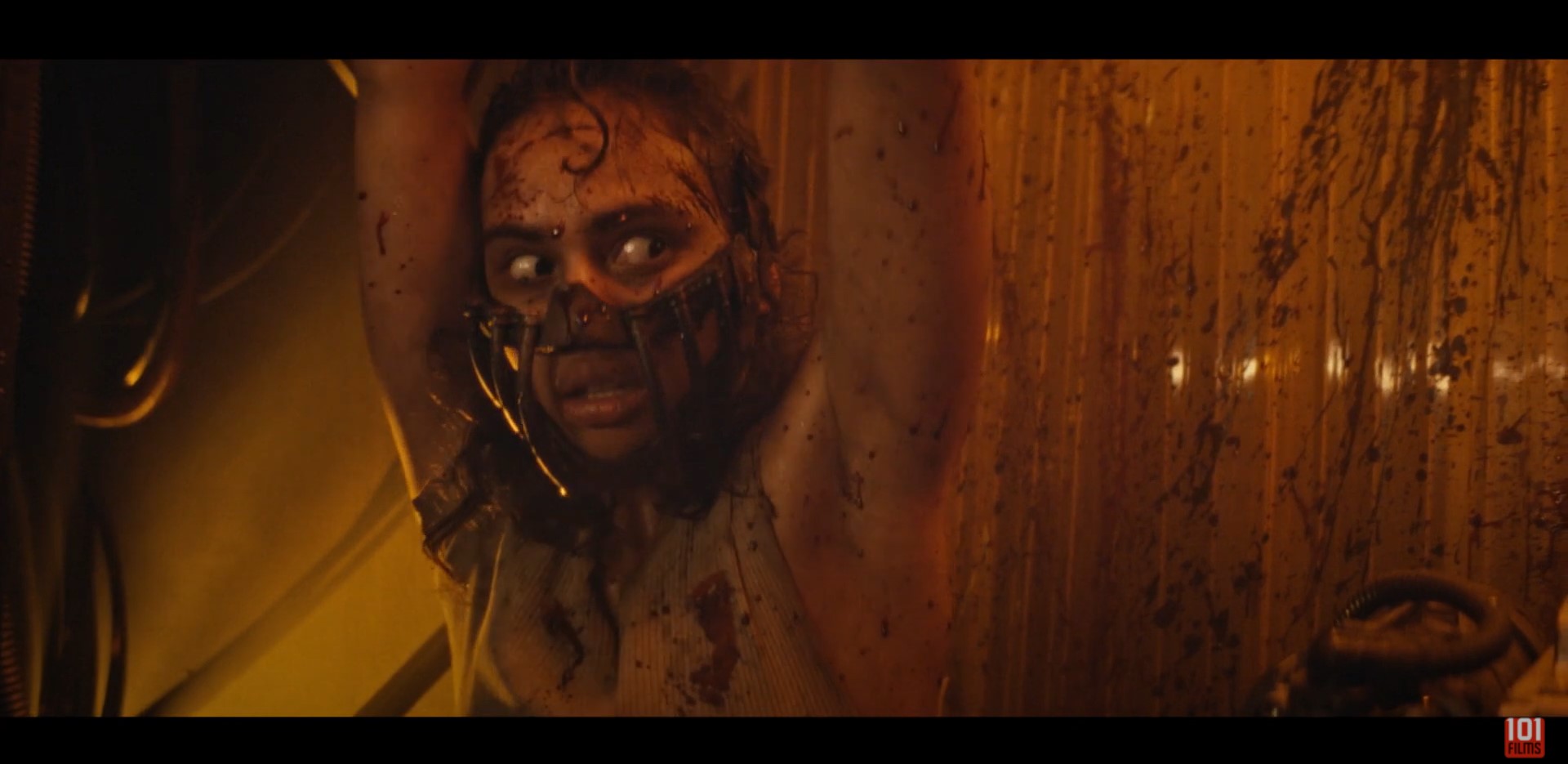
In a zombie apocalypse wasteland, the gaseous belching undead are used as the primary energy source, but the sight for a cure is still the goal for survival.  At least that is for boots-on-the-ground foot solder Rhys who lives in an isolated camp surrounded by the dead and ventures out to retrieve uninfected humans to bring them to the bunker-dwelling Surgeon General in hopes in discovering a cure.  After snagging a hybrid female named Grace who can control her turning by drinking single vial of blood, Rhys quickly learns that the Surgeon General and his armed entourage are experimenting to death the people he’s delivering to the bunker for their own selfish objectives.  Teamed up with Grace’s people – Grace’s sister Maxi, Barry, and Barry’s sister Brooke who is also a hybrid – Rhys is determined to no longer retrieve people but rather retrieve his soul from a group of well-armed maniacs while trying to not get eaten by the zombie hordes.

For someone like me, a film reviewer, whose fairly anal about watching a series, franchises, sequels, etc., in sequential order, I am stepping outside my comfort zone and out of my own convictions and into unknown territory by watching “Wyrmwood:  Apocalypse,” the direct sequel to Kiah and Tristan Roache-Turner’s 2014 Australian bloody zombie comedy-romp, “Wyrmwood” aka “Wyrmwood:  Road of the Dead”, before the first film.  While typically a no-no in my book, and very much likely in the rest of the filmic community, I like to live dangerously.  Any who, Kiah Roache-Turner sits once again in the director chair with the direct, follow-up sequel that picks up immediately where the other film left off or, I at least think so.  In reading the ending to the 2014 film, I see no mention of a couple of characters that are present at the beginning of “Apocalypse” and so I’ll be interested to watch “Road of the Dead” to see for myself how both films tie together.  The script is penned by Kiah and brother Tristan after fan support of the first film urged the filmmakers to do a sequel to their brainchild inspired by the blood-soaked and vaudeville slapstick horror of New Zealand and Australia – such as Peter Jackon’s “Dead Alive” aka “Braindead” and the Spierig brother’s “Undead.”   “Wyrmwood:  Apocalypse” is a Bronte Pictures production (“Out of the Shadows”) in association with Roache-Turner’s Guerilla Films and backed by the executive producer team of Todd Brown, Tim Nagle, Rhys William Nicolson, Sam Gain-Emery, Clement Dunn, and Maxime Cottray.

To make matters more confusing for someone like myself who hasn’t seen the first film, Tasia Zalar and Shantae Barnes-Cowan, nor their badass sisterhood characters Grace and Maxi, are listed in the cast of the first film nor are they in the short-lived teaser episodic series from 2017, causing a bit of disconnect for a nobody like myself who knows absolutely nothing of Wyrmwood universe when beginning the Roache-Turner series will the latest production. The “Uninhabited” Zalar and the “Frostbite” Barnes-Cowan quickly establish themselves as survivors devoted to each other by blood as their introduced rather quickly, harshly, and without background in the company of returning actors Jay Gallagher as Barry, described in the first film as a talented mechanic, and Bianca Bradley as the zombie hybrid Brooke who can control the regular horde of gas-chucking dead heads. Of course, being that a direct sequel, at least that’s how the Roache-Turner plays it, follows up 8-years later, some of the characters don’t quite look the same as when we first left them. For instance, Barry’s a little rounder and beefier and Brooke is, well, blonder. However, the bond between brother-sister is still strong and is even reinforced by Grace and Maxi’s relationship that blood trumps all. Another actor returns for the sequel but not toward the same character as Luke McKenzie adds to the theme of family by playing the avenge-longing brother of the first film’s antagonist known only as The Captain. Rhys (McKenzie) has more of a pure heart in contrast to his brother, or so we’re informed by returning characters, and becomes the unintended principal character amongst an ensemble cast by being the retriever, the deceived, and the reclaimer of his soul when he discovers the paramilitary survivors – The Doctor (Goran D. Kleut, “Alien: Convent”), The Colonel (Jake Ryan, “Out of the Shadows”), and the Surgeon General (Nicholas Boshier_) – are experimenting and killing captives for their own survival and grinding their corpses to make into anti-viral pills. There’s nothing bland about the Roache-Turner brothers’ character diversity and charisma as they each stick to a persona throughout the unfolding that quickly established who-is-who in the bad and good category.

“Wyrmwood: Apocalypse” is dieselpunk coated dead and delirium. With a definite George Miller approach and a zany-zombie gift of gore and gags, I can see where fans of the zombie genre can feel freer and more relaxed outside the confines of the somber-and-serious toned oeuvre of zombie films of the last two decades that has literally been beaten like a dead horse with a stick at every angle. The gonzo-gearhead carpet definitely matches the drapes in an outlandish universe where zombies are the Duracell and Diehard batteries of the future and while the story engrains a kindred theme and blood splatter fun, one element still guts me more than the multiple eviscerated entrails in the movie. Being a zombie movie of the flesh-eating kind, one would hope scenes of flesh-eating would be apparently present. Unfortunately, “Apocalypse” has zilch on zombie feasts. Though close in one scene where a big toe might be become an appetizer, in the end, there isn’t one bite of rotting teeth be pressed and puncturing flesh or viscera. What “Apocalypse” offers quite the opposite in where the dead are the exploited, utilized as a fuel source by feeding them beef and harnessing their oral gasses to drive vehicles and run high-powered miniguns or be under-the-influence of control by telepathic hybrids to do their bidding, aka suicide bombers or take the hits so the living can stroll in without garner so much as a scratch in a skirmish.

The final conclusion about “Wyrmwood: Apocalypse” is this, watch “Road of the Dead” first. Then, enjoy the rip-roaring and violent horror-action zomedy now available on an UK Blu-ray from 101 Films. The hard region B locked, AVC encoded Blu-ray is presented in 1080p, high definition, with an aspect ratio of 2.35:1. “Apocalypse” has the look of the early comic-book era style of pre-“300” Zack Snyder that hovers around the practical properties of “Tank Girl” in what’s fashioned together by the director of photography, and co-producer, Tim Nagle to appeal to a tactile of cold and grimy steel, sweet, and blood. The film uses very little visual effects which is mostly on the blood splatter, and you can tell the splatter is a bit off in having a waxy look to it. The decoding runs efficiently well to provide a clean picture through an edit heavy story. The English language audio mixes come in two options: a Dolby stereo PCM and a DTS-HD 5.1 surround sound. While there’s nothing wrong with the stereo PCM track that offers a clean and lossless recording, the 5.1 audio mix is a robust beast that channels every engine roar and isolates a zombie belch to be more inclusive for a viewer. If you’re in the mood for a longer sitting and bonus content, perhaps this 101 Films release is not for you as the runtime hits just above an hour at approx. 70 minutes long and just contains the feature and a scene selection. However, there is reversible front cover art. Easily, continuing the journey by working backwards in the Wyrmwood universe is worth the time as “Wyrmwood: Apocalypse” catapults the zombie into a new and unexplored rancid category of reverse exploitation in parallel with carnage, mayhem, and all of the anarchical above.

“Wyrmwood:  Apocalypse” – Z-Nation on Steroids!  Available at Amazon.

Sonar Radiation is Music to the EVIL’s Ears! “The Living Dead at Manchester Morgue” reviewed! (Synapse / Blu-ray)


Don’t Let the Sleeping Corpses Just Lie!  Grab a copy of “The Living Dead at Manchester Morgue” at Amazon!

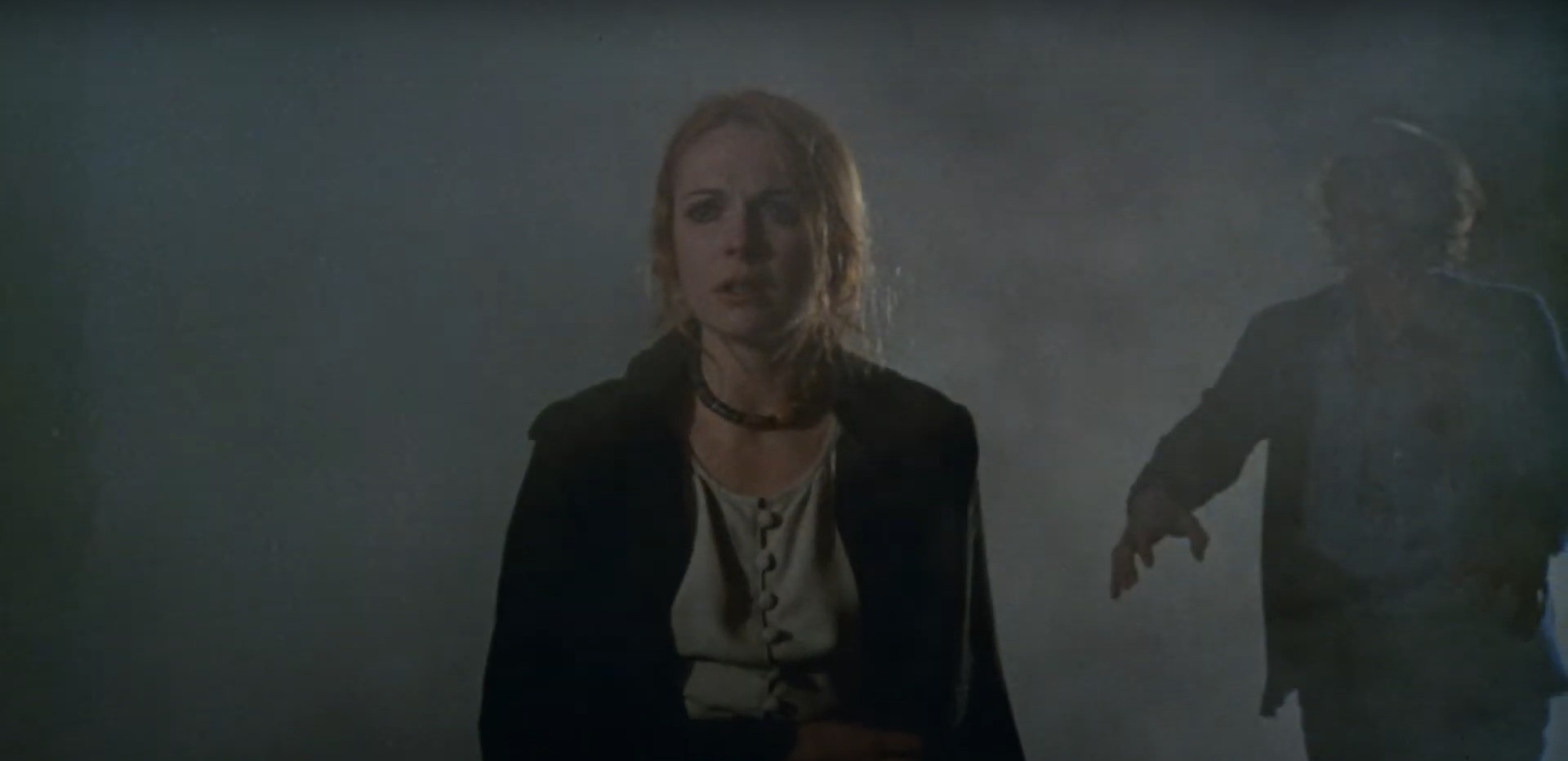
After having a run-in with a beautiful woman, Edna, at a gas station who accidently wrecking his motorbike, Manchester antique dealer George offers to drive her car to her destination in the country, her sister’s place in Southgate, and then borrow the car to continue on toward his appointment in Windermere.  However, upon their arrival in Southgate, Edna’s husband Martin has been brutally murdered and the police immediately suspect the two urbanite out-of-towners George and Edna of coming the heinous crime.  In reality, the recently dead in a mile radius has their nervous system reactivated and directed to kill the living by a new sonar radiation technology aimed to destroy crop pests.  With the police and the dead on their heels, George and Edna seek to expose the truth to the world before its too late and the experimental new pesticide’s range is extended to cover more ground. 

Hitting the stop button here before we dive into our review of “The Living Dead at Manchester Morgue.”  If you’ve never seen the Jorge Grau directed 1974 flesh eating zombie film then drop everything – you’re work, your kids, your winning lottery ticket worth millions – and take the next one hour and 33 minutes to enjoy the graphically gory, social commentary horror that not only cashes in on the George Romero “Night of the Living Dead” gamechanger undead horror but also rivals Romero’s film in story and in full, gorgeous color.  “The Legend of Blood Castle” director Jorge Grau helms the Spanish-Italiano co-produced script penned by Sandro Continenza (“Uncle Was a Vampire”) and Marcello Coscia (“Teenage Emmanuelle”) and was provided to Grau by “The Eroticist” and “Don’t Torture the Duckling” producer Edmundo Amati who wanted to make a Romero-esque flesh-eating zombie film of his own.  Also more widely known as “Let Sleeping Corpses Lie,” “The Living Dead at Manchester Morgue” is co-produced by Manuel Pérez and is a co-production between Star Films and Flaminia Produzioni Cinematografiche.

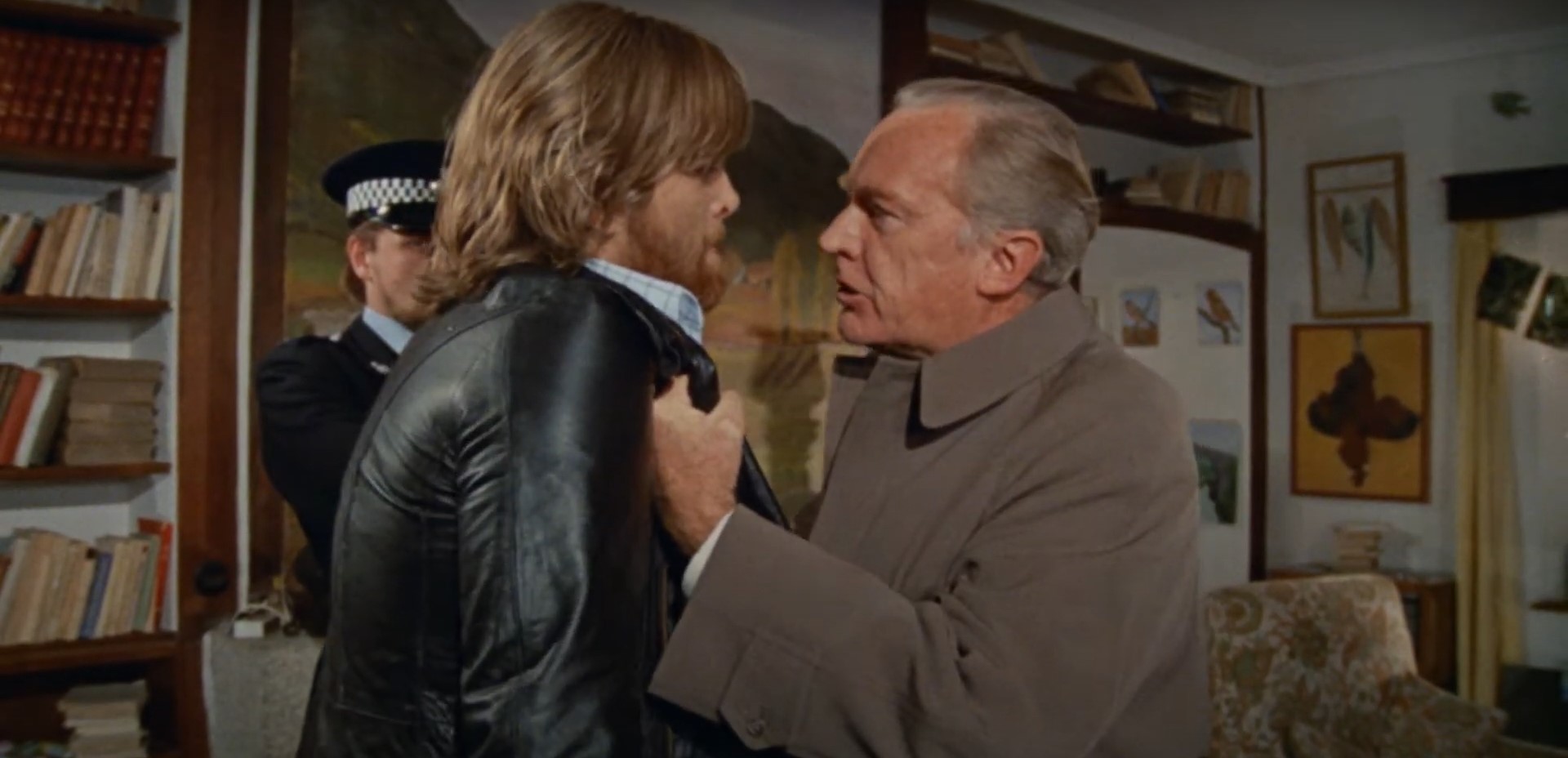
Hot off the presses of Italian action-crime dramas, Ray Lovelock (“Emergency Squad,” “Almost Human”) finds himself playing an antique merchant holding up shop in the metropolitan area of Manchester, England and as George Meaning, the relatively undisclosed personal experience as an antique merchant, Lovelock gets into character not on the business end but when the shopkeeper goes on holiday in the country, riding his motorcycle Windermere where he has arranged a meeting with some very important people that never flesh out in the end. Speaking of flesh, don’t expect the leading lady Cristina Galbó (“The House that Screamed”) to provide any as the panicky Edna Simmonds on her way to her sisters (Jeannine Mestre, “Count Dracula”) for an intervention toward her sister’s severe heroin use. Much of the only flesh to be hand in “The Living Dead at Manchester Morgue” is that is which ripped from the bodies and stuffed into rotten, undead mouths. In itself, the entire scenario between Edna and her druggie sister is a compelling enough story to warrant attention in accumulating a sense of sisterly betrayal and a sacrificial compassion to do the right thing despite the consequences. However, that pathway, no matter how distressingly prominent it may seem, does not carry over into the main plot points of an experimental pesticide treatment involving sonar inadvertently raising the dead to be superhuman zombies. Between an Italiano (Lovelock) and a Spainard (Galbó), who not throw in an American while we’re at it with Massachusetts born Arthur Kennedy (“The Antichrist”) to be the aging local inspector keen on pinning every murder on youthful urbanites with their hippie ways and satanists beliefs. “The Living Dead at Manchester Morgue” fills out the cast with José Lifante (“Night of the Walking Dead”), Vincente Vega (“Historias para no dormir“), and “Flesh+Blood’s” Fernando Hilbeck as the foremost feared zombie.

What makes Jorge Grau’s take on the living dead canon so impressive is not only the social commentary story that seeks to deconstruct ecological progression as an ironic destructive poison to the Earth and its inhabitants and the striking moments in gore effects from the team of Juan Antonio Balandin, Luciano Byrd, and Giannetto De Rossi (of Lucio Fulci’s “Zombi”) that have remained timeless in holding up and rivaling against many of today’s gruesome effects, but also the terror-inducing sound design that combines Giuliano Sorgini’s funky-spook with Antonio Cárdenas zombie-vision resonances of heavy breathing and resonating heart thuds that cues the lurking of an undead lurker.  The effect is potent and full of imminent danger when included into Grau and cinematographer Francisco Sempere’s (“Death Will Have Your Eyes”) perfectly framed shots of the Romero-esque zombie lumbering toward their prey in an unstoppable hunger to kill and eat and, sometimes, convert to their infant-legion inside-and-out of the zombie perspective.  Along the lines of “The Living Dead at Manchester Morgue’s” environmental theme is the juxtaposition of big city and countryside in regards to their pollution levels in the opening credit scene where George rides out of Manchester through the degradation of the masses who are popping pills, wearing face masks (like in today’s COVID climate), numb to shock (in the scene where a naked protestor runs in front of stalled traffic for peace and the motorists are blank to the moment), passing by death and polluted nuclear smoke stacks.  Once the lead George reaches the countryside, he removes the scarf covering his nose and mouth and breathes in fresh air with a smirk on his face.  From then on, the story moves forward with a cautionary tale of ill-fated modern progression, such as urbanism, seeping into a natural landscape and causing death and destruction, leaving an poignant aftertaste in the inevitably of man’s ignorance will kill us all.  Grau’s film is a good candidate to be a promotional movie for the dramatic effects of climate change in today’s campaign for ecological change to reduce our carbon footprint.

Synapse brings “The Living Dead at Manchester Morgue” home onto a Blu-ray home video, restored in 4K from the original camera 35mm negative that includes the authentic and intact opening and closing credit sequences. The region free, AVC encoded release is presented in 1080p high definition of a widescreen 1.85:1 aspect ratio and the picture is the gold standard of presentation with a vivid and stable color palette, controlled DNR without any posterization, and greatly detailed without an inkling of lossy image quality. Two audio mix come with the release – a DTS-HD Master Audio 5.1 surround sound remix and the distinctive to the Synapse release the original English theatrical mono mix. Though nice and nostalgic in the original English mono mix, the clarity and robustness of the channels on the DTS-HD track is by far superior with its reformulated by Synapse lossless quality and fidelity, especially in that aforementioned sound design by Antonio Cárdenas. The English dub on Ray Lovelock can be off-putting at times but the track is still beyond the best of the two available audio options. English SDH subtitles are available. Extras include two audio commentaries by author and film scholars Troy Howarth, Nathaniel Thompson, and Bruce Holescheck, a feature length (89 min) documentary Jorge Grau – Catolonia’s Cult Film King that explores the lift and films of director Jorge Grau, The Scene of the Crime is special effects and makeup artist Gionnetto de Rossi discussion on the film, another de Rossi feature of the SFX artist at a Q&A at the Festival of Fantastic Films in the UK (43 minutes), the theatrical trailer, TV and radio spots, and a sleek black snapper case that wouldn’t be complete with a Synapse catalogue booklet. If you’re a diehard zombie genre fiend, Jorge Grau’s “The Living Dead at Manchester Morgue” must be at the top of your personal video collection. If it isn’t, kick yourself in the shin really hard and then check out Synapse’s gorgeous release of the Spanish-Italiano production that’s worth every second of your life viewing.

Don’t Let the Sleeping Corpses Just Lie!  Grab a copy of “The Living Dead at Manchester Morgue” at Amazon!

Smuggling EVIL Past the Revenue Men! “Night Creatures” reviewed! (Blu-ray / Scream! Factory)

The Marsh Phantoms are Coming to a Blu-ray Near You!

A savage pirate is left for dead on a remote island by his ruthless captain, a small village avoids taxation from the British King’s revenue men by smuggling French Brandy, and on the same village’s marsh land, ghostly skeletons ride into the night, placing the fear into wanderers with ghastly-glowing skulls and undead horses. At the center of it all is Dr. Bliss, the Romney Marsh village Vicker, who also heads the liquor smuggling ring in town and plays the King’s tax revenue soldiers as fools by misdirecting their attention to elsewhere and away from their illegal brandy run. Keeping up with a ruse that’s cracking at the foundation with one of Romney Marsh’s irresolute community leaders forces Dr. Bliss to think fast and stay on top of a smuggling operation at the constant brink of collapse, but a return of a familiar face stirs up conflict and the captain of the revenge men continues to push for the truth no matter the cost.

Peter Cushing is well-known for his solemn gothic horror roles in nearly a slew of countless Hammer films. An unequivocal and stoically determined vampire hunter, the intelligently disillusioned creature maker befallen by his creation, and a wizard sleuth with a nose for clues in tracking down murders are just a few of his linchpin roles for Hammer Productions that the English actor portrayed so very brilliantly in the company’s peak, and off-peak, years. Yet, one of his most pinnacle performances stem from one the lesser-known Hammer productions based off the English author Russell Thorndike’s anti-hero and swashbuckling novel “Dr. Syn” published in 1915. Known in the United Kingdom as “Captain Clegg” and “The Curse of Captain Clegg” because of legal rights issues with the Thorndike title and Disney (yes, that Disney!), U.S. audiences might recognize the Cushing film as “Night Creatures,” directed by a Hammer one-off in Peter Graham Scott (“The Headless Ghost”) and is written by Hammer vet Anthony Hinds (“The Brides of Dracula,” “The Kiss of the Vampire”) under his usual pseudonym John Elder with additional dialogue from Barbara S. Harper. John Temple-Smith produces the film under Hammer Film Productions

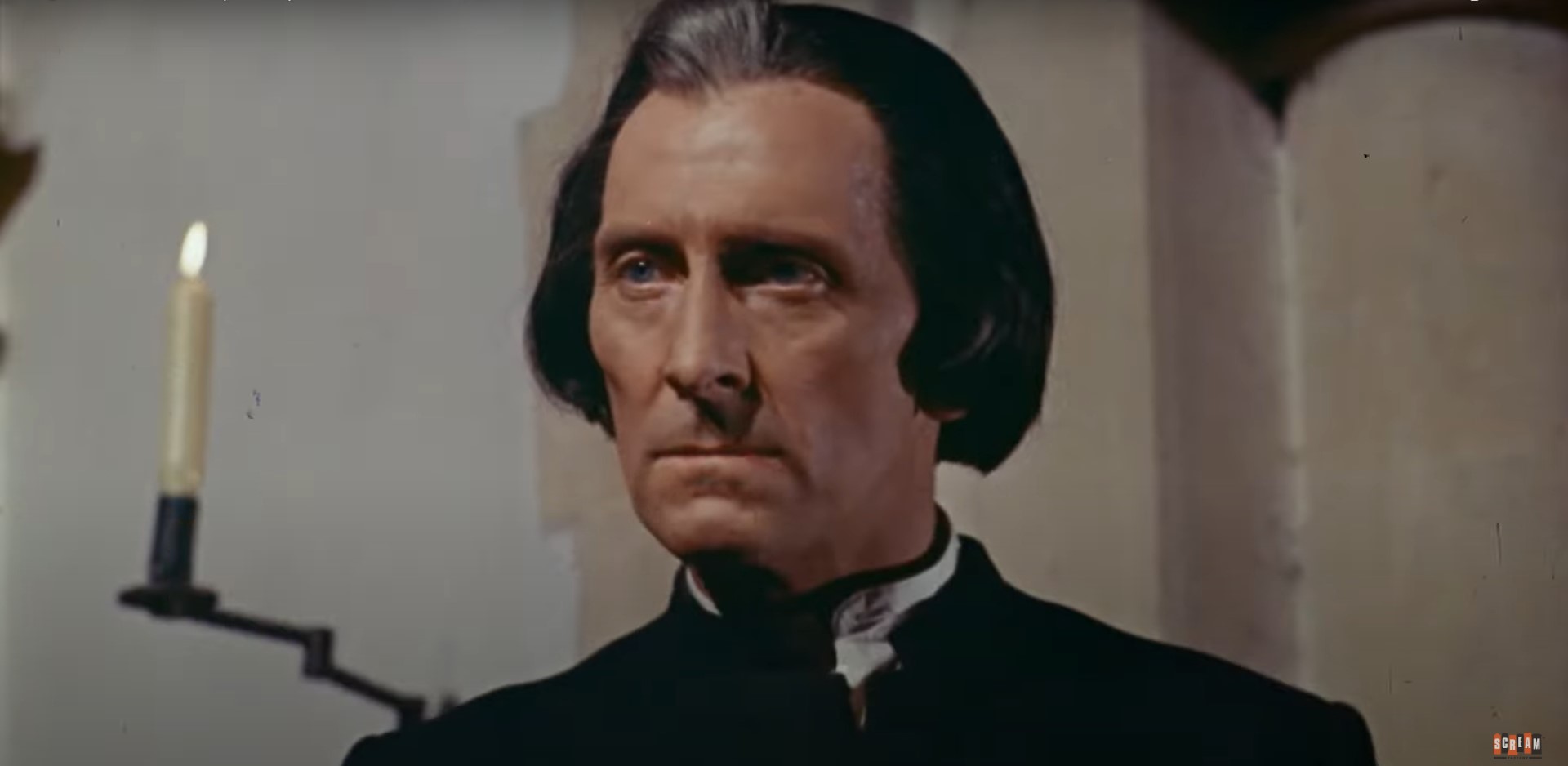
Though the cast, crew, and production company were bound not able to use “Dr. Syn” in the film that didn’t stop Peter Cushing in becoming Dr. Bliss, the peoples of Romney Flat’s very own Vicker who revitalized the small town and severed them from hefty taxation with a scheme of smuggling. Clearly, Cushing is in his glory, in his element of wide range, and can be seen as having a ball with playing a dualistic character in Dr. Bliss. Dr. Bliss bares no sign of being saintly stiff around the gills as any pious man might be portrayed and Cushing, at times, can be as rigid as they come in certain roles. Not Dr. Bliss though as a man playing the facade to hide behind-the-curtain his good intentions from those who want a piece of the pie for king and country. Opposite Cushing is “Never Take Candy from a Stranger’s” Patrick Allen as Captain Collier who trucks men by boat to land a surprise inspection after being tipped off about a possible smuggling ring. Allen’s cuts Collier from the clever cloth but the leader of revenge men is always one step behind his time as Pirate chaser and now as a fraud nabber. Another excellent act of thespianism in “Night Creature” is another Hammer household name in Michael Ripper (“The Curse of the Mummy’s Tomb,” “The Plague of the Zombies”) after a long stint of playing unnamed sidelined roles early in Hammer’s beginnings. Ripper has an unforgettable look with gravely gruff voice and a quick timed wit that makes him a pleasure every time he steps into the scene. Just coming onto the scene is Oliver Reed on the coattails of his success with “The Curse of the Werewolf” and though his role is purely supportive, his act as the love stricken and loyal to the smuggling cause son of the naive local squire and magistrate (Derek Francis, “The Tomb of Legeia”) who isn’t in on the scheme. “Night Creatures” rounds out the cast with Yvonne Romain (“Circus of Horrors”) as about the closest thing resembling a love interest, Martin Benson (“The Omen”), and Milton Reid (“Deadlier Than the Male”) as the Mulatto pirate exploited as a shackled hound dog to sniff out French Brandy…literally.

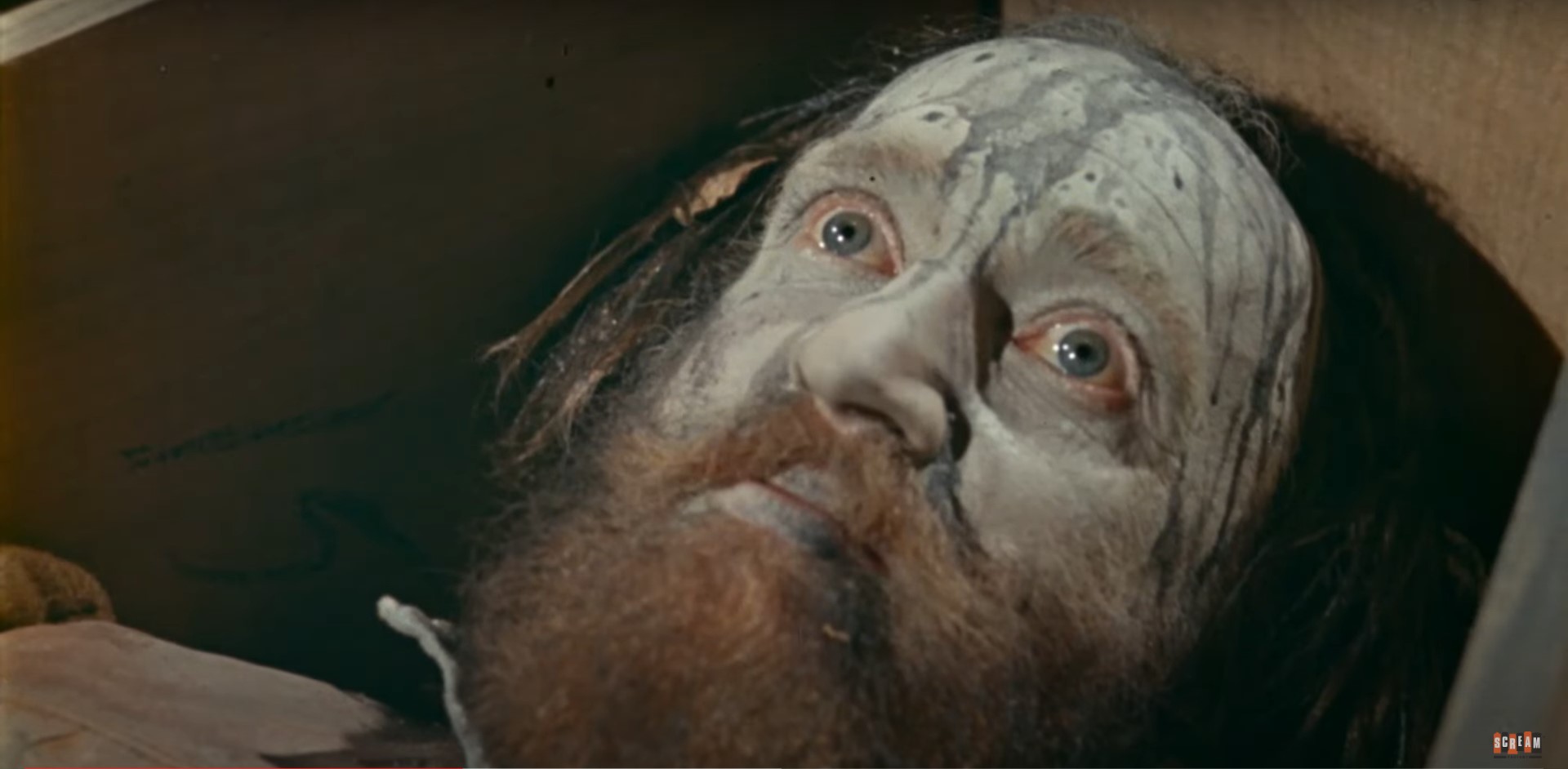
A swashbuckling, smuggling caper with notes of macabre imagery and a purloin-the-show performance by Peter Cushing stows “Night Creatures” away as one my favorite Hammer productions. Laced with characteristically grand production pieces and sets, mostly shot at Hammer’s Bray Film Studios, “Night Creatures” looks luxurious and feels expensive as pirate ship interiors, magnificent church hall, and haunting shots of a scarecrow with voyeuristic eyes propped on the countryside landscape elevate not only the story but also the rich characters brimming with complexity. Scott does a fine job sustain an ambiguous Dr. Bliss who, from our own suspicions, can be immediately pinpointed with a backstory that never falls in the pit of exposition. The true story behind Dr. Bliss is practically pressed, squeezed, tugged, and pulled by tooth and nail to finally be revealed to the audience and the moment is greatly satisfying when admission to something we all know is finally out in the open. While Dr. Bliss purposefully misguides the revenge men astray from his illicit activity, “Night Creatures” is also misguiding the audience with ghastly suspense in the existence of the Marsh Phantoms, a luminescent design of full body skeletal depictions on top of midnight cloaks and onesies, pulled off by special effects supervisor Les Bowie (“Paranoiac”) and his team to add a taste of horror to a rather subterfuge storyline of rebirth and sacrifice.

Now on a part of their Collector’s Edition line, Scream! Factory releases “Night Creatures” onto Blu-ray home video with a new 2022 2K scan from the original interpositive. The result is mostly immaculate with visualize details along the skin lines that makes every bead of sweat and every follicle more apparent to the eye. The release is presented in a 1080p high-definition transfer in what’s now labeled Univisium, an aspect ratio that is 2:1 (2:00.1), reformatted from the original 1.85:1 aspect ratio. Less than a handful of scenes display what looks to be posterization and a degrade in the scan, causing the scene to revert back to the original transfer for a split second. For this you receive a little more width that, ironically enough, homes better in on the focal image. The English language DTS-HD Master Audio mono mix has little to speak ill of as the dialogue, with a hint of continuous static, is greatly clean and clear, ambient track is balanced in range and depth, and you can follow every clashing note in Don Banks’ dramatically orchestrated score. Special features include a new audio commentary with film historian Bruce Hallenback, a new interview with Les Bowie’s special effects technician Brian Johnson, Pulp Friction with film historian Kim Newman on his take on the clustering mess of “Dr. Syn” film rights, Peter Cushing’s Changing Directions with film historian Jonathan Rigby mostly on Peter Cushing’s admiration for the role and his invested interest in playing the main role, a making-of featurette narrated by John Carson, The Mossman Legacy of film historian John Carson showcasing the lot of antique carriages crafted by the George Mossman company in Hammer films, a still gallery, and the original theatrical trailer. The unrated, 83-minute feature also includes a cardboard slipcover with new illustrated from cover art by Mark Maddox. Don’t let a claggy title like “Night Creatures” fool you! Though not the sexiest title, “Night Creatures” will enliven with the mystery of Marsh Phantoms, the suspense of the cat & mouse smuggling game, and the pure bliss on Peter Cushing’s face as he fully immerses himself into the role of his lifetime.

The Marsh Phantoms are Coming to a Blu-ray Near You!