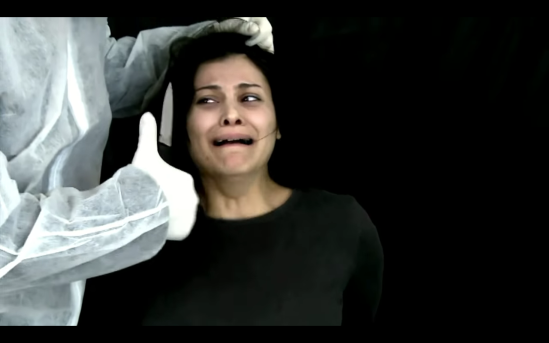
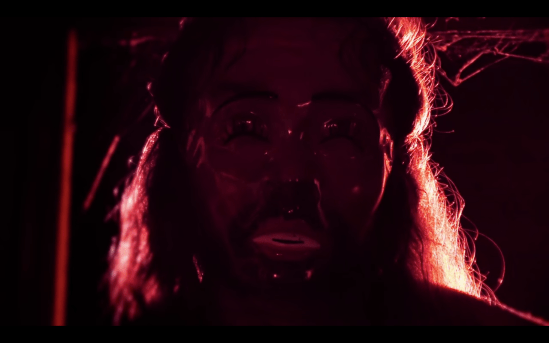
A pair of struggling paranormal investigator groups have been reduced to the gimmicky capturing and recording pay schemes of alleged ghost and spirit interactions, but when a hack actor is hired to setup a meet and greet with an apparent demon possessed girl, their investigation leads Freaky Link’s Jacob and Shawn and Spooky Links’ Lace and Rob to an abandoned and dilapidated fairground as the source of the girl’s possession. Upon arrival, they’re immediately sucked into the epicenter of Hell to battle for their very souls.

Jacob and Shawn return to confront the ruthless terrors of supernatural forces once again in “Anna 2: Freaky Links,” aka, ITN distributed titled “The Devil’s Fairground,” and aka, better known as simply, “Anna 2,” in this low-key horror-comedy sequel from the Crum brothers, director Michael and screenwriter Gerald, delivering infernal Hell straight out of the Lonestar state of Texas. Honestly, I’ve never seen the prior film, “Anna,” and at first glance, “Anna” was seemingly a rip from the successful coattails of “The Conjuring’s” universe sub story, “Annabelle,” involving a doll embodying the forces of evil. However, despite the comparable titles and a shade of the narrative, “Anna” and “The Devil’s Fairground” veer into a novel realm of the deep and ultra-surreal that became the basic construction materials needed for lush nightmares. The Dallas-Fort Worth based production company, MGI Films, founded by Michael Crum, backed the film saw fit to update the title form “Anna 2: Freaky Links” to “The Devil’s Fairground,” a simple, yet improved title change that landed some viewing confusion when the original title graced the scree when the original title graced the screen, like for myself who enjoys going into a movie knowing nothing. MGI Films has also produced “Lake Fear” and “Blood Vow.”

Returning as paranormal private eyes, Jacob and Shawn, are Justin Duncan and Gerald Crum as the hapless duo who barely survived the first demonic doll encounter and team up with the Spooky Links investigators Lace (Mercedes Peterson) and Rob (John Charles Dickson, “Meathook Massacre 3: First Hunt”) to combine their joint efforts and their holy water filled water guns up against an unknown evil. Initially, Jacob and Shawn are written without much consideration of the first happenstance with only brief hints that mean little to the layman toward the Crum pagan pageantry. There’s obvious history between the two groups beyond being competitive supernatural sleuths that’s difficult to sift through to make a full, clearer picture on their quarrelsome nature, but one thing is certain, both Freaky Link and Spooky Links are desperate to be validated ghost hunters. Gerald Crum’s script might have dissected the thick tension between the characters, but the poor audio quality and the loose preface that dots the eyes between both predecessor and sequel is about as abstract as the Hell they find themselves swallowed in. Daniel Frank, Kenzie Pallone, Shannon Snedden, and Vandi Clark fill out the cast list.

“The Fair Ground” is a tricky trickster when judgement comes during the credit roll. With all the audio issues during the story setup, as aforementioned, connecting with the characters and the story proved dreadfully challenging conjoining against the fact that I have never seen the film’s antecedent, “Anna.” I was lost, confused, and struggling to keep up with the exposition that didn’t circulate visibly a perfect picture of “Anna” to bring the viewer up to speed. Also, the very fact “Anna 2: Freaky Links” title is displayed and not “The Devil’s Fairground” threw me for a loop; I had to pause and look back at the press release to see if I was watching the correct feature. However, in the end, “The Fair Ground” became an absolute diamond in the rough with a delectably profound scare factory of terror imagery, wallowing in the timely executions in Michael Crum’s editing and Gerald Crum’s imaginative visual and special effects. Though some will see the effects being rough around the edges, the shock-horror discordances work without question with a pack of ghoulish bug-eyed zombies, a carousal of shuttering specters, a foreboding carnival PA system, an aborted past lurking in dark waters, and an overgrown monster with the biggest butcher blade you’ve ever seen while peppering with scenes of powerful gore interjections. It’s something very reminiscent of the cinema adaptations of “Silent Hill.” A lot of the imagery doesn’t make sense, like the jarring slivers of a bad dream, but I wouldn’t expect Hell to be or need to be a place of complete rational and our minds are able to grasp the nuts and bolts of it. “The Devil’s Fairground’s” interpretation is just as real, as scary, and as aptly damning without the grounded laws of physics to ease the dispiriting attitude of multi-faceted and gratifying torture and soul swallowing the investigators are subjected to. Whatever was left of a meaningful plot is whittled down to a more basic posture, a group of people engulfed by the fiery Abyss, and the movie is all better for it.

Get sucked into the depths of the blazing inferno thrill ride with “The Devil’s Fairground” on DVD home video, announced by MGI Films and distributed by ITN Distribution. Unfortunately, the video and audio specs won’t be reviewed due to being an online screener, but I did mention the dialogue is limited, capturing very little of the softly laid discourse leading up to all hell breaking loose. There are no special features included with the screener or incorporated within the feature itself. There were times I knew the jump scare was coming and, still, I couldn’t contain the tension as a little part of me died from the inside. “The Devil’s Fairground” is an up and down roller coaster of feeble and fright with a weak story abutted against concentrated horror and gore in a must-see film.
Category Archives: Just fucking awesome
Pray EVIL Isn’t This Cruel. “Suffering Bible” reviewed! (Sub Rosa Studios/DVD)

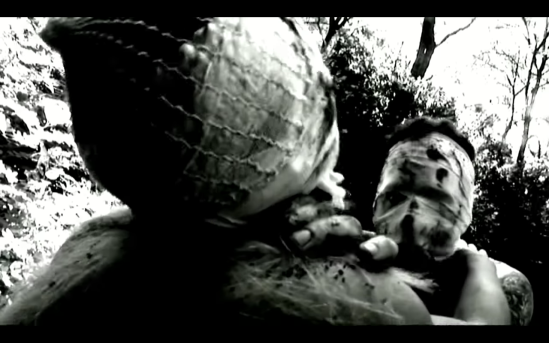
Welcome to the Suffering Bible, a collection of violating and gory interpreted religious allegories digging into stark contrasts of sin and piety and illuminating the darker side of these allegories with a lacerating gruesome perspective. These short stories include the internal strife of a psychopaths strong urge for forbidden lesbian companionship with the contentious, bigoted teachings of finding forever friends inside God’s eyes, a visceral performing depiction of the Incredulity of St. Thomas, an extreme mortification of the flesh, the prideful consequences with a Devil’s pact, and the murderous portrayals of lost souls needing redemption into God’s good graces.

Right in time for the Easter holiday, where Jesus Christ has risen back from the dead for our salvation, comes Davide Pesca’s written and directed “Suffering Bible” of sinfully derived tales of reverent and irreverent perfervid images. The Italian made and produced anthology that’s a contexture of stories is forged together with a wraparound story of the Adam and Eve in the Garden of Eden apologue. “Suffering Bible” begins with a title card excerpt, Tear thy neighbor as thyself, from an unknown storyteller named saamang Ruinees with a skewed version of the second commandment, Love thy neighbor as thyself, subtly denouncing the evils in popular religious culture and then slithering them, not so subtly, into the shorts of those suffering at behest of the bible. Pesca’s shock efforts have come across ItsBlogginEvil.com’s radar once before with another short framed macabre tale, “Hemophobia,” from Artsploitation’s home distributed release of “A Taste of Phobia” anthology and “Hemophobia” is and feels more commercialized with less than salutary toward mutilation and variety body meat, but the filmmaker does fly on a parallel body horror plane and has had his shorts featured alongside with fellow Italian auteur and shock director, Domiziano Cristophario (“House of Flesh Manniquins,” “Red Krokodil”) with a more rudimentary, analogue-video-feel approach. “Suffering Bible” is self-produced by his independent production and distribution company – Demented Gore Productions.

Being an Italian made cast functioning on the performances grounds of a heel budget writing up about “Suffering Bible’s” actors and actresses past credits, influences, methods and so on is proving to be a challenging task. Most of the cast is comprised of alternative, half-naked women, such as Nicola Fugazza and Mary Rubes who are the sole credited on IMDB.com. Rubes, an erotic model, becomes “Suffering Bible’s” inadvertent poster girl that graces the Sub Rosa Studio’s DVD cover and static menu as her seductively deceptive solo performance of body and genital self-mutilation is the most unsettling story revolving around mortification of the flesh. Rubes has previously worked with Pesca on a 2017 short film entitled “Fame de Vampira,” which also co-stars Beata Walewska. Both Rubes and Walewska sizzle in the Italian action scene with “Rage Killers” by director Roger A. Fratter, who co-directed “Fame de Vampira.” As you can see, a casting inner circle is starting to form, but that’s the extent of the network with Simon Rocca, Simon Macleod, Catlin Strange, Pate Douce, Paolo Salvadeo, Emilio Stangalini, Paolo Borsa, Emanuela La Neve, Chiara Digonzelli, and Marilena Marmo.

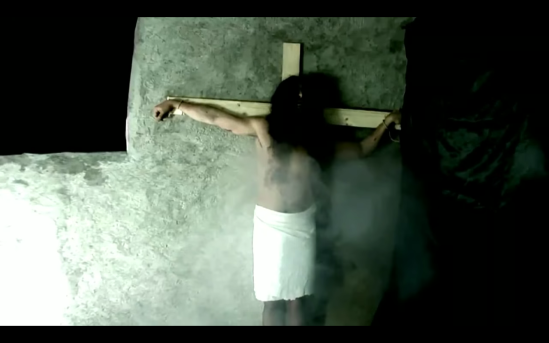
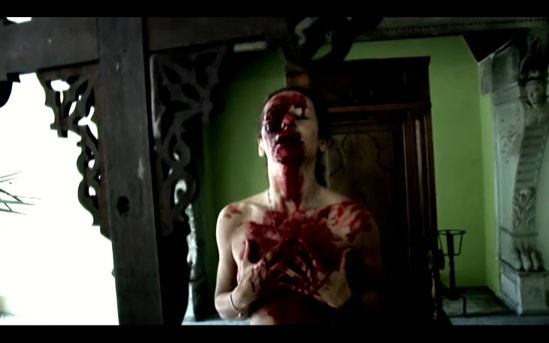
On the surface, “Suffering Bible” has a unwieldly, pigeonhole affect that places the impervious shutters around one’s peepers and thinking cap for the pleasures of gore and nudity that run continuously rampant, but Davide Pesca has a connect-the-dot vision that aims to unveil the worst of religious culture, using graphic imagery in a reverse psychological and divinity experience that’s wildly novel inside a less commercialized parameters and the more I stew on this film, the more I like it. Without this review not seeming to be a theoretical paper on Davide Pesca and the “Suffering Bible,” examples of the filmmaker using gore as the pain and suffering vessel for those struggling to be closer to God can be modeled from the first short, “My Only God” aka “Friends Forever,” in which a woman stitches herself to her now dead friend to be closer to her, as if their friendship, which was severed insinuated by the dead woman, will continue in the afterlife. Same can be said about the last, if not more potently gristly, short, “The Redemption of Last Souls,” where a druggie, a terminal ill person, and a homeless man who has lost family connectivity have nothing left to lose, have lost faith, and seek redemption through being chair strapped subjects of a snuff film. While “My Only God” and “The Redemption of Lost Souls” caters to the barbaric rite of celestial passage, Davide Pesca’s specialty falls more within the lines of body horror as the filmmaker has saturated himself in the infatuation of the Body Modification culture, reflected in his “St. Thomas” and “In The Name of The Father” that include Doubting Thomas reaching protractedly into a crucified Jesus’s side slit and include the extreme mortification of the sinful flesh – eyes, breasts, and clitoris – by a devout devotee.

“Suffering Bible” is a throwback moxie livid on sin and body destruction and it’s a title coming to you on DVD home vide like a disastrous, break faith, miracle from SRS Home Video and MVDVisual. Though listed as a retro release by SRS, “Suffering Bible” released in 2018, shooting over the course of a few years prior more than likely, with a combination sepia-color approach and the result outputted a strained and digitally cursed image of a widescreen, 1.78:1 presentation that suffers from severe compression artifacts in conjunction with digital interference. The errs are absolved by the very label of a throwback “erotic art house horror” gracing the retro, faux-VHS DVD back cover. The single channel stereo has limited flexibility with some ostentatious, if not laughable, Foley work. Aside from a little dialogue in two of the shorts, “Suffering Bible” takes a vow of silence and speaks volumes in actions alone; this creative choice, along with some probable glitch art, saves much of the technical woes already plaguing Pesca’s stain on profane. The robust grunge-brood style of OKY’s prolong guitar distortions, delicate strum and percussion echoing, and reverse melodies bedazzles in a cathartic relief that no dense, run of the mill metal band is attached to the soundtrack. Special features include a short interview with Davide Pesca, which turned out to be more of a behind-the-scenes look at handful of shorts for the film, a lengthy ultra violent and gory showreel for Pesca’s “Tales from the Deep Hell,” and SRS trailers. More grimly poetic than sleazy gore-porn, the book of the “Suffering Bible” can open eyes to the unsettling infernal of holy virtue with transfixing horrid death rooms.
EVIL Can Never Replace Love in “After Midnight” reviewed! (Umbrella Entertainment / DVD)

Well known country boy Hank has everything he could ever need in the small, rural Florida town: having an establish family lineage, being the owner of a local bar hotspot, and obtaining the love of the beautiful Abby. Their gleaming happiness suddenly goes dim when Abby abruptly takes off, leaving a note with little information of her whereabouts or her plans. Fraught in her absence, Hank drinks himself into a stupor most nights of romantic nostalgia while also fending off his rustic home from a beast out of the surrounding woods that continuously scratches at his front door nightly. Hank’s friends believe he’s suffering a mild mental break as night-after-night, the snarling beast evades Hank every effort to capture and kill it.

“After Midnight” is a sheering melodious and delicately programed romance-horror from “The Battery” writer-director Jeremy Gardner allotting co-directorial duties again with continuous collaboration beside Christian Stella. As Gardner’s third film in the director’s chair, second inside the realm of horror, “After Midnight” brandishes more a sappy love story that sings the tune of a love lost warrior where the relationship woes lie within the deepest, darkest corners of himself rather than being a frontline horror sprinkled lightly with dusted coating of amorous renewal. “After Midnight” is a topsy-turvy monster movie not for an insouciant genre fan who rather skim the surface for blood on the topsoil than dig feverously for the originating root. If you’re also a fan of the mysteriously acclaimed, H.P. Lovecraft-inspired “The Endless,” the filmmakers behind that film – David Lawson, Aaron Moorhead, and Justin Benson – produce “After Midnight” under their Rustic Films label in association with Vested Interest, Cranked Up Films, and Kavya Films, casting that querying memento clinging like a foreboding, nagging scratch needing to be itched.

Not only is Gardner the director, he also stars as Hank, enduring the multi-hat involvement in his films in thematic fashion from his previous films, spearheading the roles in “The Battery” and “Tex Montana Will Survive!,” and Gardner has also branched out beyond his work, having roles in the visceral Joe Begos’ films “Bliss” and “The Mind’s Eye.” Gardner sports his common wear of a U-shaped V-neck t-shirt and bushy beard overtop his large frame and wields a sharp tongue, whiplashing small witticisms as he charms his serenading rustic charisma upon Brea Grant as Abby. The “Dead Night” actress enacts every man’s inherent fear of being lost without their better half when Abby hightails from Hank’s steadfast stance on life. Grant provides a flood of emotional drought through a series of Hanks’ melancholy, good times flashbacks that provide backstory fuel to Hanks’ quickly withering grounded state. Gardner and Grant’s chemistry eerily dons the routine life span of young love and weary complacency without so much showing the beat work argumentative discussions and differences of a diminishing relationship; their natural banter never derails even amongst a bedeviling beast with nightly visitations on a drained Hanks’ doorstep. “After Midnight” fleshes out with a cast of superb supporting roles with nearly Henry Zebrowski (“Cut Shoot Kill”) stealing the show as a half-wit yokel, Justin Benson (“The Endless”), Ashley Song, Nicola Masciotra, Taylor Zaudtke, and creature performer Keith Arbuthnot as the man in the monster suit.

Speaking of the monster suit, the unknown origin creature is very Guillermo del Toro-esque with a quasi-rubbery look, but still renders terribly real with the puppetry facial expressions and Keith Arbuthnot contorting his body to exuberate natural movements. However, don’t look to be thrilled by a ferocious beast as the constant the source of contention. It’s more of an afterthought, a pleasant afterthought, filling Hank’s Abby void or is it? It’s a question you’ll be contemplating when the credits role when a monkey wrench finale disrupts your premediated blue print scheme of a reason for the creature’s existence. Romance and melancholy cross paths in an overwhelming heap of love sickness, guilt, disappointment, and jealousy in a well thought out, smart dialogued version of a self-growth narrative.

There always seems to a malevolent monster behind the scenes, perpetrating the demise of a flourishing relationship exemplified by a beautifully wicked allegory in “After Midnight” distributed onto DVD home video by Umbrella Entertainment. The transfer is presented in the original widescreen, 2.35:1 aspect ratio, on a region 4, 83 minute runtime disc. The presentation is virtually flawless with palatable natural coloring, gleaming southern-sweat coated, natural looking skin tones, and overall details with Hank, and Hank’s house, looking specifically grimy and unkempt. Greenery is of a brown lush backdropped inside what could be anywhere small town America. The English language 5.1 Dolby Digital surround sound audio renders a nice range and depth with the monster’s muffled scratching and growling outside the door, the shotgun blasts are powerfully exalting, and the dialogue clearly couriers through all relationship qualms and Hanks droll dialogue. As of many Umbrella Entertainment standard feature releases, there are no bonus features nor a static menu. “After Midnight” is a contagious love story for not it’s mushy, heartfelt, weepie doting into the tears of self-pity, but for that lingering presence of sinister cynicism the monster epitomizes, a stark terror scratching every night under the skin until the unbearable hole in our hearts is finally sated by love’s return.
The EVILS of the Jersey Shore! “Exit 0” reviewed! (DVD / Breaking Glass Pictures)

A young New York City couple drive down the Jersey Turnpike down to the Jersey Shore for a quaint getaway in the comforts of Cape May’s Doctor’s Inn Bed and Breakfast. With the hopes of rekindling the spark between them, the omission of the fast churning city living will surely become dampened by the island’s off-season quiet that’s more in sync with focusing on each other. However, after a strange incident at a curbside rest stop, something hasn’t felt right. From the odd tenants to the inexplicable occurrences of the Doctor’s Inn, the strain between their recoupling becomes a daunting wedge and when a videotape is discovered in their room, a videotape that shows a grisly murder on the exact spot they sleep in their room, that wedge not only drives deeper between them but also begins to suspend reality and raise paranoia.

Set on location at the Doctor’s Inn Bed and Breakfast of Cape May, New Jersey is the jarringly fear-fostering “Exit 0” that delivers the grim goods on a dead end, spook story skippered by writer-director E.B. Hughes (“Turnabout”) from a story co-writer with Philadelphian native, Gregory Voigt. Being a local Philadelphian suburbanite myself and a patron visitor of Avalon, New Jersey, having “Exit 0” be a horror-thriller that showcases the tremendous historical and Victorian-laden edifices and tourist retreats like the lighthouse on Cape May point is really invigorating to know that any kind of story, whether horror or otherwise, can be tailored into the seams of just about anywhere on this designer planet. Cape May is charming, inviting, and bustling with touristy customers who’ve answered the call from the beach from up and down the East Coast and surrounding inland areas, but during the off-season, the Jersey Shore, as a whole, is a gloomy and desolate barren land that would emit the appearance of invoking an eerily haunting atmosphere. “Exit 0” is also a charming little independent picture, self-produced by Hughes under his production company EBFIlms.

The cast is comprised of mostly locals in the tristate New Jersey, New York, and Philly area, starting off with Gabe Fazio (“Trauma is a Time Machine”) anchoring down Billy in the lead role of the boyfriend reminiscing about when his parents took him to the Doctor’s Inn when very young and being the plagued victim of severe anxiety when things go strangely muddled during his stay. “The Badger Game’s” Augie Duke plays a constant in Billy’s quickly downgrading opaque craziness as the teetering love interest, Lisa, and though typically the foundering relationship could be the heart of the story, but in “Exit 0,” Lisa might be portion of the reason for Billy’s seemingly unhinged fear. Duke’s wonderfully seductive from a distance, blue balling Billy on his wishful romantic long weekend. Billy and Lisa’s chemistry is in a beaker of unknown substance as we’re not really sure where the stand with each other: Billy doesn’t know whether he loves Lisa or not and Lisa keeps Billy at arm’s length while at the same time attempts to engage in Billy’s sexual advances. Hughes highlights often usual and direct characters to round out Billy’s source of burdens, especially with The Writer played by “The Mask’s” Peter Greene. Greene’s method approach plays into his deep ominous eyes and contoured facial features as a mysterious fixture. Federico Castelluccio plays into the latter direct category as the island’s Detective Mueller. The “Midday Demons” actor perhaps provides a character who becomes the only source of sanity not influencing Billy’s instability and Castelluccio courses a hardnose investigator to reach the truth. “Exit 0” fills out with a couple of veterans in Kenneth McGregor (“Prom Night IV: Deliver Us From Evil”) and Daniel O’Shea (“The Rocketeer”).

“Exit 0” will unavoidably not be a hit with most audiences as a salt of the earth kind of psychological thriller bearing no teeth when considering general moviegoer baits, such as lots of gore, action, and skin, but despite the rudimentary building blocks, E.B. Hughes braises shuttering tension inside a compartmentalized configuration that includes a bit of found footage vehemence mixed with some spun Cape May folklore that’ll find regional nepotism amongst from friends and relatives of the cast and the crew and favoritism from the locals and enigma enthusiastic. Another disadvantage against “Exit 0” is more technical in regards to poor sound editing that picks up way to much noise, ambient and static alike, that’ll certainly dissuade some from enjoying the core plot involving triggering suppressed mental illness and eliciting out of the box interpretation of whether or not what Billy experiences are in fact real or just in his piecing imagination.

Embark on a minatory trip to Cape May with E.B. Hughes’ “Exit 0” on DVD Home Video distributed by Philadelphia company Breaking Glass Pictures. The region 1 DVD is presented in a widescreen, 1.78:1 aspect ratio, with a runtime of 95 minutes. “Exit 0” isn’t a popping color film that limits the ranges to being bleak shades of primary colors that opalescent from scene to scene until we meet The Writer whose basking in a harsh, almost heater like, fluorescent red. These scenes exhibit quite a bit of color banding, noticeably on the walls. Details are moderately soft on times, especially on faces, but there’s plenty of good contour lighting to equalize the effect. The English language dual channel stereo mix initially begins with a rough edit that can’t discern dialogue and backdrop noise audiophiles, making the car ride exchange dampened between Billy and Lisa who are nearly drowned out from the car’s whooshing ambience. Stereophonic sound system feels more mono that can’t grasp the voices and the anxiety riddle milieu that bombard Billy’s crumbling agitation. Dialogue tracks are, for the most part, prominent and can be discerned. Special features include a lengthy and in depth Q and A with director E.B. Hughes, Gabe Fazio, Peter Greene, and Federico Castelluccio, behind the scenes footage, outtakes, a bonus short film “Harsh Light” written and directed by E.B. Hughes about an aging boxer whose career has hit a dead end, and the theatrical trailer. “Exit 0” is abstruse conjecture that mental illness and chilling folklore can be one in the same, depending on one’s subjective perspective, and E.B. Hughes and his anchoring leads masterfully leave open the murky, rheumy wounds for personal contemplation in a hair-raising tale.
The Analogies of the EVIL that Plagues Us. “Hole” reviewed! (Wild Eye Releasing / DVD)

Three peoples’ lives become coiled around the unfortunate state of death with each experiencing individual variations of the concept. The recently released convicted felon, Ed Kunkle, faces reality on the brink of insanity as his past demons vilify his temperament in the direction of total carnage. Befriended by Kunkle is Eve Adams, a single mother who struggles to cope with her infant son’s untimely murder that happened right under her watch. Assigned to the Adams Boy’s case is detective Bodie Jameson who struggles with own malevolent urges brought upon by the unsurmountable cases of grisly homicides that come cross his desk while he also tracks down a child killer. Their differences connect them, looking into their future to rediscover the past that molded their disheveled lives into fateful affairs with death.

Over the course of three years between 2007 to 2010, auteur filmmaker Joaquin Montalvan directed and assembled a gritty glimpse into the grubby windows of condemned souls with the 2010 released “Hole,” produced by his own independent production company, Sledgehammer Films, and co-written with his longtime collaborator and wife in life, Eunice Font. “Hole” is Montalvan’s third horror feature following 2002’s beleaguered with loneliness thriller “Adagio” and psychological horror, “Mobius,” which was released the year prior in 2009, plus also behind a string of documentaries. Montalvan’s an optically surreal storyteller basking in a rich and unorthodox story and color palette that revives originality bobbing in an heaving ocean of lemming horror.

“Hole” is comprised of showcasing three stories from three tormented lives. One of those lives, the mentally unfit Ed Kunkel, gorges on being the centric force that thrives the other two into a descendant hell. The late Paul E. Respass tunes into Kunkel’s manic polarity as a person who can be extremely mild mannered and pleasant then explode with caustic abrasiveness and ugly torture. Respass’s shoulder length, wavy hair, graying goatee, and iron contoured face gives him a Charles Manson appearance that goes good with crazy. Behind closed doors Repass’s Kunkle breaks with sanity slaughtering his mother lookalikes as a result of mommy issues, but when conversing with Eve Adams, Kunkle’s maintains an upright keeled temper. Teem Lucas, who like Respass has worked with Montalvan previous, subdues the abnormal imbalance with a normal person’s reactionary response to loss and heartache when Eve Adams copes with the murder of her young child. In the middle these two extremities, detective Bodie Jameson’s work seeps into his psyche, fluctuating between irrational and rational thoughts. Another actor in Montalvan’s corral, Jim Barile, who looks more like a 70’s hippie than a detective, has the hardest performance of them all of slipping into a terrifying unknown mindset while maintaining status quo in work and romantic relationships. Barile’s role isn’t well recieved, flying mainly under the radar with an underperformed and pointless conclusion to detective Jameson right and wrong affliction. Charlotte Bjornbak (“Camera Obscura”), Katherine Norland (“Cannibal Corpse Killers”), Alina Bolshakova (“Dead End Falls”), Dennis Haggard (“Cannibal Corpse Killers), Theresa Holly (“Legend of the Hillbilly Butcher”), Micki Quance, Gavin Graham, and Char Frost (“Someone’s Knocking at the Door”) co-star.

Right away, a strong sense of resemblance washed over me when viewing “Hole.” The lead actor, Paul Respass, and the overall texture felt already acquainted with my visual cortex nerves. My suspicions were justified and my sanity was cleared as I have seen “Hole” before in a later film entitled “Legend of the Hillbilly Butcher,” another Joaquin Montalvan flick featuring Respass as a delusional manic. Yet, “Hole” is one of those films that after the credits role, hasty judgements should be chewed on, reflected upon, and recollected for a second analysis. Hell, you might as well just re-watch it all over. The thing with Montalvan is is that his brand has trademark cognizance on such a level that even if “Hole,” released in 2010, and “Legend of the Hillbilly Butcher,” released in 2014, instinctually ride the same wave, they ultimately compare as individual projects with a distinct personality and artistic flair. For instance, “Legend of the Hillbilly Butcher” denotes more of an homage to early exploitation films and “Hole” puts more stake into societal system failures, even if borrowing from the likes of Ed Gein with the killer wearing a flesh mask and sewing up a fleshy garment. Both films hark about mental illness, but one glorifies the act for the sheer sake of carnage fun and the other considers it a collateral damaging symptom of a broken justice structure. Another difference to note is “Hole’s” three-way non-linear narrative that moves like the Wonkavator from “Charlie and the Chocolate Factory” in every way imaginable and can be daunting to keep up.

Out of the depths of obscurity comes “Hole” distributed on DVD home video by MVDVisual and Wild Eye Releasing under the Raw and Extreme banner. Presented in a widescreen, 1.78:1 aspect ratio, Montalvan and his D.P. R.T. Norland, brightly bedazzling with every shade of matte box and some slow motion, play the field utilizing various techniques to tap into Ed Kunkle’s disorienting madness. Using backdrops like the ghost town of Bodie and the spiritual sanctuary (or bohemian commune) of Salvation Mountain, Montalvan’s able to cast an aberrant vision out inside an independent means. There are some points of posterization, details are softer than desired, and blacks lose composition with blocky noise so there are some drawbacks to the encoding. The English language dual channel audio mix pairs about the same as the video with spliced competing facets that tend to offer come-and-go range and depth. Scream queen moments go into feedback mode during Ed Kunkle’s kill mode, losing the ideal quality via unsound mic placement. Dialoge is okay being on the softer side with some background noise being flowing in and out between the audio edits, emitting a static effect around the dialogue and then cut out when not the actors are not speaking. The bonus features are aplenty and informative with a Montalvan commentary track, an extensive mack of documentary that fine combs every pore of the film that includes interviews with cast and crew, Ed’s Journal segment conversing about the backstory on Ed Kunkle’s perverse family and killed friends portraits and souvenirs, as well as trailers. Bloodhounds will want more from Ed Kunkle’s shed of horrors, but what director Joaquin Montalvan has fashioned threads madness with a neglected mental heath system while polishing a a shiny three prong, moviegoer narrative with blood, body parts, and butchery.