Subscribe to EVIL’s Vlog! “Followed” reviewed! (Global View Entertainment / Digital Screener)


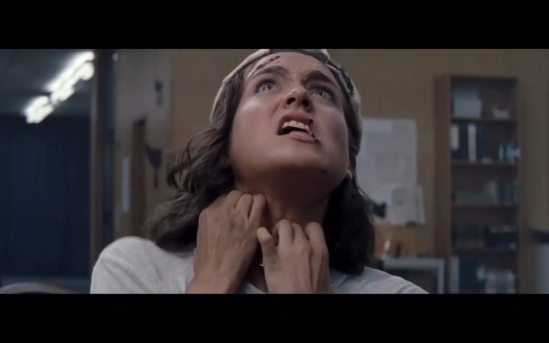
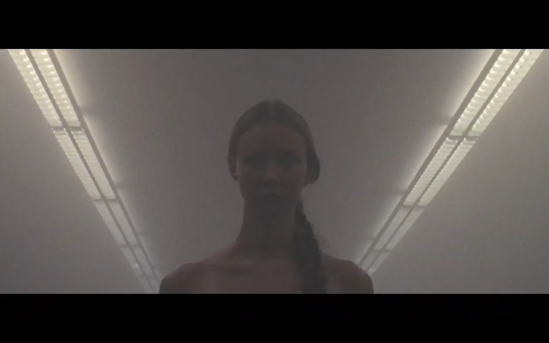
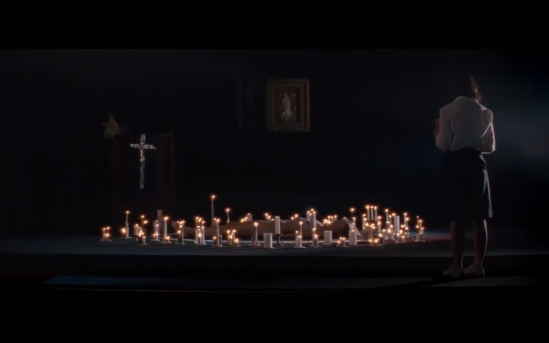
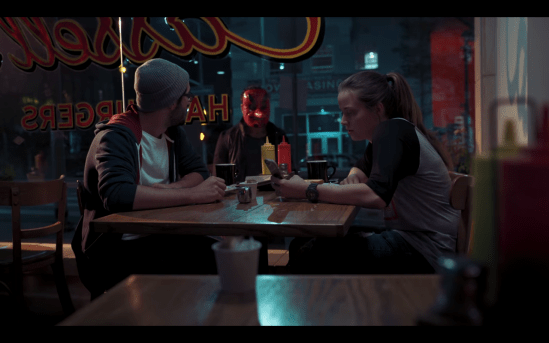
Unable to entertain that ghosts actually exist and to be one of the best social media influencers he can be on the world wide web, influencer “DropTheMike” vlogs locations’ ghastly back stories that are now presumably haunted by the very souls the locations consumed. When offered a once in a lifetime opportunity, worth a small fortune in the sum of a quarter of a million dollars and set start up his family with his recently pregnant fiancé, “DropTheMike” quickly challenges his followers to scout out the next paranormal investigation on the cusp of Halloween in 2016. With the results in, an overwhelming number of responses held one of the most notoriously haunted hotels in America, The Lennox, as his and his video crew’s next targeted exploration from the tops of the roof to the dank, dark basement. Ecstatic and eager in a pool of mixed emotions amongst his crew, “DropTheMike” pushes forward despite the forewarning counsel from a hotel historian and his friends, booking rooms for a three day stay that turns horribly frightening when the social media influencer’s greed for followers and fortune provokes the damned souls and the spirit of an infamous serial killer who once hacked up his victims in the very same room “DropTheMike” is staying in.
Us bloggers always try to use our social media platform powers to not only gain internet popularity amongst the ever growing, or continuously exploding, tsunami of 24/7 news, reviews, and inspirational muses for instant, impactful transmission to billions of users, but also to express the things we, the bloggers/vloggers, express what we’re passionate about. Sometimes, what we’re blindly passionate about undertaking can haunt and consume our very being, and also destroy our souls and that’s the epitomic baseline for Antoine Le’s 2020 supernatural cyber-horror “Followed” that’ll feed into select drive-in theaters Friday the 19th. “Followed” is Le’s debut full-length feature film penned by the self-help screenwriting guru, Todd Klick. Shot on location in Los Angeles, Le and his crew use a number of different hotels give the illusion of being inside the fictitious Hotel Lennox, including Hayward Manor Hotel for the lobby scenes and Hotel Normandie for the interior rooms, re-working the rest digitally to effectively pull off the faux location without issue. Branded Pictures Entertainment and Le’s own co-founded Viscape Arts, along with co-producers Greg Berlant and Matthew Ryan Brewbaker, server as the production studios that pushes cyber-horror virtually toward to the forefront of found footage and dark web terror.

In front of the camera, the main attraction, the host with the most is “DropTheMike,” played enthusiastically by Matthew Solomon in his sophomore feature film and handling the pressures of a demanding social influencer position with pizazz to generate subscriptions with the utmost vigor. Personally, I’m familiar with too many influencers that cast a pendulum energy to the akin of a zany children’s educator personality known as Blippie. Google Blippie and have you’ll be able to paint a picture of a less morbid version of “DropTheMike” but with the same kind of body and facial expressions. Solomon’s counterpart is Tim Drier as Mike’s director of photography, Chris. Reversed within the confines of his Christian faith, Chris has serious reservations about The Lennox stunt, opposing Mike at every plea for him to shoot what could be the influencer’s biggest achievement and turning point of his mediocre career. If it wasn’t for being sweet on Danni, a fellow DP, Chris would snuff out any venture into the what Mike thinks is the one big publicity stunt. Played by “The Incantation’s” Sam Valentine, Danni’s a bit of an instigator or, perhaps, shares Mike’s agnostic views on the spirt world, but communes with the film crew in order to reach out to her former fling in Chris and see what materializes from the questions that have been plaguing her. The story primarily focuses on the trio and their friendship dynamics, but there are interesting key support roles that provide a well timed and deserving boost to keep “Followed” grippingly tense and violently rough-hewn toward the path of the malevolent specter plane, including performances by Caitlin Grace, Kelsey Griswold, Christopher Ross Martin (“American Horror Story: 1984), and veteran actor of “Deer Hunter” and “Carnisaur 2,” John Savage.

What makes “Followed” different from other cyber-horror genre films, such as “Unfriended,” “iLived,” or “Like.Share.Follow?” Cyber-horror looks a lot different now than 20 years ago when the genre viewed the mechanics of machine was bedeviling autonomy and people were slave to the machine in one way or another. “Death Machine,” “Lawnmower Man,” and “Evil Speak” are the quintessential ghost in the machine with each plot platters different variations of to subordinate mankind. Now, these films might seem low-tech and more tangible instead of the trying to grasp the idea of cyberspace. Aside from the dark web snuff premises, cyber-horror nowadays, such as “Followed,” is bound by the original influencer, the devil, who has strewn his watermark through the many conduits of streaming services, infecting at will the dark powers to beguile and besiege the barrier of rationality, and deconstruct human morality to the most primitive and primary sin. “Followed” doesn’t break the mold of cyber-horror, but exploits the mold to the max to deliver a terrifying hotel with a ghastly black past. Based perhaps on a number of personal grim accounts and then chained together like an all-in-one anthology, “Followed” jazzes up with the second act with myths, visions, and theories between the rather ordinary bookend beginning and end, always stepping up evil’s game to the point where you never know what to expect and that’s what’s enjoyable about the found footage aspect because nothing is certain, especially when each floor has a history of violence.

Book your reservation to hell and subscribe to the nerve-racking black magic of Antoine Le’s “Followed” hitting the drive-in theaters on June 19th, insidiously expanding into more drive-in theaters on June 26, and eventually landing onto VOD later summer 2020 courtesy of the new kid on the film distributor block, Global View Entertainment. Since “Followed” was viewed as a digital screener, the video and audio aspects will not be critiqued, but the official specs include a presentation in a widescreen format, aspect ratio 1.85:1 with an English language 5.1 surround sound audio mix inside a 96 minute runtime. “Followed” is a visual feast that apply a number of different kind of filming techniques from handheld, spy cams, and security footage and brush the hue spectrum from the ominously vibrant reds to the forlorn splay of sterile metal and steel. With tactics that include a pluralistic phantom ecosystem all living together at the Lennox Hotel, the varied soundscapes and ambient bytes spookily outfit the multi-headed apparition commune existing just on the threshold of the reality plane and seeping in when poked, like a sleeping bear with a stick. There were no bonus material included or any additional scenes during or after the credits. “Followed” is a cherub of the cyber-horror junkets before it’s time that indulges itself into the destructive and careless path of a social influencer, ignoring the sinister forces amongst the other things, like personal property, public safety, or personal safety, real influences tend to disregard when climbing the social media latter to the 15 minutes of fame of internet stardom.

Find a Drive-In near you by clicking on “Followed” official website : https://followedhorrormovie.com/

[youutube=https://www.youtube.com/watch?v=VduFOTzm8DI]
Hard Bodies, Hot Vixens, Civil War Gold, and an Evil Bolivian Druglord in “Enemy Gold” reviewed! (Mill Creek Entertainment / Blu-ray)


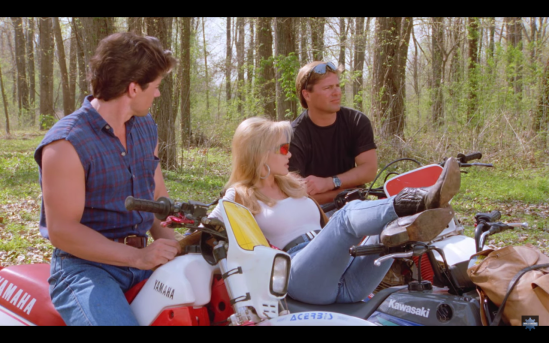
Agents Chris Cannon, Mark Austin, and Becky Midnite go in guns blazing on a drug smuggling operation operated by the goons of a Bolivian drug lord and club owner named Santiago. Furious with their meddling that cost him a hefty dividend, Santiago employs the crooked agency director, Dickson, to do something about his rogue operatives, but with his bureaucratic hands tied, Dickson can only get the agents suspended until further investigation clears them of any wrongdoing. During their leave, the three go on a gold finding expedition based off the tale of a legendary suicide mission conducted by a Confederate Lieutenant during the American Civil War that involved infiltrating behind enemies lines and stealing Union gold to fund the rebellion cause. The gold is believed to be hidden deep within the woods, a secluded area Santiago just happens to learn about while eavesdropping on the agents movements. Deciding take matters into his own hands, Santiago hires an exotic hitwoman, Jewel Panther, to hunt them down for elimination.

Perhaps the Tinto Brass of action films, Andy Sidaris wrote, directed, and produced an extensive filmography of weaponry-packed James Bond-esque films crammed with robust eroticism from the late 1980’s to the heart of the 1990s under his, and his wife’s, own independent banner and though “Enemy Gold” has all the markings of a Sidaris’ productions, including many, many female assets and rock hard abs, his son, Christian Drew Sidaris is handed the sovereignties of the 1993 bodacious hot-body, action-comedy in which he co-writes with Wess Rahn. The cult film showcases the best parts of the most beautiful people who have less-than-stellar thespian chops, hiring outside the conventional casting agencies to lure the attractive attributes of what Playboy and Penthouse have to offer, and sticking them into the tightest and skimpiest clothes that would put Miami’s South beach flamboyantly wild atmosphere to shame. Let me not bring in East Coast flavor to a production that stretches from California to Louisiana under Sidaris’ economically savvy Skyhawks Films company, in association with MBP and Starlight Films.

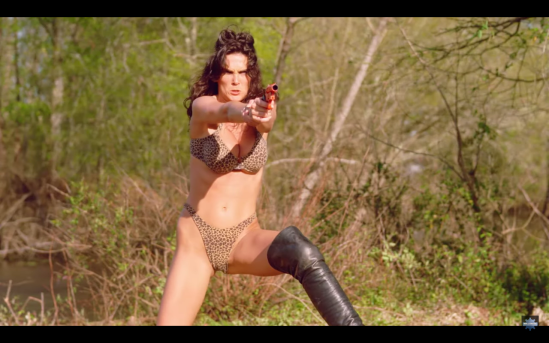
I wasn’t joking when I said Sidaris scouted out Playboy and Penthouse centerfolds that sizzle with sex appeal when strapped with an automatic weapon. The concept is every gun-toting redneck’s wet dream when the producing Sidaris’ employ the well-endowed to be the center of the action. Penthouse Pet and cult horror icon, Julie Strain, certainly fits the description. The voluptuous 6ft 1in actress has the best role in the house as Jewel Panther, the scantily-cladded assassin with a pugnacious attitude that can turn a quarrelsome skirmish into an oddly erotic babes and bombs moment as she whacks a couple of clueless park rangers in nothing more than her thong bikini. Not only does Strain play the best monikered character in the flick, but is a tantalizing, Amazonian lioness of a personality on screen. Suzi Simpson is another centerfold working for truth, justice, and the lethal way as Becky Midnite. The blonde bombshell Playmate does a little dirty work in her cut-off, daisy duke jeans, wriggling in and out of tight situations, and tight clothes, when being eyed up and down by Santiago’s thugs. Midnite’s not as interesting as Jewel Panther and Simpson acting mirror’s than par level posture with rigid aesthetics, even during her sex scenes with Bruce Penhall (“Body Count”). The last Playboy centerfold is Tai Collins, aka Taquil Lisa Collins, and before she was a renowned philanthropist, founding multiple foundations, and spearheading charities for children, Collins was a D.C. suit, an agency head that oversees operative missions, who saw fit to be in a romantic relationship with a subordinate (“Fit to Kill’s” Mark Barriere”) and underneath that suit, you guessed it, was dressed-to-kill lingerie. Then, of course, you have the Bolivian drug lord, Santiago. The role was awarded to one of Andy Sidaris’ casted actors, the late Rodrigo Obregon. The square jaw and poofy-haired Obregon quarterbacked all of Santiago’s antagonism toward the extermination of all the beautiful people aka the agents, but was in reality, or at least in character, was a big softy compared to Jewel Panther who ended up being more despicable in her foxy iniquity. “Enemy Gold” rounds out with Alan Alabew (“Bulletface”), and “Day of the Warrior’s” Ron Browning and Tom Abbott.

Though saturated with plenty of T&A, the Sidaris team keeps scenes classy, sexy, and elegant without stepping a foot into pornographic territory that would ultimate undermine and reclassify “Enemy Gold” as another Axel Braun flesh-flick. Granted, the acting is as cheesy as a cheeseball growing on a cheesy-cheeseball tree and every fit bod sports a cut off T-shirt and vest while pretending their early 1990’s Lenny Dykstra by wearing his baseball shades and fitting a mini-mullet, but for the value, “Enemy Gold” is a goldmine of cut-price epic action providing a variety of numerous explosions and marginal Michael Mann style gun fights. Throw in lengthy scenes of nudity, such as thorough shower scenes and a primal topless with a sword around a firepit, and you have “Bullets, Bombs, and Babes!” so says the tagline. It ain’t lying! Rahn and Drew Sidaris’ script fairs as the weaker link to the entire package that setups a really good criminal retaliation premise that recoils back to one half of the titular element, gold. The film opens up during CIvil War time with a narrative prologue of a Confederate suicide mission in attempting to steal union gold and burying it deep within the forest. The preface only becomes relevant when Christ and Mark decide to use their sudden suspension leave to go on their annual treasure hunt for the buried gold. Santiago’s reprisal of his drug bust forces the Civil War backstory and the gold to be subservient, debasing the story to an unbalanced point that it can’t seem to recover from the absurdity of events.

“Enemy Gold” is worth it’s weight in buxom gratification with a well-endowed Blu-ray plus digital release from Mill Creek Entertainment. The transfer hits Blu-ray for the first via a 4k restoration presented in 1080p, high definition widescreen with an aspect ratio of 1.78:1. The immense details is exquisite when regarding the show of excessive skin in nearly every segment. Exterior scenes look and feel lush within the trees, bushes, and lakeside landscape. Some of the grain is inconsistent, leaving exposed some fluctuations of blockiness to hurtle over. The transfer did suffer some irreparable minor damage, such as some deep scratches that are noticeable in editing and a moment of reel flare that pops up briefly. The English language 2.0 DTS-HD Master Audio offers a respectable mix helmed by the clearly prominent dialogue though, at times, renders a bit soft. Explosions are nicely discernable even in the dual channel. “Repligator’s” Ron Di Iulio’s “Night Court” meets “Red Shoe Diaries” score dips into a monotonous swanky-funk, but is an appeasing instrumental. English SDH are optional/ Bonus features include an introduction by director Andy Sidaris and, if you didn’t get enough boob action, a flirtatious Julie Strain that build up what to expect in a dated DVD launch intro. If you want even more Julie Strain topless, the behind the scenes featurette offers a little more of that DVD launch promo plus a gag of Sidaris guide to filmmaker, plus some interviews with wife Arlene and Drew Sidaris, an interview with Joe Bob Briggs, and some a brief history into the Sidaris legacy. There’s also an audio commentary and trailers. “Enemy Gold” is a prime example of the best erotica action before the turn of the century, fearlessly proud and independent to be perfectly content in the content that’s centerfold perfect. Recommended.

May the EVIL Be With You! “Star Wars: Episode IX – The Rise of Skywalker” reviewed! (Disney / Blu-ray)


The rebellion suffers lost after lost against the oppressive First Order and news that the evil Emperor Palpatine lives casts an even larger shadow of fear and hopelessness across the galaxy. As Fin and Poe Dameron continue running small strikes against imperial targets, Rey finalizes her training as a Jedi with the help of Princess Leia, but as Kyle Ren discovers the Sith coven and the existence of Palpatine, his desire to search and track down Rey grows stronger before releasing a new First Order fleet of Star Destroyers with the capabilities to destroy entire planets. The Force pulls at Rey, guiding her to face her most difficult challenge: the truth about her parents and lineage. Rey faces crossroads that will determine whether she will continue to fight for good or cave into her anger and fear that’ll inevitably lead to the dark side.

Star Wars? What is Star Wars doing being reviewed on a blog that mainly covers the schlocky low-budget horror scene and the occasional obscure and weird Sci-Fi arthouse film? And the fact that “The Rise of Skywalker” is a Disney film makes this writeup the first ever Disney review for ItsBlogginEvil. No, don’t fret. I’m not selling out my love for the gore, scream queens, and pint-sized productions for the mondo-glitzy, big budget Hollywood epics nor am I making a soft right turn into bloodless PG-13 commercial commodities, but, and this is a big atypical but, “Episode IX” needs to be heard from those outside on the fringes. “Episode IX” is perhaps the darkest film of the cross-generational saga alongside “Revenge of the Sith,” or at least a close second, and, so it be, Disney was gracious enough to provide us a Blu-ray review copy of the J.J. Abrams grand finale to an adventure that has trekked through 40 plus years of galaxy-conflict, saw countless different alien species, gave us more pew-pews than we could ever hope to hear, three different versions of Anakin Skywalker, and the phantasmic super powers of what is known as the Force, all of which is encompassed by a fascist, utilitarian power. Co-written with Abrams is “Argo” and “Justice League” writer Chris Terrio from a story co-written also by “Jurassic World’s” Derek Connolly and Colin Trevorrow.

“Episode IX” begins with Kylo Ren (“The Dead Don’t Die” and “BlacKkKlansman’s” Adam Driver) discovering a pyramid shaped device that’ll Mapquest his way to find the secret Sith location where a familiar evil figure from the past returns and has built a gigantic fleet over the last three decades. This time around, Kylo Ren’s less of a toddler in the throes of brain development as he’s embattled with guilt and choice. Adam Driver does nail the performance with solemnity in his last performance as the son of Leia and Han Solo. The story’s heroine, Rey (Daisy Ridley), is also facing internal conflict with self-discovery as the prospect of knowing who she is sets her on a quest to discover her ancestry and what she might find might blur the sides of good and evil. The young actress who had a number short films and one horror title under her belt (“Scrawl”) before skyrocketing into “Star Wars” mythology returns to Rey as a Jedi hot off the Leia training course and thrusted immediately into the Force’s subconscious dark star, shielding her from the truth for fear of what may come of it. While Ridley shines, the Rey character sprints from, at this point in the Saga, point M to point Z, jettisoning much of the internal grappling to a mere blip on the ship’s internal sensors. Rey also feels entirely infallible, thrusting her character beyond the limits of mortality by completely overshadowing not only Kylo Ren, but also Emperor Palpatine. The other two new to the “Star Wars” crew, Poe (“Ex Machina’s” Oscar Isaac) and Finn (“Pacific Rim: Uprising’s” John Boyega), received similar shaft treatment of reworked characters from the original trilogy, possessing nothing new to offer. Poe a watered down version of Han Solo, a hot shot pilot who doesn’t understand the concept that together him and his fellow rebellious friends can defeat anything that stands in front of them; Lando Calrissian had to educate him with a bit of heart-to-heart exposition. However, Finn is perhaps the biggest undercooked character who has an inkling of Force within him that always simmers to the surface, but nothing is definite, nothing’s explained, and nothing is provided to perhaps the best known minority character in all of “Star Wars” behind Lando. Lastly, and I know the character write is up long and might be a little drawn out, Abrams really botched Carrie Fisher’s Leia that worked in awkwardly unused footage of the Princes/General from previous films. The simple and bland rhetoric used when Leia’s having a “conversation” with Rey is nearly painful to stand as Rey pours from an emotional spigot and all Leia can be, responsively, is cold, blank, and superficial. Mark Hamill, Anthony Daniels, Naomi Ackie, Domhnall Gleeson, Richard E. Grant, Lupita Nyong’o, Joonas Suotamo, Kelly Marie Tran, Billy Dee Williams, Ian McDiarmid, Harrison Ford, and Greg Grunberg co-star.

I adore “Star Wars” as much as the next nerd who grew up between the first and second trilogy. The blending between science fiction, westerns, and samurai tropes speaks volumes on how engrained George Lucas made space come alive with larger-than-life gusto that appeased not only fans of space adventure and wonders, but also fans saturated inside the spaghetti westerns and those with an affinity for Akira Kurosawa films. Those genre bending tactics really brought the film community together to appreciate the novelly detailed miniatures that came to life and the eccentric, sometimes outlandish, characters like Han Solo, Jabba The Hunt, Boba Fett, and Leia in that scantily-clad slave girl bikini. Yet, “Episode IX” irks me, irks me hard, as the once innovate “Star Wars” has been placed into a bingo ball spinner to have it’s originality called out once again in one ginormous homage to see, again, the Emperor, who seems very high and mighty upon his throne of Sith muscle, pitted against a ragtag team of good doers and their champion quasi-Jedi who has to make a between benevolent freedom or a junta power. That’s not to say that “Episode IX” is a total sham of a finale. Fans will receive the totality of a “Star Wars” film complete with light saber clashes, space battles, and the beautiful, yet sometimes violent, different worlds that ships can hyper speed to in seconds. The visual and practical effects are bar-reached and awe-inspiring by means of thousands of ships clustered together, the dim-lit bars crowded with varied character creatures, and the speeders racing through canyons and sandpits become heart-pounding thrill rides of excitement. The introduction of new characters, like the amiable and smile-evoking bot technician Babu Frik, the former Poe co-spice trader and survivalist Zorii Bliss, and another ex-Storm Trooper, Jannah, forms that similarity bond with Finn, are new blood that delight when on screen. Yet, these new characters are shamefully underused as minuscule support that garners only a speck of adoring fandom but little else to the story’s plotline.

“Star Wars: The Rise of Skywalker” comes home with a 2-disc Blu-ray and Digital Code release, sheathed inside a rigid slipcover, presented in 1080p, full high definition, widescreen, 2.39:1 aspect ratio. Video is top shelf quality of everything a “Star Wars” film should be with colors and details galore that are arranged purposefully and perfectly to aesthetically please a contrast against the bleakness of space. The extensive line textures are seriously sharp and along with the vast special effects professions who model, shape, and digitally imprint the liveliness into the work, but there are instances, such as on the Sith home world, where the visual effect of an arena filled with distantly scoped blurry Siths dampens the moment of Rey’s endmost consignment. It looked and felt cheap and didn’t properly convey’s Rey’s loneliness against all odds. The lossless English language 7.1 DTS-HD Master Audio caters to every pew-pew blaster sound, every ship zipping through space with an engine-like exhaust, and every electrical discharge of a light saber humming in the throes of dual. The dialogue, and Chewbacca’s guttural growls, are effervescently prominent with a natural tone and not commingled by the other tracks, making “Episode IX” some of the best sound work to date in any “Star Wars” film. Capping off the Saga soundtrack with the familiar John Williams robust overtone and coursed throughout an engaging orchestra that moves in synth with story’s dynamics. The bonus feature disc includes an over two-hour documentary entitled “The Skywalker Legacy,” a full length feature of orgasm supplementary regarding “The Rise of Skywalker” and diving deep into the mythos of “Star Wars'” history. Other bonus material includes the mechanics of creating a speeder chase on the Pasaana world, shooting in Jordan to utilize it’s dessert location to create an alien planet, exploring the D-O ship that’s new to the franchise, an interview with Warwick Davis who returns to “Star Wars” to once again don an Ewok character along with his son Harrison, and a cavalier look at the otherworldly creatures and highlighting those who play the part of these beings. For many, the book of George Lucas’ “Star Wars” has been closed as the final episode completely arcs the Skywalker story. Yet, for a few who wish to explore more, “Star Wars” is sought to be an open to a means for other characters to be explored, such as with The Mandalorian,” and, just maybe, that cute Babu Frik. “The Rise of Skywalker” exited in a cliche fashion, a warp drive to an already established and tiresome rehash of circumstances, while only supplying a healthy demand of star power and intense action inside a rapturous package overflowing to the brim with too much content and too little substance.

Complete the Saga! Amazon has “The Rise of Skywalker” on Blu-ray+Digital!

When EVIL Gets Inside Your Head…


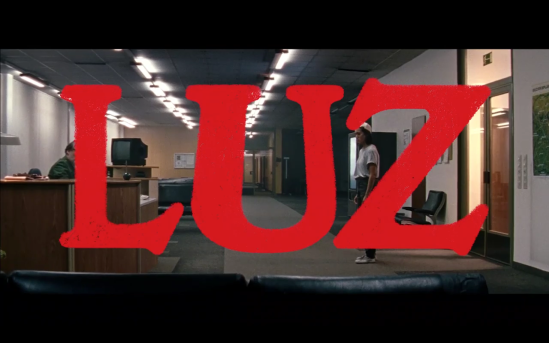
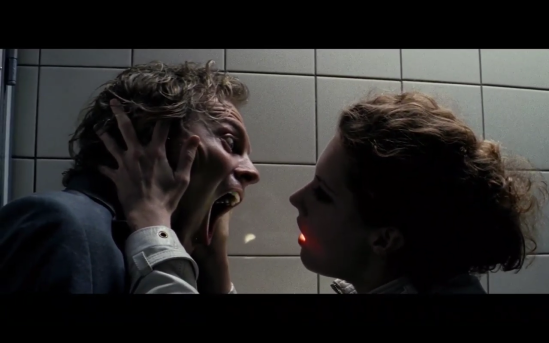
An immigrant cabby named Luz stumbles dazed into a German police station, repeating a profane distortion of a religious prayer to a couple of baffled detectives. Meanwhile, in a nearby bar, a forwardly chatty woman is diving seductively into a spiel about her Catholic schoolgirl friend who just recently jumped out of her moving taxicab to a psychoanalysis specialist on the edge of his seat. Drunk enough to take advantage of, the Doctor falls for the woman’s alluring trap, beguiling him to do her bidding as an unwilling host. As the now possessed doctor arrives to evaluate Nora for the police, he instigates a hypnosis recreation of the details events leading up to Luz’s ravings and disillusions. What happens next goes beyond human comprehension and rational as the doctor desires more from the stupefied Luz than what meets the eye.

Undoubtedly a strong skiff of demonic peculiarity weathering forth against an unforgiving maelstrom of spiffy-glamourous and yacht-sized counterparts is Tilman Singer’s memorizing tale of demigod deception in “Luz.” As the German born filmmaker’s first written-and-directed full length feature film, a film school project shot entirely on 16mm color negative, Singer dazzles with a throwback grindhouse glow set ablaze with a neon flare that adds to the perilous seduction and violation of the mind and primal infatuation. “Luz’s” was filmed in Cologne, Germany, where Singer studied film at the Academy of Media Arts Cologne, during the production year of 2018 and saw success at various Germany festivals, including it’s debut at the Berlin Film Festival and the Fantasia Film Festival. The Academy of Media Arts Cologne also serves as the production company, as it was, after all, a school project, and listed as Kunsthochschule für Medien Köln (KHM).

“Luz” wouldn’t be what as staggering as it is if it wasn’t for the invested cast who brings Singer’s vision to the spectrum. Luana Velis’s seamless grasp of the editing has remarkable wealth when playing a disoriented cab driver coming in off the street and Velis as Luz, in the ebb and flow of reality when Dr. Rosinni (Jan Bluthardt) entrances her with a blend of hypnosis and psychoanalysis techniques, sustains character through various transitions present inside a large police board room, reality, and the subconscious recollection of places and events inside her mind that Singer constructions for visualization, not reality. Singer melds together places, people, and events, throwing audiences for loops and casting misleading signals and just where the hell our characters are gathered. Bluthardt is equally captivating post transformation, coming off like a calculated maniac, resolved in his wild role. Perhaps, my favorite of the cast list goes to Julia Riedler as Nora Vanderkurt, Luz’s icy former bedfellow from Catholic School who slithers into Dr. Rosinni’s ear like a bewitching asp while seeming like a normal bar patron, but Riedler’s spin on Vanderkurt breaks the construct beyond that of the sleazy barfly and into something more conniving, wicked, and alcohol infused while still steamy with sexual emissions. All three performances are keystones to “Luz” success while fellow cast mates Johannes Benecke, Lilli Lorenz, and Nadja Stubiger, offer some spot on support.

“Luz” summits fear with intrinsic performance art of hazy, but colorful, atmospherics and off-kilter shapes and lines, making the most routine settings feel unsettling. It’s a strong cinematography showcase by Paul Faltz who was able to frame and fright a scene from a sterile and fatigued, wood paneled office environment; essentially put, Faltz turned coal into a diamond while Singer brought a keg of European horror to the party. Unconventional, of course, with a profound arthouse quality about it, “Luz” is very much inspired by the European masters of horror, but pulls quite a bit from the vibrancy of American filmmaking too, pulling inspiration more noticeably from John Carpenter’s overwhelming sense of apocalyptic doom from such a scale down narrative and the terror looms like a chandelier hanging by a single thread just waiting from the startling crash of glass and metal. There are themes related Catholicism, homoeroticism, guilt, and obsession through the venomous innate nature of demon, as if unknowingly leaving an open invitation for evil by way of spiritual clairvoyance and Catholic defiance. Full of abstract visuals and melodious dialogue, “Luz” still burns the scary story lantern with a flickering of imminent existential combustion.

While the theatrical release has been officially canceled, “Luz” will still live on through the digital world, being released by Sharp Teeth Films, who released the POV slasher horror “You Are Not Alone,” on June 1st in the United Kingdom. With this being now a digital release, critiquing the audio and video quality will be limited to the artistic direction. Video-wise, Singer sought the use of a 16mm film stock with the speckle and grain texture of that beloved, yet enveloping imperfection and shooting in an anamorphic widescreen aspect ratio of 2.35:1, using an Arri Alexa and RED cameras that supported an anamorphic lenses. The result is phenomenal to digest with some serious depth when considering how small the sets are, turning mere pockets of space into the likes of grand ball rooms. The German, Spanish, and very little English dialogue tracks are clear and prominently abutted against a well adjusted ambience mix; in all, the audio package has good depth and range. There were no bonus features included with the digital screener. “Luz” is weird, mystifying, and can wriggle into your favor with a chilling essence taking a leisurely stroll along your back, propping up the hairs one strand at a time. Highly recommended.

EVIL is a Slice of Deep Dish Hell in “Creepy Tales of Pizza and Gore” reviewed! (Bayview Entertainment / Screener)


Pizza, that delicious concoction of bread, marinara, cheese, and your topping of choice kneaded and pieced together in a gooey circular of staple culinary awesomeness, has somehow found its way baked into an Italian-sans-meatball horror anthology that promises an equally saucy taste of crusted blood red gore. Five varied, harried tales of horror molded into a gruesome and terrifying VHS-style that will send chills down your spine as you swallow your first piping hot bite of pizza will either have you hungry for more or hurling out your pepperonis. These tales of macabre include the cursed audio tracks of a deadly screaming ghost, the grisly torture and murder in the name of Satan, the tragic and supernatural deaths of two ill-fated lovers, a wooded creature stalking stranded motorists, and a VHS tape that seeks revenge on its former, ungrateful owner.

Let’s take our time traveling machine back to 2014 where Italian filmmaker, Lorenzo Fassina, releases his second feature directorial film behind the horror-comedy, “Anamnesi Mutante,” transmitting by way of a five tale anthology humorously entitled “Creepy Tales of Pizza and Gore;” the titles of the shorts are “Screaming Ghost,” “Devil of the Night,” “Alone in the House,” “Wood,” and “Killer Tape.” Co-directed with producer Marco Giangiarelli, The Milan born Fassina’s background also includes being a director of a collection of short films and music videos for bands that include Italian metal bands Cripple Bastards and Viscera///, similar music scores the anthology. The eclectic tales that greatly homage horror of the 80’s that include rich in color film titles and poignant atmosphere audio mixes, each have a runtime average of approx. 10 minutes long, and offer a mixed macabre of subgenre goodness from technological horror to inanimate object horror besieged with an interlacing host, a faceless, demon-like presenter with much to say, much like the Crypt Keeper. My apologies in advance as the screener that was provided didn’t have subtitles so the host’s soliloquy goes mostly misunderstood, but by the way of editing and how the syntax is structured, one would assume the ghoulish emcee sets up the pizza eaters with the next short video nasty. “Creepy Tales of Pizza and Gore” is produced by Fassina’s indie company, DirtyTape.

Most of us in the States more than likely won’t find any familiar faces inside the confines of these five tales and, know what? That’s okay! Aside from our hell bound host, there’s not a lick of dialogue spoken, but the capability to connect with the characters and the capacity to understand the story without words is as transparent as crystal clear waters of the Venice canals. An assemble of facial and eye expressions and a well edited together script and structure by Fassina for each short provides a sustainable and a sufficient menacing mixed bag of mouthwatering horror. The largely novice cast has either worked on previous projects with Fassina before or are an unknown delight to us viewers and cast list includes Sara Antonicelli, Beatrice Cartoni, Jonathan Farlotta, Jacopo Grandi, Francesco Marra, Tommaso Meledina, Alessandro Melito, Riccardo Tiberi, and Bunny Roberts with a cherry on top topless scene for good measure.

I’m not a terribly big fan of anthologies. Yes, I enjoy “Creepshow 2,” like every other horror fanatic smuck, and I do revel in the grave zest of the low-budget spectrum, especially with compilations from directors of the “HI-8”, aka “Horror Independent 8,” that featured the bloodbath films of some 80s/90’s SOV prodigies in Ron Bonk, Donald Farmer, Tim Ritter, and Marcus Koch, but most anthologies find their unsuccessful way right toward the trash bin, condensed to third-rate releases with little-to-no marketing and hardly any surplus material in the special feature department. “Creepy Tales of Pizza and Gore” may be a foreign anthology barely making an insignificant speck in the cinema market, but certainly shouldn’t be overlooked as the derived golden age of an immensely beloved straight-to-VHS horror courses through the veins of Fassina’s reverencing anthology. The stories garnish b-reel content, but not necessarily effortless or incompetent in substance and range from serious, to tongue-in-cheek, and out right absurdity, with the latter stories being the weaker links. In all, it’s a fun and entertainment horror show from our Italian friends.

“Creepy Tales of Pizza and Gore is delivered fresh and blood warm onto DVD home video courtesy of the New Jersey based distributor, Bayview Entertainment. As aforementioned, Bayview Entertainment publicity provided a streaming screening link so the audio and video aspects will not be critique for this review, but the DVD specs include a single disc, Anamorphic widescreen presentation, with an unrated rating on an Italian language anthology that, supposedly, has English subtitles – my screener did not have subtitles. Bayview Entertainment’s DVD casing resembles entirely like a VHS-cassette with faux movie rental stickers stuck on the outer plastic. The packaging is a nice and warranted touch to a VHS-homaging anthology. There were no special features included with the screener or released in the press release. Chow down on night with “Creepy Tales of Pizza and Gore;” a validating horror anthology worthy of time and effort and reaffirming the faith in anthologies once again with wild, imaginative macabre ambitions without the stiffening efforts of pushy financiers calling behind-the-wheel shots.

“Creepy Tales of Pizza and Gore” won’t disappoint! Buy here on Amazon.com