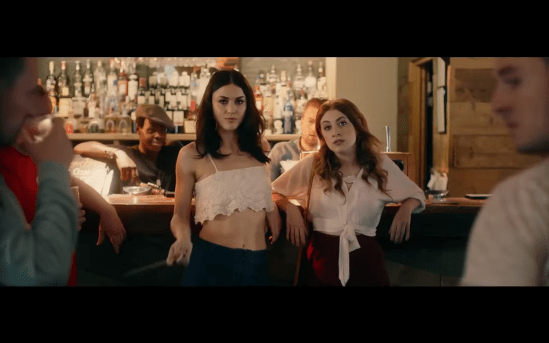
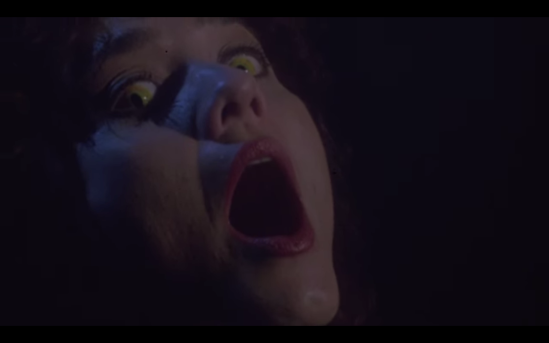
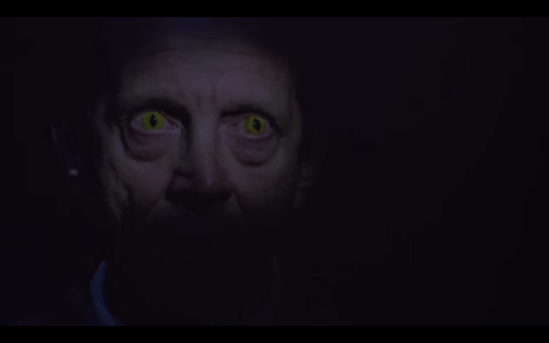
Brock Chirino, a survivor after tragedy strikes twice by a serial killer named Motherface who stalked and killed his campus fraternity brothers of DELTA BI THETA, is found gruesomely hung from a flagpole with his guts strewn tightly around his neck. Brock’s twin brother, Brent, wants answers and begins pledging with the troublemaking and cursed fraternity that is on the verge of having another Motherface encounter, beginning with the death of his popular twin. Sinister powers to be send the remaining DELTA BI THETA brothers to an isolated and notorious lake house where one-by-one, beer-by-beer, each brother is hunted down with their own personal fears invoked by the serial killer and lethally weaponized against them.

More enjoyable than a cheap case of beer pong beer is the trope-after-trope satirical genre upheaval in “Dude Bro Party Massacre III” from first time feature film directors Tomm Jacobson, Michael Rouusselet, and Jon Salmon with a screenplay penned by lead actor Alec Owen along with contributions from the directors and Ben Gigli, Brian Firenzi, Joey Scoma, Michael Peter, Mike James, and Timothy Ciancio. Usually with a conglomerate of writers and directors attached to a single project, the resulting work lacks coherency as a mesh of styles create a havoc bearing exhibition for the viewer whose head is about to explode and ready to give up on trying to make sense of disastrous, multi-motivational storyline, but these particular guys are a part of an internet comedy troupe the under 5-Second Films production company, established in their good ole college days circa 2005 to 2008, and have long list of meaningless, yet funny, credits in sketch comedy that include Uproxx Video and Funsploitation. The filmmakers’ “Dude Bro Party Massacre III” is the supposed third film in a trilogy of unspeakable comedic terror without really having a first film or its sequel as the gag, but rather recap, ingeniously and in a squeamishly gory fashion, a fast-paced and well thought out montage of series of events from the “first two” Dude Bro Party Massacres.

The 5-Second Film troupe can be synonymous with the guys of Broken Lizard, but in a slightly tweaked version that’s sure to be piss your pants funny and keep eyeballs glued to their 103 minutes of beer, hazing, and blood. Kicking it off in a dual role is Alec Owen as Brock and Brent Chirino; one super cool bro and the other just a regular cool bro, share a meaningful twin experience that keeps both characters in the mix. Owen dons daft well, but do so the slew of other in his close knit entourage of Paul Prado, Ben Gigli, Joey Scoma, Brian Firenzi, Michael Rousselet, Jon Salmon, and Kelsey Gunn. Their well-oiled machine of timing, exuberance, and expressions, from years of collaboration, make them a juggernaut in their field, leveling with, or even just beating out, the Broken Lizard team for best satire horror film. To top things off, the eclectic special guest stars add that little something, a little spiked cream in the dark, bold, Columbian coffee if you will, of unprofessionalism that just makes “Dude Bro Party Massacre III” a go to rental (or purchase) on a movie and chill night. Did you ever think you’d see Larry King in a horror movie? Yeah, that Larry King who made millions as a late night talk radio host said, “Star in a horror movie? Sure, why the hell not?” Though brief, King’s appearance is welcoming gory garnish and other guest stars whoopee in the same fate, including esteemed porn actress, the queen of sex, Nina Hartley, in an unusual non-sexual role, rock performer and producer Andrew W.K., Tommy Wiseau collaborator Greg Sestero, and my fellow Portsmouth, Virginian native, Mr. Patton Oswalt in another brilliant comedic performance. Yes, I’m dead serious, bro. Plus, Olivia Taylor Dudley as Motherface equals a repeat performance; perhaps for “Dude Bro Party Massacre IV???”

“Dude Bro Massacre III” is a 100% intentional caricature of the 1980s slasher genre, going against the well established and solid bedrock that’s bred horror fans for generations, and rocking the sacred structure to the core that not only will be admired by hardcore horror fans, but also not objectionable in its goofiness those said fans and will sufficiently gaudy for the causal popcorn moviegoer. Those in the former will recognize that tropes vitalize without tiring out the dude bro party, such as with a snarky, masked killer returning from the grave, twice, whose a bit of a mash up of Jason Voorhees and Freddy Krueger, the Final Girl notion is reversed to a Final Boy left to tell the ostentatious tale, and extravagant and elaborate deaths ultimately become a living, breathing entity to inspirit. Plus, backstories and character tangents diversify the story perpetuation enough to not over-saturated solely on DELTA BI THETA reckoning. In all honesty, the gore is the star and if gore was the object of wealth, “Dude Bro Massacre III” would be an affluent God with blood splatter on a divinity level.

5-Second Films and Snoot Entertainment release the Not Rated, 2015 satirical horror, “Dude Bro Party Massacre III” onto DVD home video distributed by MVDVisual. Presented as the only surviving VHS copy of a dismissed and banned film by some guy recording a television airing over his childhood memories, a 4:3 aspect ratio continues to sell the artificial, retrograded video nasty of obscurity. Even the mock cut in faux commercials are a nice touch that reminded me a little bit of John Ritter’s “Stay Tuned.” One thing that’s missing was the presence of digital noise as the image was really too vibrant and clean to be a super VHS or any other kind of SOV. The English language 2.0 audio track is clean with prominent dialogue and hefty amount of ambient blood gushing, splashing, exploding, etc. Bonus features aren’t impressive with only audio commentary available through the static menu, but Devon Whitehead, whose cover arts with Scream Factory releases are beyond ridiculous, lends his talents here with another intrinsic, manic storytelling work of art. A little late to the game with this review for a film from 2015, but “Dude Bro Party Massacre III” is getting a re-release and is worth the time pledging oneself to again and again with a high level rewind satisfaction rate.
Category Archives: Just fucking awesome
The Only Way EVIL Would Go Out With a Virgin! “Double Date” review!

Recently dumped and severely panicked around women, the prospect of ever dating again seems like a long shot to Jim. Self-assured Alex sees the opposite for his best mate as a golden opportunity for him to get Jim laid before his 30th birthday. When Alex finally coerces and assists Jim on scoring a double date with two sisters, Jim can’t believe his stuttering awkwardness actually proved fruitful, but little do Jim and Alex know that the sisters, Kitty and Lulu, are out for blood. The sisters seek a virgin to sacrifice to bring their long deceased father back from the dead and to complete their trio-family once again at the expense of Jim’s involuntary celibate lifestyle. Night clubs, fast cars, and visits to the parents take the four through a series of dark and drug fueled misadventures and the unexpected moment of falling love that makes this double date one to die for!

First dates are always inherently frightening. The idea of being alone with a stranger, who you’re kind of attractive to and trying to impress, yet don’t really know a single thing about them, can be daunting, if not paralyzing. First date in a double date is supposed to ease that overwhelming fear and take the strain off from the lack of possible interest in the other person, but for director Benjamin Barfoot’s amusing horror-comedy, “Double Date,” all bets are off and all tensions are on edge when dating goal sights are deadly different. Danny Morgan pens a comedic gem in which he stars as the bumbling virgin, Jim, joining his long time collaborating partner, Barfoot, to complete their first feature film together. The British made and produced film gives glimpses of London’s fung shui through the pubs, clubs, and overall eclectic nightlife to the aristocratic mansion homes to the likes of “Downton Abbey” resulting in a slight blend of the past and present into a well-oiled story embodied with terror and fun.

Funny man Danny Morgan stars as the awkward and blundering Jim whose plagued with fumbling qualities around women that usually leaves him somewhere in the inner circle of the friend zone. Morgan brilliant showcases Jim’s stunting inadequacies that eventually come to flower while maintaining a solid naturally slapstick presence of self-deprecation that turns into a full-blown bull in a china shop. The scene with his parents and himself singing his birthday song in front Lulu in audience, while tripping on drugs, is cathartically enjoyable and a riot of inner laughter. Morgan’s joined by “Being Human” actor, Michael Socha, as Jim’s very good friend, but all talk confident friend, Alex. Alex is certainly the yang to Jim’s yin on screen and off screen as Morgan and Socha have a certifiably fresh dynamic that makes them very entertaining to digest. Socha brings a different kind of comical energy that compliments Morgan’s dry humor that diversifies the content. In fact, all the characters bring a little something different to the table, such as with the sisters, Kitty and Lulu, played respectively by Kelly Wenham (“Dracula: The Dark Prince”) and Georgia Groome (“The Cottage”). Training like an elite athlete, Wenham takes the role to heart being a dark and beautiful villain that’s inarguably alluring as she’s cold and deadly. The Cheshire born actress, whom hands down can be the next Megan Fox, sinks her teeth into the performance and excels in the physical role that’s showcases her range of talent. Then, there’s Georgie Groome as Lulu, the timid opposite of Kitty. Also known as the girlfriend of Harry Potter’s Rupert Grint, she nails being the one in the shadows, relinquishing control mostly to Wenham for most of the film, and then slowly build character confidence and strength.

“Double Date” is a great blend of horror and comedy. The climax has this satirical and retro quality about that seems unfitting, but is stitched carefully to fit without bursting and popping a seam (or scene?) to the point of overly obtrusive. Benjamin Barfoot also has a keen eye to capture the pivotal and incandescent moments that make scenarios have more an impact, whether that being a facial expression, an awkward dance, or any kind of verbal or action exchange between characters. Doesn’t hurt that Barfoot’s rapport with Danny Morgan is a relationship riding the same director-actor level plane, similar to the dynamics between Adam McKay and Will Ferrell, with a synonymous cerebral synergy that clicks well for the silver screen.

From the independent film company who delivered “The Man Who Killed Hitler and then the Bigfoot,” Sparky Pictures releases the Screen International/FrighFest awarding winning horror-comedy, “Double Date”, onto digital, DVD, and Blu-ray come September 9th in the United Kingdom. Unfortunately, an in-depth review of the video and audio specifications will not be covered as a BD screener disc was provided, but what can be said about the soundtrack, performed by GOAT, is pure primitive gold and the appearance by Big Narstie is equally solid. Bonus material, on this check disc, included an extensive behind-the-scenes, from conception to wrap, of Danny Morgan and Benjamin Barfoot’s roller-coasting adventure on getting their film made. There’s also a commentary with cast and crew, deleted scenes, photo gallery, and trailers. “Double Date” is a true black comedy and a whole lot of fun that should skyrocket filmmakers Danny Morgan and Benjamin Barfoot toward future endeavors as a rising, powerhouse duo, contending to be the next hit in the satirical category.
EVIL Wants to Feed Off Your Pain & Suffering in “Hotel Inferno” Reviewed!

Gulf War decorated soldier Frank Zimosa uses his particular set of skills as a professional contracted hitman. Frank’s current assign takes him oversees to a luxurious hotel to eliminate a couple of marks, a man and a woman, who are itemized as atrocious serial killers who’ve murdered over 150 people and Frank’s employer seeks to provide the same gruesome retribution in a certain kind of way – remove the brain the skull and the guts from the body. The relatively simple task for Frank turns into a fight for his life and his very soul as he finds himself trapped inside the hotel, owned by a secret organization swarming with putrefying acolytes of an ancient, fire breathing demon known as The Plague Spreader. Frank was ordered to kill to satisfy her pain and suffering hunger pangs, but his tenacious refusal awakens the demon who now hunts him, craving his pain, his suffering, his eternal soul for her own sated gratification and disrupts the organization’s creed to keep her dormant for the sake of humanity.

More, more, more! My internal fireworks outpouring and wanting more from a fire and brimstone gore forged finale from the action-packed first person view feature length horror film, “Hotel Inferno,” could not quell the embodied explosiveness wanting more from writer-director Giulio De Santi! Hailing from Italy, “Hotel Inferno” pulls little-to-no punches when dishing out uber-violence and non-stop carnage that invigorates the sensory and corporeal experience in the first installment of what’s called the Epic Splatter Saga that will total over six films. Two have already been produced with the third in production! De Santi, who is no stranger to the fervid gore film, teams his visual effects knowledge with long time, special effects collaborator, David Borg Lopez (“The Mildew from Plant Xonader”), and makes something shockingly beautiful that’s only been wrongfully teased in predecessors.

What’s also unique about “Hotel Inferno,” other than its first person perspective, is nearly the entire dialogue is layered with a voice over track. Unique as well as cleverly cool, we’ll touch on why later, faces with distinctive dialogue pinpoint main characters, but their faces are either shrouded by some sort of horror-esque mask, turned away toward another direction, or fed through a communication conduit, such as a portable television-radio device. Same goes with lead character Frank Zimosa whose vision never goes eye line with a mirror, never gaining a glimpse see his frantic mug, though Zimosa sounds like a chisel chin, hard-nose, angry-looking ass kicker, especially when voiced vehemently by Rayner Bourton. Playing the arch nemesis that’s quickly established and continuously prominent through duration is not the all-powerful Plague Spreader, but, in fact, the faceless Jorge Mistrandia. Donning the voice is English born actor Micahel Howe (“Solo”) who has one of the more sinister intonations amongst the few; an attribute that can be cool, calm, and inviting and can suddenly transform into a treacherous, malevolent, and vile performance that amplifies the intensity tenfold. Bourton and Howe are essentially the sole two main characters inside a melee of supernatural goons and goblins, amongst them in the cast is the introduction of Jessica Carroll who went on to do more voice work in video games and actors from De Santi’s inner film circle with Christian Riva and Wilmar Zimosa, who without a doubt was the moniker inspiration for Frank.

What sets “Hotel Inferno” apart from other splatter films? The first person shooter style, or FPS, video game structure is it! In literally the first of it’s cinematic kind, “Hotel Inferno” looks, sounds, and feels like a FPS from start to finish, a blended progeny from the ultra-violent horror survival games like DOOM or BLOOD; honestly, everything about De Santi’s film feels like a BLOOD rendition minus the shirtless, axe-wielding zombies and the robe hooded, tommy gun shooting cultists, though the rotting henchmen due speak in a high pitch dialect. Think about it. In BLOOD, a game built on a foundation of iconic horror, the anti-hero, Caleb, is a gunslinger against a unholy cult he once was a part of and then becomes his opposition. Same goes with “Hotel Inferno’s” own anti-hero Frank Zimosa, a hitman hired by an organization who then deceives him for nefarious reasons and then Frank has to blast his way out to save his soul. The story goes right for the throat, throwing Frank almost immediately into peril, and from room to room, layout to layout, the anti-hero has to slice through henchmen and ghastly demons in a very HOUSE OF THE DEAD kind of face-off, weaponizing everything against foes with armaments in the anterior of a cultish backdrop. Super. Fucking. Cool.

MVDVisual distributes Giulio De Santi’s “Hotel Inferno” onto DVD from the Wild Eye Releasing’s Raw and Extreme label. Presented in a widescreen, 16:9 aspect ratio, the Necrostorm produced “Hotel Inferno” engages the viewer into battle, but also invokes slight vertigo and turbid at times, especially the cave-like dungeon that’s almost absolute pitch-black. Again, atmospheric video games are much of the same regard for instant jump-scares and De Santi pulls that off here by not illuminating much of the scenes. The English language Dolby Digital 2.0 stereo audio track is in an opposing stratum to how the film plays out; doesn’t quite sync with the action as the audio track is an obvious track laid on top to emphasis how much “Hotel Inferno” is like a FPS storyline. There’s an array of depth and range from each tier Frank has to painfully endure and willfully live through. English and Italian subtitles are available. Bonus material includes a secret bonus film entitled “Hallucinations,” a rough cut SOV, direct-to-video supernatural gore feature from twin brothers John Polonia (“Feeders”) and Mark Polonia (“Sharkenstein”) and Todd Michael Smith (“Splatter Farm”). Giulio De Santi’s “Hotel Inferno” is only part one of the highly anticipated Epic Splatter Saga, with part 2 and 3 very high on my to-do list The blood splatter is in a doom of mayhem, will quench gore hounds from any walks of life, and reap the collective FPS gamer from their stationary consoles and blow their mind with the most seriously berserk action-horror of this decade. Crudux cruo!
Edna is EVIL According to the “Reform School Girls!” Reviewed!

After being apprehended for robbery, underage Jenny is sentenced to 3 years at Pridemore reform school where she immediately clashes with an iron fisted dorm administrator named Edna and her intimate inmate enforcer Charlie Chambliss. With a few friends on the inside, Jenny’s group becomes the target of Edna’s biased infraction system and Charlie sets her domineering sights on breaking the girls’ wills into submissive followers. The school is controlled by an equally sadistic, evangelically abusive Warden Sutter and Jenny’s multiple attempts at reforming the reform school with the assistance of a sympathetic psychologist staff member, and even her attempt to escape, have failed with torturous consequences. As Edna tightens her grip, Jenny and the girls seethe more violently as the weeks pass up to an inevitable uprising, snapping the young girls’ spirits when enough is enough.

Wet, wild, and womanizing, Tom DeSimone’s 1986 satirically women in prison film, “Reform School Girls,” is a cavity invasive good time all around! DeSimone, who also penned the script, has a revolutionary background as a male gay porn filmmaker, but made the crossover into cult genre films after his successful runs with “Chatterbox” featuring exploitation starlet Candice Rialson and “Hell Night,” starring “Exorcist’s” Linda Blair. Yet, “Reform School Girls” is hardly separation from the director’s once moonlit experiences other than the cast is almost entirely made up of beautiful, naked women showering together and when they’re not fully nude and wet, they might as well be wearing nothing while cladded in skimpy outfits and lingerie as a few characters copulate insinuatingly instead of explicitly. The only thing DeSimone was probably uncomfortable with was his last two WIP features, “Concrete Jungle” and “Prison Girls,” as they struggled to find an appreciative audience and thus “Reform School Girls” was constructed to be a mockery of the whole WIP market, exploding it violently, and sensationally, with the genre tropes that, ironically, skyrockets this film’s cult success.

The incarcerated characters offer a wide variety of individualities that are ultimately filled by big personalities themselves. Sometimes, those personalities come with a little head scratching questions. Such is the case with lead actress Linda Carol who isn’t the headliner of the “Reform School Girls,” but she’s certainly one of the main leaders, Jenny, of an imprisoned pack. Born in 1970, Carol had to be no more than 14 to 16 years of age at filming and was cleared for a number of nude scenes, especially around other nude women, but Carol had fire in her performance; in fact, the cast from specified roles to the undesignated titled roles were all highly stimulating in their presence and demeanor. When first entering dorm 14, teased hair and underwear was the unofficial name of the scene that spoke about the genre of the decade in a matter of a few minutes. This is where we meet Charlie Chambliss, a buff, scantily-cladded, totalitarian gang leader of dormitory 14, played fluorescently by rocker Wendy O. Williams. The then mid-30-year-old Williams was a bit of a duck out of water in a role that was for a teenage girl, but the front woman of The Plasmatics was awfully charismatic, brash, and a real illustrated performer who exaggerated dramatics to the next welcoming level in her knee high platform boots. While Williams had sexy hot-to-trot flair, Pat Ast leisurewear offered nothing more than a dull white coat over matron garb, but Ast punctures through anything matriarchal and goes full blown maniacal as dorm keeper Edna. Ast goes over the top and beyond with a love to hate – scratch that – kill character. If you think the evil that embodies Charlie and Edna ends there, you’re wrong! “The Howling II: Your Sister is a Werewolf’s” Sybil Danning’s apex of evil, Warden Sutter, struts around the school like a German commandant with a soapbox of vile and wretched women in a perverted Biblical sense and mastermind behind the abusive culture at Pridemore. The cast concludes with Charlotte McGinnis, Sheri Stoner, Denise Gordy, Laurie Schwartz, Tiffany Helm (“Friday the 13th: A New Beginning”), Darcy DeMoss (“Friday the 13th Part VI: Jason Lives”), and Winnifred Freedman.

Shooting from the hip on first viewing impressions, “Reform School Girls” is nothing like we’ve ever seen before. Sure, we’ve all see women in prison films, from “Big Bird Cage” to even making an argument on Netflix’s “Orange is the New Black,” and we’ve also see cheeky 1980’s comedy that if made today would be grossly lambasted with politically incorrect protestors. Yet, DeSimone’s satire take undercuts the stern nature of the WIP genre with great flamboyancy toward institutional exploitation and the ugly invasive issue of sodomy and rape that the themes can be easily pushed aside without so much of an inkling of consideration. Explosions, gunfire, skimpily dressed women, shower sequences, bitter tongue and cheek, and anything and everything that was omitted from grindhouse market place in this film constructs a smoke and mirrors effect that pivots sharply before getting ankle deep into the issues, no matter the severity just as long as Pat Ast crunches her face into a luffa shape and appoints a barely clothed inmate to a mandatory cavity search and the viewers would be just as captivated.

Umbrella Entertainment and Lakeshore Entertainment release the International Cinevision and New World Pictures production of “Reform School Girls” on a PAL 4 region DVD, presented in a widescreen, 1.77:1 aspect ratio; a slightly cropped version of the original film format. Whatever is cropped out is too trivial and the image picture supplies a palatable presentation with bold hues and bare, but naturally colored, skin tones, despite some fake tanning. One noticeable fleeting moment of an 35mm stock cigarette burn in the upper left corner of a scene, but in-and-out in a blink of an eye. The stereo 2.0 Dolby Audio mono track has balance that singles out the robust dialogue against a leveled down ambient and score recording. The range is good amongst all the reform girl chatter in the dorm rooms. A handful of shower and bathroom scenes have some muffled echoed moments, but the discord in these moments is still extremely low. Surprisingly, there isn’t one single bonus material on this disc, not even a static menu as the film goes right into play feature mode. “Reform School Girls” makes light of wretchedness, revels in the fun of unsavory fraternizing, and is unapologetic of a carnal and wicked tone on and off the screen, harboring one hell of a women in prison cinematic guilty pleasure.
Triangular Space EVIL is the Sign of the Beast! “The Dark Side of the Moon” reviewed!

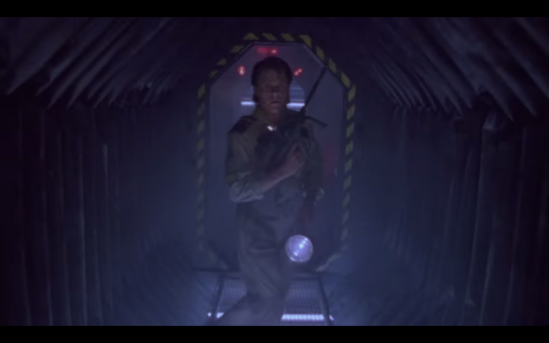
In the year 2022, orbital satellites carry nuclear missiles and maintain flight patterns around the moon. When a satellite repair ship, known as a “refab” ship called Spaecore 1, attempts to intercept a satellite for maintenance, the system wide computer goes into an unexplained power failure that jeopardizes communications, life support, and navigation. Drifting helpless toward sector Centrus B-40, the dark side of the moon, all hope will be lost within 24 hours unless operations can be restored, but a mysterious spacecraft, NASA’s Discovery shuttle, heads toward them and docks onto their outer hull without so much of a hail from the shuttle. Captain Flynn and Lt. Giles investigate a seemingly abandoned ship until coming across a dead body of a presumed missing NASA astronaut, eviscerated with an opening left in a perfect triangle as the cause of death, and that opens the door to more questions than answer as a sinister presence boards their ship, pursuing damnation for their souls.

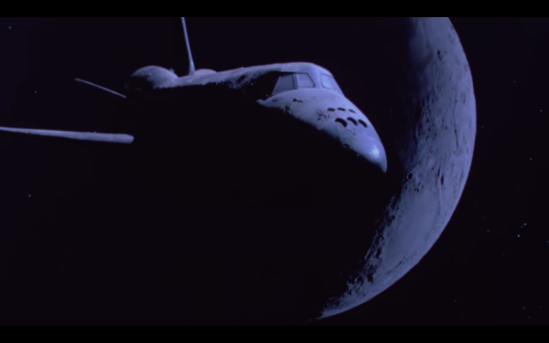
Just think, in two more years, weapons of mass destruction satellites will loom just above fluffy white clouds, ready to mushroom clouds out of targets with a 10-ton yield; at least that’s what director D.J. Webster and the screenwriters, identical twins Carey W. Hayes and Chad Hayes, modeled the future when conjuring up this delectable Sci-Fi horror film approx. 20 years ago. With special effects models and techniques that withstand against powerhouse space films, such as from the immaculate effects of Alien franchise, “The Dark Side of the Moon” becomes more than just a 1973 Pink Floyd album title Fabricated out of warped creativity of old and new concepts with a Biblical horror base that only the 1990’s could loosely spin into an hour and 27 minute feature, for many of the filmmakers involved, “The Dark Side of the Moon” credits as their first taste of a feature length, large scale production, especially with the mainly music video director D.J. Webster, who loves his closeups, and director of photography Russ T. Alsobrook, as they auto clicks into a team that seemingly have experience of seasoned veterans or, perhaps, spent some secretive, unlogged time in space. Who knows, but the outcome ruminates about the dark side of religion and how each of us deal with it internally.

When mullets and giant framed glasses are afoot, the late 80’s, early 90’s filming era is beyond evident with interestingly gritty characters lined up for an evil figure eager to knock them down and, of course, the story’s lead character is the mullet sporting pilot named Lt. Giles Stewart who is unwittingly thrust into the fast track of a hero’s lane. Giles’s atheism framework has a pleasant sardonicism about it when face-to-face with the immortal conqueror of his ship and crew. Will Bledsoe paints Giles as such as faithless space pilot, bound to duty, and willing to do anything to just not save himself, but others. One of the only recognizable faces, at least for myself, in the cast is John Diehl. The “Stargate” and “The Shield” television actor is best at being a wild card in turmoil situations and as shipmate Phillip Jennings, the same can be expected without being utterly conventional or warrant any kind of typecast label. Another actor to note is Alan Blumenfeld as the ship’s panicky Dr. Dreyfuss Steiner. Blumenfeld, who had a role in the best Jason Voorhees film, in my humble opinion, “Friday the 13th Part VI: Jason Lives, is once again stalked by a larger-than-life villain while maintaining a profusely sweaty persona that’s symbolically intended to be true, unadulterated fear. As a whole, the cast is amazing regardless of some first time filmmakers at the helm, rounding out with “Re-Animator’s” Robert Sampson as the ship’s Capt. Flynn, Joe Turkel from the first “Blade Runner,” “Blood Frenzy’s,” and overall erotic thriller goddess, Wendy MacDonald, stunt man (“Kill Bill Vol. 1 & 2, “Army of Darkness”) Ken Lesco, and another “Friday the 13th” actor, Camilla More, or Tina from “The Final Chapter,” as the stationary sexy, ship’s onboard computer-robot named Lesli – think on the same lines as Mother from “Alien,” but in the flesh.

What makes “The Dark Side of the Moon” very interesting is the film being an unofficial precursor to other science fiction horror films like “Event Horizon” that was released roughly seven years later. Space as this gateway to Hell concept is sorely under-appreciated and underutilized. Space is already vastly frightening to begin with and by adding a devilish abyss aspect to it makes the idea an absorbingly scary thought. What’s also fascinating is the Hayes brother. “The Dark Side of the Moon” is the brothers’ roots film; the proverbial patient zero that spread successful movie writing careers for the twins, spawning turn of the century horror with the remake of “House of Wax” that saw the on-screen death of Paris Hilton, had “Underworld” star Kate Beckinsale track down a killer in Antarctica in “Whiteout,” and they penned “The Conjuring” that constructed its very own universe.

“The Dark Side of the Moon” comes in at #2 on the Unearthed Films’ Classics label distributed MVDVisual. The newly restored 4K transfer of the Wild Street Pictures production is presented in a widescreen, 1.85:1 aspect ratio, region A Blu-ray release. Surprisingly sharp despite consistent low-lit scenes and not as washed like previous VHS versions, this restoration fine tunes the nitty-gritty specifics needed for proper presentation that doesn’t falter from heavy digital noise or blotch artifacts and shows no signs of enhancing The English language LPCM 2.0 audio track is strapping for a dual channel format. Dialogue pronounced clearly, ambient spaceship clinks and clunks create atmospheric range and depth, and the relentless brooding score by “Society’s” Mark Ryder and Phil Davies delivers shuddering spinal-tingles without being monotonously dull. Bonus features include a commentary with executive producer Paul and Unearthed Films’ Stephen Biro, interviews with Alan Blumenfeld, FX artist R. Christopher Biggs, and stuntman Chuck Borden, plus vintage audio track, trailers, photo gallery, and a insert booklet that dives into about the production and the cast. All packed into a nice little slipcover package. “The Dark Side of the Moon” pioneers into the future of space horror as a good ole dread-inducing fear-monger of the great expanse, deserving this Unearthed Films’ release, hands down.