Let the Heavens Fall to Cleanse the EVIL Away! “Undead” reviewed! (Umbrella Entertainment / Bluray)

The small finishing town of Berkley, Australia comes under siege by blazing meteoroids that turn the quaint residents into mindless flesh-hungry zombies. A small band of survivors led by the town’s dismayed local beauty queen and a fisherman turned doomsday prepper fight the undead hordes in order to escape the carnage by reaching the city limits, but when faced with an otherworldly monolithic barrier surrounding the town and blocking the exits, a hopeful way out becomes quickly fleeting. To make matters worse, unusual rainstorms drench them with fear of what’s really in the rainwater of the apparent alien attack. In a last-ditch effort, the remaining survivors board a personal prop plane to scale the great extraterrestrial wall that’s imprisoning them with the undead. An onslaught of end of days catastrophes drives their instinct to battle on, to push forth toward living, despite all the evidence of a contrary methodology to the misunderstood, overwhelming alien actions.

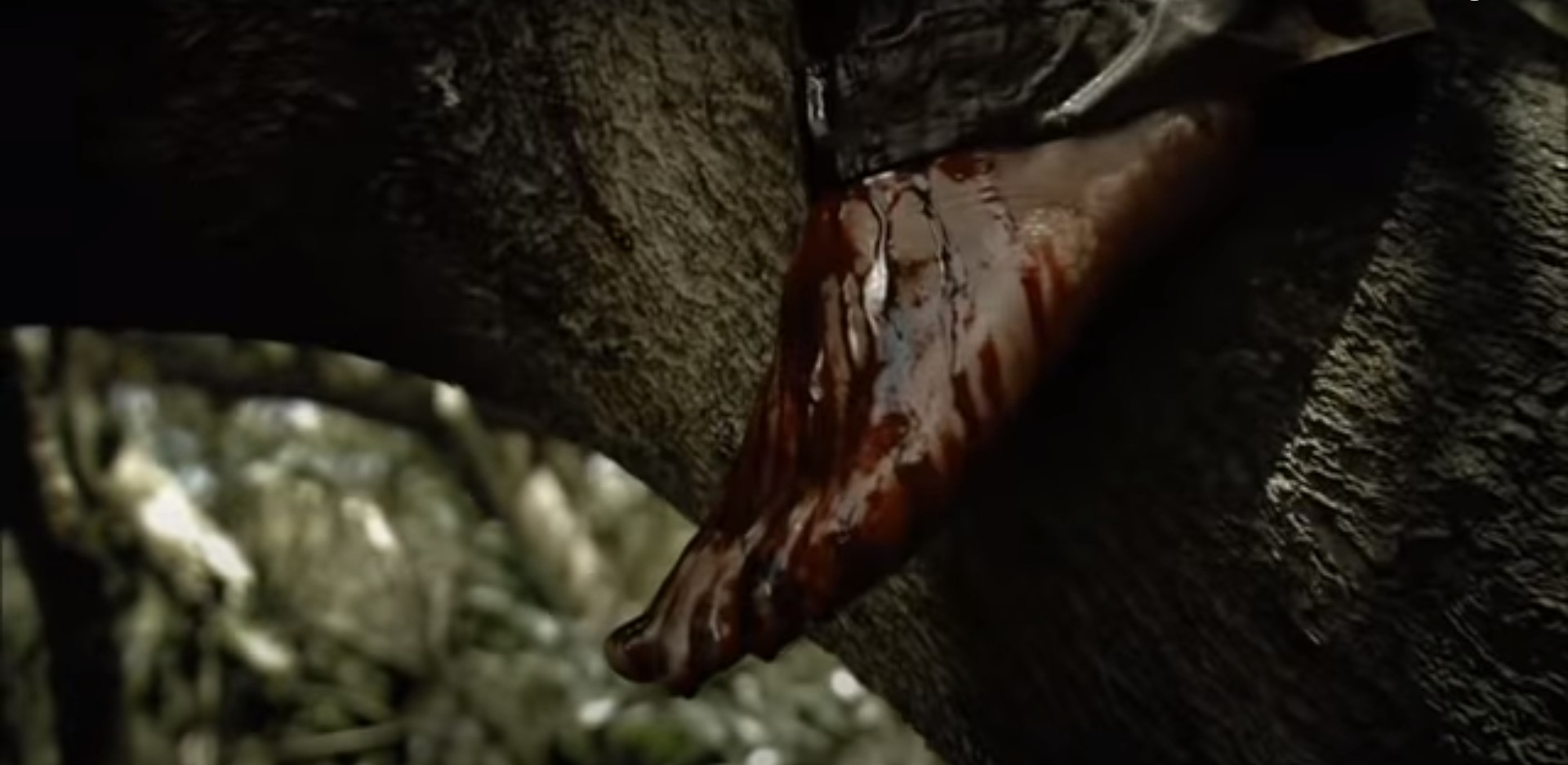
A 9-year marriage, three children, the death of my dog, two states, a new home, four jobs, four presidents, and a global pandemic in more than almost two decades’ passing has transpired since the first and last time I saw the Spierig brothers’ 2003 zombie-comedy “Undead” and, still, the 2003 Australian film impresses with a large-scale gore show on a small-scale budget. Before terraforming new vampire words with Ethan Hawke in “Daybreakers” and taking a stab at an entry in the “Saw” franchise with “Jigsaw,” the brothers Michael and Peter Spierig’s first full feature-length venture was an ambitious love letter to their’ most endeared cult films of their youth, more heavily influenced by Sam Raimi’s “The Evil Dead.” Blowing through the meager budget halfway into filming and shooting an insane 40 to 50 shots per day for the better part of two months, the completion of “Undead” was a must for the self-funding brothers under their production banner of Spierigfilm and the success of “Undead” also jumpstarted the careers of cinematographer Andrew Strahorn (“Hostel III,” “Lethal Weapon” television series), production designer Matthew Putland (“San Andreas”), and special effects artist Julian Summers (“Bait,” “Mortal Kombat” ’21).

“Undead” was the first film for Felicity Mason and Mungo McKay in a lead role as that dismayed local beauty queen, Rene, and that fisherman turned doomsday prepper, Marion, mentioned in the above synopsis. Rene seeks to leave the town of Berkley in the wake of the tragic death of her parents before becoming the burdened beholder of their debt; instead, she thrusted into a crisis that won’t allow her to escape so easily from a destiny laid out for her in hometown. Mason’s humble portrayal of Rene is nearly invisible compared to her more boisterous and gun-fu counterparts but grounds us to an agreeable realism of reactions whereas Marion’s limitless gun-toting out of his fishing overalls and Matrix-like gunplay moves adds that layer of voguish fun of the Chow Yun-fat variety. The other four survivors fall into the run-of-the-mill of yowlers and cutting personality types who throw around their weight and cowardly sarcasms in immediate show of unfounded animosity. Supposedly, a longer cut of “Undead” provides more backstory for father-to-be charter pilot Wayne (Rob Jenkins, “Australiens”) and the law enforcement neophyte Molly (Emma Randall, “Bullets for the Dead”) but the release copy which this review is based off was not of that longer cut. Dirk Hunter supplies a purge of negative comic relief as Harrison, the chief constable without a clue, and Lisa Cunningham’s Sallyanne is Wayne’s antagonizing pregnant lover of bitterness as she comes in second place next to Rene at the local beauty pageant and seizes moments, during all Hell breaking loose, to confront Rene’s rope-wrangling talent that won her the cast prize.

Over the past year, I watched and reviewed another Australian sci-fi horror “Dustwalker” from director Sandra Sciberras where crash landed space objects turned the local dustbowl residents into the resemblance of zombies and connected to the chaos is a not from this world creature. I likened “Dustwalker” to be a lesser, weaker, total rip-off of the Spierigs’ ozploitation rager and I still stand 100% behind my claim as I reaffirm “Undead” to be the reigning supreme champion, and “did it first” as far as story goes, between the two nearly identical narrative plots. There’s an uncrushable affinity for “Undead’s” bold risk of looking at the bigger picture head on and absolutely landing each scene whether in prosthetics or in post with better than your average computer rendered imagery. Are the effects the sleekest, most realistic, graphics you’ve ever seen? Absolutely not but what they are are ultra-rich in creative detail rather than quality detail and can give most substantial budgeted films a run for the money, especially in the closeup shots that can be an obvious slapdash, might as well be silicone, fake. The Spierig brothers also don’t overcomplicate the plot with survivors trying to simply quickly decamp the overran town madness with plot points sensible to character designs and not relying on gratuitous happenstance scenarios for the sake of gore alone. However, do believe me when I say that “Undead” will delight gore geeks with a gut-spilling, face-lifting, head-decapitating mixture of zany zombie knockoffs that are steady throughout. If you’re deciding between the more recent “Dustwalker” and the now almost considered antique 15+ year-old “Undead,” the choice is clear with “Undead’s” superior campy, shoot’em, blood-splattering zombie mayhem.

For U.S. horror viewers looking for something that borders obscurity and might be out of their comfort zone, “Undead” has yet to make an appearance on Blu-ray, surprisingly enough. Only the Lionsgate DVD version is the known, and authorized, copy to be released in America. For those searching high and low, the all-region Blu-ray from the Australian distributor, Umbrella Entertainment, offers a 2-disc alternative with a new 1080p, Full High-Definition, release as volume # 12 on the company’s World on Film: Beyond Genres banner. The Aussie cult modern classic is presented in a widescreen 1.77:1 aspect ratio and with a runtime of 97 minutes, mirroring the U.S. DVD length which is a bit disappointing as longer cuts of the film do exist on other European releases. Day scenes play into an agreeable enough flat, more natural, color scheme with some serious grain in the 16mm film stock use, moving the photography toward a retro de-aged semblance courtesy of Spierigs’ cult film homage, but the darker scenes, mostly through a moderately intense blue filter, sees the unstable pixelation flareups, especially in black blank spaces and I’m taken aback by the lack of touchup to clear up any stylized misgivings. Umbrella offers two audio options – an English 5.1 DTS-HD Master Audio and an English 2.0 DTS-HD Stereo. Paired with an excellent soundtrack, the audio tracks do “Undead” complete justice without a smidgen of lossy fidelity. With plenty of action to go around – firearm discharges, explosions, zombie grunts/groans/sneers, and sundry of miscellaneous and oddball effects – each elemental output is distinct and clear. The dialogue renders nicely as well. Umbrella holds a few exclusive and rehashed special features that include an audio commentary from Peter and Michael Spierig and cinematographer Andy Strahorn, a raw video behind-the-scenes look on the set of “Undead,” the more production quality making of “Undead,” “Attack of the Undead” short films from the Spierig brothers that inspired the feature, home-made Dolly Video, the camera and makeup tests, still gallery, and theatrical trailer. Plus, an exclusive Simon Sherry illustrated art on the front covers of the snap case and the cardboard slipcover along with reversal DVD cover art and a second disc containing the complete 17-track soundtrack from Cliff Bradley. The rating is listed as an Australian certified MA 15+ for horror theme, medium level violence. which sounds severely tamer than it is for the more recent video nasty with all its zombies punching holes through hapless skulls, bloody brain munching, gooey face ripping, and severed torsos with spine exposures.

A Saltwater Croc is Pure EVIL in “Black Water” reviewed! (Umbrella Entertainment / Blu-ray)


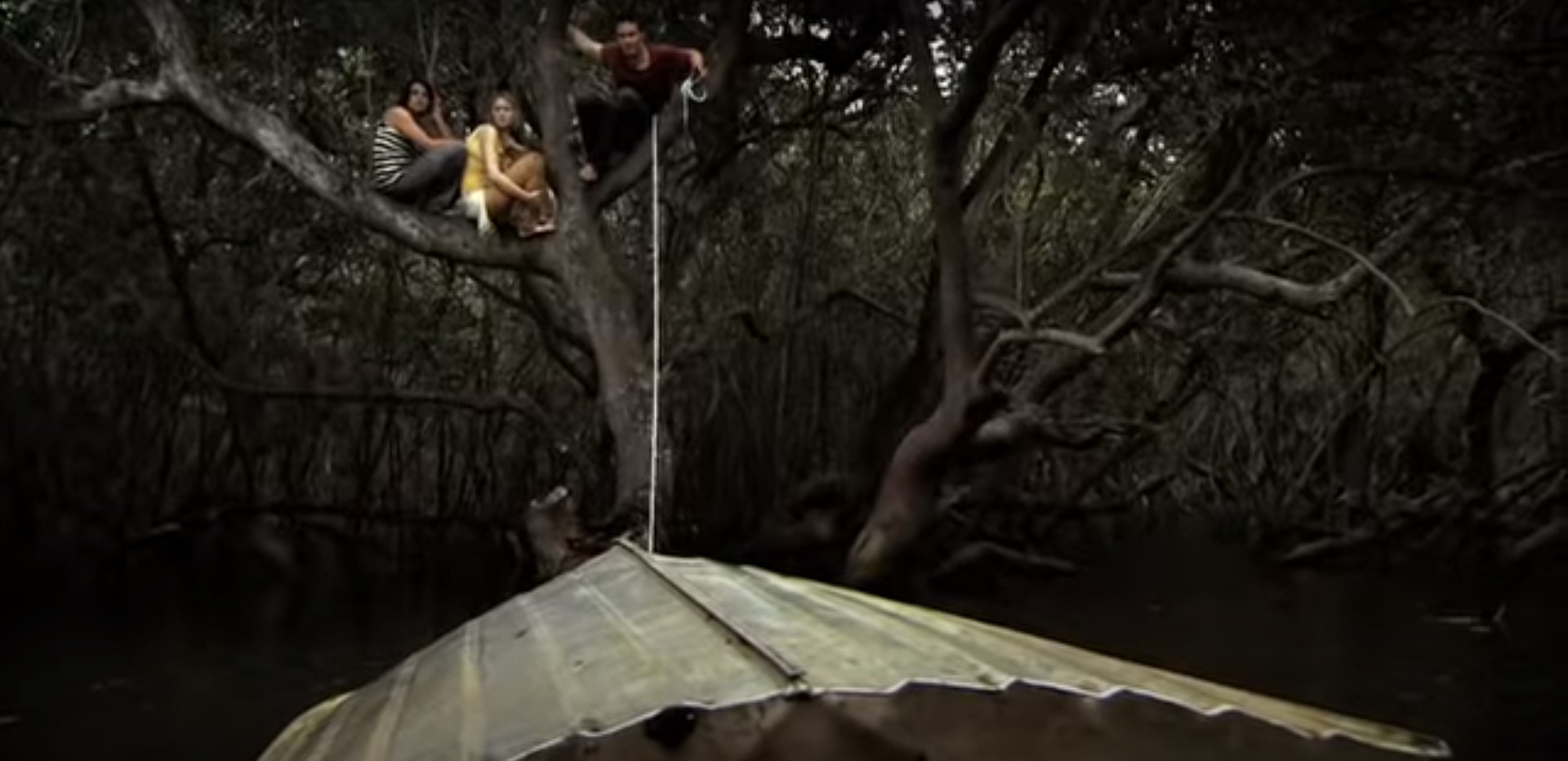
On a two week holiday, Grace, her husband Adam, and her younger sister Lee, embark on a road trip through Northern Australia, stopping at the local bars and roadside attractions all along the way.  Their next ad hoc destination is to fish at the rurally located and rinkadink river tour and fishing guide, Backwater Barry’s.  With Barry himself already out with another tour group, his assistant happily agrees to take them fishing out on a small, metal Jon boat along the mangrove tree dense distributaries.  When their boat is flipped by a large, aggressive crocodile and their guide dead, the water-protruding trees become a lifeline for temporary safety, but being fully encircled by murky water leaves them with no escape route and hidden from the river mainstem where help would like cross.  With a hungry croc lurking below, the only means of survivor is to reach the flipped Jon boat that’s stuck stranded in the middle of water. 

Aside from my personal favorite subgenre, Sharksploitation, the next best would the reptiliansploitation!  If there is even such a scaly subgenre about cold-blooded killers, especially involving the waterproofed skin of alligators and crocodiles lurking and wriggling in murky waters.  I’m a child of the 80’s and grew up on such classics as “Eaten Alive” (technically the late 70’s), “Alligator” and “Alligator 2, and the Australian ozploitation thriller, “Dark Age.”  Even the more modern reptilian ravagers, “Lake Placid” series and Alexandra Aja’s “Crawl,” are hugely exciting, entertaining, and come with a lot of bite!  Another ozploitation crocodile themed film came across my viewing pleasure just recently is the Andrew Traucki and David Nerlich co-written, co-directed “Black Water.”  The 2007 independent production is filmed across multiple locations in the Northern Territories and New South Wales of Australia where much of the butt-clenching terror is filmed in the crocodile-less mangroves of the Georges River.  “Black Water” is presented by The Australian Film Commission and Territorial Film Developments and developed by Michael Robertson’s ProdigyMovies who cater to low-budget ozploitation genre pictures that usually pit man versus nature to the death!

The concise cast provides “Black Water” with an intimacy you wouldn’t get with a bigger, cast-saturated production.  Three principles and two supporters imbues the characters’ fears, tensions, and their rush of adrenaline into the viewers without having to dilute into offshoots with an extensive list of throwaway and expendable roles.  Diana Glenn, Maeve Dermody, and Andy Rodoreda turn from touting tourist to terrorized tenderloins for one of nature’s most ruthless hunters. The dynamic between the three is one that is high on the relationship status; a family consisting of a wife and husband and sisters, leaving zero room for apathy between the characters themselves and between the viewers and the characters as their importance of loss is greater to each other and that extends beyond the screen.  Traucki and Nerlich give little-to-no wiggle room for escape, forcing the survivors to wade the ominous waters.  The fear is prevalent more so in the eyes of Grace (Glenn) who is not only worried about her husband and sister, but also her motherly instinct to protect her newly learned pregnancy.  Lee (Dermody) and Adam (Andy) lack that hesitation, that trembling moment of dipping their toes back into water, in a seemingly inability to feign being affected by the force of flesh-ripping nature lurking just below the surface.  Even with subsequent failed survival attempts, I found difficulty relating to Lee’s fear who, in the latter half of the story, calmly breaststrokes approx. ten yards to reach the boat in a moderate attempt at heart-racing desperation.  Fiona Press (“Out of the Shadows”) and Ben Oxenbould (“Caught Inside”) round out the cast.

“Black Water” is the epitome of ingenuity when placing actors and crocodiles in the same space together.  Real people, real crocodiles.  Yes, the visual effects produced by Nerlich, Traucki, and their team, including of compositor Peter Jeffs, create a frightening cohabitation, stretching the limits of the VFX with the instinctual movements of in captivity crocodiles and laying them over the mangrove scenes that have the actors.  Whenever the croc pops up from the water with just his snout, eyes, and the few ridges of his back breaking the surface, the motionless stare from the beady Devil-eyes can make you hold your breath.  “Black Water” has killer anticipation with a death roll component that no one is safe from a maneater’s hunger. At some instances, the composites are not entirely seamless with the depth or the angles as which the croc moves through the water, but the overall effect is successful and potent. With limited escapes routes come limited plot devices. “Black Water’s” length felt almost painfully reliant on time spent in the mangrove trees with the characters mulling and weighing the options, the option to go for the boat became it’s own motif, and a short lull quickly stiffens the initial boat-flipping tumult. One second, the four fishers have lines in the water and the next second they’re in the water, “crocodile in the water” is being screamed at the very top of Adam’s lungs, and tour guide Jim has instantly disappeared from story in a blink of a crocodile’s snapping smile. No amount of backwater expertise assisted in Jim’s, or any of the patrons’, survival. After the commotion has subdued and the realization that a crocodile has come to feed, survivors stick the trees like monkeys a mere 7 to 10 feet from the surface water, stagnant still in shock and unable to muster a thought about what to do. After the lull, man versus nature gets right back outwitting one another with the croc having a big screening advantage.

Holidaying never looked so terrifying where a day in the office seems like an escape in “Black Water.” The story is a cautionary one of the increasing populations of both humans and crocodiles in Northern Australia and was based off true events as noted by director Andrew Traucki off the account of two teenagers stuck in a tree after the death of their friends by a croc in an interview with MovieWeb.com. A reemergence of the 2007 film, stemmed by the recent sequel, finds itself on a full HD, 1080p Blu-ray from Umbrella Entertainment. The Australian label’s region B release presents the 89 minute feature in a widescreen 1.85:1. More than most of the picture is shot in natural light without being too heavily under the guise of lens manipulation with the steady cam under “Primal’s” John Biggins cinematography. The composited recordings crocs and locations blend almost seamlessly, only rendering a smidge of smear glossiness around the croc’s edges in the tinted blue nighttime scenes. Whenever the croc pops up in the water with a human character sharing the scene, the frame unveils evident cropping but only to sell the effect of the two being in the same moment, removing the outer edges to avoid potential gaffes. The English language and ambiance audio tracks offer two options, a 5.1 and a 2.0, both congenially in a DTS-HD master audio mix. For this particular review, the 5.1 was explored and the dialogue, ambience, depth, range, and run of the mill soundtrack do sound clear, without a hinderance of muddles dialogue, and pertinent to the circumstances happing on screen. Special features include an audio commentary with the directors, a mixture of polished and rough deleted scenes, a making of segment that includes interviews with the directors, actors, and producer Michael Robertson about locations, special effects challenges, and the characters who sell the story, and the theatrical trailer. There’s no pretense with “Black Water” in it doesn’t hawk mutant crocodiles or a behemoth beast thought lost over time; instead, “Black Water” feasts on realism, capturing plausibility and instinctual fear that makes us never want to go into knee high water ever again.

“Black Water” is now available from Umbrella Entertainment on Blu-ray!

Once You Let EVIL In, EVIL Will Never Let Go. “The Babadook” reviewed! (Second Sight Films / Blu-ray Screener)


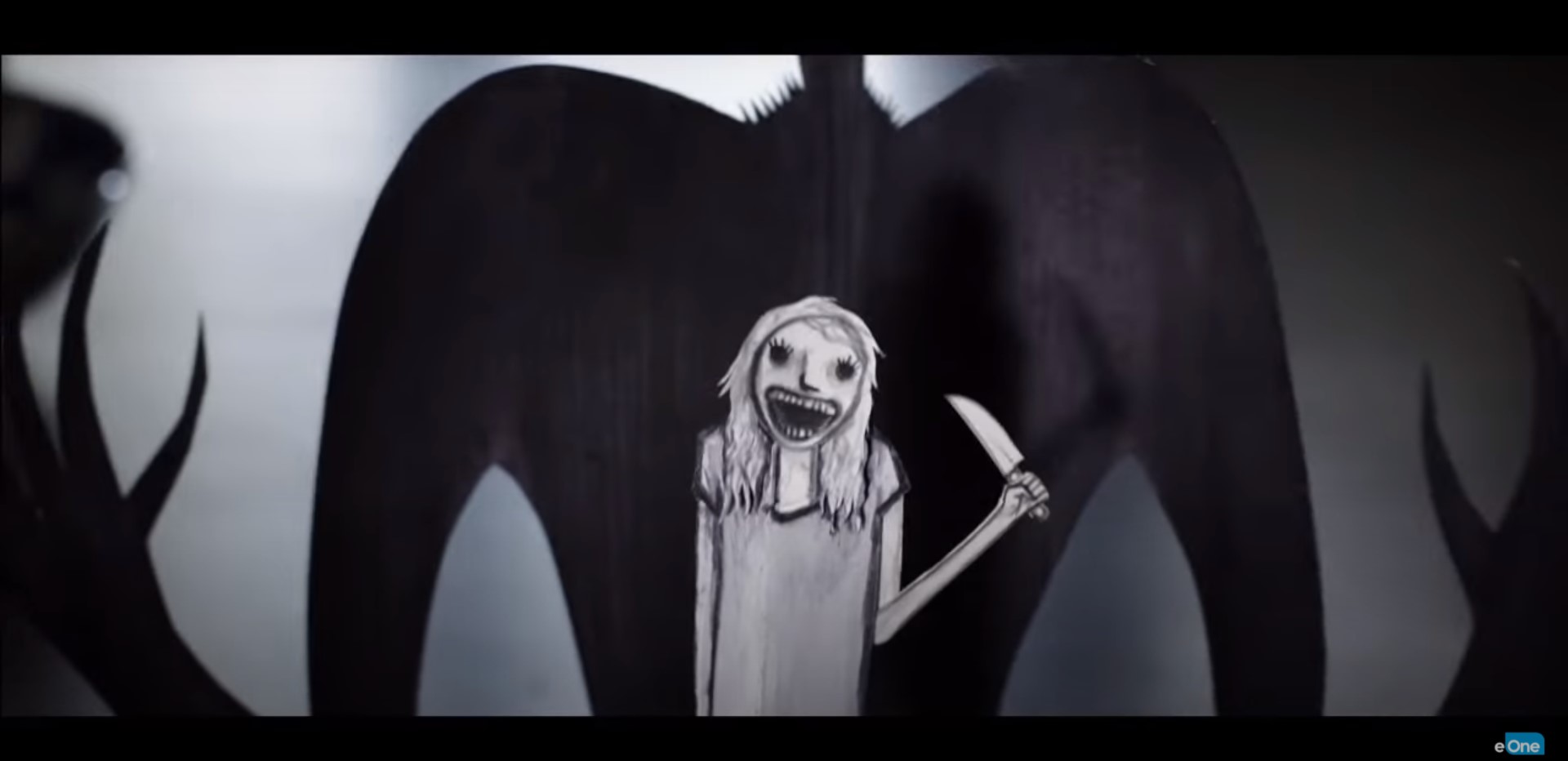
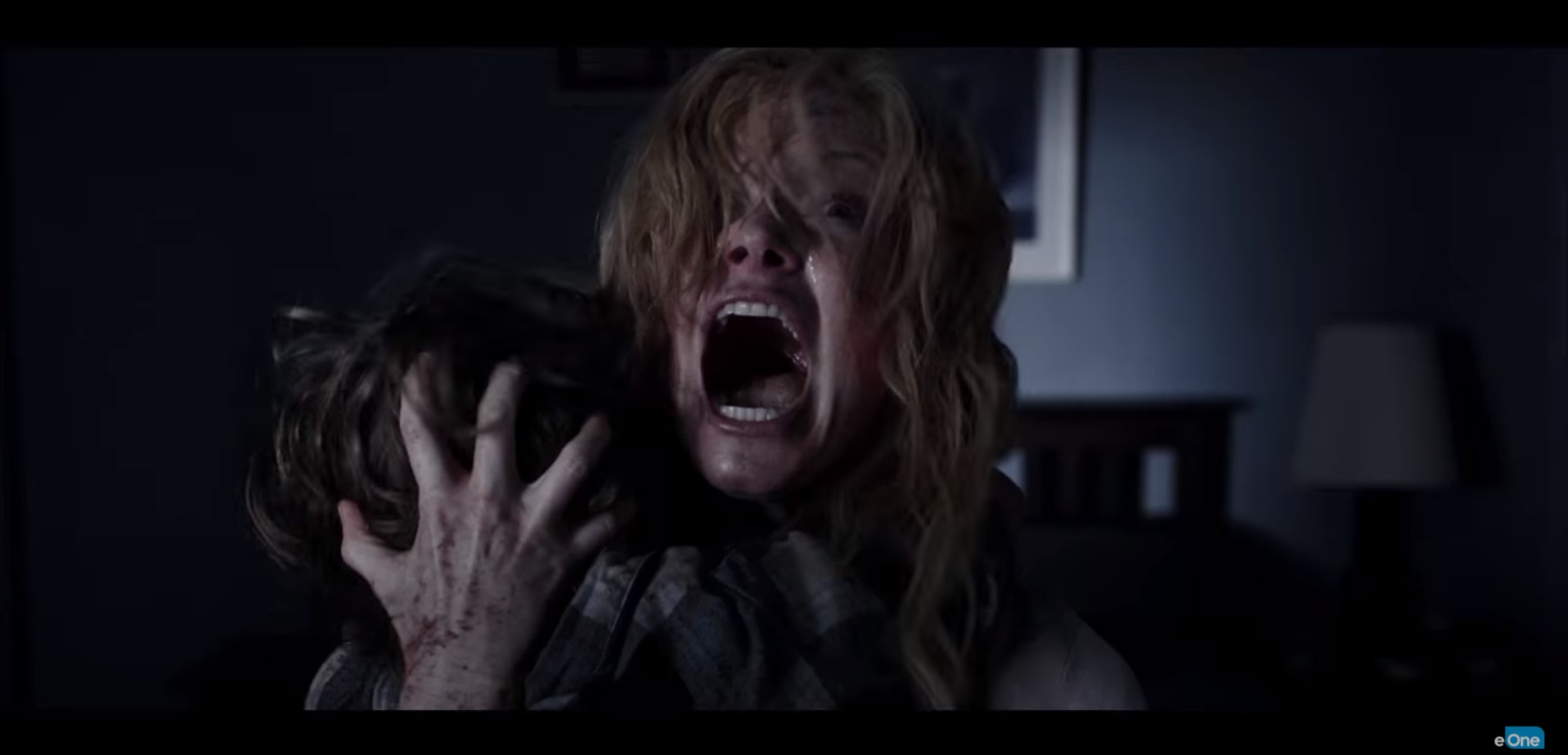
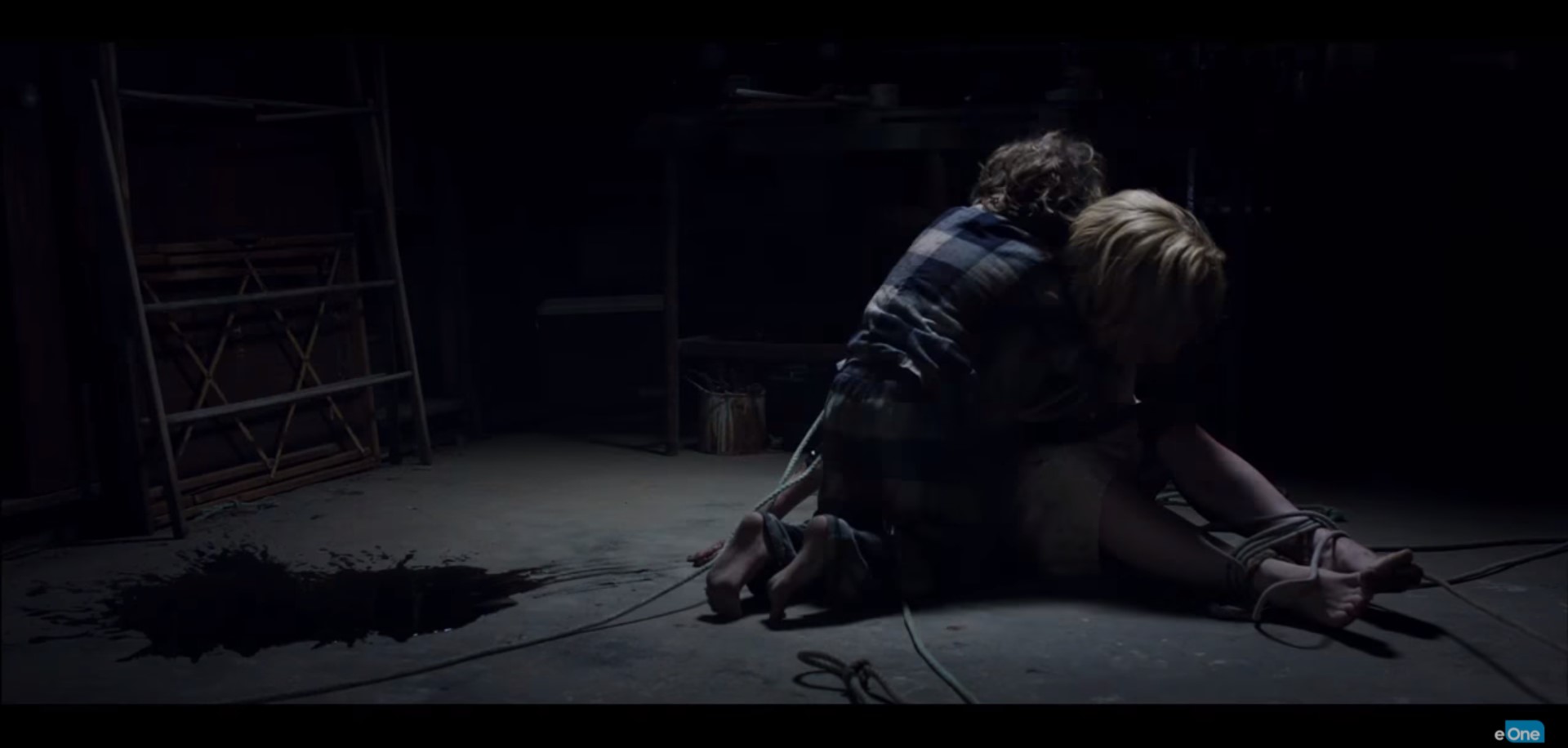
Stage set six years after a car accident involving the death of her husband, single mother Amelia and her difficult six-year-old son, Samuel, struggle to find a harmonious balance in their mother-son relationship.  Samuel’s outbursts and aggressive behaviors deflate the boy’s sometimes sweet nature that has oppressed Amelia into her wits end, alienating her from connecting with other people, even her own sister.  For days Amelia can’t sleep as the stress mounds and Samuel’s erratic temperament continues to worsen, especially when Samuel discovers a mysterious book from the shelf entitled Mister Babadook.  A book he can’t shake from his mind.  The frightening book, filled with graphic imagery and popups, tells of an ominous, dark figure eager to be let into their lives and when the Babadook presence lurks from the pages to reality, hiding in the darkest corners of their home and leeching on the strained anxiety and fear, Amelia and Samuel must rely on each other to wade out the Babadook’s horrible wretchedness only to realize that the way to stop from succumbing to the Babadook’s wrath is to face it head on. 

I can not believe that nearly 7 years has gone by and I have not once sat with a viewing of Jennifer Kent’s “The Babadook.”  Well, luckily for me, genre UK curator and distributor Second Sight Films is releasing the golden egg of limited edition 4K UHD/Bluray sets and was able to snag a screener for review!  The Australian film is an emotionally complex and enormously identifiable thriller that demonizes the post-death states of those dealing with loss and struggling to live on tasked with what’s typically a two person responsibility of mutual support and care.  Kent, who wrote and directed the film, expands upon her original 2005 short entitled “Monster,” by keeping the wrenching core that close in tighter and tighter on the mother and son while upping the visual and audio stylistic elements to make an immersive sympathetic undergo and not just an empathetic one.  “The Babadook” is a production of a conglomerate of companies, including Screen Australia, Causeway Films, Smoking Gun Productions, The South Australian Film Corporation, and Entertainment One and is produced by “Cargo’s” Kristina Ceyton and Jeff Harrison along with “The 13th House’s” Kristian Moliere.

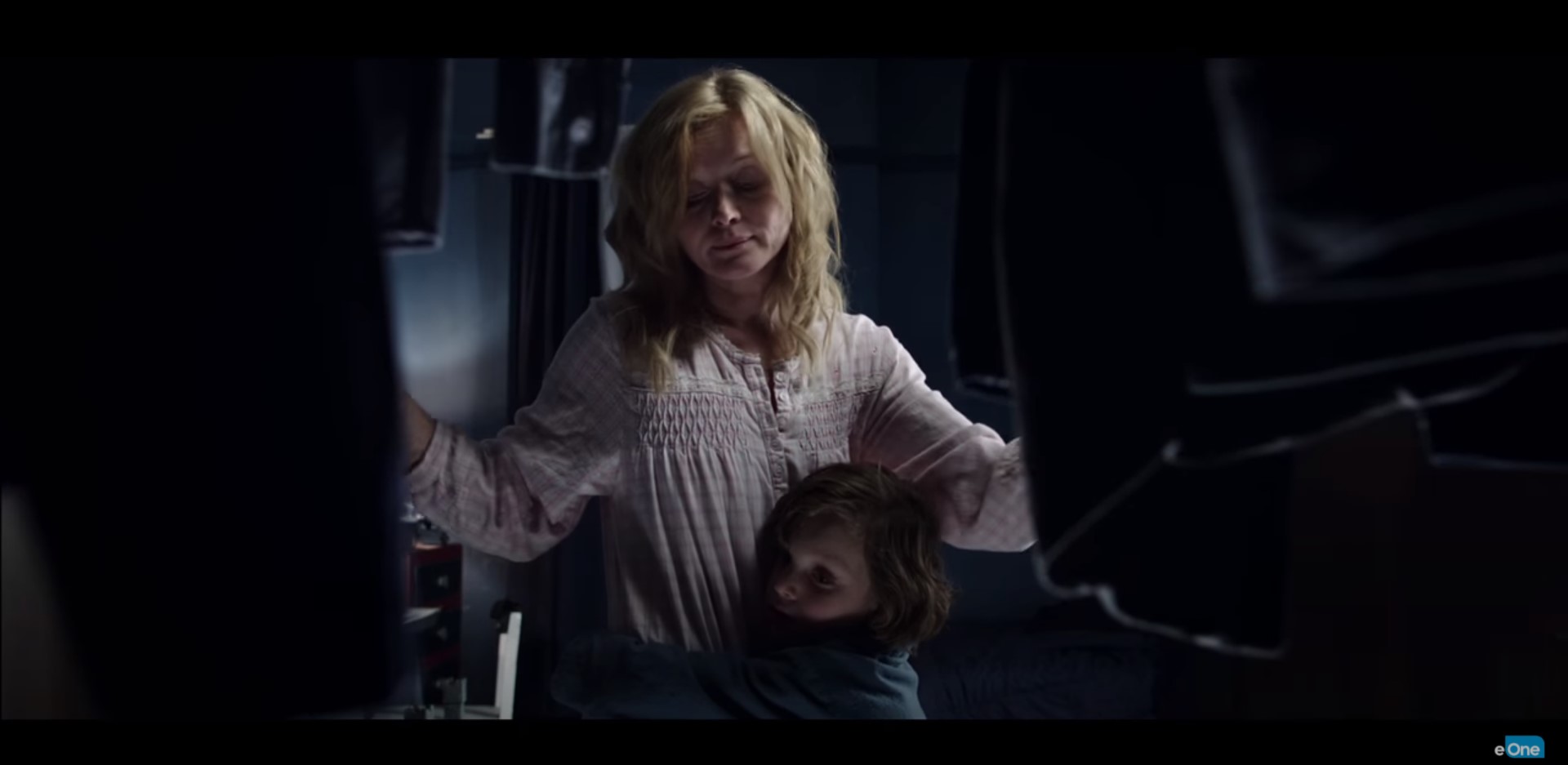
Tackling these performances of a suppressed grief-stricken mother on the edge of snapping and a young boy growing up without a father and innocently oblivious to his own autistic like behavioral issues come with layers upon layers of character depth and, in my firm opinion, Essie Davis and Noah Wiseman crush the roles with a heartbreaking dynamic.   “The Matrix Reloaded” and “Revolutions” star Davis has a tangible wearied performance of a single parent with no one to turn to for help as your unconditional love for her troubled son runs on fumes, dangerously low without an outlet for support, encouragement, or relief.  Samuel has more familiarity in the genre as a relatively new trope, an autistic child that becomes intertwined with a wicked presence that has popped up more recent films, such as Jacob Chase’s “Come Play” and Greg McLean’s “The Darkness,”  as researches learn more about autism and society has been able to authenticate the condition over the years.  The debut feature performance from young Noah Wiseman can get under-your-skin being a restless busy body, a screeching backseat thrasher, and a poke and prod child in constant need of attention, but Noah is able to switch right into a sweet natured young boy with lots of wonderment and love for his mother.  Noah’s inventive, creative, and has a knack for self-preservation when dealing with a looming evil hungry for his fearful submission but because Noah is different from other children, he’s society labeled “disadvantage” is actually advantage, a tool for survival, that keeps him fixated on what’s important.  Focally attuned to just Amelia and Samuel in the story, the film barely registers the supporting cast that rounds out with Hayley McElhinney, Daniel Henshall, Barbara West, and Tim Purcell as the obscured Babadook.

Right from the opening scene, director Jennifer Kent instills a visually stylish premise geared to layer Amelia’s troubled mindset with an etherealized environment nightmare of her husband’s tragic death followed with the reality-grounding energy drain of raising single-handedly a difficult child and the rest of Amelia’s social bubble imploding without a sense of compassion.  From Samuel’s school to her own sister, Amelia is bombarded with delineation of Samuel’s behavior, riddling her psyche with shot after shot of disparaging remarks compounded upon a lingering pain that goes all the way back to her husband’s death nearly seven years ago and to which she subconsciously assigns Samuel blame.  Culminating to a head on Samuel’s birthday, the exact same date of her husband’s death, is a flood of weary and breakdown overtaking Amelia’s last bit of hope for her child and for herself.  This manifests an internalized darkness protruding out into the exterior in the form of Mister Babadook, the embodiment of grief pent up and let loose, feeding off Amelia’s exhaustion and malevolently possessing her being to want to do the worst possible thing overly stressed and repressed parents can do – take out their pain on their children.  Kent masterfully crafts symbolizing grief as an atypical presence of our normal selves.  The sheer amount of dimly lit negative space for the Babadook lying in waiting goes not to waste as when you think something is there, perhaps the Babadook, nothing actually materializes from the ominous shadows, but, in the realm of the story’s reality, that sensation of feeling a presence in the room with you is beyond a tauten tangibility and Kent, playing with that construct, adds stomach knotting audible cues, a guttural discordance, that narrow the eyes, pull the covers over the head, and have you wait with bated breath.

Let the “The Babadook” in with Second Sight Films’ 3-disc limited edition dual formatted, region free 4K UHD and region B Blu-ray, release arriving in the UK on June 21st.  The 4K presentation, an upscaled 2160p, is mastered by the original post production facility and presented in a 10-bit HDR10.  Both 4K and Blu-ray have an aspect ratio of 2.35:1 widescreen.  Audio options include the an English language DTS-HD master audio 5.1 and an English LPCM 2.0, complete with perplexing creature roaring soundbites from the original Resident Evil game on PlayStation.  Since only a screener disc was provided for this review, I am unable to comment on the exact quality of the release’s audio and video outputs; however, the rigid slipcase, with artwork from Peter Diamond, sheaths an abundance of special features, including a new audio commentary by Alexandra Heller-Nicholas and Josh Nelson, “This is My House!” – an interview with lead actress Essie Davis working with the cast and crew as well as her impressions of the story, “The Sister:  Interview with Hayley McElhinney” who talks about her character’s uncompassionate sibling role, and interviews with producers Kristina Ceyton and Kristian Moliere, editor Simon Njoo, production designer Alex Homes, composer Jud Kurzel, and book illustrator of Mister Babadook Alexander Juhasz.  The release also comes with Jennifer Kent’s inspirational short film, “Monster,” the making-off “”They Call Him Mister Babadook,” featurette about production design and set location in “There’s No Place Like Home:  Creating the House,” special effects talk about the sole stabbing scene, segment on stunt work, “Illustrating Evil: Creating the Book” that was illustrated by Alexander Juhasz, and a 150-page hardback book with brand new essays, an achieved interview with the director, concept illustrations, and behind the scenes photos  and collectors’ art cards that were not included with the screener.   Broodingly topical and harrowingly acted with perfection, “The Babadook” is the epithet for silent deadly threats, squirrelled and suppressed away by innate survival instincts only to be a subsonic explosion when the unstable psyche’s flashing point is sparked. 

To EVIL, Just Another Slab of Meat for the Butchering. “The Slaughterhouse Killer” reviewed! (Breaking Glass Pictures / Digital Screener)


The local swine slaughterhouse perfectly suits the solitude of Box, barely sating the fervent urge of his killer spirit, but when a young ex-con, Nathan, who is trying to walk the straighten arrow with his girlfriend, falls under Box’s wing at work, keeping that urge at bay is proving more difficult with a likeminded companion.  When the workplace bully pushes Nathan too far, Box orchestrates a killer opportunity to murder the bully in his own home as a gift to the young parolee.  The death of their intimidating colleague solidifies an unique relationship between the men, opening Pandora’s box in their small town where no one is safe from their lust for blood.  As the bodies pile up and their corpses are ground up into chuck at the slaughterhouse, their relationship is tested when a child becomes the unintended next victim, severing the unspoken principles of their bond. 

“The Slaughterhouse Killer” is director Sam Curtain’s entry into the minds of bloodlust wolves living in sheepskin day-to-day amongst the clueless flock.  The senseless violence-laden thriller out of Tasmania, Australia is the sophomore feature from the “Blood Hunt” writer-director and is co-written with Benjamin Clarke.  The pair harness their continued onslaught for aggression from “Blood Hunt’s” human race cruelty with a rumbling storm brewing, waiting, for the right conditions when two very different people find a common interest by setting a little part of their world on fire.  The indie picture is streamlined through Curtain’s Stud Ranch Films entertainment banner and is backed by Black Mandala, a big and upcoming label showcasing an expertise in extreme low-cost horror, under the producer’s eye of Nicholas Onetti who has supported a number of genre fan favorites under his banner such as “The Barn,” “Aquaslash” and has even collaborated with brother, Luciano, on the 70’s giallo inspired  “Abrakadabra” and “Francesca.”  If Onetti is attached, prepare yourself for merciless and bloody circumstances in this particular ozploitation maniac thriller. 

You obviously can’t shoot a film titled “The Slaughterhouse Killer” without the slaughterhouse setting garnished with meathook strung up and process gutted livestock much in the same way the killer can’t fall into the average-looking joe category.  In steps Craig Ingham, a Sydney born 6’4” big fella with distinct facial features that includes a gleaming bald head and an angry sneer delineating fiercely from his bulbous, pink-as-a-pig cheeked face.  Ingham has an uncompromising maniacal approach of being large and in charge under a lame façade of a daft abattoir employee.  To balance out the oversized archetype antagonist, usually from one that lumbers around in slashers genre circles, hacking away at sex-crazed teens, James Mason buoys “The Slaughterhouse Killer” from capsizing in that humdrum trope of tasteless, flat water by adding a pretty face to the madness that is equally as ugly on the inside in character in what becomes the Laurel and Hardy of exploitation horror.  However, there’s nothing remotely funny about the performances of two men becoming unlikely best buds, drinking beer, and making hamburger out of the sheila from next door, but they do act like a pair of chuckleheads searching for motivation with their roles and instead come up empty handed in the arbitrary of Curtain and Clarke’s headway halting story.   “The Slaughterhouse Killer” is simply a two man show that aims to cycle through their unusual connection with Kristen Condon (“Sheborg”) as Nathan’s girlfriend, Tracey, and Dean Kirkright (“Cult Girls”) as the unfortunate workplace bully rounding out the small cast of collateral damage characters.

One of the biggest problems with “The Slaughterhouse Killer,” a tale that’s supposed to be driven by the characters’ dysfunctional ties to society and their knack for violence, is that very lack of purpose Box and Nathan get out from the random bloodlust.  Nathan, on parole for we don’t know what, easily falls bewitched by Box’s gore giddiness and willingness to let Nathan into his little big secret.  Without Nathan’s incarcerated backstory, a sentence served that proved nothing but his ability to still land a job, doesn’t age well as the film progresses and just seems to be there in a glint of development substance that never circles back.  Box falls onto the same static line of where the hell is his arc heading as the film opens with Box resting sweaty in his whitey-tighty inside his ramshackled shack.  There’s not much too Box’s creepy disposition other than keeping his squinty eyes glued to a rather attractive woman’s behind and taking abusive orders from the abattoir boss, but what he sees in his new guy to take him on a journey of bloodletting is something of a mystery that never pans out.  Even Box’s bound and blinded plaything in a padlock trunk transcends every act met, creating a glass ceiling of knowledge to the inner workings of his warped thinker.  Box and Nathan’s nihilism and madness unleashed is the purest part of Curtain’s film as the sensation is like a fat kid in a candy store where the two men can just go to town by butchering the residents of their own town by any means seen fit to them, but in the grand scheme of cinema, there are far superior violent films to consider.

As if it was destined to be, “The Slaughterhouse Killer” finds friendship with a kindred, malignant soul to carry out dark fantasies and Breaking Glass Pictures brings us this tale of two treacherous serial killers onto VOD and DVD this month of April. Digital platforms will include Vudu, iTunes, Google Play, Amazon, Fandango, and more. Presented in a widescreen, 1.78:1 aspect ration, and recorded in 4K, cinematographer Leuke Marriott rejoins Curtain on the director’s second feature, providing 78 minutes worth of intimate imagery invasive on Box’s grimy lifestyle and Nathan’s furrowed brow by corralling much of the action directly in front of the camera. Marriott might not employ novel angles and techniques but makes up with holding tight and fast on the brutality and the meatgrinder of Box and Nathan’s vile run while also supplying a few bold filters, such as a rich blue and a light yellow, in more unsettlingly taut moments and capturing some of Tasmania’s landscape with aerial drone shots of Arthur’s Lake with the trees seemingly floating up out of the tenebrous water. “The Slaughterhouse Killer” has the title of a 80’s printed VHS SOV and leverages the ogre villain to the max, but can’t muster a rooted sense of purpose, not even a simple reason such as pure, unadulterated evil, to drive a span of violent behavior to be a worthwhile token to the viewer.

Own on DVD or Watch on Amazon Prime Video!

The Dying Baltic Traditions Live in the Ashes of EVIL. “Cult Girls” (Umbrella Entertainment / DVD)

The pagan Cult, the Golden Path, remains nearly all that is left of the ancient practice as Lithuania becomes one of the last countries to be converted to Christianity in the late 14th century.  Led by an archaic, yet powerful, goddess named Ragana, the Golden Path promises to flourish once again with the power of death, reincarnation, and control through sordid misdeeds.  When Dalia and her two young sisters become prepped for a ritual of an important role in the cult, potentially leading them down the path of sex and sacrifice, a traitorous follower helps the sisters attempt to escape their emmeshing fate as the police raid the Golden Path compound ensuing a firefight that leads to the death Ragana and Dalia’s getaway, but her sisters are kidnapped and held captive by the remaining cult members.  Years later and riddled with guilt, Dalia must know what happened to her sisters and she tracks down a death metal cultist, Moloch, who seemingly has a connection to Golden Path, with the help of Samoth, a black metal fanatic, but Moloch forestry hermit lifestyle cuts off Dalia and Samoth from the rest of the world and the convicted arsonist against all things Christianity may have more up his sleeve than what meets the eye.

With a title that sounds like an all-girl goth band from the grunge era of the 1990’s, or maybe even more so from the “Scooby Doo” franchise (Hex Girls anyone?), “Cult Girls” summons the actuality of being an acute quasi-historical and dark fantasy thriller hailing from the Ozploitation capital of the world, Australia.  “Cult girls” is the second, non-documentary film from “The Matrix’ inspired “Narcosys” director, Mark Bakaitis, who directed, wrote, and edited his the multi-location sophomore film that has on location scenes from not only in Australia, but also in Lithuania, at the notable Hill of Crosses landmark, and in the indiscernible urban locations of Germany.  Bakaitis serves as producer alongside executive producer Douglas Kaplan of the diverse arts platform production company, All Edge Entertainment, based in Santa Monica, California. 

The Australian production casts an American to star as Ragana, the brood matriarch destined to rejuvenate Golden Path’s permanence, with “V’s” very own Jane Badler.  Badler brings an international presence to the feature and isn’t a stranger to films from the down under.  With the actress’s soul-seducing cutting eyes and demonic empress allure, the New York born Badler exacts Ragana’s clutching strength as an underground Pagan seeking unlimited decadent power.  However, Badler is overshadowed by the timorousness of Dalia whose polar opposite presence is granted a more favorable chunk of screen time.  Finnish born Saara Lamberg plays the humbled Dalia, living her life out of a covenant while searching out the cult that once almost stitched her into the sew of sleazy affairs to unearth the whereabouts of her younger sisters.  Dalia’s a bit of a dull principle with no substantiated efforts in finding her siblings and it isn’t until Samoth stalks her one night, recognizing the Golden Path’s symbol tattooed on her wrist and offering his manhunt services to find the expelled Moloch, an exaggerated black metal anti-Christianity anarchist in a saturating performance by Albert Goikhman.  In the middle, masked brutes, half naked women, and, fallen by the waist side, Dalia’s sisters in standalone plot point narratives that, as far as story structure goes, does nothing to motivate the narrative other than be an ostentatious aesthetic of locations and debauchery.  “Cult Girls” rounds out the cast with Tony Markulin (“MurderDrome”), Algias Karazija, Dean Kirkright, a handful of Bakaitis’s family, and Simay Argento, a distant relative to Dario Argeno playing a Cult Auntie in the film.

“Cult Girls” borders being avant-garde of an unfiltered auteur’s will in a mesh of artistic polishes and prose dialogue, but the film slides into being more of an 83 minute music video over staying it’s welcome and drudges through a repetitive stylistic cycle to an almost nearly unwatchable extent.  Yet, “Cult Girls” somehow manages to retain attention despite the chewy acting and it’s ambling story that hits a dam wall of uncertainly of where the script should head. Bakaitis shoulders the story for modern Gothicism tapped with half naked occultist, sometimes bathing in blood, and a plague of nightmare imagery that director of photography Trent Schneider tunes into well with noir vitality despite being the cinematographer’s debut feature film, but through the shiny exterior of a handful of solid mise-en-scene work, “Cult Girls” numbs the impact of the soul corrupting Pagan syndicate, that may or may not be shrouded with supernatural foundations, and the anti-Christian propaganda with half-baked violence from geriatric men, masked with Dia de los Muertos style masks, able to be kingpins of an untouchable prostitution ring façade for their occult sacrifices in broad public without a bat of an eyelash.  Granted, prostitution is likely legal in Germany and Lithuania so authorities might turn a blind eye, but brothels are a convenient opportunity for police investigations. “Cult Girls” treasures the fact of Lithuania’s languishing heritage without being overly filmic heresy by blending in shaded sleaze and death, but there lies no story in Dalia’s unenthusiastic search for her sisters in a much more preacherly themed death metal horror that confuses cult with religion.


Apocalyptic reincarnations and traditional folklores collide in Mark Bakaitis’s “Cult Girls” on DVD now from Umbrella Entertainment. The Australian release is a single layer DVD with region 4, PAL encoded format, presented in a widescreen 2.40:1 aspect ratio. Trent Schneider’s keen eye captures a grim fairytale surface of black magic masochism and, at the same time, breathtaking in the pure nature scenes, but the imagery is mostly in devoid of richer color that lingers around a bluish-gray monochrome tone and struggles with hazy details, especially around facial features, that smoothly fuzz over. The English, German, and Lithuanian Dolby Digital 5.1 surround sound mix battens down with shiplap genres of traditional Lithuania folk and modern metal from composing sound designer Erin McKimm, implementing the traditional songs of Lithuania sung by the Melbourne-Lithuania community singers, The Lost Clogs. Industrial action fills in every nook and cranny of the remaining score with decent range and depth of ambiance. While the dialogue is prominent and clear, there are spelling errors and tiny text issues with the English subtitles when the narrative lands in Germany and Lithuania. The DVD’s bonus features includes audio commentary, making of featurettes with cast and crew interviews, Bakaitis’s short film, “Mercy Kill” that serves one of the founding themes for “Cult Girls,” and music videos directed by Mark Bakaitis. For an Australian film, “Cult Girls” will feel more worldly, unlike anything else that comes out of Australia, and have partisan propaganda against Christianity, but in the end, the insidious Pagan evil, on the precipice of resurrecting, wearies on, like a tireless sermon of doom.