
In the year 2022, orbital satellites carry nuclear missiles and maintain flight patterns around the moon. When a satellite repair ship, known as a “refab” ship called Spaecore 1, attempts to intercept a satellite for maintenance, the system wide computer goes into an unexplained power failure that jeopardizes communications, life support, and navigation. Drifting helpless toward sector Centrus B-40, the dark side of the moon, all hope will be lost within 24 hours unless operations can be restored, but a mysterious spacecraft, NASA’s Discovery shuttle, heads toward them and docks onto their outer hull without so much of a hail from the shuttle. Captain Flynn and Lt. Giles investigate a seemingly abandoned ship until coming across a dead body of a presumed missing NASA astronaut, eviscerated with an opening left in a perfect triangle as the cause of death, and that opens the door to more questions than answer as a sinister presence boards their ship, pursuing damnation for their souls.
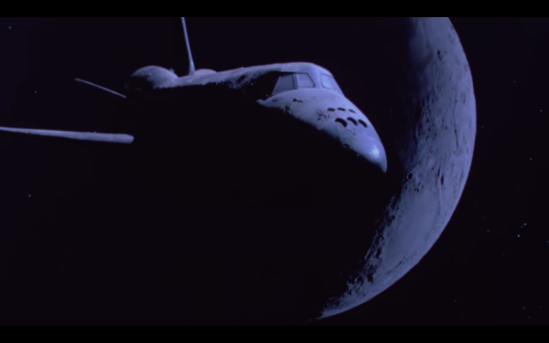
Just think, in two more years, weapons of mass destruction satellites will loom just above fluffy white clouds, ready to mushroom clouds out of targets with a 10-ton yield; at least that’s what director D.J. Webster and the screenwriters, identical twins Carey W. Hayes and Chad Hayes, modeled the future when conjuring up this delectable Sci-Fi horror film approx. 20 years ago. With special effects models and techniques that withstand against powerhouse space films, such as from the immaculate effects of Alien franchise, “The Dark Side of the Moon” becomes more than just a 1973 Pink Floyd album title Fabricated out of warped creativity of old and new concepts with a Biblical horror base that only the 1990’s could loosely spin into an hour and 27 minute feature, for many of the filmmakers involved, “The Dark Side of the Moon” credits as their first taste of a feature length, large scale production, especially with the mainly music video director D.J. Webster, who loves his closeups, and director of photography Russ T. Alsobrook, as they auto clicks into a team that seemingly have experience of seasoned veterans or, perhaps, spent some secretive, unlogged time in space. Who knows, but the outcome ruminates about the dark side of religion and how each of us deal with it internally.
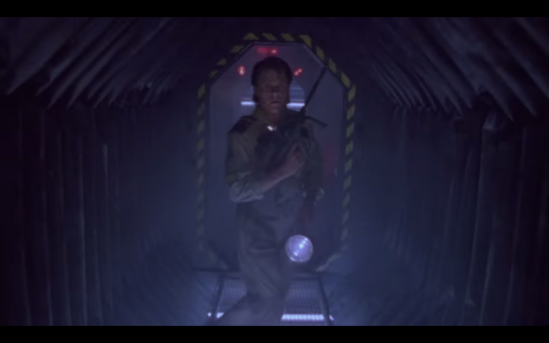
When mullets and giant framed glasses are afoot, the late 80’s, early 90’s filming era is beyond evident with interestingly gritty characters lined up for an evil figure eager to knock them down and, of course, the story’s lead character is the mullet sporting pilot named Lt. Giles Stewart who is unwittingly thrust into the fast track of a hero’s lane. Giles’s atheism framework has a pleasant sardonicism about it when face-to-face with the immortal conqueror of his ship and crew. Will Bledsoe paints Giles as such as faithless space pilot, bound to duty, and willing to do anything to just not save himself, but others. One of the only recognizable faces, at least for myself, in the cast is John Diehl. The “Stargate” and “The Shield” television actor is best at being a wild card in turmoil situations and as shipmate Phillip Jennings, the same can be expected without being utterly conventional or warrant any kind of typecast label. Another actor to note is Alan Blumenfeld as the ship’s panicky Dr. Dreyfuss Steiner. Blumenfeld, who had a role in the best Jason Voorhees film, in my humble opinion, “Friday the 13th Part VI: Jason Lives, is once again stalked by a larger-than-life villain while maintaining a profusely sweaty persona that’s symbolically intended to be true, unadulterated fear. As a whole, the cast is amazing regardless of some first time filmmakers at the helm, rounding out with “Re-Animator’s” Robert Sampson as the ship’s Capt. Flynn, Joe Turkel from the first “Blade Runner,” “Blood Frenzy’s,” and overall erotic thriller goddess, Wendy MacDonald, stunt man (“Kill Bill Vol. 1 & 2, “Army of Darkness”) Ken Lesco, and another “Friday the 13th” actor, Camilla More, or Tina from “The Final Chapter,” as the stationary sexy, ship’s onboard computer-robot named Lesli – think on the same lines as Mother from “Alien,” but in the flesh.
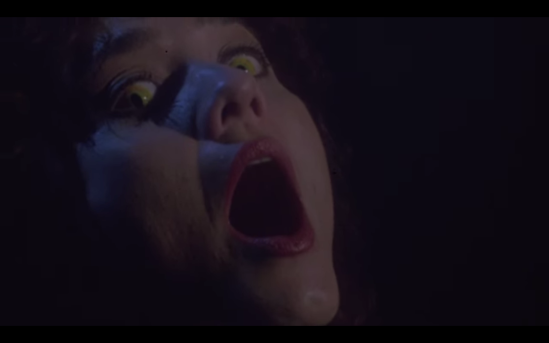
What makes “The Dark Side of the Moon” very interesting is the film being an unofficial precursor to other science fiction horror films like “Event Horizon” that was released roughly seven years later. Space as this gateway to Hell concept is sorely under-appreciated and underutilized. Space is already vastly frightening to begin with and by adding a devilish abyss aspect to it makes the idea an absorbingly scary thought. What’s also fascinating is the Hayes brother. “The Dark Side of the Moon” is the brothers’ roots film; the proverbial patient zero that spread successful movie writing careers for the twins, spawning turn of the century horror with the remake of “House of Wax” that saw the on-screen death of Paris Hilton, had “Underworld” star Kate Beckinsale track down a killer in Antarctica in “Whiteout,” and they penned “The Conjuring” that constructed its very own universe.
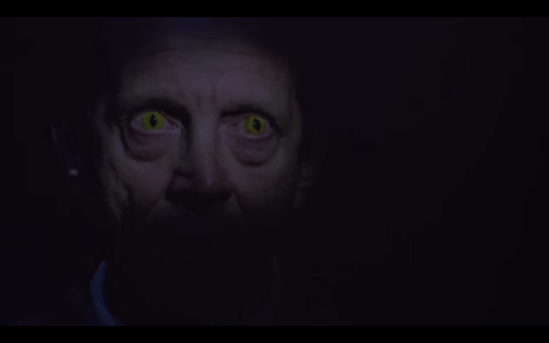
“The Dark Side of the Moon” comes in at #2 on the Unearthed Films’ Classics label distributed MVDVisual. The newly restored 4K transfer of the Wild Street Pictures production is presented in a widescreen, 1.85:1 aspect ratio, region A Blu-ray release. Surprisingly sharp despite consistent low-lit scenes and not as washed like previous VHS versions, this restoration fine tunes the nitty-gritty specifics needed for proper presentation that doesn’t falter from heavy digital noise or blotch artifacts and shows no signs of enhancing The English language LPCM 2.0 audio track is strapping for a dual channel format. Dialogue pronounced clearly, ambient spaceship clinks and clunks create atmospheric range and depth, and the relentless brooding score by “Society’s” Mark Ryder and Phil Davies delivers shuddering spinal-tingles without being monotonously dull. Bonus features include a commentary with executive producer Paul and Unearthed Films’ Stephen Biro, interviews with Alan Blumenfeld, FX artist R. Christopher Biggs, and stuntman Chuck Borden, plus vintage audio track, trailers, photo gallery, and a insert booklet that dives into about the production and the cast. All packed into a nice little slipcover package. “The Dark Side of the Moon” pioneers into the future of space horror as a good ole dread-inducing fear-monger of the great expanse, deserving this Unearthed Films’ release, hands down.
Category Archives: Trailers


Writer’s Block is a Fictional Author’s EVIL! “Blood Paradise” review!

Flustered about the severe flop of her latest book, crime novelist Robin Richards encounters writers’ block as a result. Losing inspiration in the big city with her droll boy-toy, her publisher recommends a visit to the scenic Swedish countryside as a change of pace that’ll remove her out from the comfortable surroundings and, hopefully, begin to craft new ideas for a rebound book. Totally out of her element quartered inside a farm residence, Richards can’t help to investigate her peculiar hosts and a chauffeur, a super fan who is besotted with her while his wife voices her utter disdain for the writer, but their odd behaviors stimulate inspiration for her work beyond her ability to observe that something is dreadfully and dangerously wrong with them.

From a title that can be interpreted as an oxy-moron, “Blood Paradise” spills onto the screen as a sexy suspense-thriller with pinpoint-peppered dry comedy. The Swedish bred film is directed by Patrick von Barkenberg, who also has an important-minor role contribution to the narrative as well as co-written alongside the film’s lead, Andréa Winter, that proposes total control over the juxtaposition of not only the sane versus the insane, but also enthralls with a crime storyteller from the city thrust into her own calamitous tale of murder on the rural fringes. Barkenberg and Winter have poised chemistry weaving a story that’s mostly building the bizarre attributes of characters with even Robin Richards’ pooled into that group being a stranger in a strange land; the filmmakers’ past collaborations of short films, including “A Stranger Without” and “A Little Bit of Bad,” firmly establishes them as being the right kind auteurs for the job.

As stated in the above, Andréa Winter stars as Robin Richards, an adventurously alluring writer willing to try anything to get her career back on track. Winter, who is also an electro indie pop singer in Baby Yaga, is as stunning at her performance as she is in her natural beauty with a role that tenaciously exhibits her uneasiness with the locals and their bare necessities while also not being afraid to bare nearly all herself in compromising positions and places. While Robin is most solitary in conversation as she is interactions with other characters, there’s great dynamic contrast with Hans. Hans Bubi and, yes, if you say it out loud, a definite nod to a memorable line from “Die Hard.” Played by Christer Cavallius in his sole imdb.com credit, Cavallius’s wide-eyed and big smile below his shoulder length hair makes him a comical to a point and when you add Hans’ current hell of a marital status with a potted plants devoted woman and his mental blocking obsession with Robin Richards, the overly flawed and desperately optimistic character has hopes and dreams from a slim chance opening that he is hesitant in completely seizing, though we, and even perhaps Hans himself, knows the outcome if he took the risk. Another character highly involved in Richards’ circle of exchanges is with the farmer, Rolf, played by Rolf Brunnström. Rolf is a seriously complex character, an irresistible mystery to the author who spies on his enigmatic tasks involving a locked barn with windows covered with plastic. Rolf’s detached and impassive with his wife’s death that looms throughout the story and Brunnström, a middle-aged man, turns out to be more than his simple life implies. “Blood Paradise” remaining cast includes Martina Novak, Ingrid Hedström, Ellinor Berglund, and Frankie Batista.

Finding the comedy in a film like “Blood Paradise” might be a task suited for people with a dark sense of humor, but the quality is present and can be compared to the offbeat nature that Eli Roth subtly nurtured in his breakout flesh-eating squeamish-er “Cabin Fever.” Dry and restrained, the comedy is dialed down to a low-lying hum in “Blood Paradise,” honing in frequently on the sexualized suspense that’s audience attractive and runs parallel with Robin Richards profession as a crime novelist who pens tales involving gimp-cladded deviants, and the story simmers to a boil, reducing down story intricacies into an unraveled macabre of things once dead are now very much alive in transcendence, just like a good crime narrative should unfold.

Gripping with toe-curling tension, “Blood Paradise” arrives on a Blu-ray home video courtesy of the Philadelphia based distribution company, Artsploitation Films. Presented in HD, full 1080p anamorphic widescreen, 2.35:1 aspect ratio, Artsploitation Films has a remarkable looking release on their hands that’s soft where intended and detailed where necessary, registering a vast palette of rich colors thats typical with digital films recorded with an Arri camera, as listed on the internet movie data base. The English and Swedish 5.1 Dolby Digital surround sound has an equally good and clean facet of range and depth for a rather subdued thriller that’s more mystery, than panic stricken. Soundtrack by Andréa Winter adds a bit of lively-atrocity synth that doesn’t push through enough to be a factor in it’s assimilation between the ambience and dialogue tracks. Bonus material includes three deleted scenes and two music videos by Baby Yaga – “Dreamer” and “You and Me” – that feature artistic renders of the film. “Blood Paradise” is no tick sipping on sangre-sangrias on a beach somewhere. Patrick von Barkenberg’s “Blood Paradise” captivates in the inexplicable without sheering away from fraught character contexts while still maintaining a healthy dose of sex appeal and blood.

“Blood Paradise” available now for purchase!

Undead EVIL Versus Hot Shot Mercenaries in “The Jurassic Dead” Review!

After being terminated from Government involvement and dismissed as a professor at a prestigious university, controversial scientist, Dr. Wojick Borge, vows retaliation against those who deem his life work, re-animating lifeless cerebrals into fevered ferociousness, irresponsible and dangerous, but before developing his plan of attack, an irefully distracted Borge is struck down and crippled by a pickup truck. Surviving the accident, Dr. Borge joins a radical militant group with a mission of destruction toward the United States of America. An elite team of five special ops hired guns are dispatched to Borge’s isolated desert compound to locate and destroy the mad scientist and revoke his dastardly end of days card that also involves a pre-calculated asteroid strike on Earth, leaving an EMP trail that wipes out all electronics and with America dark, the crazed scientist intends on releasing his toxin amongst millions of people that will vehemently destroy themselves. Caught in the mix are college kids on a road trip when their car dies and nothing can prepare them when they come face-to-face with an undead pre-historic sentinel at Dr. Borge’s compound.
First, there was the baaah’d-ass, four-legged, undead lamb chops in Jonathan King’s “Black Sheep.” Then, these living dead aqua rodents didn’t give a dam in Jordan Rubin’s “Zombeavers.” Now, directors Milko Davis and Thomas Martwick go full pre-historic carnivore with “The Jurassic Dead.” A indelicate cross between “Jurassic Park” and any zombie film you could probably think of for a film that’s has nifty alternate titles, such as “Zombiesaurus” and “Z/Rex”, Milko Davis co-writes an intrinsic script with “Generation X-tinct” screenwriter Michele Pacitto that narrates the mining of calcified tree sap and extract the DNA from fossilized mosquitoes in the Jurassic period….wait….that’s, uh, “Jurassic Park.” “The Jurassic Dead” isn’t that problematical, so forget I said anything about an intrinsic script. No amber colored fossils and no GMO dinosaurs here. Just chomp and chew action that’s “Jurassic Park” meets “Re-Animator” in this farcical, action-packed tour de force.
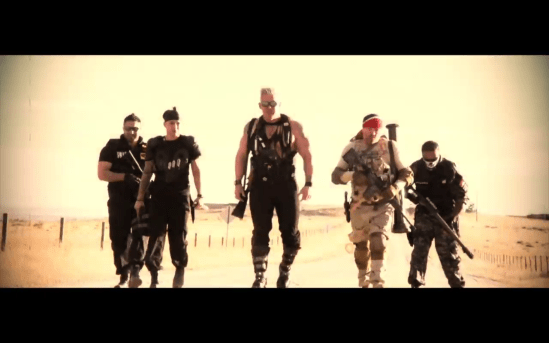
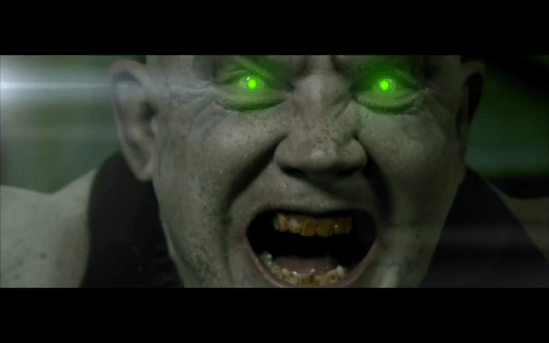
With a film about a miniature zombie Tyrannosaurus that infects people into burning-eyed and enraged zombies with a single bite, just like your typical dead head would be able to accomplish, “The Jurassic Dead” moreover has character flair gaudy with macho-isms and sarcastic tiffs lined in every scene and entrenched in a saturated dialogue and the character flair is flared by an eclectic cast, starting with professional bodybuilder Andy Haman. The 53-year-old built like a Mac truck steps into the platform combat boots of Duque, head mercenary in charge, and is notably mentioned resembling the video game pop culture stud, purposefully varied as Duque, Duke Nukem with the blonde spikey hair, shades, cigar, and muscles bulging out from a sleeveless shirt. Get this guy a seven-figure contract before he gets any older! Another noteworthy cast member and biological badass is an Ultimate Fighter Championship boxing style fighter, Raquel “Rocky” Pennington. The 30-year-old Pennington goes silent, but deadly as Cuchilla, one of the mercenaries with a liking for raising a machete to one’s manhood. Haman and Pennington already pair as formidable force, but the rest of the mercenary actors based in Colorado, where “The Jurassic Dead” is filmed, stacks more assorted attitude and brute. Big Fish Talent’s Ruselis Aumeen Perry (“Tsunambee”) masses what’s left of his team against Dr. Borge and his re-animated fossil as Stick and then, there’s Spivey, a fitting role satirically portrayed by another Tsunambee actor, Shale Le Page. Spivey’s rootin’ tootin’ good ole boy show is the cherry on top levity that tops a mound of primordial preposterousness. The Hits’ lead singer Mia Klosterman (“Battered”), Ben Johnson (“Curse of the Black Lagoon”), Cooper Elliot, Adam Singer, Mary Jo Mauro, and Juan Gonzoalez bring up the tail end of the cast.
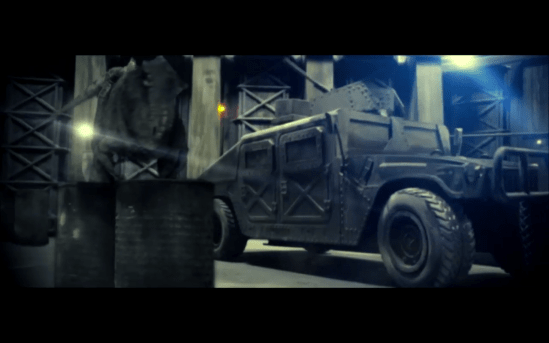
At first glance, the shoddy digital effects and disjointed storyline (like what’s up with the two prefaces about Dr. Borge’s downtrodden woes that really have no standing leading into the meat of the story) might write off “The Jurassic Dead” on surface level viewing, but look closer, beyond the 1990’s sorely stretched rotoscope and a dino who bites like a puppy dog playing with a knotted rope toy and you’ll notice a respectable layer of re-played movie magic that includes just as much practical effects than it does visual. Detailed miniature models and a man, who I believe was Cooper Elliot, donning those realistic personal T-Rex costumes used more notably when pranking unsuspecting Japanese denizens walking clueless down a vacant building hallway. Hell, even some of the black drums are miniatures constructed from food cans sprayed painted black and the military-esque Humvee is a RC doctored battle-worn. The man behind the effects, Thomas Martwick, shows that Davis and Markwick are a pair of jacks of all trades and wear many hats that define dedication to indie filmmaking culture. A quality that surpasses subjective tastes of good and bad effects or films in general.

MVDVisual and Wild Eye Releasing present another wild horror film with “The Jurassic Dead” onto a Blu-ray and DVD combo pack. The Blu-ray was the sold reviewed format which is a MPEG-4 AVC encoded BD-25 disc presented in a widescreen, 16:9 aspect ration, with a region free cherry on top code. From the view point of looking through some of the sour effects, the image quality is like looking through the murky surface level to find cleaner, bluer ocean water, but the non-green screen portions of the film are sharp and more defined. The English Dolby Digital 5.1 surround sound caters to a lossy audio mix that betrays the dialogue track, favoring a generic and boring stock soundtrack over what I think was semi-important dialogue about how events play out. Bonus features include director’s commentary, a petite behind-the-scenes featurette, a few outtakes and trailers. While saturated heavily with chintzy composites and a scare level hover around nil, the ambitious “The Jurassic Dead” still bares entertainingly sharp teeth as a fun, no frills, feast or famine action horror abundant with Dino action.

Undead DINOSAURS!!!! ROAR!

The EVIL of True Norwegian Black Metal Roots Out the Posers! “Lords of Chaos” Review!
Euronymous, an Oslo teenager hellbent on launching true Norwegian Black Metal, shapes his band Mayhem with edgy publicity stunts that invokes the calling of Satan and being an anarchist against the moral norm to make his brand renowned around the underground music world in the late 1980s. As his fame flourishes with creating ungodly music, owning and running a music store, and helming his own record label, Euronymous continues his crusade agasint the establishment, but the lines blur when his messages of hellfire become unforeseen reality. Suicide, arson, violence, and coldblooded murder push Euronymous to the limits of his own soapbox inactions, leaving him open for the possibility of being overthrown by his own acolyte metalheads.
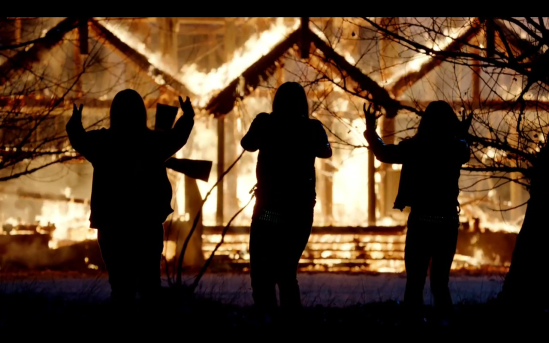
To prepare myself for Jonas Åkerlund’s biographical thriller, “Lords of Chaos,” I immersed myself into Jason Lei Howden’s 2015 black metal horror film “Deathgasm” as precursor preparation into the intense and unforgiving metal macabre genre. Whereas “Deathgasm” is a balls to the weed whacker splatter film of the pissed off demonia kind, “Lords of Chaos” is a polar horror feature with factual roots. Åkerlund’s, who directed Mads Mikkelson in Netflix’s “Polar” and has an extensive history in directing music videos for various artists, draws inspiration for the 2018 film from his own experience in a Swedish Black Metal band, Bathroy, from the late 80’s. The Grammy award winning music video director creates beauty out of the horrific true life event, unidealized nearly entirely without much speculation that faithfully puts to picture a misanthropic tragedy in a bone-chilling manner.

From “Signs” to “Scream 4,” Rory Culkin has remained on the actors-to-watch radar and is most certainly, our favorite Culkin to watch on the screen. In “Lords of Chaos,” Rory plays and narrates the story as Øystein “Euronymous” Aarseth, the guitarist and creator of Norwegian Black Metal band, Mayhem. As if written stars, Euronymous surrendered to Rory Culkin’s performance and Rory Culkin became Euronymous. The eerie synonymous blurred identities that catapults Culkin to be admired amongst his peers and his worked beloved. Opposite Culkin is Emory Cohen as Kristian ‘Varg’ Vikernes, former Mayhem bandmate and convicted murdered of Euronymous. Cohen is bitterly intense with a historical figure whose committed arson and homicide and the New York City born actor uncomplicated approach to a complicated character had a natural phenomena about that would spook your soul from your body. Culkin and Cohen fed off each other’s energy to an explosive dynamic too good to be stagecraft. Another highlight from “Lords of Chaos,” though rather story line brief, is Val Kilmer’s son, Jack Kilmer, as Per Yngve Ohlin aka Dead. Kilmer tackles a depressed introvert and, in one opinion, nails the mental deficiency metalhead who was ordained to take his own life with great savagary showmanship. The film also costars Sky Ferreira (“Green Inferno”), Valter Skarsgård, Anthony De La Torre (“Johnny Gruesome”), Jonathan Barnwell, Sam Coleman (“Leatherface”), and Lucian Charles Collier.
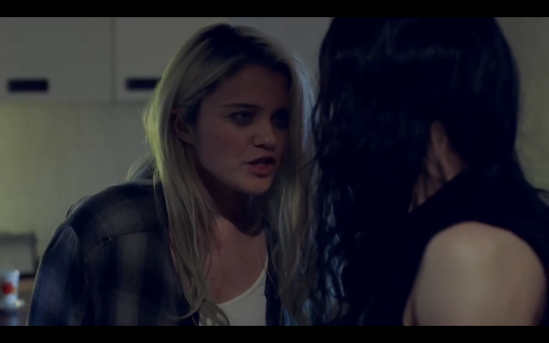
If not paying attention, “Lords of Chaos” will slip under the radar since most audiences are conditioned to subsidize shiny cinema productions that make you feel all warm and cozy inside and spark wander and induce marvel and amazement. Åkerlund’s film will not send those sorts of puppy dog tingles down your spine. Many biopic films about ill-fated tragedy don’t do well with the general population; “Auto Focus” comes to mind with Greg Kinnear and Willem Dafoe. Critics eat up the inherent black dramas like Cookie Crunch and “Lords of Chaos” exudes madness and misery through deep seeded vigor for fame and principle. Åkerlund deserves nothing but our admirable applause for delivering an unadulterated visualization of literal mayhem from soup to nuts.

Umbrella Entertainment releases onto DVD home video “Lords of Chaos,” a co-production from Gunpowder & Sky, 20th Century Fox, Vice Films, and Insurgent Media. Presented in a widescreen, 1.85:1 aspect ratio, Umbrella Entertainment’s picture quality is exemplary in it’s natural, yet supernatural-like surrealistic manner in a clean digital presentation. Pär M. Ekberg’s depiction is hard-edge elegant and haunting with recreations of and the intertwinement of actual photos of Euronymous, Varg, and Dead. If you’ve seen “Polar,” you know Åkerlund and Ekberg brush stroke a fine line between reality and graphic novel much the same as “Lords of Chaos'” allegory. The English language Dolby Digital 5.1 surround sound mix has high level attributes with clean and perceptible dialogue, a vast range of ambient noise, and a killer black metal soundtrack worth banging your head to. No bonus features accompany this title. “Lords of Chaos” is a heavy story that needed to be told and feels very much like a part of Åkerlund, an extension of himself through his past brought forward to illuminate the blackness in us all derived from the power of metal with a psycho-psychology that’s industrial-built.


Two Undisciplined Girls Do EVIL in the Netherlands! “My Nights With Susan, Sandra, Olga, & Julie” review!

After years with struggling with fame, Susan finds solace in an idyllic and solitude Netherlands’ farmhouse near the waterfront. Her peaceful lodging transforms in a youth hostel as she welcomes three refuge women – Sandra, Olga, and Julie – and one man – Albert – into her life and in exchange for a place to stay, Susan embraces the company after her entanglement with loneliness. Despite Sandra and Olga’s sex-crazed psychopathy and an unhinged Albert’s voyeuristic habits, Susan has been able to maintain an even keel quality of life. That’s until the handsome Anton shows up. His arrival stirs the nest of sexual desires and has Susan questioning her reclusive lifestyle. Anton’s presence also riles up Piet, a crazed women living in a shed on the outskirts of the farmhouse. To make matters more complex, Anton becomes mixed into a murder mystery involving a dead American. Was it the mischievous sexual delinquents Sandra and Olga? Or did the wild Piet finally snap her moral conscious?
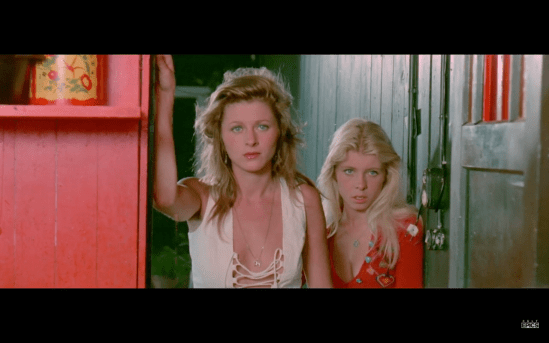
During the height of the 70’s sexual revolution, the Dutch seize the opportunity to piggyback their own free love films. Pim de la Parra’s 1978 “My Nights with Susan, Sandra, Olga, & Julie is an epitome example of the Dutch sex wave genre that shares the tantalizing groping, succulent squeezing, fornicating spooning, and …well, you get the idea. Originally titled as the longwinded My Nights with Susan, Olga, Albert, Julie, Piet, & Sandra (whew), this film is the last production of Pim de la Parra’s Scorpio Films from a script co-authored between Parra, Harry Kumel from Belgium, David Kaufman from America, Charles Gormley from Scotland, and Carel Donck from the Netherlands in a melting pot of cultural creativity. “My Nights with Susan, Sandra, Olga, & Julie” sizzles the screen with nudity in characters just walking around or riding on a child’s rocking horse stark naked that’s ostensibly organic for a story beginning with cold blooded, arbitrary murder.

Before partying the circumstantial matron of a youth hostel, Netherlands’ Willeke van Ammelrooy was Eva in “Frank & Eva,” another film by Pim de la Parra. She was also Alicia in “Blue Movie” director Wim Verstappen’s “Alicia” and also played Mira in Fons Rademakers’ “Mira.” As the evidence provides, Ammelrooy is very experienced as the leading lady role, portraying three titular characters from 1971-1974 by post-humorously acclaimed Netherland directors. Yet again, Ammelrooy plays a titular character in Susan, a country cloistered luminary seeking to be a forgotten face, but Ammelrooy steely performance of a woman pretending not to be hiding secrets is a fascinating insight into a character’s personal shielding; however, when Anton, “Wet Dreams’” Hans van der Gragt, their hot and cold dynamic creates a formidable hard love rigidity influenced by forces internal to Susan and external forces from those her immediate life at the farmhouse. Olga and Sandra have more intoxicating behaviors that run the story amok and what’s more interesting about the actresses, Franulka Heyermans and Marja de Heer, is that they’re amateur actresses according to Pim de la Parra. Cold and, yet, lively, Heyermans and Heer have mountainous ration and serve Parra genuinely. Marieke van Leeuwen, Serge-Henri Valcke, Jerry Brouer, and Nelly Frijda round out the small cast.

Pim de la Parra’s influences stem heavily from Alfred Hitchcock. The filmmaker implements voyeurism and the wrongfully accused that are essential to the Hitchcockian style. I also find it hard to believe that on the first day of shooting on Hitchcock’s birthday, August 13, that Pim de la Parra’s first scenes are that of birds on a beach. Coincidence or a little salute to the master of suspense, either way, the now retired filmmaker unifies a harrowing score with birds and a beach to not only by respects to Hitchcock, but also sets the tone of the film of an erotic thriller with blotches of dark comedy strewn in.

Cult Epics proudly releases “My Nights with Susan, Sandra, Olga, & Julie” onto a new high definition two-disc Blu-ray/DVD combo set. Presented in a widescreen, 2.35:1 aspect ratio, in a 1080p transfer from the original 35mm print, preserved by the Eye Film Institute in Amsterdam. The original print is nearly pristine with a palatable amount of stock grain and with only a minor amount of film wear. No observations of border enhancing or sharpening that would dilute the bona fide quality. The Dutch DTS-HD 2.0 Master Audio track nicely accompaniments the film with depth and range and the Dutch dialogue upfront and present and the very Hitchcock-esque soundtrack by Elisabeth Lutyens (“The Skull”) provided a perfect suspense drive score in her last composer post. Supplements includes an introduction by Pim de la Parra, poster and photo video gallery, Scorpio Films’ shorts that includes “Heart Beat Fresco,” “Joop,” and “Joop Strikes Again,” and Scorpio Films’ theatrical trailers. Cult Epic’s region 1 DVD and the all region Blu-ray release favors another Dutch sex wave cinema flavor with just modernization of an intertwinement of erotically charged lust and lives with repulsive and deadly temperaments and with Pim de la Parra at the helm, you’re going to get primo framing and angles sure to captivate.

Purchase by Clicking the Blu-ray Cover!


