When The Waters Rush In, It’s the EVIL in Your Head That’ll Kill You. “Relentless” reviewed! (Terror Films / Digital Screener)

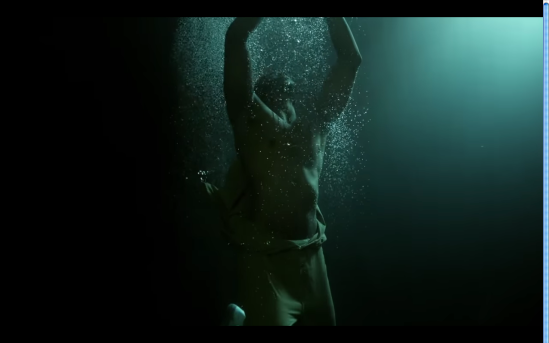
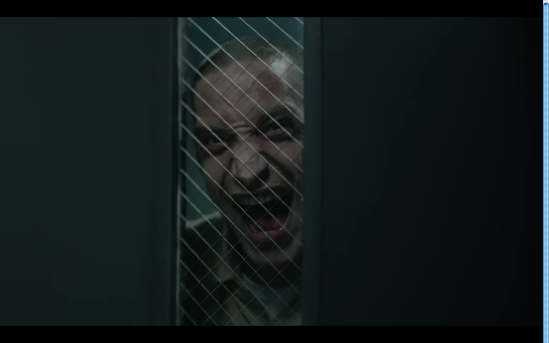
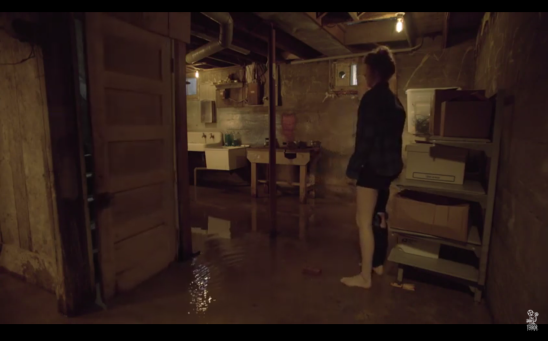
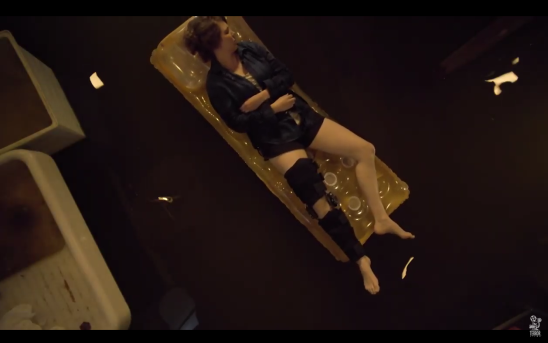
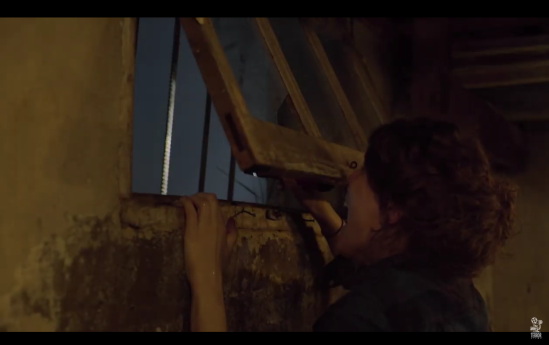
Jennifer Benson’s life is a storybook fairytale that’s embraced by her close sister, exalted by a sweet, kind husband, and excited with the news of an upcoming baby. Yet, all good things come to an end and in Jennifer’s case, in a devastating tragedy when everything and everyone she held close to her heart is unexpectedly wiped away within a single year. Physically injured and suffering from depression, Jennifer withdraws from family and friends inside an empty house, sinking lower into despondency, and letting bills and the house upkeep slip through the seemingly insignificant cracks. Jennifer eventually decides climb up a little out of her rut by cleaning up and letting go of some sentimental materials that leave painful memories by storing them in the unfinished basement, but when the basement door jams and won’t open, Jennifer finds herself trapped in a subterranean state with a large thunderstorm dumping rain that’s seeping from the basement walls, plumbing, and the ground. As the torrential rain continues to fall, the water level continues to rise with no way out.

Get ready to hold your breath in Barry Andersson’s agog of metaphorical poignant survival, “Relentless.” The filling of the fish tank mender is the director’s first and only release of 2020, following his 2019 releases of the historical drama, “The Lumber Baron,” and a 1940’s set sleep deficient thriller, “The Soviet Sleep Experiment.” Andersson continues to tell stories of intricately varied human responses as the filmmaker pens “Relentless” surrounded by themes of reactionary and recovery paths toward death with the film echoing more so with Andersson’s introductory “The Lumbar Baron” on a much smaller scale in terms of cast and setting. The story is set in or near Minnesota, a Midwest state prone to some of the United States worst flash flooding hit areas, and Andersson crafts his creative juices with that in mind to mold a symbolic cognitive descension stemmed by escapism inside creature comforts. Deodand Entertainment and Andersson’s filmic workshop company, Mogo Media, designate as the production companies.

“Relentless” indurates around being a one woman show with Rachel Weber spearheading the subject of crippled and downcast Jennifer Benson. Weber, whose worked briefly with Barry Andersson in “The Soviet Sleep Experiment,” has to operate Jennifer animatedly in a near voiceless, tacit role to simulate one alone with their thoughts and emotions. Only flashbacks limn with dialogue present the state of Jennifer’s woebegone mind as she goes from despair to reluctant acceptance by reopening the wound of concealed painful memories. Weber fulfills every inch of empty space with a tinge sorrow in some way, shape, or form but doesn’t quite convey the impact well enough to fortitude a presence. Weber’s post-flashback expressions deflect the corpus theme with no real tell of how Jennifer actually feels as she stands over a box full of memorabilia of what should be inducing whether a pensive sadness or vitalizing inspiration as she goes through an unbalanced reel of memories that include bedroom book snuggles with her sister at young age or survival life lessons with her father to up at the moment of what was supposed to be a joyous baby shower occasion that turns unexpectedly into tragic point in her life. Though the story acutely restricts the camera on Weber, the unfolding flashbacks ultimately tell the story from the past that includes stint performances from Charles Hubbell (“The Bitch That Cried Wolf”), Anna Hickey, Bea Hannahan, and Presley Grams.

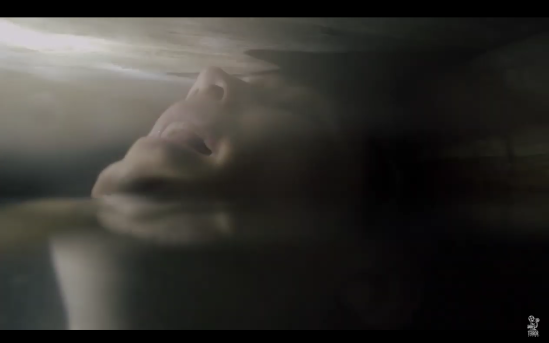
“Relentless” has thought-provoking messages splayed up, down, and all around it’s encased four-walled theme of, literally, drowning in your own self pity and digging yourself out of a hole of depression. The water that gushes into the air tight unfinished basement represents the rising fathoms of depression that initially trickle in harmlessly enough, but the longer the despair drips go unchecked, as noted when Jennifer reaches out to nobody up on the top floors of her house and would rather recap wedding photos in the first act, the more intense the cascades can become when your submerged in from head to toe. Along Jennifer’s rather stagnant perilous journey, sitting on top of work benches as a hapless invalid and rummaging through miscellaneous items, she opens and goes through various storage boxes of her past that she carefully tries to keep dry by continuously moving the boxes out from the low-lying waters. Each box evokes a single memory from her past fashioned in an unchronological order and stews in a melting pot of stirred emotions that work backwards from melancholy to hope to, eventually, in my opinion, an inescapable suicide. My subjective take on Barry Andersson’s open-ended culmination is purely speculative as Jennifer’s struggles for survival may all be for naught, even in the evidence of the character leaving behind a note for storm survivors, or whomever, to collect staggering into what could be Jennifer’s tomb strongly suggests that particular path. That’s what admirable about intense thrillers, such as “Relentless,” that teases an unwritten coda for those to survive and tell the rest of the story, woven with their own personal singularities, but Andersson’s film, heavy in metaphors, lacks spirited vitality in a somber stroll through what’s innately a human fear: death.

Basements continue to retain their bad rap in the traditional horror sense as well as in Terror Films’ release of Barry Andersson’s survive-or-die succumbing to mopery in “Relentless,” distributed digitally across multiple platforms. Rigorous self preservation might be watered down, but the stagecraft and production design is top shelf quality with a simple set of a well dressed dank and bare basement where streams of water rush into from the barred awning windows and waterlogged plumbing. The basement in itself is a character of misfortune, a cell of rehabilitation, and is just simply effective in a cinematic sense without seeming overly menacingly but rather like every other basement in the world. With the digital screener, there were no bonus material included nor any bonus scenes during or after the credits. Don’t expect a nonstop nail-biter that aims to fill your lungs with asphyxia inhaled water; instead, sympathy or empathy will play significantly in “Relentless'” success with an aggregating flurry of thoughts generator in a post-traumatic vicissitude.

“Relentless” included with Prime Video and available for purchase!

This EVIL Santa is Ho, Ho, Horrible. “Slayed” reviewed! (Terror Films / Digital Screener)

Five years after a murderous, Santa Claus-cladded maniac massacred a couple of young women in the dank basement of a water treatment plant in Harris County, AZ, the stigma of the plant being open has caused enough controversy, heartache, and notoriety for the local residents and will soon close the chained-link gate forever to soon transform into a car dealership. On the last day of operation, Christmas Eve night, the lone survivor of that night five years ago walks vigilantly around the perimeter with a tingled sense that something just isn’t right as he stashes weapons around the facility…just in case. With the last administrative staff gone for the night and a novice guard at the helm of watch, not a creature was stirring, not even a mouse, until there arose such a clatter and who did the guard and the survivor find? It was the return of Jolly Old Saint Nick with an axe to grind.

Merry Christmas, readers! You can’t spread Christmas fear without watching at least one, count them one, homicidal Holidays flick starring our favorite Yuletide strangler, Santa Claus. This year, the Fatman reins down upon a few unfortunate recipients on his coal gifting list in Jim Klock and Mike Capozzi’s “Slayed” that was released digitally this last month of 2020. The script is penned by Jim Klock following another Klock and Capozzi collaboration, the 2019 released Devil trickery detective-thriller, “Red Letters,” that has the unconventional atmospherics of a Christmas themed slasher set in the fictional location of Harris County, Arizona even though the climate of Arizona is semiarid and “Slayed” appears to be taking place in a lush, semi-tropic climate that’s perhaps more in tune with a Floridian winter. However, production company, Jim Klock and Darrell Martinelli”s Code 3 Films, is based out of New Jersey with offices in Los Angeles, suggesting a summer shoot with the cut off shorts, short sleeves t-shirts, and the wicking sporty running attire being worn amongst the limited primary characters.

Klock not only directs, writes, and produces the serial killer Santa but also co-stars as a new-to-the-area, aspiring actor standing in for a regular security guard. Klock enacts a classic clueless constitution for a baffled and bumbling outsider caught in the middle of historical notoriety having returned from the grave. Standing side-by-side and opposite is co-director, Mike Capozzi, who institutes a doomsday prepper’s fantasy come to fruition as the lone survivor of the 5-year bygone Harris County water plant massacre. The role of a water plant operator turned lone wolf of misanthropy never truly fleshes out of a state of rigid inflexible measures that stagnant the character’s mysterious backstory of surviving Santa’s bloody red-handed carnage and extend his development into an explanation of his long-awaited revenge obsession. Klock and Capozzi only bookend the film being in the same scene together, leaving much of the midsection, essentially the second act, for distressing females as hunting game for Santa’s slay. Coel Mahal and Kyra Kennedy, who have previously worked with Klock and Capozzi on previous projects, adequately fill in those rolls to an extent. Mahal’s masculine bity, water plant administrator acutely shifts into trope slasher-fodder of hapless articles of loosely bound prey. Things worsen with Kyra Kennedy’s rando abductee with an uncontrollably irritating sniveling in unprompted immediate danger as she sits in the passenger seat of a truck and just inconsolably cries, cries, and cries. Luckily, “Slayed” is a indie-reined in production that doesn’t swarm with halfhearted and ill-deserving characters as the film rounds out with minor roles casted to Delton Goodrum, Chuck Roberts, and Jennifer Meakin and Crystal Cameron as half-naked, strung up torture toys for a deranged Kris Kringle.

In a peeve already mentioned, “Slayed” rarely invokes as a Christmas chronicled horror film, striking lukewarm resemblances to that of “Silent Night, Deadly Night” or “Christmas Evil,” to which those films set a very low bar to emulated, unless you’re a trash-loving, so-bad-it’s-good, cult film enthusiastic, like yours truly, than its nothing but top shelf quality. However, the unexplained warm weather upholstery cripples “Slayed’s” genre-blend construct that’s been in august status of next level output over the last few years to dispel the happiest time of year into a certifiable time of fear in an apparent hostile seasonal takeover in a return of spite that Halloween shortens every year with Christmas nipping at the heels as soon as the first brown leaf hits the ground. If the shooting location is truly set in Arizona, winter months typically hover around a light jacket and shorts 60 degrees during the day and nippy 40 degrees at night, but the sweaty, wintery deficient clothing worn suggests a sweltering otherwise. Klock and Capozzi’s good faith effort into “Slayed’s” festive fare is in the garish Holiday decorations and ornamental lighting production design denotes the showy display of Christmas spirit, held in which season is not exactly clear. To speak more on the lighting, Emily Adam, another patron believer of Klock’s work, uses a restrained soft fuchsia lens tint, among other vivid primary colors, to elevate the seasonal veneer and Adam’s lighting is especially a favorable hallmark of the season with the use of the soft, but brilliant glow of Christmas string bulbs utilized to lash and tie up up naughty listers. Yet, up to scratch cinematography can’t fix what’s inherently broken with a story penned as a sequel structure that assumes the audiences’ knowledge of past events when, in fact, leaves viewers in blackout darkness with many questions: Why the Harris County water plant? Where did maniacal Santa go for five years? How did the water plant survivor make it out alive and is now determined to end not only maniacal Santa’s life but also his own? Why did maniacal Santa kidnap this random young lady from her house? What’s the significance of Christmas for maniacal Santa and why this period in time to return? I enjoy Christmas horror as much as the next genre votary but wrapping your head around “Slayed” topples any chance of actually enjoying the disgruntled, menacingly muttering “Ho Ho Ho” catch-phrasing, maniacal Santa terrorizing an unjolly skeleton crew on Christmas Eve night.

Ho Ho Horror! Santa delivers the gift of sufferable tidings and killjoys in the Terror Films distributed “Slayed” digitally only onto Prime Video. If you didn’t catch “Slayed” before Christmas when released on December 18th, then no worries! Quickly nosedive into your laptop or television set and catch Santa axing away on Prime Video today! An interesting tidbit about the crew of “Slayed” comes from the music department with composer Jojo Draven, former guitarists for a number of Las Vegas shows such as performance artists, the Blue Man Group, and Gothic street illusionist, Chris Angel. The Indonesian-American female rocker’s agreeable experimental-industrial sound comes across professionally astute toward the context with unbuckling tension baked right into the scene. There were no bonus material included with the screener nor where there bonus scenes during or after the credits. Instead of racing down the stairs, excited by the prospect of unwrapping that one main horror-inspired Christmas movie on Christmas Day, “Slayed” turns out to be a disappointing hefty lump of coal with a few diamond patches sparkling through the sedimentary rock and catching our eye in a rather humbug holiday horror falling short of that so-bad-its-good set bar.

Watch “Slayed” on Prime Video by clicking the poster!

EVIL Circulates All Decks of the “Blood Vessel” reviewed! (Blu-ray / Umbrella Entertainment)

As the second World War nears conclusion, the Atlantic infestation of German U-boats are ordered to sink and destroy any and all allied ships, including the vulnerable hospital ships.  The survivors of a torpedoed hospital vessel has been adrift for days, if not weeks, on an inflatable raft running on fumes with food and drinkable water.  All seems hopeless until a ship, hoisting the Nazi flag, cuts through the thick fog, providing life sustaining optimism even if in the hands of the merciless Germans, but when they board the ship, the motley of allied survivors discover the vessel has seemingly been abandoned yet none of the deliberately sabotaged lifeboats are missing and the bridge helm is tamper-proofed into place.  The discovery of mutilated German sailors send an ominous threat down their spines that the rescue ship holds a terrible secret, a Nazi occult secret isolated to run rampant within and on the decks of a ship heading for populated land. 

Set sail with the best Nazi-themed horror from the last decade aboard the “Blood Vessel,” a densely packed, 80’s stimulated, Nosferatu-inspired thriller with an ensemble cast of character who not only have to survive the Axis enemy and the horrors of war, but also a terrifying night on a deadly ghost ship run amok with a family a starving, ancient vampires.  The ambitious sophomore feature from writer-director Justin Dix (“Crawlspace”) is an all ahead full, exceptional terror-vision on the high seas surrounding the Nazi’s obsession with titling the war into their favor with utilizing the occult.  The Australian produced film is co-written alongside Jordan Prosser in his first feature length film credit and shot in Williamstown, Melbourne, Victoria on an actual, fully restored, World War II Bathurst Class corvette, the HMS Castlemaine.  Adding hands-on molds and prosthetics to his own work, Dix is also a special effects stud, credited on a pair of “Star Wars” film as well as his work on “The Babadook,” who applies his own effects and production company, Wicked of Oz Studios (“100 Bloody Acres”), to coproduce next to Storm Vision Entertainment (“Better Watch Out”) to bang out a diligently-detailed horror from down under. 

Dix and Prosser channel a passion for bygone horror through the decades with an ensemble cast representing a sundry of Allied nationalities as survivors of a U-boat attack.  A pair of American cooks, played by Christopher Kirby, returning to the authoritarian centric and eccentric genre from his lead role in 2012’s “Iron Sky,” and Mark Diaco (“Vessel”), an Australian swinging for the fences with an Italian-Americano New Yorker, and their Captain, “Meg’s” Robert Taylor, bookend the amalgamated survivors with their military ranks, but it’s the two cooks who have a more intriguing bubble dynamic bred from molded disparity of a time period of American segregation with Kirby as a black man secondary to Diaco’s character on their former ship’s galley but when aboard the Nazi cruiser, the social and Naval hierarchy crumbles under the pressures of survival, buoying them toward a boiling point of who still commands who.  Two British nationals, a hospital ship’s nurse and a communications codebreaker, anchor down the group with courage and cowardice.  Alyssa Sutherland (“The Mist” television series) is the nurse cherub of reason, unafraid to face challenges head on with a passion to heal the wounded, while desk jockey codebreaker from John Lloyd Fillingham will do anything in his sniveling turncoat powers to survive at the expense of his fellow stranded.   The lone Australian soldier actually played by an Australian, Nathan Phillips (“Snakes on a Plane,” “Wolf Creek”), whittles down into being a co-principle character alongside a wounded and disparaged Russia soldier played by Alex Cooke.  Cooke does a fine job keeping the Russian sharpshooter’s communism sheathed being a soldier who has seen more than his fair share of combat and torture while paralleling his closed off humanity with anecdotal melancholia about losing his family to the Germans.  Ruby Isobel Hall, Vivienne Perry, and Troy Larkin round out the cast by putting the “blood” in “Blood Vessel” as a dynasty of archaic and supernatural vampires hangry upon awakening.

“Blood Vessel” might seem like another pun-driven Naziploitation that might be brimming with crassly barked Heil Hitlers and preach about the cleansing of the master race while skating out on pinpointing historical accuracies, such as the warship corvette being nowhere near the layout of German naval engineering, but don’t be hoodwinked by the knockoff Swastikas as Justin Dix steers “Blood vessel” far from being another, run-of-the-mill Naziploitation once-over. Instead, there are no Nazis. Well, there’s only one frantic and alarmed Nazi whose only on screen for maybe couple minutes before being a stepping stone, focusing on the nonexclusive group of harried and battered survivors’ stories that dabble into backgrounds of each chucked to the Davy Jones’ Locker soul. Speaking about emerging out of the depths of the blackness, the Wicked of Oz Studios’ work on the look of the Patriarch and Matriarch vampires pays a tremendous homage to the likes of Nosferatu with the oversized ears, elongated frontal fangs, and glowing eyes. The overall package, with Troy Larkin and Vivienne Perry underneath all that latex pale skin, is more bat-esque and is unapologetic in doing so as actor and mold become one with Larkin’s heavy weight performance commanding the Patriarch’s Dark Ages semblance. We should also give a big shout out to the youngest actress, Ruby Isobel Hall, who was able to learn and speak Romanian, along with Larkin, to fulfill a sense of fiendish family vernacular. Story comes first as “Blood Vessel’s” vehicle to separate itself from the fascist film pack, building up mysterious circumstances surrounding a ghoulishly-splayed ship that will float into our nightmares.

“Blood Vessel” is the best thing to happen to b-side horror in awhile and it didn’t have to a gaudy, cult-stroked, once-in-a-lifetime, white whale tale that solidified a place in genre fandom history before it’s conception and, now, “Blood Vessel” has pulled into port on a region B Blu-ray home video courtesy of Umbrella Entertainment. The full high-definition, 1080p presentation is exhibited in a widescreen, 2.35:1 aspect ratio, of Martin Gubbins dark and grubby cinematography and I mean as the sincerest compliment. Gubbins showcases ship cramped quarters without feeling claustrophobic and can make models seem genuinely bona fide and seamless with simplistic effort, adding a scary pretense that isn’t obviously unknown to cinema, but must be a crime for being this good. The English 5.1 DTS-HD Master Audio earshot illuminates every clank, clunk, and uninflected hum of a steel, diesel vessel dredging through the waves. Dialogue is not as robust as hoped, losing a bit sharpness through the thick range of ambient sound. Special features include an audio commentary from Justin Dix and cast as well as Dix and editor Dave Redman, “Blood Vessel” production diary, an extensive and thorough making of featurette that dives in the genesis and entire stretch of “Blood Vessel’s” journey, an interview with Troy Larkin as the Patriarch vampire, the Nazi newsreel that almost wasn’t a part of the narrative, a visual effects breakdown reel, animated shorts from John Lloyd Fillingham to boost moral, online promos, and theatrical trailer. Sink your teeth into “Blood Vessel’s” arteries and imbibe the metallic taste of a warm novelty vampire bracer.

Hurry! Only 10 left in stock of “Blood Vessel” on Umbrella Blu-ray at Amazon.com U.S.

EVIL Drugs Are Bad, Mmkay? “Beyond Hell” reviewed (Indican Pictures / Digital Screener)


A lowkey party experiments into a new drug called Changa, brought back from South America by one the friends but is no ordinary narcotic. After inhaled, Changa opens a conduit to an infernal dimension oppressively reigned by Belial, a trickster demon seeking to rule the world of man. Channeling his dark energy through the utterly wholesome Maryssa, Belial exploits her innocence to reach her friends and one-by-one their hallucinogenic and horrible deaths give way to releasing their souls to him. Once he obtains enough souls, Belial will be able to freely walk the Earth and damn everyone on the planet into servitude. Its up to Maryssa and her remaining friends to thwart Belial diabolical plans and send him back to Hell.

Is seeing disembodied, outreaching arms and shape-shifting demons covered in broken glass and tentacles to the effect of a gateway drug!? The invasively surreal and drug repercussion-themed “Beyond Hell” is the 2019, pre-apocalyptic. doom and damnation, survival thriller from writer-director Alan Murray in his first feature film production. The Cambridge, Ontario born filmmaker shoots in his home country to entertain and scare audiences with a version of religious text’s prime opposition to God, the Devil, in the form of the heavily prosthetic and dastardly theatrical Belial. “Beyond Hell” is a co-produced by Murray alongside Gavin Downes under the Dark Spirits Films banner with Don Smith, Jacqui Smith, and Christopher Lane serving as the film’s capital investments of executive producers.

“Beyond Hell” plays considerably into the slasher blueprint that aims to off, one-by-one, inept school students, whether they’re the self-stated part of the college body or, in a slight of confusion, sit in on classes and have row lockers like high schoolers, who stumble with defensives against a much darker scheme of soul extracting exploitation and world domination. Murray takes a full-on female primacy with strong heroine-performances by introducing Kearston Johansson and Natalie Jane to set aside their characters’ at-odds, find security in their flaws, and battle it out against an ancient evil. The respective roles in the goody two-shoes Maryssa and wildly eye-cutting Brook’s backgrounds are kept in a palpable line by Johansson and Jane’s drive to roleplay one-upping the other despite a petite background for character support and they’re anchored by Sebastian Deery (“Bad Dose”). The UK-born Deery plays the pursued rake, Jake, in a triangular love interest with Johansson and Jane’s characters. While Deery seemingly attempts to rein back his English accent without much success through his satisfactory presence as a level-headed, good-lookin’ guy, Jake’s acutely transforms into a wily coquet by initially buttering up Maryssa with good intentions and verbally loathe Brook for her derogatory attitude toward Maryssa only to then switch quickly to desiring a distraught Brook when Maryssa winds up in a mental institute for the criminally insane after the gruesome death of one of their friends. The off-putting dynamic pens a promiscuous casualness about these group of friends. Dominique Smith, Sean Rey, Chris Kapeleris, Shahrad Fredotti, Richard Collier, and Gavin Downes as the profaner Belial.

“Beyond Hell” conjures a sassy-mouth, wise-cracking demon, Belial, adorned in a black and white molten-rock shape skin with curved horns and rows of beaded sharp teeth, but the makeup effects, though strong in prosthetic effort, appear extremely rubbery to the point that even Belial’s teeth bend and flap when Gavin Downes tosses out sarcastic quips when ripping the souls from his victims.  This awkward stance of where our eyes and brains struggle to compute what make sense from the worst-of-the-worst of hell bound fiends is where “Beyond Hell” becomes forehead-rubbing frustrating because of how much time and application goes into the overall look of the creature that, in the end, just dips into disbelief.   The gory, but crude practical effects trend into the visual effects territory, going beyond the gates of hell to where Belial himself would be frightened by the sheer shock of shoddiness.  In one frantic scene where Brook attempts to escape Belial’s brimstone breath, decrepit arms breach a stairwell wall to grab her, but the arms, which are all of the same cut and move in the same motion, float like ghosts without ever puncturing through the drywall, or even breaking through that plane of narrative reality for that matter, that’s reminiscent of the horrendous flock of CGI birds, hovering autonomously as survivors try to whack at them in an awful reaction in James Nguyen’s “Birdemic:  Shock and Terror.”  Now, I’m not saying that “Beyond Hell” is as rough as intangible birdies behaving badly as Murray avails in manufacturing a stable low-spirited atmosphere of plague youth in between the real world and the underworld with their innocent lives hanging in the balance in a sordid enterprise off ill-will.

More laic than spiritual, “Beyond Hell” scratches the surface of narrative depth in a modest clash of “Hellraiser” meets “A Nightmare on Elm Street” from the celluloid plunging distributor, Indican Pictures. The 89 minute supernatural thriller has entered the digital platform realm, at least in the U.S., this December. “Beyond Hell” is Rhys Jones’ first director of photography venture filmed in 5K Raw on a RED Dragon that’s uninhibited in the illuminating details. While the shots are mostly natural, clearly capturing the pimples on the young actress’ foreheads, Belial is always casted in a semi-harsh blue tint to hide any part of the latex inflections and imperfections that might expose Downes even more as a man in a monochromic rubber suit. Dan Eisen and Norman Orenstein (“Diary of the Dead”) team-up to compose a single note and pennywise synth blended score that plays into a cleaved pop-glazing and survival horror video game and, can at times, be on the precipice of one of John Carpenter’s Lost Themes without evoking a soul-binding tension. Though the depth isn’t spectacularly precise and the dialogue disperses with echo at times, the range of audible effects is vast in echoing the unsettling cacophonies of a shrilling Hell, making the feature’s soundtrack and score a highlight in the rest of the mediocre quality. I applaud “Beyond Hell’s” ambitious, no holds barred concept, but the indie picture malnourishes a healthy dose of unconfined horror with bastardized acting and a haphazard flank of effects that make this Alan Murray film so bad it’s good to the very cringed tone ending.


Click Banner to Rent or Own “Beyond Hell” on Prime Video!

This Dinner Party Dishes the EVIL! “Happy Times” reviewed! (Artsploitation Films / Digital Screener)

A small, but affluent, Los Angeles Jewish community dine together at a Hollywood mansion in celebration of the Shabbat.  Mixed feelings about each other compounded with mixed drinks stir the emotions of heated topics, including business ventures, religious attitudes, social statuses, marital qualms, and hidden desires.  Lines are being drawn and sides are being taken when one thing leads to another and undisclosed secrets become evident in a clash of suburban violence that pits friend versus friend, colleague versus colleague, and husband versus wife to the death. 

Director Michael Mayer reminds us that you should never mix business with pleasure with a keep your friends close, but your enemies closer black comedy entitled “Happy Times.”  The brawl of survival centered around Israel immigrants living in the U.S. is the second written and directed film from Mayer, following polar oppositely against another Israel themed, 2012 picture, “Out in the Dark,” a gay drama in the backdrop of the two rival and patriarchal sides of the Israeli-Palestinian conflict.  The only conflict in this 2019 thriller-com is of the gravely plentiful and concentrated kind inside a L.A. mansion turned battle arena that sees about as much confrontation as the war-torn Gaza strip.  Co-written with Guy Ayal, “Happy Times” is a collaboration produced by Erri De Luca and Paola Porrini Bisson of OH!PEN and, the Israeli born, Gabrielle and Tomer Almagor’s Urban Tales Productions in association with Michael Mayer’s own company, M7200 Productions.

The Israel-nationality cast can be an immersive experience and a sign of good faith casting from the filmmakers as well as a show of open diversity from the production studios that casting Hebrew speaking, Israel background actors implies a serious interest and respect embroidered into the project. Mayer, born in Haifa, Israel himself, is a breath of a fresh air of non-appropriation in a time where whitewashing can still be prevalent in the movie industry. Israel born actresses Shani Atias, Liraz Chamami, and Iris Bahr command the screen not only as Israeli women in lead roles, but as different personas that interact and keep lively the one night, single dinner party narrative. Chamani especially dazzles in the details as the dinner hosting socialite wife and mother, Sigal, who exacts an assertive Jewish woman with a cooped up attitude and a knack for handling her own while also worried about her social status, an extravagant exhibition of a screen trope that you might experience on shows like “The Marvelous Ms. Maisel” or movies like “The Slums of Beverly Hills,” enacted on point when she’s handing a frightened dinner guest, outside their Jewish circle and fleeing from the scene, tin foil wrapped leftovers with a wide menacingly unsure smile, while holding a medieval crossbow to go frag another party guest, in the plain view driveway. The wives’ counterparts are equally as Jewish and equally as prominent in the fold of the affair with Ido Mor as a unscrupulous businessman co-hosting the dinner, Guy Adler as a construction manager with money problems, and Alon Pdut as an unhappily married Ph.D engineer bothered by his fellow dinner guests’ lack of education and tact. In all, most of the characters are undilutedly snobbish with the exception of Sigal’s struggling actor cousin, Michael, played by Michael Aloni, whose magnified Hollywood liberalism deconstructs the Hebrew bible as racist and inaccurate among other colorful adjectives and becomes the catalyst that begins all hell breaking loose. Stéfi Celma, Mike Burstyn, Daniel Lavid, and Sophie Santi become the filament around the principle leads that strengthen the kill or be killed melee in “Happy Times.”

As if dinner parties weren’t already stressful enough, having to make trivial small talk, possibly acquaint or re-acquaint with unaccustomed faces, or pretend to enjoy the slop being served as food, “Happy Times” turns the internally exasperating dinner party debacle on its head with guests and hosts who are just too terribly comfortable with each other as volatile personalities explode like little active volcanos plumed to reach every corner of the house in a deadly playground for unstable, on-edge adults spewing their strident emotions and Mayer is able to maintain a layered pace with a narrative that’s snowballing quickly.  Where “Happy Times” struggles is the redline occurrences that trigger things to go very badly.  Though hardly trivial episodes between the guests, involving innocent infidelity affections or a slight practical joke stretched beyond devastating consequences, the harried moments afterwards diverge into a blown out result while more nefarious consequential revelations are held back, in after the fact chaos, and these differently graded spurs seem unbalanced, if not flip-flopped, in the story.  The characters themselves adequately course into being delightfully insane and as about as relatable as the internal frustration against our friendly-façade enemies, but there’s a part of me that personally wanted more development.  Military vet Avner, for example, exhibits symptoms of post-traumatic stress disorder (PTSD) as the horror sounds of war play in his head when under stress.  As he stares into oblivion when the rage fills into his face, especially by a nagging, browbeating wife who doesn’t seem to be aware of his condition, the subconscious killing-machine overcomes the mild-manner tech engineer.  There’s also Yossi’s opaque tax evasion scheme, Michael’s thespian struggles, and Mati, the late arriving Rabbi, who pockets money on the side from Yossi and Sigal that factor into an erratic equation that’s a mind field surprise every step of the way.

“Happy Times” relishes in unpredictable violence as a round table of feast or famine hatred in this dog-eat-dog thriller coming to you from the Philadelphia based distributor, Artsploitation Films. Slated for a February 9th, 2021 release, the unrated film will be presented in a widescreen, 2.39:1 aspect ratio, in a gorgeously rich color of a modest, natural color scheme. Kazakhstani cinematographer, Ziv Berkovich, distills a solid, yet uninspiring, photography of mostly still cam mixed with subtle steady cam, rooting firmly to particular rooms without capturing the flow of a big mansion, reducing much of the in clover luxuries of the hosts. The Hebrew, English and some Spanish 5.1 Dolby Digital mix offers well balanced layers of audio tracks with dialogue clarity and establishing good range with depth not really set up because of the close up or medium shot frames. Guy Aya;’s score offers a good blend of a violin-screeching from a murder mystery dinner theater with the inklings of traditional Israel folk sprinkled in to create an anxiety riddled brew of trouble. There were no bonus material included with the digital screener nor were there any bonus scenes during or after the credits. The best of times and the worst of times doesn’t compare to the bloodletting of “Happy Times” in a wildly amusing dark comedy with every impulsive-driven and tension-wrought scene chockfull with bated breath.

Pre-order “Happy Times” on DVD or Blu-ray at Amazom.com (Click the poster)