In a Remote Australian Town, EVIL Can Hear You Scream. “The Dustwalker” reviewed! (Umbrella Entertainment / DVD)

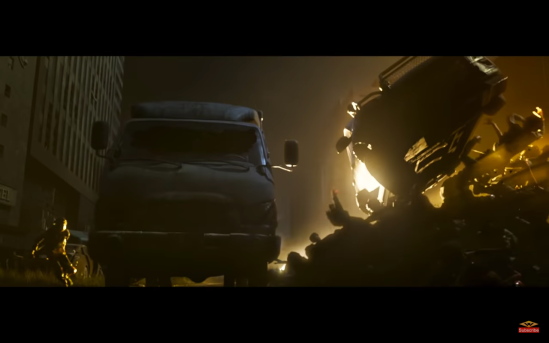
A quaint, outback town become the epicenter of a mysterious, otherworldly contagion that infects lifeforms to become mindless carriers, targeting loved ones for senseless, uncontrollable violence.  In her last days as sheriff of the town she grew up in before moving to the big city, Jolene must piece together the puzzle of last night’s mysterious meteor that crashed on the outskirts of town having an correlating connection between the town’s sudden communications blackout and the unknown epidemic that has physically and mentally transformed the townsfolk into a vicious, violent horde.   Jolene bands together the remaining survivors when the town is overrun by the zombie-like residents and tries to organize an escape, but a large dust storm walls them in not letting them flee to safety, while a large subterranean creature burrows through the dusty landscape intent on searching for the infected.

Sandra Sciberras’ “The Dustwalker” brings big universe problems to small town Australia as an alien tainted corruption courses violence through the veins of secluded outback locals with a humungous extraterrestrial on a raging prowl.  Shot in the shire of Cue, Western Australia, Sciberras’ written-and-directed Sci-Fi terror cataclysm of zombies and monstrous creature showcases some of Cue’s unique historical and architectural buildings and natural landscapes landmarked around the microscopic population of a few hundred people of the dust bowl region, creating a isolating apprehension of endless nothingness when hell breaks loose on Earth.  “The Dustwalker” is the first thrilling genre film outside the drama and comedy context for the director, creating new challenges for the seasoned director to incorporate monsters and mayhem into the fold, while also serving as co-producer, alongside Megan Wynn and Grace Luminato, in this female steered production under Sciberras and Luminato’s Three Feet of Film banner and financed by a conglomerate of Head Gear Films, Kreo Films, Metrol Technology, and SunJive Studios.

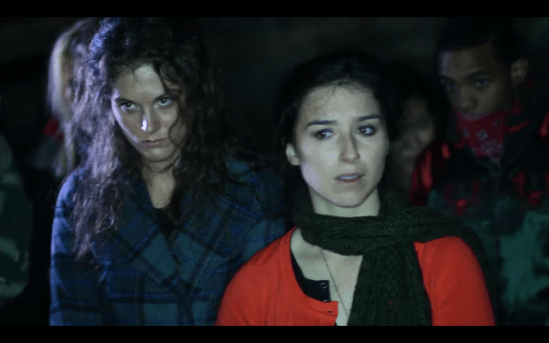
With a strong female contingent behind the camera, there is also one in front of the camera beginning with Jolene Anderson (“Prey”) as longstanding Sheriff Joanna Sharp who’s ready to leave her hometown in the dust, but before disembarking on her new big city adventure, the municipal officer has a showdown with a plague not of this Earth.  Anderson is sided by “The Hunger Games’” Stef Dawson and “Wolf Creek’s” Cassandra Magrath, playing the roles of little sister, Samantha, and the local geologist, Angela, respectively.  Aside from the sheriff rounding up an uninfected posse to arm and fight their neighbors plagued by an insidious infection, Samantha and Angela rarely contribute to the cause with their subtle character terms.  Samantha cowers mostly behind her big sister’s shield and gun, never adding substance to the sibling dynamic, sidelining Dawson’s confident performance.  Subjecting Samantha’s young son, Joanna’s nephew, into harm’s way would have affably weaved an obligatory edge-of-the-seat motivation toward family tension and desperation into the story that’s very honed in on a small town framework.   On the opposite side, Angela runs wild around town and is continuously depended upon by the story to be the scientific expert, though displays very little scientific knowledge, who discovers the crash site crater in solid rock and is willing risktaker with experimenting driving into the dust storm wall.  Despite her character’s poor introduction and setup who literally appears out of nowhere, Magrath’s outlier enthusiasm forces her character more into the narrative than otherwise innately.   The poorly written Samantha and Angela character are completely overshadowed by Joanna’s second in command, and the town’s only other cop, Luke, played with a righteously thin long mustache and scruffy mullet on Richard Davies.  Davies entrenches a consistency that’s present throughout “The Dustwalker’s” fluid scenario as the causal, yet dedicated, man of the law that compliment’s Anderson’s butt out the door Sheriff who has to stick around a few hours more to see the disturbance come to a head.  A miscellany of townsfolk partition side stories for the sheriff to investigate, involving a portion of the film’s remaining cast with Talina Naviede, Harry Greenwood, Ben Mortley, Ryan Allen, and Oscar Harris.

I have a very big problem with Sciberra’s “The Dustwalker.”  A problem that is approx. 16 years the film’s senior and has invaded a portion in my brain that is already occupied, trying to evict the current and rightful tenant that has paid, in full, dues of being the blend of sci-fi and horror I want domiciling my mental vacancy.  “The Dustwalker” follows nearly an identical story path as the 2003, Michael and Peter Spierig film, “Undead,” that follows a small Australian town under siege by a meteorite brought plague that turns residents into flesh eating zombies with something more obscure transpiring around them.  Sounds familiar, right?  If not, scroll up to the top and re-read the synopsis for “The Dustwalker” once again.  Now, I won’t slip spoilers into this review to explain exactly how “Undead” and “The Dustwalker” are undoubtedly two peas from the same pod, but minor tweaks here and there issue obvious differences in names, places, and villainous traits, but the rudimentary bone structure mirrors strongly “Undead” so conspicuously that “The Dustwalker,” after some contemplative comparisons, leaves a sour taste.  As for the film itself, the first 20 minutes of “The Dustwalker’s” first act compellingly sets up caught off guard characters being mixed into an unknown and threatening situation that is well-crafted with bread crumb clues provided to the characters as well as the audience, but the second acts staggers through principle character awareness with a stillness in their too-little-too-late reactions from being completely ignorant of the facts that something terribly wrong is happening and this leads into the unfolding of the third act which divulges the “Undead” echo.  The mindless local horde have a malformed screech producing from an abnormal elongated jaw, are speedier than Speedy Gonzales, and jump higher than a professional basketball player, but their purpose for at first targeted then randomized violence has an unclear schematic other than being driven by the ooze from the space. Correlation between the substance controlling the townsfolk and the oversized camel cricket with a scorpion tail and can breath fire fails to materialize purpose, especially when great dust walls, expanding as far as the eye can see, are formed to keep things nicely contained that provides one certainty – there is an alien intelligence at work here.

From out of this world and into your living room, Umbrella Entertainment releases “The Dustwalker” onto DVD home video. The NTSC formatted, region 4 release runs at 95 minutes and is rated MA15+ for strong horror, themes, and violence (and language if you’re easily offended by “what the fuck was that?” line stuck on repeat by the principle characters). Presented in a widescreen, 2.35:1 aspect ratio, image consistency holds throughout and really develops that dusty, outback setting with a bunch of aerial shots of the rocky terrain and spread apart shanties to tune up the isolation factor. David Le May’s blend of hard and natural lighting adds to emptiness as long shadows have no structures to bounce off on. However, some of May’s shooting techniques on filming the running infected tilted into being too cleanly staged that often downplayed the tingling fear from the organic full speed sprint of a crazed person. “The Dustwalker” standalones as a feature without any bonus materials on the DVD which isn’t atypical of many Umbrella Entertainment releases. There were also no bonus scenes during or after the credits. Supporting Sandra Sciberras’ “The Dustwalker” has been nothing less than controversial for the soul due chiefly against the derivative storyline from a better assembled modern classic that’s full of gore, fun, and, at that time, an ingenious concept, but “The Dustwalker” clone feels pieced together by the leftover scraps of an august predecessor.

Own “The Dustwalker” on DVD!

EVIL’s All Inclusive Resort. “Paradise Z” reviewed! ((Yet) Another Distribution Company / Digital Screener)

Sylvia and Rose are living the life of harmonious luxury together on a beautiful and serene Thailand resort. There’s only one tiny problem with their first-class accommodations: the world surrounding them is overrun by a population of rabidly crazed zombies. After establishing a rigorous routine of perimeter checks and pool time, food and gas are running dangerous low to keep a secluded and safe survival lifestyle sustained, leaving them no choice but to venture out to nearby villages in search for fuel, but the smallest of sounds could invite the hungry dead to storm their idyllic retreat. No matter how careful scouring outside the gated walls of isolated tranquility, the zombies’ insidious ways infest as bad resorts guests that turn Sylvia and Rose’s make-due habitation to their prospective tomb when all routes of escape are foiled by flesh-feasting zombies. The couple must rely on each other for survival.

There’s trouble in paradise from Wych Kaosayananda’s melancholic-apocalypticism horror “Paradise Z” focusing on two young women, romantically brought together by undead circumstances, to outlive the encompassing fatalist outlook. Marketed in the United Kingdom as a “Lesbian Zombie Apocalypse Gore-fest” and having been through the wringer with title changes from the original title of “Two of Us” to “Dead Earth,” as called in the States, the uptrend to incorporate the Z in any zombie film has been a musky motif ever since Max Brooks introduced the epithet for his 2006 zombie apocalypse novel, “World War Z,” yet that doesn’t stop writers Kaosayananda and Steve Poirier in dishing out a sanguine trilogy with “Paradise Z” laying the ground work as the first installment and “The Driver,” the third installment, following suit shortly after wrapping production on “Paradise Z.” With the second film, “The Rider,” is still in pre-production and the shot films released out of sequential order, Kaosayananda’s unconventional trilogy methods caters to a seemingly budget and location ready-timeline to which characters from all three films will interconnect the dissociated titles under the filmmaker’s self-funded production company, Kaos Entertainment.

Throughout the entire 1-hour and 35-minute runtime, there are only five speaking roles with three of those roles rarely comprising of about four minutes of combined dialogue, assigning by default much of the chitchat the principle characters, Sylvia and Rose. For the first nine and half minutes, Milena Gorum and Alice Tantayanon don’t say a single word as the day’s routine of waking up, showering, topless swimming, poolside yoga, lunch, and other recreational activities dominate the setup of quietude. When Gorum (as Sylvia) and Tantayanon (Rose) do utter a few words, they’re muttered projection is nearly unintelligible with little effort into the purpose of speaking. Born in Los Angeles and now, predominately, a New York city fashion model, Gorum has come across my radar before with a bit Succubus role in the 2017, Cleopatra Films produced demonic thriller, “The Black Room,” opposite Lin Shaye, Lukas Hassel, and Natasha Henstridge and though “Paradise Z” provides Gorum with her first lead role that showcases her immense beauty but limited acting range. The same wooden expressive opinion can be said for the little known Alice Tantayanon whose pigeonholed herself into a Kaosayananda celluloid corner with her only credits being three of his films. Sylvia and Rose rarely separate from each other sides, being lovers noodled into a pot of thick zombie soup, in a rigid position of affixed dynamics difficult to gauge how either one of them is handling the situation. When a show of complexity is finally unveiled, such as when Sylvia murders in cold blood two other survivors and turns to Rose to say it’s better this way, those actions somewhere along the story from there on out should be dissected in explaining just why lacerating two men to death is a good thing. Of course, we can all assume the survival of the fittest and selfish obvious reason that two rugged men are looking for more than just a box of Twinkies and an unopened can of goulash substitute from two good-looking ladies outside the safety of their homemade stronghold; yet, doesn’t answer where the killer instincts root and Kaosayananda shelves that bit of human nature when the zombie caca spreads throughout the resort upon their return that also evaporates a steamy sex scene and inklings of frustration for their dwindling supplies and mundane routine symbolizing an inching wedge between them. “Ghost House’s” Michael S. New rounds out the cast the DJ, an on-air beacon of infected information.

An Elysian-fabricated getaway resort can be an ideal hunker down for an apocalypse of the zombie kind. Mega resorts have a large footprint that are usually gated and fenced, plenty of food and lodging to accommodate a small village, and an escape route from the beach to the open waters where we all know zombies can’t swim. That works here for “Paradise Z” and almost plays like a pillar character that embeds the women survivalists from going on walkabouts, creating a real sense of comfortable isolation and simmering paranoia of the outside world. Kaosayananda, who can’t quite get the bad taste that lingers from out his mouth with the panned Antonio Banderas and Lucy Liu starring critically slammed and chaos-riddled film “Ballistic: Ecks vs. Sever,” left himself to his own devices in trying to rebuild his career shooting in Thailand, but “Paradise Z” crumbles as a stepping stone trilogy that lacks proper severe conflict of placing the heroines into a tight, perhaps inescapable, spot. What the couple have to escape from are the wild, warm flesh-craving leftovers of a plagued mankind, springing to a sprint at the first audible or visual morsel that tickles the eardrums, but the patchwork caked-face, grayscale zombies don’t render the likes from the bygone Golden Age of Horror, or even the current Golden Age of Modern Horror for that matter, in what looks and feels like cheap knockoffs of the genuine fictional man-eaters by rouge applying professionals. What Kaosayananda has made here is a two-tone, straight-forward, out-smart the dumb zombie breed of uninspired mirth, burdening the actresses to shoulder the story on looks alone rather than include emotional depth oppressed by the Z-factor.

Spend your vacation in a halcyon “Paradise Z” exclusively releasing on UK digital platforms come the new year on January 4th from the marginalized advocating distributor (Yet) Another Distribution Company. In regards to cinematography, presented in a widescreen 2.39:1 aspect ratio, Kaosayananda safely approaches most stories set in Thailand with a warm, yellowish glaze overtop the lush tropic vegetation, but, aside from a class I rapid stream the women decide to cool off in on a whim, without weapons and, basically, in their skivvies, outside the resort walls, there’s a limit to the Thai landscapes that doesn’t reach beyond the resort perimeter sufficing to just the surrounding allure rather than cutting in scenes of breath-taking grandeur. Kaosayananda occasionally reduces the frames per second to emphasize certain scenes with slow motion, such as with Gorum and Tatayanon’s topless make out session or when the two are back-to-back unloading an unlimited amount of ammo against a rushing horde with every shot being a fatal one; the silver lining here is the scene is at least aesthetically cool to watch. However, once again, Sylvia and Rose are given winning hands to play without as much showing their cards that work backwards their highly skilled background of arms fire. With the digital screener, there were no bonus material or bonus scenes included. No need to check the yelp reviews on holiday spot as “Paradise Z” is a four star resort with one star performances battling an underwhelming, minimum gory zombie contingent without dutifully jeopardizing survivors enough for the sake of gratefully being alive.

EVIL’s Off the Train and onto the “Peninsula” reviewed! (Well Go USA / Digital Screener)


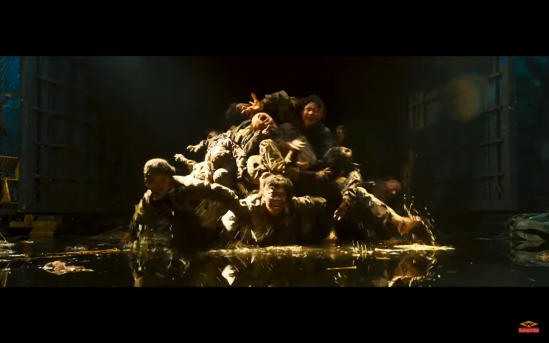
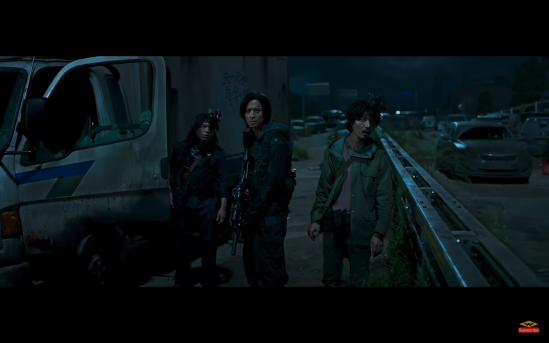
For four years after the initial zombie outbreak, a unified Korean peninsula is completely quarantined from the rest of the world with the remaining survivors having to fend for themselves. A former Korean Captain, Jung Seok, who was one of the last survivors to escape pre-quarantine and now lives in Hong Kong, is hired for a four man team to return to the peninsula and retrieve an unmarked and abandoned truck stowed with $20 million dollars in U.S. currency. With a promise from a Hong Kong mafia boss to keep part of the loot for their recovery services in order to start a new life, the team agrees to the terms and embarks on the seemingly succeed mission only to find survivors who have gone mad, pillaging their mission and conscripting them into a malicious betting game of survival in a watery pit full of zombies.

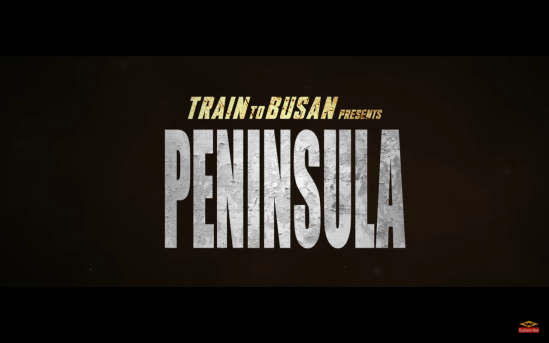
The highly anticipated sequel to South Korea’s 2016 sleeper zombie hit, “Train to Busan,” docks into U.S. theaters and VOD services on August 21st and is entitled simply, “Peninsula.” From the bullet train rails to the a devastated Korean port, the predecessor film’s director, Yeon Sang-ho, returns with a zombie overrun post-apocalypse that completely metastasized Korean derived from a biological agent quickly spreading throughout the two cinematically unified, North and South Korea. Joo-Suk Park returns as co-writer alongside Yeon to provide heart clenching, brutal action-horror suspense and a human sense of selfless compassion that won the hearts of many genre fans with “Train to Busan.” Zombie hordes rampage down streets, alleyways, and toppling over cars, fences, and other structures as a collective flesh easting unit that specializes in dominating and ravaging for the pure motive of infection and while that sounds all hip and cool that the “War World Z” and “I Am Legend” running zombie pandemonium makes for a glitzy entertainment feedbag, the Next Entertainment World and RedPeter Film production punches down on the gas pedal of gaslighting audiences with more of a “Fast and Furious: Tokyo Drift” with zombies, revving more to the tune of an exasperated exhaust rather than finishing strong with gripping storytelling.

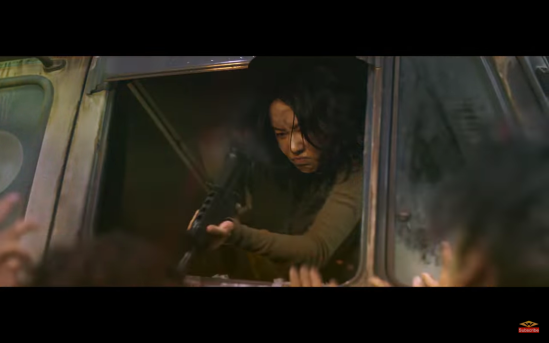
As a standalone film, the story doesn’t return the surviving characters from “Train to Busan.” Instead, a whole new set of characters reset the parameters of expectations, starting with the guilty conscious of the grief-stricken ex-soldier, Jung Seok, played by Dong-won Gang, who will star in Scott Mann’s upcoming disaster film “#tsunami.” Seok’s a reserved and stoic individual whose good a gun play, but isn’t the thinker when a plan is needed in place and while Dong-won Gang gives a par performance, the overall package of the lead character is sorely two-dimensional. This leaves room for other characters flourish, such as the mother and children Seok attempts to save on a second go-around. The mother, played by Lee Jung-hyun, has more grit that clearly defines her underlining hope for not only her salvation, but also her children who’ve known nothing but death, destruction, and meaning of being devoured growing up in the midst of a zombie apocalypse. On the slim change of success, she implements a plan to infiltrate Unit 631, former military turned murderous scavengers, to steal back a satellite phone and a truck full of cash while not becoming zombie chow or get caught in Unit 631’s sadistic survival methods. That brings us to the villains, the real villains, where are not the zombies, but the section 8 soldiers of Unit 631, Captain Seo (Koo Kyo-hwan) and Sergeant Hwang (Kim Min-jae). Though Seo and Hwang bring internal tension to the table, a mental game of cutthroat chess, they’re inevitably soft against the main threat, a combined effort of Jung= Seok and Min-jung, and don’t spill enough blood and craziness onto the screen to make them worthy of the antagonist position. “Peninsula” rounds out the cast with Kim Do-yoon, Lee Re, Lee Ye-won, Moon Woo-jin and Bella Rahim.

As almost methodical as it is with any second film in a series, “Peninsula” failed to be a rejuvenating and transcending sequel to “Train to Busan,” abandoning the first story’s benevolence for CGI flair that extends to not only the zombie hordes, but to the car chases. As excellent as the rendered zombies are slammed against the drifting cars can be represented, in what “Peninsula” can be described as an “Escape from L.A.” meets “Land of the Dead” meets “Mad Max: The Road Warrior,” the cars themselves are a product of computer imagery with little authentic driving happening. While the effects are not bad (they’re pretty good chiefly obscured by dim lit night scenes), the sensation of being scammed can’t be ignored as the vehicles operate unnaturally and maneuver in impossible situations without blowing a tire or upending or just frankly be dead in the water with an overheated and stress tussled engine that frags zombies left and right, becoming a collective character to have the highest kill count. That disingenuous feeling also spreads to the overly long-winded ending that tries really, really hard to capture a courageously defiant and heroic moment of family and personal redemption and much of the blame lies on director Yeon Sang-ho with a drawn out awkwardness and edit that made it seem satirical. In light of some positive words for “Peninsula,” the zombies are a greater, gigantic force that swarm on a colossally epic scale more so than the much more compact “Train to Busan” and, as aforementioned, the structured CGI isn’t of the degraded detail variety so the hordes never look cheap or obviously artificial alongside the more palatable, practical versions. What’s also interesting about “Peninsula” and what makes it separate from “Train to Busan,” which perhaps laid the foundation for, is “Peninsula” has integrated the western counterparts as English speaking actors chime in as U.S. Military, U.N. peacekeepers, or English mafia bosses based in the U.K. This challenges the Korean actors to speak a few different languages, especially English, inclining “Peninsula” as more of a global problem than an isolated Korean one.

The zombie genre isn’t just defined by the ungodly amount of undead bodies reaping the world of every living soul, but is also defined by the diversity of chaos-driven social structures people find themselves confronted with in the action-heavy “Peninsula,” arriving into U.S. theaters on August 31 and distributed by Well Go USA Entertainment. This review will not contain the A/V aspects of the release as it’s a theatrical screening of the feature, but the theater specs will look something like this: projection is in scope lens format at an aspect ratio of a widescreen 2.39:1, a surround sound 5.1 stereo mix, Korean/English/Cantonese language with English subtitles, and has a runtime of just under two hours at 116 minutes. I will note that some scenes are very dark, but this only adds to the complete blackout of a civically desolated Korean peninsula. From fast trains to fast cars, “Peninsula” has retained the adrenaline popping rampant style with weaving, bobbing, and chassis chucking zombie bodies like the ball in a pinball machine despite a facile approach, but is ultimately missing that down-to-Earth social context complexity aimed to provoke thought and shed a few tears as an inferior part two of the “Train to Busan” universe.

When Life Hands You EVIL, You Make EVIL-ade! “American Zombeland” reviewed! (ITN Distribution / DVD)


In Corsicana, Texas, Sam’s a zero-budget horror filmmaker whose trying to make it big in Hollywood, submitting every garbage zombie movie he can muster. When he receives a letter back from a film festival, he immediately calls for a party with all his friends and family in attendance, but the letter is actually a rejection letter, proving once again, that Sam’s still a filmmaking loser. In a stroke of turnaround events, an actual zombie apocalypse breaks out and the undead are knocking at his door. Jumping at the opportunity of top-notch, free special effects and a horde of zombie “actors,” Sam delegates his friends as the production crew, going out into a zombie infested Corsicana, Texas to shoot his legacy, non-Hollywood zombie epic.

If there was ever an American political and cultural lampooning zombie film, “American Zombieland” is it. Originally titled “Fat Ass Zombies,” the George Bennett written and directed horror-comedy nixes the original title, albeit keeping the rubric for Sam’s movie, and seemingly goes hot off the coattails of the Woody Harrelson and Jesse Eisenberg crowd-pleasing and long awaited sequel, “Zombieland 2: Double Tap.” As Bennett’s freshman directorial, he co-writes the feature with Christopher De Maria and Brave Matthews that’s has little to do with the loveably gory Ruben Fleischer riot. Instead, “American Zombieland” is a none-politically correct satirical farce that’s sticking a hard poker at red state, gun-toting conservatives and the morbidly obese American subsociety lifestyle, sporting the red, white, and blue as if being patriotically proud being 300+ pounds. Brother and sister, George and Karina Bennett, co-founded company, MagicBullet Media, and Summertown productions fund and serve as the production company.

As a running joke, the story continues to deface one of Sam’s zero-budget films, “Dead Beat Zombie Dad.” In reality, “Dead Beat Zombie Dad” is a zero-dollar budget short comedy by David Slayter who wore multiple hats in the cast and crew of “American Zombie” and was not, in fact, a film directed by MagicBullett Media executive product and lead actor of the film, Dave Mussen in his first horror-comedy performance as the downtrodden, piss-poor director Sam. Mussen’s resembles the average joe; he bares no chisel chin, he’s balding, and does a good enough job being a mediocre individual so pretending a hectored filmmaker for his obscene and schlocky small horror ventures didn’t perceive challenging. One of the more memorable characters is the flagrantly perverse, yet harmless Poppers, played by FX’s “The Bridge’s” Johnny Dowers. Dowers dons a Joe Exotic-like green dyed hairstyle, handlebar mustache, and a slippery slope into unfashionable redneck garb with a more than less-Tiger King pizazz. Dowers steals much of Dave Mussen’s scenes as an unforgettable caricature a grease monkey yokel. On the opposite spectrum is A.D. Johnson as Horatio, a tragic character not exactly from the same vain as William Shakespeare’s Hamlet, but deride a proper Englishman’s snide accent to be the ever condescending and stanch critic of Sam’s projects. “American Zombieland” cast and extras are vast, including Kristen Renton (“Xenophobia”), Samantha Walker (“Ghost Story Chronicles”), Bryan Handy, Stephen Archer, Sondra Currie, and Benjamin Chamberlain.

George Bennett and crew attempt a horror-comedy aimed at desensitizing and making light of beliefs and lifestyles. What results is a crude, rude, and painfully stale fly by the seem of the pants zombie ruckus on an average entertainment scale that relies heavily on poop and fart jokes, missing the mark of sarcastic repartee targeting misrepresentative patriotism embodied by big corps, big bodies, and big racism. “American Zombieland” ultimately is a big mess of a narrative with characters coming and going without a visual diagram, segues are muddled beyond the power of understanding, and, again, the ill-approached poop and fart jokes. “American Zombieland” is also a big F.U. to the uppity and disheartening inner workings of Hollywood and, in my opinion, this is where Bennett and “American Zombieland” excels, casting caution to the wind with an unorthodox, zomedy to be frank as possible and not really giving a care of what others think – my self more than likely included. Not everything in the film is unfunny or uninteresting, such as with a pothead’s vivid visual quest of an animated interjection of seemingly random bits of American identifiers, consumerism, and, again, poop and fart jokes; a scene that reminded me of the dessert hallucination/Rob Zombie music video segment from “Beavis and Butt-head Do America.”

“American Zombieland” is the anti-Hollywood, independent zombie-comedy brought to DVD home video by ITN Distribution and Millcreek Entertainment. The DVD is presented in an anamorphic widescreen 1.78:1 aspect ratio, and features a steady natural lighting for much of the 1 hour and 28 minute runtime, not focusing on creative mattes or visual tweaks to up the ante. There are some impressively seamless drone ariel shots that exhibit little lag from the compression. Amongst a lot of the foreground focusing, skin tones look correct despite a minor softness in the detail and the night scenes are balanced out properly. Lastly, the visual effects are above par quality, the ariel shots of smoke and fire coming out of houses, the lawnmower death, and other visual sfx renders out nicely. The English Dolby Digital dual channel audio output has limitations, especially for a zombie film that powers it’s fear by the moans of the undead, but for what it is, the audiophiles are better than expected with a robust two channel mix. Dialogue is clear, soundtrack has range, and ambience is a bit overzealous…again, with the poop and fart jokes. Bonus features only include the trailer. Scatterbrained undead folly, “American Zombieland” is a rash whack of cultural farce without literally scattering brains, falling short of the intended meaning, and becoming tousled in it’s own jumbled message.

Only on DVD! “American Zombieland” at Amazon!

Come With EVIL If You Want to Live. “The Zombinator” reviewed! (Bayview Entertainment/Screener)


In Youngstown, Ohio, a small documentary team follows popular fashion blogger JoAnne and while continuing to roll film during a friend’s wake, a fallen member of the military during combat, a horde of zombie horror storm the reception hall packed with celebratory mourners. JoAnne, the documentary crew, and a handful of JoAnne’s friends run for their lives through all of Youngstown only to be rescued by a former Afghanistan war solider, Atam, debriefing the situation of a powerful drug manufacturing corporation behind the localized crisis. The survivors soon realize that a band of greedy mercenaries, Atam’s ex-brothers in arms, are supervising the drug’s effects that will, in turn, create a money making, desperation cure in the weeks to come.

If you haven’t guessed, 2012’s “The Zombinator” is a zombie title melded with “The Terminator” franchise and helmed by documentarian and comedy writer-director Sergio Myers. “The Zombinator” is the first horror feature in the filmmaker’s videography repertoire that chips in comedic soundbites to fully absolve the zombie apocalypse film from being a strictly horror. The very reason the film’s called “The Zombinator” should have been a great comedy-horror indicator as well. Sergio Myers’ 7 Ponies Productions finances the micro-budget, semi-found footage feature that egregiously pollutes the very “Terminator” brand in a way that promotes “Lady Terminator” from being not only a grandly exploitation of Indonesian deference, but now an innate fragment of the renowned franchise. “The Zombinator” endoskeleton is not as indestructible with little-to-no homage connection other than a muscly actor donning his best Arnold Schwarzenegger lookalike getup, dressed a bastardized version of the T-800 infiltrator. No machines. No time travel. No anything that approximates the franchise that would have been a cool concept of a time traveling machine hellbent on blowing zombie scum away.

The cast is virtually made up of unknowns, faces who certainly received their career start with a foot inside the door of “The Zombinator.” The talent is young and unseasoned, but hungry to make a name for themselves with melodramatic performances despite a poorly written script that’s more stationary than progressive on the coattails of the last “Terminator” film “Salvation.” While the documentary team films fashion blogger JoAnne played by Joanne Tombo, Tombo isn’t the headliner. In fact, a lead is lost in the scuffling mist of the zombie outbreak, but the top bill is certainly given to an experienced acting vet in the hard-nosed form of Patrick Kilpatrick (“The Toxic Avenger,” “Eraser”) as a military colonel squaring up against the poster boy of “The Zombinator” and the film’s co-producer, Joseph Aviel in his debut feature film. Aviel, who has doubled as Arnold Schwarzenegger in the YouTube sci-fi comedy episodes of “Terminator: Genisys: The YouTube Chronicles,” is just as monstrous as Schwarzenegger was in his prime, garbed in a pitch black trench coat, wielding a shotgun, and sporting shades inside dark warehouse and nighttime scenes – keep in mind, Aviel is not playing a machine, but a ex-soldier so there’s really no need for the sunglasses. The rest of the cast, including Aviel, are quite rigid and lost, stuck in a loop of spewing much of the same peculiarities without every changing. “The Zombinator” rounds out with Lucia Brizzi, Justin Brown (“Early Grave”), Diana Sillaots, Jennifer Sulkowski, Scott Alin (“What’s Eating Todd?”), Travis Bratten, Melvin Breedlove, Maria Desimone, and Michael Angelletta.

Recently, I caught “Star Trek: Deep Space Nine” episode from “Star Trek: Deep Space Nine” with Patrick Kilpatrick as a hardnosed, war-torn Starfleet officer whose been part of a team holding a pivotal Jem’Hadar communications array in the Chin’toka system. The lean and towering Kilpatrick from 20 plus years ago is nearly unrecognizable as Father Time has been rather unforgiving to the actor’s midsection, but Kilpatrick still has that apathetic stare on top of a sternly contoured face graced now by an impressively horizontal and lengthy bushy mustache. Kilpatrick’s a brilliant highlight in a rather abysmal film of bleary lines on whether it’s supposed to be found footage or not horror-comedy; somehow the found footage crew are not a part of the surrounding action to the extend that zombies and the mercenaries are not aware of their presence despite standing merely a few feet away in plain view, but the survivors are clearly aware of them combatively noting to the crew to turn off their cameras …? Also, the comedic lines, such as, “getting popped by the grand fucking wizard of zombies,” seem sorely out of place, poorly timed between frantic moments of confusion, fear, and strife, and don’t really know if they’re actually intended to be funny…? Confusion doesn’t end there as Youngstown, Ohio is a hop, skip, and jump from rural, to urban, to a dam-side cabin in segued acts, scaling down to miniature and unrealistic grounds of time and space. Lastly, there’s an uneven ratio of zombie action and dialogue exposition that will bore audiences with locale-to-locate histrionics without the commingling remedy of undead mayhem equalization to lure back in the attention of wandering eyeballs and dissatisfied brains.

“The Zombinator” targets and destroys zombies with a brand new DVD home video, released this past March from New Jersey based distributed, Bayview Entertainment, with a slick looking front cover of a T-800 skull half dripping with zombie flesh surrounding a milky white eye. Unfortunately, I was provided with an online screener for review and can’t officially comment on the exact video and audio technical quality, but I will say that the found footage approach render very dark when only a couple of moving LED ring light accessories become the primary source of lighting. The underused original score provided by Todd Maki bests out much of everything else about the project with harrowing tracks baselined by zombie groans and the undetermined reverberations of distant ambience. There were no special features on the screener as well. Like a chunk of spoiled meat prime for tasteful critical fodder, there’s absolutely no wriggle room for positivity for the high concept, low output film, “The Zombinator.” Hasta la vista, baby.

Buy “The Zombinator” on DVD!

Watch “The Zombinator” on Prime Video